

A friend recently tried for a fifth baby, hoping she would get her girl after four boys.
Her fifth was a boy.
Many couples, myself included, have tried various methods for gender selection (including fad diets, and fancy positions) to shift the odds in our favour. Yet it often feels like whether you have a boy or a girl is simply down to luck.
Once you get pregnant, your first glimpse at finding out whether you got your desired gender is during your 20-week scan – and even then, the results aren’t always 100% accurate.
Enter Urobiologics, an innovative American company that aims to revolutionise the entire gender selection process. With one of the most effective and accurate methods available, Urobiologics offers couples a reliable way to select the gender of their baby long before the 20-week mark.
In this article, we will discuss the different methods for gender selection available and how Urobiologics is leading the way in family planning using their non-invasive Alternating-Phase Method.
So, what is gender selection?
Gender selection refers to the various methods employed to increase the likelihood of conceiving a baby of a specific gender, either male or female. You can broadly categorise these methods into natural, medical, and scientific approaches. Each category uses different strategies and offers varying degrees of success and scientific backing.
Why are couples interested in methods for gender selection?
There are many reasons couples opt for the gender selection route, but the primary reasons include family balancing and cultural preferences. We’ll go through some of these reasons now:
Family balancing
Family balancing is a significant and personal reason for gender selection. Many parents wish to have children of both genders to create a balanced family dynamic. This desire is driven by several factors:
- Personal fulfilment: Parents often feel that having both a son and a daughter can complete their family experience. Each gender brings unique qualities, enriching the overall family life.
- Siblings’ relationships: Some parents want their children to grow up with siblings of both genders. This can help children develop better social skills and relationships by learning to interact with both males and females.
- Parental experience: Many parents want to experience raising both boys and girls. They believe each gender offers unique experiences that contribute to a diverse and fulfilling parenting journey.
Psychological and emotional Factors
- Previous loss: Parents who have experienced the loss of a child may have a strong desire to conceive a child of the same gender, using it to cope with grief and feel a sense of continuity.
- Medical and genetic reasons: Some parents may opt for gender selection to avoid passing on genetic disorders linked to a specific gender. For example, certain genetic conditions, like haemophilia or Duchenne muscular dystrophy, are more likely to affect males. In such cases, parents may choose to conceive a female child to reduce the risk of the disorder.
Understanding the methods for gender selection
Gender selection involves various methods to increase the likelihood of conceiving a baby of a specific gender. These methods can be natural, medical, or scientific.
Natural methods for gender selection
Natural methods focus on lifestyle changes, timing, and specific behaviours to influence the baby’s gender. These methods are generally less invasive and can be easily implemented by couples at home. However, there is a huge debate on the scientific validity of these methods and their success rates can vary.
- Dietary changes: Some believe altering the mother’s diet can influence the baby’s gender. For example, a diet high in potassium and sodium is thought to favour conceiving a boy, while a diet rich in calcium and magnesium may increase the chances of having a girl. The theory is that these dietary changes can affect the pH level of the cervical mucus, creating a more favourable environment for either X or Y-chromosome-bearing sperm.
- Timing of intercourse: The Shettles Method suggests timing intercourse with the woman’s ovulation cycle. For conceiving a boy, intercourse should be timed as close to ovulation as possible, as Y sperm (which produce boys) are faster but less resilient. For a girl, intercourse should occur a few days before ovulation, allowing the slower but more resilient X sperm (which produces girls) to be more likely to fertilise the egg. NIH has debunked this concept here.
- Sex positions: Certain sexual positions are believed to influence gender selection. Deep penetration positions, like rear entry, are thought to deposit sperm closer to the cervix, favouring Y sperm for a boy. Shallower penetration positions, such as the missionary, are believed to favour X sperm for a girl because of the different environments they encounter. Still, this approach has remained a game of chance.
Medical methods for gender selection
Medical methods typically involve medical intervention and can provide more accurate results than natural methods. These methods are often used by couples with a strong preference for a specific gender because of personal, medical, or cultural reasons.
- Preimplantation genetic diagnosis (PGD): This method is used with In Vitro Fertilization (IVF). Embryos are created in a laboratory, and a few cells are extracted from each embryo for genetic testing. PGD can identify the gender of the embryos, allowing only embryos of the desired gender to be implanted into the mother’s uterus. This method is highly accurate but also expensive and invasive.
- Sperm sorting: Techniques like MicroSort involve separating sperm based on the amount of DNA chromosomes they carry. Sperm carrying the X chromosome (for girls) are separated from those carrying the Y chromosome (for boys). The selected sperm is then used for intrauterine insemination (IUI) or IVF. While not 100% accurate, sperm sorting increases the likelihood of conceiving the desired gender.
Scientific methods – Urobiologics’ Alternating-Phase Method
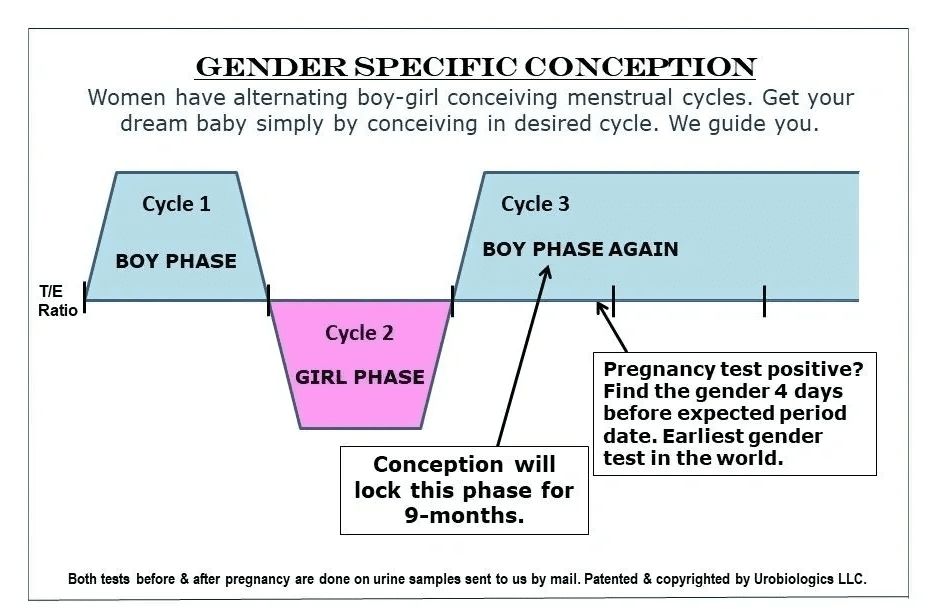
Urobiologics has developed a groundbreaking, 100% natural, and non-invasive method for gender selection. This method, created by Dr Kuldeep Verma, is based on the discovery that the hormonal environments in a woman’s uterus alternate between any two consecutive menstrual cycles, which play a direct role in sperm selection, thereby making it more conducive to conceiving either a boy or a girl.
Couples collect three mid-cycle urine samples from consecutive menstrual cycles and send them to Urobiologics’ laboratory in Livonia, Michigan. Based on the analysis, the lab provides individualised conception plans, guiding couples on when to conceive to achieve their baby of the desired gender. The PreGender Preconception Test has a success rate of 94% and 98% whether two or three preconception samples are tested respectively.
The FirstGender Post-Conception Test
Starting from the day, the woman has a positive pregnancy test or for those already pregnant, Urobiologics offers the FirstGender Test to evaluate the baby’s gender by collecting urine samples during the early days of pregnancy. The results can determine the baby’s gender as early as day one of a positive pregnancy test with 95% accuracy.
Practical application of Urobiologics’ methods
Step-by-Step guide for using the PreGender and FirstGender Tests
- Collecting Samples: Follow the instructions provided under respective sections to collect mid-cycle urine samples over two (or three) consecutive menstrual cycles for the PreGender Test or early pregnancy urine samples for the FirstGender Test.
- Submitting Samples: Ship the collected samples to Urobiologics’ laboratory in Livonia, Michigan, using any courier service. It’s legal to ship urine samples from healthy women throughout the globe under ‘Exempt Human Specimen’ classification.
- Receiving Results: For the PreGender Test, you will receive guidance up to 18 months on the optimal cycle for conceiving the desired gender. For the FirstGender Test, you will receive an accurate gender determination within three days. All results are confidentially delivered via email only.
Example case study
Let’s consider a couple named ABC who wanted to conceive a girl. They named the baby Rose in advance.
They sent three mid-cycle urine samples, which showed the following phases:
- The first sample (5/22/23) indicated a boy phase.
- The second sample (6/23/23) indicated a girl phase.
- The third sample (7/20/23) indicated a boy phase.
- The period start date was 8/3/24 when the girl phase started. The conception plan was sent. The couple conceived.
The FirstGender test confirmed a girl on 9/10/23, and an ultrasound on 12/15/23 confirmed the result.
Success stories and testimonials
Urobiologics has helped many couples achieve their desired family balance. Here are a few testimonials from satisfied clients:
“I completed my family through preconception advice from Urobiologics. I got my son last week. It is amazing that simply by conceiving in the cycles recommended by them one can get the baby they wanted.”
Gloria Hu, Netherlands
“Not only has Urobiologics got extremely high success rates, but Dr. Verma is so helpful and supportive. I found out yesterday that the pre and post-gender test had worked for me when other techniques failed.”
Emma Hine, UK
The Conception Plan – My Experience with Urobiologics
I decided to try for a baby girl with Urobiologics after having two boys. Despite initial challenges in sending urine samples overseas, my samples were eventually processed. My cycles alternated between boy and girl phases, and I received personalised conception plans in every girl phase.
Conception Plan:
- Sample Collection: Mid-cycle urine samples were collected to determine the hormonal environment.
- Results: My cycles alternated between boy and girl phases.
- Action: We followed the plan strictly, but it was taxing and affected our relationship.
Outcome:
- First Girl: We became pregnant with our beautiful Poppy girl successfully with Urobiologics’ conception plan, however, we sadly lost her at 16 weeks pregnant, due to a PPROM
- Second Girl: We had our beautiful baby girl, Ayla, in September 2019.
- Third Girl: Another baby girl, Amelia, was born on 30th June 2021.
You can find more information in my preconception series, ‘Journey to getting my girl’ here.
The effect of Dr. Verma’s Alt-Phase Method on IVF and IUI
Couples undergoing IVF or IUI can directly benefit from the Alternating-Phase Method. But make sure you’re in the correct phase before egg retrieval and embryo implantation, so you can significantly increase the success rate. For example, if you are trying to get a girl through IVF / IUI, your egg must be retrieved when you are in the girl phase. This is so it is biocompatible with the X-sperm to develop a proper embryo and thereafter that embryo must be implanted when you are in the girl phase. The bio-incompatibility is the main cause of the 35% success rate of IVF / IUI. Clinics are ignoring these important parameters.
New trend for would-be brides
Urobiologics has started a new trend advising brides-to-be to get tested 2-3 months before their wedding. This way, the bride can fully control when to conceive a balanced family. This allows couples to plan their families right from the start, avoiding the stress of having multiple children of the same gender first and then seeking gender selection methods.
Comparing Dr Verma’s Alt-Phase methods with other gender selection techniques
Cost-Effective: Most affordable compared to medical interventions like IVF.
IVF with PGD: Highly accurate, low live-birth success rate (<35%), expensive and invasive. Usually, they ask to repeat the attempt at additional cost.
Sperm Sorting: Increases likelihood but is not 100% accurate.
Dr. Verma’s Alt-Phase Method: Most natural, non-invasive, highest success rates between 94% to 98% depending upon the number of samples submitted as PreGender Preconception test for gender-specific conception.
Comparing methods for gender selection
Urobiologics’ Methods vs. Other Techniques
- IVF with PGD: Highly accurate but expensive and invasive.
- Sperm Sorting: Increases likelihood but is not 100% accurate.
- Natural Methods: Less invasive but variable success rates.
Benefits of Non-Invasive, Natural Methods
- No Medical Interventions: Urobiologics’ methods do not require invasive medical procedures.
- High Success Rates: Proven success rates of up to 94% for gender-specific conception.
- Cost-Effective: More affordable compared to medical interventions like IVF.
Ethical and social considerations
Gender selection raises ethical questions about the implications of choosing a baby’s gender. It is important to consider the moral and social impacts of such choices. Urobiologics ensures its methods are used responsibly and ethically, focusing on family balancing rather than gender preference.
Gender selection methods vary in their approaches and success rates. Urobiologics offers a reliable, natural, and non-invasive method for couples seeking family balance. With a high success rate and ethical considerations, Urobiologics stands out as a leader in gender selection.
For more information, to order tests, or to schedule consultations, visit Urobiologics’ website or contact Dr. Kuldeep Verma at drverma@urobiologics.com.
FAQ answered by Dr Kuldeep Verma
Is gender selection ethically right? Why or why not? The ethics of gender selection vary by cultural and personal beliefs. Some argue it can lead to gender imbalances and reinforce stereotypes, while others believe it’s acceptable for family balancing or preventing gender-specific genetic disorders.
Are there ways you can make sure you have a boy or a girl? While no method is 100% guaranteed, techniques like PGD/PGS and Dr. Verma’s Alternating-Phase Method have high success rates. Other natural methods also exist but with varying degrees of effectiveness.
What if anything can parents do to influence their chances of conceiving a child of their preferred biological sex? Parents have been using baseless and highly unreliable Shettles Method for timing intercourse and dietary changes, but these theories have been debunked by NIH. Dr. Verma’s Alternating-Phase Method and medical interventions like PGD/PGS and sperm sorting are more reliable but also more invasive and costlier than Urobiologics’ method.
Specific methods and techniques
How can I ensure that I conceive a male child with 100% guarantee? No method can provide a 100% guarantee. However, methods like PGD/PGS with IVF and Urobiologics’ Alternating-Phase Method have high success rates for gender-specific conception.
How do I conceive a baby girl as a firstborn? What is the best way to have a female child? What is the easiest and cheapest way to conceive a baby boy? How can we have a boy or girl baby naturally? The best way to naturally influence the gender of your baby includes methods like Dr Verma’s Alternating-Phase Method, which offers a natural, non-invasive approach. For a more reliable but costly option, medical interventions such as PGD/PGS with IVF can be considered.
Can the process of selecting a baby’s gender through an IVF treatment in PGD be done in India? Yes, gender selection through IVF and PGD can be done in India, provided it aligns with local regulations and ethical guidelines.
IVF and PGD-specific questions
Can you find out the gender during in vitro fertilization (IVF) with preimplantation genetic diagnosis (PGD)? If so, how much does it cost for that service? Yes, the gender of an embryo can be determined during IVF with PGD. The cost for this service varies depending on the clinic and location but generally ranges from $4,000 to $7,000 in addition to the cost of IVF.
Can the gender of an embryo be determined during in vitro fertilization (IVF)? If yes, what is the process for determining the gender? Yes, during IVF, embryos can be tested for gender using PGD. A few cells are extracted from each embryo for genetic testing, and only embryos of the desired gender are implanted.
How difficult and invasive is it to go through IVF for gender selection? IVF for gender selection involves multiple steps, including hormone treatments, egg retrieval, fertilisation, and embryo implantation. It is an invasive process that requires medical intervention and can be physically and emotionally demanding.
Would you do gender selection and go through IVF to guarantee a boy if this is your first child? We’ve never tried to get pregnant naturally and he’s not willing to. Choosing IVF for gender selection as a first option is a personal decision that depends on individual circumstances, including medical, ethical, and financial considerations. It is advisable to discuss this thoroughly with a fertility specialist and consider trying to conceive naturally first.
Financial and geographical considerations
How much does gender selection in Cyprus cost? How much does gender selection cost? How much does it cost to pick the gender of your baby? The cost of gender selection varies widely depending on the method and location. On average, IVF with PGD can cost between $15,000 and $25,000, whereas non-invasive methods like Urobiologics’ Alternating-Phase Method are generally more affordable.
Which are the best clinics for IVF with Gender Selection in Thailand? Several reputable clinics in Thailand offer IVF with gender selection. It’s essential to research and consult with multiple clinics to find the one that best meets your needs in terms of success rates, cost, and ethical considerations.
Family planning and preferences
When there is a question of family balancing, there is a desire for a specific gender of the upcoming baby. So what to do if you are planning for a baby boy? For planning a baby boy, you can consider methods like the Shettles Method, dietary changes, and Urobiologics’ Alternating-Phase Method. Medical options like PGD/PGS with IVF can also be pursued for higher accuracy.
*This collaborative post is sponsored by Urobiologics