They say prevention is the best cure, which is even the case in most cancers. However, some people will spot some early symptoms and ignore them hoping they will go away. In some cases, they will, but in others, it could lead to late-stage cancer, and it may be too late to treat at this stage. Most people diagnosed with bowel cancer are over the age of 50. However, more than 2,500 people under 50 are diagnosed each year in the UK. Bowel cancer, if diagnosed early enough, is very treatable and you have a much higher chance of successful treatment if cancer hasn’t become widespread. It is essential to know the signs of bowel cancer so you can have it treated early. So, let’s check out the symptoms of bowel cancer:
N.B – Most people with the below symptoms don’t have bowel cancer, as other health problems can cause similar symptoms to arise. But, if you have one or more of the below, it is highly recommended that you go see your GP anyway to eliminate the possibility of bowel cancer.
Bleeding from your bottom/blood in your poo
There are several reasons why you could bleed from your bottom or have blood in your bowel movements. Sometimes a poor diet can cause hard stools and scratch the back passage, causing blood. Bright red bleeding can indicate swollen blood vessels resulting from piles of haemorrhoids in your rear passage. However, if the blood is dark red or black, then this blood may be coming from your bowel or stomach. Talk to your doctor straight away about any bleeding so he can find out what the causes are.
An unexplained change in bowel habits
Again, a change in bowel habits could be down to a change in diet, stress or other external health problems. But, if you have found that you are going to the toilet more often, or not often enough, or even that your stools have changed, then it’s worth telling your GP to find out what the causes of this bowel activity are so they can eliminate the possibility of bowel cancer.
It’s important to note that a poor diet can lead to a change in bowel habits which can lead to bowel cancer. Foods like processed meat
It’s important to note that a poor diet can cause a change in bowel habits which may lead to bowel cancer. Foods like processed meat are bad for the body and are linked with chronic diseases including bowel and stomach cancer because they contain cancer-causing substances called N-nitroso compounds which are believed to be responsible for some of the adverse effects of processed meat consumption. N-nitroso compounds are used to preserve the red/pink colour of meat and improve flavour by suppressing fat oxidation. These compounds also prevent the growth of bacteria, as well as enhances the taste and cuts the risk of food poisoning. Check out the infographic from HARTMANN Direct below for more information.
Fatigue
Tiredness or fatigue can occur for a number of reasons, including a poor diet, anaemia from lack of iron in the body, or it could be stress induced. However, bowel cancer can also lead to a lack of iron in the body, which can subsequently cause anaemia, and in turn, this makes you feel exhausted. Talk to your GP about the fatigue to eliminate the possibility of bowel cancer.
A pain or lump in your tummy
Not being able to go effectively can cause pain or a lump in your stomach as this creates a build-up of stools. If these symptoms are not going away or they are affecting your sleep, then contact your GP straight away to find out the cause of the lump/pain
Weight loss
Some symptoms of bowel cancer may not include weight loss, and it may be a more indirect symptom resulting from other issues. If you have lost weight and you don’t know why you feel sick, bloated or have a lack of appetite, then it is necessary to contact your GP straight away to find out why.
How does your GP diagnose Bowel Cancer?
When you visit your GP, you may have some preliminary tests done. Other tests will be conducted at the hospital, and the diagnosis of bowel cancer may be done through a screening programme.
It is important that you follow up on any unusual symptoms as soon as possible to find out the causes before it is too late. Know your signs for bowel cancer and treat it before it becomes untreatable. Click here for more info on the symptoms of bowel cancer.
*Collaborative feature post*
Understanding the Odds in Carrier Genetics
You may find that you have basic knowledge about genetics from your high school days, like how particular genetic traits (for instance, hair colour) are inherited. While this rudimentary understanding is important and useful, it can seem inadequate when you need to understand a genetic condition, the results of a carrier screening, or your child’s likelihood of developing a genetic condition.
Children inherit two copies of a gene — one from each parent. In autosomal dominant inherited genetic conditions, if only one parent has a particular mutation that causes the condition, then the child has a 50% probability of inheriting that condition and being affected by it.
Autosomal Recessive Inheritance
In an autosomal recessive inherited genetic condition, if both parents have a particular mutation that causes the disorder, then each child born to the couple has a:
25% chance of inheriting (and being affected by) the disease
50% chance of inheriting the disease as a carrier, but not being affected by its symptoms
25% chance of not inheriting (or being affected by) the disease and not being a carrier
If only one parent has the mutation, the child has no chance of developing the disease but has a 50% chance of becoming a carrier.
X-linked Dominant Inheritance
With x-linked inherited disease, it matters who (mother or father) has the genetic mutation and if the child in question is a male or a female. This is because women have two x chromosomes and men have one x chromosome and one y chromosome. When a woman and a man have a male child, the mother passes on one of her x chromosomes and the father passes on his only y chromosome. When a woman and a man have a female child, the mother passes on one of her x chromosomes and the father passes on his only x chromosome.
If a man has an x-linked dominant inherited condition, any male child he has will not be a carrier and will not be affected. This is because a boy will not inherit any genes from his father’s x chromosome. If that same man has a female child, the father will pass on the genes from his x chromosome and his daughter will have a 100% chance of inheriting and being affected by the genetic disorder. Because a woman has two x chromosomes to potentially pass on to either a son or daughter, there is a 50% chance that a woman with an x-linked dominant inherited condition will pass on the mutation for each of her children and they will be affected, regardless of whether they are male or female.
X-linked Recessive Inheritance
If a man has an x-linked recessive inherited condition, their sons will not be affected at all and their daughters will have a 100% chance of getting the mutation and being carriers for the genetic condition (but they will not necessarily be affected — this will depend on the mother’s genes). If a woman has an x-linked recessive inherited condition, this means that she inherited the mutation on both x chromosomes, so she will pass the disorder and mutation onto her son — who only gets an x chromosome from her — but her daughter may only become a carrier (depending whether the father also passed on the disorder with his x chromosome). If a woman is only the carrier (not affected) for an x-linked recessive inherited condition, she has a 50% chance of passing on the disorder to her son (who will be affected), and a 50% chance of passing the mutated gene onto her daughter (who may be a carrier or may be affected depending on whether the father also passed on the disorder with his x chromosome).
Y-linked Inheritance
In y-linked inherited conditions, only men have and inherit the Y-chromosome — and any genetic mutations located therein. This type of inheritance can only be passed from male to male. If a father is affected by the disorder, any sons he has will also be affected.
Talk to Your Doctor
The thought of passing on an inheritable genetic condition to your child is enough to cause considerable stress and uncertainty to a couple who definitely wants to have children. These doubts can affect all aspects of the pregnancy and the relationship, so it’s important to arm yourself with knowledge and always ask questions. If you find yourself with doubts or concerns, speak with your doctor or genetic counselor. They will be able to better explain any particular genetic risk factors that you and your partner are facing, in addition to providing a strong working knowledge of genetics.
I was approached recently to raise awareness on the topic of sepsis by a colleague whose cousin had survived, thanks to spotting it early and being provided with quick treatment.
I asked a few people about whether they knew what sepsis was, and it was surprising to note that six out of the ten whom I spoke with were unclear or unsure about what sepsis is and therefore would not be able to spot early signs of sepsis in their children. It is fundamental that you know what sepsis is and how to treat it quickly because it can become fatal very quickly. Sepsis can occur in adults too, but I will be focussing on spotting the signs of sepsis in children.
“25,000 children are affected by sepsis every year in the UK.” Sepistrust.org
So, what is sepsis?
When you have a viral/bacterial infection or injury, the immune system kicks into action and starts fighting back, by rustling up cells to fix the infected/damaged area. Generally, the symptoms are manageable, and your child’s immune system will help them recover fully within a few days.
Sometimes, for some unknown reason, the immune system can overreact, releasing chemicals into the bloodstream to fight the infection, but then also turning on its own organs and tissues. This overreaction by the immune system is called sepsis (or blood poisoning). Sepsis can cause inflammation, blood clots, low blood pressure, trouble breathing and organ failure. And, if not treated quickly enough, sepsis can be fatal and life-threatening. Otherwise, if spotted early, you can treat sepsis with antibiotics.
“Sepsis is the body’s overwhelming and potentially life-threatening response to an infection.” Sepsis.org
Who is at risk of developing sepsis?
Sepsis, although rare, can develop in both children and adults. It can be most common, however, in those with a weakened immune system and:
Newborns and infants under three months of age. Their immature immune systems cannot fight off large infections, and so sepsis can occur.
Children who are also not vaccinated for Streptococcus pneumonia (also known as pneumococcus) and Haemophilus influenzae.
Children with chronic medical conditions
Children with HIV, cancer or other conditions that weaken the immune system “Sepsis is the leading cause of death in children worldwide. 3 million children die every year.” sepsis.org
Newborns are affected by sepsis when bacteria enter the blood. Common culprits tend to be group B Strep, E. Coli, Listeria monocytogenes, Neisseria meningitis, Streptococcus pneumoniae, Hemophilus influenzae type B and salmonella.
Premature babies who have also spent time in the NICU, are also at most risk of sepsis because of their underdeveloped immune systems. They may be exposed to bacteria through long-term intravenous lines, catheters or tubes, and breathing tubes attached to a ventilator. If you feel that medical negligence has occurred, which has led to your child contracting sepsis, then you should contact a solicitor and ask for legal advice.
Infections can be passed down from mother to baby
Sometimes the risk of infection can occur during pregnancy, which can raise a newborn’s risk of infection, i.e when:
The pregnant mother has an infection/fever during labour
There is an infection of the uterus or placenta
The mother’s amniotic sac ruptures before 37 weeks
The mother’s amniotic sac ruptures 18+ hours before delivery
Up to 30% of pregnant women carry group B strep, which can be passed to baby during delivery. Ask your doctor to be tested for group B strep during pregnancy. It is a simple swab and if it is present, you will be treated with IV antibiotics during labour to prevent transmission.
How to spot for signs of sepsis in children
There isn’t a specific sign and some symptoms can present themselves in different ways. Sepsis can initially look like flu, a chest infection or gastroenteritis. So, if your child is unwell with either fever or a low temperature, then call 999 and ask whether it could be sepsis.
Here are some signs to look out for. She or he may:
Feel very lethargic or difficult to wake
Have a ‘fit’ or convulsion
Have a bulging soft spot
Be breathing abnormally fast
Pause for breath for more than 10 seconds (apnea)
Have a rash that does not fade when you press it
Feel unusually cold to touch
Be unable or unwilling to make eye contact
Be inconsolable or irritable
Look bluish or pale
Look jaundiced (yellowish skin and/or eyes)
Not be feeding
Look confused
Be repeatedly vomiting
Have not passed urine in the last 12 hours
Have an existing infection (like pneumonia) with symptoms getting worse.
If you notice any of these symptoms, call your child’s doctor IMMEDIATELY. They may require emergency medical attention.
What does septic shock look like?
Sepsis can become severe when at least one of the following symptoms occur, as this may indicate that your child’s organs are failing:
Abnormal heart beat
Change in mental status
Difficulty breathing
Abdominal pain
Not passing urine
Decreased platelets
Very low blood pressure that doesn’t respond to typical treatment
How is sepsis diagnosed in children?
If your child’s doctor suspects sepsis or wants to rule out severe infection, he or she may order the following for diagnosis:
Urine tests
Your child’s doctor can look for bacteria in the urine that could indicate sepsis
Blood tests
Your child’s doctor can look for infection, abnormal liver or kidney function and low oxygen levels, which may show sepsis has occurred
Lumbar puncture
Your child’s doctor may need to examine a sample of your child’s spinal fluid and check for infection (including meningitis)
X-rays
X-rays can show pneumonia and other conditions which indicate sepsis.
If your doctor suspects that sepsis has occurred, even before the results come back, s/he may start your child on a course of antibiotics straight away. If the results show that your child has sepsis, s/he will need to be treated in hospital with antibiotics and IV fluids, as well as be provided blood pressure medication and equipment to help them breath. It is vital that this treatment be given as early as possible to prevent any organ damage or disability.
Ways to prevent sepsis occurring in your child
You are not able to prevent all cases of sepsis, but you can protect your child from infections that may lead to sepsis, by:
Making sure that your child is fully vaccinated, especially for Streptococcus pneumoniae and Haemophilus influenzae
If you’re pregnant, make sure you are tested for Group B strep between Week 35 and 37 and follow up on the results to ensure if you need antibiotics during labour. If you experience premature labour, ensure you ask your doctor about receiving antibiotics. If you know that you are group B strep positive, then head straight to the hospital after labour symptoms start or your water breaks
Make sure you and your child wash hands frequently to help prevent infection. Don’t allow sick visitors near young babies and children
If your child needs medical devices like long-term IV lines and catheters, make sure you follow the doctor’s directions for cleaning and accessing the device
It is important to note that many children who do survive sepsis are left with life-changing effects, both mentally and physically. Some children are left with a change in their cognitive skills or they experience post traumatic stress. And, in some cases, treatment of sepsis can result in some organs not working correctly, and/or your child may have to have limbs amputated.
This is why it is vitally important that if you are concerned and you believe that your child is experiencing any of the symptoms above, that you call 999 immediately and say that you are concerned about sepsis. The earlier you act, the more chance you have of your child surviving sepsis without disability or death.
Keep pushing your doctor!
*Collaborative feature post*
Preparing for Emergencies with Kids
As much as we try our best to ensure that everything runs smoothly, there’s always the potential for an emergency to occur. When kids are involved, the stakes can feel even higher so it’s best to be prepared. Here are some ways that you can ensure you’re ready for just about anything.
Practice First Aid
Paediatric first aid courses are always popular with new parents and you can learn how to deal with a lot of issues on these courses. It’s a good idea to have grounding in basic first aid, as well as paediatric specific courses too. These classes don’t take too long and can be completed at your leisure.
As well as dealing with treatment, many of these courses teach you how to react in an emergency. Keeping your cool is essential to providing the best treatment, so feeling like you know what to do can make a huge difference to your demeanour.
You want to make sure that you have the right tools to hand to deal with this too. You can look online for first aid kits for sale and ensure that they are kept stocked up. Having this to hand in an emergency can really come in handy.
Have a Plan
The best way to get ready for an emergency is to have a plan. If each person in the family is aware of and follows the plan, then you can work together. Working with other adults in the house, you can delegate tasks and create an escape plan to be used for a fire or other disaster. If you have multiple children in the home, then this is key to know that each has a designated adult that will help them in an emergency.
This is a good way to teach the kids about safety too. You can teach them about the best ways to leave the home in an emergency and the dangers of this kind of evacuation. You never know when this kind of information might just save their life.
Stock Up
In an emergency in which you can’t get access to supplies, you’ll be glad to have some in your own home. Canned food and fresh water can be stored in the basement of the home for such an emergency. You can also add to this with blankets, batteries, candles and other essential items. These can make all the difference to your family should the home be hit by a natural disaster.
While you may not think that this is a big concern for your family, this is a small thing that you can do to make them safer. Should you be snowed in at home or can’t travel, this bank of supplies can increase your chances of surviving long term.
Being prepared is half the battle when it comes to these kinds of emergencies. If you’re able to take these small steps then you’ll find that you’re much more confident should an emergency happen to strike while you’re with your kids.
*Collaborative feature post*
How the weather can affect your mood
According to research, various weather patterns can affect our moods and emotions. For several years, people have been diagnosed with suffering from SAD (seasonal affective disorder). Experts also believe that the resulting hot and cold temperatures can drain our energy and tamper with our sleeping patterns.
So, what’s the truth? Here, we’ll look at how different weather patterns can affect how we feel — and whether there’s any proof to back up the claims that climates can alter our moods and behaviour…
Rain
Looking outside and seeing rain lashing against the window rarely puts people in a good mood. But is there more to it? Some experts believe that rain could actually negatively affect our social lives, leading us to feel isolated, frustrated and downbeat.
A study of more than 11,000 adults, led by Dr Alan Teo, found that digital communication (e.g. emails and phone calls) offered little protection against participants developing depression over a two-year period — unlike face-to-face contact. The people who met up with friends and family members three times a week showed the lowest rate of depression after two years — only 6.5% developed the condition compared to those who met up one a month (11.5% development rate). If it’s raining heavily and consistently, we may be more inclined to cancel plans to physically meet our friends and family, or have them cancel on us, which could leave us to a less fulfilled social life.
Also, getting drenched in a downpour could lead to us feeling unwell, which may also cause our moods to dip even lower. An experiment, carried out by researchers at the University of Freiburg, found that mice injected with a virus similar to human flu showed signs of despair, lethargy and sadness when battling the infection. According to the researchers, this is because our bodies react to an infection by releasing a protein that doesn’t respond well with our hippocampus — a region of our brains that controls mood.
Rainy mornings can also lead to bad traffic conditions and a tougher commute. So, to avoid letting the rain dampen your spirits, make sure you stay as dry as possible and set off for work earlier to avoid delays that cause anger and frustration.
Sunshine
A lowering of moods during winter has apparently been recorded as far back as 1845. Now named seasonal affective disorder (SAD), the condition is a type of depression that happens to sufferers at certain times of the year — most notably autumn and winter. According to research, 6% of UK adults have the disorder, and it can even affect children — although, the average age of SAD sufferers is 27 years.
So, does sunshine equal happiness? It may well be the case. Those studying SAD have found that the rate of vulnerability rises the further from the equator you live. Reports also show that sunshine boosts our moods by raising the level of a certain brain chemical called serotonin, which is believed to regulate our mood, anxiety and social functioning. Serotonin can also be found in many antidepressants. So, less sunshine means a weaker production of serotonin.
Similarly, it seems that sunny weather makes us get a better night’s sleep — and we all know how great an effect that can have on our moods the following day. Research carried out at the University of Rochester Sleep Laboratory in New York discovered that good weather caused participants of the study to sleep more soundly. This could have something to do with the fact that being exposed to bright light during the day encourages our bodies to produce more melatonin — a hormone that acts as a detoxifier, rejuvenator and sleeping agent —when the sun sets. In fact, a Finnish study discovered that rodents that were given daily sun exposure produced a great deal more melatonin at night than those that received only artificial light. Evidently, natural sunlight and a good night’s sleep seem to go hand in hand.
With the fact that less sunlight means your body generates lower levels of vitamin D — essential to good health and a subsequent happy mindset— it’s important to look for ways you can increase your exposure to sunshine. To help your body get plenty of sunlight, save up for a winter-sun holiday and spend as much time as you can outdoors when the weather is good.
Temperature
How hot or cold the day is can also impact our feelings of happiness or sadness. During colder months, our bodies are forced to work harder to keep us warm, which includes raising our heart rates. This means that more energy is diverted to achieve this aim, causing us to potentially feel lethargic and less willing to participate in social activities when the temperature drops. But why is this important? Mental health organisation, Mind, states that getting exercise is a contributor to sound mental health, while another scientific study found that getting active holds ‘the promise of better mental health outcomes’.
Typically, our immune systems are under more pressure during the cold season, and so we are less capable of fending off illnesses — which we have already discussed can contribute to low moods. On top of this, chronic conditions such as back pain are more likely to flare up due to winter weather, which may make you feel frustrated. But what about hot weather? Apparently, one UK study predicted that higher temperatures due to climate change will cause 9,000 fewer deaths in winter by 2050, while other US studies have shown that there may be a link between crime and rising heat levels!
It seems that hot and cold weather also have an impact on how we feel and our behaviour, so learning about how the weather climate works may prepare you for the unpredictable weather changes. Schools in the US are now benefitting from integrating a weather curriculum which helps children collect and analyse weather data, so they can understand what the weather changes mean.
With experts using technological advances to predict further changes in weather patterns as climate change progresses, what can we expect from how the weather will affect our psychology in the future?
This article was written in collaboration with by Fulton Umbrellas — an industry leader and premium supplier of clear umbrellas.
Staying Connected with my Baby after Returning to Work
I loved being a full-time Mom, but I knew that it could not last forever. Not only would I go insane spending my days with a baby and the occasional playgroup, but the bank balance was also going to need replenishing.
Being able to spend the time at home with my son at that stage of his life was special and our bond is the strongest that it could be as a result. The biggest challenge in returning to work is how I can nurture that bond, so it continues to grow after we are separated for that work time.
This was a source of constant worry for me. I had no idea how he would cope. How would I cope? Putting on a brave face for him might wear me down over time.
Now that some time has passed there is definitely some light at the end of the tunnel. It was not always easy, and I still miss him like crazy every day! But it was the best thing for him and I hope my experience can also help others who may be in that darker place I was not too long ago.
The Impact of Day Care
The hardest part of this process was finding a place at daycare for him, and then managing that transition. We were able to start him off on two days a week before I did finally return to work. These were tough days.
The look on his face when he realised that I was leaving him there, and the cries of desperation to get to me. It was one of the most heart-breaking things that I have ever had to go through.
On top of this, he started getting very sick. I panicked about this early on but have since been told by almost everyone that this is normal and will probably continue for another 12 months…. Great! No sleep for Mommy.
It was difficult not to question whether I was doing the right thing or not. Perhaps this was a bad idea and I should just leave things as they were? Was it really worth the stress, pain, and lost sleep? He can’t be a baby forever, and I have to work to make a living. So really, I had no choice but to power on.
Thankfully things did start to turn around. In hindsight, it has been one of the best things for him and the growth in his confidence has been amazing. He also tries to talk nonstop now, and we often spend our walk home talking about the day just gone – well he tries to anyway.
Now I am faced with a different sight in the morning. He now runs in the door to see his friends and grab his favourite toy. Some days he doesn’t even look back. Now my worry has turned from him feeling a sense of abandonment, to being reminded that he will need me less and less as he gets older. I guess there is always something to worry about as a Mom.
Another side of this is that he also seems happier at home now. Like he is trying to make the most of the time we spend together because he knows that it is not every day now. He has a new kind of glow and playfulness… and he definitely knows when it is the weekend and we can sleep longer and have a day out. But more on this in a moment.
Breastfeeding
My Son recently turned two years old and I still feed him. Where I live, this is certainly not the norm and I do get some very surprised reactions when it comes up in conversations. But the fact is that it is still good for him, and he loves it.
He also eats like crazy! So, it is not necessary for his nutrition, but it remains a comfort for him. After being separated all day our routine is the same every day. We get home, collapse on the couch and he feeds for 15-30 minutes. Sometimes he will fall asleep and I can get on with the evening chores, other days he recharges and its off again.
This is one of my favourite times of the day. Taking this period of quiet time to reconnect and bond, while he gets a rest and top up of energy. If we didn’t do this I am not sure what we would do in its place. But I guess I will have to figure that part out soon enough when I do start to wean him off.
For now, I just enjoy the moments we have… Even though he does come home a bit smelly and I just want to get him in the bath!
He does have trouble sleeping at day care sometimes because he often just dozes off while breastfeeding in the evenings. So I also have to pump occasionally so that I can send him with a small bottle of milk just in case. If he doesn’t sleep he comes home exhausted and will sleep straight away and all the way through to the next morning.
Weekend Magic
My Son just knows when it is not a work day. He bounces out of bed and has an extra sparkle in his eye. Now that we have limited time I am determined to make sure the time we do have is quality time.
This requires some discipline during the week so I can stay on top of all the smaller daily chores, so I can keep the weekends as wide open as possible. It would be easy let the laundry and dishes pile up after a long work day. But if I did, half my Saturday would be gone taking care of this, and my energy with it.
Making the most of this time is the key to ensuring our bond flourishes. We can choose our own path and go exploring. There are so many places in my city that I have not been to since I myself was a child and it is a lot of fun getting reacquainted with these places and letting my Son wander and learn about his surroundings.
Some days we will head to the beach for a swim, others we go the other direction up into the mountains for a hike. Some days we will just go to a new park and he will chase the birds and feed the ducks.
For me, this is where the magic happens in parenting. The look on your child’s face when they see anything for the first time is a mixture of cute, funny, curiosity and shock. There are a lot of firsts for them, but they will run out. So, I want to be there for as many of them as possible.
During the week our relationship is on maintenance mode. Yes, we have our moments, but we spend most of our time apart. So, budgeting your time and aligning your activities with when your child is at their best will ensure that you both grow closer together.
Achieving Balance
At first, I was working five days a week and the strain was just too much. My new employer has been kind enough to let me reduce this to four days, with one of those days working from home.
I feel so lucky to have found this as an option and I now feel that we are in a routine that is sustainable, and a happy balance for both my Son and me. We would have adjusted to the five days, but it was just beyond that point where I could say that was in his best interest.
I don’t want to say that it is not, because there are a lot of people out there where five days in day care is necessary. My hat goes off to you because it is a hard slog and I know you do it for your family.
But if you can, the extra time with your child can raise your level of happiness across all areas of your life. At the end of the day, my Son’s happiness is what matters most and I feel that I have found the right balance to give him the happiest child hood I can.
Guest post contributed by Giselle May – the Chief Editor at katherinerosman.com
Never miss a new post!
Don’t forget to tailor your preferences, so you just get the posts you want to read!
Women have an equal role in gender selection before conception
Conception is that moment when the final standing male sperm beats the vying sperm in the race to fertilise the female egg (ova) and kickstart pregnancy. If the winning sperm contains a ‘Y’ chromosome, that baby will become a boy. Alternatively, if the sperm contains ‘X’ chromosomes, the baby will become a girl.
Many sources claim that you can maximise your chances of conceiving either a boy or a girl through fad diets and certain fancy positions and that getting the baby boy or girl you want is, ultimately, down to pure luck. Plus, if you wanted to find out whether these diets and conceivable positions worked, you would typically have to wait until the 20-week ultrasound scan to catch a glimpse of your baby’s parts – and, even then, it’s not 100% accurate.
But, what if a company from America has come forward and not only claims that they can, with over 90% accuracy, offer gender determination of baby from the date of conception but also claim that women have an equal role in gender selection of their baby before conception has even begun?
Get an insight into your fertility with an accurate at-home test and check your female hormone levels from the privacy of your own home. Code below!
Urobiologics’ hypothesis – women’s hormonal environments can determine gender
A company called Urobiologics extensively researched 100% natural, non-invasive methods of gender selection and post-conception gender determination, and they have finally proven that there is a way. The answer lies within the woman’s hormonal cycle.
Dr Kuldeep Verma, Chief Scientist of Urobiologics, believes that women play an equal role in gender selection. Just like there are two different types of sperm, ‘X’ and ‘Y’, there are two different types of hormonal environments which alternate in every menstrual cycle. Urobiologics advise couples that if they want to have a boy, they conceive in the ‘boy cycle’, and if they want to have a girl, they conceive in the ‘girl cycle’. And these tests are believed to be over 90% accurate. But, how do they work?
The PreGender Preconception Test Service (for Gender Planning Before Pregnancy)
Dr Kuldeep Verma is vehement that couples do not need to play a game of chance and end up with multiple babies of the same gender. There are no pH hoaxes, no acidic or alkaline douching, no gender dieting, charts, calendars or moon theories to follow. Using the PreGender Preconception Test, couples are only required to submit mid-cycle urine samples, which can be mailed from most countries without the need for travel. Urobiologics then identifies the alternating uterine hormonal environments by testing the urine samples (you cannot identify the cycle by testing the blood or saliva.) And, Dr Verma is so confident of the test’s success that Urobiologics will refund couples double if they do not get their planned boy or girl using his program. The woman’s hormones will do everything that is needed to determine the gender of the baby.
“I completed my family through preconception advice from Urobiologics. I got my son last week. It is amazing that simply by conceiving in the cycles recommended by them one can get the baby they wanted. As I didn’t go for any other test, scepticism kept me occupied all the time during pregnancy; now I am a stronger believer in this technology”
Gloria Hu, Netherlands, 11.02.2012
Get a comprehensive picture of your hormonal health without the need for clinics or appointments. Easy testing, free shipping, and fast results.
The science behind the PreGender Preconception Test
Ovulation creates two types of hormonal environments in the uterus. These environments alternate in consecutive menstrual cycles. The sperm then ‘determines’ the gender, yet the hormonal environment of the uterus in that cycle appears to ‘influence’ the expression of the baby’s sex characteristics. So, if there is a ratio of more testosterone to oestrogen in one cycle, the environment will favour the conception of a boy. If there is a ratio of more oestrogen to testosterone in the alternate cycle, the environment will favour the conception of a girl (and select the ‘X’ chromosome bearing sperm). Urobiologics will then guide the couple via a conception plan on when and how they should conceive. The process of conception then ‘locks’ the environment and that the environment would stay the same until the baby is born or miscarried.
Urobiologics believe they can prove that the above steps work and that the result will allow for gender-specific conception to be possible naturally if one conceives in the appropriate menstrual cycle.
The above diagram shows the alternating ‘boy’ and ‘girl’ cycles after testing two urine samples. If conception occurs in ‘Cycle 3’, the boy phase is locked for nine months. Some pregnancy test kits can detect pregnancy six days before the expected period date. However, Urobiologics’ second test, The FirstGender Test, can detect the gender of the baby from the date of conception and there is a 90% chance that it would be a boy because conception occurred in a boy phase.
The below diagram shows some examples of the process the PreGender Test uses to conceive the gender of choice:
The FirstGender Test Service (for Gender Detection after Pregnancy)
Dr Kuldeep Verma’s company uses unique technology to evaluate the gender of the baby by testing a mid-stream sample of the expecting mother’s urine (for two resting periods pooled into one bottle). The test can be administered from as early as five weeks up to the twentieth week of pregnancy, and with an expected accuracy of 95%. More information on the process used can be found on Urobiologics’ website.
What is the scientific basis of the early FirstGender Test?
If the mother is carrying a boy, her urine will contain more testosterone than of a mother’s urine who is carrying a girl. Through several developed procedures, Urobiologics compares the sample with that of a mixed sample from several women who have delivered girls or confirmed they are carrying girls through amniocentesis or CVS test. If the sample matches, then Urobiologics are reasonably confident that the baby is a girl
“You ensure conception, we ensure gender”
Dr Kuldeep Verma, Urobiologics
Get an insight into your egg reserve with LetsGetChecked's Ovarian Reserve test.
Urobiologics claim they are the first ever company to determine gender by testing urine and have put in thirty years of extensive work on developing unique technology for gender selection and determination.
Urobiologics believe they can detect gender as soon as the woman has confirmed a positive pregnancy test.
No procedure can ever be 100% accurate. Urobiologics believe their test results are 95% accurate as long as directions are followed for sample collection and storage carefully.
Urobiologics have currently filed two patent applications worldwide.
If you have any more questions on the FirstGender test, please visit Urobiologics’ website for Frequently Asked Questions.
Isn’t Urobiologic’s PreGender Test just a natural way of creating Designer Babies?
No, because you are not genetically modifying the baby through invasive methods; you are simply selecting the cycle in which to conceive and then letting nature take its course. This process may work well for couples who already have multiples babies of the same gender.
How do I order a test?
The PreGender Test can be ordered over the phone or through the website.
Urobiologics will mail the urine sample materials along with a prepaid ship-ready UPS or FedEx envelope so that you can mail the samples back to them.
You collect two urine samples separately for two cycles near ovulation and ship both samples together.
A full plan is then discussed as to which cycle you are advised to conceive, as well as how to conceive.
No additional testing is required for six months.However, Urobiologics do recommend to take two tests any time after six months to reposition the family planning effort. This is because undetected conception may temporarily lock the hormonal environment and disturb the sequence.
If conception is a problem, Urobiologics recommend customers to go for Intra-uterine Insemination (IUI) but in an appropriate cycle. IUI is a more natural alternative to IVF, as IVF involves a lot of hormonal injections and may cause an imbalance to the natural hormone set up in a particular cycle, ultimately causing low success rates.
Customers are offered a 10% discount (on the combined price) when buying both the PreGender and FirstGender test (please refer to the fee table below). Customers are also offered a double refund warranty and entry into the ‘Live Chart’. More information on these benefits can be found on Urobiologics’ website.
Customers can contact Urobiologics by calling toll free at 1-877-HE-OR-SHE (1-877-436-7743) or direct at 313-574-7500 in the USA or through email: drverma@urobiologics.com
“Not only has Urobiologics got extremely high success rates but Dr Verma is so helpful and supportive. I found out yesterday that the pre and post-gender test had worked for me when other techniques failed. Dr Verma guided me in which cycles to conceive to get me a girl. Interestingly, I conceived in the desired cycle, and the post-con sample test also confirmed a girl. Finally, after two correct boy reports by Urobiologics, my ultrasound was very clearly a girl. If you are reading this, I know how desperate you are to have a baby girl/boy. Please try it; you can only imagine how happy I am, I want you to experience it too.”
Emma Hine, UK, 19.05.2011
Whether you are planning for your first baby or you have boys, and you would like a daughter (or vice versa), Urobiologics offers a PreGender Test so you can successfully conceive a baby of your desired gender. However, a caveat must be inserted here that the sex of the baby should not matter more than his/her health and well-being, and that all babies are miracles regardless of whether they end up as boys or girls!
If you are planning a family would you want to know the gender of your baby before conceiving? Share with us in the comments below!
LetsGetChecked can help you understand your hormonal health with their female fertility testing options. Collect your sample from home and you'll receive accurate results within 2-5 days of the lab receiving your sample
*Links marked with a ‘*’ are affiliate links which means I may earn a small commission on qualifying purchases
Feel Good Contacts Review– cheapest online contact lenses
I am a long-term contact lens and glasses wearer – I started wearing glasses at around 12 years old and then contact lenses at 16. So, I’ve spent more than half my life wearing corrective lenses. Considering I’ve spent about £25 per box every month, that is… hold on, let me work out the total amount… approximately £12,000 on contact lenses so far!
Now, considering I change my prescription glasses every few years or so and each pair of glasses costs, on average, £400 minimum, I have spent around £4,800 on glasses thus far. Plus, as I have Myopia (short-sightedness) and Astigmatism (distorted vision at all distances), I have to wear special contact lenses and glasses, which cranks the price up even further.
The brand of contact lenses I used to wear was Johnson & Johnson 1 Day Acuvue Moist for Astigmatism*, which normally costs me around £25 to £40 per box, depending on where I buy the contact lenses online. Luckily I found an online retailer called Feel Good Contacts* which sell Toric lenses for astigmatism* at a super cheap £20 a box. Each contact lens case holds 30 contacts so that’s just 67p a lens!* I now wear Acuvue Oasys 1 Day for Astigmatism* which I find more comfortable and cost just £23.90 per box.
Want to go even cheaper than that?
The comfi Daily Disposable contact lenses* are just £8.49 a box – that’s just 28p per lens!*
So, below is my Feel Good contact lenses review of the website, lenses and Feel Good Contacts’ online delivery service. So, if you’re a contact lenses wearer and you’d like to receive a discount on your eye care and sunglasses, then stay tuned because there’s more information to follow.
Who are Feel Good Contacts?
Feel Good Contacts is currently the cheapest online retailer of contact lenses in the market, due to their Price Match Guarantee, so customers can save up to 50% on their contact lenses. To top that off, Feel Good Contacts also offer next day delivery on orders made before 7 pm, which is a lifesaver for me, as there have been many a time when I’ve gone to use my contact lenses and I realised I was fresh out… Glasses don’t stay on my face when I have two boys and a toddler girl hanging off my limbs…
So, I’m going to take you through buying contact lenses from Feel Good Contacts and review their delivery service, as well as the contact lenses themselves.
Feel Good Contacts’ website – purchasing the contacts
Your first port of call is Feel Good Contacts’ website, which is https://www.feelgoodcontacts.com*.
Straight away you will see the offers that Feel Good Contacts have available at that moment, along with reviews left by other customers, which is always handy. If you know what you’re looking for, there is a navigation menu on the left-hand side, which displays the brands, type of contact lenses, manufacturer and even the optician you’re looking for. I know what I’m looking for – So I’ll head straight to ‘Torics for Astigmatism’*, as seen below:
I click on ‘1 Day Acuvue Moist for Astigmatism*’ or ‘Acuvue Oasys 1 Day for Astigmatism’* and then fill out my prescription details. Make sure to consult your optician or take an eye test to update your prescription as Feel Good Contacts won’t check your prescription details – it is your responsibility to get this right.
Once you’ve done that, proceed to the purchase page and buy your contact lenses. You have the option for them to be delivered the next day on a tracked service (if ordered before 7pm Monday to Saturday), Guaranteed Next Day delivery by 1 pm or Click & Collect from the closest station.
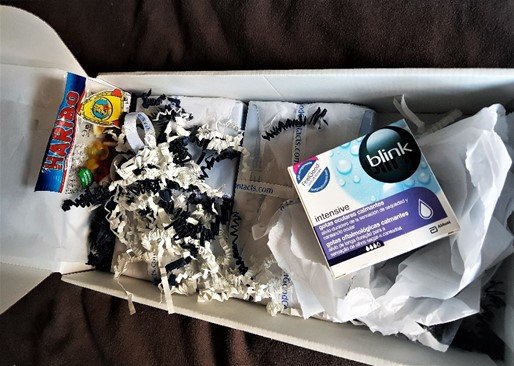
The contacts, as promised, were delivered the next day in a rather large box (as I had six packs of 30 contact lenses inside). The products inside were carefully presented, which is a lovely touch and there was a rather surprising, but very welcoming present inside too!
I could have given these sweets to my boys… but…
As I wear my contact lenses for at least six hours a day, my eyes dry out a lot by late afternoon/early evening. So, these below Blink Tear Vials eye drops* came in very handy!
Onto the contact lenses.
I’ve been wearing the contact lenses for about a month now and they haven’t given me any trouble at all. They keep my eyes moist during the day and they don’t move around or scratch my eyes, which is great. When I’m out and about, I really don’t feel them in my eyes. But, towards the end of the day, my eyes get tired and dry, so I normally take them out at that point and put on my glasses. The eye drops, however, have allowed me a further couple of hours of use, if I can’t get to my glasses in time.
Other money-saving options on Feel Good Contacts
If you’re a monthly contact lens wearer
You can buy either a 3-pack* or 6-pack* of the highly-rated Air Optix Aqua monthly contact lens for just £12.89 to £25.78, which is a huge saving.
You can currently get the comfi All-in-One Solution Triple Pack cleaning solutions for just £9.99.* Top sellers Comfi have tons of different contact lens options.
If you’re looking to buy in bulk, then the Dailies AquaComfort Plus (90 Pack)* costs just £41.55 at the moment. Don’t forget you can get an extra 10% off your first order when you sign up.
Feel Good contacts sell sunglasses too!
Feel Good contacts also sell glasses and to protect you from the sun, they have a vast range of polarised and fully UV protective sunglasses where you can make a massive saving too. I love the round square wayfarer sunglasses and they’re super cheap too!
You have tons of frame shapes: aviator, oval, rectangle etc. so check it out and you can always contact customer service if you can’t find something you’re looking for in particular. They have a live chat service but you can also call on 0800 458 2090 if you need optical advice.
You can also ask them whether they have a Feel Good contacts coupon code you can use at checkout – don’t ask, don’t get, right!
One of the brands Calvin Klein sunglasses is on sale and costs just £83.13. And with 10% off your first order, that’s just £75!
Other brands include Gucci, Hugo Boss, Tommy Hilfiger, Versace and Jimmy Choo, so take your pick because they are all discounted at the moment.
Are you a student? Get further discounts!
You can get a Feel Good contacts student discount if you are at uni. Students get 16% off their first order if they are full time students. Click here to select your student discount provider and you will then be redirected to a new page.
Does Feel Goods Contacts ship to US?
Yes! Feel Good contacts delivery to USA is tracked and takes 7 to 10 business days if your order before 7pm BST. Delivery costs from £9.50.
Feel Good Contacts Returns
If you’ve ordered the wrong lenses, your item has been damaged or you no longer need it, Feel Good Contacts have a 100% money-back guarantee or exchange. They also offer free tracked returns and a full refund (not including delivery charges) within 90 days of purchase. Check out this page for more details on their returns policy.
Overall opinion
From start to finish, Feel Good contact lenses’ service was seamless – it was super simple to order the contacts I wanted – they arrived the next day and were beautifully wrapped, with Haribo’s in the box too (nice touch!). I had no problems with the contacts at all, plus, I saved a lot of money using Feel Good Contacts’ service because the contacts are only £19.90 a box – that’s a clear £5 saving per box every time. It’s no surprise that Feel Good store reviews’ and Trustpilot score is 9.6/10.
So that’s my Feel Good Contacts Review UK version. Why don’t you give it a try for yourself? If you are a contact lenses wearer, looking for some prescription sunglasses, or you just require general eye accessories, check out Feel Good Contacts because the amount you can save on your eye care will become substantial over the years.
So, head over to https://www.FeelGoodContacts.com and get 10% off your first order now!
What about you? Do you prefer contact lenses or glasses and why? Share your favourite brand in the comments below.
*I was gifted 3 months’ supply of Contact Lenses and Intensive Eye Drops from Feel Good Contacts, but all thoughts and opinions are 100% my own
*Links marked with a ‘*’ are affiliate links which means I may earn a small commission when you click through to buy at no extra cost to you
*Prices are correct as at 7 June 2021
Home HIV tests save lives – so why the concerns?
Around 90,000 people, including 315 children aged under 15, received specialist care in the UK in 2015 and since 2015, the number of people accessing specialist care for HIV has grown. There are now sufficient HIV treatments that can control the condition and allow those who are HIV-positive to live long and productive lives. Sports legend Magic Johnson and Dr Rupert Whitaker, the founder of the Terrence Higgins Trust, are just two of the high-profile names who have been living with and effectively managing the condition for decades.
Yet diagnosis is still the biggest problem. People are reluctant to be tested for all sorts of reasons, and this means that one in three do not get the treatment they need that could save their lives.
Home testing
A simple home test for HIV is the ideal solution to a prickly problem. There is no requirement to phone or attend a clinic and ask for a test, and you do not even have to walk into a pharmacy to buy a test kit – they can be bought over the internet at sites like http://hivtestkit.co.uk/. The tests are relatively simple to use – obtaining a blood sample via a pinprick in the finger is neither as complicated nor as painful as it might sound, and the result is right there before your eyes in a matter of minutes.
Home tests are also highly accurate, as long as you choose one that is CE-approved and you use it correctly, with an accuracy of more than 99.5 per cent.
What are the concerns?
Despite the fact that home HIV testing can and does save lives, there are still justifiable concerns. These are not so much about the tests themselves as around how people might use or misuse them, and the inherent risks of home testing over being tested in a medical environment.
Bad test = bad result
Tests such as the one described above have been through all the necessary approvals and are highly accurate. However, there are others out there that are less reliable and are more likely to give a false negative, particularly the saliva ones, that many will be tempted with as they negate the need to take a blood sample.
Potential partner screening
The three-month window
The home tests screen for HIV antibodies, which start to appear in the bloodstream up to three months after contracting the virus. If therefore, you take a test during this three-month window, you might get a false negative result.
Lack of support
Testing in privacy at home sounds great, but what if the result is positive? This is a time when you really need expert support around you, and it is at this point that being all alone in the comfort of your own home is less of a good thing.
Home HIV tests are without doubt a great tool in the fight against HIV, because they will save lives. However, learning how to use them correctly and responsibly should be prioritised to reduce concerns as much as possible.