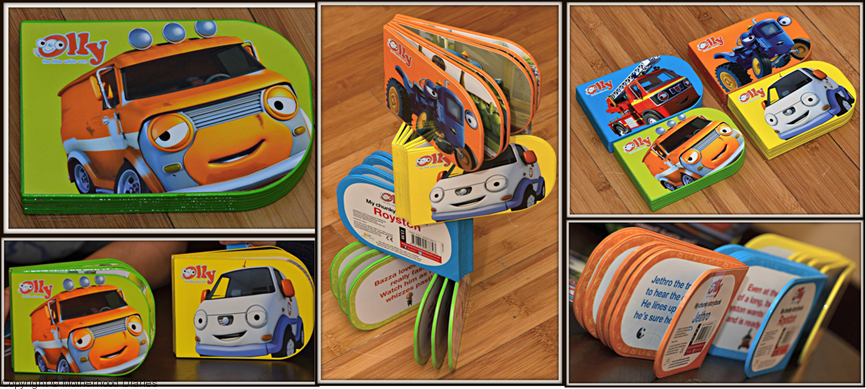
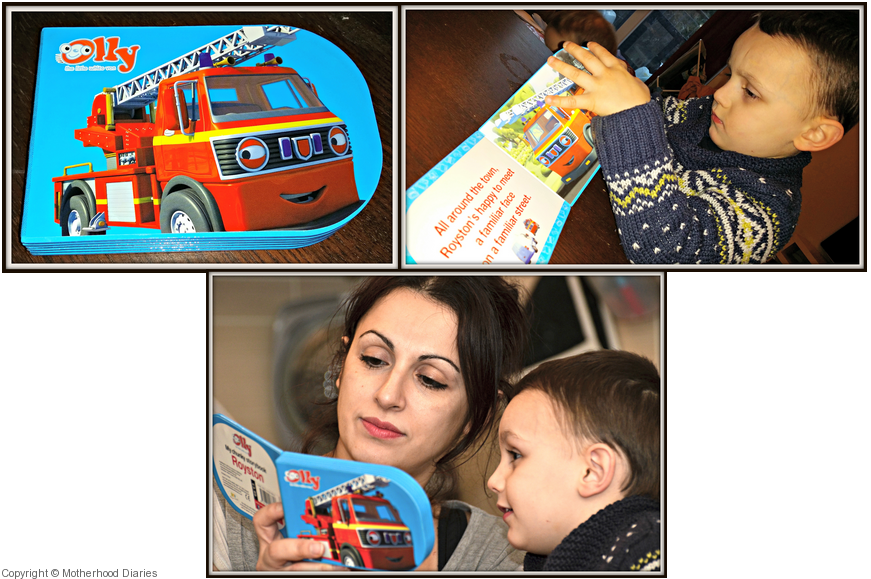
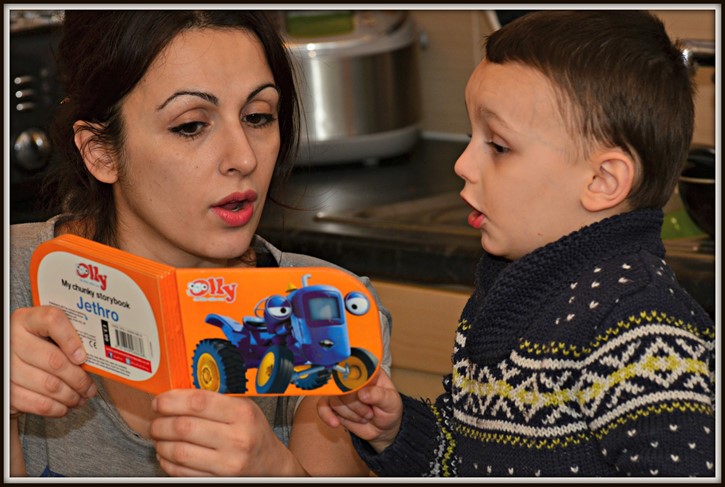
Olly the Little White Van is a pre-school TV show that currently airs on Milkshake and is 100% written, designed and animated in the UK. Olly and his friends have brought out a number of books, which are suitable for children aged 1 year plus and cater towards pre-school children’s practical, logic and problem solving skills.
How much does each book cost?
Chunky Story Books – RRP £3.99
Story Books – RRP £3.99
Press-out Sticker & Activity Fun Books – RRP £4.99
Sticker & Colouring Fun Books – RRP £3.99
Where can you buy Olly and the Little White Van books?
All of us were very excited to receive all of the Olly and the Little White Van’s books in the series and we couldn’t wait to get stuck in and try them all out.
Chunky Story Books – RRP £3.99
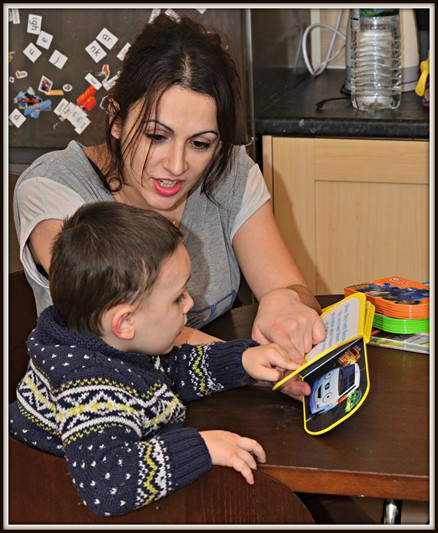
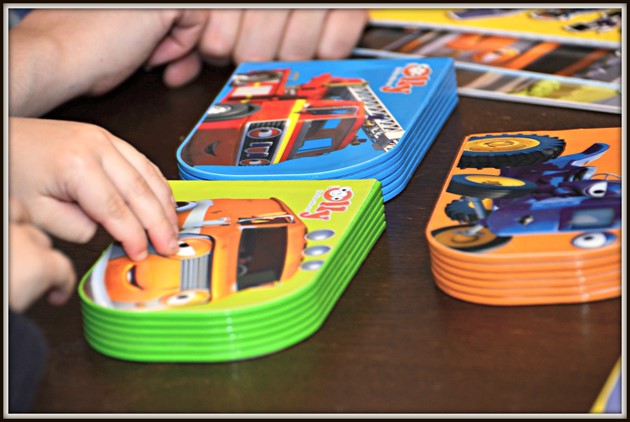
The chunky story books were the boys’ favourite from the get go, simply because they are small, sturdy and easy to handle. Each of the chunky board books of Olly and his friends have painted edges and are perfect for little hands from 1 year old and up.
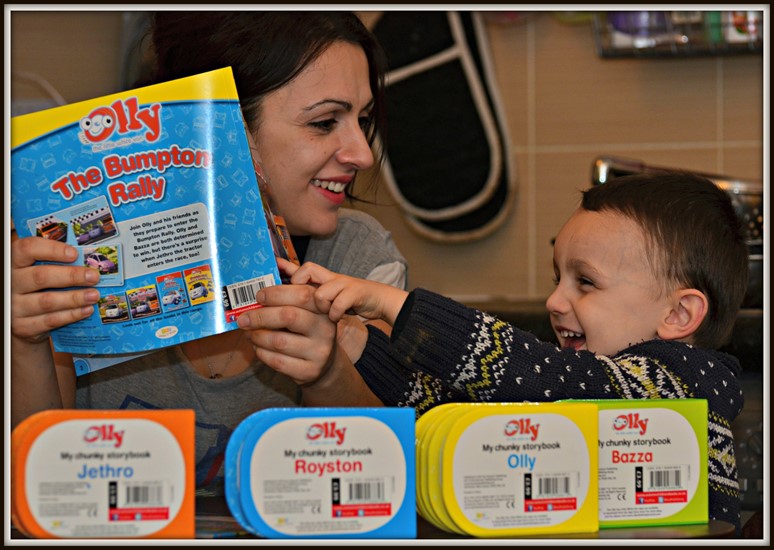
There are 4 books in the Chunky Story Books series, all related to Olly and his friends, who are Bazza, Royston and Jethro. Aron’s favourite was Olly, the main character, and Aidan’s favourite was Bazza, Olly’s best friend.
Olly
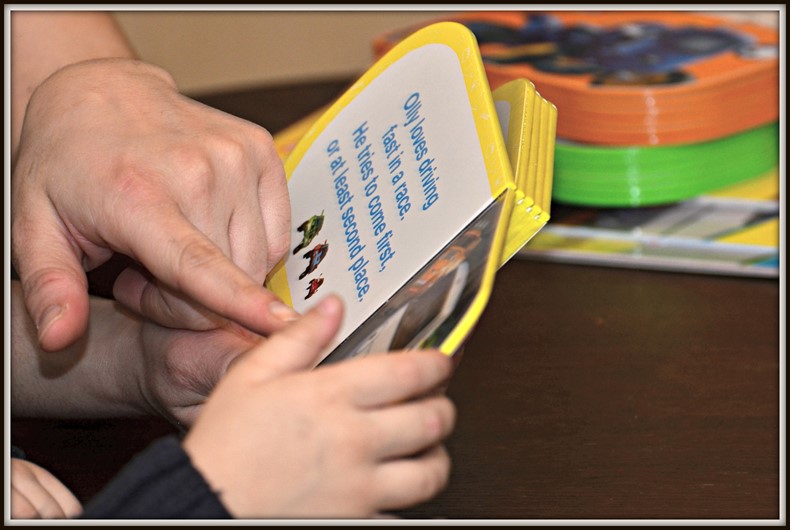
Olly, the main character in the whole series, is a friendly white van who loves to help whenever he can. He likes to have fun with his driver, Stan, and his favourite game is football. When he scores, the crowd cheers Olly’s name. When Olly is with his best friend, Bazza, everything is always ok in the end, no matter what happens. Olly is a keen racer and loves to drive very fast, so that he can come first, or at least second place.
Bazza
Bazza, the orange van, likes to get into trouble whenever he can. But, sometimes his cheeky tricks can land him into trouble. At the Bumpton Rally, Bazza ends up in squelchy mud, but Olly, his best friend, never lets him down and manages to break him free. (I can see why Aidan loves Bazza the best – their personalities are very similar!)
Royston
When Bumpton needs help, they always call Royston the fire engine because no job is too small for him. Royston is happy to meet a familiar face on a familiar street and if there’s a fire to put out or a cat up a tree, Royston is at the rescue! He likes to turn on his siren really loud when he’s racing around Bumpton town and even at the end of a long, busy day, Royston still wants to have fun and play.
Jethro
Jethro the tractor likes to take everything slow because, ‘Speed isn’t everything, you know!’ Jethro is big, blue and strong and always helps his friends when things go wrong. Jethro likes to look at art and he is just as smart as he is friendly. He also likes to watch birds fly and hear the crowd roar as he lines up his football, so he’s sure he can score.
Each chunky book has an easily digestible poem that the boys really loved. The words are simple, yet effective because the story behind each book gets to the point very quickly and paints a great picture of each character in the series. When reading these books again and again to the boys, they remembered the words that came next. Even Aidan, who is one month shy of 2, remembered which word came next before I read them. It’s a very clever way to engage the kids and get a feel of the character’s personality. I can easily understand why these books were the boys’ favourite.
Story Books
The Chauffer
In the story books, you get to delve deeper into the character’s lives and meet all the secondary characters in the series, like Stan, who is Olly’s driver, and Lisa the Limousine. The book talks about a very special day, Alice’s birthday (Stan’s wife), and Stan has booked Lisa the Limousine to take them out for a special birthday dinner. Olly is very excited to see Lisa drive up to the house, but Lisa’s car phone rings and Sir Ronald Grump informs her that she has been double-booked that day. She is supposed to pick up Sir Ronald Grump at the station and drive him to an important meeting. Olly is always around to lend a helping hand and offers to take Sir Ronald Grump to the meeting, so that Lisa can drive Stan and Alice to the restaurant as planned.
Sir Ronald Grump is a real grump and is waits impatiently for Lisa the Limousine to arrive, instead he finds Olly coming to pick him up.
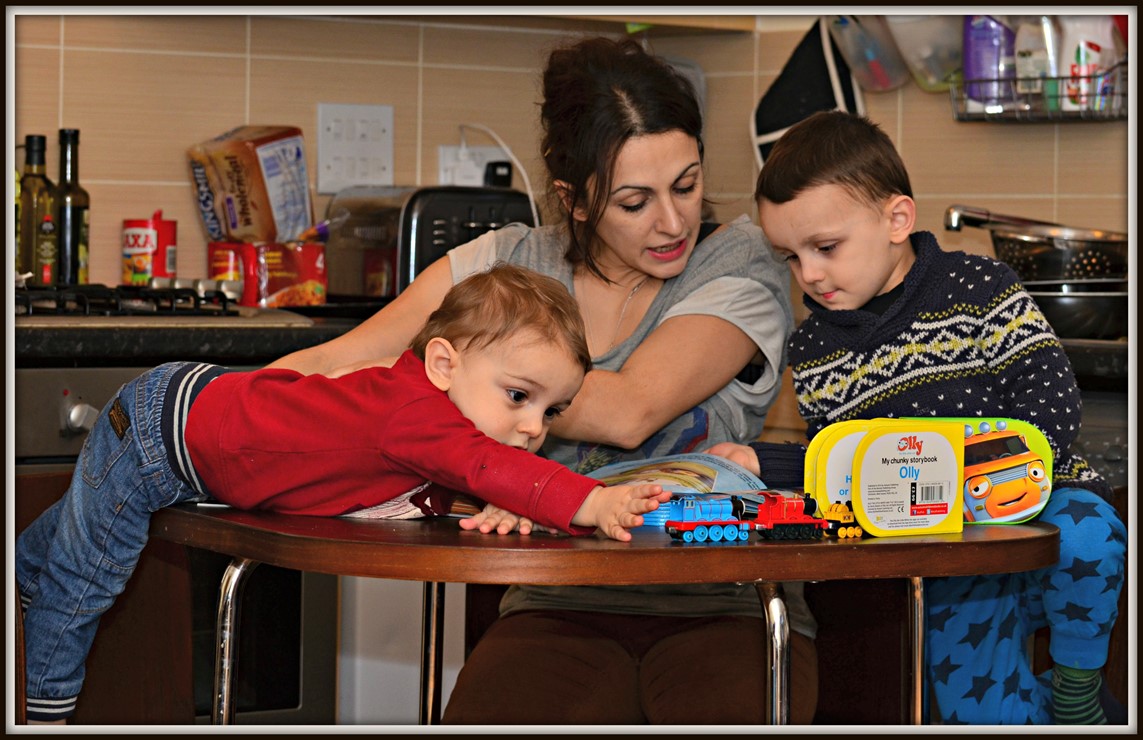
‘He’s very cross!’ Aron exclaims. (Aidan at this point, loses interest and reaches out for his trains on our dining table!)
Olly works hard to impress Sir Ronald Grump, but Sir Ronald is only interested in getting to the Grump Tower in twenty minutes. So Olly drives as fast as he can, but they are stopped by a traffic jam.
Do they make it to the meeting on time? It’s up to you to find out!
Aron really enjoyed ‘The Chauffer’ book. He was eagerly waiting to find out whether Sir Ronald Grump made it to his meeting on time and impatiently turned the pages as I was reading them to find out. The illustrations in the book tell a lot of the story, so Aron understood what was going on very well. He even had a go at reading some of the words. Aidan, on the other hand, knew what was going to happen and lost interest. One step ahead…
The Bumpton Rally
The Bumpton Rally talks about the annual town race in Bumpton. Olly and his driver, Stan, are preparing to take part. Olly’s friend, Bazza, is also taking part and doesn’t hide the fact that he’s there to win the race, even though the annual Bumpton Rally is really just a bit of fun. Bazza and Olly banter with each other at who’s faster than who whilst all the vehicles make their way to the start line to get ready to start the race. Other drivers taking part are Tasha, Dirk and, surprisingly Jethro, who believes his slow and steady pace will win the race. The race starts and there are a lot of bumps on the road for the drivers. A sudden twist in the story causes some of the drivers to run into problems.
But, who comes first?
The Bumpton Rally was Aidan’s favourite story book because it involved a lot of fast cars racing against each other. Aron enjoyed the book too, but I could tell he was just biding his time, so that he could get me to read the 4 chunky story books again.
Again, the illustrations tell the story as much as the words, so both boys really enjoyed flicking through the pages and studying the pictures as I was reading to them. It’s a really fun story and it contains a lot of hidden morals, which teach the boys that being fast and strong may not always be the answer, but to think with your head and keep at a steady pace, can win you the race in the long run. (Did I just give the story away?)
Press-out Sticker & Activity Fun Book
The Press-out Sticker & Activity Fun Book is a fantastic educational book catered towards pre-school children, so Aron was the perfect age to give everything a go in the book.
There are a number of activities in the book, such as:
Odd one out (Spot which picture is the odd one out)
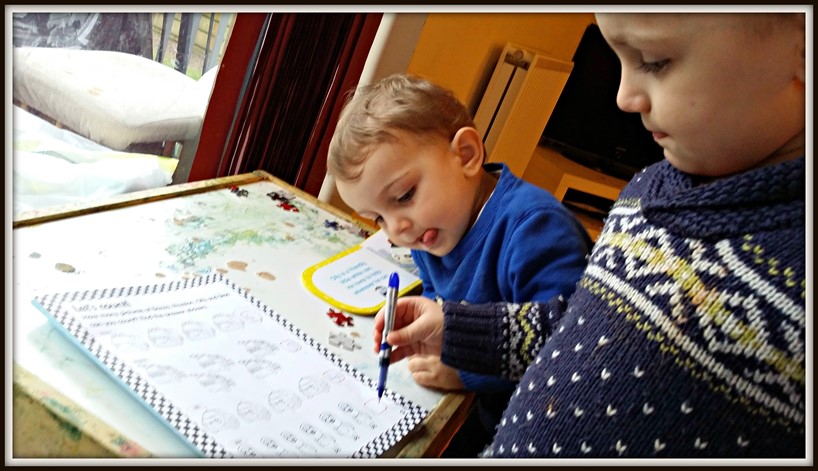
Let’s count! (where you have to count how many pictures of each character are on the page and find the answer stickers (Aron preferred to write the numbers instead, as you can see from the picture below)
Sticker Fun! (Find the stickers appended to the book and place them on the correct images to complete the picture (Aron got all of these right straight away, but it was a lot of fun helping him go through every sticker and eliminating the incorrect ones first).
Double Trouble! (Spot how many different pairs of pictures you can see, for which there is an answer sticker for. Aron, again, preferred to write the number instead and I didn’t want to stop him, as he has only just started using a pen and I wanted him to practice writing his numbers.)
Colouring fun! (A double page of characters in the series for you to have fun colouring in.)
Jolly Olly! (Perfect for practicing motor skills – join all the dots around the pictures and then find the stickers to match.)
A board game and pieces to press out (Aron wasn’t at all interested in trying this out, but I assume it’s because he is too young and didn’t understand the point of the game.)
Spot the difference (where you have to find all five differences between two almost identical pictures)
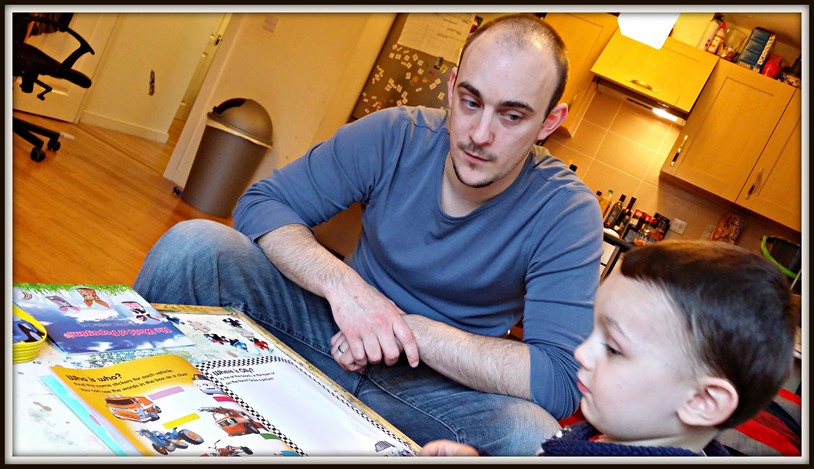
Who is who? (Find the name stickers for each vehicle (I was really surprised and impressed that Aron could spot the correct word for each picture. The activities in this book forced him to have to read the character’s names in order to complete the activity and he remembered the names for this particular activity.)
Where is Olly? (This is a blank page where you can choose to draw Olly at the beach, in the town or on the farm. Aron didn’t attempt this at all, but he hasn’t started drawing yet, so I will patiently wait until he’s more confident in his drawing skills and attempt this activity with him again).
Who wins the race? (Where you need to follow the lines to match the driver to the correct place they came in the race and find the stickers that correspond to the number. Aron correctly used his pen to follow the lines to the drivers’ correct places, but, again, refused to find the stickers and instead write the numbers down with his pen. Not complaining!)
Copy and colour (Use the grid below the picture of Olly, which is drawn on an identical grid, as a guide to draw your own picture of the character. Aron didn’t attempt this at all, but I believe he will arrive at this drawing stage in his own time.)
Wordsearch! (Find all the names listed in the wordsearch grid given. I had to help Aron with this as he’s only just started reading and found it very difficult to distinguish words from the jumble of letters in the grid. Admittedly, I ended up completing the wordsearch myself because it was fun, but I made sure Aron watched me do the whole thing and point out where the words were).
Sticker Fun! (More sticker fun where you need to find the correct stickers to complete the pictures given. This activity turned out to be Aron’s favourite and I quickly realised how much fun Aron has with stickers in general, so I made a mental note to buy more sticker books in the future).
Answer page (Where you will find all the answers to the activities in the book. We didn’t use it as I am a walking answer page!)
I was very impressed with the amount of diverse activities that you could find in one book. Each activity caters to so many developing skills which are vital for a pre-schooler of Aron’s age. I immediately saw an improvement in Aron’s writing skills and reasoning ability and definitely believe that the Sticker & Activity Fun book had a lot to do with Aron’s progress.
Sticker & Colouring Fun Book
The Sticker & Colouring Fun Book contains a lot of very simple pictures for the boys to colour in and a double page full of tiny stickers of all the characters in the series. The boys didn’t attempt this book at all, but only because they were so interested in the other books in the series that I decided not to push them to complete this particular book.
Left to their own devices, however, the boys ended up adding a lot of the stickers to our fridge…
What did I like most about Olly and the Little White Van Books Series?
I liked how diverse and educational the Press-out Sticker & Activity Fun Book was for Aron and, in the future, Aidan. The book really honed in on Aron’s writing skills and the ability to think logically about the problems posed in the book.
I would imagine the boys liked the chunky story books the most because they are easy to handle, the storylines are simple to digest, and the boys related to each main character’s personality, which was so well portrayed in the story.
What to watch out for:
After a lot of handling from both boys, one of the chunky story books started to pull apart in the middle. I don’t think that this is a fault in the book, but down to my boys’ heavy handling.
Other points to note:
The boys have not watched the TV show yet, and I will make sure I record a couple of episodes on Sky, so they can sit down and understand the characters and the story lines before reading the books and attempting the activities again. They really enjoyed the characters and I think the TV show will cement their interest indefinitely.
Rating:
5 out of 5, simply for the versatility of the book series. You have an easily digestible chunky story book series for 1 year old plus, activity and sticker books for pre-schoolers, and story books for children of all ages to enjoy.
Fantastic and very educational!
Subscribe here to stay on top of new content added to Motherhood Diaries.
Research shows that reading with children for just ten minutes per day can make a dramatic difference in how they perform at school. But, finding enough interesting reading material at the right level for your child can be difficult, with few schools changing books daily and few libraries providing a solid selection of reading scheme books.
However, now you can encourage children to develop their love of reading with Reading Chest, an innovative book rental service for primary-aged children learning to read.
Reading Chest offered three months of free access to the Bronze Level Membership as part of our review on Reading Chest, and here are our findings:
Reading Chest, founded by Liz Walker, a former primary school teacher and mother of three, is the UK’s only through-the-post book rental service for reading scheme books aimed at children aged 4 – 9. For a monthly membership fee, children receive regular deliveries of books from Reading Chest’s extensive selection of reading schemes, including Oxford Reading Tree, Project X, Rigby Star and Collins Big Cat. These include both fiction and non-fiction titles.
There is a great selection of reading schemes for children and each delivery comes complete with a pre-paid return envelope, making it easy for even the busiest of parents to provide their children with some great choices for their daily dose of reading.
Monthly membership starts from £9.95 and all new members receive a book bag, a bookmark, a reward chart and stickers. Certificates are available to download from the Reading Chest website and budding literary critics can even see their own book Reading Chest reviews published online! Check to see if you can find a Reading Chest discount code or Reading Chest vouchers online before you subscribe.
Reviewers:
Aron (3 years old)
Review:
I was very excited to receive an offer to review Reading Chest’s service as Aron is a very keen reader, and even though he’s only 3 years old and this service caters for children from 4 years plus, Aron has in fact begun to read. He learned phonics when he was just shy of 3 and can read a lot of the two to four-letter words in the English language. So, I am very keen to build on his reading skills.
To get started, I visited Reading Chest’s website, www.readingchest.co.uk, to sign up. Here is a screenshot of their home page:
Step 1 – Prices & Packages:
When you click on ‘Sign up’, you are taken to a page that shows you the membership offers available – ‘Step 1: Prices & Packages’:
The packages available are:
Bronze Package
Silver Package
Gold Package
You receive an initial delivery of:
4 books
4 books
6 books
How many swaps per month?
2
4
Unlimited Swaps
Based on returning 3 books at a time this will give you up to:
6 books each month
12 books each month
Unlimited amount of books each month
How many book lists can you make?
1
1 or 2
1, 2, or 3
A good supply of books for 1 reader. All books selected will be at the same reading level.
A great supply of books for 1 reader or good to share between siblings at different reading levels.
Unlimited books for 1 reader or good to share between two or three siblings at different reading levels.
Price
£9.95
£12.95
£15.95
I was offered 3 months free for the Bronze Package, so I signed up to the Bronze Package.
Step 2 – Choose a Book Band:
You are then taken to a page where you can choose Reading Chest Book Bands.
As Aron is at the very beginning of his reading journey, I picked ‘Stage 1’, which is the ‘Pink book band’ and then clicked on, ‘Go to the next step!’.
The recommended reading age is 4 – 5 years old. If you are unsure of which band to pick, the page below offers you the chance to look through the sample pages to see if the selected book band is right for your child.
Step 3 – Reading Scheme Selection:
You are given further options to tailor the package to meet your child’s interests.
01 – You can select whether you would prefer to read fiction, non-fiction or both. I selected ‘Both’.
02 – You can tell Reading Chest the reading schemes you would like. All the schemes are selected by default, but you can exclude particular schemes by unchecking the boxes. I just left it on, ‘all schemes selected’.
03 – Your choices above will determine how many books you will be given. The selection I picked will give me 137 books. Sounds like more than enough to me!
Step 4 – Your Details:
Here you’ll get the chance to input all of your details..
Step 5 – Correspondence Details:
You are then asked to fill out your address details, your child’s name (as it will appear on the envelope) and whether you’d like to receive an occasional email newsletter from readingchest.co.uk.
Step 6 – Payment Details:
You get the chance to review your choices here and confirm your selections are correct. You will be asked to enter your credit card details.
Step 7 – You’re done!
Our first delivery should be with us within 2 -3 working days. So, now we wait!
Step 8: We receive our package!
We were very excited when a package came through the post and Aron anxiously ripped open the white envelope (above) to go through all the items in his red book bag.
So, what did we get?
One super cute red book bag for Aron to carry his books in;
One A4 pre-paid envelope;
One bookmark;
One set of stickers;
One reward chart;
Leaflet on Reading Chest, welcoming you to the service; and
4 x books in the pink band. These are:
Tiger’s Family
My Cushion!
Who is it?
Got It!
I placed all of the items in the red book bag provided for Aron, so that he could pick out his lucky first book to read. He brought out the book, ‘Who is it?’
Who is it? – Series created by Roderick Hunt and Alex Brychta – Oxford Reading Tree Scheme
‘Who is it?’ is a very thin book, 8 pages in length, but at this early stage of reading, I can imagine a four-year-olds’ concentration span lasts about five minutes when they’re reading. So, I knew the length of the book wouldn’t bother Aron. At the back of the book, a label was added to let you know what book you are reading, the book band, the scheme and the book’s stock code.
Inside the front cover, there is an address label for ‘Reading Chest’ to remind you this book belongs to Reading Chest and it is not a keepsake. The inside cover very helpfully tells you what to do with your child before reading the book, during reading, and a little bit about the words in the book. More specifically, it talks about how to read the book to your child, ensuring they gain maximum benefit from reading through the scheme, i.e. talk about the words you see and help your child sound out some of the words in the book.
Each of the pages in the book only contains one to three words, with large illustrations above each sentence. This helped Aron grasp what the words meant in relation to the pictures and what the book was about as a whole. ‘Who is it?’ is set at a family and friends gathering, under a lit marquee, and friends and family make shadows using the light and themselves, so the others have to guess what they are. Everyone has a go, including dad, who dresses up as a spaceman.
There is an ‘After Reading’ instruction from Reading Chest to prompt me to ask Aron about what he thought of the shadow game and how dad made himself into a spaceman using household items, such as a colander and some bedding.
We dived into a deep conversation about shadows and throughout the day Aron pointed out his shadows to me whenever he noticed them. He even learned some words in the process!
Tiger’s Family – by Shoo Rayner and illustrated by Jon Stuart – Project X Scheme
Tiger’s Family is another short book, containing twelve pages in total, and the concept is pretty much the same as ‘Who is it?’ The book, helpfully, tells me what I should be doing with Aron before, during and after reading the book and warns me of some tricky words Aron might find during this reading.
Tiger’s Family is about a boy called Tiger and a typical day with his family, who are all aptly named at the beginning of the book. Mum has made some cakes, which all get hurled to the floor as Tiger and his brother runs through the kitchen door. The book very cleverly talks about the varying emotions each member of the family are faced with, i.e. ‘Mum is sad,’ ‘Dad is mad’, and I am instructed to talk with Aron about why mum was sad and whether Aron liked the book. I believe this is to get him to talk about his own emotions and teach him to express himself through words.
Again, each page only has one – four words, to not overwhelm the child during reading, and a lot of the words are repeated to help imprint that word onto the child’s brain.
I was very impressed that Aron already knew how to read the word, ‘Tiger’, but I had to help him with the tricky words that were forewarned in the front of the book. Aron enjoyed sounding out ‘sad’ and ‘mad’ and even acted a little angry when the cakes fell onto the floor.
Got it! – By Charlotte Guillain and Ley Honor Roberts – C. Collins Big Cat Phonics Scheme
Got it! Has 15 pages in total and uses three to six words in a sentence. There are no instructions at the front of the book, but a more detailed instruction sheet at the back entitled, ‘Ideas for reading’, which goes into more detail about how to read to the child and what to discuss with them during and after reading.
Got it! Is about a father and daughter at the beach, trying to catch a crab using a net and tipping the crab into a pot. The daughter then tips the crab back into the pond it came from, with an illustrative final two pages showing the process of how she caught the crab.
I was instructed to read the title and blurb with Aron, focusing on blending the individual words together. I also discussed rock pooling and what we need it for. I asked Aron what he could see in the pictures and he intelligently pointed out the beach, the net, the pot and the crab. He even explained what the daughter was doing, ‘She is catching that crab in the net’.
I wasn’t able to challenge Aron to suggest other words that ended in ck, for example, or to draw a picture of equipment needed for rock pooling, as he isn’t at that stage yet. But, if I keep on with this reading activity at least once every day, it won’t take long for him to widen his vocabulary enough to complete these stages at a later date.
My Cushion! By Alison Hawes and Tania Hurt-Newton – Rigby Star Scheme
My Cushion! Has eight pages in total and uses very simple wording, mainly repeating, ‘My Cushion!’ in various contexts. It contains only two keywords, ‘my’ and ‘no’, which I felt was just enough to help Aron understand and memorise the words properly before moving on.
The book is all about a brother and sister fighting over a cushion, which finally breaks, and mum comes in and exclaims, ‘Oh no! My cushion!’
My Cushion! Was Aron’s favourite book. He wanted to read it about five times before putting it down. I think he related to fighting over something with his brother.
I was instructed to ask Aron why mum was upset at the end of the story and how the children felt during the book. Aron said it was everyone’s cushion, which was actually right, so I couldn’t argue with him on that point. Although, I did mention that too much fighting over something could lead that object to break and then no one could play with it afterwards.
Towards the end of the day, I noticed Aron offer his trains to his brother. Perhaps, the book had left a mark on him to not fight over his toys with his brother? Well, perhaps, just for now…
Sticker chart
I emphasised to Aron that because he had read all four books so beautifully, he was allowed to place four stickers on his reward chart to progress his journey through the reading map. I asked him about which colour stickers we should add to the reward chart when he had successfully completed four pink band books. He answered correctly, ‘pink’, but decided it was more fun to take out all of the stickers and add them to the fridge.
I helped him pick out four pink stickers instead and he took great pride in adding them to his reading map.
After sampling Reading Chest’s first book session, I felt very proud of my son that he had read four books so well, and, most importantly, I felt like Aron had progressed in his reading. I decided to hold onto the books for a couple more days so I could get Aron to read them again before placing three of them back in the pre-paid envelope and sending them back to Reading Chest to swap for three more books.
I really enjoyed the whole service. I felt like I had learned how to be a teacher and not just a parent, and I want to carry this on every day with both of my boys. I believe Reading Chest will make up a valuable part of both of my sons’ reading education and help them expand on their already growing love for books as well as their reading levels, even up to Oxford Reading Tree Level 7 books or Oxford Owl Readers before they get to that stage at school!
The great thing is you can help them to read by yourself and you don’t need to be a teacher to do that. I may even get some alone time if I could leave the kids to read by themselves. One can dream…
What did I like most about Reading Chest’s service?
I liked how simple it was to set up the service and how much I learned about teaching my son to read.
Other books that are great are:
Barney 1 2 3 4 5 Senses
Barney I Love Bugs
Sail Back Dinosaur Bug
What to watch out for:
One book came with a huge fold down the front. Make sure you make a point of this in the sections provided at the back of the pre-paid envelope so you are not charged for the damage. The back of the pre-paid envelope offers you three options when returning the books, i.e.
‘Received the wrong book(s)’
‘Book(s) damaged – sorry!’
‘Book(s) received already damaged’ – This is where I pointed out that the front of ‘My Cushion!’ had a fold down the middle.
Other points to note:
As these books are not yours and they will need to be returned at some point, you have to make an extra effort to not let any little people get their hands all over it. I felt very bad for Aidan, who is only two, because every time he wanted to handle the book, I had to snatch it back off him and take control over his interest.
Rating:
5 out of 5
Reading Chest is a fantastic service and it will not just help Aron to progress with his reading, but also build on our strong mother/son relationship. I just wished Aidan was old enough to join us too.
In July 2012 our lives took a different turn. My son and daughter-in-law were expecting their first child and I was looking forward to having a new baby granddaughter. Nothing could have prepared us for what was to come.
It was a straightforward pregnancy and birth. She was born at term at Crowborough Birthing Centre but it was immediately apparent she was very ill and was transferred to Tunbridge Wells. Her little body was covered in petechiae (red blood spots) she had an enlarged liver and spleen, low platelets, low birth weight, seizures, jaundice, microcephaly…….. and more. She was diagnosed with congenital Cytomegalovirus (CMV), a common virus, harmless to most people, but devastating to a developing baby. In the coming weeks, we had to come to terms with the knowledge that she is severely mentally and physically disabled, blind and medically fragile.
I knew a bit about CMV, I was a Teacher of the Deaf and had worked with a severely disabled child for nearly two years. What struck and horrified me was how little the professionals knew about CMV and its devastating consequences. In the neonatal unit, none of the doctors or nurses had ever seen it. The GP had to look it up. Midwives, health visitors, sonographers, audiologists, friends, family, people in the street – had never heard of it.
Congenital CMV is the most common birth disorder in the UK. Around 1 in 150 babies in the UK are born with the virus and around 1 in 5 of these children – 900 every year – will develop serious, permanent problems such as deafness, blindness, cerebral palsy, mental and physical disabilities and seizures. As CMV is a relatively unknown condition, it is a common misconception that it is rare. In fact, it is more common than Down’s syndrome, Toxoplasmosis, Spina Bifida or Cystic Fibrosis.
About 60% of the population has been infected with the virus at some time, with symptoms no more severe than the common cold. It is easily transmitted through close contact with bodily fluids such as urine, saliva or blood. It is only dangerous to those with a weak immune system or when passed from the mother to her unborn baby. It is tested for in pregnancy in the USA and Europe but not in the UK – other than for those undergoing IVF treatment. There is no cure, no vaccine.
Anti-viral drugs such as Ganciclovir and Valganciclovir can be used to treat newborns with severe symptoms. Research indicates that, if given in the first month of life, it may help the baby retain some hearing or slow the progression of the hearing loss. It cannot repair the damage already done. However, the drug is very toxic as it weakens the immune system, attacking the white blood cells that fight infection and causing damage to the kidney and liver. It is not a simple solution.
It is the leading cause of non-hereditary Sensori Neural Hearing Loss (SNHL) in children. CMV infection can only be confirmed in babies in the first few weeks and that has made it difficult to estimate the proportion of SNHL that is attributable to CMV. Studies define SNHL in children differently so this also complicates the estimation of the full magnitude of the effect of CMV on the incidence of hearing disabilities. It is generally estimated that about 25% of hearing loss in children by 4 years of age is likely to be a CMV-related hearing loss. Some research has this as high as 60%.
Universal Neonatal Screening alone is unlikely to identify the majority of cases of CMV-associated SNHL due to the large proportion of affected children who have hearing loss that has its onset in later childhood or progressively increases over time. Deafness caused by CMV is sensori neural and may affect one or both ears. In half of the children, their hearing will get worse over time. The virus may cause unilateral deafness, particularly in asymptomatic children, but these children can go on to develop deafness in the other ear. Sometimes the hearing will fluctuate. Research is underway to try to understand how CMV affects hearing and how this damage may be prevented. The progressive nature of SNHL suggests that there is a chronic infection in the central nervous system that continues to be active through early childhood.
Many children who appear to ‘only’ have a hearing loss as a result of CMV infection often have additional difficulties. Their sensory integration system may be damaged affecting balance (vestibular) and they may have little sense of individual joint position and movement (proprioception). They may have hyperactivity, sensitivity to sound and vision, sleep problems, behaviour issues, dyspraxia, poor muscle tone, autistic tendencies, high pain threshold or no sense of fear.
CMV is complicated and no two children are affected in exactly the same way.
My granddaughter continues to fight all that life has thrown at her. Yes, she has cerebral palsy, epilepsy, chronic liver disease, is blind, has scoliosis of the spine and is vulnerable to infection. Most children are not so severely affected, she was unlucky. But she is a happy bunny, we have found what makes her smile and even chuckle – she is an absolute delight and we love her to bits.
So …. What can we do?
Raise awareness
The US government agency, the CDC (Centre for Disease Control), published statistics on women’s awareness of conditions affecting children versus the actual occurrence of those conditions. This demonstrates that the condition with the highest incidence (CMV) had the lowest awareness rating!
Condition
Women’s Awareness
Incidence per year in the US
CMV
14%
5500
Fetal Alcohol Syndrome
97%
5000
Down’s syndrome
83%
4000
Spina Bifida
79%
3000
HIV/Aids
98%
200
There are no similar statistics for the UK but it is likely that they are similar or worse.
Learn about prevention and take simple hygiene precautions
As a child carrying CMV infection may show no symptoms, pregnant women should
Avoid sharing cutlery, drinks or food
Avoid kissing babies, toddlers, and small children directly on the mouth
Wash hands regularly, especially after changing nappies and coming in contact with bodily fluids
CMV Action – CMV Action is a UK charity that has been set up to raise awareness of the virus, campaign for better prevention measures within the health service and encourage research into a CMV vaccine. It offers advice and support to anyone affected by Congenital CMV and helps ensure they receive the best care possible. It puts families in touch with each other and provides a personal support service for each of its members. It also offers information and resources for professionals. www.cmvaction.org.uk
The start of a school term can be a huge relief for some parents but, daunting to others. My son Sam started full time school this September and although he is more than ready – being the oldest in his year, as the baby of our family the thought of leaving him all day filled me with dread.
Admittedly, the last two years have taken their toll. The half days in a preschool setting are weak competition. Now, once I drop Sam to school at 8.55am I realise that I don’t have to be back at those playground gates by midday. For the first time in ten years I have my days back.
School is the best place for Sam. Already he is confident with the alphabet and he can comfortably count to 140. Walks through the park, trips to the library, toddler groups have sadly been exhausted. Our fun activities become routine. This dawned on me a year ago when I had another year of a preschool setting to take him through! There was nothing wrong with the nurseries that Sam attended but he has simply outgrown them. It wasn’t unusual for him to want to do something else after lunch.
So, I can honestly say, that as Sam settled into a school routine I too, settled into being temporarily free.
Nothing could have prepared me for what was to come.
I was devastated when Sam came out of school and told me that he was in pain…I had to collect his brother and sister from the Junior’s playground – then walk home! Instinctively, I knew something was wrong. We walk everywhere and he never complains.
Half an hour later, we were home, I was distressed. Chris, my husband, decided to contact our doctor whilst finishing his shift. It was cold and dark and I couldn’t wait for him to come home.
He walked in and told me to get Sam ready ‘quick!’ My other children looked worried and I just did as I was told. Chris couldn’t be seen at the surgery so after explaining the symptoms he was told to take Sam to A&E.
It didn’t stop there. Sam was not responding to antibiotics and had to stay in hospital. He spent two days on a children’s ward and although he is at home with us now he is still off school.
School is where Sam should be but this has taught me a lesson. Children are always the responsibility of the parent and, we cannot simply switch off when they start school all day…
How did you feel when you sent your child to school for the first time?
Teaching good judgement in children
Negative perception and bad judgement is the basis for many of the ‘evils’ in our world today. Racism is a way to pass judgement on people of a different race, and label them as worse or better than you are, purely because of the colour of their skin. The same can be said about bullying, homophobia, xenophobia, gender discrimination, etc. These issues are not only rife in our society; they are often on the rise. With all our modern schooling and psychology, more children are turning to suicide because of bullying than ever before and therefore it is time to start teaching good judgement in children so we can move towards a future of being judgement free.
The reason I am bringing this up is that I did the most fascinating exercise on the weekend. I attend a writing group once a month. It’s nothing formal; just a few people sitting in a room, writing whatever nonsense comes to mind, and encouraging one another. This past Saturday, our group leader told us to write a story about an incident, but in two different voices. In other words, we had to write the same event from the perspective of two different characters.
Think of the benefit of teaching this kind of good judgement to children, and allowing them to practise this skill. Do you think there would be so many bullies around if they had to imagine the pain that their victims felt? Would so many people hate gay people, if they understood how gay people really felt? Below is the story that I wrote in one of my writing groups. Just to give a little background, in South Africa, where I live, we have car guards. They work at shopping centres, or wherever cars often park, and as the name implies, they guard cars. They don’t earn a salary for this. They actually have to pay the mall to be there. Thus, their only source of income is tips from people parking their cars. On an intellectual level, I don’t support the car guard movement. Malls should provide security with paid workers. However, the ‘people level’ is another story… Here is what I wrote.
Voice 1
The sun shone brightly over Durban. Everybody jumped into their cars and headed for the beach. Just as well that I got there early. By the time I left, there was no parking available. After drying off, I hopped into my car, retrieved my wallet from my bag and pulled out a few coins. I handed them to the guard and drove off.My stomach grumbled as I drove home. Luckily there is a Spar along the way. I ran in, grabbed a pie and was out of there in under three-minutes, and wouldn’t you know it, the car guard shadowed my walk back. What a nuisance. Really, this car guard story is getting ridiculous. I’ve only been here a few minutes, I thought to myself. He ‘ushered’ me out of the parking lot. Well actually what I mean to say is that he just stood in my way. Without looking, I sped off.
Voice 2
Eish, the sun is out today. It’s hot and I can’t find my hat, but the taxi is coming soon. I can’t wait; I’ll just have to suffer, again… “Goodbye children. I promise there will be food on the table tonight.” I ran the two kilometres to the taxi rank. I was already sweating before I even got in. The 17-kilometre journey took over an hour today. There was traffic. My heart pounded as the driver raced through. More close calls than usual today. I hope the rest of the day is going to be better. For a change, it was, until my loaf of bread at lunchtime. Some white guy nearly rode me over. No thanks, no tip, no nothing. It’s like I wasn’t even there. It was like I didn’t even chase those children sitting on his BMW. Now, my head is burnt, my heart is broken and my spirit is crushed
These kinds of writing exercises are perfect to get children to understand what the shoe is like on the other foot. Not only will it teach them good self-judgement, but it will encourage good judgement in people around them too.
One of the most common pieces of advice for expectant mothers is to practice prenatal exposure to classical music. Playing concertos for your baby will supposedly result in a head start in education.
A 2011 study reported that babies who were exposed to music three weeks prior to delivery remembered the melodies one month after birth. In the study by Psychobiologist Carolyn Granier-Deferre, the babies’ heart rates slowed by 12 beats per minute with the familiar melody and only 6 beats per minute with an unfamiliar tune.
Despite these findings that newborns do apparently react to familiar sound, there is little consensus among experts as to whether music really does have any great effect on babies prior to birth. So here are some myths and what we actually can determine about music and prenatal development.
If anything this kind of pressure, even prior to birth, will probably only mean that the child’s parents are placing ‘too much emphasis on achievement at a too-early age’. Instead, mothers and fathers should concentrate on helping the time in the womb to be full of as many simple pleasures as possible.
Music Can Help a Baby Relax
While you may not be able to ensure a college scholarship for your baby just yet, there is evidence that exposure to music can help to slow a baby’s heart rate and aid sleep.
The Baby Center.com related the findings of a Californian obstetrician, Rene Van de Carr, who reported observing a 33-week-old fetus adjusting his breathing pattern to match that of Beethoven’s Fifth Symphony. However, other researchers remain unconvinced that this is caused solely by exposure to a song.
Music can cause the mother to relax. “When a woman relaxes, that’s good for the fetus and that’s an indirect effect of music on the fetus,” says Janet DiPietro, a psychologist studying fetal development at Johns Hopkins.
But whether it is the song itself or a response to the mother’s heart rate, the effects may still be beneficial for the baby.
Can Music Disrupt the Baby?
Music can be a positive way of bonding the mother and child prior to birth. However, there is a slight danger that exposure to too much loud noise over a long period of time can have adverse effects.
The American Academy of Pediatrics found in several studies from the 1990s that unborn children exposed to loud noise for long units of time had a greater chance of premature birth, lower birth weight, and hearing loss. But this was usually caused when their mothers worked in a high volume environment.
But it is still a good idea to keep your stereo below 65 decibels so as to protect the baby and not startle it. This is because there is the potential risk that cranking on Handel may wake the baby from its natural sleep pattern. Choose good quality headphones/earphones with a stronger bass to encourage a more subtle sound to penetrate through the mother’s belly.
To Play or Not to Play
All in all, there is definitely no detriment to your baby caused by providing a musically full uterine environment. Your fetus’s hearing is developed by the end of the second trimester so play away.
There are other things that will contribute to stimulating and bonding with the baby include:
Stroking the abdomen to feed the sense of touch
Reading aloud and just talking to expose the child to your voice
And if you are relaxed this will transfer to the baby. So if finding local piano teachers and taking a lesson or two helps you to feel mellow, then this will be good for your child as well. But it probably won’t help them become a genius either.
What methods do/did you use during your pregnancy to stay calm and relaxed?
The day I almost killed my daughter – keep an eye on your kids!
It started out like any other Sunday. We went to a car boot sale in the morning and gave our girls £1 each. Thing One immediately dropped hers and Thing Two immediately offered up her own £1.
We did not let her give the £1 to her sister. Instead. she carefully chose a little doll in a wood crib, her chubby hand opening like a flower to reveal her sweaty, shiny £1.
“Thank you for mine Dolly.”
…she said shyly to the seller’s shoes.
Back home we dined on Marmite and cheese sandwiches in the garden which was washed down with milk and slices of apple.
I then brushed off the crumbs from my T-shirt and cracked on with digging a large hole to plant an Acer in. My husband got busy laying down foundations for a summer house. The children bounced on their trampoline, they played in their paddling pool and they frequented their cubby house.
I was busy swearing at the Ivy roots that my spade would not cut through and my husband was busy making sure the foundations were flat for the summer house. We had our backs to our babies, as so much more important were our tasks!
We did not notice Thing Two get off the trampoline and wander round and round the garden. Did she stop to pick up a snail or a dying daffodil head before she found the weed killer?
She appeared by her daddy’s side and her mouth was on the nozzle. Her little chubby hand that recently held her £1 was now on the trigger.
We went on our knees, trying to make eye contact and stay calm, but we were begging…
“Did you spray it in your mouth, baby? Tell daddy!”
Too scared to admit the truth, for fear she might be in trouble, she vehemently denied spraying the bottle. She didn’t seem ill. In fact, she seemed fine. She wanted to go back to bouncing on the trampoline.
But, soon the sickness came. She was lying on the sofa, her blue eyes to big for her grey face.
“Baby, do you feel ok?”
“I’m ok…”
… she whispered. But, she was not. She got sick again and again. My husband raced her to A&E and I stayed at home with her crying sisters, pacing, obsessively cleaning and waiting for my phone to ring.
At last.
She is going to be ok. We’ll be here for a while yet, though.”
I crumpled into a pile of her dressing up clothes.
I was not there when she had her anti-sickness and she got treated or dehydration. Apparently, when they asked her to open wide, so they could put the lolly-stick in her mouth, my amazing daughter, with her sore little throat croaked…
“Where’s the lolly?”
When she left she told them…
“I go home, have bath with mine mummy now. Thank you.”