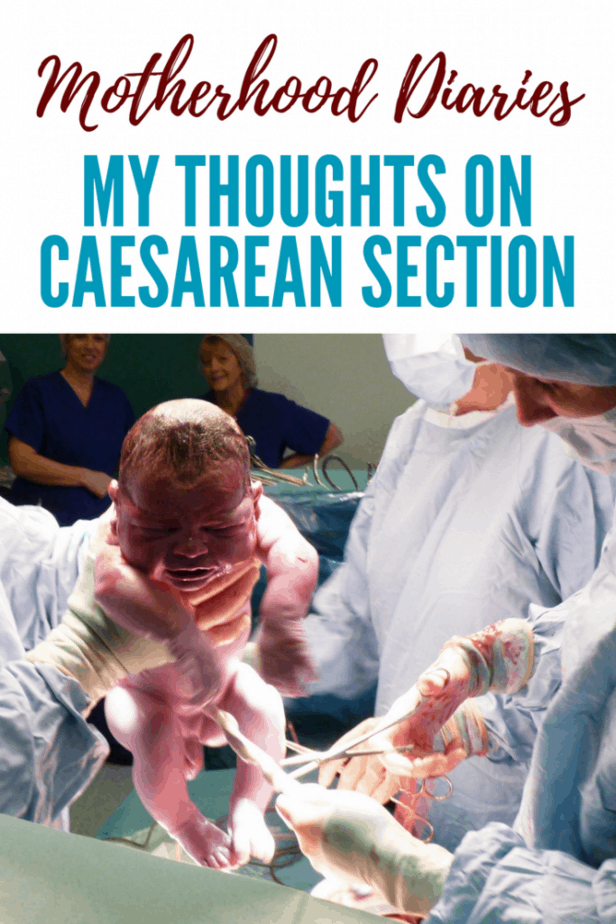
I created this blog post after what Kirsty Allsop said about birth and parenting. On reading the articles myself I feel very familiar with many of her points. However, we have come to quite different conclusions. As a doula and AIMS member I strive like Kirsty for women’s rights to be respected and within that I want the care we receive to be appropriate for what each of us wants, not that birth be seen as so awful that we should just opt out and not that we feel there are no choices for fear of being judged.Anyway, with some time to consider Kirsty’s views on birth I wanted to revisit my own feelings after the birth of my son by Caesarean section.
C section recovery
Initially, I didn’t feel traumatised, or horrified. The recovery was a struggle and I felt disappointed and annoyed but mainly I felt angry. I was angry with others talking about their births, I felt left out and not full as a mother – I didn’t have this birth story everyone was sharing. I remember distinctly being so jealous of one friend as she described her labour and birth. She actually had a very traumatic and damaging instrumental birth but in my mind, at that time I thought that at least she had ‘birthed’, she had laboured spontaneously and her baby had come out the way he was meant to. So here I can understand Kirsty’s frustration that so many women feel like I did.
I was chemically induced (for no other reason than being almost 42 weeks) and after some other interventions due to my body ‘failing’ to progress (or baby not being ready to come yet) and my baby’s heart rate reacting to the epidural (that I was told to have to stop me pushing), I had an emergency c section. Some emergency c sections are urgent and life-saving. I do believe mine was necessary but I believe it only happened because of several elements that I felt I had no control over.
My overriding feeling afterwards was:
“Why does everyone keep looking at me with pity?!, I have a beautiful baby! It’s all fine! Stop pitying me!“
I remember thinking that society was wrong as I shouldn’t be made to feel bad about not having had a vaginal birth. That I wouldn’t have to feel bad about it if others didn’t. My feelings were that I hadn’t done it, I couldn’t do it. I didn’t work. I didn’t consider that actually what should and could change was the maternity system that I had my baby within.
Over the next 2 years, I spent time being disappointed, my c section recovery time was long because of an infection and anaemia. I coped with the emotional side by pushing it aside. When my son was 14 months old I fell pregnant for the second time. I told the midwife I wanted to go for a vaginal birth and not opt for an elective Caesarean. I knew this was an option but I didn’t look into it too much as I was absolutely terrified of being disappointed again.
However, I did start to read some resources when I got to around 30 weeks. Still, I wanted to go with the flow, but I realised that just going with the flow may not have been enough last time around. I could have said no to being induced, I hadn’t even been aware of the risks to the baby with being induced. I hadn’t known how alone I would feel and afraid on a ward alone in labour without anyone supporting me as I wasn’t considered to be labouring. Also, I had not been aware of the risks of the epidural and the Caesarean in relation to me and my baby. The risks of not doing these things were made clear at the time but not the risks of c section procedure. Having more knowledge and support may not have changed the mode of birth but it would certainly have changed how I was able to view the birth itself afterwards.
I sought out support from other women who had decided on a vaginal birth, I looked up the current research on the subject which all pointed to a vaginal birth still being safer all round than a caesarean. What seemed important in achieving a vaginal birth and avoiding unnecessary risky interventions was to have as minimal interventions to start with as possible. This was a battle, having had a previous caesarean the hospital protocol was to recommend (tell me) to have electronic fetal heart monitoring, a cannula sited on admission, restricted access to water for labour and time limits to prevent long labour. The research that these recommendations were based on was either limited or didn’t exist, it appears to have all come about the wrong way around. The technology was introduced and then they couldn’t take it away even though it never seems to have been proved to improve outcomes and there are many associated links to further interventions and other risks to mother and baby.
So….. I thought being informed was enough this time. I wanted to birth in the hospital with the NHS rather than at home and I had to fight my corner to request to be treated normally and not have the interventions unless needed. The previous caesarean not only affected my birth first time around but it was a major factor this time around also. I felt I had to change my community midwife to one who knew my rights and was supportive of me rather than telling what I wasn’t ‘allowed’ and I even found myself and hubby having a debate with staff in hospital during labour as to why I was wanting to have a mobile and active labour without straps and machines attached to me. I did have a VBAC, it was amazing and wonderful to birth my baby. But the support I had in labour was shocking, I was seen as someone who may or may not be able to do it. The hospital midwife was still doubting it 30 minutes before my babies head appeared. This is not good enough. The support we get in labour and birth is vital. However our babies are born, Kirsty is right, we should not feel guilty about it, but quite frankly I feel that often those working within the maternity system should!
Birth has no guarantees, and for some women, it can be truly traumatic, no matter the mode of birth. Sometimes birth is traumatic because of what happens to the baby or mother. What also often makes a birth traumatic is the support or lack of support a woman receives before during and after her labour and birth. This is what the focus should be, not the mode of birth or trying to control it.
Instead of campaigning that we should stop focusing on natural birth I support that we should be focusing on how to protect women in labour and how to reduce the number of births that are unnecessarily traumatic. If women automatically had a named midwife whom they knew and trusted (and could change if they wished) throughout pregnancy, labour and birth then this would automatically reduce so much intervention and importantly fear and guilt. Women would feel safer, the midwives would know the women and their history, midwives would be less dependent on machines and more dependent on their knowledge, skills and experience. This is what the M4M campaign is about, and you can read more here www.m4m.org.uk
Currently, in the UK we don’t usually have access to one to one care of this nature on the NHS. It has been called the ‘gold standard of care’ and has been proven to improve outcomes for women and babies but it is a long way from our centralised labour wards in busy hospitals. What we do have in the UK, are Independent midwives, who we hope will continue to provide care for women when new insurance regulations come in. Independent midwives may not be available to all (they are paid for by the client except in special circumstances where they have waived fees or been paid for by an NHS trust) But they are an amazing group of practitioners who not only have the right to practice independently but whom women have the right to access. To find out more and support the continued practice of IMs please visit here www.independentmidwives.org.uk
For those who support the idea of having a one to one midwife, can’t afford or access an IM there are also other regional changes taking place. In the north, there is a group called one2one midwives who are supporting women via the NHS in a one to one capacity. However, they too are facing constant challenges as the GP commissioning groups are not currently seeing women’s one to one care as a priority. As centralised maternity care has become the norm, birth centres, access to midwives for one to one care and home births seem to have become seen as expensive and unnecessary.
Well, I urge any pregnant women to seek information. Disappointment does not come from that. I’m not asking that we have huge expectations about birth and motherhood – what happens and how each of us experiences it is so different. But what we can have is expectations with regards to the level of care we should receive. What is available to you locally? What are the intervention rates of where you plan to give birth and how do you feel about them? How are you treated? What do other women say about their care? Are you spoken to with respect?
No, we cannot know how birth will turn out. But, we can expect support, appropriate care (for normal birth as well as for when intervention is truly necessary – which is more confidently ascertained when one to one midwifery is used) And all of this from a midwife who knows us, who is confident in normal birth not just machines and who is available to us when we have our baby.
This is not preparing for disappointment as I originally thought, it is not trying to ‘get an experience’. It is trying to reduce the likelihood of risky interventions, a traumatic birth or surgery and ultimately trying to ensure the safest birth for your baby which without other medical indications is still vaginally. For me, it is about trying to ‘not’ have an experience rather than trying to ‘get’ one.
Background reading
Tew, Marjorie, Safer Childbirth? A critical history of maternity care. 1998 NICE guidelines – Caesarean Section 2011 www.nice.org.uk/cg132 RCM Practice guidelines 2012
SM’s birth story
Once pregnant this time I was worried that ‘preparing’ too much would lead me to an even deeper disappointment this time around if things went wrong. I found however that as I neared 30 weeks I started wanting to really prepare again. I again did yoga, enrolled in an NCT refresher course, used raspberry leaf tea and capsules and listened to natal hypnotherapy CDs most days from 32 weeks. I also bought a selection of aromatherapy oils that are recommended for various uses in pregnancy and labour.
I did a lot of research into VBAC, the stats, birth stories, what the hospital policies are, what my consultant would support and what my midwife’s views were. I actually found my midwife to be lacking in up-to-date info about the hospital policies and also the fact that all their recommendations are simply that, ‘recommendations’, and that I can choose to say no! Due to her attitude, I went to see my consultant who agreed to write down my birth preferences in my notes and show her support for them. I was lucky to have a very VBAC friendly consultant. I also went to a different midwife clinic for the last couple of visits so as to avoid this particular midwife.
The latent phase of my labour started on Sat eve when I was 39+2. I had contractions on and off between Sat eve and Tue morn. They were always more regular in the eve and overnight and would then tail off in the morning again. I went for some nice brisk walks in this time to try and encourage baby’s head to come down and also to encourage the labour on.
By Tue afternoon the contractions were getting stronger and more regular – about every 15-20 mins. My contractions never did follow a ‘regular’ pattern in the way that the midwives look for. By Tue eve I was struggling to cope with some of the contractions so I asked a friend to come over who had offered her support.
My hubby had tried to massage me but I realised I could not cope with being touched during the contractions so he said he felt a bit redundant after that. We had discussed hiring a doula earlier in the pregnancy but neither of us had really known how we would feel about that or what we would want her to do. Anyway, what I now know I needed and what my friend provided, was basically a female in the room, but also one who had expertise in labour and birth! Having someone there to chat between contractions earlier on and then, later on, be able to tell me how I was doing and what was happening with my contractions. She also supported me with homoeopathy remedies and by giving me ideas on trying different positions and movements to try during and between contractions in order to get the labour moving but also help me cope so I could stay at home as long as possible. This type of support was invaluable and I would certainly recommend having someone with labour and birth experience with you. What I found worked for me changed throughout my labour. In the earlier days, I could just stop what I was doing and breathe through them. Later on, I had to lean forward stood up or on my knees.
By the Tuesday eve, I was kneeling over the ball trying to relax my whole body but this became less effective for me as the contractions intensified and I started to tense up rather than relax. My friend (also a yoga teacher) suggested a walking movement (which she called the Charlie Chaplin walk) that opened my pelvis and made each contraction feel more like a workout. This worked incredibly well for me. Not only did it get my labour progressing much quicker (from 5-10 min apart down to 1-5 min apart) it also enabled me to cope with the intensity. By 10.00pm I was asking to get my son to his grandparents, at 10.30 we called the hospital but they suggested we wait and my contractions actually slowed anyway (this happened every time hospital was mentioned and also whenever my hubby came into the room, basically whenever I lost focus).
At about 1 am I felt lots more pressure with each contraction and decided to head to the hospital so I said goodbye to my friend and got to the hospital at about 2 am. I was still using lavender oil on a cloth to inhale at each contraction, moaning on the out breath and doing the ‘walk’ but the contractions slowed incredibly on arrival. This, however, meant I was very able to assert myself on arrival which I, unfortunately, had to do several times. The midwife on reception said I could not use the pool as I was trying for a VBAC and would need constant monitoring. I informed her that their hospital guidelines said that I could and if they needed to monitor me they could use the telemetric monitor…. to which she replied it was broken. I then informed her that I chose not to be monitored so I could still use the pool. She seemed quite flummoxed that I knew my rights so got another midwife and a registrar to speak to me. Once in a delivery room, I repeated my preferences – no constant monitoring, no cannulisation and keeping active. The registrar asked me to ‘tell her why I thought they recommended monitoring the baby’ in order to prove that I knew what I was declining, I was able to coherently answer as I had done my research and my labour had slowed so much I was barely having contractions. This must be very difficult for a woman in full-blown labour to get across though! I did agree to their admission monitoring (20min) (which I have since found is not routine) but I insisted that I stayed upright and mobile while they did this and I kept the belt pressed to my baby in order to get a ‘good reading’ so that they would then leave me alone. I also had a vaginal examination at this point which showed that I was only 2cm. At this, I was deflated especially as I had wanted to get in the pool but knew it was too early really as it could slow things down. My hubby and I went for a walk and I marched up and down the stairs for half an hour but I just got exhausted.
As a VBAC mum, I knew that the consultants would be clock watching very carefully with me so I made the decision to go home and get some rest and come back in when labour became established again. (What I have since learnt is that your cervix can dilate but then shrink back if presented with fear etc so perhaps I had been further along until arriving at the hospital). Back at home (now 3.45am) I sent hubby to bed and had a rest myself. I woke up after about 30 min to 2 very strong contractions. I ran a bath and the contractions continued irregularly and I tried to cope with them but I was getting an urge to push at the end of every contraction. I remembered how this urge had led to the epidural in my first labour and I started fearing that this labour was going to end in the same way. I got out of the bath and my mucus plug came away intact with a bit of pushing that I was trying not to do. It was now 5 am and I woke hubby and asked to go back to the hospital as I was feeling that I may need some pain relief to stop pushing…. as I was not yet trusting my body.
On arrival at the hospital my contractions continuing strongly I was again given admittance monitoring which I did bouncing on my ball this time and I asked for it to be removed when I could no longer cope with the contractions with it on. I also asked to have a vaginal exam again and found I was still only 4cm. At this point, the midwife said that as I had only reached 7cm last time we would just ‘have to see how I went’, not the resounding positivity I was hoping for! I was again disappointed that I was only 4cm so I was considering starting on gas and air but I decided to start listening to my natal hypnotherapy music again and start the Charlie Chaplin walk again. After 3 strong contractions focusing on the music I went to the toilet, whilst there I could not stop the urge to push again and as there was no midwife to discourage it I allowed my body to do what it wanted and after 3 pushes my waters burst all over the toilet. I had to have help getting back to the room as the contractions were now on top of one another but I still felt in control. I got on the bed on my knees and started to push. The midwife insisted on me stopping and checking me and she found me to be 10cm. She did say that there was a slight lip left so to hold off pushing for 10 more contractions and she gave me some gas and air in order to help me do this, however, I believe I held off for 1 and then just let my body do what it wanted which was push!
My hubby said that around this time the midwife said ‘they won’t let her push for long’. Again what a positive comment! Luckily although I did not hear this I knew it to be true so again I took things into my own hands. After 10 min of pushing on my hands and knees I asked how I was doing, she said she could not see anything yet but that I was doing well. I asked my husband to move the back of the bed up so I could lean over it with my arms to use gravity when pushing. The whole period of pushing for me felt like a very intense aerobic workout, which interestingly is what the natal hypnotherapy cd referred to labour as. This upright position worked really well and after only 25 min of pushing I pushed my little girl out. Just before she was born I told them I wanted her straight to me and they passed her right under my legs and into my hands. The most wonderful feeling in the world!
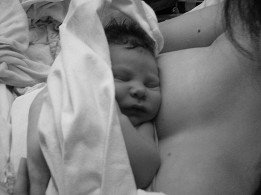
They cut the cord quicker than I hoped but I was so elated with the birth that I did not want to argue. I breastfed straight away and had some wonderful skin to skin while we waited for the placenta. I had asked for the injection as I thought this a safer option with a section scar but this seemed to make them rush slightly to get the placenta out because of the syntocin speeds up the closing of the cervix. When it did not come with a bit of tugging they eventually got a registrar in who confirmed that it was retained. I had to go into the theatre to have a spinal and have it removed. It adhered to the c section scar tissue which I believe is quite rare.
The retained placenta was unfortunate but it was handled well and calmly once discovered and I still had a good 2 hours of time with my baby and hubby before I had to go to theatre. Overall I felt so proud of my birth and after discussing it with my husband afterwards even more so as we both realised that I had actually done it DESPITE the maternity services rather than because of them. The excellent support and advice I received from my friend in early labour, the confidence my husband had in the knowledge that I had gained with regard to what was necessary and my ability to be very assertive throughout my time in the hospital were what got me my VBAC.
My Son was born by emergency c section. A surprisingly calm experience but one that left me feeling disappointed. I had prepared well for labour using relaxing techniques, raspberry leaf tea, pregnancy yoga, perrineal massage and lots of reading. I hurt my back at 38 weeks and this meant I was a lot less active than I would have liked. Baby’s head was engaged from 32 weeks though so I did not expect there to be any problems.
I had an unsuccessful sweep at 41 weeks and then I was persuaded to be induced at 41+5. I had the prostaglandin gel at 9.30pm and was then monitored lying on my back for an hour. I began getting period pains straight away and then was having contractions by 11pm. At 1pm I asked to be checked as I was struggling to cope (probably because I was all alone in the maternity ward in a small bay trying to stay quiet so as not to disturb the mums and babies in the same ward). I was not even dilating yet so I asked for pethadine to help me sleep. This did not help me sleep just made me woozy.
At 5am I asked to be checked again after spending 4 hours breathing through the contractions while kneeling over the head of my bed. I was 3-4cm and they said they would call hubby and I could go to labour and delivery. Once there I had some gas and air and was monitored again (what is this obsession with monitoring!) I stayed standing though so that I could lean forward on the bed to breathe through my contractions. Once my hubby arrived and they were happy with the monitor results I went into the pool.
Unfortunately (due to baby’s position apparently) I was very slow to progress further and I started getting the urge to push while only 5cm. This resulted in the cervix swelling and slowed things down. I was advised to have an epidural, this resulted in baby’s heart rate dropping and the decision was made that a section should be performed. They did say that I had by this point moved to 7cm but that I was not going to progress any further and baby was in distress. My c section was a calm experience but my baby was wrapped in a blanket with a hat on before I saw him and the epidural top up went too high so I could not feel my arms and struggled to breathe. This meant that I had to wait to go to recovery before I could hold my baby and although they put him on me skin to skin to feed I could not feel any of it. I did however have a very healthy baby boy and I did still bond very easily with my son and breastfed him until he was a year so I am very grateful for that.