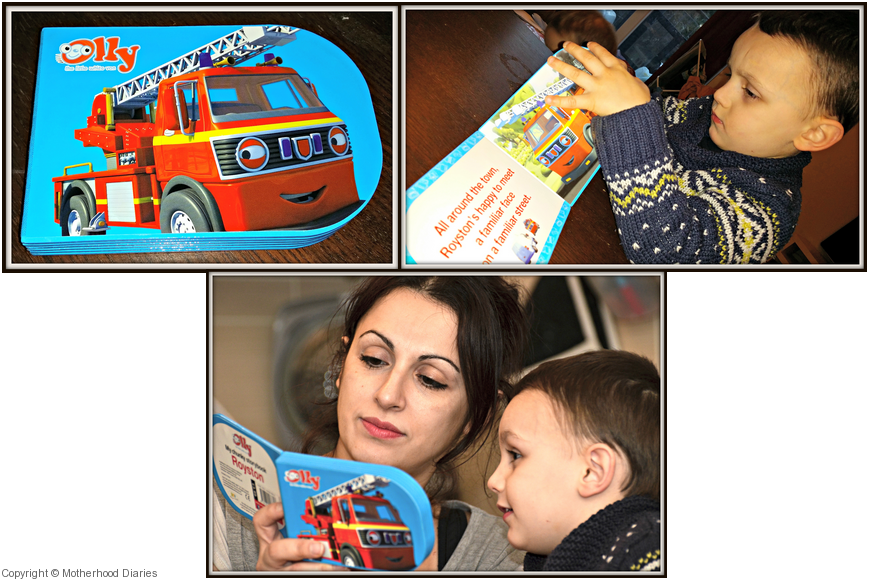
The benefits of your child learning to play an instrument
Motherhood Diaries is working in partnership with Yamaha Music London to bring you a feature series all about the importance of music in your child’s life. This feature series will include the following articles: (1) The benefits of your child learning to play an instrument (which is this article), (2) How to encourage your child to take an interest in learning music, (3) The link between music therapy and ADHD/anxiety, which will include encouraging your child to express their emotions through music (music therapy is something I relied on quite heavily growing up, as you will learn below), and (4) I will finish the series off with an extensive review of the Yamaha YDP-S34 Arius Digital Piano, which, I believe is the perfect companion to assist in your child’s piano lessons. I may add some bonus music theory lessons in the feature series too, as I had so much fun explaining the theory basics below.
So, let’s get started!
If you look around and listen, you will find music everywhere. It is in the shops when you are casually perusing the fashion aisles. It is on the soundtrack of your favourite films and it’s in your car when you’re driving to work. If you listen closely enough, it’s in nature – in the birds’ morning song, the howling gust of the wind, the pitter patter of the rain hitting the ground, and it’s in the fearsome clap of thunder. Music is unequivocally limitless in its offering to us beings – it can evoke all kinds of emotions, bring people together, and it can even make you smarter. If you dissect music, you need four out of your five senses to learn a musical instrument. So, why is music not at the forefront of our education? Of our children’s education? Why is its importance not in line with compulsory subjects like maths, English, and science? I have thought about this topic in great detail and it does make me wonder how many of us learned to play an instrument as a child. How many of us still play an instrument? And, how many of us have children who are learning to play an instrument right now?
If you answered yes to any of these questions, then great! You have enriched your life and of the lives around you. If you didn’t answer yes to any of the above questions, then you are missing out. I will tell you why in a moment or two. But, first I want to alert you to the current statistics.
In 2014, ABRSM (the UK’s largest music education body) published the most comprehensive survey of the learning, progression and teaching of musical instruments ever undertaken in the UK. The survey uncovered some very interesting statistics in that seven out of ten children (69%) in the UK say that they currently play a musical instrument. This figure, however, encompasses everything from playing simple percussion at a basic level to working towards your Grade 8 exam. The survey also found that the percentage of children claiming to know how to play an instrument had increased significantly, which is cause for celebration of course. But, more needs to be done to shake off this mentality that learning to play an instrument is preserved for the rich and middle class.
“Children from lower socioeconomic groups continue to be significantly disadvantaged compared with their peers from more affluent backgrounds.” ABSRM
This is most likely down to the growing cost of musical instruments and music lessons, as well as music exams and related resources. The truth is, learning to play an instrument is expensive and therefore we are inhibiting those who can’t afford to play an instrument from the magic of musical education. It can even be argued that children who suffer from external hardship probably need the healing powers of music more so than others.
So, why is music so important?
Music makes you smarter
Many scientific studies have shown that when children learn to play music, the parts of their brain that control their motor skills, i.e. hearing, storing audio information and memory, grow and become more active. In fact, music increases a child’s memory skills – it teaches them how to create, store and retrieve memories more effectively.
This relationship between learning an instrument and high intelligence has been around for a while, but how conclusive is this evidence?
“Life without playing music is inconceivable to me. I live my daydreams in music. I see my life in terms of music … I get most joy in life out of music.” Albert Einstein – a master violinist as well as a revolutionary physicist.
In this article, I will also talk about the ‘transfer effects’ of learning to play an instrument and its impact on a child’s intelligence. Before I proceed, however, I would like to provide you with some history of my own musical background first.
My long journey with music
During my early childhood at primary school, I was much like my seven-year-old son is right now – bouncing off the walls, highly energetic, happy-go-lucky and very bubbly. I would talk to anyone and everyone, which meant I was prone to distracting my peers as well as being easily distracted. My teachers were unable to control my energy and one of my teachers at parents evening even asked my mum “How do you handle her every day!?” In fact, the same teacher ‘informed’ my parents that she couldn’t see a future in me academically because of my inability to have both feet on the ground and to focus on anything in class.
I was seven.
My mum was, of course, mortified because she knew deep down that I wasn’t a naughty child, but that I was just very bored and understimulated, with a thirst for knowledge and social interaction. Unfortunately, unbeknownst to myself, my parents were unable to instil that message in me early on and I carried on getting into trouble at school. In hindsight, I may have had undiagnosed ADHD.
But, it was music that changed my life – quite literally.
My parents noticed my growing obsession for music from the age of three when I would jump up and down, and clap my hands to music on the TV, especially when I saw a violin. I was singing all the time and beating to an imaginary drum, which would constantly get me into trouble at school. I don’t remember doing this of course, but my parents had an inkling that there was some connection between my love for music and my unknown, untapped musical ability, and so I was thrown into violin lessons at school when I was eight years old. My then teacher (I’ll never forget her) Mrs Marshall, believed I had a talent for playing the violin and a few years later, with her help, I passed my Grade 5 Violin and Music Theory, both with distinction.
When I was thirteen, I passed my Grade 8 Violin with distinction, apparently not losing a single mark, despite thinking I did terribly in my sight reading. Mr Wookey, my high school violin teacher regularly used to say to me, “You sight read like a don,” but I never really understood the difficulty, perhaps because the skill came naturally to me. I’m not tooting my own horn, but merely stating that it was this positive acknowledgement from Mrs Marshall, my Grade 8 examination teacher and Mr Wookey that instilled in me this inner confidence that I didn’t know I had. Something inside me had changed – like a part of my brain had finally switched on. I was a lot calmer as a person, I became more focused on my goals and my head was no longer in the clouds. I also, surprisingly had fewer detentions/timeouts, as well as, much to my parents’ relief, fewer after-school meetings with my parents to discuss my misbehaviour. I had a new objective – to learn all the instruments in the world. I wanted to do more, so my parents enrolled me in a music school (Harrow School for Young Musicians) and with the Philharmonic Orchestra I was able to tour to different countries and play in the Royal Albert Hall and Royal Festival Hall. During my high school years, I led the school orchestra and string quartet, and I regularly participated in local and national events. I still had tons of energy, but I was channelling them all into orchestras, solo violin performances, singing and bands.
I ended up doing well in my GCSEs, breezing through my Music GCSE with an A*, and I felt that I had finally found my calling during my childhood years – it made me feel ten feet tall.
By the time I started uni (to study law), I had also picked up the piano, guitar, clarinet, and saxophone. I learned them all by myself, so I wasn’t great at them, or particularly skilful – I’m probably not even at a Grade 5 level – but it didn’t matter. I learned enough so that these instruments allowed me the opportunity to escape from the real world now and again – I could transfer my overflowing energy and strong emotions into playing music, much like how you use yoga to release tension in your muscles and find your inner chi. The music would flow through my bones, hit my core and I would feel centred – it felt amazing.
I’m now in my late thirties – I have two boys aged six and seven years old and, until I had kids, I didn’t realise exactly how beneficial music was to a child – not just the benefits, the FUNDAMENTAL IMPORTANCE that music has in a child’s overall well-being. You see, my eldest is going through EXACTLY the same problems as me – full of energy, getting distracted, and distracting people – it’s all one big déjà vu to me. Not just that, he sings all the time, and he pretends to play the piano, as well as beats to an imaginary drum. And, he even told me that he can hear music everywhere. So, I enrolled him (and my youngest) in piano lessons as early as possible and, within a few weeks, my eldest could play most of the songs in the beginner piano book. Plus, he picked up how to play the basic melody of Ed Sheeran’s Galway girl. He’s me but a few decades later and even though I have massively incorporated music into our home (I have two guitars, two violins and a piano sitting about), I still don’t see music at the forefront of their education. In fact, it’s hardly ever talked about. The waiting list at the kids’ school for violin and piano lessons is apparently one year long! So, I had to scour Facebook and ask many of my friends about how I could enrol my children in violin and piano lessons. And, now that my youngest has taken a deep interest in the drums and the guitar (I bought him a guitar and he never puts it down), I shall be enrolling him in guitar lessons too. Why? Because music is so much more important than you think for a child. And, frankly, I’d rather invest my money into music lessons than smartphones and TV screens.
Here are some of the very many benefits of children learning to play an instrument:
“Everything’s better when you add music”, Yamaha Music London
Benefits of learning to play a musical instrument
Music increases memory skills
Learning to play an instrument teaches a child how to create, store, process and retrieve memories more effectively. It is still uncertain why musicians have a long-term memory advantage, but it may be down to the training required to read music and visual cues with more proficiency.
Music improves coordination
Playing an instrument requires you to read music which is then converted in the brain to the physical movement of playing the instrument. When you’re playing in an orchestra, this coordination is further enhanced by following the conductor’s baton and listening to your fellow orchestra members to ensure you’re playing within the beat and in harmony with the rest of the instruments. If you’re a string musician like myself, you will know that there is an added nuance to this list – moving the bow in the same speed and direction as your group members.
Music increases your IQ
Music allows you to simultaneously utilise your creative right brain and logical left brain and, in fact, practising a musical instrument regularly engages in all your four brain hemispheres – and this synergy optimises your brain power.
Music teaches discipline, perseverance, and a sense of achievement
It’s not easy to pick up an instrument and play. There is a long and large learning curve, which takes time, patience, and practice. It takes discipline to progress and once your child starts to see an improvement, s/he will feel a sense of accomplishment and achievement, especially when playing in front of an audience.
Music improves concentration and attention
Many people listen to music when they are studying for their exams, driving a car, reading a book, or carrying out a task. These people claim that music helps them focus, despite needing to concentrate on two things at once. The reason for this is because the brain has two systems that work simultaneously with each other – your conscious and your subconscious. The latter is in its much simpler form, but it never switches off. As you are consciously focussing on a task, your subconscious is running in the background, scanning for anything important in your peripheral senses. The harder you find it to focus on your conscious task, the stronger your subconscious is working, picking up the sounds of the cars driving outside, people sipping at their coffee, or machines running in the background. This is why music works so well to focus your attention and concentration on the conscious task at hand. And, you can enhance this skill when playing an instrument. Playing music requires you to concentrate on the pitch, note duration, rhythm and quality of sound, all at the same time. Music engages the areas of the brain involved in paying attention, which is why, as mentioned above, I found it easier to focus and stay engaged in school as soon as I picked up an instrument. Playing an instrument is inspiring and motivating, so it becomes a transferable skill that mirrors the child’s behaviour and attitude towards the more mundane subjects like maths and science.
It would be interesting to find a study that has examined children’s attention spans in class when calming music is played in the background. I would be willing to bet that the majority of kids would find it easier to focus on their classwork if music drowned out all the other noises in the background.
Music improves maths, reading and comprehension skills
If you’ve read music before, you would know that music is just another form of mathematical equations. Without going too deep into the understanding of music theory (because then I would talk about it all day and this article would be over 10,000 words long), sight music can be dissected and further dissected into a series of rhythmic beats. I think the only way I can explain this is to show you in basic form below. (This should be fun!)
You start with your stave (these are the lines where your notes live)
The squiggly line on the left is a treble clef and signifies that the middle/base note in the scale is ‘Middle C,’ as shown below:
See how the MIddle C falls in line with the circle at the end of the treble clef?
The stave or staff is divided into bars, which correspond to how many beats there are in each bar. The image below shows the musician that there are four beats to every bar, i.e. you tap, 1, 2, 3, 4 and then you start a new bar, 1, 2, 3, 4 etc.
Now, let’s complicate this further by adding music.
The way it goes in music (generally 4/4 time like the above) is:
Crotchet (Quarter Note) = 1 beat
Minim (Half Note) = 2 beats
Semibreve (Whole Note) = 4 beats.
And, just to make things harder:
Quaver (Eighth Note) = ½ a beat
Semiquaver (Sixteenth Note) = ¼ of a beat.
I couldn’t find a suitable image to demonstrate what I meant, so I drew it. The notes signify Middle C as mentioned above.
Going up from a Semibreve, you also have a Breve (double Whole Note), a Long (Quadruple Whole Note) and a Large (Octuple Whole Note). Going down from a Semiquaver, you have a Demisemiquaver (Thirty-second Note), Hemidemisemiquaver (Sixty-fourth Note), a Semihemidemisemiquaver (Hundred twenty-eighth note) and a Demisemihemidemisemiquaver (Two Hundred fifty-sixth note).
You see my point about music being like maths?
Now try to play this (and the notes aren’t just middle C anymore – you have a whole scale of notes!):
This piece is taken from Cesar Franck’s Sonata in A Major, Allegro, 2nd Movement, which I played in a concert when I was 16 years old
By understanding the beats, rhythm, and scales, while playing an instrument, children are learning how to divide and create fractions, as well as recognise patterns and play along with the beat. Furthermore, learning and playing music requires constant reading and understanding of music. Children need to identify the notes and recognise in which pitch they need to play on their instrument, as well as how long to hold it, what finger to use and how loudly the note needs to be played. PLUS, with stringed instruments, such as the violin, viola, and cello, children need to focus additionally on their bow movements as well as their finger movements.
Music exposes you to cultural history
Children learn a variety of different music types, including classical, folk, gipsy and medieval, and they are taken through the history and evolution of music, as well as how music type changes around the world. The history of music is a whole new untapped world to a child – and it is so interesting too.
Music promotes and spreads happiness
Going back to what I said before about enriching your life and the lives of others, playing music is not only fun, but it also feels amazing when you have an audience hearing you create and play music with your instrument. When they applaud at a great performance, it can be very humbling and gratifying for a child who voluntarily plays for their community and spreads the music love to people as they listen to them play.
How can I encourage my child to pick up an instrument?
I will discuss this topic in more detail in my second article, but the first thing to do is to get an idea of what your child is into. When my children were very young, I used to play clips of all different types of instruments on YouTube and gauge their interest. At first, your child may pick them all, but the subtle differences over time will show in which instrument they share a kindred connection. For example, I always had a connection with my violin, I would go literally go nuts when I heard someone play the violin beautifully on the TV – and I was three! My youngest loves the guitar and drums and my eldest stops in his tracks when he hears piano music. If you are unsure where to start, Yamaha Music London is a fantastic retail store in the heart of London’s Soho that stocks an impressive array of instruments for your aspiring musician to discover and even try out. Yamaha Music London often holds events where expert music teachers will be at Yamaha Music London to help your child get started on their chosen instrument. You may even spot Tokio Myers, Jamie McCullum and Jools Holland, as they are ambassadors for Yamaha. I guarantee that your child will be wowed by all the instruments and music on display.
Music at home
Once your child has chosen their instrument, then it’s all about practice and perseverance. At first, it’s hard because your child will expect to know how to play their instrument from the offset, but it is important that they understand they are learning an entirely new skill, one that will shower them with rewards if they keep at it.
There are so many more benefits to learning an instrument, but if I listed them all then this article would become a novel. The bottom line is that music is a gift that should be learned and shared. Playing an instrument not only helps your child focus at school, but it will optimise their brain power, enhance their social intelligence, and allow them an outlet in which they can fully express their emotions in their own unique way.
In the next article, I will be going into further detail on how to encourage your child to pick up an instrument and take an interest in music.
Connect with Yamaha Music London and find out how you can get started on your child’s musical journey below:
Leyla is a UK mum of four, a writer and the founder of Motherhood Diaries, which she has edited since 2010. She has written about pregnancy, birth and family life for more than 15 years, edited NCT Harrow’s Special Delivery magazine, and is the author of several children’s and family books. She is also co-founder of Poppy, a new app helping UK parents find trusted local support, and presents Tech Talks Zone, a YouTube channel reviewing tech and AI tools for busy parents. Read Leyla’s story
When you’re planning to take up a new skill, you’ll find that there never really is a good time to start trying – like planning for a new baby. Either you can’t afford to spend money on resources, you don’t have enough time to put aside, your kids depend on you 24 hours a day, or you just don’t feel like starting at that moment for whatever reason.
I’m Turkish Cypriot by origin but born and raised in London, and my husband is Swiss. I can barely speak Turkish, but for the bulk of my life, I kept meaning to put aside some time to learn Turkish fluently. I, then, met my husband and decided that I wanted to learn Turkish, German, Swiss-German, Spanish and Italian. But I found myself using all the excuses under the sun to put off actually starting the process. Learning a language is no different to starting a new course or learning to play a new instrument. It takes motivation to start, drive to keep going and consistency and practice to improve. But, most of all it takes time, time which you need to be willing to sacrifice, even if it’s one hour a day.
So, when is the best time to start learning a language?
Really, the best time to start is, well, now. Schedule in small bite-sized chunks every day, or coordinate starting when you have a free pocket of time available, however rare that may be. And, if you can manage a long-term stint like pregnancy for nine months then you can certainly coordinate learning a language too. If you’re pregnant, first of all, congratulations! Now you can set aside learning a language in nine months, along with your pregnancy because, not only will you achieve a massive milestone like learning how to communicate in another language, but your baby will also learn the language with you as well! But, more on those benefits later…
Can I actually learn a language in nine months?
Benny Lewis in his article on ‘How to learn a language in hours, not years,’ stated that you have to be devoted to learning the language and expose yourself to that language at every opportunity. One of the key factors in being devoted to learning another language is to have a good reason to learn, so you stay motivated. Do you have family members who speak another language and you want to communicate with them (like me) or does your future career depend on learning that language? Whatever the key reason is for learning that language, it is important to stay motivated throughout and do as much as you can in that language as possible.
Immerse yourself in that language. Read the newspaper, watch TV or listen to the radio in that language. Keep a dictionary nearby, so if you don’t understand a certain word, make sure you look that word up and build your vocabulary whenever possible. Speaking to yourself in that language if you have no one to practice on is also a great way of practicing and, if you’re pregnant, you’re speaking to your baby who will also learn the language with you too!
You can learn a language remotely
You may be thinking, “How would I be able to travel to a language school to learn while I’m pregnant and/or have kids?” Thanks to the world of technology, there are many courses available online, so you can start right now in the comfort of your own home. If you’re interested in learning a language like Spanish, you can check out online language platforms like Maximo Nivel to learn Spanish online. There are other free resources online that you can subscribe to and receive emails every day. Hit up Google and get the ball rolling now.
Benefits of learning a language during pregnancy
As the baby grows in your belly, they can start to hear sounds from the outside world from as early as 23 weeks, with their mother’s voice and heart being the clearest sounds to them. If you live in a bilingual or multilingual family, your baby may already be growing with the ability to speak bilingually/multilingually too. This is because the baby is exposed to the languages in the womb. A US and Swedish study showed that newborns are already used to their mother’s language and show curiosity for other languages too. Exposing your prenatal baby to different languages affects the newborn’s brain sensibility and speech processing ability and in the last 10 weeks of pregnancy the prenatal baby is not just listening to their mother, but actually taking note of the words and learning them.
Even if you’re not pregnant
Then, I still encourage you to start. Learning a language is a massive skill and one that could provide you with dividends for the rest of your life. Just remember to remind yourself why you are learning because this is important to motivate you to carry on until the language clicks in your brain. Make realistic and specific goals. Breakdown your language goals that can be achievable over the nine months, so you’re not overwhelmed by how difficult you’re finding it or how much you need to learn. Focus on a number of resources that can submerge you into the language, like reading a book, watching a TV show or talking to someone else in that language. The quickest way to learn is to DO, so expose yourself at every opportunity.
I’m embarking on the road to learning Turkish so I can speak to my family in North Cyprus and I aim to become fluent in nine months!
What are your tips to learning a new language in months not years? Please share with us in the comments below.
Leyla is a UK mum of four, a writer and the founder of Motherhood Diaries, which she has edited since 2010. She has written about pregnancy, birth and family life for more than 15 years, edited NCT Harrow’s Special Delivery magazine, and is the author of several children’s and family books. She is also co-founder of Poppy, a new app helping UK parents find trusted local support, and presents Tech Talks Zone, a YouTube channel reviewing tech and AI tools for busy parents. Read Leyla’s story
Our health articles follow NHS guidance and aren’t a substitute for advice from your midwife, health visitor or GP.
Make learning fun with Math Bingo
Have you ever tried to explain long subtraction and addition to a 6-year-old (who is already good at maths by the way)? A certain glaze sweeps over their eyes and within minutes you’ve lost them to a faraway land somewhere in their brain. So, I am forever trying to think of fun ways to teach my boys topics from school that are both engaging and educational. Recently, I found out about Maths Bingo, which I now believe is one of the BEST ways to teach kids maths. At school, turning a chore into a game is a fantastic way to encourage class participation and keep the children’s attention for the entire class period. Teachers, parents and students alike find that the popular game of bingo is a fun and exciting way to learn math.
A Game Created with Learning in Mind
It might surprise you to know that educators in Germany created bingo more than 100 years ago to teach young learners how to first recognise numbers on sight. Later, as their education progressed, bingo was used as a teaching tool to help students understand how to add and subtract, learn multiplication tables, solve multiplication and division problems and other concepts and vocabulary associated with math.
Using Bingo Today
Since its creation, teachers around the world have continued to use the game of bingo to teach students mathematics at every level. Beginning even in pre-school all the way through elementary school, high school and beyond, students can have fun learning math by playing bingo. Starting with simple math problems and then working up through multiplication, division, and algebra, math bingo can help students feel more confident in solving problems by themselves or as part of a team.
How to Incorporate Math Bingo at home
You can easily create bingo cards in advance, which you can then print out. Or you can let the children create their own cards with paper, a marker and a ruler. Pre-printed math bingo cards are also available on educational suppliers online.
Child finds the solution to the math problem on the bingo card
To prepare for the game, you can either create the bingo cards yourself in advance or you can get the children to create the cards themselves. Make sure you have plenty of pencils, scratch paper or calculators for each child to use during the game. It is also a good idea to have few extra cards left over just in case and keep a bingo card template for future use.
To prepare for the game, write out all the math problems and their answers in advance. Decide whether you or your child would be the bingo caller. The designated bingo caller calls out the math problem so that they can be worked out by the child. The child then works out the problems either on paper or by using a calculator
The child will need about 20 or more bingo tokens to cover up the correct answers that appear on their cards. Some parents have used beans or pennies to serve as bingo tokens as well.
The correct answer to the problems as they are called may or may not appear on the cards. If the answer to a question is not on the bingo card for that problem, then a bingo marker doesn’t go down on their card. Either way, children will have to work out the problem to find out if they have the answer.
The winner of the math bingo game is determined when the child has five answers in a row in either a horizontal, vertical or diagonal pattern. As soon as the child believes they have five in a row, they should shout out, “Bingo!”
You may want to have a bingo game that makes use of other types of picture patterns or play blackout bingo until the squares of the entire card are covered.
Winners are finalised after all the answers that have been marked on the card are checked against the answers to the equations that the bingo caller has made. If there are incorrect answers, the game continues until a winner with the correct answer is determined.
Bingo is a game that has stood the test of time and is something that both kids and adults love to play. When using bingo to teach math, it can easily be tailored to fit all grade levels. For math-challenged children, the parent or an older sibling can act as a mentor and assist in solving the problems during the game. It is that kind of sibling or parental interaction and teamwork that can also help build math confidence in the long run.
If you have any other fun ways that you teach your children maths or any other school topic, please share with us in the comments below.
About Leyla Preston
Leyla is a UK mum of four, a writer and the founder of Motherhood Diaries, which she has edited since 2010. She has written about pregnancy, birth and family life for more than 15 years, edited NCT Harrow’s Special Delivery magazine, and is the author of several children’s and family books. She is also co-founder of Poppy, a new app helping UK parents find trusted local support, and presents Tech Talks Zone, a YouTube channel reviewing tech and AI tools for busy parents. Read Leyla’s story
Our health articles follow NHS guidance and aren’t a substitute for advice from your midwife, health visitor or GP.
Demystify code at the Institute of Imagination’s first ever ‘Lab Live – Recode’ exhibition
In this technological age of iPads and Smartphones, it is becoming increasingly difficult to engage our modern child with wooden building blocks or even pen and paper. While I still think the classic art of handwriting and physically turning the pages on a real book still has a large place in our current curriculum, I am noticing that to beat the system, you must join it. Schools are turning to handheld technical devices to create art and protractors are becoming a thing of the past. And, yes, I do believe that we parents should roll with the times, however, I do not think that we should say goodbye to the tools of yesteryear. Surely, the most important factor that we should all be concentrating on is engaging the child’s supersonic sponge of a mind through imagination and creativity, no matter whether they use electricity or core motor skills. So, when I heard about The Institute of Imagination, the world’s first hub for imagination, I was both thrilled and curious as to what this kind of event really meant. The Imagination Lab, which opened on 11th February 2017 was a cross between a community centre, a laboratory, a gallery, a science centre and a museum. Recode, its first ever exhibition, which offered an exhilarating day of dance, movement, crafting, engineering, numbers, language and demystifying code by asking children to recode, was truly one of a kind. Although, brand new in its innovative approach, the Institute of Imagination received dedicated support from a range of partners, including the Royal Academy of Dance, Makercart and Maths Explorers. Children from 5 – 12 years old were immersed in numerous opportunities to engage in a vast array of activities and really stretch their imagination to the max. Adults and children tested their words, symbols, sketching skills, movement and sound to rework, mix and share ideas on what code is and how it can be used.
The boys and I truly witnessed an amazing fusion of computer coding and dance, as well as coded languages through Morse code and finding our zen in the calm room. Here are just a few of the activities that we managed to immerse ourselves in at the Imagination Lab’s ‘Lab Live – Recode’ family festival on Saturday 11th February:
Design your own Denster
A Kickstarter project, launching on November 1st, Densters are a set of flexible toy monsters that attach onto furniture and allow children to build their own forts at home, unleashing their creativity through play. Each Denster is a character that also serves as a function in the house, for example, a bookmark, a door stopper, or a phone holder, but once they connect, they assemble to make a magical hideaway.
Each Denster has a unique method of grabbing onto furniture.
Cheekabook clamps on shelves and chairs
Hoopsta hooks around curtains and knobs
Snella sucks onto windows and walls
Wizetta curls around handles and rods
Grumpo tucks underneath doors or wardrobes
Zigzies clips onto bed sheets and blankets
Check out Densters in action and support their project here:
https://youtu.be/1vEa_87ILJY
The boys were introduced to the Densters at the Imagination Lab, by working on a fun activity of combining inanimate objects and animals to bring them to life. The boys were handed two piles of cards, one containing animals (domestic and wild) and the other containing everyday objects.
Aidan chose a tape measure as an object and snake as the animal and his Denster was called ‘SnakeTape”. Aron chose a computer mouse and a crocodile and he created ‘CrocSnakeMouse’.
Product designers are taught to treat objects like they are alive and this activity encouraged the children to stretch their imagination and treat the objects as if they were animals. It was great to see the boys thinking outside of the box and I do believe these kinds of projects should motivate children to treat their belongings with more care and creativity.
To find out more about Densters, visit their website here and follow them on Instagram.
Okido Drawbots
On the left-hand side of the entrance, we could see a bunch of pens bundled together in a tripod-like stance, circling around a long piece of paper and creating pretty circular designs. The boys were quite intrigued and wanted to take a closer look. They couldn’t quite work out how the pens were moving because they knew that pens generally are inanimate and can only be used for colouring. Upon closer inspection, the pens were attached with a rubber band to a little battery-powered hexbug to create the ‘draw-bot’ (by Okido). The vibration of the hexbug moved the drawbot and if you spaced the pens differently, the drawbot could draw straight lines too!
If you want to try making this at home, follow the instructions below to make your own Draw-bot.
What you will need
Three pens
Blu-tack
Elastic band
A big piece of paper
A hexbug
Squeeze the pens onto the blu-tack to make a tripod
Use the elastic band to hold them together
Attach the hexbug with a small piece of blu-tack, and turn it on!
Okido is a bi-monthly Arts & Science Magazine for children aged 3 to 8 years old that includes stories, games, doodles, recipes and poems.
Visit their website here for more information on subscribing to their magazine. Don’t forget to check out their Facebook page for updates on their innovative creations!
Ozobots
Aidan saw a tiny little light moving on a table nearby and was intrigued as to what this light could be. These little glowing and moving lights were, in fact, tiny little robots called Ozobots, which were travelling around on what looked like little road maps with blue, red and green squares. These roadmaps were coded little pathways for the Ozobots to travel around. I had no idea how these little roads worked, but the boys were shown how to calibrate these circuits either via a smartphone or a tablet. So, a representative handed them some pens and off they went drawing circuits for their little Ozobots.
Ozobots are programmed little robots which follow a circuit that you draw with a black marker pen on a piece of paper. The fun part is that you can control the Ozobot by adding additional coding, which would be represented by the different colours, i.e. green, blue or red. You can find out more here http://ozobot.com/ or via their Twitter, Facebook, YouTube or Instagram pages.
Aidan is a huge fan of fixing things. He’s not fussy as to what thing he is fixing, as long as he gets to use a screwdriver. So, when we happened upon the Restart Project’s table, where their ultimate objective is to encourage people to fix electronics rather than throw them away when they break down, Aidan was very interested in learning more. Thankfully, a representative had a broken computer DVD drive that needed fixing and Aidan got to work straight away, spending an age unscrewing all the tiny screws and prying the top open. He was given a brief overview of everything inside the DVD drive, including how each part works and what was wrong with it (although, I wasn’t too sure what that reason was). After the overview, Aidan proceeded to screw everything back on with patience and a certain calmness that I can only be proud of. My dad (a self-employed design engineer and consultant) has always said that Aidan has the patience of an engineer, so I will be watching this space very closely from now on!
The Restart Code’s aim is to encourage people to fix their relationship with electronics and make devices last longer. If you’d like to learn more, they regularly hold meetings, which you can find out more about here or you can visit their website to learn more.
“Don’t’ despair, just repair!” #RestartParty
Maths Dance and the Royal Academy of Dance
We got to witness some interactive dance workshops and movement games with the Royal Academy of Dance and Maths Dance, where children were encouraged to draw what they were feeling when they watched the dance in front of them.
I thought this was a great idea to tap into your inner creativity and draw what comes from the heart when you’re seeing beautiful dance in motion. However, the boys were less interested in watching the dance and more into what they were drawing in front of them. Aron did draw a beautiful tree, but I am not too sure whether this tree was dance-inspired…
The Calm Room
Just before heading off to lunch, Aron and I spotted a little yellow den called The Calm Room and, as we’re both generally quite calm people (ish), we thought we’d find our zen a bit before finding something to eat. I was half expecting Aron to jump up and down, not sit still or tell me that he was bored. But, in fact, he did quite the opposite.
A curly haired woman sat cross-legged and very still, as she placed a finger to her lips to signify that no one speaks in the Calm Room. She motioned for Aron and two other children to sit in the same way, i.e. cross-legged, and close their eyes, which they all faithfully did very well. The lady picked up some chimes and clanged them together to make a resounding sound which lingered in the air. I decided to join in as she passed the chimes around so that each could reproduce that same echo sound. Again, Aron repeated her movements with concentration. She went on to ring the bell behind her and then glide an instrument around a bowl which made the softest sound. She motioned for the children to do the same. She put all the instruments away and sat very still and quiet as we stared at her, listening to the soft meditation sounds coming from the nearby speaker. I was watching Aron closing his eyes and sitting as still as the lady and I was blown away by his inner zen. He, indeed, had bundles of zen and when the lady reopened her eyes, she smiled at Aron and ran a very affectionate hand through his hair. I think she was as impressed as me that he had sat so still, repeating all the calming motions so well. This prompted me to start thinking about a zen corner for Aron at home because I think that this calm would make all the difference to his frequent troubles with getting to sleep at night, due to his over-active imagination. To say I was proud, was an understatement. After about ten minutes, we quietly left the room and we were calm.
Lunchtime
All that fun work of coding, designing, moving and sketching had worked up a huge appetite, so we found a place to sit at the back of the large hall, whilst I grabbed some much-needed coffees for hubby and me, and juice for the boys. We also bagged some pretty delicious looking crepes from a very hard-working and lovely man called Kaz from Heavenly Crepes, who worked tirelessly to provide us (and 600 other visitors!) with delicious crepes (I was very tempted to buy the fruit version or the Nutella crepes, but, as we still had quite a bit of the exhibition to see, I didn’t want the boys to suffer from a sugar crash and then get tired and irritable. The cheese and tomato crepes were just as good, though.
While hubby and I were catching our breaths back after a mentally exhausting and exhilarating morning of learning all about code, the boys were working off their crepes in the corner of the room, with a very engaging SEN activity, which was simply aiming a ball at the interchangeable lights on a custom-made wall. I overheard that this particular activity is used for children with special needs because it supports their learning. This ball to light activity was unanimously the boys’ favourite game at the exhibition.
Maths Explorers
Fuelled up after lunch and eager to learn more, we headed over to a rather large section of the exhibition that was dedicated to maths. Both of my boys like numbers and I’m pretty sure that they would choose numbers over letters if they had the chance. So, I was very interested in learning more about Maths Explorers, where the club encourages children to learn all about maths through inventing dance/movement and number coding. Aron took a particular interest to this, as he caught on quite quickly to the idea of using a square that was numbered with, ‘1’, ‘2’, ‘3’ and ‘4’ in each corner, to work out addition and subtraction problems. A very bright and energetic Maths Explorer representative asked Aron to make ‘6’ using 2 of the numbers on the square and then make the same number using 3 and then 4 of the numbers. After about 5 minutes, Aron had all hands and feet sprawled on the floor in an attempt to use all his limbs to make a total of ’10’.
Hubby was even roped into also creating numbers, this time through dance and movement, and both boys really enjoyed seeing him prancing around and forming numbers with his body.
I think the idea of using movement to understand basic math is a brilliant idea to encourage children who may not be as interested in maths and tap into their creative side to understand the basic rules of addition and subtraction. As the boys already enjoy maths anyway, these extra ideas were just bonus points into working on what they already love doing. However, I can totally understand how Maths Explorers can bring out those maybe less confident to give it a shot and understand maths in a much more creative way. If you’d like to find out more, you can email Maths Explorers at maths.explorers@gmail.com and schools can also register their interest in using Maths Explorers in addition to the current maths curriculum.
Code club
We didn’t manage to attend the several workshop areas that the Code Club were hosting, for example, their Lost in Space project, which offered children the chance to learn how to program their own animation using Scratch software and create a spaceship which they could control, as well as include additional galaxy components, like the earth and stars. However, the boys did get to spend quite a bit of time on the ‘Synchronised Aliens Dancing’ project by the Code Club, where they created aliens out of play-doh and Plasticine and used them as controllers to code the alien to perform a dance routine on the computer.
How it works:
You make 5 mini aliens out of play-doh or Plasticine to use as the controller
Connect the computer using a program called Makey. Connect each alien to Up, Down, Right, Left, and Space.
Write Scratch write code to perform a synchronised dance routine. You can code the alien to draw colourful patterns. For the finishing touch, you can add music too.
Finally, watch the alien clones as they perform their colourful synchronised dancing routine
The Code Club is a nationwide network of volunteer-led after-school coding clubs for children aged 9 to 11 years old. For more information, please visit their website www.codeclub.org.uk, or get in touch with the team at hello@codeclub.org.uk.
Hackadoodle
Apart from the lunchtime ball-to-wall SEN activity, the boys spent most of their time in the Hackadoodle section, created by a brilliantly quirky man, Sam Cox, A.K.A. ‘The Doodle Man’, who encourages you to ‘hack’ doodles with your own ideas. The Hackadoodle workshop area was covered by black and white doodle designs, inviting adults and children to come along and hack his doodles with some colour, by creating characters, giving them eyes and teeth, filling in empty windows and cars, designing smaller doodle worlds, and literally bringing art to life. I noticed a lot of adults were joining in too and there was something very therapeutic about sitting down and creating doodle art. If you want to learn more about The Doodle Man, he has an awesome documentary on his website, which contains a fantastic story about being kicked out of this world due to his doodles and landing in his own world, Doodle Land. His evil brother fought The Doodle Man and kicked him out and so he is now trying to find a way to get back to Doodle Land.
The Doodle Man’s designs are so intricate and wonderful that I will definitely be looking into hiring Sam Cox to create a Doodle Wall in my children’s bedroom very soon!
Shattered Glass to Chandelier – Poetry Bucket
Just before finishing up, we noticed a poetry area, which was all about picking 1 word from the 4 words provided on the table (‘code’, ‘data’, ‘game’ and ‘play’) and finding 3 rhyming words to make a poem. We had learned so much about numbers and maths at this exhibition that I thought it would make a nice change to get creative with words too. The Poetry Bucket, by Shattered Glass to Chandelier, is not just a play on words, but its sole purpose is to eliminate discrimination and challenge negative ‘Attitudes and Values,’ ‘Recycling and Educating’, and ‘Equipping and Empowering’, with what the founder, Meshack Pond, calls Communication ‘Survival-Skills’. Meshack’s communication survival-skills have helped him navigate his own countless challenges and his aim now is to demonstrate how to translate those negatives into positives through Shattered Glass to Chandelier (beautiful name). Watch this space, as I will be looking to work more with him to help spread the support via Motherhood Diaries too.
Vivid Matcha green tea – make your own juice
Our very last activity was spotted by accident when we were sat at the HackaDoodle table. We gazing through a nearby window, where we saw a young woman combining juice from 3 cartons to create one super juice. I was interested in learning more about what was going on at her table, so I took the boys over and she beckoned for them both to sit down. The aim of this activity was to create your own Vivid Drink. This juice project, hosted by VIVID Matcha Green Tea, was all about creating a juice that encourages your mind to be focused and full of energy but, also, to take it one step further and think about its packaging and brand name. So, this activity got the boys thinking about the marketing and design process around the juice brand that they were creating and not just about how it tasted. It was a very basic introduction into the world of manufacturing and marketing and so I was 100% on board, as these areas are most likely going to grow exponentially, as we delve further into the technological and digital side of marketing.
How it works:
Part 1: Flavour design
Start with a base flavour – 125ml
Choose a juice or water that would work with a lot of flavours and acts as a good base
Grape
Coconut
Sparkling Water
Apple
Add your main flavour – 75ml
Choose your main flavour of juice. Think about what will stand out and work well with your base flavour
Blueberry
Pineapple
Cranberry
Put a flavour twist on your drink – 25ml
Give your drink an interesting twist
Pear
Mango
Pink Grapefruit
Pomegranate
Part 2: Branding
Decide on a brand name and design your packaging. Use coloured pens and design a logo for your bottle.
Aron’s juice drink combined mango, grape and apple to make his new brand of juice, ‘Relax Fruit’.
Aidan’s final drink contained mango, grape and apple (which was a little different to the instructions that were set out) and he named his drink ‘AppleFlash’.
After downing their bottles of juice, the boys and I decided that it was time to go home. It was nearing around 4 pm and we were all shattered. We had used our brains so much that we could not fit in anymore. There was so much to see at the Imagination lab that we didn’t even make our way around all the workshops.
All children were invited to vote for their favourite art concept for the new interactive installation that the Institute of Imagination has commissioned in partnership with ICF International Charitable Foundation. The three shortlisted creators were Shawn Brown, the art group from London Brain Project and Jim Bond.
What we had seen at this exhibition was truly mind blowing. I had learned so much myself about coding and just how important it is to get the children to think about their methods and explore other ways of getting to their solutions. My favourite part of the exhibition was the Calm Room because I got to see a totally different side of Aron, one I had never seen before. Since that day, we have been playing yoga and meditation music to help Aron to get to sleep and it has worked simply wonders on him.
The Institute of Imagination constantly update their website with new events, so please make sure you keep an eye out for these. To find out more about the Institute of Imagination and to attend one of their events, make sure to visit their website here and follow them closely via Twitter, Instagram, and Facebook. Events generally take place in a dedicated Imagination Lab space over a morning or an afternoon.
The Institute of Imagination’s next event is on 1 May and the next theme is ‘reality’. The event is promising to be filled with lots of virtual and augmented reality activities, so I thoroughly recommend that you and your family attend.
We are the ones holding the keys to our children’s future, so let our forthcoming generation be filled with imagination, creativity and education, for I believe these three very important factors are what puts us back on track to making the world a better, smarter and more inspirational place for the generation of our future.
#labliverecode
*Disclaimer: Motherhood Diaries and family were gifted tickets to attend probably one of the greatest events we have ever witnessed for the children. All views are 100% my own and if I could write 3,000 more words about the Institute of Imagination, I would! *
*Photos by Tomas Preston Photography *
About Leyla Preston
Leyla is a UK mum of four, a writer and the founder of Motherhood Diaries, which she has edited since 2010. She has written about pregnancy, birth and family life for more than 15 years, edited NCT Harrow’s Special Delivery magazine, and is the author of several children’s and family books. She is also co-founder of Poppy, a new app helping UK parents find trusted local support, and presents Tech Talks Zone, a YouTube channel reviewing tech and AI tools for busy parents. Read Leyla’s story
Our health articles follow NHS guidance and aren’t a substitute for advice from your midwife, health visitor or GP.
NCC Home Learning Nutrition and Health QCF Award Level 2 Overview
Ad · This is a paid collaborative post. Links to the partner are sponsored.
Back in the day, when the internet had not been invented yet and being accepted into university was only held for the crème of the crop, it was nigh on impossible for stay-at-home parents or those without wealth to study and build on their CV in their own time. Nowadays, distance learning and home learning courses (recognised and accepted, free or paid), are now readily available for anyone to study in the comfort of their own home, to better their chances of finding work or building on their qualifications. NCC Home Learning provides that flexibility and knowledge in order for Joe or Jane Bloggs to do this.
I was offered the chance to review the NCC Nutrition and Health QCF (NVQ) Level 2 course so I could build on my knowledge of food (my passion) and understand the connection between weight gain and the link to emotional eating. The QCF course, which has now replaced the NVQ qualification, is all about understanding the differences between normal weight, overweight and obesity, and the connection we build between food and our feelings.
Who are NCC Home Learning?
NCC Home Learning is a complete resource for NCC online courses. There are hundreds of NCC resources and home study courses to choose from, whether you are looking to top up your qualifications or embark upon a new career, NCC should have the right course for you. They boast a vast selection of over 350 distance learning courses at home which are accredited by various awarding bodies such as NCFE, 1CB, SAGE, and Ascentis. NCC also offer student support and course tutor phone calls if you require any help or advice during the course. Their homepage provides a link for you to choose your course via industry here.
So, what is the NCC Nutrition and Health QCF Level 2 course about?
“With obesity on the rise and the Foresight Study predicting that by 2050 60% of men, 50% of women and 25% of children will be obese; the time to make a change is NOW and this accredited qualification can help you to achieve that. In one compact course, you can respond to the rising level of obesity across adults and children, and prevent the expected expenditure of £45 billion a year (in 2050) on care, missed working hours and ill-health.
Instead, with only a basic knowledge of this subject, you can almost immediately begin improving the health and well-being of your friends, loved ones and yourself, and most importantly have the chance to add an approved qualification to your CV that will make you stand out from the crowd.” NCC Home Learning
The NCC NCFE Level 2 Nutrition and Health course (QCF) is specific to the UK and tackles problems the NHS has with rectifying the obesity epidemic that is on the rise. (i.e. the proportion of obese adults between 1993 and 2010 had increased from 13.2% to 24.4% among men and 6.4% to 25.1% among women.
The course is split into three concise units and can be completed at your own pace over the course of twelve months. It comes with the full support of a qualified tutor, who will guide you through the entire process, whether you complete it online or by paper.
The course details are:
Qualification Title: NCFE Level 2 Award in Nutrition and Health (QCF) Qualification Number: 501/0038/5 Total Credits: 12
Price: £210.00 (reduced from £280.00)
Course duration: 120 hours
A brief overview of how to navigate the course
You will be provided details of the NCC Home Learning login for your course via email. Once you log in you will be taken to your dashboard and on the left-hand side, you have a folder tree, which allows you to navigate through the course modules.
The course contains 15 modules and an exam at the end to test your knowledge. Each module plunges you straight into a PDF of ‘underpinning knowledge’, which you can download and save to your desktop. Be sure to read the User Guide for all students at the introduction of the course, as it takes you through how to get started, how to access the course with ease, and how to log in and actually go through the course itself. You must read and understand all modules before passing the exam and unlock the course completion certificate.
The NCC Home Learning course website helps those who are unable to attend college or university to build on their CV
With tons of NCC remote classes to choose from, arranged by industry, career, interest, experience and course type, it’s really easy to search for a course from NCC learning you’re really passionate about and build on your knowledge. I would definitely recommend signing up and choosing your course, whether it’s an entry-level teaching assistant or a care diploma level at home course. NCC classes broaden the NCC learning pool and will help you either in your current job, to find a new job or start that business you’ve always been meaning to start. Contact NCC Home Learning directly if you have any questions or require more information on their at-home learning courses.
FAQ
Is NCC Home Learning legitimate?
Another question asked was, ‘Is NCC Home Learning accredited?’
NCC Home Learning is an award-winning education provider with over twenty years experience offering distance learning courses from home. To date, they have delivered training to over half a million learners worldwide.
The NCC certificates offer proof of completion of your NCC courses which you can provide either at the job you’re applying or as proof of expertise in your business or current employment.
How has NCC changed your life?
I’ve applied what I’ve learned in the nutrition at home courses to daily life, making changes to our diet and lifestyle so that we can live our best life as a family.
How do you feel about NCC Home Learning?
NCC Home Learning allows everyone to build on their most important assets – themselves. So I absolutely back NCC Home Learning as a great way for parents to build on their qualifications around their kids so they have a chance against others in vying for that desired hobby/job/role/business.
How does your home study environment and your study habits affect your productivity?
You need to know how and when you like to revise. Everyone is different. For example, I like to get up before anyone else in the morning and write out my task list. If you’re a visual person, you’ll want to stick to bright, colourful text, illustrations and videos/images to help you study. If you prefer to revise audibly then you can use a text to speech software like Word to read out the content in the course. Work out how you want to revise then trial and error until you hit your sweet spot.
*Collaborative feature post*
About Leyla Preston
Leyla is a UK mum of four, a writer and the founder of Motherhood Diaries, which she has edited since 2010. She has written about pregnancy, birth and family life for more than 15 years, edited NCT Harrow’s Special Delivery magazine, and is the author of several children’s and family books. She is also co-founder of Poppy, a new app helping UK parents find trusted local support, and presents Tech Talks Zone, a YouTube channel reviewing tech and AI tools for busy parents. Read Leyla’s story
Our health articles follow NHS guidance and aren’t a substitute for advice from your midwife, health visitor or GP.
Olly the White Van Book Series Product Review
Olly the Little White Van’s Website:
http://www.ollythelittlewhitevan.co.uk
What is Olly the Little White Van all about?
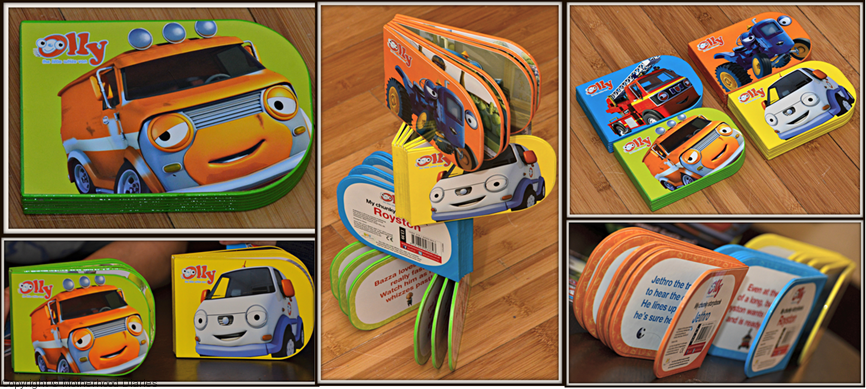
Olly the Little White Van is a pre-school TV show that currently airs on Milkshake and is 100% written, designed and animated in the UK. Olly and his friends have brought out a number of books, which are suitable for children aged 1 year plus and cater towards pre-school children’s practical, logic and problem solving skills.
How much does each book cost?
Chunky Story Books – RRP £3.99
Story Books – RRP £3.99
Press-out Sticker & Activity Fun Books – RRP £4.99
Sticker & Colouring Fun Books – RRP £3.99
Where can you buy Olly and the Little White Van books?
All of us were very excited to receive all of the Olly and the Little White Van’s books in the series and we couldn’t wait to get stuck in and try them all out.
Chunky Story Books – RRP £3.99
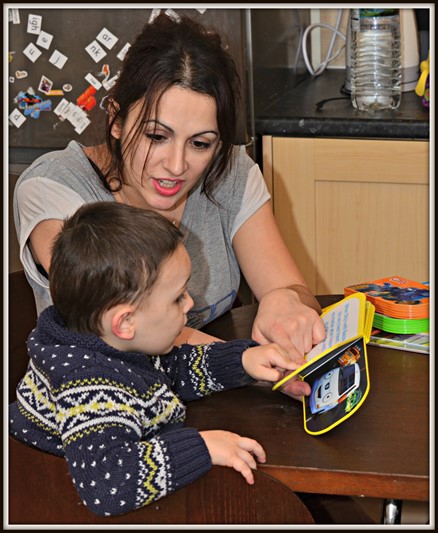
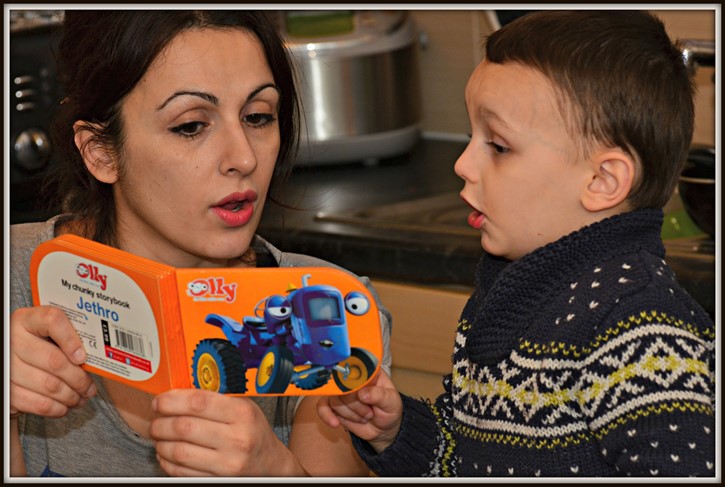
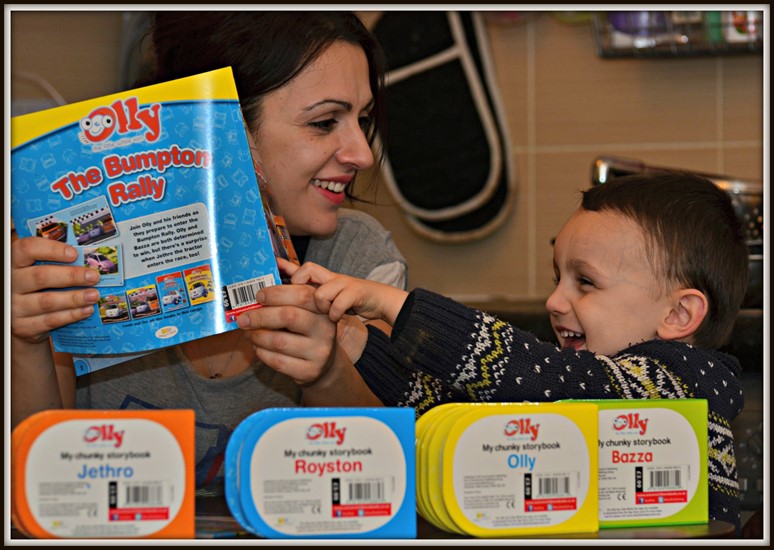
The chunky story books were the boys’ favourite from the get go, simply because they are small, sturdy and easy to handle. Each of the chunky board books of Olly and his friends have painted edges and are perfect for little hands from 1 year old and up.
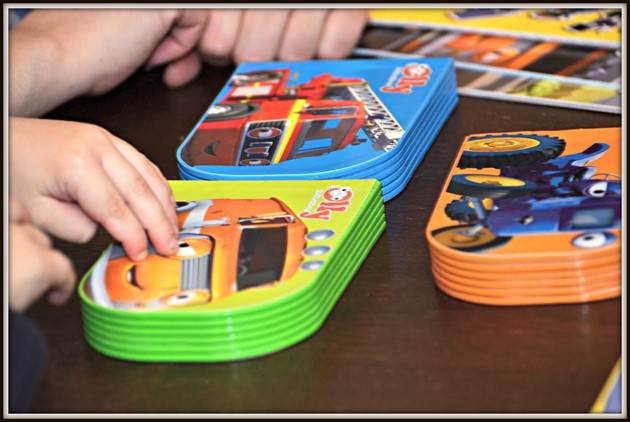
There are 4 books in the Chunky Story Books series, all related to Olly and his friends, who are Bazza, Royston and Jethro. Aron’s favourite was Olly, the main character, and Aidan’s favourite was Bazza, Olly’s best friend.
Olly
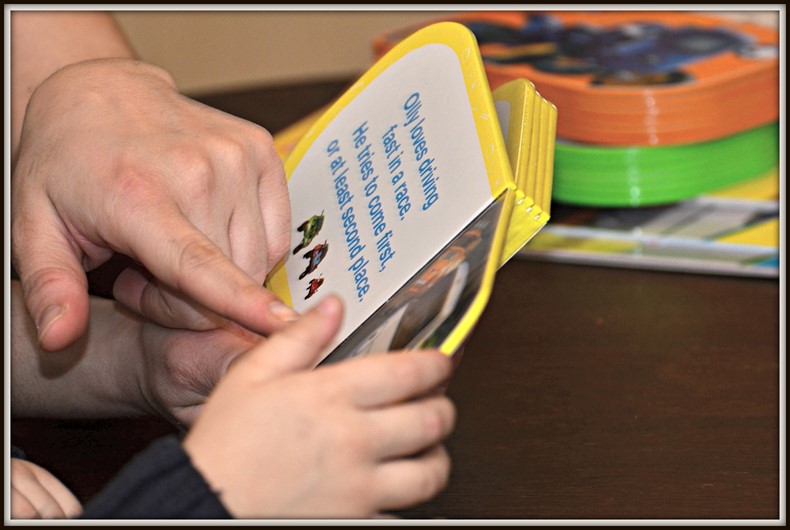
Olly, the main character in the whole series, is a friendly white van who loves to help whenever he can. He likes to have fun with his driver, Stan, and his favourite game is football. When he scores, the crowd cheers Olly’s name. When Olly is with his best friend, Bazza, everything is always ok in the end, no matter what happens. Olly is a keen racer and loves to drive very fast, so that he can come first, or at least second place.
Bazza
Bazza, the orange van, likes to get into trouble whenever he can. But, sometimes his cheeky tricks can land him into trouble. At the Bumpton Rally, Bazza ends up in squelchy mud, but Olly, his best friend, never lets him down and manages to break him free. (I can see why Aidan loves Bazza the best – their personalities are very similar!)
Royston
When Bumpton needs help, they always call Royston the fire engine because no job is too small for him. Royston is happy to meet a familiar face on a familiar street and if there’s a fire to put out or a cat up a tree, Royston is at the rescue! He likes to turn on his siren really loud when he’s racing around Bumpton town and even at the end of a long, busy day, Royston still wants to have fun and play.
Jethro
Jethro the tractor likes to take everything slow because, ‘Speed isn’t everything, you know!’ Jethro is big, blue and strong and always helps his friends when things go wrong. Jethro likes to look at art and he is just as smart as he is friendly. He also likes to watch birds fly and hear the crowd roar as he lines up his football, so he’s sure he can score.
Each chunky book has an easily digestible poem that the boys really loved. The words are simple, yet effective because the story behind each book gets to the point very quickly and paints a great picture of each character in the series. When reading these books again and again to the boys, they remembered the words that came next. Even Aidan, who is one month shy of 2, remembered which word came next before I read them. It’s a very clever way to engage the kids and get a feel of the character’s personality. I can easily understand why these books were the boys’ favourite.
Story Books
The Chauffer
In the story books, you get to delve deeper into the character’s lives and meet all the secondary characters in the series, like Stan, who is Olly’s driver, and Lisa the Limousine. The book talks about a very special day, Alice’s birthday (Stan’s wife), and Stan has booked Lisa the Limousine to take them out for a special birthday dinner. Olly is very excited to see Lisa drive up to the house, but Lisa’s car phone rings and Sir Ronald Grump informs her that she has been double-booked that day. She is supposed to pick up Sir Ronald Grump at the station and drive him to an important meeting. Olly is always around to lend a helping hand and offers to take Sir Ronald Grump to the meeting, so that Lisa can drive Stan and Alice to the restaurant as planned.
Sir Ronald Grump is a real grump and is waits impatiently for Lisa the Limousine to arrive, instead he finds Olly coming to pick him up.
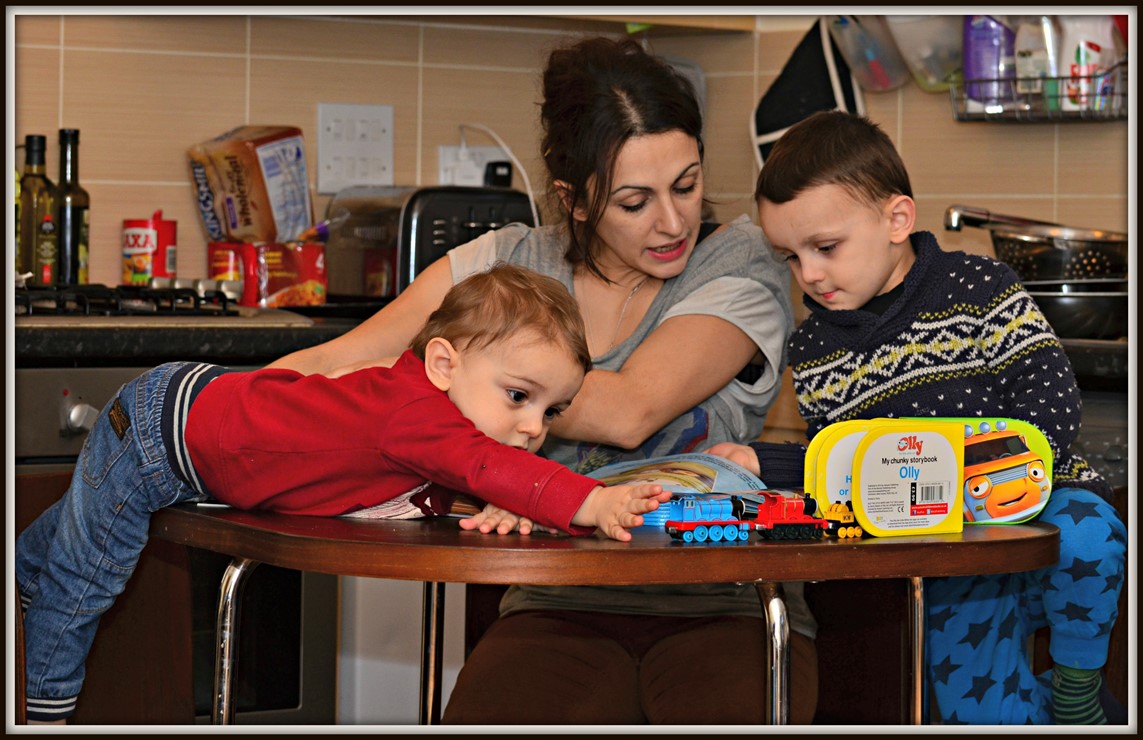
‘He’s very cross!’ Aron exclaims. (Aidan at this point, loses interest and reaches out for his trains on our dining table!)
Olly works hard to impress Sir Ronald Grump, but Sir Ronald is only interested in getting to the Grump Tower in twenty minutes. So Olly drives as fast as he can, but they are stopped by a traffic jam.
Do they make it to the meeting on time? It’s up to you to find out!
Aron really enjoyed ‘The Chauffer’ book. He was eagerly waiting to find out whether Sir Ronald Grump made it to his meeting on time and impatiently turned the pages as I was reading them to find out. The illustrations in the book tell a lot of the story, so Aron understood what was going on very well. He even had a go at reading some of the words. Aidan, on the other hand, knew what was going to happen and lost interest. One step ahead…
The Bumpton Rally
The Bumpton Rally talks about the annual town race in Bumpton. Olly and his driver, Stan, are preparing to take part. Olly’s friend, Bazza, is also taking part and doesn’t hide the fact that he’s there to win the race, even though the annual Bumpton Rally is really just a bit of fun. Bazza and Olly banter with each other at who’s faster than who whilst all the vehicles make their way to the start line to get ready to start the race. Other drivers taking part are Tasha, Dirk and, surprisingly Jethro, who believes his slow and steady pace will win the race. The race starts and there are a lot of bumps on the road for the drivers. A sudden twist in the story causes some of the drivers to run into problems.
But, who comes first?
The Bumpton Rally was Aidan’s favourite story book because it involved a lot of fast cars racing against each other. Aron enjoyed the book too, but I could tell he was just biding his time, so that he could get me to read the 4 chunky story books again.
Again, the illustrations tell the story as much as the words, so both boys really enjoyed flicking through the pages and studying the pictures as I was reading to them. It’s a really fun story and it contains a lot of hidden morals, which teach the boys that being fast and strong may not always be the answer, but to think with your head and keep at a steady pace, can win you the race in the long run. (Did I just give the story away?)
Press-out Sticker & Activity Fun Book
The Press-out Sticker & Activity Fun Book is a fantastic educational book catered towards pre-school children, so Aron was the perfect age to give everything a go in the book.
There are a number of activities in the book, such as:
Odd one out (Spot which picture is the odd one out)
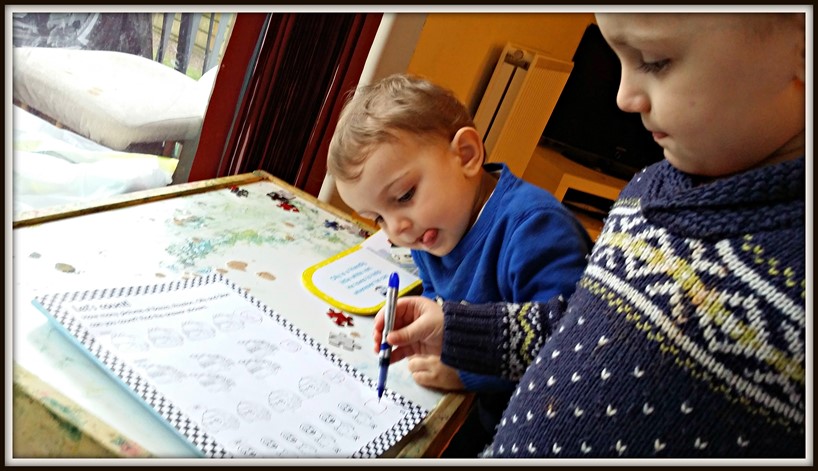
Let’s count! (where you have to count how many pictures of each character are on the page and find the answer stickers (Aron preferred to write the numbers instead, as you can see from the picture below)
Sticker Fun! (Find the stickers appended to the book and place them on the correct images to complete the picture (Aron got all of these right straight away, but it was a lot of fun helping him go through every sticker and eliminating the incorrect ones first).
Double Trouble! (Spot how many different pairs of pictures you can see, for which there is an answer sticker for. Aron, again, preferred to write the number instead and I didn’t want to stop him, as he has only just started using a pen and I wanted him to practice writing his numbers.)
Colouring fun! (A double page of characters in the series for you to have fun colouring in.)
Jolly Olly! (Perfect for practicing motor skills – join all the dots around the pictures and then find the stickers to match.)
A board game and pieces to press out (Aron wasn’t at all interested in trying this out, but I assume it’s because he is too young and didn’t understand the point of the game.)
Spot the difference (where you have to find all five differences between two almost identical pictures)
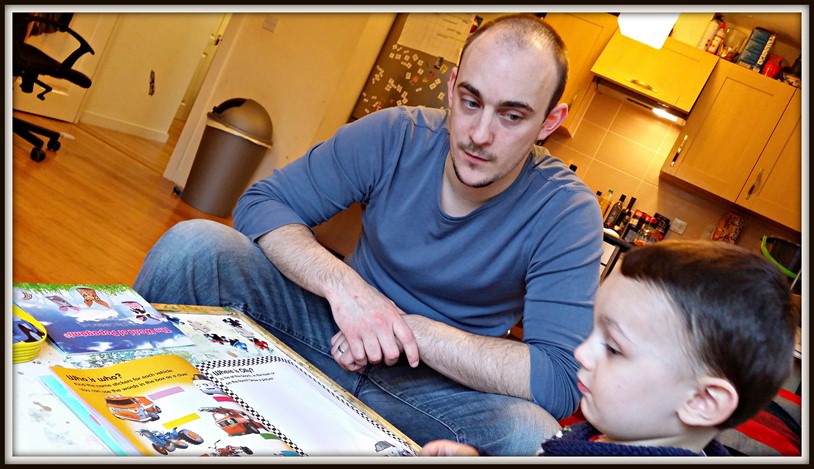
Who is who? (Find the name stickers for each vehicle (I was really surprised and impressed that Aron could spot the correct word for each picture. The activities in this book forced him to have to read the character’s names in order to complete the activity and he remembered the names for this particular activity.)
Where is Olly? (This is a blank page where you can choose to draw Olly at the beach, in the town or on the farm. Aron didn’t attempt this at all, but he hasn’t started drawing yet, so I will patiently wait until he’s more confident in his drawing skills and attempt this activity with him again).
Who wins the race? (Where you need to follow the lines to match the driver to the correct place they came in the race and find the stickers that correspond to the number. Aron correctly used his pen to follow the lines to the drivers’ correct places, but, again, refused to find the stickers and instead write the numbers down with his pen. Not complaining!)
Copy and colour (Use the grid below the picture of Olly, which is drawn on an identical grid, as a guide to draw your own picture of the character. Aron didn’t attempt this at all, but I believe he will arrive at this drawing stage in his own time.)
Wordsearch! (Find all the names listed in the wordsearch grid given. I had to help Aron with this as he’s only just started reading and found it very difficult to distinguish words from the jumble of letters in the grid. Admittedly, I ended up completing the wordsearch myself because it was fun, but I made sure Aron watched me do the whole thing and point out where the words were).
Sticker Fun! (More sticker fun where you need to find the correct stickers to complete the pictures given. This activity turned out to be Aron’s favourite and I quickly realised how much fun Aron has with stickers in general, so I made a mental note to buy more sticker books in the future).
Answer page (Where you will find all the answers to the activities in the book. We didn’t use it as I am a walking answer page!)
I was very impressed with the amount of diverse activities that you could find in one book. Each activity caters to so many developing skills which are vital for a pre-schooler of Aron’s age. I immediately saw an improvement in Aron’s writing skills and reasoning ability and definitely believe that the Sticker & Activity Fun book had a lot to do with Aron’s progress.
Sticker & Colouring Fun Book
The Sticker & Colouring Fun Book contains a lot of very simple pictures for the boys to colour in and a double page full of tiny stickers of all the characters in the series. The boys didn’t attempt this book at all, but only because they were so interested in the other books in the series that I decided not to push them to complete this particular book.
Left to their own devices, however, the boys ended up adding a lot of the stickers to our fridge…
What did I like most about Olly and the Little White Van Books Series?
I liked how diverse and educational the Press-out Sticker & Activity Fun Book was for Aron and, in the future, Aidan. The book really honed in on Aron’s writing skills and the ability to think logically about the problems posed in the book.
I would imagine the boys liked the chunky story books the most because they are easy to handle, the storylines are simple to digest, and the boys related to each main character’s personality, which was so well portrayed in the story.
What to watch out for:
After a lot of handling from both boys, one of the chunky story books started to pull apart in the middle. I don’t think that this is a fault in the book, but down to my boys’ heavy handling.
Other points to note:
The boys have not watched the TV show yet, and I will make sure I record a couple of episodes on Sky, so they can sit down and understand the characters and the story lines before reading the books and attempting the activities again. They really enjoyed the characters and I think the TV show will cement their interest indefinitely.
Rating:
5 out of 5, simply for the versatility of the book series. You have an easily digestible chunky story book series for 1 year old plus, activity and sticker books for pre-schoolers, and story books for children of all ages to enjoy.
Fantastic and very educational!
Subscribe here to stay on top of new content added to Motherhood Diaries.
Leyla is a UK mum of four, a writer and the founder of Motherhood Diaries, which she has edited since 2010. She has written about pregnancy, birth and family life for more than 15 years, edited NCT Harrow’s Special Delivery magazine, and is the author of several children’s and family books. She is also co-founder of Poppy, a new app helping UK parents find trusted local support, and presents Tech Talks Zone, a YouTube channel reviewing tech and AI tools for busy parents. Read Leyla’s story
Our health articles follow NHS guidance and aren’t a substitute for advice from your midwife, health visitor or GP.
Reading Chest Review
Research shows that reading with children for just ten minutes per day can make a dramatic difference in how they perform at school. But, finding enough interesting reading material at the right level for your child can be difficult, with few schools changing books daily and few libraries providing a solid selection of reading scheme books.
However, now you can encourage children to develop their love of reading with Reading Chest, an innovative book rental service for primary-aged children learning to read.
Reading Chest offered three months of free access to the Bronze Level Membership as part of our review on Reading Chest, and here are our findings:
Reading Chest, founded by Liz Walker, a former primary school teacher and mother of three, is the UK’s only through-the-post book rental service for reading scheme books aimed at children aged 4 – 9. For a monthly membership fee, children receive regular deliveries of books from Reading Chest’s extensive selection of reading schemes, including Oxford Reading Tree, Project X, Rigby Star and Collins Big Cat. These include both fiction and non-fiction titles.
There is a great selection of reading schemes for children and each delivery comes complete with a pre-paid return envelope, making it easy for even the busiest of parents to provide their children with some great choices for their daily dose of reading.
Who does Reading Chest cater for?
Children aged 4 – 9 years old
How much does membership cost?
Monthly membership starts from £9.95 and all new members receive a book bag, a bookmark, a reward chart and stickers. Certificates are available to download from the Reading Chest website and budding literary critics can even see their own book Reading Chest reviews published online! Check to see if you can find a Reading Chest discount code or Reading Chest vouchers online before you subscribe.
Reviewers:
Aron (3 years old)
Review:
I was very excited to receive an offer to review Reading Chest’s service as Aron is a very keen reader, and even though he’s only 3 years old and this service caters for children from 4 years plus, Aron has in fact begun to read. He learned phonics when he was just shy of 3 and can read a lot of the two to four-letter words in the English language. So, I am very keen to build on his reading skills.
To get started, I visited Reading Chest’s website, www.readingchest.co.uk, to sign up. Here is a screenshot of their home page:
Step 1 – Prices & Packages:
When you click on ‘Sign up’, you are taken to a page that shows you the membership offers available – ‘Step 1: Prices & Packages’:
The packages available are:
Bronze Package
Silver Package
Gold Package
You receive an initial delivery of:
4 books
4 books
6 books
How many swaps per month?
2
4
Unlimited Swaps
Based on returning 3 books at a time this will give you up to:
6 books each month
12 books each month
Unlimited amount of books each month
How many book lists can you make?
1
1 or 2
1, 2, or 3
A good supply of books for 1 reader. All books selected will be at the same reading level.
A great supply of books for 1 reader or good to share between siblings at different reading levels.
Unlimited books for 1 reader or good to share between two or three siblings at different reading levels.
Price
£9.95
£12.95
£15.95
I was offered 3 months free for the Bronze Package, so I signed up to the Bronze Package.
Step 2 – Choose a Book Band:
You are then taken to a page where you can choose Reading Chest Book Bands.
As Aron is at the very beginning of his reading journey, I picked ‘Stage 1’, which is the ‘Pink book band’ and then clicked on, ‘Go to the next step!’.
The recommended reading age is 4 – 5 years old. If you are unsure of which band to pick, the page below offers you the chance to look through the sample pages to see if the selected book band is right for your child.
Step 3 – Reading Scheme Selection:
You are given further options to tailor the package to meet your child’s interests.
01 – You can select whether you would prefer to read fiction, non-fiction or both. I selected ‘Both’.
02 – You can tell Reading Chest the reading schemes you would like. All the schemes are selected by default, but you can exclude particular schemes by unchecking the boxes. I just left it on, ‘all schemes selected’.
03 – Your choices above will determine how many books you will be given. The selection I picked will give me 137 books. Sounds like more than enough to me!
Step 4 – Your Details:
Here you’ll get the chance to input all of your details..
Step 5 – Correspondence Details:
You are then asked to fill out your address details, your child’s name (as it will appear on the envelope) and whether you’d like to receive an occasional email newsletter from readingchest.co.uk.
Step 6 – Payment Details:
You get the chance to review your choices here and confirm your selections are correct. You will be asked to enter your credit card details.
Step 7 – You’re done!
Our first delivery should be with us within 2 -3 working days. So, now we wait!
Step 8: We receive our package!
We were very excited when a package came through the post and Aron anxiously ripped open the white envelope (above) to go through all the items in his red book bag.
So, what did we get?
One super cute red book bag for Aron to carry his books in;
One A4 pre-paid envelope;
One bookmark;
One set of stickers;
One reward chart;
Leaflet on Reading Chest, welcoming you to the service; and
4 x books in the pink band. These are:
Tiger’s Family
My Cushion!
Who is it?
Got It!
I placed all of the items in the red book bag provided for Aron, so that he could pick out his lucky first book to read. He brought out the book, ‘Who is it?’
Who is it? – Series created by Roderick Hunt and Alex Brychta – Oxford Reading Tree Scheme
‘Who is it?’ is a very thin book, 8 pages in length, but at this early stage of reading, I can imagine a four-year-olds’ concentration span lasts about five minutes when they’re reading. So, I knew the length of the book wouldn’t bother Aron. At the back of the book, a label was added to let you know what book you are reading, the book band, the scheme and the book’s stock code.
Inside the front cover, there is an address label for ‘Reading Chest’ to remind you this book belongs to Reading Chest and it is not a keepsake. The inside cover very helpfully tells you what to do with your child before reading the book, during reading, and a little bit about the words in the book. More specifically, it talks about how to read the book to your child, ensuring they gain maximum benefit from reading through the scheme, i.e. talk about the words you see and help your child sound out some of the words in the book.
Each of the pages in the book only contains one to three words, with large illustrations above each sentence. This helped Aron grasp what the words meant in relation to the pictures and what the book was about as a whole. ‘Who is it?’ is set at a family and friends gathering, under a lit marquee, and friends and family make shadows using the light and themselves, so the others have to guess what they are. Everyone has a go, including dad, who dresses up as a spaceman.
There is an ‘After Reading’ instruction from Reading Chest to prompt me to ask Aron about what he thought of the shadow game and how dad made himself into a spaceman using household items, such as a colander and some bedding.
We dived into a deep conversation about shadows and throughout the day Aron pointed out his shadows to me whenever he noticed them. He even learned some words in the process!
Tiger’s Family – by Shoo Rayner and illustrated by Jon Stuart – Project X Scheme
Tiger’s Family is another short book, containing twelve pages in total, and the concept is pretty much the same as ‘Who is it?’ The book, helpfully, tells me what I should be doing with Aron before, during and after reading the book and warns me of some tricky words Aron might find during this reading.
Tiger’s Family is about a boy called Tiger and a typical day with his family, who are all aptly named at the beginning of the book. Mum has made some cakes, which all get hurled to the floor as Tiger and his brother runs through the kitchen door. The book very cleverly talks about the varying emotions each member of the family are faced with, i.e. ‘Mum is sad,’ ‘Dad is mad’, and I am instructed to talk with Aron about why mum was sad and whether Aron liked the book. I believe this is to get him to talk about his own emotions and teach him to express himself through words.
Again, each page only has one – four words, to not overwhelm the child during reading, and a lot of the words are repeated to help imprint that word onto the child’s brain.
I was very impressed that Aron already knew how to read the word, ‘Tiger’, but I had to help him with the tricky words that were forewarned in the front of the book. Aron enjoyed sounding out ‘sad’ and ‘mad’ and even acted a little angry when the cakes fell onto the floor.
Got it! – By Charlotte Guillain and Ley Honor Roberts – C. Collins Big Cat Phonics Scheme
Got it! Has 15 pages in total and uses three to six words in a sentence. There are no instructions at the front of the book, but a more detailed instruction sheet at the back entitled, ‘Ideas for reading’, which goes into more detail about how to read to the child and what to discuss with them during and after reading.
Got it! Is about a father and daughter at the beach, trying to catch a crab using a net and tipping the crab into a pot. The daughter then tips the crab back into the pond it came from, with an illustrative final two pages showing the process of how she caught the crab.
I was instructed to read the title and blurb with Aron, focusing on blending the individual words together. I also discussed rock pooling and what we need it for. I asked Aron what he could see in the pictures and he intelligently pointed out the beach, the net, the pot and the crab. He even explained what the daughter was doing, ‘She is catching that crab in the net’.
I wasn’t able to challenge Aron to suggest other words that ended in ck, for example, or to draw a picture of equipment needed for rock pooling, as he isn’t at that stage yet. But, if I keep on with this reading activity at least once every day, it won’t take long for him to widen his vocabulary enough to complete these stages at a later date.
My Cushion! By Alison Hawes and Tania Hurt-Newton – Rigby Star Scheme
My Cushion! Has eight pages in total and uses very simple wording, mainly repeating, ‘My Cushion!’ in various contexts. It contains only two keywords, ‘my’ and ‘no’, which I felt was just enough to help Aron understand and memorise the words properly before moving on.
The book is all about a brother and sister fighting over a cushion, which finally breaks, and mum comes in and exclaims, ‘Oh no! My cushion!’
My Cushion! Was Aron’s favourite book. He wanted to read it about five times before putting it down. I think he related to fighting over something with his brother.
I was instructed to ask Aron why mum was upset at the end of the story and how the children felt during the book. Aron said it was everyone’s cushion, which was actually right, so I couldn’t argue with him on that point. Although, I did mention that too much fighting over something could lead that object to break and then no one could play with it afterwards.
Towards the end of the day, I noticed Aron offer his trains to his brother. Perhaps, the book had left a mark on him to not fight over his toys with his brother? Well, perhaps, just for now…
Sticker chart
I emphasised to Aron that because he had read all four books so beautifully, he was allowed to place four stickers on his reward chart to progress his journey through the reading map. I asked him about which colour stickers we should add to the reward chart when he had successfully completed four pink band books. He answered correctly, ‘pink’, but decided it was more fun to take out all of the stickers and add them to the fridge.
I helped him pick out four pink stickers instead and he took great pride in adding them to his reading map.
After sampling Reading Chest’s first book session, I felt very proud of my son that he had read four books so well, and, most importantly, I felt like Aron had progressed in his reading. I decided to hold onto the books for a couple more days so I could get Aron to read them again before placing three of them back in the pre-paid envelope and sending them back to Reading Chest to swap for three more books.
I really enjoyed the whole service. I felt like I had learned how to be a teacher and not just a parent, and I want to carry this on every day with both of my boys. I believe Reading Chest will make up a valuable part of both of my sons’ reading education and help them expand on their already growing love for books as well as their reading levels, even up to Oxford Reading Tree Level 7 books or Oxford Owl Readers before they get to that stage at school!
The great thing is you can help them to read by yourself and you don’t need to be a teacher to do that. I may even get some alone time if I could leave the kids to read by themselves. One can dream…
What did I like most about Reading Chest’s service?
I liked how simple it was to set up the service and how much I learned about teaching my son to read.
Other books that are great are:
Barney 1 2 3 4 5 Senses
Barney I Love Bugs
Sail Back Dinosaur Bug
What to watch out for:
One book came with a huge fold down the front. Make sure you make a point of this in the sections provided at the back of the pre-paid envelope so you are not charged for the damage. The back of the pre-paid envelope offers you three options when returning the books, i.e.
‘Received the wrong book(s)’
‘Book(s) damaged – sorry!’
‘Book(s) received already damaged’ – This is where I pointed out that the front of ‘My Cushion!’ had a fold down the middle.
Other points to note:
As these books are not yours and they will need to be returned at some point, you have to make an extra effort to not let any little people get their hands all over it. I felt very bad for Aidan, who is only two, because every time he wanted to handle the book, I had to snatch it back off him and take control over his interest.
Rating:
5 out of 5
Reading Chest is a fantastic service and it will not just help Aron to progress with his reading, but also build on our strong mother/son relationship. I just wished Aidan was old enough to join us too.
About Leyla Preston
Leyla is a UK mum of four, a writer and the founder of Motherhood Diaries, which she has edited since 2010. She has written about pregnancy, birth and family life for more than 15 years, edited NCT Harrow’s Special Delivery magazine, and is the author of several children’s and family books. She is also co-founder of Poppy, a new app helping UK parents find trusted local support, and presents Tech Talks Zone, a YouTube channel reviewing tech and AI tools for busy parents. Read Leyla’s story
Our health articles follow NHS guidance and aren’t a substitute for advice from your midwife, health visitor or GP.
The Start of a School Term
The start of a school term can be a huge relief for some parents but, daunting to others. My son Sam started full time school this September and although he is more than ready – being the oldest in his year, as the baby of our family the thought of leaving him all day filled me with dread.
Admittedly, the last two years have taken their toll. The half days in a preschool setting are weak competition. Now, once I drop Sam to school at 8.55am I realise that I don’t have to be back at those playground gates by midday. For the first time in ten years I have my days back.
School is the best place for Sam. Already he is confident with the alphabet and he can comfortably count to 140. Walks through the park, trips to the library, toddler groups have sadly been exhausted. Our fun activities become routine. This dawned on me a year ago when I had another year of a preschool setting to take him through! There was nothing wrong with the nurseries that Sam attended but he has simply outgrown them. It wasn’t unusual for him to want to do something else after lunch.
So, I can honestly say, that as Sam settled into a school routine I too, settled into being temporarily free.
Nothing could have prepared me for what was to come.
I was devastated when Sam came out of school and told me that he was in pain…I had to collect his brother and sister from the Junior’s playground – then walk home! Instinctively, I knew something was wrong. We walk everywhere and he never complains.
Half an hour later, we were home, I was distressed. Chris, my husband, decided to contact our doctor whilst finishing his shift. It was cold and dark and I couldn’t wait for him to come home.
He walked in and told me to get Sam ready ‘quick!’ My other children looked worried and I just did as I was told. Chris couldn’t be seen at the surgery so after explaining the symptoms he was told to take Sam to A&E.
It didn’t stop there. Sam was not responding to antibiotics and had to stay in hospital. He spent two days on a children’s ward and although he is at home with us now he is still off school.
School is where Sam should be but this has taught me a lesson. Children are always the responsibility of the parent and, we cannot simply switch off when they start school all day…
How did you feel when you sent your child to school for the first time?
Teaching good judgement in children
Negative perception and bad judgement is the basis for many of the ‘evils’ in our world today. Racism is a way to pass judgement on people of a different race, and label them as worse or better than you are, purely because of the colour of their skin. The same can be said about bullying, homophobia, xenophobia, gender discrimination, etc. These issues are not only rife in our society; they are often on the rise. With all our modern schooling and psychology, more children are turning to suicide because of bullying than ever before and therefore it is time to start teaching good judgement in children so we can move towards a future of being judgement free.
The reason I am bringing this up is that I did the most fascinating exercise on the weekend. I attend a writing group once a month. It’s nothing formal; just a few people sitting in a room, writing whatever nonsense comes to mind, and encouraging one another. This past Saturday, our group leader told us to write a story about an incident, but in two different voices. In other words, we had to write the same event from the perspective of two different characters.
Think of the benefit of teaching this kind of good judgement to children, and allowing them to practise this skill. Do you think there would be so many bullies around if they had to imagine the pain that their victims felt? Would so many people hate gay people, if they understood how gay people really felt? Below is the story that I wrote in one of my writing groups. Just to give a little background, in South Africa, where I live, we have car guards. They work at shopping centres, or wherever cars often park, and as the name implies, they guard cars. They don’t earn a salary for this. They actually have to pay the mall to be there. Thus, their only source of income is tips from people parking their cars. On an intellectual level, I don’t support the car guard movement. Malls should provide security with paid workers. However, the ‘people level’ is another story… Here is what I wrote.
Voice 1
The sun shone brightly over Durban. Everybody jumped into their cars and headed for the beach. Just as well that I got there early. By the time I left, there was no parking available. After drying off, I hopped into my car, retrieved my wallet from my bag and pulled out a few coins. I handed them to the guard and drove off.My stomach grumbled as I drove home. Luckily there is a Spar along the way. I ran in, grabbed a pie and was out of there in under three-minutes, and wouldn’t you know it, the car guard shadowed my walk back. What a nuisance. Really, this car guard story is getting ridiculous. I’ve only been here a few minutes, I thought to myself. He ‘ushered’ me out of the parking lot. Well actually what I mean to say is that he just stood in my way. Without looking, I sped off.
Voice 2
Eish, the sun is out today. It’s hot and I can’t find my hat, but the taxi is coming soon. I can’t wait; I’ll just have to suffer, again… “Goodbye children. I promise there will be food on the table tonight.” I ran the two kilometres to the taxi rank. I was already sweating before I even got in. The 17-kilometre journey took over an hour today. There was traffic. My heart pounded as the driver raced through. More close calls than usual today. I hope the rest of the day is going to be better. For a change, it was, until my loaf of bread at lunchtime. Some white guy nearly rode me over. No thanks, no tip, no nothing. It’s like I wasn’t even there. It was like I didn’t even chase those children sitting on his BMW. Now, my head is burnt, my heart is broken and my spirit is crushed
These kinds of writing exercises are perfect to get children to understand what the shoe is like on the other foot. Not only will it teach them good self-judgement, but it will encourage good judgement in people around them too.