Personalised gifts for the family this Christmas – CanvasChamp review
Christmas is around the corner, which means fishing out the Christmas tree and assorted decorations and planning your gifts for friends and family. I find the gift part of Christmas particularly difficult because I always follow the natural thinking process of:
Will they like it?
Do they have it already?
So, I am exercising damage control this year and I have opted to send personalised gifts because they are unique to the recipient and chances are they won’t have it already.
But where can I find personalised gifts for the family?
There are lots of websites online that offer personalised gifts and I found a great website called CanvasChamp™ who are offering a massive sale at the moment, with canvas prints as low as £3.89. If you sign up now you will automatically receive a coupon for a free 8″x 8″ canvas print.
Who are CanvasChamp™?
CanvasChamp™ provide personalised gifts, predominantly canvases, at very reasonable prices. They also offer specialised prints, accessories, wall displays, photo gifts and calendars.
My sister is leaving to Amsterdam soon and one of my best friends has moved back to London from New York, so I wanted to find special gifts for Christmas this year that portrayed how important they are to me. I have purchased personalised photo pillows in the past for other family members and friends, and they were all very well received. They still showcase their own personalised pillows on their couch when people come to visit. Ordering a Photo Pillow on CanvasChamp™ is very simple. You head over to the ‘Photo Gifts’ section and then select the first section, ‘Photo Cushions,’ like below:
Once you click on ‘Photo Cushions’, you’ll be taken to the main page, where you can click on ‘Start Order’ to, well, start your order. You will then be taken to an interactive ‘Pillow Tool’ where you can select either a Square Pillow or a Rectangle Pillow in various sizes. You can also opt for the back side of the pillow to either have a block colour or for an extra £1.99, you can add a personalised photo on the back. My suggestion is that for £1.99 only it’s worth personalising the back with photos.
Click in the middle of the pillow in the main window to upload your photo. I used a tool called Canva to create a collage of photos before I uploaded my image, as you can see below:
Once you’ve sorted out the image on the front, go to the back side of the pillow. If you are adding an image to the back, then click the right arrow to ‘Continue to Upload Images’. In this section you can choose to upload your image either from your Computer, Gallery, Facebook or Instagram. When you have finished uploading your image, you will be taken to the Palette Colour Option, but this is only for the back side if you have chosen to use a block colour. You won’t see the colour palette if you are adding a personalised photo on this side. You also have the option of adding text to your pillow, if you wanted to. Finally, you can preview your pillow and if you’re happy, click save and add to your Cart. You should receive your personalised photo pillow within 3 to 10 business days.
Currently, 12″ x 12″ Square Pillows are only £8.75, which is a price massive reduction from £62.50. Plus, when you buy two pillows you get one worth over £30 for free. The code is on the website, so I would utilise this free offer in time for Christmas!
So how did the Personalised Photo Cushions turn out?
Interestingly, the photo cushions arrived in a pink bin with the pillow squashed inside and the cover separate (also squashed). I was initially confused as to why CanvasChamp™ sent the pillow in this way because it meant that the cover was creased. However, when I took the pillow out of the pink bin (which I’m now using as my food bin) and placed the cover over the pillow, the shape of the pillow ironed out the creases.
I am not entirely convinced that the cushion is made of expensive material, but the overall look was pleasing to the eye and I would be happy to send one of these personalised cushions as a Christmas gift to a valued family member or friend.
My dad’s birthday is coming up on 31st December and he has expressed on many occasions that he would like a sentimental photo of him and his two grandkids that he can put up in his office. So, I thought, here’s my chance to send him a personalised canvas of him and his grandkids! Check it out!
Much like the process for the personalised photo cushion, you head over to ‘Canvas Products’ and then click on ‘Canvas Prints’ to take you to the page where you can select the size you want. Prices range according to sizes, but there is a huge sale now, so you can receive a canvas for as little as £3.89! That’s crazy!
When you’ve selected your canvas, click on ‘Start Order’ and follow the steps to create your canvas.
Types of Canvases
You have options to make your print a Wall Display, Photo Collage, Hexagon Prints, Split Canvas, Photo Mosaic, Word Print, Acrylic Prints, Metal Prints, Photo Boards, Lyric on Canvas, 3D Photo Prints or even a Bus Roll!
Select the size
Once you’ve picked your style, upload an image and then select the size you want the canvas to be. CanvasChamp™ will recommend a size according to your image if you are unsure.
Image wrap
Next you can opt for how you’d like the image to wrap around the canvas. You can go for a Thin or Thick Gallery Wrap, a Rolled Canvas, or a Hanging Canvas.
Borders
If you’d prefer a border, there are various options for those too. Once you’ve selected your choice you will then be given an option to hang your canvas with hooks, a sawtooth hanger, an easel stand, or a dust cover back.
Optional colour finishing
You have the option of changing the colour and style of your canvas, using well known colour finishers like Sepia, Grayscale and even an Andy-Warhol effect. There are lots more to choose from so it’s worth playing around a bit with the finish
Lamination Options
If you want to laminate your canvas that’s an extra £3.74 on top, otherwise you can opt not to if you don’t want to pay extra
Minor Photo Touching
If you require any touches to your image like red eye remove or you need to enhance the colour, you can in this section. You can also leave instructions to CanvasChamp™ if you require to change something specific
Proof Request
You can even ask for CanvasChamp™ to send you an email with the design proof before they print to canvas, so you can make sure your image looks perfect before you receive the finished product.
What did I think of the personalised canvas?
I am impressed with the sturdiness that the thin MFI board at the back of the canvas provides. It means that you’re less likely to poke a hole through the front by accident when propping up against the wall. I would suggest you pick the lamination option so that the quality comes out as best as it can get, but at its most basic setting, the picture quality is great, and I think my dad will be very happy to receive this canvas as his birthday gift.
What do I think of CanvasChamp™?
CanvasChamp™ is quite widely used around the world and so has already built up a reputation for quality and reliability. I would say that more care can be taken in the presentation of the photo cushions. But, at least there is a multi-purpose to the bin they provide. I’m more impressed with the sturdiness of the canvas which I haven’t seen when purchasing from other companies. I also found the multitude of options available to you online easy to use and ideal when you are trying to make your gift as unique as possible. I would recommend using CanvasChamp™ as a great personalised gifts service. But, I’d start shopping now so you don’t miss the shipping time.
*In collaboration with CanvasChamp*
9 of the easiest vegetables to grow in your garden
Growing your own vegetables means that you can save a lot of money in the long run and they are organic, especially when you plant in season. But, let’s face it, some produce is a nightmare to grow, and some sprout from the moment you drop them into the soil. And the most straightforward crop does not require much space to grow and harvest. You can start small in containers and then transfer to a broader area, either in your garden or in an allotment. So, what are the easiest vegetables to grow in your garden? Here are 9:
Tomato
Ok, tomatoes are a fruit. But, they are also very easy to grow in your back garden. Tomato plants can come in two forms, determinate and indeterminate. Determinate plants are compact, and they are great for those who have a small garden or only a small space at home. Indeterminate varieties can grow and produce fruit until the cold kills them. You start by growing the seeds indoors in March on a well-lit windowsill, and then you transfer to the garden in the summer. Tomato plants do well in a greenhouse or a Polytunnel (you can find a domestic Polytunnel from First Tunnels), but they will grow in pots and baskets.
Beans
Beans are quite trouble-free to grow, and they mature early. Sow the seeds when the soil starts to warm in the spring, about a week after the last frost date. Plant the seeds about 1 inch deep and 4 inches apart. You then harvest the beans when the pods are young and tender. Pick them often to promote growth.
Cucumbers
Cucumbers grow great in the garden during the summer, but you’ll need plenty of space for them to sprout. Slicing cucumbers are great in salads and picking cucumbers are smaller and more mild flavoured. Sow the seeds in the spring and plant about 1 inch deep and 6 – 8 inches apart.
Lettuce
Sow your salad leaves in the summer months, and you’ll be cutting fresh lettuce for your salads in less than a month! They will continue to keep growing too. If you don’t have the space, you can also grow lettuce in containers.
Carrots
Carrots are easy to grow in the ground, in deep soil and a raised bed. Make sure there is full light, or they might not grow very big. You can grow mini ‘Thumbelina’ carrots in containers if you don’t have space.
Radishes
Radishes take just 20 days to grow and reach full size, plus they’re very versatile in dishes. You plant the seeds directly into the garden in early spring or late summer, and they are sweetest when harvested young.
Potatoes
Potatoes are great to grow in deep soil and can be planted in late March. However, it’s preferable to plant in early April, so that by late June/July you’ll have new potatoes. You can grow them in patio pots if you don’t have space. Buy seed potatoes from a garden centre rather than a grocery store as those are the ones that are free from chemicals.
Garlic
Garlic is super easy to grow, and you only need a small amount of preparation to ensure a great harvest. Plant the garlic 6 to 8 weeks before your estimated hard frost date in the autumn. Garlic bulbs grow individually from the cloves, so separate the cloves and then plant the garlic 6 inches apart and 4 inches deep. Water them well.
Bell Peppers
Like tomatoes, bell pepper plants are widely available and are really easy to grow. You can find starter bell pepper plants available in home improvement stores. Peppers require full sun and nutritious soil to increase, so make sure you plant when the frost has passed.
It may be a bit too cold to start planting your veg now, but by spring, you will have the tools and the know how you need to potentially have 9 new vegetables growing in your garden by the summer. And you don’t need masses of space if you don’t have it. Start the process in pots/containers and then transfer your plants to the garden or a special allotment to watch them sprout. Most produce will require the frost to have passed before planting, so start planning what you want to grow now so that you’re ready by spring to plant your veg and build your own supply at home.
*Collaborative feature post*
21 Fashionable and Affordable Work Clothes for Women
Thanks to online shopping and affordable stores like Bonmarché, it is becoming less frustrating to find work clothes for women. Stores have listened to us mums and designed work clothes for women that are smart, affordable and comfortable enough to wear in pretty much any office environment, whether it is at home or in a corporate firm. And, even if we are still sporting that baby belly or packing an extra bit of weight after birth, clothes like Bonmarché’s fashionable and glamourous work clothes for women, can suit any age, height and shape.
I have come up with 21 affordable work clothes for women that I would wear myself and listed them below.
Also, fancy winning a £50 voucher to spend on work clothes for yourself? Read on!
Tops/Shirts
Spot Print Blouse
The Spot Print Blouse is a classic, yet smart enough to wear to work. The floaty blouse covers up the lumps and bumps while the cuffed blouson sleeves provide a feminine touch to the look. The all-over white polka dots playfully contrast against the sleeker black shoulder and sheer lace panels. Tuck the blouse into a pencil skirt or smart black trousers and finish off the look with understated heels.
You can also stock up on staples like white blouses as they’re bright, comfortable to wear, and flexible, so they go with anything like flowing skirts, tight leggings or even shorts. Opting for clothes which are versatile and drape over your belly can make you feel comfortable when you’re out and about – because comfort is key.
2 in 1 Jumper and Mock Shirt
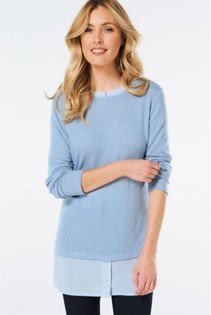
You get 2 for the price of 1 with this 2 in 1 Jumper and Mock Shirt, which features a knitted jumper and a mock shirt underneath. The outfit has a collarless style and long sleeves, which is perfect for the upcoming colder months and comes in two blue hues, which you can easily pair with separates. Great with a pair of ankle boots.
If you’re looking for more value for money, then this 2 in 1 Black Cardigan and Stripe Top is the perfect combination when pulling off a smart casual outfit in a flash. It features a smart black cardigan and a multi-coloured stripe print camisole underneath, which provides a vibrant pop of colour. Made from soft jersey, this top is comfortable to wear all day and looks great with a pair of smart black trousers and heeled boots for a smart but casual office look.
These Straight Leg Trousers are a staple for your work wardrobe and go with pretty much any smart top like a crisp shirt. The streamlined cut and neat front pleat create a smart look, while also helping to flatter and lengthen the legs. These trousers also have an elasticated back panel and bi-stretchy fabric, so they are extra comfortable. Finish the look off with a smart pair of heels.
Price: £16.00 (2 for £28.00)
Length: Available in four lengths: Inside Leg 25in (64cm), 27in (69cm), 29in (74cm), and 31in (79cm)
These Crepe Wide Leg Trousers are part of the Mark Heyes Edit Collection and makes a bold statement at work. The elegant crepe fabric falls elegantly around the legs and the wide fit encourages a flattering shape. They are easy to slip on and offer large buttons and a high waist for that retro look at work. Perfect for the office with a bright colour on top to match.
Price: £28.00
Length: Available in two lengths: 27in (69cm) and 29in (74cm)
Wow the office with this exclusive Button Detail Jumpsuit from Mark Heyes. It has a flattering V neck front that creates a feminine shape, and the flared trousers balance out the glamourous top. There is a zip at the back for a comfortable fit. Pair this jumpsuit with a smart blazer and kitten heels. Also available in Black.
Upgrade your office style with this beautiful grey Prince of Wales Check Ponte Pencil Skirt which is sophisticated and neutral enough to style it with shirts and blouses for that formal yet elegant look. The pattern adds texture to the outfit and the elasticated waistband ensures that the skirt is easy enough to pull on. The flattering knee length enables this skirt to be perfect for office wear.
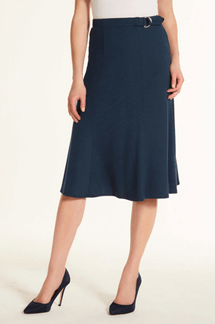
This versatile and graceful D-Ring A Midi Skirt features a lovely soft, jersey crepe fabric which falls gracefully just below the knee and the D-ring waistline can be adjusted to find the perfect fit. The hem flares out slightly which provide plenty of movement and completes the elegant and feminine look. You can pair this skirt with a lovely floral blouse and smart shoes to make a great impression at the office. This skirt is available in two lengths and as a web exclusive only available online (apart from the 27-inches length in khaki and navy). Available also in colours Black, Charcoal, and Khaki.
Price: £14.00
Length: Available in 2 lengths: 27in (69cm), 29in (64cm)
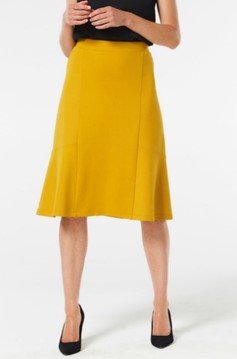
This A-Line Flippy Skirt is an essential at the office because it features an elasticated waistband for all-day comfort and adopts a feminine shape with a flattering slightly flared out A-line and high-rise cut. It comes in two lengths, in black and gold and both lengths and colours are web exclusive. The wine and taupe shades are available in the 25in length and are not web exclusive.
Price: £18.00
Length: Available in 2 lengths: 25in (64cm), 27in (69cm)
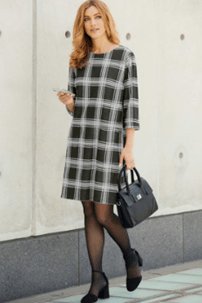
This Checked Tunic Dress in monochrome is the perfect addition to your smart but casual office wardrobe. The material is made from a soft touch jersey fabric and has a tunic style shape which makes it easy to throw on in the morning, ready for an action-packed day. The round neck is simple yet sophisticated while the ¾ sleeves provides that much needed coverage. Cover in the colder months with a lovely blazer for officewear.
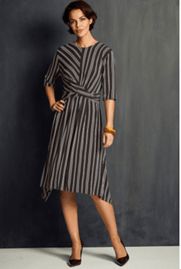
This Striped Knot Front Dress is an ideal dress for the office as it is stylish and flattering thanks to the vertical stripe. The detailed knot cinches at the waist and the halfway sleeves create a graceful elegant look perfect for the office. This dress is crafted from stretch jersey fabric, so it is soft and comfortable to wear in all day.
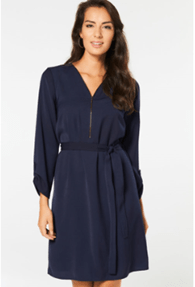
This Zip Front Tunic Dress is a modern take on the classic tunic dress due to its unusual zip neckline and turnover sleeve detail. The versatile dress boasts textured woven fabric which looks comfortable yet elegant. This dress pairs well with tights and heels to complete that smart office look. Also available in colours Black and Green.
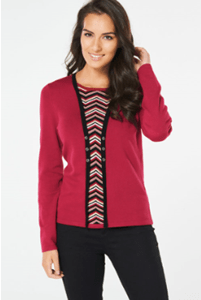
This Mock 2 in 1 Cardigan is an easy and comfortable alternative to layering and looks like two coordinated pieces, but it is actually a long-sleeved top made from fine-knit fabric and a zig-zag design inner front panel. A raised mock trim with buttons down the front adds to the elegant illusion perfect for officewear. Also available in Grey.
Price: £22.00
Length: 63cm (25in) for size 10 + 2cm for each additional size
This elegant Spot Print Tie Neck Jumper has a wide V-neck and long sleeves, with a lightweight and gentle touch on the skin. The fine-knit viscose nylon blend and the pussy bow tie detail at the neck, as well as the classic polka dot print, pairs perfectly with either smart black trousers or grey treggings for a stylish office look.
Price: £22.00
Length: 62cm (24in) for size 10, + 2cm for each additional size
Material: Main body: 70% Viscose, 30% Nylon, Collar: 100% Polyester
This Eyelash Snowflake Christmas Jumper is perfect to wear around the office during the Christmas season and is available in a range of colours, with the mint version a web exclusive item. The eyelash knit fabric provides that extra fluffy effect while the lurex snowflakes, which are embellished with pearls, adds that perfect sprinkle of seasonal magic. The jumper has long sleeves and a simple round neck which looks and feels cosy but elegant enough to wear in the office.
Price: £25.00
Length: 62cm (24in) for size 10, +2cm for each additional size
This Smart Check Coat provides an all-over statement with an elegant cut on a timeless navy background. The single-breasted fastening offers a versatile wear, and the sharp collar completes the sophisticated look perfect for those cold trips to the office.
Price: £60.00
Length: 97cm for size 10 +1cm for each additional size
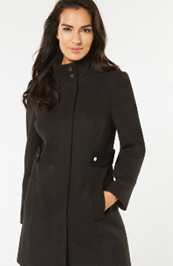
This Formal Black Coat makes you look sharp and sleek with its A-line shape and waist-cinching tabs. The stand-up collar not only looks so elegant and feminine, it keeps the chill from your neck. Just zip up the front before you head out to the office.
Price: £45.00
Length: 87cm for size 10 +1cm for each additional size
Step out into winter with this web exclusive Midi Length Coat with Fur Collar. The long sleeves and the zip fastening, as well as the midi-length design is fully lined to keep you warm and cosy on your trip to the office. The tie belt that cinches into the waist completes the flattering look. Just turn up the collar for added flair! Also available in Plum.
Price: £55.00
Length: 84cm for size 12 +1cm for each additional size
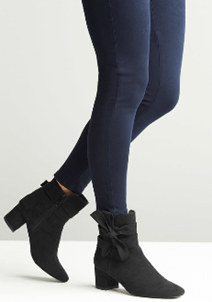
These Suedette Bow Detail Boots are part of the Comfort Plus collection, which offer an instant flourish to your winter wardrobe. They are made from a Suedette fabric and offer a soft finish and feminine bow detail. The chunky block heel keeps the boot looking stylish, yet effortless to walk in. Just zip up the boots on the side and head out to the cold weather on your way to the office.
Price: £35.00
Heel Height: 5.6cm
Material: Upper: Textile Lining & Sock: PU/Textile Sole: PU
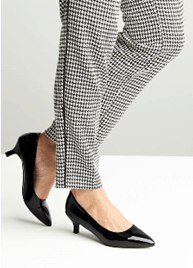
It’s all about comfort in the office and these Comfort Plus Patent Kitten Heel Shoes are comfortable enough to wear in the office all day, even with 5cm kitten heels to glam up your outfit and lengthen those legs. They are versatile enough to wear with work trousers or a sophisticated work dress.
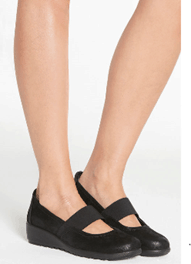
These casual and super cheap Mary Janes are perfect for every day office use, with their Cushion Walk padded insoles and lightweight wedge outer sole. An elasticated strap makes them easy to slip on and off while the versatile black means you can wear them with pretty much any office item in your wardrobe.
Price: £20.00 (currently £10.00)
Heel Height: 4.5cm
Material: Upper: PU/Textile Lining and Sock: PU Outsole: PU
So, there you have it! 21 fashionable and affordable work clothes for women that suit any look that you’re going for in the office.
COMPETITION TIME!
Now you’ve got the chance to bag yourself some Bonmarché outfits of your own as one lucky winner will win a £50 voucher to spend on whatever they like on Bonmarché’s website!
All terms and conditions can be found below. Good luck!
*Prices are correct as at 23 October 2018. Prices may vary after this date*
Easy Tomato Chutney Bruschetta Recipe
One of my favourite recipes to make for the family is Bruschetta, mainly because it is simple, quick and super delicious. But, also because I can hide lots of veg inside like chopped up broccoli and spinach greens.
Another big bonus of making Bruschetta is that it only takes about 10 minutes to prepare (if you don’t leave the ingredients in the fridge to marinade) and you don’t have to cook anything.
The staple ingredients that I normally use for Bruschetta are olive oil, vinegar, lime, salt and black pepper, along with vine tomatoes, ciabatta bread, spring onions and fresh basil.
This time, I found the most delicious tomato chutney called Chunky Tomato Chutney, which is made by Tracklements, an award-winning supplier of high quality homemade condiments, with over 60 artisan chutney, pickle and jam products to choose from. The Chunky Tomato Chutney contains all the seasoning ingredients I need for this Bruschetta recipe – plus more! So, this means that this Tomato Chutney Bruschetta recipe only requires fresh basil, spring onions and bread!
1 loaf of bread, ciabatta bread or sourdough bread – sliced and then halved
30g of fresh basil, chopped finely
Method
Add the finely chopped spring onions into a medium sized bowl
Chop up 30g of fresh basil finely and add to the bowl with the chopped spring onions
Add half the pot of Tracklements Chunky Tomato Chutney or approximately 145g. If you have the time, place in the fridge for at least 30 minutes so the ingredients can marinade together.
While you are waiting, lightly toast the bread (I used Sourdough bread)
Finally, add the marinade on top.
You should be able to make around 12 pieces. You can essentially make 24 Bruschetta slices using all the Tracklements Chunky Tomato Chutney
“Imagination is more important than knowledge. For knowledge is limited to all we now know and understand, while imagination embraces the entire world, and all there ever will be to know and understand.”
That was a quote by Albert Einstein, esteemed theoretical physicist, and some might say the father of modern physics. It might sound like an odd thing to say for someone who had such a deep love and understanding of the sciences and the real world, as typically, scientists are used to working in a lab, with things that are measurable. They collect data and build reports. So what was Einstein doing talking about something intangible, something that lives in our minds? Well, Einstein realized that there is more to life than what we can perceive with our five senses alone. And he knew that the only way to get there was through our imaginations. He knew that we first had to dream the impossible dream, and only then can we make it a reality.
It seems that we have things a little backwards in our society today though. Not many people esteem imagination, books or reading, or even intelligence. Often, society calls the ones who do as nerds, geeks or four-eyes. Sometimes this even results in bullying, victimization or abuse.
Instead, many have fallen prey to the images that we find in glossy magazines, newspapers and on TV: perfectly airbrushed models trying to sell us things, that most of the time we don’t even need. Things like a newer, fancier car, or even flashier clothes. I’m talking about adverts like the Axe deodorant ad on the right. The underlying message is if you wear Axe, women will be all over you. And look at his smile; if you wear Axe, you’ll be happy and everything will be great in your life. From years of personal experience, I can tell you that this is basically a lie!
Adverts like this, tell us to ‘work’ on our outsides: buy better shoes, a bigger house, more of this or that. It tells us that we can find happiness in buying things and materialism: gadgets and gizmos such as cell phones and other communication technology devices. It’s cool to have the latest cell phone today: Galaxy S4 or iPhone. I went to a shopping centre the other day and found eight stores dedicated to selling cell phones and accessories. In some homes today, when mom is cooking, she uses her Blackberry to tell the children that supper is ready, instead of walking the few steps to talk to them face to face.
In addition to the way we communicate today, technology has also influenced how we entertain ourselves. Many people believe that lying in front of the TV and allowing one’s brain to rot is an acceptable past time. We perpetuate this in our society. TV isn’t the only electronic way we entertain ourselves. There is also internet and video games and many others.
Because of all of this, the demand for information is almost instant today. Instead of using what’s inside our heads to figure something out, many would rather just Google it. Some can’t even do a simple two times two without a calculator, because they never bothered to learn their times tables. Instead of spending the time to research for our essays, we use a company like essaylab.com. This site offers to write the papers for us for a cheap price. This is often the state of our current society. In addition, only one per cent of our population are book buyers, fourteen per cent are regular readers and a very minuscule five per cent of parents read to their children.
So what, some of you may ask. What’s the big deal with all that? It’s my life, so what if I want to lie around all day and watch TV, and communicate with everyone via MXIT. Well, with TV specifically, scientists have conducted many studies. They proved that too much TV could lead to anti-social behaviour, addiction and other mental illnesses. Especially when we are children, TV can lead to an underdeveloped brain. When we are growing up, there are window periods where certain parts of our brains mature and expand. If our brains aren’t stimulated during these window periods, the damage can be irreversible, and your brain may never fully develop. Unfortunately, TV doesn’t stimulate many of these parts of the brain. TV can also lead to an inability to speak properly. Human beings learn to communicate with one another via face-to-face interactions, not from a TV screen. Further to this, and contrary to what some believe, there is little educational benefit from watching TV.
In his poem Charlie and the Chocolate Factory, written in the early 1960’s, Roald Dahl warned about the destructive effects of TV viewing: “It kills the imagination dead!” and children’s “powers of thinking rust and freeze!” On the left, is the cover for the book Charlie and the Chocolate Factory along with another Roald Dahl book James and the Giant Peach, which we read when I was in school.
Despite all this, technology continues to infiltrate our society. At the same time, however, depression and other mental illnesses are also on the rise. We can only wonder if there is a link between them… I’m sure the labs and universities all over the world have conducted many studies on this subject, but I want to give you my take.
We have five senses: sight, hearing, taste, smell and touch. When using electronics, say watching TV, we can only properly engage with two of our senses: sight and hearing. This makes for a very dull and under stimulated existence; not the visceral living of which human beings are capable. In addition, we aren’t interacting with what to me are our two most important senses: smell and touch.
Smell is our oldest sense, our most primal. It is the sense that is most linked to memories. And memories are important because they tell us who we are. They give us our outlook on life. Most importantly, they are our identities. A world without smell is a world where it’s easy to forget who we are.
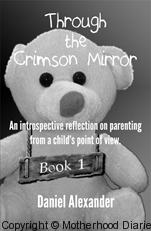
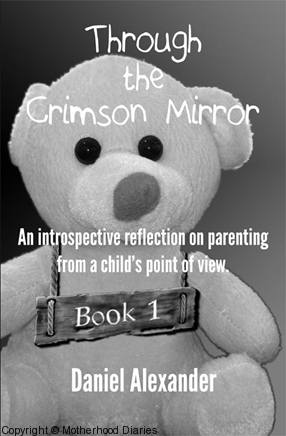
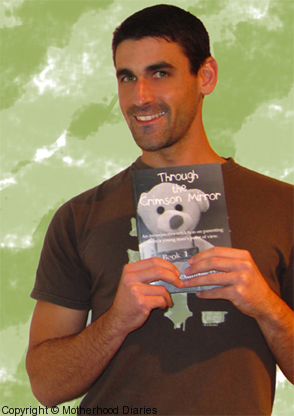
Touch: over the years, many people have written about love and its importance to humans. In the 1960’s the Beatles sang, “All you need is love.” Now, it might sound like a cliché, but the older I get the more and more I realize just how important messages like that are. I wrote a book (Through the Crimson Mirror) about my experiences growing up and the changes I’d like to see in the way parents raise their children today. In doing the research for my book, I interviewed many people from alcoholics to drug addicts to people who work with those in prison, etc. What I found is that in an overwhelming number of cases, whether the person turned out to be a criminal, a bully, even those who are bullied, those with mental illnesses, etc., if you look deep enough, there is usually a lack of love in their lives. Often it starts with their parents.
The sad thing is, as I’ve explained above about the beliefs our society currently holds, often parents don’t realize that they aren’t loving their children correctly. Very persuasive marketing surreptitiously tells society that if they buy their children a Play Station 3 or the latest this or that, that’s love. Sadly, it’s not.
So, what does touch have to do with all this? Well, love is a feeling. Therefore, by definition, touch is our sense of love. Yes, technology will one day replicate the warmth and texture of a human hand. However, the more I learn, the more I realize there is something more to this world, and technology will never be able to replicate that. Nothing will ever come close to the comfort found in the simple laying of hands or the embrace of another human being. If this is what we are losing out with technology, we have to ask ourselves, is it really worth it?
It’s no secret our society, South Africa, has some problems. We have a government that is rife with crime and corruption, a largely uneducated population and an economy that fails to meet the basic needs of many of its people: including a roof over their heads, warm clothes on their back and food in their stomachs every day. To you, I say these problems are real. For this and many other reasons, countless citizens have already left our shores. They’ve gone over to the so-called first world in search of greener pastures. Places like America, Canada, England, Australia and New Zealand. They and many of the people who still live here demand access to the luxuries that the first world enjoys: cheap goods and services, free education and healthcare, etc. But I ask you, do we deserve all these luxuries…
As I said earlier, I wrote a book about my experiences growing up. On weekends, I go to markets and sell my book. In one of these markets, I met a couple from the UK. A part of their business is collecting second-hand books from people in England and bringing them down to South Africa for distribution to underprivileged schools. We chatted about our different cultures and they were shocked at how few people in South Africa read. As I said earlier, only 14% of our population are regular readers. They said that in England almost everyone walks around with a book or some reading material, tucked under their arm or in their bag. I was on the radio the other day, and one of the other guests said, in some countries where there is a long delay between red and green lights in the traffic, taxi drivers pull out novels and read between the lights. So again, I ask, do we deserve the luxuries of the first world, when large parts of our population fail to do the things that people in the first world do? Yes, our government has problems and the challenges we face are real. However, the biggest problem here is the people and our inability to do what we need to do to work on our most valuable asset: our minds!
So, I’ve been banging on about how bad technology is, and I’ve written a little about books. Why should you read books? Books expand your mind. It’s like a workout. Same as when you work out your body and it grows, so does your mind grow. The only difference is, instead of doing a pushup or running around the field, you’re reading a paragraph. And it’s not only the information that’s found within books that helps the mind to expand. It’s also the act of reading itself.
Books give you the courage to think differently, so that you may be able to change the circumstances in your life. They light the path in front of you and show you new horizons. As Nelson Mandela once said, “Education is the most powerful weapon, which you can use to change the world.”
Unlike TV, reading is an active mental process. This means you are actively engaging your brain. This makes you smarter and allows your imagination to grow. This will help you to see new worlds. I remember reading the Harry Potter books a few years ago and seeing the wonderful worlds, JK Rowling had so vividly imagined in her mind. I’m talking about places like Hogwarts castle on the left. The act of her sitting down and writing out what she saw in her mind allowed me to visit lands that I didn’t even know existed.
Books are a skill builder; they help clarify difficult subjects. There is only so much that teachers can teach us, as their time is limited. When something peaks your interest, it’s up to you to continue your learning. For every good course, workshop, subject or skill out there, there is an accompanying book, which can help you to further your knowledge.
Books can help you to earn more money. As you read more in your chosen career or field, you gain more knowledge and become specialized. From there it’s simply supply and demand. If you can supply companies and employers with more skills, there will be a greater demand for you. This affords you the opportunity to ask for more money. Obviously, this isn’t a guarantee. One needs many other skills, in addition to knowledge, to get a raise. However, it certainly doesn’t hurt.
Reading is also a fantastic form of entertainment, which unfortunately is being lost in our society. Unlike electronic forms of entertainment, books cost almost nothing: you can go to a library right now and get a book free. Some gaming consoles cost thousands and the games more and more hundreds. Books require no plug points or anything else, except you and your imagination. In fact, books can help you get away from all the digital distractions that we find in our lives today. Books and reading are your ammunition and armour, in a world that is becoming more and more focused on technology and data.
Books can help you acquire the thinking necessary to overcome obstacles in your life. One of the biggest obstacles one may have to overcome today is time spent surrounded by prison walls. Often, those who leave jail, re-enter society lost and confused and with nowhere to go. With no dreams or goals to believe in, with many returning to a life of crime, and the cycle continues. As Nelson Mandela once said, “When a man is denied the right to live the life he believes in, he has no choice but to become an outlaw.” Reading opens your mind, so that you may find another life to believe in.
One man who used his time in prison effectively is Malcolm X. Malcolm was born in America in 1925. This is a time in America’s history when black people didn’t have many rights. As a result, he had a tough upbringing. In addition, he lost both his parents before his 14th birthday. First, Malcolm’s father was killed, allegedly by white supremacists. A few years later, his mother suffered a mental breakdown and was admitted to the hospital. Malcolm and his six siblings were split up and forced into a series of foster homes.
Through it all, Malcolm persevered and did well at school. He aspired to study law, but dropped out after a teacher said that, that was, “no realistic goal for a black person.” It made him feel that there was no place in the white world for a career orientated black man, so at age 18 he became involved in drug dealing, gambling, robbery, pimping and other crimes. In 1946, at age 20, police arrested and sentenced to him eight years in jail for robbery.
In prison, Malcolm met John Bembry, a self-educated man who he would later describe as “the first man I had ever seen who commanded total respect…with words.” Under Bembry’s influence, Malcolm developed a voracious appetite for reading.
Malcolm was paroled in 1952. Soon after his release, he quickly rose to power in various organizations that fought for the rights of human beings. It culminated in him starting the Organization of Afro-American Unity.
When questioned by a religious leader about his time in prison he said, “Between my correspondence, my visitors, and my reading of books, months passed without my even thinking about being imprisoned. In fact, up to then, I had never been so truly free in my life.”
The picture alongside is of an SR-71 Blackbird stealth plane. It was the goal of the man who wrote A Child Called Its dream to be a part of the team that worked on this plane. His name is Dave Pelzer. His life wasn’t always fun and flying, though. At the age of four, his mother started to abuse him. It isn’t in the book, but I can only imagine that his mother must have been severely mentally ill. She would lock him in the bathroom with chemicals in a bucket, which made David cough up blood. She would beat him until he was black and blue. She even stabbed him once, by accident. Her worst punishment, however, was denying him food. She would not allow David to eat for days and days, and if she suspected that he had stolen food from school, she would make him vomit it up, and sometimes even eat it. She didn’t even allow him to sleep in his own room. She relegated him to the garage. He would sleep on an old army cot with his hands tucked under his armpits. You see, The Mother did not allow him a blanket, so this is how he kept warm. If he was lucky, he would find a dirty rag to cover his feet.
It is here in this dark and dirty garage that David found refuge in books. His teachers at school had introduced him to reading. David used books as an escape from the harsh reality of his life and the ever-present Mother.
For eight years, David suffered at the hands of The Mother. For years the teachers witnessed the black and blue condition of his body. The final straw came when David came to school with no skin on his arms, after soaking them in chemicals his mother used as his punishment in the bathroom. They intervened. After a long battle, David entered the foster care system. There were ups and down; he took some time to adjust. Through it all though, he continued to read.
In his final foster home, his neighbour was a Vietnam War veteran. They befriended one another, and David would spend many afternoons perusing this man’s library. Over the years, he had built quite a collection of war and aviation books. The rules were David was not allowed to take the books home, but so voracious was his appetite for knowledge, that David would sneak back into his neighbour’s house after leaving for the day, grab a book, and return it early the next morning. He stayed up late into the night studying planes. It’s in these books, that David introduced himself to the SR-71 Blackbird. This is where the dream started.
After school, David got the right certificates and diplomas to enrol in the Air Force. The road was not easy, but he persevered and eventually became one of the privileged few who worked on the Blackbird project. During his life, he received personal commendation from three US presidents. He was also honoured as one of the Ten Outstanding Young Americans (TOYA) and was the only American to be selected as one of the Outstanding Young Persons of the World (TOYPW), for his efforts involving child abuse awareness and prevention, as well as for instilling resilience in others.
Thad Roberts is the main character in Ben Mezrich’s latest book, Sex on the Moon. His dream is to be the first man to walk on Mars. The buzzword at NASA (National Aeronautics and Space Administration) now is Mars. Everybody is talking about Mars. In the 1960’s, it was all about the moon. The sixties culminated in man landing on the moon for the first time on July 20, 1969. To date, man has landed on the moon six times. Each time we collected moon rocks and various samples.
The beginning of Thad’s life was poles apart from NASA and space. His family was extremely religious. After Thad made what is really a small mistake (if one can even call it a mistake), his family banished him. Forced to fend for himself, Thad had to get a job to put himself through college.
When he reached the end of his diploma, Thad still didn’t know what he wanted to do with his life. Fortunately, the university had an office where students could research possible careers. For hours, Thad sifted through files, from A to Z. He brushed through astronaut, thinking it was a pipe dream. When nothing else caught his eye, he started seriously considering becoming an astronaut. He read the file and documented what he needed to do. He continued his research off campus and decided that he would need to learn new languages and various skills, such as scuba diving. Self-funded, self-motivated and often on his own, he learned the skills he needed. Then he applied for a co-op position at the Johnson Space Center, which is a stepping-stone to working at NASA. The JSC accepted Thad before they even interviewed him.
Thad thrived at the JSC. He adapted quickly and was soon head of his social circles. Due to his genius level intelligence, his superiors also favoured him. He worked for a few years going from strength to strength. Unfortunately, this is where things took a bit of a wrong turn. Remember I spoke earlier about a lack of love being the root cause of many problems? Well, even though Thad had achieved so much, he still always felt like something was missing and that he wasn’t accepted. He hatched a plan to steal used moon rocks to impress his girlfriend. Moon rocks are extremely valuable but are illegal to own.
The caper went off without a hitch. However, Thad and his accomplices were caught while trying to sell their prize. Thad went to prison. Now, he could have given up and said my life is over. Instead, he investigated what courses were available for inmates. He realized that he was at a much higher level than anything offered, so he decided to teach an astronomy class to fellow convicts. In return for teaching the class, he didn’t ask for money. Instead, he asked that the students who left prison would please send him a physics textbook.
This is what he spent his time in prison doing: teaching others about the stars and the sky, reading physics textbooks and writing his own book. He left prison with his own seven-hundred-page manual about seeing the world in eleven dimensions. Now, don’t worry if you don’t know what that means. I don’t either. Through it all, Thad never lost sight of his dreams. He still plans to be the first man to walk on Mars. Much of this wouldn’t be happening without books.
Many may wonder why I chose to use three Americans as my examples, as opposed to our very famous prisoner, Nelson Mandela, whom I’ve quoted a few times. Well, other than my dichotomous admiration for America (anybody who wants to send me a plane ticket to the States, is more than welcome – hehe), most of us here, in South Africa, know the basic story of Mandela. He was incarcerated for 27 years, and then become the president of our country. Further to that though, I wanted you to realize just how many similarities there can be between the first world and us.
Earlier I spoke of that couple from England; the shock they felt knowing how few people here read. Well, if we want to compete on a global stage, if we want all the luxuries of the first world, then we need to do the things that people in the first world do: expand our minds. We can’t sit around and wait for everything to come to us.
Reading, along with other skills, can literally take you to Mars. However, you have to be the ones to get up, go to your libraries, and get books. You have to be the ones who take those books home and then read them.
To conclude I want to share another quote from Albert Einstein. Up until a little while ago, I never fully understood it. I hope that something I said will help you to understand it. The details are vague, but from what I can gather, Einstein said this to an anxious mother after she asked him how she could help her son to become a scientist,
“If you want your children to be intelligent, read them fairy tales. If you want them to be more intelligent, read them more fairy tales.”
The benefits of your child learning to play an instrument
Motherhood Diaries is working in partnership with Yamaha Music London to bring you a feature series all about the importance of music in your child’s life. This feature series will include the following articles: (1) The benefits of your child learning to play an instrument (which is this article), (2) How to encourage your child to take an interest in learning music, (3) The link between music therapy and ADHD/anxiety, which will include encouraging your child to express their emotions through music (music therapy is something I relied on quite heavily growing up, as you will learn below), and (4) I will finish the series off with an extensive review of the Yamaha YDP-S34 Arius Digital Piano, which, I believe is the perfect companion to assist in your child’s piano lessons. I may add some bonus music theory lessons in the feature series too, as I had so much fun explaining the theory basics below.
So, let’s get started!
If you look around and listen, you will find music everywhere. It is in the shops when you are casually perusing the fashion aisles. It is on the soundtrack of your favourite films and it’s in your car when you’re driving to work. If you listen closely enough, it’s in nature – in the birds’ morning song, the howling gust of the wind, the pitter patter of the rain hitting the ground, and it’s in the fearsome clap of thunder. Music is unequivocally limitless in its offering to us beings – it can evoke all kinds of emotions, bring people together, and it can even make you smarter. If you dissect music, you need four out of your five senses to learn a musical instrument. So, why is music not at the forefront of our education? Of our children’s education? Why is its importance not in line with compulsory subjects like maths, English, and science? I have thought about this topic in great detail and it does make me wonder how many of us learned to play an instrument as a child. How many of us still play an instrument? And, how many of us have children who are learning to play an instrument right now?
If you answered yes to any of these questions, then great! You have enriched your life and of the lives around you. If you didn’t answer yes to any of the above questions, then you are missing out. I will tell you why in a moment or two. But, first I want to alert you to the current statistics.
In 2014, ABRSM (the UK’s largest music education body) published the most comprehensive survey of the learning, progression and teaching of musical instruments ever undertaken in the UK. The survey uncovered some very interesting statistics in that seven out of ten children (69%) in the UK say that they currently play a musical instrument. This figure, however, encompasses everything from playing simple percussion at a basic level to working towards your Grade 8 exam. The survey also found that the percentage of children claiming to know how to play an instrument had increased significantly, which is cause for celebration of course. But, more needs to be done to shake off this mentality that learning to play an instrument is preserved for the rich and middle class.
“Children from lower socioeconomic groups continue to be significantly disadvantaged compared with their peers from more affluent backgrounds.” ABSRM
This is most likely down to the growing cost of musical instruments and music lessons, as well as music exams and related resources. The truth is, learning to play an instrument is expensive and therefore we are inhibiting those who can’t afford to play an instrument from the magic of musical education. It can even be argued that children who suffer from external hardship probably need the healing powers of music more so than others.
So, why is music so important?
Music makes you smarter
Many scientific studies have shown that when children learn to play music, the parts of their brain that control their motor skills, i.e. hearing, storing audio information and memory, grow and become more active. In fact, music increases a child’s memory skills – it teaches them how to create, store and retrieve memories more effectively.
This relationship between learning an instrument and high intelligence has been around for a while, but how conclusive is this evidence?
“Life without playing music is inconceivable to me. I live my daydreams in music. I see my life in terms of music … I get most joy in life out of music.” Albert Einstein – a master violinist as well as a revolutionary physicist.
In this article, I will also talk about the ‘transfer effects’ of learning to play an instrument and its impact on a child’s intelligence. Before I proceed, however, I would like to provide you with some history of my own musical background first.
My long journey with music
During my early childhood at primary school, I was much like my seven-year-old son is right now – bouncing off the walls, highly energetic, happy-go-lucky and very bubbly. I would talk to anyone and everyone, which meant I was prone to distracting my peers as well as being easily distracted. My teachers were unable to control my energy and one of my teachers at parents evening even asked my mum “How do you handle her every day!?” In fact, the same teacher ‘informed’ my parents that she couldn’t see a future in me academically because of my inability to have both feet on the ground and to focus on anything in class.
I was seven.
My mum was, of course, mortified because she knew deep down that I wasn’t a naughty child, but that I was just very bored and understimulated, with a thirst for knowledge and social interaction. Unfortunately, unbeknownst to myself, my parents were unable to instil that message in me early on and I carried on getting into trouble at school. In hindsight, I may have had undiagnosed ADHD.
But, it was music that changed my life – quite literally.
My parents noticed my growing obsession for music from the age of three when I would jump up and down, and clap my hands to music on the TV, especially when I saw a violin. I was singing all the time and beating to an imaginary drum, which would constantly get me into trouble at school. I don’t remember doing this of course, but my parents had an inkling that there was some connection between my love for music and my unknown, untapped musical ability, and so I was thrown into violin lessons at school when I was eight years old. My then teacher (I’ll never forget her) Mrs Marshall, believed I had a talent for playing the violin and a few years later, with her help, I passed my Grade 5 Violin and Music Theory, both with distinction.
When I was thirteen, I passed my Grade 8 Violin with distinction, apparently not losing a single mark, despite thinking I did terribly in my sight reading. Mr Wookey, my high school violin teacher regularly used to say to me, “You sight read like a don,” but I never really understood the difficulty, perhaps because the skill came naturally to me. I’m not tooting my own horn, but merely stating that it was this positive acknowledgement from Mrs Marshall, my Grade 8 examination teacher and Mr Wookey that instilled in me this inner confidence that I didn’t know I had. Something inside me had changed – like a part of my brain had finally switched on. I was a lot calmer as a person, I became more focused on my goals and my head was no longer in the clouds. I also, surprisingly had fewer detentions/timeouts, as well as, much to my parents’ relief, fewer after-school meetings with my parents to discuss my misbehaviour. I had a new objective – to learn all the instruments in the world. I wanted to do more, so my parents enrolled me in a music school (Harrow School for Young Musicians) and with the Philharmonic Orchestra I was able to tour to different countries and play in the Royal Albert Hall and Royal Festival Hall. During my high school years, I led the school orchestra and string quartet, and I regularly participated in local and national events. I still had tons of energy, but I was channelling them all into orchestras, solo violin performances, singing and bands.
I ended up doing well in my GCSEs, breezing through my Music GCSE with an A*, and I felt that I had finally found my calling during my childhood years – it made me feel ten feet tall.
By the time I started uni (to study law), I had also picked up the piano, guitar, clarinet, and saxophone. I learned them all by myself, so I wasn’t great at them, or particularly skilful – I’m probably not even at a Grade 5 level – but it didn’t matter. I learned enough so that these instruments allowed me the opportunity to escape from the real world now and again – I could transfer my overflowing energy and strong emotions into playing music, much like how you use yoga to release tension in your muscles and find your inner chi. The music would flow through my bones, hit my core and I would feel centred – it felt amazing.
I’m now in my late thirties – I have two boys aged six and seven years old and, until I had kids, I didn’t realise exactly how beneficial music was to a child – not just the benefits, the FUNDAMENTAL IMPORTANCE that music has in a child’s overall well-being. You see, my eldest is going through EXACTLY the same problems as me – full of energy, getting distracted, and distracting people – it’s all one big déjà vu to me. Not just that, he sings all the time, and he pretends to play the piano, as well as beats to an imaginary drum. And, he even told me that he can hear music everywhere. So, I enrolled him (and my youngest) in piano lessons as early as possible and, within a few weeks, my eldest could play most of the songs in the beginner piano book. Plus, he picked up how to play the basic melody of Ed Sheeran’s Galway girl. He’s me but a few decades later and even though I have massively incorporated music into our home (I have two guitars, two violins and a piano sitting about), I still don’t see music at the forefront of their education. In fact, it’s hardly ever talked about. The waiting list at the kids’ school for violin and piano lessons is apparently one year long! So, I had to scour Facebook and ask many of my friends about how I could enrol my children in violin and piano lessons. And, now that my youngest has taken a deep interest in the drums and the guitar (I bought him a guitar and he never puts it down), I shall be enrolling him in guitar lessons too. Why? Because music is so much more important than you think for a child. And, frankly, I’d rather invest my money into music lessons than smartphones and TV screens.
Here are some of the very many benefits of children learning to play an instrument:
“Everything’s better when you add music”, Yamaha Music London
Benefits of learning to play a musical instrument
Music increases memory skills
Learning to play an instrument teaches a child how to create, store, process and retrieve memories more effectively. It is still uncertain why musicians have a long-term memory advantage, but it may be down to the training required to read music and visual cues with more proficiency.
Music improves coordination
Playing an instrument requires you to read music which is then converted in the brain to the physical movement of playing the instrument. When you’re playing in an orchestra, this coordination is further enhanced by following the conductor’s baton and listening to your fellow orchestra members to ensure you’re playing within the beat and in harmony with the rest of the instruments. If you’re a string musician like myself, you will know that there is an added nuance to this list – moving the bow in the same speed and direction as your group members.
Music increases your IQ
Music allows you to simultaneously utilise your creative right brain and logical left brain and, in fact, practising a musical instrument regularly engages in all your four brain hemispheres – and this synergy optimises your brain power.
Music teaches discipline, perseverance, and a sense of achievement
It’s not easy to pick up an instrument and play. There is a long and large learning curve, which takes time, patience, and practice. It takes discipline to progress and once your child starts to see an improvement, s/he will feel a sense of accomplishment and achievement, especially when playing in front of an audience.
Music improves concentration and attention
Many people listen to music when they are studying for their exams, driving a car, reading a book, or carrying out a task. These people claim that music helps them focus, despite needing to concentrate on two things at once. The reason for this is because the brain has two systems that work simultaneously with each other – your conscious and your subconscious. The latter is in its much simpler form, but it never switches off. As you are consciously focussing on a task, your subconscious is running in the background, scanning for anything important in your peripheral senses. The harder you find it to focus on your conscious task, the stronger your subconscious is working, picking up the sounds of the cars driving outside, people sipping at their coffee, or machines running in the background. This is why music works so well to focus your attention and concentration on the conscious task at hand. And, you can enhance this skill when playing an instrument. Playing music requires you to concentrate on the pitch, note duration, rhythm and quality of sound, all at the same time. Music engages the areas of the brain involved in paying attention, which is why, as mentioned above, I found it easier to focus and stay engaged in school as soon as I picked up an instrument. Playing an instrument is inspiring and motivating, so it becomes a transferable skill that mirrors the child’s behaviour and attitude towards the more mundane subjects like maths and science.
It would be interesting to find a study that has examined children’s attention spans in class when calming music is played in the background. I would be willing to bet that the majority of kids would find it easier to focus on their classwork if music drowned out all the other noises in the background.
Music improves maths, reading and comprehension skills
If you’ve read music before, you would know that music is just another form of mathematical equations. Without going too deep into the understanding of music theory (because then I would talk about it all day and this article would be over 10,000 words long), sight music can be dissected and further dissected into a series of rhythmic beats. I think the only way I can explain this is to show you in basic form below. (This should be fun!)
You start with your stave (these are the lines where your notes live)
The squiggly line on the left is a treble clef and signifies that the middle/base note in the scale is ‘Middle C,’ as shown below:
See how the MIddle C falls in line with the circle at the end of the treble clef?
The stave or staff is divided into bars, which correspond to how many beats there are in each bar. The image below shows the musician that there are four beats to every bar, i.e. you tap, 1, 2, 3, 4 and then you start a new bar, 1, 2, 3, 4 etc.
Now, let’s complicate this further by adding music.
The way it goes in music (generally 4/4 time like the above) is:
Crotchet (Quarter Note) = 1 beat
Minim (Half Note) = 2 beats
Semibreve (Whole Note) = 4 beats.
And, just to make things harder:
Quaver (Eighth Note) = ½ a beat
Semiquaver (Sixteenth Note) = ¼ of a beat.
I couldn’t find a suitable image to demonstrate what I meant, so I drew it. The notes signify Middle C as mentioned above.
Going up from a Semibreve, you also have a Breve (double Whole Note), a Long (Quadruple Whole Note) and a Large (Octuple Whole Note). Going down from a Semiquaver, you have a Demisemiquaver (Thirty-second Note), Hemidemisemiquaver (Sixty-fourth Note), a Semihemidemisemiquaver (Hundred twenty-eighth note) and a Demisemihemidemisemiquaver (Two Hundred fifty-sixth note).
You see my point about music being like maths?
Now try to play this (and the notes aren’t just middle C anymore – you have a whole scale of notes!):
This piece is taken from Cesar Franck’s Sonata in A Major, Allegro, 2nd Movement, which I played in a concert when I was 16 years old
By understanding the beats, rhythm, and scales, while playing an instrument, children are learning how to divide and create fractions, as well as recognise patterns and play along with the beat. Furthermore, learning and playing music requires constant reading and understanding of music. Children need to identify the notes and recognise in which pitch they need to play on their instrument, as well as how long to hold it, what finger to use and how loudly the note needs to be played. PLUS, with stringed instruments, such as the violin, viola, and cello, children need to focus additionally on their bow movements as well as their finger movements.
Music exposes you to cultural history
Children learn a variety of different music types, including classical, folk, gipsy and medieval, and they are taken through the history and evolution of music, as well as how music type changes around the world. The history of music is a whole new untapped world to a child – and it is so interesting too.
Music promotes and spreads happiness
Going back to what I said before about enriching your life and the lives of others, playing music is not only fun, but it also feels amazing when you have an audience hearing you create and play music with your instrument. When they applaud at a great performance, it can be very humbling and gratifying for a child who voluntarily plays for their community and spreads the music love to people as they listen to them play.
How can I encourage my child to pick up an instrument?
I will discuss this topic in more detail in my second article, but the first thing to do is to get an idea of what your child is into. When my children were very young, I used to play clips of all different types of instruments on YouTube and gauge their interest. At first, your child may pick them all, but the subtle differences over time will show in which instrument they share a kindred connection. For example, I always had a connection with my violin, I would go literally go nuts when I heard someone play the violin beautifully on the TV – and I was three! My youngest loves the guitar and drums and my eldest stops in his tracks when he hears piano music. If you are unsure where to start, Yamaha Music London is a fantastic retail store in the heart of London’s Soho that stocks an impressive array of instruments for your aspiring musician to discover and even try out. Yamaha Music London often holds events where expert music teachers will be at Yamaha Music London to help your child get started on their chosen instrument. You may even spot Tokio Myers, Jamie McCullum and Jools Holland, as they are ambassadors for Yamaha. I guarantee that your child will be wowed by all the instruments and music on display.
Music at home
Once your child has chosen their instrument, then it’s all about practice and perseverance. At first, it’s hard because your child will expect to know how to play their instrument from the offset, but it is important that they understand they are learning an entirely new skill, one that will shower them with rewards if they keep at it.
There are so many more benefits to learning an instrument, but if I listed them all then this article would become a novel. The bottom line is that music is a gift that should be learned and shared. Playing an instrument not only helps your child focus at school, but it will optimise their brain power, enhance their social intelligence, and allow them an outlet in which they can fully express their emotions in their own unique way.
In the next article, I will be going into further detail on how to encourage your child to pick up an instrument and take an interest in music.
Connect with Yamaha Music London and find out how you can get started on your child’s musical journey below:
Is using a domestic cleaning service worth the money?
When was the last time your oven was cleaned out completely? Do you bleach your bathroom(s) every week? When did you last take everything out of the cupboards and give the shelves a good wash? Have you ever spring cleaned your garden furniture? It is difficult when you barely have enough time to cover all the basic household chores, let alone the jobs that require a deeper clean. So, do you sacrifice more time in the day to ensure that these cleaning jobs get done or do you hire a domestic cleaning service to help?
My first cleaning experience
I work from home when the kids are at school. That means I have about six hours in the day to work. About two of those hours are spent on household chores, i.e. loading the dishwasher and washing machine, hoovering the floors, changing the bedding, and wiping down the counters and the bathrooms etc. I am then left with about four hours to work.
When the kids come home from school, I am back in the kitchen, cleaning and preparing their snacks and then, subsequently, their dinner, which then leads to more cleaning. By then, I have run out of time to clean out the fridge and give the skirting boards a good go over, and I have forgotten all about the windows.
By 5pm/5.30pm, I have worked at a lightning pace to ensure dinner is on the table and during that time, the kids have taken out all their toys and scrambled up the neatly folded clothes in their cupboards, so they could change out of their school clothes. Food is all over the kitchen table and chairs, which brings on more cleaning… I manage to grab about five to ten minutes to sit and talk with the boys during dinner before I take another load out of the washing, empty and reload the dishwasher, and then hoover/mop up the floor, which is now covered with food.
The kids head off for their bath before their bedtime routine starts, which means water/soap is now smeared all over the bathroom walls and floor. However, I don’t have time to get out the bleach and scrub all the residue off, so I end up just giving it a spray. By the time it is 8.30pm, the kids are fast asleep, the school clothes (and daddy’s work clothes) are washed and drying on the clothes rack and I have only managed a wipe down of the kitchen floor before I crawl up the stairs to try and work a little bit until 10.30/11pm (sometimes 12/1am).
I’ve bundled the unfolded clothes into a nearby basket, with the promise to myself that I will fold them and put them away in the morning. I am exhausted and I haven’t even dusted the house. I have spent minutes with the kids when they came home and rushed them through their homework and ‘golden time’ due to spending most of my time cleaning.
What’s more, we entertained visitors, who stayed at ours from mid-December right up until the first weekend in January. So, no deep cleaning had been done at all during this time. One evening, I collapsed in front of my husband and sobbed that I couldn’t handle my dual full-time/work-at-home mum role. And, it was then I had given up the façade that I was any good at staying on top of the cleaning. The truth is, I am truly rubbish at cleaning – and I hate it.
I am not one of those people who gets a thrill out of scrubbing counters and achieving that reflective gleam. I am also not one of those who gets excited when I pick up a hoover. I am the total opposite. I love a clean and tidy house – in fact, I am instantly stressed as soon as I step into mess, dirt and grime – but I do not love cleaning any of it up.
I feel like the hours spent in the day cleaning the constant mess is a huge waste of my time, which has been taken away from my kids, my husband and my work. It was when I had a mini breakdown that I decided I needed to outsource my cleaning duties to domestic cleaning services to help me gain back those precious hours lost. But, was it worth the money?
During that week, my friend had just started a domestic cleaning services company and I jumped at the chance to be her first customer. I needed someone to help me with the deep clean, so I could just maintain the clothes, the washing, the dishes, and anything that takes minutes to do.
What I couldn’t keep up with was the frequent bathroom and fridge deep cleans, as well as hoovering and mopping all the floors properly and dusting the shelves. The first time my friend came over with her cleaning colleague, my little one had suffered a double ear infection, so the house was in a real state, due to not sleeping the previous two nights. I completely lost my mojo to clean or even work. So, my friend sent me to the doctor with my second and assured me they would do their best to clean the house in the two hours I was away.
When I came back, my house was clean. Not just clean, professionally clean.
I tell you what I felt when I stepped foot into a professionally cleaned house. I felt relief. I felt pure overwhelming and euphoric relief. The kitchen was spotless, the floors were gleaming, the rooms were tidy and the house smelled fresh. The second wave of emotion hit me like a hammer. I felt proud that my house could look so beautiful when it was professionally cleaned. So proud that I wanted to re-organise playdates and invite my friends over, instead of coming up with some lame excuse because I was so ashamed of how my house looked.
The last emotion I felt put a huge smile on my face. I felt inspired. Inspired to summon up that last bit of energy and pull through after endless nights of no sleep. I felt inspired to maintain the house at this professional level and encourage my boys to keep their rooms tidier too. I had got my mojo back.
So, is using a domestic cleaning service worth the money? It certainly is to me! But, before you decide to take the plunge, there are certain factors that you may want to consider before you hire some cleaning help yourself:
Work out the cost
House cleaners are generally worth anywhere between £11 per hour to £15 per hour. You may need to book around three hours at a time, depending on the size of your house, to ensure you get a good clean for your money. That will cost you between £21 and £45 in total.
Also, you should take into account that you would probably need to provide your own cleaning equipment, especially when using private cleaners. Professional cleaning agencies tend to bring their own, but you may need to pay a booking fee in return. Some professional agencies like anyclean.co.uk don’t require a booking fee, but they would ask you to sign a contract, which you would need to return before they can commence their cleaning services. Also if you prefer to use eco-cleaning products, some cleaners may ask for extra per hour to bring to each clean, if you don’t provide them at home.
Calculate how much your time is worth and then track the time you spend cleaning for one week. Work out the amount you would pay yourself if you were a cleaner. If a cleaner would cost significantly less and do a better job than you, then it’s definitely worth hiring the cleaner.
Get some recommendations
I’m sure we have all wasted money on sub-par services at one point, which is why getting recommendations from your friends and family are crucial, especially when it comes to hiring services who should be helping you with your daily grind, not hindering you. If you ask around, you are more likely to find a trusted cleaner that can get the job done quickly and efficiently.
If you hire professional cleaning services, you’re also protected from any unforeseen incidents that may occur while the cleaner is in your house. Professional agencies like anyclean.co.uk take the work out of finding a trusted and vetted cleaner for you and their prices start at £13/hour. To check whether Anyclean offers a cleaning service in your area, simply head over to their website and get a free quote. Another professional agency, Helpling.com, have a great Spring Cleaning guide, which has some brilliant hacking tips on keeping on top of your spring cleaning – it’s definitely worth a read!
Work out what you need cleaning
For me, it’s very simple, I don’t have time to deep clean, so I need extra help with cleaning out the fridge, thoroughly cleaning the kitchen, and bleaching the bathrooms etc. But, if you have a much longer to-do list, it is worth writing it all down, from top priority to low priority, and ask the cleaner to work through that list. Whatever they don’t get done in their slotted time, they will complete in the next session.
Reasons why you should get a cleaner
A cleaner can be more efficient at cleaning and get the work done in half the time, whereas, if you’re anything like me, you will probably dilly-dally about and half-heartedly clean up the mess, which would then lead you back to square one.
You get your time back, whether that is spending time with the kids or using the extra hours to work. For me, I have gained quality time to sit down with my kids now and I don’t have to worry about deep cleaning the fridge (which I sometimes have nightmares about!) I also get to work those extra few hours during the day and make the money back – plus more!
A new professionally cleaned house will make you feel amazing. The relief and inspiration I get from working while my house is being cleaned is something I cannot even describe in words. I just feel enormous relief.
Getting a cleaner is not for everyone, some parents are super-efficient and can get everything done in fifteen minutes. But, if you’re like me and cleaning is a significant source of stress in your life, then I think it’s definitely worth spending that extra bit of money to outsource and gain back your time with your children – and to do something more worth your time!
Have you ever used a cleaning service? What are your thoughts on outsourcing your daily clean? Please share with us in the comments below!
Does your personality affect the way you plan your holiday?
When you’re a family getting ready to head on a journey, either in the car, on the plane or by foot, you’ll learn pretty quickly that planning what you need to take with you will save you hours of stress and nightmare, especially when you are taking babies and young children with you. You must factor in food, a spare set of clothes, drink and, if you’re in the UK, a jacket, sunscreen and an umbrella – all at the same time! But, did you know that your personality or the personality of the chief packer, will affect the way you plan your holiday? For example, I’m organised, but I’m also quite an in-the-moment kind of packer, which means I don’t make long lists to tick off while I pack. I mentally visualise the beginning to the end of the journey and try to factor in what could possibly go wrong on the way. Then I pack for that situation. Of course, this means I naturally overpack. But, ‘just-in-case’ works a lot better for me than not having it when it’s needed. My husband, on the other hand, packs like a Swiss clock – with precision. Due to his well-travelled childhood, he knows exactly what to pack. He never overpacks – but his clockwork manner means that sometimes he forgets to pack the anomalies which my non-clockwork manner picks up.
You see? Personality can mean a lot! So, how does your personality affect the way you plan your holiday? Let’s find out!
You’re a planner in life
You’re the kind of person that has a constant to-do list running through your head, on your desk and probably in your bag as well. Your whole life is made up of to-do lists because if you don’t have one you’re scared that you’ll forget what it is that you need to remember. You get as much fun out of planning the journey as being on the journey itself. Being a good planner makes you a conscientious person and someone who pays attention to detail. This is a great skill, but you may end up being the one who takes control of the planning and either you will feel resentful of this, or your partner will. Are you letting others plan the holiday for you? Let me rephrase that question. Are you afraid of letting others plan for you? What do you think will go wrong if someone like me plans your journey, for example? Remember to take a step back sometimes and allow someone the reins for a bit. If they mess it up, take the reins back. But at least let them try.
You hate planning
You’re the one who steps back and lets the planners plan. You like to experience life at the moment and, like me, you plan for emergencies, but for anything else, you wing it. However, you may suffer from continuous planning errors and end up in certain disastrous consequences. Either learn how to plan for the most basic things that you need on your journey or carry on letting the planners plan for you. Remember, however, if you’re going on a journey by yourself, you must learn how to plan for the least number of things that you need. You don’t have to spend all day on it, but it may be worth planning two days in advance and committing the list to memory, so you don’t feel you’re planning.
You love new experiences
You’re an innovator, you’re open to new experiences and you seek places you’ve never been before. You feel you get the most out of your journey because you plan to try and do as much as possible to expand your mind on holiday. You’ll pick the most elaborate places. However, remember that not everyone wants to try novel places all the time. Some people like the same-old-same-old holiday, so compromise with the family and see if you can get them to agree to take a few days doing something new to you all and then go back to the comfort zone. You may broaden the minds of those who don’t like to experience new things and they may end up agreeing to pick up the pace with you next time. This means that planning can become difficult. Plan for the new experiences and let the comfort planner take control of the rest.
You don’t love new experiences
Vice versa, as above. You like to go to the same place every holiday and you pack the same items as you always do. You’re happy to just do the things you love and know the places you go to without having to learn anything new. You will chill and relax, grab some respite from your busy reality, rather than attempting to try something new and wasting conserved energy. As above, some members of the family may want to try new things so it’s important to take into account that not everyone plans for a journey to stay in the same familiar destination. Broaden your mind and allow yourself to experience something new, even if it’s just for a few days. You’ll never know, you may like it and start enjoying the new experiences!
You penny-pinch
You don’t like to part with too much cash on holiday, so you’d probably scour the net, undertaking hours upon hours of research to find the best all-inclusive deals that you can find. You interview your friends and family to find out what worked on the holiday and what didn’t. You’re probably neurotic about the value and want to pay for the absolute minimum, from choosing the right tyres for your car to picking the right seats on the plane. If you can bring your own sandwiches on holiday, then that’s perfect for you – no one wants to pay £15 for chicken nuggets and chips! Be honest with yourself, however. Are you worried because you don’t have the cash to spare? If so, is it the right time to plan a journey? Or are you worried about being swindled? Maybe it’s time to just roll with the punches, so to speak, and if you find a place that requires money, but it will make a great memory for the family, then just allow yourself to let go once in a while. Your family will be happy, and you don’t have to spend too much money on holiday, as you’ve already planned for the cheapest journey and destination.
You’re laid back
Holidays are a time to let go, not to worry about what will happen. You are a mix of someone who likes to try new experiences or can stay in the same place for two weeks – you don’t care, as long as you are on holiday. You’re highly agreeable and you don’t get too bothered when you encounter problems on holiday, like travel delays, unhelpful staff or when someone gets sick. You plan for experience and fun, not the kitchen sink and if you forget something then, what the hey, “we’ll pick it up on the way!” It’s a fun way to be and you make a great companion on holiday. However, those who are too agreeable may get taken advantage of, and you may not know of some dangers of travel. However, if this situation happens, you’ll fix it and you’ll move on. Sometimes we just can’t control everything, can we? Just make sure you’re taking your family’s worries seriously and that you don’t shoo them away for the sake of having a relaxed holiday experience.
Interestingly enough, I am a little bit of all of the above, so it’s hard for me to plan sometimes when my mood is in penny pinching mode, or in laid back mode. A tyre company called TyrePlus sent me an infographic, which posed the question about what people think about before they head on their journey and the road trips they enjoy, which can be heavily influenced by their personality. This infographic is what inspired me to write this post, so I’d like to share it with you below:
So, whichever personality you fit into, it’s important to take other family member’s personalities into account, and make sure you’re planning for that journey. As long as you have the basics in mind, and you’ve found yourself a good deal before you set off, then you should be good to go with no further worry or arguments along the way.
*Collaborative feature post*
How to create the best Pokémon themed birthday party for your child
The birthday events industry has exploded in recent years, largely due to our children living, breathing and sleeping their favourite characters, especially on the most special day of the year. Since the release of the Pokémon Go app, the Pokémon craze is burning ever strong, with a whole new generation of young Pokémon lovers and a massive 1,000 Pokémon characters to revel in now – a far cry from the original 150 back in my day!
My boys are obsessed with Pokémon, so it seemed right to organise a Pokémon themed birthday party for my youngest, who recently turned six. Melanie, the Sandy Art entertainer, transformed the party with sand equipment that she had brought with her and she tidied everything up afterwards. She successfully engaged twenty children in Pokémon Sandy Art for 1½ hours and they worked together to create some pretty spectacular sandy art. The added bonus was that they also got to take their creations home too as going home gifts.
More on the entertainment package below, but let’s go through the basics of how to create the best Pokémon themed birthday party for your child, i.e. the venue, the invites, the party supplies, the party food, the birthday cake and, of course, the entertainment!
P.S – this article is aimed at children between 5 and 9 years old, however, there is no reason why children who fall outside this age group can’t enjoy sandy art too!
The venue
When considering Pokémon themed entertainment, your best bet is to find a venue that is big enough for the fun and games, as well as the table settings for the party food. Don’t forget to factor in space for parents to sit and spectate as well. Added bonuses would be having a toilet that is within walking distance and a kitchen in which to prepare the party food and cake. If your home is big enough then great, you save money on the venue costs. However, if not, then places like local halls, churches and some schools (especially those with sports halls) may permit you to hire the room for a couple of hours.
Invitations
You’ve picked a date and time, so now you need to tell the guests. Melanie offers Sandy Art invitations, as part of her package (see above), but if your entertainment doesn’t include this option, then I use Kenzie’s Cards from eBay, which are a brilliant company, who personalise birthday invites for cheap and with a very short lead time.
Telling parents in advance about what they are likely to expect at the party will allow them to prepare their children too. Perhaps the entertainment is first and will likely take 1½ hours, but knowing this in advance means that parents can feed their kids a snack before arriving at the party, so they are not too hungry when the activity starts. I made sure people knew it was a Sandy Art party, so they would expect a hands-on sand experience, but Melanie’s invitations were enough to give it away.
Party Supplies
You can include as many or as little Pokemon themed party supplies as you want. You can buy affordable Pokémon Party Supply sets on eBay, which has TONS of options. For my son’s birthday party, I ordered a party supply package x 3, which contained paper plates, napkins, tablecloth (1) and paper cups x 8. Some sellers like the one I used, throw in balloons as well because I ordered multiple sets. eBay is a great source for party planning, even down to the tools I used for the cake, so it’s worth checking it out during the preparation stage.
I would say, at the very least, your party supply package should include the following:
Tablecloths
Paper Plates
Napkins
Paper Cups
Platters to serve the food
Cutlery
Balloons
Then, if you want to go further than that, then I’d get the following:
Table decorations
Ornaments
Birthday banners
Helium balloons
Party favours
Party Food
It has taken me a long time to get the food right, even though I still haven’t got the volume correct, i.e. there is always tons left over. So, I now stick to the following party food criteria:
Sandwiches with the crusts cut off (I don’t throw away the crusts, I place them in plastic cups or bowls and offer them with a variety of dips if there isn’t any filling on them. (Or I munch them while I’m preparing the party food at home, hence why I put on about 5lbs during the preparation stage… just FYI…)).
Fillings I find work really well are:
Chocolate
Cheese and tomato with butter
Tuna, cream cheese and sweetcorn
Egg mayonnaise
Crisps – all flavours
All sorts of fruit – clementine, bananas and apples, as well as berries and grapes
Biscuits – as many various kinds as you can get
Veggie trains – bell peppers (for the train), cucumbers (for the wheels), sliced celery, carrots and bell peppers (the passengers) – along with yoghurt and hummus dips – The lettuce makes up the grass on the ground (the platter).
Popcorn – sweet, salty, and/or sweet and salty. You can get toffee flavoured popcorn too if you’re feeling risky.
Drinks – water or juice for the kids and fizzy drinks for the adults. Although you’ll find some of the kids tiptoeing over to the adults’ table to help themselves to the soft drinks…
For the purposes of my son’s Pokémon themed party, I Pokémonised (not sure that’s a word, but we’ll go with it) the apples and strawberries. I was so rubbish at doing them, so I’m sure you can do a much better job than me! The good thing is, the kids didn’t notice, and they loved eating the candy off the apples and strawberries. I found the instructions via Koalipops’ YouTube videos for the Pokémon apples here and the Pokémon strawberries here. (I love that guy!)
Birthday Cake
I have somehow got myself into a bit of a pickle because I agreed to make the kids’ birthday cakes every year. It started last year when my eldest was in Year 1. I asked him what he would like the most for his birthday and he said a Ninja Turtles birthday cake made by me. I thought, yeah, why not! Easy, right?
I lost those 5lbs I gained during the food prep stage, due to stress… I have a newfound respect for cake makers and decorators – I don’t know how you do it! It took me six hours to make his cake and the fondant was so tricky to work with. But, it definitely looked homemade and no one can argue that it was a labour of love. Nevertheless, the kids loved the cake and it was totally worth seeing Aron’s eyes light up when he saw the cake for the first time.
I complain about the stress accrued making the cakes, but it was totally worth it to make my kids something completely unique and personalised. I’m happy to kill myself twice a year to get that priceless look on their faces – it makes me proud that I can offer something so personal to them.
Entertainment
With the entertainment, you can afford to be as simple or as extravagant as you want. You can opt for simple party games like Pass the Parcel and include little Pokémon toys as treats, with the main prize being Pokémon related. Or you can play Pin the Tail on Pikachu and other basic games like that. However, we went for the entertainment package where the entertainment was provided by a professional entertainer who engaged the children for up to two hours, while we parents sat back and watched – and possibly opened some Prosecco…
Pokemon Sandy Art Party Package
As mentioned above, we went for a Pokémon Sandy Art party, which was hosted by Melanie, who arrived half an hour earlier to set up four stands that contained four bowls of different coloured sand in each.
A bit of information on sand play
Sandy art or sand play is considered a sensory activity¹, meaning that it involves the child’s five senses² (i.e. taste, touch, smell, hearing, and sight), well eight senses³ in total, actually. Just, FYI, the latter are the senses that tell us where our body is in space, how it is moving and what is happening inside our body (i.e. tummy ache and when you need the loo.) So, sensory activities like sand art and play is a fantastic way for kids to engage in an activity that is mentally and physically stimulating. It is a very developmental process too, as it fine tunes motor skills and encourages kids to tap into that creative part of their brain.
So, how does Sandy Art work?
After Melanie arrived and set everything up, the kids were guided to the end of the hall as soon as they arrived, where Melanie had set up a corner stand of Pokémon design cards. The kids could choose any two designs that they wanted to start the sandy art process. There were also other designs to choose from (for e.g. Disney princesses or Minions) as some of the guests were not very interested in Pokémon.
Melanie peeled away at certain parts of the design cards and let the children have free rein with the sand, so they could decorate their cards as they so wished:
The children tottered around the stands and filled in their first colour before they went back to Melanie who then peeled off a bit more of the card. This way, the rest of the design was unaffected by the sand and it kept the overall look very neat. It’s quite simple, yet so clever!
And the process was repeated until the children had every part of their card filled in with coloured sand.
The finished result was pretty remarkable!
At the end of the activity, the kids had so much fun that they enjoyed having their photos taken with their creations.
If you’d like to learn more about Sandy Art or you’d like to book the above package, you can find Melanie’s contact details on her website. Melanie is very versatile and can offer children’s entertainment for multiple occasions in alternative types of events, for example, weddings (during speeches), workshops, festivals, Holy communions, Family & Fun days and School Fairs.
Going home gifts
Going home gifts are a necessity at parties. Every young guest expects to go home with a treat after the party, whether it is a chocolate bar or a whole myriad of party favours. If your budget allows, you really do have free rein here. We ordered personalised Pokémon Kit Kat bars and a Pokémon pencil from eBay. We also ordered mini Pokémon notepads, but, sadly, they never arrived. We also wrapped up a piece of the birthday cake to include in the Pokémon party bags as well. The great thing about Melanie’s Sandy Art⁴ party is the kids got to keep their two sand designs to take home with them, so these doubled up as great going home gifts for the kids.
If you want to be fancy:
Little Pokémon mini figures or soft toys are a lovely going home gift for the guests and a great keepsake
Pokémon cards – or, even fancier, a Pokémon card set. Children who collect and trade Pokémon cards will love you for this, but it is a bit pricey, especially if you’re buying for up to thirty children.
Pokémon fiction and/or activity books. Young Pokémon fans will receive a book they’d really want to read, and they develop their brain while doing so – win-win!
If the budget doesn’t allow:
Making it yourself is really the best way to save money.
You could make mini cupcakes and buy a set of Pokémon cake toppers to Pokémonise (there’s that word again) them.
Little Pokémon mini keepsakes are a bit of fun for a short period. There is a whole variety to choose from, from yo-yos to bubbles – younger kids still love these kinds of things.
If your child’s birthday party is coming up and they love Pokémon, then I would thoroughly suggest that you check out Melanie’s Sandy Art Entertainment Package. The kids were engaged from beginning to the end of the party and the parents got the chance to sit back and relax for a couple of hours.
Sources
[1] Source from https://pathways.org/blog/sand-play-natures-etch-a-sketch/