Pui-San Wong is the Operations Executive at Laundrapp, who collect, clean, and deliver laundry across the UK. Here, she shares her top tips for getting your washing done quickly, efficiently, and without any mishaps.
When you have kids, the amount of laundry you need to do each week can double or even triple. And, once you’ve washed, dried, and sorted everything, it can feel you have little time left to do anything else.
To help you out, I’m going to share some expert laundry hacks that will help you get through your laundry quicker than ever before. These hints and tricks could help your clothes to look and feel much better, too. Read on to learn how you can tackle your family’s washing more efficiently.
Sort your clothes into different washing baskets
During laundry day, do you rifle through a basket full of dirty clothes, looking for all the white, dark, or delicate pieces that you can wash together? Not only is this unhygienic, but it can be time-consuming, too. Plus, finding a pair of black socks at the bottom of your basket after you’ve washed all your dark colours can be really disappointing when you were hoping to see your basket completely empty for once.
To save time and stop you from having to create piles of dirty washing on your floor every laundry day, buy different baskets for the kinds of washes you do. Or, you can opt for a basket that comes with compartments.
Use the towel trick to help your clothes dry faster
If you use your tumble dryer when you’re short on time but still find that it takes longer to dry your clothes than you would like, try the towel trick. This involves throwing a clean, dry, and preferably thick towel in with your wet washing for the first 15–20 minutes of it being in the dryer. This will help to absorb a lot of the excess moisture, drastically reducing the time your washing will take to dry.
Hang clothes up straight out the dryer
Ironing is the chore that Brits hate the most, according to YouGov. It can take a lot of time and effort — plus, you don’t always get the results you’re after. So, to reduce the amount of ironing you must do, try hanging your family’s clothes up as soon as they come out the dryer. Most wrinkles should simply fall out, and this will also prevent any stubborn creases from being made through folding.
This tip should help to reduce your ironing pile dramatically, and you’ll only be left with the likes of formal shirts, suit trousers, and skirts or dresses that are prone to creasing.
Throw a ball of tin foil in your dryer
If you aren’t a fan of dryer sheets, or you need to dry a load of washing and don’t have any to hand, throwing a couple of balls of tin foil in your dryer can do a similar job, but without the residue. They will help to remove static from your clothing and can even help your washing to dry faster.
This is also an eco-friendly and cost-effective option when compared to dryer sheets, as a ball of tin foil can be used in this way for up to six months. Just make sure you replace your tin foil when it starts to look worse for wear.
Being a mum can be hard work and saving energy and time is always helpful. If you take these expert laundry hacks on board, you should find your laundry becomes much easier to manage. And, you’ll have even more time to enjoy the fun and exciting aspects of being a parent!
* Post written by Pui-San Wong, Operations Executive at Laundrapp*
Home HIV tests save lives – so why the concerns?
Around 90,000 people, including 315 children aged under 15, received specialist care in the UK in 2015 and since 2015, the number of people accessing specialist care for HIV has grown. There are now sufficient HIV treatments that can control the condition and allow those who are HIV-positive to live long and productive lives. Sports legend Magic Johnson and Dr Rupert Whitaker, the founder of the Terrence Higgins Trust, are just two of the high-profile names who have been living with and effectively managing the condition for decades.
Yet diagnosis is still the biggest problem. People are reluctant to be tested for all sorts of reasons, and this means that one in three do not get the treatment they need that could save their lives.
Home testing
A simple home test for HIV is the ideal solution to a prickly problem. There is no requirement to phone or attend a clinic and ask for a test, and you do not even have to walk into a pharmacy to buy a test kit – they can be bought over the internet at sites like http://hivtestkit.co.uk/. The tests are relatively simple to use – obtaining a blood sample via a pinprick in the finger is neither as complicated nor as painful as it might sound, and the result is right there before your eyes in a matter of minutes.
Home tests are also highly accurate, as long as you choose one that is CE-approved and you use it correctly, with an accuracy of more than 99.5 per cent.
What are the concerns?
Despite the fact that home HIV testing can and does save lives, there are still justifiable concerns. These are not so much about the tests themselves as around how people might use or misuse them, and the inherent risks of home testing over being tested in a medical environment.
Bad test = bad result
Tests such as the one described above have been through all the necessary approvals and are highly accurate. However, there are others out there that are less reliable and are more likely to give a false negative, particularly the saliva ones, that many will be tempted with as they negate the need to take a blood sample.
Potential partner screening
The three-month window
The home tests screen for HIV antibodies, which start to appear in the bloodstream up to three months after contracting the virus. If therefore, you take a test during this three-month window, you might get a false negative result.
Lack of support
Testing in privacy at home sounds great, but what if the result is positive? This is a time when you really need expert support around you, and it is at this point that being all alone in the comfort of your own home is less of a good thing.
Home HIV tests are without doubt a great tool in the fight against HIV, because they will save lives. However, learning how to use them correctly and responsibly should be prioritised to reduce concerns as much as possible.
*Collaborative feature post*
What does a baby see during their first year of life?
When you meet your newborn for the first time, you can see her clearly, but your baby cannot see you quite so well yet. That’s because your baby’s brand-new eyes will see quite blurry at first, and then develop gradually during her first year of life. By the time she hits her first birthday, she will have eyesight almost as good as yours. If you’d like to view the world through your baby’s eyes, you can check out Vision Direct”s interactive tool here. The tool was designed by Vision Direct to help you understand how your baby’s eyes develop over time, from newborn to 12 months old. You can also input your child’s age and the tool will give you an idea of your baby’s field of vision, depth perception and colour awareness. As you move the slider along, you’ll notice that not only do objects and colours become sharper for baby, but the background will also slowly come into view as well, so your baby starts to develop their peripheral and depth vision over time too.
“We hope that this will help parents understand how their baby’s vision changes during this critical time for development. The tool features helpful tips on how to support your child as they learn to focus, track objects and see colours.” Brendan O’Brien, Vision Direct’s Head Optician and Chief Operating Officer.
Newborn
(A newborn can barely see her own mother in the first few weeks of life and they can only see in black and white).
Unlike your baby’s hearing, which has fully matured by her 1st month, her sight develops more slowly. During the first month of life, a newborn can see shapes, light and movement, but only in shades of grey. At birth, you may notice how small her pupils look, which means that her eyes are very sensitive to light. As her central vision develops she will continue to develop the peripheral (side) vision. Within a couple of weeks, as her retinas develop and get stronger, the pupils will widen, which means more light and dark patterns can enter through the eyes. You will see that your baby will start to pay more attention to objects in front of her too. At about one month, baby can see you a little clearer, but will still prefer brightly coloured objects about three feet away.
2 months old
By 2 months old, your baby will be able to see only the bright primary shades. Don’t be alarmed if you notice your baby’s eyes crossing or wandering around because, in most cases, this is normal and her eyes will eventually correct themselves. Please notify your paediatrician if you start to see baby’s eyes constantly look towards the nose or outwards from the nose.
6 months old
By 6 months, the baby can move her eyes more quickly and is able to follow moving objects, allowing her to develop physically, mentally and emotionally, until, at one-year-old, she can see almost as good as her parents. Her ability to see how far an object is away from her (depth perception) is developing more fully now. She can almost see the world in 3D and so you will probably see her reach out for objects that are both near and far to her. Her colour vision is developing well too, although not to an adult’s capacity just yet.
(A 6-month-old baby can see her mother more clearly now, but everything else in the background is still blurry)
At 6 months, baby can also understand object permanence, which means that she knows that objects continue to exist even when she cannot see, hear, touch, smell or sense them in any way. This is why touching and handling objects are really important for infant development, and it especially encourages her to strengthen and use her eyes.
10 months old
(By 10 months, baby can see in colour and, bar a couple of shades or two, this vision will stay with her when she’s grown up. Baby can also start to see the background more clearly)
By 10 months, baby’s can judge distance quite well at this point and you’ll notice this by the way they can pull themselves up to stand. They have an almost full capacity for a range of colours in their vision and by 12 months, they can almost see as well as us adults, bar a few developments along the way.
Protecting your eye health is for life
Protecting your baby’s eyes should not stop at 1 year old. It is important that you and your family continue to look after your eyes well into adulthood. Make sure you receive regular eye health and prescription checks so that you maximise your chances of good eye health and your sight can last you a lifetime. Make sure that you continue to watch for any signs of eye and vision problems in your baby. This can include an inward or outward turning of eyes, a noticeable delay in not being able to track moving objects well and any other signs you may have picked up on baby’s central, peripheral and depth perception. Whatever inkling or gut instinct you have, notify your paediatrician straight away as eye or vision problems can delay a baby’s development. The paediatrician should be able to help you find age-appropriate activities that you can do with your baby to encourage them to develop their vision. Click here for more information on Vision Direct and stay updated with new articles on eye health, as well as new products and features on Facebook, Twitter and Instagram.
*This post is sponsored by Vision Direct*
*Where I have made references to the baby as ‘her’ or ‘she’, please take that to include all babies and not just females. *
Never miss a new post!
Don’t forget to tailor your preferences, so you just get the posts you want to read!
My sister-in-law was the first person ever I knew who breastfed because on my side of the family, no-one had ever attempted it; I was determined to be the first. I was ready to possibly struggle a little bit and maybe have sore breasts, but breastfeeding was my only option.
My beautiful little girl arrived and after a quick check over, she was put on my chest and, tears in my eyes, I will never ever forget that moment when she turned her head to my breast and so naturally started sucking; oh wow, what a strange and amazing feeling it was to feel something going through my breast and being sucked by my little girl!
As she was born in the evening, we stayed overnight in Broadlands at the Princess Anne hospital and discharged ourselves early morning to go straight to the New Forest Birthing Centre (a midwives only led centre) as there was a space available. Unfortunately, by the time our little girl was not even one day old, I realised that my breastfeeding experience was going to be much harder than I expected. My little girl was happy to sleep pretty much all day – the dream of many parents – which means that feeding was the last thing on her mind. The midwives at the centre were ever so patient and we tried so many things to keep her awake (stocking her head, putting a damp flannel on her, stripping her down to her nappy, taking the nappy off and so on) but after a few minutes of sucking she would fall asleep again. After four days at the Birthing Centre, her weight was still more than 10% lower than her birth weight and despite the worries of the midwives, we decided to go home where I would be more relaxed and in my environment.
But the breastfeeding did not improve. We went twice to Breastfeeding Babes at the hospital and despite some good advice, my little girl was still not feeding much. To make things worse, she suffered from reflux which meant that I had to keep her upright for at least one hour after each feed, in the hope she would keep it down. My health visitor was coming to see us at home every two days and after two weeks of struggle and my little girl’s weight still not being anywhere near her birth weight, she suggested formula. Up to that point, I was already in tears two or three times a day and that suggestion tipped me over the edge and broke my heart. I am lucky to have a supportive husband and family but still, I had failed my daughter! To stop me going into depression mode, my husband convinced me to agree to the formula feed and within a week, my daughter started to feed better.
She now is 3 years old and still not a big eater – unless you give her cheese which she could eat by the bucket. I am still unhappy about my breastfeeding experience but I am now able to talk about it without getting too upset (but still with a few tears in my eyes) and feel it is very important for me to share my experience so that other mums in similar situations know that they are not alone. So my advice to any pregnant women is to make a list now (while you are still pregnant), with the names and contact details of Breastfeeding counsellors and find out where your local breastfeeding support groups are. Once you have done this contact list, give a copy of this list to your partner and close family so that they can ask for support if you are not in the right frame of mind to seek for help yourself. Check out www.nct.org.uk, or ask your midwife now for any of those contact details.
But my most important advice is to be happy with your choice. If breastfeeding does not work, if it doesn’t feel right, if it stresses you out too much, then use formula (or do a combination of both). If you’re struggling for options, there is a range of baby formula available at Pharmacy2u.My husband and I are hoping to have a second child and I will most definitely try to breastfeed again – but this time, I will be more prepared. I will have my support contact list ready months before the due date and I will also have formula at hand, just in case.
Good luck
Tips from parents on how to raise multiples
They say parenting a child is a full-time job, but what must it be like parenting multiples? Multiple births are becoming more common than ever, as more couples are having babies later in life or turning to fertility treatments for help, both of which increase the chance of having multiples. I am not a mother of multiples myself, but I can imagine that it is probably double, triple, quadruple or even quintuple the trouble. The truth is each child comes with its own unique package of fun, but when they’re multiplied, how do parents cope? Motherhood Diaries spoke to some parents who kindly provided their tips on how to raise multiples.
“Always feed them at the same time, if possible, otherwise when they’re newborn, you could be up every hour. Also, if you need to get other things done when they get a bit bigger, I have five children so sometimes two hands are never enough, we rolled up towels for blankets to prop their bottle up, it’s not ideal but sometimes there’s no choice”. Helen Power, mum of twins (mum to five children in total) http://www.crazyfamilystory.com.
Each child is different
Parenting multiples may mean that you feel guilty or sad for having less time to spend with each baby. And, treating your multiples the same way may sometimes seem like a practical solution and even contribute to survival in those newborn/toddler days. But, it’s important to think about your children as individuals with different characteristics and needs. Make it easy for people to tell which child is which, so they start to have their own identity from the very beginning. As they get older, ensuring they have their own space and possessions can also help for that child to form their own life separate from their life with their multiple siblings. Each person is unique no matter whether they were born at the same time. Embrace those differences and ensure you are not favouring one over the other, even subconsciously, as this may lead to competition amongst themselves.
“Most people think it’s like parenting their children twice over. It’s not. No matter their identical DNA they are two very individual people – with individual needs, issues, temper, and attitudes! Saying that, my girls are now 4 and I’ve found this last year having twins has become much easier. They always have someone to play with and it gives them confidence, whilst they bicker like nobody’s business, it feels like I’m being rewarded for an easier life as they amuse each other”. Beth Law, mum of twins (mum to three children in total) http://www.twinderelmo.co.uk“
“The challenges change- but it does get easier. I think that would be my advice to any new parent of twins. The moment I was able to tandem feed my twins, life got exceptionally better (due to problems with feeding one of the boys this didn’t happen until week 12), and so the sleep deprivation of managing consecutive feeds was so difficult. The moment they can feed themselves- again a huge bonus. The moment they could move- never in the same direction brought more challenges. But every milestone brings a new celebration, life gets a little easier, and a bit more challenging. Mine are now six so full-time school was a bonus for sanity, but it has been important for me to be aware of their individual differences as in an educational setting there can be a habit to talk about ‘them’ (by everyone), and so I’ve had to be really on the ball with their differences. This has been so different to the experience with my daughter. The school are great, and we’ve gained a lot of support, but yes, they are individuals who may learn differently, at different paces, have different interests, different friends. Like siblings, not ‘twins’. ” Debbie Johnson, mum of twins (mum to three children in total) http://www.anorganisedmess.com
Get the right Support
The first six to eight weeks at home tend to be the most challenging for parents who often need additional help from family and friends to make things more manageable for them. If you don’t have friends or family around, reach out to friends and neighbours in the area. Asking for help, especially in the first three months, is important.
“Some of the differences in lifestyle the multiple births will need are easy to expect, standards for household’s neatness will likely have to relax for a few years unless you can afford to hire a house cleaning service. You will get a lot less sleep, as multiple babies need frequent feeding and care at night. Raising twins or multiples is easier with the right support. Meeting other parents of multiples in your area is an invaluable way to share knowledge and experience. Find out if there’s a way to share knowledge and experience. Find out whether there is a multiple group in your team, look for clothing sales, and take advantage of opportunities pick up things in duplicate”. Elizabeth Plumb, http://www.thehomemakersjournal.com
Learn how to manage your routine your way
“Our boys are two and our girls are one. My partner manages our two sets of twins with a mixture of routine, kindness and just letting things go – twin parents can’t really be held to the same standard as singleton parents; they have double the child to manage! Me? I keep them out of the house all day where I can. Hence, I’d be a dreadful SAHM – we’d have no money left by halfway through the month because it would all be frittered on activities and coffee!” Amber Allen, mum to two sets of twins! http://www.meetthewildes.com
No matter how organised your house is, there will be destruction along the way. Establishing a good and simple routine is key to surviving life with multiples. It takes trial and error, but with the right support, you will start to establish routines for feeding, bathing, changing and bedtimes and soon you’ll become a pro multiple parenting superstar! Just remember that you’re not alone because there are tons of great resources online that can help you get your mojo back when you feel like you’re losing it in a sea of multiples and mess.
And, if you really want to feel like you have your eye on the multiple ball, check out the Busbys’ fly-on-the-wall reality show on TLC called OutDaughtered, which follows them parenting the US’ first all-girl quintuplets. New shows air every Monday at 9 pm on TLC and you can catch the repeats every Sunday at 8 pm either TLC online, SKY channel 125, Virgin channel 167 or BT TV channel 323.
*This post is sponsored by TLC*
Haemophilia in Babies: What Are the Signs and Symptoms?
*This post was created in collaboration with Phamax*
Haemophilia is an inherited blood disorder that impairs the blood’s ability to clot. Someone with haemophilia won’t have the clotting factors of an average person and, as such, cuts and scrapes will bleed for far longer than usual. The symptoms associated with this condition can be mild, or they can be severe, but it is important for new parents to be aware of the warning signs of haemophilia, so they will know when to seek urgent medical attention.
Most individuals with haemophilia are diagnosed at an early age, usually by the age of two. However, mild cases might not be diagnosed until adulthood. You might wonder how haemophilia could ever go undetected. After all, if it is inherited from our parents, wouldn’t we all get tested at birth? The fact of the matter is, in some cases, haemophilia might appear to surface out of nowhere.
It may be that the family had forgotten, or may not have known, about ancestors with haemophilia. It is also possible that the gene for haemophilia had been carried by females for generations without presenting itself, as women rarely demonstrate the symptoms of the disorder. The condition might also, on rare occurrences, present itself out of nowhere as a spontaneous genetic mutation. This is the case for roughly 30% of haemophilia cases.
Whatever the case, the prospect of haemophilia is likely to be terrifying to a new parent. We all want the best for our children and, though the idea of your loved one having haemophilia might be concerning, it’s important not to fret. The condition is manageable and your child will most likely go on to live a completely normal, happy life. What is important is that haemophilia is detected at an early age.
Below are a few signs and symptoms of the rare disease to keep an eye out for.
Prolonged bleeding after circumcision
Although circumcision is not common across Europe, if you decide to circumcise your son for religious purposes, this might very well be the first indication of haemophilia in a newborn. Your baby might experience extreme bleeding at this point and it is essential that you obtain medical assistance as soon as possible.
Bleeding relating to teething
Parents of haemophiliac babies have to deal with more than screams and late nights. Baby teeth can be very sharp and infants tend to bite their gums and tongue. If the bleeding doesn’t stop, this can certainly be a sign of haemophilia.
Excessive bruising following falls and bumps
Babies are adventurous and inquisitive. It’s hard to raise one without them experiencing a number of lumps and bumps. Bruises are to be expected, but keep an eye out for extreme bruising, or what is known as ‘bleeding into joints‘. The bruises will usually be a deep purple, swollen and cause your toddler a lot of discomforts. Pay special attention to the ankles, elbows and knees.
Unusual bleeding after vaccinations
To keep your baby happy and healthy, vaccinations are a necessary part of life — and they’re usually forgotten ten minutes after the event. If, however, you notice unusual bleeding after a vaccination that won’t let up, contact a doctor and he or she will help you get to the bottom of the matter.
Unexplained nosebleeds
If you’ve noticed your baby or toddler often experiences unexplained nosebleeds that last longer than ten minutes, this could be a sign of haemophilia. It’s not something to be overly concerned about and, more than likely, your child won’t be experiencing any pain.
Blood in urine
This might be one of the scariest haemophilia signs for a new mother or father to witness. But haematuria (blood in the urine) is a fairly common symptom of haemophilia, with 66% of haemophiliacs claiming they have experienced it at some point.
Emergency symptoms of haemophilia
Once you have had your baby diagnosed with haemophilia, you should keep an eye out for the following symptoms. If you witness them, get in touch with a medical professional as soon as possible. Although no bleeding may be visible, there might be some internal bleeding causing the following issues:
Double vision
Extreme tiredness
Prolonged headaches
Constant vomiting
Neck pain
Confusion, or a similar change in mental state
Slurred speech, or other speaking difficulties
A loss of balance
Facial paralysis
How is haemophilia detected?
A haemophilia diagnosis will begin with your doctor asking questions about your child, his or her health and your family history. Your child will then have to give a blood sample for testing. This test will look at how your child’s clotting factors are missing or at low levels. You should be prepared for a number of tests over time, so your doctor will be able to monitor change in your child’s platelet levels, among other factors. On top of determining severity, a blood test will also be able to identify whether your child has haemophilia A or B.
This might be a challenging time for your family, but eventually, you will become accustomed to the diagnosis and certain adaptations will become second nature. Remember: your child isn’t alone. Though the condition is certainly rare, there are 400,000 people worldwide living with haemophilia. The best thing you can do for your baby at this time is to learn as much as you possibly can about this rare blood disorder. You’ll eventually gain confidence in managing the condition and you’ll realise there is nothing to stop your baby from growing up and being happy, healthy and successful.
*This post was created in collaboration with Phamax*
How to create a memorable birthday party for your child
Since my kids started primary school, they have each been inundated with birthday party invites almost every week. Just to give you an idea of numbers, there are 30 children in each class, which means that we generally receive just under 60 birthday party invites per year.
So, it is almost obligatory to host a birthday party for your child these days. The problem is that these birthday parties can become quite expensive when you need to think about hiring the hall and an entertainer/party package, along with, food, party supplies, party bags and, of course, the birthday cake. Some parents set the bar high and spend hundreds if not, thousands of pounds on creating a memorable birthday party for their child. And, some parents make everything themselves, including a 3-tier birthday cake (*cough*).
(I spent six hours making this Teenage Mutant Ninja Turtle cake for my eldest’s 6th birthday – it was exhausting!)
So, either way, you should start by having a good think about how you can make your children’s birthday party go from ‘meh’ to ‘wow’! After planning and preparing for quite a few birthday parties myself and attending what feels like hundreds of birthday parties, I now have somewhat of an idea of what I think is fundamentally important to include at a birthday party. Here are Motherhood Diaries’ tips on how to create a memorable birthday party for your child.
Think about your child’s interests and pick a suitable theme
Is your child active? Do they love sports? Do they like creating and decorating things? It’s important that the running theme of the party suits your child’s personality so that they will really enjoy every aspect. Picking a theme also allows you to be more specific in other areas (like the party supplies) and that can help reduce costs in the long run, especially if you buy as part of a package. Aron loves superheroes and Teenage Mutant Ninja Turtles (TMNT), so we decided that the running theme was going to be superheroes with a TMNT birthday cake.
Before you go ahead and buy all the party supplies and party bags, take a step back and think about what you need to do after you have picked a theme. How many kids do you want to invite to the party?
Having an accurate guest count is important for several reasons when planning a child’s birthday party. It helps to determine the appropriate venue, as well as the necessary number of chairs, tables, and other furniture. It also ensures that there is enough food and drinks to go around. Most importantly, it allows the host to plan age-appropriate activities and choose appropriate games and prizes. For instance, if you are planning to have an inflatable bouncy house, having a guest count can help determine the size of it. You can try to personalize every detail that you bring in for the special day. You may have the bouncy house printed with the child’s favorite character or choose among so many options of creative customized inflatable characters, that can be personalized to easily fit the occasion or event, and will bring a lot of joy to the special person’s day.
Having an idea of numbers will help you sort out the best location that can accommodate your group size. Then, you can send over ‘save the dates’ ASAP to your intended guests, while you get the invitations and other bits of the party sorted in the interim.
Sort out the guest list
Do you want to invite the whole class at school or a select few of their friends? Are siblings invited? Once you have a rough idea in mind, say, 30 guests, look around venues to see who and what can house those guests. Sports and leisure parties are generally more suited for larger numbers, whereas a private party at home or even at the cinema can suit up to around 8 or 9 guests. Once you have got a rough idea of numbers and you have an idea of the theme, it’s time to start looking for ideal party venues.
Get the venue sorted
So, now you have an idea of the theme and a rough guide of guest numbers, you can find a venue that should accommodate. Remember, you need to think about what your child would prefer. Aron loves anything with high energy, so I decided to go for a sports-related theme for 30 guests (his entire class). Luckily a sports centre in our local area offers sports party packages, so we managed to hire a ‘Trampolining and General Games’ party, which included 2 coaches (the entertainment) and a room to lay out all the party food and decorations. We had to think about the party food ourselves, as it was not included in the package. However, some packages do include food, so it’s worth checking out any venues that offer a party food element. Ideas for parties can include:
Soft play parties (some venues also include party food in their package)
Hiring just the hall and sourcing the entertainer and food yourself
Sports packages, mostly found in local school sports halls or leisure centres
Bouncy castle parties
Home and Garden parties (you save the cost of the venue and host in your own home)
Princess parties (generally includes princess-style entertainers)
Lego Party, which involves hiring a hall and Lego professionals to bring a huge amount of interest/theme-related Lego pieces for the guests to build. A few weeks ago Aron attended a Star Wars-related Lego theme party and the kids had so much fun building Lego according to the entertainer’s instructions. I will be considering going down this route in the future.
Getting the venue sorted means you can plan around the space and the party services you will get and, subsequently, send confirmed ‘save the dates’ for your guests to RSVP to the birthday party as soon as possible. Sometimes you can send save the dates without a location in mind, but you would need to make sure that you can secure a suitable venue on that date to avoid any last-minute changes that may, ultimately, result in guest cancellations on the day.
Send the ‘Save the Date’ now and invitations at least 2 weeks before the event
So, you have your date sorted, you have a rough idea of how many guests you would like to invite, and you have the location secured, so now you need to alert the guests. A simple email or text will suffice, just to make sure the guests pencil in the date of your child’s birthday early and arrange their own plans to attend. This will also buy you some time to sort out the real invitations to formally invite your guests to your child’s party. I like to make an effort on the formal invites because my boys feel a certain sense of pride when they are handing them out to their guests and I get to keep an extra one as a keepsake. I use a small business called Kenzie’s Cards who offer printed personalised birthday invitations (alongside other special events), sometimes with the option of adding personalised photos. I have used them for a few years now and they always deliver good quality on time, every time. Worth taking a look!
Here is an image of Aron’s party invite (created by Kenzie’s Cards) last year. I’ve blocked out the personal details and included the type of information that was displayed on the invite.
Entertainment
As we opted for the sports package, entertainment was in the form of sports coaches and equipment, as well as music during the food portion of the party. However, if you are hiring just the hall, you can make the party more interesting by hiring a theme-specific entertainer or pretty much any entertainment you want, including pirates, clowns, magicians, and Lego experts. Hiring entertainment can become expensive, sometimes costing as much as £250 for an entertainer alone. However, ParentVille is a quick and easy planning tool that can take the stress out of trying to source these entertainers yourself and assist in finding entertainment suppliers within your budget at no extra cost. You can consider other options like purchasing arts and crafts equipment from Poundland or Costco and have an arts and crafts party. Let the kids make something awesome during the party that can also double up as their party bag too. Add some music in the back and some age-old games like pass-the-parcel or musical chairs and the 2-hour party will fly by due to all the fun-filled activities!
N.B – A friend of mine recently told me about her genius idea of buying everyone a set of paint and a plain white T-shirt, so that they could decorate their own T-shirt at the party. Once they had finished, they got to take their personalised T-shirt home as a party bag, so she didn’t have to hire an entertainer or fork out extra for the going home gifts.
Food
(image taken from mommymoment.ca)
I have experimented a lot with party food throughout the years and I have realised that less is definitely more, especially at children’s parties. I now stick to the below staple party food, which seems to be the most successful (based on feeding 30 guests, plus their parents too!):
Cheese & Tomato Pizzas (you can buy them from the store, but I generally order from Dominos at a 2 for 1 discount)
Wholemeal caterpillar sandwiches, which include the following fillings:
Nutella
Tuna, cucumber and Philadelphia cream cheese
Cheese & Tomato
Fruit kebabs or cupcakes (apples, red grapes, strawberries, banana)
(Bad timing to get a nice huge shiner from school, a couple of days before your party, Aron!)
Now, normally I would recommend buying the birthday cake if you can afford it. However, my son’s one birthday wish was for me to make him a TMNT birthday cake, so I had to suck it up and attempt to make my first ever proper cake, which didn’t turn out too bad, but it did take me over 6 hours to make. If you want to make the cake and you have a knack for it, that’s great! There’s no stopping you from giving this a real go. If you think your time is better spent elsewhere, then ParentVille list some great birthday cake specialists who can create a bespoke birthday cake according to your requirements.
Think about your party supplies and extra embellishments – and don’t overspend!
So, all the major party components have been sorted out and now you have to think about the little embellishments that will make the party stand out. Items like tableware, party banners, and balloons etc can all be theme related and you may save money if you buy a tableware set, rather than the individual items. But, theme-related tableware does come at a premium, so if you’re pinching pennies, just head to the major supermarkets and buy bold coloured tableware that matches the base of the theme. For example, my son’s 5th birthday party will have a PJ Masks theme, but as I have not managed to find any PJ Masks-specific tableware, I have just opted to go for royal blue as the main colour of the party supplies and I have saved a huge chunk of money doing this.
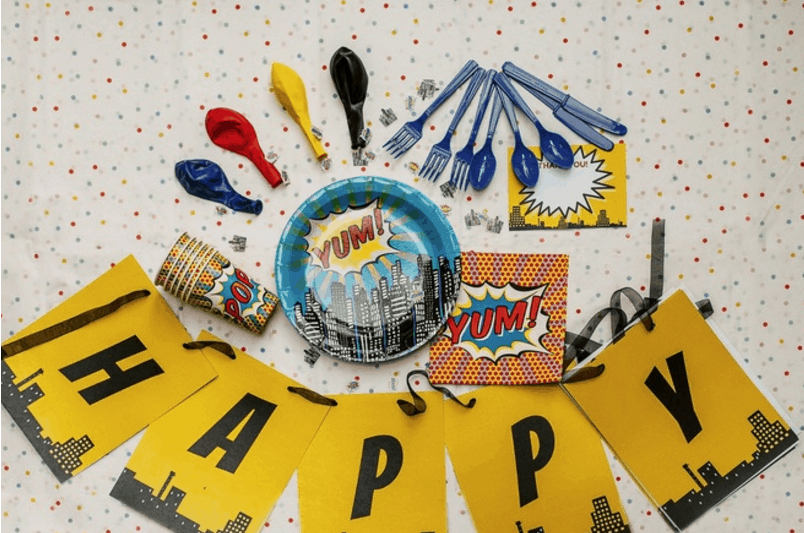
ParentVille is a one-stop party shop that connects you to recommended party suppliers in the London area. As we opted for a superheroes theme for my son’s birthday last year, we received the following Superhero party supply package from Crate a Party:
– Superhero themed paper plates
– Superhero themed napkins
– Blue and white striped straws
– Dark blue plastic cutlery (knives, forks and spoons)
– Superhero ‘Happy Birthday’ banner designed and made by Crate a Party
– 5 red, 5 yellow, 5 dark blue and 5 black latex balloons
– Silver balloon ribbon roll
– Multicoloured spotty tablecloth
– Superhero packet of table confetti
The Superhero Party Supplies package costs £7.50 per child – So, for 30 children that would be £225
You can find cheaper supplies at your nearest Pound Store or Supermarket. However, it is important to note that the quality may not be the same as Crate a Party’s party supply package, which all comes bundled together in one box and fits the theme of the party exactly. So, instead of sourcing all the items yourself, you may find it easier to go for the practical version that Crate a Party offers.
Party bags
Most people now do one useful gift, rather than a bag full of useless gifts and I am inclined to agree with this mindset. In the past, I thought that the more a child gets in their party bag, the more excited they are at receiving it. And, this may still be the case for the child, but for the parents, it’s a nightmare! So, I would seriously consider getting one decent gift instead, something that the child may get multiple uses out of, like a jigsaw set, a water bottle or a book. The parents will be grateful! I would suggest browsing through Parentville’s Party Bags & Sweets collection to see if you can find something suitable for your child’s party. Oh, and I always add a cupcake in the party bag, just as an extra sweet treat for the guests to take home. If you’re looking for theme-related cupcakes, Caketoppers specialise in cakes, cupcakes and printed icing edible toppers for delivery across the UK. They can personalise your cupcakes with a photo, logo or message. At my son’s party, I personalised the guest’s cupcakes with the TMNT crew, which went down very well with the guests.
Expect to not be in control of everything
You may have planned your party to a ‘T’, but on the day anything can happen. Not all the guests may turn up, or the venue may create some delays in the schedule. Maybe the food doesn’t turn out as planned or the entertainment bombs. Look in your child’s eyes. Do they care? Are they having the time of their lives? Then, throw all that negativity to the wind. You will get some parents who will complain that something wasn’t up to scratch, that’s normal. You can’t please everyone. As my mum always says:
“Give it your all, planning and preparing before the event because you can’t change what happens when it happens.”
I use this mantra in everything that I do and it has saved me a lot of stress going forward.
Video of Aron’s 6th birthday party
Taking into account everything that I have just said above, here is a video of how my son’s 6th birthday party turned out after careful planning and preparation.
https://youtu.be/DndbZXb1GtM
Good luck!
P.S – It’s nice to send out some Thank You cards to the guests after the party to acknowledge their attendance and thank them for their generous birthday gift. Crate a Party’s Superheros Party Package included some great Thank You cards, which we swiftly sent out a few days later.
Have you got any tips on how to create a memorable birthday party for your child? Please share wish us in the comments below.
*Disclaimer – Motherhood Diaries was gifted a party supplies package from Craft a Party, in collaboration with Parentville
Ravensburger Jigsaw Puzzle and Puzzle Handy Reviews
We are a family of jigsaw lovers, so when we do get the chance to review some very interesting puzzles from Ravensburger, we don’t tend to turn that opportunity down. This month, we received several jigsaw puzzles for review, including a helpful puzzle handy, which we now can’t do without!
Ravensburger jigsaw puzzles are brilliant, not just because of their great cardboard quality, but because of the way that Ravensburger innovatively fuses our love of jigsaw puzzles with art and education. So, people of all ages will be able to take something away with them every time they complete a puzzle.
Ravensburger products for review
Puzzle Handy
Best of British – The Supermarket, 1000pc Jigsaw Puzzle
The Puzzle Handy is a foldaway puzzle board that is best suitable for assembling 500-piece and 1,000-piece jigsaw puzzles. This durable board, which is made from top quality FSC board, is as handy as it says ‘on-the-tin’ because folding and unfolding is a breeze and you can secure the board with brackets included in the box so that everything stays put while you’re completing your jigsaw. The dotted guidelines help to position either a 500-piece or a 1000-piece puzzle, which is great during the jigsaw building process. When you’ve finished the puzzle, you can just fold the Puzzle Handy away by removing the brackets, refolding the board and popping it back in the storage box provided.
Specifications
Size: 30 x 43 x 6cm
Contents: Foldable jigsaw assembly board and 4 sturdy clamps
Buy here:
Best of British – The Supermarket, 1000pc
The boys (4 and 6 years old) and I loved this puzzle because it is so colourful and full of detail. This ‘CheapoSave’ supermarket epitomises the true experience that you receive when visiting a British superstore. There is so much to look at and lots of funny and amusing scenarios, which us Brits have experienced at a British supermarket at some point. The image reminds me of an Asda Walmart, a Costco or a Macro store, where you can find absolutely anything you need within the building and you get to witness people from all walks of life.
“Enter the world of “CheapoSave”, where you get less for a whole lot more. The attentive staff, excellent displays and extensive product range promise so much – but make sure you read the offers and labels very carefully to ensure you know what you’re really buying. Is that really a Jackson Pollock on the fish counter, and Mouskouri Nanas in the fruit & veg section?” Ravensburger
This puzzle was very difficult to build and it took such a long time, but we enjoyed the experience throughout because of the sheer image detail and the constant surprise as the puzzle was coming together. This jigsaw is suitable for people with patience and a sense of humour!
(We lost two pieces in the process )
Specifications
Size: 27 x 37 x 6cm
Buy here:
Vintage Travel, 500pc
The boys and I loved this vintage travel jigsaw. We enjoyed finding all the text first and piecing them together before working out the book edges for each respective country. This is such a beautiful and colourful jigsaw puzzle with very interesting travel guides. Again, the premium grade cardboard is such high quality and contains a linen finish which minimises glare on the puzzle image. Also, when you pick up a bunch of pieces, they don’t just fall apart in your hand. You can transport a group of pieces together and combine with the rest of the puzzle.
(one piece missing )
Specifications
Size: 49 x 36cm
Ages: 10 years and up
Buy here:
Gold Edition Country Cottage 300pc – with large pieces
This gold edition country cottage puzzle is a little bit different to the others as the pieces are larger, which makes them easier for kids to handle. Although, still a challenge, this timber framed English country cottage and garden in spring was a delight to complete and the boys had a great time, especially, piecing all the flowers together. It’s such a lovely colourful jigsaw with, again, premium grade cardboard and linen finish print to minimise glare.
Specifications
Size: 49 x 36cm
Age: Suitable for ages 9 years and up
Buy here:
Ravensburger puzzles are always a delight to complete and especially fun and educational for little hands too. You can find a whole range of Ravensburger’s puzzles on the website here or via various other stockists. They don’t just sell jigsaw puzzles too, you can find educational games like ‘My First Clock’ or slightly more difficult jigsaw puzzles like the Big Ben Silhouette puzzle (you can find the review here).
*Motherhood Diaries was gifted the above Ravensburger products, but all opinions are 100% our own*
Psoriasis – what you should know
Unpredictable, irritating, and puzzling, psoriasis is a multifactorial inheritedautoimmune skin condition, where the skin cells multiply up to 10 times faster than normal, resulting in red and white scaling (plaques) when the cells reach the surface and die. Scientists are only now beginning to understand the exact mechanism behind these accelerated skin cells and believe that genetics and environmental factors play a part in this chronic, but a non-contagious skin condition.
You will likely have one or more of the following symptoms if you suffer from psoriasis:
Dry, cracked skin that may start to bleed
Raised red areas of skin with silvery scales (plaques)
These red areas may itch or be sore. You may feel a burning sensation too
Thick, pitted fingernails
If you suffer from psoriasis on your legs, you may experience swelling of your ankles, due to poor circulation. Heels and toes can also become cracked and swollen.
The science behind psoriasis
Doctors are not entirely sure about why some people get psoriasis, but they do know how the disease works. The white blood cells called the T lymphocytes, or T cells, are the cells that go around your body and fight off bacteria and viruses, to stop you from getting sick. But, when someone has psoriasis, their T cells start attacking their healthy skin and their immune system responds by making new skin cells and white blood cells. However, the dead skin and white blood cells cannot shed quickly enough and therefore they build up on the surface and then turn to scales as the skin cells die. The important thing to note here is that psoriasis is not contagious, so you are not at risk of catching it from anyone. Genes are a huge factor here, however, the environment has a part to play too. Certain medicines, feeling unwell, cold weather and stress may trigger off a flare up.
(Image taken from World Psoriasis Day 2015 video on YouTube)
Different treatments work for different people, so it is best to speak to your doctor about what works for your skin. You will either be prescribed some medicine (in the form of a cream, lotion or ointment) or phototherapy. Light therapy includes exposing the affected skin to some natural ultraviolet light. A little sunlight can help to alleviate some skin flares up, however, be mindful that too much sun could make psoriasis worse. Also, keeping your skin – especially your feet – as clean and as fresh as possible is the key to managing psoriasis. For feet, footwear should be light and comfortable throughout the year. During the winter, you should keep your feet as warm as possible, especially if you suffer from poor circulation in the legs.
Can changing your diet help?
Being overweight has also been known to be a factor because psoriasis can break out where the excess skin folds. Some psoriasis suffers have claimed that the infamous paleo diet (where you follow the diet our ancestors had during the Palaeolithic era) is the key to alleviating symptoms of psoriasis. However, results have shown that a personalised diet plan and great exercise works to help keep the body functioning at its best, thus, improving psoriasis symptoms in the long-term.
YouTube is a great way to gain access to lots of information about psoriasis
Head over to YouTube where you can use psoriasis videos to help you understand your skin condition, learn how to treat it, and gain support from other psoriasis sufferers too. Ladies, you can even find a great video on creating a flawless foundation base too!
Track your psoriasis at the touch of a button with MyPso app
When you get a flare up at any point in the day, it may feel like you are not in control of your psoriasis. So, LEO Pharma has created a free psoriasis treating tracking app, where you can log your symptoms and triggers, map your trends and progress and download results, which will help you to see the ‘bigger picture’ of your psoriasis. MyPso also includes practical advice to make small changes that can have a big impact on your skin. Click here to download the app today.
Take the MINDBOOST questionnaire and get psoriasis support today
Psoriasis can be inherently stressful because of the impact it has on your daily life. So, MINDBOOST created a free customised programme that offers you a series of physical and mental exercises that are grouped into three key areas: confidence, mood and focus. Your progress in each MINDBOOST area is shown on its shield. When you have completed all the exercises in a particular area, your shield will be fully boosted. Take the psoriasis support questionnaire here.
Help raise awareness and join the #DiscoverPsoriasis campaign now
There is a lack of knowledge about psoriasis, which means people around the world are suffering in silence. Spreading the knowledge and raising awareness on the effects of psoriasis in both children and adults can mean that patients feel more understood and accompanied. If you want to help increase awareness, join the campaign now, by writing ‘#DiscoverPsoriasis’ somewhere on your skin, take a picture or make a video, and share one of the two below messages to support people with psoriasis:
(Image taken from World Psoriasis Day 2015 video on YouTube)
PSORIASIS IS NOT CONTAGIOUS
2 OUT OF 100 PEOPLE SUFFER FROM PSORIASIS
Are you suffering from psoriasis? How do you alleviate your symptoms? And, please do let us know if you will be taking part in the #DiscoverPsoriasis campaign. Hopefully, we can spread the message to the whole world!
*Collaborative Featured Post*
Subscribe here to be updated with new posts. Don’t forget to tailor your preferences, so you just get the posts you want and need!