What to include in a high conflict divorce parenting plan
Divorce is one of life’s most challenging transitions, often bringing a whirlwind of emotions and significant life changes. Navigating this difficult period requires more than just legal assistance; it demands a focus on self-care and emotional resilience. While the role of divorce lawyers is crucial, it’s equally important to employ strategies like a high conflict divorce parenting plan that not only supports your mental and emotional wellbeing, but explores practical ways to manage the emotional toll of divorce, so you can come out stronger on the other side.
In this article, we’ll discuss what a high conflict divorce is and provide tips on what to include in the parenting plan that offers physical and mental health support for the entire family.
What is a high conflict divorce?
High conflict divorces are characterised by intense, prolonged legal disputes and significant emotional turmoil. These divorces often involve frequent and hostile interactions between the parties, making it difficult to reach amicable resolutions. The conflicts can revolve around various issues, including child custody order, financial settlements, and personal grievances, and can have a profound impact on everyone involved, especially children’s lives.
Unlike more amicable divorces where both parties may work together to resolve their differences, high-conflict divorces are marked by ongoing disputes with high-conflict custody situations and a lack of resolution. Key indicators of a high-conflict divorce include:
Frequent litigation over joint custody and financial matters
High levels of stress and emotional strain
Difficulties in co-parenting and reaching a parenting agreement
Persistent negative interactions and direct communication breakdowns
Importance of a structured parenting plan
In high-conflict divorces, a structured parenting plan is essential to mitigate the negative effects on children’s well-being and to provide a clear framework for co-parenting. Learning how to co-parent with an ex effectively is crucial for implementing these plans successfully, especially when dealing with ongoing conflicts and communication challenges. A well-designed parenting plan can help:
Reduce conflict
A structured plan can minimise the potential for disputes and outline the responsibilities and schedules of each parent.
Provide stability for children
Children thrive on routine and predictability. A detailed parenting plan will ensure kids have a consistent and stable environment, despite the parental conflict.
Ensure fairness and clarity
A comprehensive plan helps both parents understand their roles and responsibilities, which promotes fairness and reduces resentment.
Support emotional wellbeing
Having a clear plan in place can reduce the stress and anxiety that often come with high conflict divorces, which helps both parents and children cope better with the transition.
Embrace a support system
During a divorce, isolation can amplify negative feelings, so it’s important to lean on a support system of friends, family, and professional counsellors. Surround yourself with people who offer emotional support and engage in open conversations, where you can express your feelings and seek help when needed. These connections provide a buffer against stress and help you process your emotions more effectively.
Role of friends and family
Friends and family can offer the emotional backing you need to navigate this challenging time and can help mitigate feelings of loneliness and isolation. Social connections are linked to better mental healthoutcomes, which is particularly important when dealing with the emotional strain of a divorce.
How to communicate your needs to your support system
Communicating effectively with your support system helps you get the support you need. Here are some tips:
Be Honest: Share your feelings openly with trusted friends and family members. Let them know exactly what you’re going through and how they can help.
Be Specific: If you need specific support, such as someone to talk to, or help with childcare or daily tasks, make these needs clear.
Set Boundaries: While it’s important to lean on your support network, it’s equally vital to set boundaries so your relationships remain healthy and balanced.
Show Gratitude: Express appreciation for the support you receive. Acknowledging their help strengthens your bond and encourages ongoing support.
Professional counsellors and therapists
Professional counsellors and therapists offer structured support that friends and family might not be able to provide. They can help you navigate complex emotions, develop coping strategies, and provide a safe space to express your feelings. Here are some specific benefits:
Objective Perspective: Therapists provide an impartial viewpoint, helping you see situations more clearly and avoid being overwhelmed by emotions.
Coping Strategies: They can teach you practical techniques to manage stress, anxiety, and other negative emotions.
Long-term Support: Professional guidance can help you build resilience and equip you with tools to handle future challenges.
How to find the right therapist or counsellor
Finding the right therapist or counsellor is crucial for effective support. Here are steps to help you find the right professional:
Research: Look for therapists who specialise in divorce, family therapy, or high conflict situations. Online directories, such as Psychology Today, can be helpful.
Ask for Recommendations: Seek recommendations from friends, family, or your primary care physician.
Check Credentials: Make sure your therapist is licensed and has the necessary qualifications and experience.
Initial Consultation: Many therapists offer a free initial consultation. Use this opportunity to discuss your needs, ask about their alternative approach, and see if you feel comfortable with them.
Consider Compatibility: It’s important to choose someone you feel comfortable with and who understands your specific situation.
Relevant Studies:
Holt-Lunstad, J., Smith, T.B., & Layton, J.B. (2010). Social Relationships and Mortality Risk: A Meta-analytic Review. PLoS Medicine, 7(7), e1000316.
This study highlights the importance of social relationships and their impact on health outcomes, emphasising the value of a support system during stressful times like a divorce. The meta-analysis found that individuals with strong social ties had a 50% increased likelihood of survival, underscoring the critical role of social support in mitigating stress and promoting overall health.
Prioritise physical health
Physical health is closely linked to emotional wellbeing. Regular exercise, a balanced diet, and adequate sleep are fundamental to maintaining your physical health. Exercise, in particular, releases endorphins, which can boost your mood and reduce stress. Consider incorporating activities like yoga, which not only benefits the body but also calms the mind. Eating nutritious meals and maintaining a regular sleep schedule can also provide stability during turbulent times.
Exercise can:
Boost Mood: Physical activity increases the production of endorphins, the body’s natural mood lifters, which can help alleviate feelings of anxiety and depression.
Reduce Stress: Exercise helps lower the levels of stress hormones like cortisol, providing a natural way to manage stress.
Improve Sleep: Regular exercise can help you fall asleep faster and enjoy deeper sleep, which is essential for emotional resilience.
Enhance Focus and Concentration: Physical activity increases blood flow to the brain, improving cognitive function and helping you stay focused during challenging times.
Recommended activities
With exercise, finding activities that you enjoy is key to maintaining a consistent routine. Here are some recommended activities:
Yoga: Yoga combines physical postures, breathing exercises, and meditation to promote relaxation and mental clarity. It’s particularly effective for reducing stress and improving flexibility.
Walking: A simple walk in nature can do wonders for your mental health. Walking is accessible, requires no special equipment, and allows you to clear your mind.
Gym Routines: Strength training and cardiovascular exercises at the gym can provide a structured way to improve your fitness and release stress.
Swimming: Swimming is a low-impact exercise that can help you stay fit without putting too much strain on your joints. It’s also a great way to relax and unwind.
Balanced diet
Nutrition plays a crucial role in how your body manages stress. A balanced diet can help stabilise your mood, boost your energy levels, and support overall wellbeing. Here’s why nutrition matters:
Regulates Blood Sugar Levels: Eating balanced meals with protein, healthy fats, and complex carbohydrates can prevent blood sugar spikes and crashes, which can affect your mood and energy levels.
Supports Brain Health: Nutrients like omega-3 fatty acids, found in fish, and antioxidants, found in fruits and vegetables, are essential for brain health and can help reduce symptoms of depression and anxiety.
Promotes Physical Health: Good nutrition supports your immune system, reduces inflammation, and helps maintain a healthy weight, all of which are important for managing stress.
Sample meal plans and dietary tips
Maintaining a balanced diet doesn’t have to be complicated. Here are some simple meal ideas and tips to keep you on track:
Breakfast: Start your day with a nutrient-rich meal, such as oatmeal topped with berries and nuts, or a smoothie made with spinach, banana, and almond milk.
Lunch: Opt for a balanced meal like a quinoa salad with mixed vegetables and grilled chicken, or a whole-grain wrap with hummus, avocado, and fresh veggies.
Dinner: Include a variety of foods such as baked salmon with steamed broccoli and sweet potatoes, or a stir-fry with tofu, brown rice, and colourful vegetables.
Snacks: Choose healthy snacks like Greek yoghurt with honey, apple slices with peanut butter, or a handful of almonds.
Adequate sleep
Getting enough quality sleep is essential for emotional resilience and overall health. Here are some tips to help you improve your sleep:
Establish a Routine: Go to bed and wake up at the same time every day, even on weekends, to regulate your internal clock.
Create a Sleep-Conducive Environment: Ensure your bedroom is dark, quiet, and cool. Consider using blackout curtains, earplugs, or a white noise machine.
Limit Screen Time: Avoid screens (phones, tablets, computers) at least an hour before bedtime, as the blue light can interfere with your ability to fall asleep.
Practice Relaxation Techniques: Engage in calming activities before bed, such as reading, taking a warm bath, or practising mindfulness meditation.
Sleep is crucial for emotional wellbeing and cognitive function. Lack of sleep can:
Increase Stress Levels: Sleep deprivation can elevate stress hormones, making it harder to cope with daily challenges.
Impair Final Decision-Making: Poor sleep affects your ability to think clearly and make major decisions, which is particularly important during a high conflict divorce.
Affect Mood: Lack of sleep can lead to irritability, mood swings, and increased feelings of anxiety and depression.
Seek professional guidance
Besides the invaluable support from friends and family, professional guidance from therapists or counsellors can offer more structured support. Therapy provides a safe space to explore your feelings and develop coping strategies. Cognitive-behavioural therapy (CBT), for example, can help reframe negative thought patterns and foster a more positive outlook. Don’t overlook the importance of legal advice either; consulting with experienced divorce lawyers ensures you understand your rights and can make informed decisions about your future.
Legal assistance
Navigating a high conflict divorce requires specialised legal expertise. A lawyer experienced in handling high conflict divorces can provide critical support in several ways:
Strategic Guidance: They can develop a tailored strategy that addresses the specific challenges of your case, so yours and your child’s best interests are protected.
Legal Representation: An experienced lawyer can represent you in family court, manage negotiations, and handle all legal documentation, reducing your stress and workload.
Conflict Mitigation: A skilled lawyer can help de-escalate conflicts by acting as an intermediary between you and your high-conflict ex-spouse, which promotes a more civil and productive dialogue.
Knowledge of Legal Rights: They can educate you about your legal rights and obligations, ensuring you make informed decisions throughout the divorce process.
How to choose the right lawyer
Choosing the right lawyer is important for managing a high conflict divorce. Here are some tips to help you find the right legal professional:
Research: Look for lawyers who specialise in family law and have extensive experience with high conflict divorce cases. Online reviews, legal directories, and recommendations from friends or other professionals can be valuable resources.
Consultations: Schedule initial consultations with a few lawyers to discuss your case and evaluate their approach. Many lawyers offer free or low-cost initial consultations.
Check Credentials: Make sure the lawyer is licensed and in good standing with the state bar association. Look for any disciplinary actions or complaints against them.
Assess Compatibility: It’s important to choose a lawyer you feel comfortable with and who understands your specific situation. Effective communication and mutual respect are key factors in a successful lawyer-client relationship.
Ask About Fees: Understand the lawyer’s fee structure, including hourly rates, retainer fees, and any additional costs. Make sure you are clear about how you will be billed and what services are included.
The role of therapy in high conflict divorces
Therapy plays a crucial role in helping individuals navigate the emotional turmoil of a high conflict divorce. Here’s how therapy can benefit you:
Emotional Support: A therapist provides a safe and non-judgmental space to express your feelings, helping you process emotions like anger, sadness, and fear.
Coping Strategies: Therapists can teach you practical coping mechanisms to manage stress, anxiety, and other negative emotions. These strategies can improve your overall emotional resilience.
Improved Communication: Therapy can enhance your communication skills and offer communication guidelines, making it easier to interact with your ex-spouse and high- conflict co-parent effectively.
Perspective and Insight: A therapist can offer new perspectives on your situation, helping you gain insights into your behaviour and thought patterns. This can be particularly useful in breaking negative cycles and fostering personal growth.
Overview of Cognitive-behavioural Therapy (CBT) and other relevant therapies
Cognitive-behavioural therapy (CBT) is one of the most effective therapeutic approaches for managing the psychological impact of a high conflict divorce. Here’s an overview of CBT and other relevant therapies:
Cognitive-behavioural Therapy (CBT): CBT focuses on identifying and changing negative thought patterns and behaviors. It helps individuals reframe their thinking, develop healthier coping mechanisms, and improve emotional regulation. According to Hofmann, S.G., Asnaani, A., Vonk, I.J.J., Sawyer, A.T., & Fang, A. (2012), CBT has been shown to be highly effective in treating various mental health issues, including anxiety and depression, which are common during high conflict divorces.
Mindfulness-based Therapy: This approach incorporates mindfulness practices to help individuals stay present and manage stress more effectively. Techniques such as meditation, deep breathing, and mindful awareness can reduce anxiety and improve emotional well-being.
Emotionally Focused Therapy (EFT): EFT is designed to improve emotional attachment and bonding between individuals. It can be particularly helpful for couples going through a divorce who need to improve their traditional co-parenting relationship.
Family Therapy: This type of therapy involves working with family members to address and resolve issues affecting the family dynamic. It can be beneficial for children experiencing the effects of a high conflict divorce, helping them process their emotions and improve communication with both parents.
Engage in self-reflection
Divorce, while painful, can also be an opportunity for self-discovery and growth. Taking time to reflect on your life, your goals, and what you want for your future can help you navigate this challenging period and journalling can be a helpful tool in this process. Reflecting on your experiences helps gain insights into what you want to change and what you aspire to achieve.
Benefits of journalling during divorce
Journalling is a powerful tool that can help you process your emotions and gain clarity during a high conflict divorce. Some benefits include:
Emotional Release: Writing about your feelings can provide an emotional outlet, helping to reduce stress and anxiety.
Self-Awareness: Journalling encourages self-reflection, allowing you to better understand your thoughts, behaviours, and reactions.
Problem Solving: By documenting your experiences, you can identify patterns and develop strategies to address challenges.
Goal Setting: Writing about your goals and aspirations helps to clarify your vision for the future and keep you focused on positive outcomes.
Prompts and tips for effective journalling
To get started with journalling, consider these prompts and tips:
Daily Reflections: Write about your day, focusing on your emotions, interactions, and any challenges you faced.
Gratitude Lists: List things you are grateful for each day to shift your focus toward the positive aspects of your life.
Future Goals: Write about your short-term and long-term goals, and outline steps to achieve them.
Stress Triggers: Document situations that trigger stress or anxiety, and explore ways to manage these feelings.
Letters to Yourself: Write letters to your future self, offering advice and encouragement based on your current experiences.
Relevant Studies:
Pennebaker, J.W., & Seagal, J.D. (1999). Forming a Story: The Health Benefits of Narrative. Journal of Clinical Psychology, 55(10), 1243-1254.
This study explores how writing about emotional experiences, such as through journaling, can promote mental and physical health. The act of forming a narrative around your experiences can help you make sense of them and facilitate emotional healing.
Setting future goals
Setting clear, achievable goals is crucial during a high conflict divorce. Goals provide direction and purpose, helping you stay focused on the future rather than dwelling on past conflicts. They also give you something positive to work toward, which can boost your motivation and self-esteem.
Steps to set and achieve personal goals
Here are some steps to help you set and achieve your personal goals:
Identify Your Priorities: Determine what is most important to you, whether it’s your career, personal growth, relationships, or health.
Set SMART Goals: Make sure your goals are Specific, Measurable, Achievable, Relevant, and Time-bound.
Break It Down: Divide larger goals into smaller, manageable steps to make them less overwhelming.
Create a Plan: Develop a detailed plan outlining the steps you need to take to achieve each goal.
Monitor Progress: Regularly review your progress and adjust your plan as needed.
Celebrate Milestones: Acknowledge and celebrate your achievements along the way to stay motivated.
Stay connected with your passions
Reconnecting with hobbies and interests that bring joy can be incredibly therapeutic. Engage in activities you love so it helps shift your focus away from the stress of divorce. It’s also an excellent way to meet new people and build a new social network, further supporting your emotional health.
List of hobbies and their benefits
Here are some hobbies you might consider and their benefits:
Painting or Drawing: Creative activities like painting or drawing can be very relaxing and provide a way to express your emotions visually.
Hiking or Walkming: Being in nature and getting physical exercise can improve your mood and reduce stress.
Reading: Losing yourself in a good book can be a great escape and help you relax.
Cooking or Baking: Trying new recipes and cooking healthy meals can be both enjoyable and beneficial for your wellbeing.
Gardening: Working with plants can be therapeutic and provide a sense of accomplishment.
Finding new interests
If you’re looking to explore new hobbies, here are some tips:
Try Different Activities: Experiment with various activities to see what you enjoy most.
Join Clubs or Groups: Look for local clubs or online communities that focus on activities you’re interested in.
Take Classes: Consider taking a class to learn a new skill or hobby.
Volunteer: Volunteering can be a fulfilling way to spend your time and meet new people.
Meeting new people post-divorce
Building a new social network is important for emotional support and companionship. Here are some ways to meet new people:
Join Social Groups: Look for groups or clubs in your area that share your interests, whether it’s a book club, hiking group, or art class.
Attend Community Events: Participate in local events and activities to meet new people.
Use Social Media: Online platforms can help you connect with like-minded individuals and expand your social circle.
Take Up a New Hobby: Engaging in new activities can introduce you to people who share your interests.
Volunteer: Volunteering for a cause you care about can help you meet compassionate and dedicated people.
Social connections are vital for your emotional health and well-being. They provide:
Emotional Support: Friends and social networks can offer comfort and understanding during tough times.
Reduced Stress: Social interactions can help reduce stress and improve your mood.
Sense of Belonging: Being part of a community or group can give you a sense of belonging and purpose.
Opportunities for Fun: Social activities can bring joy to your life, which is essential for emotional well-being.
Educate yourself
Knowledge is empowering. Educating yourself about the divorce process and the legal and financial implications involved can help you feel more in control and reduce anxiety stemming from uncertainty. Understanding what to expect can also prepare you for the practical aspects of your divorce.
Key stages of the divorce process
Here are the key stages you can expect during the divorce process:
Filing for Divorce: One spouse files a divorce petition, and the other spouse is served with divorce papers.
Response: The other spouse files a response to the petition, indicating whether they agree or disagree with the terms.
Discovery: Both parties exchange information and documents related to assets, debts, income, and other relevant matters.
Negotiation: The spouses negotiate terms of the divorce, including division of assets, physical custody of the children, and support arrangements. This can involve mediation or collaborative divorce processes.
Trial: If negotiations fail, the case goes to trial, where a judge makes the final decisions on contested issues.
Finalisation: Once all terms are agreed upon or decided by the court, the divorce is finalised, and a divorce decree is issued.
Legal and financial implications
Understanding the legal and financial implications of divorce is crucial. This includes:
Division of Assets: How property and debts will be divided between the spouses.
Child Custody Time and Support: Arrangements for the custody exchanges and support of children, including parenting time holiday schedules.
Spousal Support: Whether one spouse will provide financial support to the other, and for how long.
Legal Fees: The costs associated with hiring attorneys and other legal expenses.
Online resources
There are numerous online resources available to help you understand the divorce process and its implications:
Motherhood Diaries: Our website provides valuable insights into various aspects of life, including handling major transitions like divorce.
Legal Websites: Websites like LegalZoom and Nolo offer detailed information about the divorce process and legal considerations.
Support Forums: Online forums and support groups can provide community and advice from others who have gone through similar experiences.
Books and workshops
In addition to online resources, books and workshops can provide in-depth knowledge and support:
Books: Look for books on divorce by reputable authors and legal experts. Titles like “The Divorce Handbook” by James T. Friedman and “Crazy Time: Surviving Divorce and Building a New Life” by Abigail Trafford can be helpful.
Workshops: Many communities offer workshops on divorce and co-parenting. These can provide valuable information and support from professionals and peers.
Practice mindfulness and meditation
Mindfulness and meditation are effective practices for managing stress and maintaining emotional balance. These techniques encourage you to stay present and focused, reducing the tendency to dwell on past regrets or future worries. Regular mindfulness practice can improve your overall mental health, making you more resilient to the emotional ups and downs of divorce.
Practicing mindfulness and meditation offers numerous benefits, including:
Improved Emotional Regulation: Meditation can enhance your ability to manage emotions, reducing reactivity and promoting calmness.
Better Focus: Mindfulness practices improve concentration and mental clarity.
Enhanced Wellbeing: Regular meditation can increase feelings of happiness and well-being.
Overview of mindfulness practices
Here are some mindfulness practices that can be particularly beneficial during a high conflict divorce:
Mindful Breathing: Focus on your breath, observing each inhale and exhale without judgment. This simple practice can be calming and centring.
Body Scan: Pay attention to different parts of your body, noticing any sensations without trying to change them. This practice helps you become more aware of physical and emotional tension.
Mindful Walking: Walk slowly and deliberately, focusing on the sensations of your feet touching the ground and your surroundings. This practice helps you stay present and grounded.
How meditation can help manage stress
Meditation trains your mind to stay focused and calm, even in stressful situations. By regularly practising meditation, you can:
Decrease Anxiety: Meditation reduces the physiological markers of anxiety, such as heart rate and blood pressure.
Increase Resilience: Regular practice builds mental resilience, helping you bounce back more quickly from setbacks.
Improve Sleep: Meditation can enhance sleep quality by promoting relaxation and reducing the mental chatter that often interferes with sleep.
Techniques and exercises
Here are some basic meditation techniques to get you started:
Mindful Breathing: Sit or lie down comfortably. Close your eyes and take deep breaths, focusing on the sensation of air entering and leaving your body. If your mind wanders, gently bring your focus back to your breath.
Loving-Kindness Meditation: Sit comfortably and close your eyes. Focus on sending positive thoughts and wishes to yourself, then gradually extend these thoughts to others, including people you have ongoing conflicts with.
Guided Meditation: Use apps like Headspace or Calm, which offer guided meditation sessions that can help you stay focused and relaxed.
Mindfulness exercises for daily practice
Incorporate these mindfulness exercises into your daily routine:
Mindful Eating: Pay full attention to the taste, texture, and smell of your food. Eat slowly and savour each bite.
Mindful Listening: During conversations, focus fully on what the other person is saying without planning your response or getting distracted.
Gratitude Practice: At the end of each day, write down three things you are grateful for. This practice shifts your focus to the positive aspects of your life.
Relevant Studies:
Goyal, M., Singh, S., Sibinga, E.M.S., Gould, N.F., Rowland-Seymour, A., Sharma, R., … & Haythornthwaite, J.A. (2014). Meditation Programs for Psychological Stress and Well-being: A Systematic Review and Meta-analysis. JAMA Internal Medicine, 174(3), 357-368.
This meta-analysis supports the efficacy of meditation programs in reducing psychological stress and improving well-being. The study found that meditation can significantly reduce symptoms of anxiety, depression, and pain.
Build a new routine
Establishing a new daily routine can create a sense of normalcy amidst the chaos of divorce. Incorporate activities that promote wellbeing, such as exercise, healthy eating, and social interactions. A structured routine helps you stay grounded and focused on the positive aspects of your life.
Importance of routine for stability
A consistent daily routine provides structure and predictability, which can be incredibly comforting during times of upheaval. It helps you:
Maintain Focus: A routine keeps you organised and focused on your daily tasks, reducing overwhelm.
Enhance Productivity: Knowing what to expect each day can improve your efficiency and productivity.
Promote Stability: Routines offer stability and normalcy, helping you feel more in control of your life.
Sample daily schedules
Here are some sample daily schedules to inspire you:
Morning Routine:
Wake up at the same time each day.
Engage in a brief meditation or mindfulness practice.
Have a healthy breakfast.
Plan your tasks for the day.
Afternoon Routine:
Take regular breaks during work or daily activities.
Have a nutritious lunch.
Incorporate physical activity, like a walk or workout.
Evening Routine:
Wind down with a relaxing activity, such as reading or listening to music.
Have dinner at a consistent time.
Reflect on your day and journal any thoughts or goals.
Practice a bedtime routine that promotes good sleep hygiene.
Tips for balancing work, parenting, and self-care
Balancing your responsibilities while taking care of yourself is crucial. Here are some tips:
Prioritise Self-Care: Schedule time for self-care activities, such as exercise, hobbies, and relaxation.
Set Boundaries: Clearly define your work hours and personal time to prevent burnout.
Delegate Tasks: Don’t hesitate to ask for help with household chores or childcare to lighten your load.
Plan Ahead: Use planners or digital tools to organise your tasks and ensure you have time for self-care and family activities.
How to adjust routines as needed
Flexibility is key to maintaining a routine that works for you. Here’s how to adjust your routines:
Evaluate Regularly: Periodically assess your routine to see what’s working and what isn’t.
Be Flexible: Be open to making changes as your needs and circumstances evolve.
Stay Consistent: While adjustments are necessary, try to maintain core elements of your routine for stability.
Final thoughts on a high conflict divorce parenting plan
Divorce is undoubtedly challenging, but with the right strategies, you can navigate this transition with resilience and emerge stronger. Embrace your support system, prioritise your physical and emotional health, seek professional guidance, and stay connected with your passions. By focusing on self-care and personal growth, you can transform this difficult period into an opportunity for a fresh start and a brighter future.
FAQ Section
General questions about high conflict divorce
What constitutes a high-conflict divorce?
A high-conflict divorce is characterised by frequent and high-conflict situations between the divorcing parties, often involving issues such as custody, financial disagreements, and personal animosity.
How do you win a high-conflict divorce?
Winning a high-conflict divorce involves securing favourable terms for the custody schedule and child support, financial settlements, and other key issues. It often requires a strong legal strategy, the support of a skilled lawyer, and maintaining a focus on the best interests of any children involved.
What percentage of divorces is high-conflict?
It is estimated that approximately 10-15% of divorces can be classified as high-conflict, involving prolonged and contentious disputes.
What is considered a high-conflict marriage?
A high-conflict marriage is one in which frequent, intense, and unresolved high levels of conflict occur, often leading to a toxic and unsustainable relationship dynamic.
Percentage…what percentage of divorces are high conflict?
Similar to the earlier statistic, around 10-15% of divorces fall into the high-conflict category.
Dealing with high conflict divorce
How to deal with high conflict divorce?
Dealing with a high-conflict divorce requires effective communication strategies, professional guidance, and a focus on emotional resilience. It’s important to seek support from therapists and maintain healthy routines.
How to handle high conflict divorce?
Handling a high-conflict divorce involves setting clear boundaries, documenting interactions, and seeking the support of legal and mental health professionals to navigate the challenges effectively.
Legal and professional guidance
How can a family divorce attorney help someone who is facing a high conflict divorce?
A family divorce attorney can provide crucial legal advice, represent your interests in court, and help negotiate terms that protect your rights and well-being.
How did you succeed in getting sole legal custody in a very high conflict parenting situation?
Succeeding in getting sole legal custody typically involves presenting a compelling case that demonstrates the other parent’s inability to provide a stable and safe environment for the children.
How much does a trial for custody usually cost on average if it’s high conflict?
The cost of a custody trial in a high-conflict divorce can vary widely but often ranges from several thousand to tens of thousands of dollars, depending on the complexity and duration of the case.
Parenting and custody concerns
How do conflicts over parenting play a role in the increasing number of divorce cases in Hong Kong?
High conflict cases over parenting can exacerbate the stress and disagreements that lead to divorce, particularly in high-stakes environments like Hong Kong where cultural and societal expectations can add pressure.
What are some strategies to ensure the safety of children in divorce and custody battles?
Strategies to ensure children’s safety include establishing clear custody arrangements, involving child psychologists, and maintaining open communication about their needs and feelings.
Emotional and practical support
What is the best way to avoid a messy divorce? It seems so silly to waste all your money, time, and resources on lawyers rather than saving for your kids’ future
The best way to avoid a messy divorce is through mediation, open communication through text messages if needs be, and focusing on amicable solutions that prioritise the wellbeing of the children over personal conflicts.
How do stepmoms deal with a high conflict biological mom without losing your mind and your marriage?
Stepmoms can deal with high-conflict biological moms by setting boundaries, seeking support from their spouse, and possibly engaging in family therapy to manage the dynamics.
What are some tips for coping with your parents’ custody battle for kids?
Tips for coping with your high-conflict parents’ custody battle include talking to a trusted adult, seeking counselling, and finding healthy outlets for your emotions, such as hobbies or sports.
Why would an 11-year-old or teenager wish for shared time with a divorced parent where there is high conflict to the point the matter has reached court especially if it might upset the primary carer parent in some way?
An 11-year-old or teenager might wish for shared time to maintain a relationship with both parents, despite the conflict. Parents must address these feelings and involve a therapist if needed.
What’s the best way to survive in a high conflict household until one can get out on their own?
The best way to survive is to seek support, develop coping strategies, and plan for a safe and stable exit when possible.
Is divorce a good idea when you have kids? How did the kids get affected with this?
Divorce can be a good idea if it leads to a healthier environment for the kids. The effects on children vary, but they can be mitigated with proper support and communication.
Is it true good relationships keep us happier and healthier? Does high conflict marriages, for example without much affection, turn out to be very bad for our health perhaps worse than getting divorced?
Yes, good relationships contribute to happiness and health, while high-conflict marriages can have detrimental effects on mental and physical well-being, often making divorce a healthier option.
*Collaborative feature post*
How to make a reasonable parenting time holiday schedule
Family travel is a wonderful way to create lasting memories, strengthen family bonds, and expose your child to new cultures and experiences. However, for separated or divorced parents, creating a parenting time holiday schedule can be challenging because the holiday schedule needs to be fair, balanced, and in the best interest of the child. A well-planned parenting time holiday schedule is crucial for ensuring that both parents can spend quality time with their children during special occasions like Father’s Day, Mother’s Day or your child’s birthday.
This article will go through practical tips for creating a holiday schedule that balances time between both parents and also aligns with your child’s best interests. A clear and thoughtful parenting plan can significantly reduce conflicts, and make the holiday experience a smoother and more enjoyable ride for the entire family.
General rules applicable to parenting time
Parenting time, also known as visitation, is the schedule that determines when the child can spend time with each parent. This schedule helps to maintain consistency and stability in the child’s life and prioritises having a meaningful relationship with both parents, which is essential for emotional wellbeing and development. A structured parenting time plan can avoid confusion and conflict, providing a predictable routine for the children.
Court guidelines
Family courts often provide guidelines for creating a parenting time schedule. These guidelines offer both parents the opportunity to spend time with their young children during the holidays. Courts typically consider factors such as the child’s age, school schedule, and the distance between parents’ homes. For example, Wayne County parenting time holiday schedule guidelines in Michigan provide specific recommendations to ensure fairness and balance.
Flexibility and communication
Flexibility and open communication are key components of a successful parenting time schedule. Parents should be willing to adjust plans as needed to accommodate each other’s schedules and the child’s needs. Effective communication can help to conflicts amicably and ensure both parents are on the same page regarding holiday arrangements.
Specific parenting time provisions
Holiday parenting time: key considerations for major holidays
Planning your holiday parenting schedule can be complex, as it involves major holidays such as Christmas, New Year, and Thanksgiving, as well as school breaks like summer break and spring break. Key considerations include making sure both parents celebrate significant holidays with their child and maintain a fair balance of time. Parents should alternate or share specific holidays like Memorial Day, Labor Day, Christmas Day and New Year’s Day to allow both parents to enjoy those special moments with their child.
Scheduling tips: practical tips for creating a holiday budget
Creating a holiday budget will help you manage your expenses, so you can enjoy your vacation without financial stress. For practical tips, consider creating a holiday budget, so you’re financially ready for holiday activities. This includes setting aside funds for travel, gifts, and special events, which can help alleviate financial pressures and allow for more enjoyable and stress-free holidays.
Parenting time when distance is a major factor
Long-distance parenting: challenges and solutions
When parents live far apart, travel arrangements for children can become more complex. This might involve longer stays with each parent during holidays or breaks to reduce the frequency of travel. It’s important to plan ahead and consider factors such as travel costs, time zones, and the child’s comfort during long trips.
Travel arrangements: tips for smart planning
Smart planning can help manage costs and reduce stress. For tips on saving on travel expenses, consider smart planning for travel and accommodation. Booking flights in advance, using comparison websites, and being flexible with travel dates can significantly cut down costs. Additionally, planning activities and accommodations that cater to your child’s needs can make the experience more enjoyable.
Virtual visits: incorporating video calls
In cases where physical visits aren’t possible, virtual visits through video calls can help maintain the parent-child relationship. Regular video calls, online games, and virtual shared activities can bridge the gap and keep the bond strong, so your child feels connected to both parents, even when distance is a factor.
Shared parenting
Co-parenting strategies
Effective co-parenting practices always includes clear communication and flexibility. Parents should coordinate schedules for the school day, school year and family traditions in advance, remain open to adjustments and respect each other’s time and commitments to maximise a cooperative environment.
Holiday swap: alternating holidays
Alternating holidays means both parents get to enjoy special times with the children. For instance, one parent might have the children for Christmas one year and New Year’s the next. This balanced approach helps keep things fair and allows both parents to celebrate important holidays with their children.
Shared parenting benefits: emotional wellbeing
Shared parenting can be a meaningful experience for your child because it provides stability and continuity, which is crucial for development and a more balanced and supportive upbringing.
Parenting coordination
Role of a parenting coordinator: mediation and conflict resolution
A parenting coordinator can help mediate disputes and create a workable holiday schedule. This neutral third party helps resolve conflicts and makes sure both parents agree on the schedule. Mediation and arbitration can provide a structured environment for discussing and resolving disagreements.
Conflict resolution: strategies to handle disagreements
Strategies to handle disagreements include creating a detailed holiday schedule well in advance and agreeing on contingency plans for unexpected events. This proactive approach reduces last-minute conflicts and ensures both parents are prepared for any changes that might arise.
Will shared parenting work for you?
Self-assessment questions
Self-assessment questions can help determine the feasibility of shared parenting. You should start by evaluating your ability to cooperate and communicate effectively and consider factors like mutual respect, willingness to compromise, and the ability to prioritise your child’s needs over personal differences.
Impact on children: stability and happiness
Consider how different schedules can affect your child’s stability and happiness. A consistent and predictable schedule helps them feel secure and reduces anxiety. It’s important to understand the impact of shared parenting on your child’s emotional and psychological wellbeing so you can create an effective parenting plan.
Conflicts between regular and holiday weekends
Resolving conflicts: overlaps between weekends and holidays
Address overlaps between regular weekends and holidays as early as possible. When a holiday falls on a regular visitation weekend, the holiday schedule should take precedence. Provide clear guidelines from the offset on how to handle these situations to prevent conflicts.
Prioritising holidays: when to take precedence
You should outline clear guidelines on when holiday schedules should take precedence over regular parent visitation to help maintain fairness and consistency. Holidays are special times, and giving them priority can ensure both parents can celebrate these occasions with their children.
Making your holiday visitation schedule and implementing and adapting the schedule
Clear communication should be at the forefront of effectively implementing the holiday schedule, as well as a written agreement and regularly reviewing that agreement to account for changes. Both parents should agree to the schedule and sign so they are on the same page.
Adjusting over time and adapting to changes
Changes are inevitable, so it’s important to adapt the schedule as your child grows and family circumstances change, so it remains relevant and effective to your child’s needs.
Legal considerations: compliance with court orders
You must comply with court orders and legal guidelines where necessary. A legally binding schedule provides a clear framework for both parents to follow and helps prevent disputes. Seeking legal advice when necessary to ensure your schedule aligns with court requirements.
Safety and health considerations during holidays
Maintaining health and safety during holidays, especially during travel, is essential. This includes following health guidelines, carrying necessary medications, and making sure your child’s health needs are met.
Emergency preparedness
Being prepared for potential health emergencies is very important. Parents should have a plan in place for medical emergencies, including contact numbers for healthcare providers and a basic first aid kit.
Wrapping up
A well-thought-out holiday parenting time schedule ensures that both parents can enjoy quality time with their children, minimising conflicts and promoting a positive family dynamic. Planning meals, packing smart, and ensuring safety and health precautions will help you enjoy a smooth and enjoyable trip. So be sure to embrace these tips and embark on affordable family adventures that everyone will cherish.
Holiday custody schedule FAQs
General parenting time and custody questions
What is the best schedule for co-parenting?
The best schedule for co-parenting is one that prioritises your child’s needs and ensures that both parents have a meaningful time. Common schedules include alternating weeks, 2-2-3 (two days with Parent A, two days with Parent B, then three days back with the first parent), and week-on/week-off time arrangements for holiday time.
What is the new child custody law in Utah?
As of recent updates, Utah’s new child custody law emphasises equal parenting time and shared responsibilities between both parents. The law ensures children maintain strong relationships with both parents post-divorce.
What is the standard parenting time schedule in Michigan?
In Michigan, the standard parenting time schedule often includes alternating weekends, one weeknight visit, and extended time during summer and holidays. However, the exact schedule can vary based on the court’s determination of the child’s best interests.
When two parents can’t coparent?
When two parents can’t coparent effectively, it may be necessary to involve a mediator or a parenting coordinator to help resolve conflicts. In severe cases, the court might need to intervene to establish a structured parenting plan that minimises interactions between the parents.
What is considered a weekend for custody?
A custody weekend typically starts on Friday evening and ends on Sunday evening, though exact times can vary. Some agreements may extend the weekend to include Friday afternoon to Monday morning.
What is the norm for divorced parents visitation schedules?
The norm for visitation schedules usually involves alternating weekends, one or two-weeknight visits, and split holidays and vacations. The specific schedule can vary based on the child’s age, parents’ work schedules, and other factors.
What does the average person think is a fair parenting time arrangement after separation or divorce? Why do so many moms think standard visitation is fair?
Many people believe a fair parenting time arrangement allows both parents to have significant involvement in their child’s life. Standard visitation is often seen as fair because it provides regular, predictable time for the non-custodial parent while maintaining stability for the child.
Holiday and special occasion questions
What’s the most balanced child custody arrangement you’ve seen for splitting time with kids during the holidays?
A balanced arrangement often involves alternating holidays each year. For example, one parent has the child for Christmas Eve in even years and the other in odd years. Additionally, splitting longer holidays, like winter break, ensures both parents spend time with the child during special occasions.
How are holidays determined per the parenting plan if you have primary physical custody in a divorce case?
If you have primary physical custody, parenting plans typically outlines specific holidays your child will spend with each parent. This might involve alternating holidays (this could include religious holidays with special considerations too) or splitting the holiday itself, ensuring both parents have quality time during these periods.
How do you handle 50/50 custody when one parent with holidays included sometimes has a child up to two weeks? Do you compromise and allow a visit or two?
In 50/50 custody, flexibility is key. It’s often best to allow a visit or two to ensure the child maintains a consistent relationship with both parents, even during extended holiday periods. Communication and compromise can help make these arrangements smoother.
What does this mean in a court order: custody holidays are periods of time that take precedence over but do not break the continuity of the regular parenting schedule?
This means that during holidays specified in the court order, the holiday schedule takes priority over the regular parenting schedule. However, the regular child custody schedule resumes immediately after the holiday period ends.
How do families that share custody 50/50 say 2-2-3 handle holidays?
Ways to divide holiday time between coparents could include a 2-2-3 schedule that oftens alternate holidays to ensure each parent has equal time with the child during special occasions. For example, if one parent has the child for Thanksgiving, the other parent might have the child for Christmas.
If there is no court order, which parent gets custody for the holidays?
Without a court order, it’s up to the parents to agree on a holiday schedule. If an agreement can’t be reached, it might be necessary to seek mediation or a court order to establish a fair arrangement.
How does a 3-4 schedule work in a joint custody order rotating as far as holidays? Both parents will be splitting holidays if mom has the baby for three days on Christmas and dad has New Year’s but New Year’s
In a 3-4 schedule, holidays are typically alternated annually. One parent might have the child for three special days on Christmas one year, while the other parent has New Year’s. The following year, they would switch. This ensures both parents spend significant holiday time with the child.
What if your custody order only addresses a specific year for holiday visits? Do I keep following that order since there are no other orders?
If your custody order only addresses a specific year, it’s best to follow that order while seeking an updated agreement or court modification to cover subsequent years. Consistency with the initial order shows good faith in adhering to legal agreements.
How do I figure out what day to pick up my kids? Court order reads petitioner father shall have custody of the minor children for the spring break holiday in all even numbered years commencing on the Monday after the…
Based on this court order, you would pick up your kids on the Monday following the start of spring break in even-numbered years. It’s important to clarify the exact dates with the other parent or through the court if there’s any confusion.
How do you interpret this visitation schedule: Mom gets 1st, 2nd, 3rd, 4th weekends; Dad has full custody gets the 5th weekend of the month. Does Dad get the 5th weekend since the order was made or of the months that have?
In this schedule, Dad gets the child on the 5th weekend of any month that has a 5th weekend. This means Dad has custody on those extra weekends, which typically occur a few times a year.
What can I do when my child’s mother scheduled a vacation to take our child out of state and the vacation is on my placement time, which she never asked my permission if it is okay to take days away from me?
You should communicate your concerns to your child’s mother and try to reach an amicable solution. If this doesn’t work, you may need to consult an experienced famiy law attorney or seek a court intervention to ensure your child visitation rights are respected.
When it comes to custody and holidays, is Valentine’s Day a holiday the courts consider parents splitting, alternating? Also, how to handle if ex never celebrated a holiday before but now all of a sudden claims to?
Valentine’s Day is typically not a major holiday considered in standard custody arrangements, but parents can choose to include it if they wish. If your ex suddenly wants to celebrate a previously unobserved holiday, communication and compromise are key. It might help to involve a mediator if necessary.
Specific custody arrangements and modifications
Has anyone experienced the week-on/week-off or 50/50 custody arrangement? How is this psychologically for the child?
Week-on/week-off arrangements can work well if both parents live close enough for the child to maintain routines. Psychologically, it can be beneficial as long as both homes provide a stable and supportive environment. Regular contact with both parents can support the child’s emotional well-being.
What are suggestions for modifying child custody for an alternating weekend schedule if Monday drop-offs are removed and weekdays are not an option?
If Monday drop-offs are removed and weekdays aren’t an option, consider extending the weekend visitation to Friday evening to Sunday evening, or Friday after school to Monday morning, if possible. Communication and flexibility are crucial in finding a solution that works for both parents and the child.
How do you think visitation schedules should be decided?
Visitation schedules should be decided based on the best interests of your child, considering factors like each parent’s availability, your child’s routine, and the need for stability. Courts often provide guidelines, but parents should communicate and collaborate to create a workable schedule.
In cases of joint custody, what is the standard schedule for when children spend time with each parent?
In joint custody, a common schedule includes alternating weekends, one or two weeknight visits, and splitting school holidays and vacations. The goal is to ensure that your child has consistent and meaningful time with both parents.
Do most non-custodial fathers get at least one holiday with their kids over the 16 years they pay child support?
Yes, most non-custodial fathers have the right to spend holidays with their children as part of their visitation schedule. Courts typically ensure that both parents have opportunities to celebrate holidays with their kids.
If you’re separated and have 50/50 custody, how much vacation time away from your kid is appropriate?
In a 50/50 custody arrangement, vacation time is usually shared equally or agreed upon by both parents. Typically, each parent might have two to three weeks of vacation time with the child per year, but this can vary based on the agreement and the child’s needs.
In a shared child custody situation, can one parent schedule appointments during the other parent’s time and insist on taking them?
Ideally, parents should communicate and agree on scheduling appointments. One parent should not unilaterally schedule appointments during the other parent’s time without consent. Joint decision-making and respecting each other’s time is crucial.
What is the best shared custody schedule?
The best shared custody schedule depends on the family’s specific circumstances. Common effective time schedules include 2-2-3, week-on/week-off, and alternating weeks. The key is ensuring your child has stability and consistent time with both parents.
How does time spent with a child work if the dad lives 5 hours away? How does the judge schedule visitation days? Does he have to drive every weekend?
If a parent lives far away, visitation schedules might include longer but less frequent visits, such as extended weekends, holidays, and school breaks. The judge will consider the child’s best interests and the feasibility of travel. Parents might share driving responsibilities.
What is your favorite child custody arrangement: Alternating weeks, 2-2-3, 3-4-4-3, or something else?
Different arrangements work for different families. Alternating weeks provide consistency, while 2-2-3 allows for frequent contact with both parents. The 3-4-4-3 schedule offers a balance of stability and time with both parents. The best arrangement depends on the family’s needs and dynamics.
When one parent has sole custody of a child, what is the standard visitation schedule for the non-custodial parent?
The standard visitation schedule for a non-custodial parent typically includes alternate weekends, one weeknight visit, and extended time during summer and holidays. This schedule ensures regular contact while maintaining the child’s routine.
Will my ex get 50/50 custody if he works nights?
If your ex works nights, the court will consider whether a 50/50 custody arrangement is in your child’s best interest. The court aims to create a schedule that ensures your child’s needs are met and that both parents can spend quality time with your child.
What is the maximum amount of time that can be considered overnight for visitation purposes when calculating child support payments in the United States?
The maximum amount of time considered overnight for visitation purposes can vary by state. Generally, any time from your child’s bedtime to morning is considered overnight. Specific guidelines depend on local laws and court interpretations.
Who is the custodial parent with a temporary visitation order: Dad gets 2 days overnight and Mom gets 5 overnights? There’s no documentation on who is custodial or non-custodial.
Without specific documentation, the custodial parent is generally the one with the majority of overnights. In this case, if Mom has 5 overnights and Dad has 2, Mom would typically be considered the custodial parent.
*Collaborative feature post*
Navigating co-parenting with long distance parenting plans
When parents live far apart, sharing child custody can get pretty tricky and you might face new challenges almost every day. Often, it starts with legal stuff, where divorce lawyers help figure out who gets to make what decisions for the kids. But it’s not just about the legal side. When you’re co-parenting over a long distance, you need practical long distance parenting plans because you’ve got to think about what’s best for your child.
This article is here to help you figure out how to make a long-distance parenting plan when you are long distance co parenting. We’ll also talk about how to maintain an amicable relationship, so your child gets the best out of both of you. I’ve included a long distance parenting plan template at the bottom of this article that you can pin to Pinterest or print out and fill out. Make sure you seek legal advice to ensure that your plan complies with UK laws and that the plan adequately addresses the needs of your child.
What is a long distance parenting plan?
So, what is a parenting plan? And how does long distance parenting work? A long distance parenting plan is like a special plan for mums and dads who are divorced, separated or don’t live close to each other, usually because they’re separated or divorced. This plan is important because it helps ensure that kids can keep a steady and stable relationship with their parents, no matter how far apart they live.
How many miles is considered long distance parenting?
There’s no set rule for what makes up “long-distance” parenting. It’s basically when parents live far enough away from each other that regular face-to-face visits are tough. This can be different for everyone, depending on things like how easy it is to travel and how busy the parents are.
Even if the distance isn’t super far, it could still be considered long distance if the trip is really hard or takes a long time. This might mean having to cross state lines, travel through places where it’s hard to get around or deal with really busy cities. The main thing is if the distance makes it hard to see each other often and be involved in person.
What are the goals of a long distance parenting plan?
The main point of a long distance parenting plan is to help your child keep a great relationship with both mum and dad, even when they live far apart.
What goes into this plan can be different for each family, so here are some important things to think about when considering how to make a long distance parenting plan:
Keep in touch
It’s important to make sure your child regularly chats and meets with the parent they don’t live with. This could be through phone calls, video chats, emails, texts, or distance visitation.
Look after their feelings
Your child should feel loved and supported by both parents, no matter how far apart they live.
Visits on the calendar
Visitation and custody scheduling in long-distance parenting plans should be clear from the offset. Set up a clear plan for when your child will visit the other parent, especially on special days like the summer break and birthdays, while thinking about travel arrangements, the child’s school and extracurricular activities. You could create a linear calendar so all the events are in chronological order, for easier planning.
Stable school and social life
You should arrange visits so the child’s school life and friendships aren’t disturbed by moving around or travelling.
Parents should talk well
Parents should talk well about what their child needs, how they’re doing, and any problems, to keep things friendly and cooperative.
Be flexible
Make sure there’s room to change the plan as the child grows or as things change for both parents.
Decide on health and school
Talk about and share decisions on your child’s health, education, and other important situations.
Avoid arguments
Make sure there are clear rules and expectations to stop arguments and make things more stable for the child.
Follow the rules
Make sure everything in the plan follows the law and any court orders about custody and visits.
Sort out disagreements
Have a way to fix any arguments or problems that come up with the parenting plan.
How do I make a long distance parenting plan?
The easiest way to make a parenting plan is to have a good chat with the other parent first. Travel in long-distance parenting plans should be discussed in detail like child support for example. Talk about how often your child will visit each parent and how you’ll handle long distance holiday schedules and birthdays. Work out how your child will travel between you two. Who’s going to do the driving or book the train tickets? And think about who’ll cover the costs.
Plan how you’ll keep in touch when your child isn’t with you. Maybe set times for phone calls or video chats. It’s all about making sure you both stay a big part of your child’s life.
Make sure your plan fits with your child’s school and activities. You don’t want them to miss out on important stuff. Some factors affect long distance parenting plans, like when kids grow and things change. So make sure your plan can change too.
Agree on how you’ll make big decisions about things like your child’s health and education. Think about how you’ll handle disagreements. Maybe agree to chat it out or get some advice if you can’t agree.
Write it down and get legal advice
Once you’ve agreed on everything, ease long-distance parenting with convenient tools like writing it all down using the template below for example. This is the easiest way to make a long distance schedule work because you both know what you’ve agreed to and can refer to it if needed. It’s always smart to get some legal advice, especially if you’re not sure about the different parts of a long-distance parenting plan or if things are a bit complicated.
The most important thing is that your plan works for your child and keeps them happy and settled.
How discipline and rules are handled in long-distance parenting plans
Good communication, consistency, and teamwork are super important for handling discipline in long-distance parenting. It helps keep things smooth and fair for your child.
First off, both long distance parents need to have a good chat about how they handle discipline because it’s important to agree, especially if you’ll be the custodial parent or residential parent and you want things done your way. What’s okay and what’s not? What kind of rules do you both agree on? Try to have similar rules at both houses. It helps if bedtime, homework rules, and screen time limits are more or less the same, so your child knows what to expect no matter where they are.
When you’re the one parenting from a distance, keep in touch about the day-to-day stuff. This way, you’re still part of decisions about discipline and can support the other parent’s rules. Make sure your child knows what the rules are and that they apply no matter which parent they’re with. Clear rules mean less confusion.
If there’s a bigger issue or a major rule is broken, it’s best to tackle it together. Maybe have a video call where you both talk to your child about it. Each parent might have different ways of doing things, and that’s okay. It’s about respecting each other’s space and methods, as long as the main rules stay consistent.
Working with an attorney on long distance parenting plans
Working with a professional third party like an attorney on long-distance parenting plans can be helpful. Here’s how you can do it in a straightforward way:
Find the right attorney
Look for a lawyer who knows about family law and long-distance parenting issues. It’s great if they’ve got experience with situations like yours.
Share your story
Tell your attorney about your situation. Where do both parents live? What’s your child like? What’s your work schedule? This helps them understand your needs.
Discuss your goals
Talk about what you want from the parenting plan. Do you want to make sure your child visits during the holidays? How often should they travel? Get these ideas clear.
Understand legal stuff
Your attorney can explain any legal rules you need to follow. They know the ins and outs of what the law says about parenting plans.
Plan for the future
Talk about how the plan might need to change as your child grows. A good plan can adapt over time.
Work on communication
Your attorney can advise on how to communicate with the other parent, especially when it’s about legal stuff or tricky issues.
Get help with disagreements
If you and the other parent can’t agree on something, your attorney can help sort it out. Sometimes they suggest mediation, where a third person helps you find a solution.
Put it in writing
Once you’ve got a plan, your attorney will help you put it all in writing. This makes it official and clear for everyone.
Review and adjust
After some time, if things change, your attorney can help you update the plan. It’s always good to keep it up-to-date.
Remember, an attorney is there to guide you and make sure the parenting plan is fair and works well for your child. They’re a great resource for making sure everything is done right.
Managing missed parenting time and rescheduling in long distance parenting plans
Managing missed parenting time and rescheduling in long-distance parenting can be a bit of a puzzle, but here’s how you can handle planning for parenting time:
Stay cool
First off, try not to stress too much if a visit gets missed. It happens! The key is figuring out how to make up for it.
Talk about it
Have a chat with the other parent. Be understanding and try to work out a new plan together. Maybe you can add extra days to the next visit or plan a special trip.
Be flexible
Flexibility is super important. Both parents need to bend their visitation schedules to make up for the lost time.
Keep your child in the loop
Let your child know about the changes in a simple way. They’ll appreciate being kept up to date.
Plan ahead
If you can, try to have a backup plan for when visits can’t happen as scheduled. Maybe you can agree on extra phone or video calls until the next visit.
Use technology
If a physical visit isn’t possible, maybe do something fun like a video call, watch a movie together online, or play a game.
Write it down
If you keep missing visits, it might be good to write these changes in a parenting agreement. It helps to have a record, just in case.
Legal advice
If missed visits become a big issue, it might be worth getting some advice from a lawyer, just to make sure everything’s okay legally.
Remember, the goal is to keep your child connected to both parents. So, it’s all about working together and being creative with solutions!
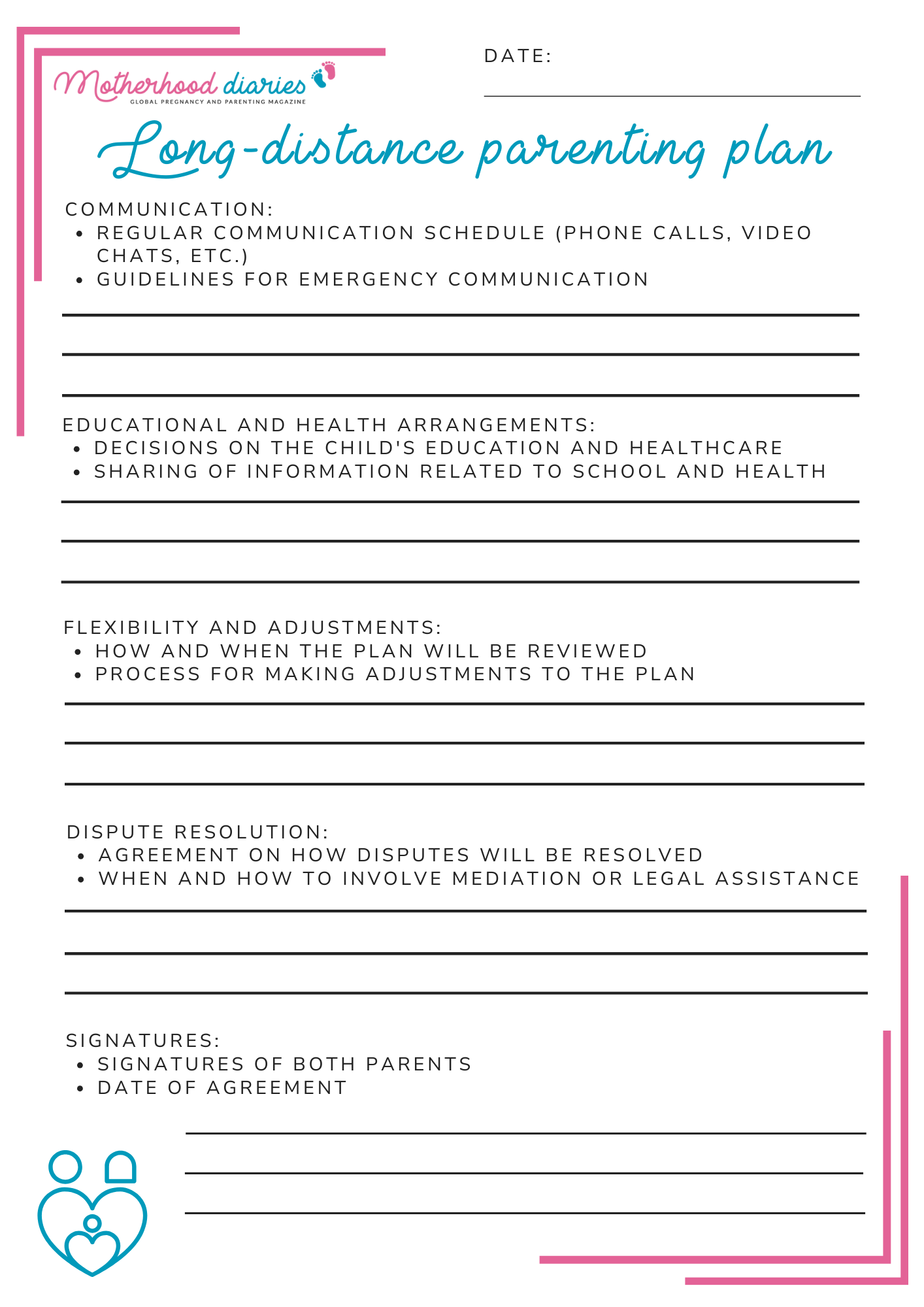
Long-distance parenting plan template
Click on the images below to view the templates that you can use for your long-distance parenting plan. Please consult with a solicitor specialising in this area for more advice.
Navigating the challenges of long-distance parenting requires a blend of legal guidance, practical planning, and emotional intelligence. Whether you’re discussing the logistics of travel or the intricacies of co-parenting from afar, the central focus should always be on what’s best for your child. Remember, a well-thought-out 50/50 long distance parenting plan is not just a legal requirement; it’s a roadmap for maintaining a loving, stable, and consistent relationship between your child and both parents, regardless of the miles in between.
Embrace the journey of long-distance parenting with patience and positivity. Use the template provided as a starting point or long distance parenting plan examples online, but tailor them to fit the unique needs of your family. And most importantly, never underestimate the power of open, respectful communication and flexibility in fostering a healthy, happy environment for your child to thrive.
As you embark on this journey, remember you’re not alone. Many parents have successfully navigated these waters before you, and with the right approach, you too can create a nurturing and supportive long-distance parenting arrangement. Follow the above tips on long distance parenting plans, keep your child’s best interests at heart, and you’ll find your way through the challenges with grace and resilience.
*Collaborative feature post*
Who gets custody of children in a divorce or separation?
When couples separate, who gets custody of children in a divorce? Read on to find out more.
Divorce and child custody – everything you need to know
One of the most critical and emotionally charged decisions parents have to make revolves around child custody and divorce. In the UK, courts use the term, “child arrangements” (instead of “custody” or “access,” which is a United States term) as per the Children Act 1989 which provides the legal framework for resolving child arrangements matters. The Act promotes the principle that the child’s welfare is of paramount importance and custody child arrangements determine where the children will live and who will decide their upbringing.
The wellbeing and stability of the children involved heavily rely on how custody matters are handled. Divorce solicitors play a pivotal role in guiding parents through the legal process and ensuring the best interests of the children are considered.
Divorce is associated with increased identity crises for women, both during and after the separation. A divorce lawyer Scottsdale can help navigate the legal process, allowing women to focus on reclaiming their individuality. In their efforts to be nurturing spouses and caring mothers, many married women lose touch with their sense of self. Even though it may not seem like it at the moment, overcoming this can be a truly rewarding experience. Taking on a new persona has been linked to better psychological and physiological well-being.
Understanding the importance of deciding who gets custody of children in a divorce – What the courts may consider When deciding about custody
Child arrangement decisions significantly impact the lives of the children involved. Their emotional and psychological wellbeing is closely tied to the stability and support they receive from their parents.
A well-structured Child Arrangement Order can provide a sense of security, continuity, and routine for the children during a difficult time of transition. Conversely, poorly managed child arrangements can lead to emotional distress, feelings of abandonment, and strained relationships with parents. It is vital for separating couples to prioritise the best interests of their children and work towards a resolution that fosters a healthy and supportive environment.
Types of custody child arrangements and factors influencing court decisions – joint vs sole custody and legal vs physical custody
Physical custody child arrangements – Joint physical custody vs sole physical custody
Physical custody refers to where the children primarily live after the separation. In some cases, the court may award joint physical custody, allowing the children to spend time with both parents. In other instances, physically one parent may be granted sole custody, and the other may have visitation rights.
Legal custody child arrangements – Joint legal custody vs sole legal custody
Legal custody relates to the authority to make important decisions concerning the children’s upbringing, such as education, healthcare, and religious matters. Like physical custody, you can get sole or joint legal custody, depending on the circumstances and the parents’ ability to communicate effectively.
Factors considered by the court
When deciding child arrangement matters, the court takes various factors into account to determine the arrangement that serves the best interests of the children. These factors may include the child’s age, emotional and physical needs, child support issues, the parents’ ability to provide a stable home environment, any history of abuse or neglect, and the child’s relationship with each parent.
Additionally, the court may consider the preferences of older children if they are deemed mature enough to express their views.
Working on child arrangement issues outside of court
Open communication
Despite the emotional challenges of separation, maintaining open and honest communication between parents is essential. Having a constructive conversation about child arrangements will help each parent understand each other’s concerns and preferences, and reach a mutually beneficial resolution.
Mediation
Mediation is a beneficial alternative dispute resolution method that allows parents to work with a neutral third party when reaching a custody agreement/child arrangement agreement. Mediation can be less adversarial than going to court, promoting a more cooperative approach and preserving a positive relationship between the parents.
Parenting plans
Creating a detailed parenting plan can provide structure to the child arrangement. A parenting plan outlines visitation schedules, decision-making processes, and contingencies for future adjustments if necessary.
Benefits of alternative dispute resolutions
Financially better
Resolving custody issues outside of court through mediation or negotiation can be more cost-effective than lengthy court battles. The financial savings can be better invested in the well-being of the children.
Less conflict
Alternative dispute resolutions often foster a more cooperative and less confrontational environment, reducing conflict and emotional strain on both the parents and the children. This can lead to healthier long-term relationships between parents, which ultimately benefits the children.
Role modelling for children
Opting for alternative dispute resolutions can show the children how conflicts can be resolved amicably. This positive role modelling can shape their understanding of conflict resolution and communication skills, providing them with valuable life lessons.
Dealing with Child Arrangement Orders. Who gets custody of the children in a divorce or separation?
Child Arrangement Orders hold significant weight and are crucial for the wellbeing and development of children during a separation. It’s important to understand the different child arrangements, as well as the factors considered by courts, and explore alternative dispute resolution methods to get help negotiating child custody during your divorce.
To navigate the complexities of child arrangements, you should seek guidance from divorce solicitors at a law firm / child custody attorney who specialise in family law matters. Their expertise can help protect your rights and advocate for the best interests of your children.
Remember, by prioritising open communication, cooperation, and the wellbeing of the children, parents can work towards creating a Child Arrangement Order that fosters a healthy and nurturing environment for their children to thrive.
FAQ
Who gets the kids if we divorce?
Other questions asked were:
Who gets custody of a child in a divorce in Canada?
How is child custody determined in the state of California?
How do I find out who has child custody?
Who takes custody of a 7 year old female child after a divorce?
Who will get custody of child after divorce?
Who gets custody of child in a divorce?
How to get full custody of your child in a divorce?
How to get custody of my child in a divorce?
In divorce who gets custody of child?
Who gets custody of child in divorce?
When determining child arrangements (in the UK, the terms are “child arrangements” rather than “custody” or “access”) in a divorce, the court’s primary consideration is the welfare of the children. The court’s aim is the safeguarding of the child’s best interests, so the outcome will depend on the circumstances of each case.
When deciding child arrangements and who is the custodial parent, the court will take into account several factors, including:
Considering the child’s age and maturity. They may also take the child’s views into account, giving more weight to older children.
The ability of each parent to meet the child’s needs and provide a suitable environment, including their parenting skills, stability and willingness to support the child’s relationship with the other parent
Assess any evidence of domestic violence, abuse, or neglect that may affect the child’s wellbeing and safety.
The court will favour joint custody or shared care arrangements, allowing both parents to be involved in the child’s life. However, if one parent poses a risk to the child, the court may grant sole custody or restricted contact.
My wife and I are getting a divorce. She doesn’t want to have custody over our son, but I don’t want it either. How could I convince her she should have full custody?
Other questions asked were:
What if I don’t want custody of my child post divorce?
What would happen in a divorce case where neither party wanted custody of their children?
If both you and your wife are in agreement that neither of you wants custody of your son, it is important to approach the situation with sensitivity and focus on what is in the best interest of your child. Here are some ideas you can broach with your wife for full custody:
Initiate a calm and respectful conversation with your wife to discuss your reasons for believing she should have full custody. Listen to her perspective and try to understand her reasoning as well.
Emphasise the primary focus should be on your child’s wellbeing. Explain why you believe your wife may be better suited to provide the necessary care and support for your son. Highlight her strengths as a parent and how she can meet the child’s physical, emotional, and educational needs.
If you genuinely believe your wife would be a better custodial parent, be prepared to provide evidence to support your claims. This might include examples of her previous involvement and responsibility in caring for your child, her understanding of his needs, and her ability to provide a stable and nurturing environment.
Discuss the possibility of creating a comprehensive co-parenting plan that outlines the roles and responsibilities of each parent in the child’s life, even if one parent has primary custody. Show your willingness to remain actively involved in your child’s upbringing through visitation rights, regular communication, and joint decision-making.
If you are can’t reach an agreement through direct discussions, you might consider involving a professional mediator. A mediator can help facilitate productive conversations and help you find common ground, ensuring the priority of the child’s best interests.
The final decision on custody will ultimately be made by the court if an agreement cannot be reached between you and your wife, so speak to a family solicitor who can provide you with guidance and help you understand the legal implications of your situation.
From a lawyer’s perspective, why do women get child custody almost 90 of the time? Is there really a bias? What factors come into play when deciding about it?
Other questions asked were:
Do you believe that fathers have a harder time gaining custody of children in a divorce? In other words, are fathers treated as second-class citizens in the eyes of the courts?
Children of divorce. Does the mother always win custody?
Why is it that women are more likely to get custody of a child than men after a divorce?
How often do men receive complete custody of the children in a divorce?
Should mothers get full custody of the children after a divorce?
What percentage of mothers get custody?
What percentage of fathers get full custody?
Why does the mother always get custody?
Mother vs father custody statistics?
What are the chances of a father getting full custody?
Why some dads don’t get primary or custody?
Who is most likely to get the children in a divorce?
Who is most likely to get custody of a child?
Custody decisions can vary depending on the specific circumstances of each case, and general statistics may not reflect individual situations accurately.
Historically, there has been a perception of a bias toward awarding custody to women, but this perception may not reflect the reality of every custody case. The approach to child custody in case of divorce has evolved over time, with an increasing emphasis on the best interests of the child rather than assumptions based on gender.
When determining the child’s custody, the court’s primary consideration is the wellbeing and best interests of the child. Various factors can come into play during custody decisions, which may include:
Parental involvement and relationship with the child. This includes evaluating each parent’s level of involvement in the child’s life, the bond they have formed, and their ability to meet the child’s emotional and physical needs.
Depending on their age and maturity, the court may take into account the child’s preferences regarding custody. However, the weight given to the child’s wishes varies depending on their age and the judge’s assessment of their understanding of the situation.
The court evaluates each parent’s ability to provide a safe and nurturing environment for the child. They will consider factors such as physical and mental health, stability, parenting skills, and willingness to support the child’s relationship with the other parent.
The court takes allegations or evidence of abuse, neglect, or domestic violence very seriously when determining custody.
How can I get partial custody of my child?
Other questions asked were:
How do I get custody of my child after a divorce?
Who gets temporary custody during divorce?
To seek partial custody of your child in the UK, you will need to go through a legal process, which may involve the following steps:
Research and understand the laws of child custody and child arrangements in the UK. This will help you navigate the process and understand your rights and responsibilities and the children’s rights after divorce.
Attempt mediation or negotiation with the other parent to reach an agreement on partial custody. Mediation involves working with a neutral third party who helps facilitate discussions and find common ground. .
If an agreement cannot be reached through mediation or negotiation, you can apply for a Child Arrangements Order from the court. This legal order determines who the child will live with and the time they spend with each parent. You can apply for this order as a way to seek partial custody.
If the case proceeds to court, both parents will present their arguments and evidence supporting their request for partial custody. The court will consider various factors, including the child’s welfare and best interests, parental capability, and the nature of the parent-child relationship. The court will make a decision based on these factors.
If the court grants you partial custody, it is important to adhere to the court’s orders and the agreed-upon visitation schedule. Compliance with court orders is crucial to maintain a positive relationship with your child and avoid potential legal consequences.
Can a non earning mother get custody of her kids if she is opting for divorce?
Yes, in the UK, a non-earning mother can seek custody of her children when going through a divorce. When determining child custody or child arrangements in the UK, the primary consideration is the welfare and best interests of the children involved. They will consider the level of involvement of each parent in the child’s life and the parent’s ability to meet the child’s physical, emotional and educational needs, regardless of the employment or income status, and they will prioritise the child’s overall wellbeing,
In the UK, the court encourages both parents to maintain a meaningful relationship with their children, unless there are factors such as abuse or neglect that could pose a risk to the child’s safety or wellbeing. When considering the types of child custody arrangements involved, the court generally promotes shared parenting and joint custody arrangements when appropriate and in the best interests of the children.
Who gets custody of child if not married?
In the UK, when parents are unmarried and separate, the mother automatically has parental responsibility for the child. Parental responsibility refers to the legal rights and responsibilities that parents have towards their child’s upbringing and welfare. However, it’s important to note that both parents have the right to apply for a Child Arrangements Order from the court to establish custody and visitation arrangements.
If the parents are unable to reach an agreement on child custody, the court will make a decision based on the best interests of the child.
At what age can a father get custody of his child?
In the UK, there is no specific age at which a father automatically gains custody of his child. The key consideration is the best interests of the child, so the court takes into account the factors as mentioned above to make a decision that promotes the child’s welfare.
Can a divorce be finalized without custody?
In the UK, you must organise child custody before divorce (otherwise known as ‘child arrangements’ under the Children Act 1989) because the welfare of the children is the court’s primary concern and they won’t grant a divorce unless arrangements for the children have been made. Child arrangements cover where the child will live and how much time they will spend with each parent.
When filing for divorce in the UK, both spouses are required to submit a statement confirming that appropriate arrangements have been made for the children. The court will review these arrangements to ensure they are in the best interests of the children before granting the divorce.
If the divorcing couple cannot agree on child arrangements, the court may intervene and make a decision based on what it believes is best for the children. If the process of child custody during divorce is taking longer than intended, the court will need to consider the child’s welfare before finalising the divorce.
How does a non-parent/third party custody or guardianship work in the UK?
Other questions asked were:
Can a non-parent get custody?
Unmarried parents and custody decisions – how does it work?
In the UK, non-parent/third-party custody or guardianship is a complex legal matter. It typically arises when someone other than the child’s biological or adoptive parents wants to get legal custody or guardianship rights over a child. Non-parent custody cases often involve situations where the child’s parents are unable or unfit to care for the child, and the third party wants to provide a stable and nurturing environment.
Non-parent custody or guardianship cases are addressed through private law proceedings. The third party seeking custody or guardianship must apply to the family court for a Child Arrangements Order or a Special Guardianship Order. The specific legal process and requirements may vary based on the circumstances and jurisdiction.
Here are two options that can be pursued in non-parent custody cases:
A Child Arrangements Order determines who the child will live with and the time they spend with each person involved. A third party can apply for a Child Arrangements Order if they can demonstrate a significant and ongoing relationship with the child, and it is in the child’s best interests to live with them.
A Special Guardianship Order provides a legal framework for a third party to have long-term care and responsibility for a child, including the ability to make important decisions about the child’s upbringing. This order is sought when it is not appropriate for the child to live with their parents, but they still maintain a connection with their birth family.
How do I request a temporary custody court order?
To request a temporary custody court order in the UK, you would need to follow the steps outlined below:
Collect all relevant information about the child, including their full name, date of birth, and current living arrangements. It is also essential to have documentation and evidence supporting your request for temporary custody, such as any concerns about the child’s welfare or safety.
Seek legal advice from a family law solicitor who specialises in child custody matters in the UK rather than you negotiate temporary custody terms yourself because they will provide you with guidance specific to your circumstances and jurisdiction, explain the legal process, and help you navigate the court system.
Your solicitor or attorney will help you prepare the necessary application documents, which may include a petition or application for a specific type of temporary custody order, such as an Interim Child Arrangements Order. The application will outline the reasons for your request and provide details about the child’s current living situation and your proposed temporary custody arrangement.
Your solicitor will guide you on the appropriate court where the application should be filed. You will need to complete the required forms, pay the necessary fees (if applicable), and submit the application to the court. Keep in mind that each court may have specific requirements or procedures, so it’s important to follow their guidelines.
Once your application is filed, the court will review the case and schedule a hearing. It is essential to attend the court hearing, along with your solicitor, to present your arguments and evidence supporting your request for temporary custody. The court will consider the child’s welfare and best interests when making a decision.
If the court grants your request for a temporary custody order, it is crucial to comply with the court’s orders and adhere to the specified terms and conditions. Failure to follow court orders may have legal consequences and could impact future custody decisions.
*Collaborative feature post*
Flying solo: A guide to single parent support in Essex
In this article, we discuss single parent support available in Essex and how to get it.
In April 2022, the UK introduced the no-fault divorce, which has made separation quicker, easier and cheaper for couples. As a result, divorce solicitors in Chelmsford and surrounding areas are dealing with many divorce cases faster than ever.
However, many divorcees still have several concerns surrounding the effects of the divorce on their lifestyle, emotions, and finances. As a single parent, the growing concern of managing single parenting and raising children on top of everything else can amplify these concerns.
In this article, we’re going to be looking at what single parent support is available in Essex and how to get it.
The impact of divorce on parents
A divorce brings with it several changes for a person, many of which are financial changes, particularly when you have children. Following a divorce, one or both parents will usually have to find somewhere new to live, which can be financially challenging after the cost of the actual divorce.
A divorce can also be extremely emotionally taxing for parents as they adjust to the single lifestyle again, something many people can take a long time to accept and overcome. With this in mind, there are plenty of resources available to assist divorcees financially and emotionally.
What single parent support is available in Essex?
As a new single parent, it’s difficult to know where to turn for support, so, in this section, we’ll be explaining the single parent support in Essex and how to access it.
Financial support resources
Often, the number one concern for single parents is money – particularly if they are not receiving financial support from the other parent of their child(ren). However, there are a few resources available for financial support and these include:
In most cases, it will take around six weeks for you to receive government benefits and so it’s important that you submit your application as early as possible.
Accommodation
Depending on your circumstances, you may be entitled to housing benefit which helps toward your rent payments. Additionally, you may be eligible to apply for a council flat or house in Essex if you can fulfil a certain set of criteria.
Essential living fund
Many towns in Essex, including Southend-on-Sea, can offer Essential Living Fund grants which provide emergency cash for those who cannot afford the basics such as food, school uniforms and more.
Family Action
If it’s financial assistance you need, then Family Action is your go-to resource. They offer grants to eligible single-parent families which can be used towards things like school uniforms or household bills.
Free childcare
In the UK, all parents are entitled to between 15 and 30 hours of free childcare every week depending on their circumstances – which can be invaluable for single parents in Essex who are looking to enter / re-enter the workforce.
Practical and emotional single parent support in Essex
As well as dealing with financial issues, a lot of newly single parents in Essex feel isolated and unable to cope. Thankfully, there are a few resources available for help as a single parent and we’ll look at some of these here:
Gingerbread
First launched in 1918, Gingerbread provides a wealth of resources for single parents in Essex, including financial advice, legal advice and access to a community of like-minded people. As well as online single parent support, the organisation also holds real life meetups to provide a much-needed social network for many single parents across the UK.
Parents 1st
Next on our list is Parents 1st. Not only do they provide emotional single parent help, but they also offer practical help, like cooking classes and baby massage sessions. So if your little one has been keeping you up at night and leaving you feeling like a zombie during the day, these folks will help get you back to being human again.
The Essex Family Information Service
Some services for single parents include The Essex Family Information Service, which is a one stop shop for all things childcare. This useful resource can help with being a single parent, like offering financial and legal support when needed.
The Fatherhood Institute
An increasing number of single parents are men and The Fatherhood Institute provides a safe space and practical help for single dads, as well as opportunities to connect with others in the same position.
Essex Child and Family Wellbeing Association
This incredible organisation offers a wealth of resources and single mother support to parents in Essex, including education, financial advice and community hubs.
Homestart Essex
Last but certainly not least is Homestart Essex. These guys provide volunteers who can come to your home once a week to provide practical single mum support and friendship for both you and your child/children. It’s basically having an extra pair of hands when things get overwhelming – except these hands come with cookies too!
Social media single parent groups
Many single parents find it helpful to connect with other single parents on social media and via a single parent group such as Single Parents Support Group UK (Suffolk, Essex & Norfolk) can be great for making new friends and sharing tips and advice on single parenthood, as well as things to do in Essex. Joining an online community for single parents may mean that you can consult them for advice when you’re rushed off your feet too.
Find the right support during your divorce
If it’s your first time around, single parenthood can be a scary place. Not knowing where to turn for support can have a very real impact on your physical and mental health.
Finances are usually the priority here and, as well as applying for government benefits, you should consult with a family law solicitor if the parent of your child is refusing to help with child support.
It’s also extremely important to make sure you are receiving the emotional support you need during this time. If you don’t have friends or family you can rely on, the resources listed in this article can provide help and support from people who know exactly what you’re going through.
So grab your coffee, take a deep breath, and remember: you’ve got this!
FAQ
Should I tell my employer that I am getting divorced?
Disclosing personal matters, such as a divorce, to your employer is a personal decision. There is no legal obligation to inform your employer about your marital status or personal life unless it directly affects your work performance or legal obligations.
Here are a few factors to consider when deciding whether you should tell your employer about your divorce:
If you believe that the divorce might affect your work performance, such as needing time off for court proceedings or personal matters, it might be helpful to inform your employer. This can allow for better understanding and potential accommodations if needed.
Consider the culture and supportiveness of your workplace. If you have a positive relationship with your supervisor or HR department, and you believe they would understand and be supportive, disclosing your divorce may provide you with emotional support or flexibility during this challenging time.
It’s important to maintain personal privacy and set boundaries in the workplace. If you prefer to keep your personal life separate from your professional life, you may choose not to disclose your divorce unless it becomes necessary.
If your divorce involves legal or financial matters that may require your employer’s involvement, such as changes to insurance coverage or benefits, it may be necessary to inform your employer to ensure compliance with policies or to seek necessary support.
Consider how disclosing your divorce might impact your emotional well-being. Sharing this information with trusted colleagues or supervisors who can offer support and understanding may ease some of the stress associated with the situation.
What percentage of men win their custody battles?
Determining the exact percentage of men who win custody battles is challenging because it can vary depending on various factors such as jurisdiction, individual circumstances, and the specific criteria used to determine custody. Custody decisions are typically based on the best interests of the child, and the court considers factors such as the child’s relationship with each parent, the ability of each parent to provide a stable environment, and the child’s preferences (if they are of an appropriate age to express them).
Historically, it has been observed that mothers were more likely to be awarded primary custody, while fathers were often granted visitation rights. However, in recent years, there has been a shift towards recognising the importance of both parents’ involvement in their children’s lives, and courts have become more open to shared custody arrangements.
It’s worth noting that the goal of the legal system is typically to promote the best interests of the child rather than favouring one gender over the other. The outcome of custody battles depends on individual circumstances, the arguments and evidence presented by each parent, and the discretion of the judge or mediator involved.
If you are involved in a custody dispute, it’s advisable to consult with a family lawyer who can provide guidance based on the specific laws and regulations in your jurisdiction and help you present the strongest case possible to support your desired custody arrangement.
Are there any single parent christian support groups available in Essex?
Other questions asked were:
Which Christian groups support single mums?
To find single parent Christian support groups in Essex, I recommend trying the following steps:
Conduct an online search using keywords like “single parent Christian support groups Essex” or “Christian parenting groups Essex.” This can help you find relevant local resources, including support groups or organisations that cater to single parents.
Contact local churches in your area and enquire about any support groups or programs they may offer for single parents. Many churches have ministries or support groups specifically tailored to the needs of single parents, and they may provide you with information or referrals.
Check online directories of community organisations or support groups that cater to single parents. Some directories allow you to search by location and specific interests or affiliations, which could help you find Christian support groups in your area.
Get in touch with community centres, social service agencies, or other family-oriented organisations in your area. They may know support groups or programs specifically designed for single parents, including those with a Christian focus.
Seek recommendations from friends, family, or other single parents in your area who may have knowledge of local support groups or resources. They may be able to provide you with valuable information or connect you with relevant contacts.
Remember to verify the credibility and suitability of any support group or organisation you find by researching their background, reading reviews or testimonials, and reaching out directly to enquire about their programs and services.
Additionally, it’s worth noting that the availability and specific details of support groups may change over time, so it’s recommended to reach out to the organisations or groups directly to confirm their current status and offerings.
What single parent group activities can I join in Essex?
Other questions asked were:
What single parent programs can I join in Essex?
Where can I join single parent support groups?
Where can I join single mum support groups?
Where can I join support groups for single mothers?
As above, look for:
Local parenting support groups or organisations that cater to single parents. These groups often organise activities, workshops, and events focused on parenting challenges, personal development, and building a support network.
Playgroups or parent-child activities in your area where you can meet other single parents and provide social interaction for both you and your child. These activities can range from organised playdates, park outings, storytime sessions at libraries, or local community centre events.
Fitness or wellness groups tailored to parents. These groups often offer activities like stroller workouts, yoga classes for parents and children, or walking groups. They provide opportunities to exercise, socialise, and meet other single parents in a supportive environment.
Community centers, local organizations, or churches that may offer group activities or programs for single parents. They might host events, workshops, or support groups that focus on parenting, personal growth, or social connections.
Online platforms or social media groups specifically designed for single parents in your area. These online communities often organise meetups, playdates, or outings for single parents and their children. They can provide a virtual support network and help you connect with other single parents in your local area.
Remember to stay updated with local resources and events by checking community bulletin boards, local newspapers, or online event listings specific to Essex. Additionally, consider reaching out to local organisations or community centres directly for information about ongoing activities or programs that cater to single parents.
What happens if you don’t answer a divorce summons?
In the UK, failing to respond to a divorce summons or petition can have legal consequences. If you don’t respond to a divorce summons, it is generally referred to as “defaulting” or “not defending” the divorce proceedings. Here’s what typically happens:
Progression of the divorce: If you fail to respond within the specified time frame, the divorce process may continue without your input. The court may proceed with the divorce based on the information provided by the other party, assuming you do not contest or defend the divorce.
Financial and child-related matters: If there are financial or child-related matters involved in the divorce, the court may decide in your absence, considering the information and evidence presented by the other party. This may include decisions regarding property division, spousal maintenance, child custody, and child support.
Decree Nisi and Decree Absolute: If the court is satisfied with the grounds for divorce and all necessary paperwork has been filed, they may grant a Decree Nisi. After a period (usually six weeks and one day), the court can grant a Decree Absolute, finalising the divorce. Once the Decree Absolute is granted, the marriage is legally dissolved, and the divorce is complete.
It’s important to note that not responding to a divorce summons can have significant consequences, including potential financial implications and the risk of unfavourable outcomes in matters related to children or assets. If you’ve received a divorce summons, it’s generally recommended to seek legal advice promptly to understand your rights, obligations, and potential outcomes in your specific situation.
This information is a general overview. The specific procedures and consequences may vary and the laws of the jurisdiction in which you live. It’s important to consult with a family law solicitor who can advise based on your particular circumstances and the laws applicable in the UK.
How do you fill in the gap on your resume due to a divorce?
Filling in a gap on your resume resulting from a divorce can be approached in a couple of different ways. Here are a few strategies you can consider:
Honesty and transparency: If you feel comfortable doing so, you can choose to be open and honest about the gap in your resume. You could briefly mention that you took time off to focus on personal matters or family responsibilities during that period. However, keep in mind that you are not obligated to disclose personal information, and it’s important to balance being transparent and maintaining your privacy.
Highlight transferable skills and experiences: Even if you weren’t formally employed during the gap, you may have gained valuable skills or experiences during that time. Consider highlighting any relevant transferable skills, such as volunteer work, freelance projects, or courses you may have taken. Focus on the skills you developed or maintained during the gap, and emphasise how they apply to the roles you’re applying for.
Functional resume format: Instead of using a traditional chronological resume format, you could consider using a functional resume format. This format emphasises your skills and qualifications rather than focusing on specific employment dates. This way, you can highlight your relevant skills, experiences, and achievements while downplaying the chronological gap.
Address the gap in your cover letter: Another option is to address the gap directly in your cover letter. Briefly explain that you took time off for personal reasons, and emphasise your commitment to returning to the workforce and your enthusiasm for the specific role or industry to which you’re applying.
Use professional development activities: If you used the gap to enhance your professional skills or pursue additional education, include any relevant courses, certifications, or workshops you completed during that time. This can show your commitment to professional growth and ongoing learning.
Remember, employers understand that life events, such as divorce, can lead to resume gaps. Focus on showcasing your strengths, skills, and experiences in a way that positions you as a qualified candidate. Ultimately, it’s important to tailor your resume and approach based on your individual circumstances and the specific requirements of the job you’re applying for.
Why do the people blame women after divorce from her husband?
It is incorrect and unfair to place blame solely on women after a divorce or to make generalisations about how people react to divorce. Attitudes and perceptions surrounding divorce can vary widely depending on cultural, societal, and individual factors. It is important to recognise that divorce is a complex and multifaceted issue, and attributing blame to one gender is an oversimplification.
Historically, societal norms and cultural expectations may have influenced attitudes towards divorced women, leading to unfair judgements or biases. However, societal views and attitudes have evolved, and there is growing recognition that divorce is a complex decision that can involve multiple factors and responsibilities.
It is essential to promote a more inclusive and supportive approach to divorce, where both men and women are treated with empathy, understanding, and respect. Divorce is a challenging and emotional process for all parties involved, and it is important to focus on providing support, fostering healthy co-parenting relationships, and promoting the well-being of any children affected by the divorce.
Attitudes towards divorce can vary among individuals, and not everyone will hold negative views or blame women. Society’s views on divorce are continually evolving, and there is increasing awareness of the need for understanding and compassion when discussing and navigating the challenges of divorce.
It is crucial to challenge stereotypes, promote gender equality, and strive for a more fair and supportive environment for individuals going through the difficult experience of divorce, regardless of their gender.
*Collaborative feature post*
DIY divorce UK: The pitfalls of doing it yourself
The idea of managing your own divorce arrangements may lead you to believe that aspects such as child maintenance payments and the division of finances and property will all be taken care of. However, this is not the case. We walk you through the divorce process UK and the pitfalls of going it alone with a DIY divorce UK.
How to get a divorce in the UK
Applying for a divorce, either in court or via an online divorce UK (England or Wales) can happen when the following are true (there is a different process for ending a civil partnership):
You’ve been married for over a year
Your relationship has permanently broken down
Your marriage is legally recognised in the UK (including same-sex marriage)
The UK is yours or your husband/wife’s permanent home
Grounds for divorce uk
Per the website gov.uk, divorce can be started by either party when you can prove your marriage can’t be saved for the following reasons (also known as ‘facts’):
Adultery
This is where your husband/wife has slept with someone else and committed adultery. You can’t use this reason if you lived for over six months together after you found out about it.
Unreasonable behaviour
You cannot reasonably live with your husband or wife because of their behaviour. This behaviour can include:
Physical violence
Verbals abuse
Drunkenness or taking drugs
Refusal to pay towards shared living expenses
Desertion
Your husband/wife has left you for at least two years. You can still claim desertion if you lived together for six months total within the two years, but it won’t count as part of the two years.
You have been separated for at least two years
If you both agree to it in writing, you can apply for a divorce if you have been separated for over two years. It may be possible to show you’ve been separated while living in the same home, as long as you can prove you’re not living together as a couple. For example, you sleep and eat apart.
You have been separated for at least five years
Even if your wife or husband doesn’t agree, you can apply for a dissolution of marriage if you have been separated for at least five years.
To file for divorce, you will need your husband or wife’s full name and address, your original marriage certificate or a certified copy and proof of your name change if you changed it since you got married. A new divorce service will be available from 6 April 2022, so it may be better to wait until then. However, if you have already started an application, make sure it reaches the court by 4pm on 31 March 2022.
The UK Parliament passed the Divorce and Dissolution Act in 2020 and under the new service it will no longer be necessary or possible for either party to prove ‘fault’ to get a divorce. This is part of a new no fault divorce law intended to end the ‘divorce blame game’.
Once both parties have successfully proven divorce is the right step to proceed, the court of law issues a final order of a decree absolute officially ending the marriage so they can remarry.
You can also apply online for a divorce, but this is only available to those whose divorce case can be handled in England and Wales. A solicitor can also apply on your behalf.
How long does it take to get divorced UK?
It takes around four to six months for a divorce to be finalised, but it make take longer if you need to sort out any issues involving money, property or children. Do not use websites that promise cheap divorce packages, as you’ll still have to pay the divorce application fee.
How much does divorce cost UK?
The average cost of divorce UK is £14,561 according to Aviva. But it can cost less or it can even be free, depending on the divorce advice you get and whether you tackle the process of divorce in the UK by yourself.
You pay a £593 fee to apply for a divorce, but the way you pay depends on how you apply. Refunds are not offered after you are sent the notice that your application for divorce has been issued. If you are on low income or benefits, you can apply for help to pay these fees.
How to do a DIY divorce UK
Under Citizens Advice divorce can be applied with no solicitor, no divorce centre or the need to go court if you and your ex-partner agree to a clean break by divorce, and the reason you want to file divorce papers. But you should receive guidance on how to divorce properly, so the process is fair and you receive justice where you need it.
DIY divorce UK Pitfalls
A do-it-yourself divorce (i.e. not using legal assistance) means you are handling everything, rather than a solicitor. Here are some reasons it may be dangerous to handle the divorce on your own.
Not all divorces are the same
Divorces can often be complex and stressful. There is no one-size-fits-all divorce. Yours and your former spouse’s circumstances are unique and there are likely intricate details in your divorce that need handling carefully.
With an online divorce, you could end up unknowingly cutting corners that can cost you time, money and energy long-term. Even if you and your ex-spouse have had an amicable separation, there is still a possibility that things could turn more sour. Child custody arrangements are not included in a DIY divorce and decisions about children will need to finalised through the court. If they are not, matters relating to this could open up again in the future.
In addition, there could be choices available to you which you don’t know about, for example, for the specifics of dividing finances and property.
You could lose out financially
One of the biggest risks of taking the DIY divorce route is losing out financially. The legal terminology on the form can be off-putting for those without a trained eye. As an example of a worst-case DIY divorce scenario, you may not correctly confirm on the form that you would like to make a financial order (an agreement that sets out how assets are divided between two spouses). This can unfortunately leave you in a regrettable and sometimes complex financial position further down the line, long after your divorce.
It is important to remember that an online divorce does not deal with financial matters and child maintenance payments; it is a system designed purely to dissolve a marriage. Therefore, it’s important to get legal advice and financial advice on where you stand before.
Under-estimating a complex case
Filling in online forms is something we have grown accustomed to in the digital world. However, petitioning for a divorce takes a little more thought than the average box ticking questionnaire and you will need to be careful while doing this. Issues can be overlooked, and the courts can reject these petitions occasionally, leading to wasted time for all concerned.
Complex issues involved in your divorce, such as matters that have not been fully solved or agreed by both parties, are generally not managed well with a DIY approach. If money is concealed, or assets transferred without your knowledge, you can be left vulnerable to financial loss.
DIY Divorce UK – conclusions
The withdrawal of legal aid, potentially reducing court fees and increase in no-fault divorce has seen online divorces increase in popularity over the last decade, but the appeal is not necessarily in the quality of the results or the service. DIY divorces do not fully consider what arrangements will be for any children, the final financial settlement, what will happen to the marital home and who gets what.
Although the ease of doing it on your own when getting divorced is attractive, especially when the divorce process is arduous, there are potential long-term consequences you should at least research and consider before you begin DIY divorce proceedings. It’s always advisable to gain knowledge from a qualified family law expert or divorce service to get the support you need to make the best choices for you and your unique situation before you file a divorce petition.
*Collaborative feature post*
How to tell your kids about a divorce
Divorce is difficult for everyone, and when you have the feelings of young children to consider too, it can be doubly challenging.
Legal advice from family lawyers like Wiselaw will establish your legal position for shared parenting, but what about guidance on supporting your child during the process? Although children need love and support during these troubled times, how to tell your kids about a divorce is based on some routine things you can expect and basic tips to follow to help you through this time. We’ve compiled some basic pointers on how to tell your kids about divorce.
‘If you love someone and you break up, where does the love go?’ Carrie Bradshaw, Sex and the City
What is divorce?
Divorce is the process of terminating a marriage or marital union. Divorce usually entails the canceling or reorganising of the legal duties and responsibilities of marriage, thus dissolving the bonds of matrimony between a married couple under the rule of law of the particular country or state.
How do you tell your child about divorce without breaking them?
The collateral damage suffered by children when couples split up varies from family to family and depends on several factors. How they react depends on what to tell your child about divorce, their age, their personalities, and the particular circumstances in which the divorced parents find themselves.
Unfortunately, the stress of divorce is experienced by thousands of children every year and it is in everyone’s interests to make the painful journey more bearable. Initially, when considering how to tell kids about separation, parents must consider the wide range of emotions the kids will go through, i.e. sadness, helplessness, loneliness, anger, and betrayal. But, if handled properly, a newfound strength and inner resolve can derive from the healing process. Therefore, it is so important you know how to tell your child about divorce in the proper way.
What you can expect from your child after divorce
Very young children aged between 18 months to five years can regress into behaviours typical of a younger age group as a coping mechanism for the stress they’re feeling. Going back to using a dummy, wetting the bed, or becoming clingier with either or both parents is quite normal if this is the case.
Young children and babies are tuned into their parents’ emotions even though they cannot verbalise this. Over time, they will understand the decision you made, but this won’t happen straight away. A young child growing up with divorcing parents will be scared.
When to tell your child about divorce – The first bit is the hardest
The initial stages of a divorce, whether that’s a year or even two years, are often the time when it’s hardest for children. The changes that happen during this period, for example, one parent moving out of the family home, are a big shift in a child’s world and they can react by experiencing anxiety, anger and shock.
Go to them first before they suspect – talking to kids about divorce first
No child wants to hear that their parents no longer love each other, but they may have guessed that for themselves if public rowing has taken place. So it is better to come from you than to leave them second guessing or, worse still, get the wrong end of the stick.
As hard as it may sound, try to come to an agreement with your partner/spouse about how to talk to your kids about divorce and be as consistent as you can with your message. If possible, both of you should be present when you sit down to discuss things with your child/children. and try to pre-empt some questions you may get asked so that you are fully prepared because, in an emotional situation like this, it is easy to go ‘off message’. When thinking about how to talk to your child about divorce, explain what the stages of divorce for a child would mean, but don’t overwhelm them.
National Charity Place2Be and National Association of Teachers (NAHT) state that more must be done by the Government to help protect the mental health of children during a divorce. There seems to be a notable increase in pupils experiencing low self-esteem and depression.
How to tell children about divorce – Toddlers
Toddlers will need support from parents by creating and sticking to solid routines to provide comfort and safety. A child’s primary bond is with their parents at this stage, so big changes can have a profound effect and a small child may look inwards to find a reason for their parent’s divorce. As a result, they can have sleeping problems and fear being alone. As well as a predictable schedule, parents should plan to spend one-on-one time their child, for example, playing a game or reading a book together, focussing all efforts on that child.
How to tell kids about divorce – 3 – 5 years
Some pre-schoolers may feel responsible for what has happened and concerned about what is going to happen in the future. It’s common for children at this age to experience nightmares and bottled-up emotions too. Although divorce can present challenges, parents should try to adopt a positive approach and avoid blame and negativity, as children will pick up on these emotions.
How to talk to children about divorce – Older children
Older children are going through their own growth pains and can often experience a fluctuation of emotions. They may be old enough to understand the reasons behind divorce, but they are still too young to compartmentalise that the divorce isn’t about them and you don’t love them any less. It’s important at this stage to not place blame, invite questions and give them time to get their head around it all.
What else you can do to support your child during divorce – How to divorce without hurting your child
When a young child is feeling anxious or uncertain about the future, it can help to explain what has happened using simple and age-appropriate language, while reassuring them that both parents love them very much. In addition, you can try one of the many children’s books available to help you communicate effectively with your child about divorce.
If one parent has moved out of the home, explain to your child when they will see that parent again. Children can often feel reassured when there is a place for them at another home already organised.
Some pre-schoolers maintain hope that their parents will reunite, especially if the divorce is being handled convivially. It’s important to be gentle but clear to children and explain that you and the other parent won’t be living together again in the same house but will always be there for them.
Because young children cannot comprehend the complexity of divorce, they may be concerned that they, too, are going to be divorced from a parent. This is when you will need to provide extra reassurance to your child that you won’t be leaving them, but you just won’t be living in the same house as their other parent again.
Try to keep the routine going
Talking to kids about divorce is especially difficult when you know uncertainty about the future ahead is often a child’s biggest concern. Try to be truthful in answering all of their questions. It is important to your child (especially younger children) that their normal routine is going to be as disrupted as little as possible.
Knowing that Mum is still going to take them to swimming lessons every week and Dad is going to do the school run may seem trivial to you at the time but these little things, if handled properly, can go towards making the bigger picture seem a little less scary. Offer as much child support as you can to cushion the disruption of their routine.
If you are going through the divorce process, there are lots of places you can turn to for support. Look at the government’s website for information about how to talk to kids about divorce and divorce mediation. Once you are ready to take the practical steps towards annulling your marriage, choose a family law solicitor and divorce coach or divorce mediator to take you through the process. If you need emotional support, Relate is also worth a visit and they can help you work out how to tell your child about your divorce.
Going through a divorce when you have young children is a testing time for parents. Practical arrangements need to be made and emotional well-being needs to be a priority too. Taking steps to reassure your child during the process will bolster the innate resilience many children possess.
FAQ
How can I convince my parents that divorce shouldn’t be taboo and is sometimes the only option?
What are the best tips for explaining to your children that you are getting a divorce?
Please read above, we have some great tips to help you talk to your child about divorce.
How do you help a friend whose parents are divorcing?
Your friend will go through a whole heap of emotions, so be the shoulder for them to cry on, help them unpack their emotions and to encourage them to communicate with their parents about how they’re feeling. Sometimes, your friend might just need a sounding board in which to help make their next few very tough decisions with their family.
How do you deal with the guilt of telling your spouse you want a divorce knowing it will break their heart?
How long after separation should I file for divorce?
“If you are divorcing on the grounds of separation, then you and your spouse will need to have been separated for at least two years if you both agree to the divorce, and at least five years if you don’t.”
How to tell a young child about divorce will be very different from working out how to tell your teenager you are getting a divorce. There is no worst age for divorce for children, so it’s very much about knowing your child and how to talk to them in a way they’d understand. This link shares a script about how to tell your kids about divorce.
Things not to say to a child of divorce
How to tell your child about a divorce is paramount to how they deal with the aftermath of separation.
Check out this link for 30 things you should never say to your kids when you’re going through a divorce:
How to tell your 8 year-old about divorce
“The Effects of Divorce on Children Ages 6–8. Children aged six to eight years old respond most often with grief. They express their grief through crying and sobbing; this happens with boys more than with girls. They also feel a deep yearning for the absent parent.”