Help your child discover the recipe for success and reach their goals and ambitions – Mindscreen Review – Part 9
*This post and the proceeding/subsequent posts in the series are sponsored by Mindscreen – an online mental health and wellbeing tool which guides children towards higher self-esteem, at home or in the classroom.*
In Part 1 of our Mindscreen Self-Esteem Series, I talked about how to spot the signs of low self-esteem in your child by using an online tool called Mindscreen. If you haven’t done so already, please read the following articles in the series first:
In this article, we deep dive into Lesson 8, easyFuture and easyFeedback, the last lesson in the Mindscreen Experience series, which is about giving your child the opportunity to discover their unique “Success Recipe” and its “vital ingredients”. The boys were then invited to complete their Learning Improvement Measurement 3 online statements, which we then reviewed and discussed.
BEFORE YOU START
Please note – you need to purchase the Mindscreen Experience to access these lesson plans. Follow the link below to get 10% off your Mindscreen Package now.
Lesson 8, easyFuture is about giving your child the opportunity to discover the recipe for success and the vital ingredients needed to create that success recipe. What this means is that success comes with a process where all key parts need to be completed before you achieve said success.
It’s important that your child must start with a destination in mind because having a goal keeps them on course, even during the tough times.
I asked the boys to get right into it and turn to their Learner Diaries. Aidan and I have been watching Masterchef, so when I talked about a recipe needing vital ingredients to come out correctly, Aidan called out some elaborate ingredients like spice, citrus and mint.
Aidan was already on the right track because a success recipe is a lot like baking a cake, but we will go into that in a lot more detail later on.
Goals, commitments and destinations
First, I asked the boys to use the back of their Learner Diaries, so they could write ‘success’ somewhere on the page and circle it.
I then asked the boys to find two different colour pens (as we couldn’t find a red pen as advised in the Parent Guide.) I asked the boys to write ‘commitment’ in the other pen colour somewhere on the page too.
I then asked the boys to grab another blank piece of paper. This time I asked them to draw a line down the middle of the page and write ‘Destination’ on the top left and ‘Get There’ on the right.
The boys wrote six to eight cities under destination and were told to leave the other side blank for now.
They were interested to know where this lesson was going because they couldn’t work out what destinations had to do with your success recipe!
The definition of a goal is:
“An object of a person’s ambition or effort or an aim or the desired results.”
Oxford Dicitionary definition of goals
Aidan – “Destination is a goal you want to achieve.”
“Exactly. Your goal is where you want to end up and what you are aiming for,” I added.
So we were going to learn about the success recipe by starting with a destination in mind because having a goal helps us stay on course to get to that destination, even when the going gets tough.
“You start at the beginning of your journey and your goal is your destination. You have to take that journey however hard it is to reach that destination. Your success recipe is the successful way of reaching your destination. You’re going to create your own goals, and find out which career and study options will help you get there. Do you understand how valuable it is to create a success recipe?”
The boys nodded their heads but I wasn’t convinced they fully understood what I meant.
Baking a cake
So we’re going to use an example of baking a cake to illustrate what we mean by your success recipe helping you get to your destination.
You have all the ingredients you need to create a really delicious 3-tiered fancy cake. The cake is your goal and the cake ingredients are those little steps you take to reach your goal. I asked the boys to list out some ingredients needed to make an awesome cake.
Aidan – “Flour, egg, lime.”
Aron – “Apple. You can use anything to make a cake right? You can even use spinach to make a cake!”
Aron – “You can even use broccoli to make a cake!”
Me – “So now tell me, do we need the right quantity of each ingredient to make the cake or can we just throw them all into the bowl? What happens if we have the wrong quantities?”
Aidan – “It will go soggy or hard or it will look horrible”
Me – “What happens if you forget to put one ingredient in the cake, like a pinch of salt. Will it affect the cake?”
Aidan – “No, the cake doesn’t need salt.”
Me – “What happens if you forget to put two or three of the ingredients in the cake?”
Aidan – “It will go soggy or weird.”
Me – “If you forget the basic ingredients like flour or egg, will it still become a cake?”
Aidan – “No, it won’t even be a cake. You need flour and eggs to make a cake. I don’t like chocolate cake so you could leave chocolate out.”
Me – “But what happens if you miss the main ingredient like flour?”
Aron – “You won’t even be able to make a cake. It’s the most important ingredient in the cake!”
Aidan – “It will be a flat weird thing.”
Me – “Now what happens if the cake needs to be baked for a certain period? Does it matter how long it needs to be baked for?”
Aidan – “Yes otherwise it may be undercooked or overcooked.”
Me – “So what happened if we had all the right ingredients and quantities but we only cooked it for half the time?”
Aidan – “It will be undercooked.”
Aron – “It will be flat, it will be dangerous to eat because the ingredients will be raw.”
Me – “What happens if you overcook it?”
Aidan – “It will burn.”
Aron – “You won’t be able to eat it, it will be charcoal.”
Me – “Right! And what about the right temperature? Does that matter?”
Aidan – “Not really.”
Me – “What if it’s on really high heat?”
Aidan – “It will be overcooked.”
Me – “What if it’s on really low?”
Aidan – “It will be undercooked, flat and soggy.”
Me – “So is it true that if you have the recipe, you use all the right ingredients, all the right quantities, you bake it for the right length and temperature, you will have a very successful 3-tier cake?”
Both boys shouted yes.
I told the boys that becoming successful is like baking a cake. You need the right ingredients, the right quantities and it needs to be cooked at the right temperature and length until you get a delicious cake.
How are your skills like the vital ingredients in a cake?
I told the boys we were now going to brainstorm what ingredients they needed to make up their own success recipe and the boys collectively put:
I asked them to write these skills down on a piece of paper, but I was also going to list out the five vital ingredients that will make up a success recipe. If the ingredients they wrote wasn’t one of the five vital ingredients, they wrote it under ‘Commitment’. The vital ingredients went under ‘Goals’.
So what are the vital ingredients for success?
Vision/dream
Goal/plan/aim
Desire
Belief
Action
These goals are key ingredients because if you leave out any one of these, you won’t have your success recipe and you won’t reach your goal.
If you leave out vision/dream you can’t see yourself achieving your dream
If you leave out the goal you won’t have a clear target to aim for
If you leave out desire you will not be motivated
If you leave out belief you will find reasons why you can’t do it
If you leave out action nothing will happen
I then asked the boys to think about their chosen careers and how they could apply these vital ingredients to achieving their goals of being a YouTuber and a police officer.
Aidan struggled a bit with working out what he needed to do but we eventually got there in the end.
We took some time to discuss how the boys could apply these vital ingredients to a plan for success, whenever they were ready to start and implement their success recipe.
Destination – Get there!
The purpose of this exercise was to help the boys discover their clear goals and aims and how they get there was going to help them focus on where they were now.
I asked the boys to raise their hands if they wanted to be successful. Both boys raised their hands.
Everyone wants to be successful at something. I want to be a successful writer, the boys’ dad wants to be a successful photographer, Aron wants to be a successful police officer and Aidan wants to be a successful YouTuber.
I asked the boys to write down one city at the bottom of their list under destination. Aidan wrote London and Aron wrote Dubai. I then told them we’re going to go to those cities right that minute. The boys gasped.
I asked them what their very initial thoughts were.
Aron – “We can’t, we are in lockdown.”
Aidan – “First thought was I wanted to see the Statue of Liberty”
Aron – “Are we actually going to Dubai?”
Aidan – “Are we going now?”
Aron – “When are we coming back?”
Aidan – “How will we get there?”
Aron -“Don’t we have to travel to Asia to get to Dubai?”
Who? When? How? What? Where? Why?
We asked a bunch of questions that used all the main keywords. Who, when, how, what, where and why are keyword questions. When you have all of these six keyword questions you find out enough information to get to where you want to be or what you want to do.
We applied these keyword questions to Aron’s chosen career option which was a police officer.
Aron – “Where do I find the information to be a police officer?”
“Why do I want to become a police officer?”
“How will I be a police officer?”
“When will I get to be a police officer?”
“Where will I work as a police officer?”
“What do I have to do to become a police officer?”
Some other keyword questions Aron could have asked were:
Why do I want to achieve this?
When will I start?
How will I get there?
What will I need?
Who can help me?
Where will I go when I achieve it?
Setting the scene – The Ship Story
I wanted to now set the scene to help the boys understand that sometimes life blows us off course, but having a goal/purpose/direction helps us get back on track after the storm is over.
Me – “You have a small boat. It’s a lovely day, the water is calm and we are going to go sailing in the ocean. How do you feel about sailing the boat in an ocean?”
Aidan – “Scared? Fun?”
Aron – “Terrible.”
Me – “Now imagine that while you are sailing your boat, a storm comes. The waves are massive and the wind is turning you one way then another, knocking you off course. Eventually, the storm dies down, but because you have spun around during the storm, you might now be facing in a completely different direction from the one you originally chose. Do you agree in life that sometimes things are easy? We sail along with little or no effort, but at other times, it feels like we’re in the middle of a storm, being pulled in different directions with little control over our lives?”
Aron – “If you have a compass you can get back to the right path.”
Me – “Sometimes life can be really difficult and sometimes it can be easy. You can use your internal compass, as Aron cleverly pointed out, to get you back to your goal when you’re knocked off the path. Your compass is your focus.”
Aidan – “Why would you get knocked off course?”
Me – “Well sometimes the storm could mean that you are rejected, you don’t get the job you want, someone tells you you’re not good enough. But knowing your goal means you can get back to your original destination. But if you don’t know where you’re going you may continue to sail in the direction that the storm knocked you in but it won’t take you where you need to go, right?”
My goal
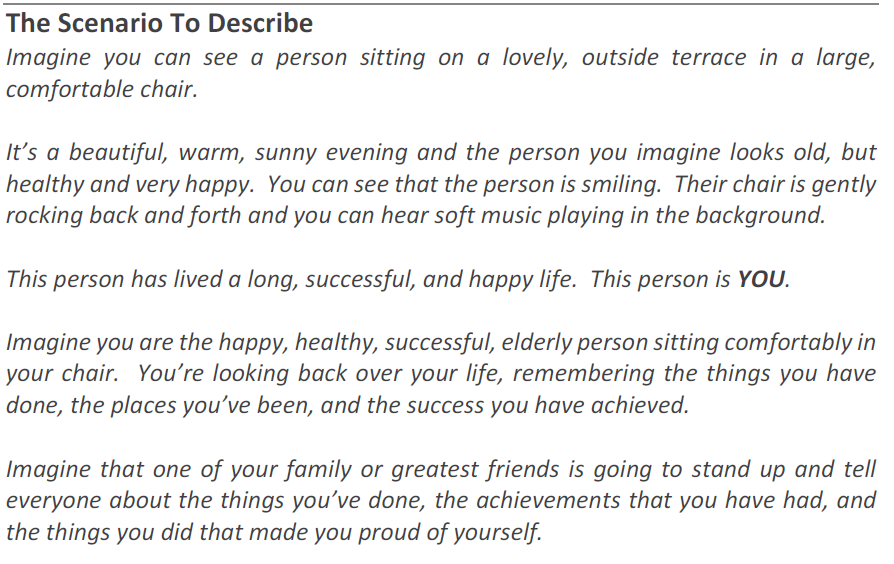
I wanted the boys to visualise another picture I was about to describe and to write down their very first thoughts in their Learner Diaries when I was finished.
I asked the boys what they would want someone to say when they stand up and tell everyone about the things they’ve done.
Aidan – “You have a happy life.”
“Are you rich? Do you have a family?”
The boys found this part really difficult. They struggled to visualise themselves as older and I figured it was because they weren’t old enough to put themselves in adult shoes. I persevered, though.
Aidan focused on a healthy and happy life while Aron focused on having a lovely life.
I told them to imagine that this speech was the very first draft of their life. Throughout their lives, they can expand on this speech, edit it, and add to it whenever they want as they get older.
I reminded them that successful people achieve amazing things because they decided what they wanted to do and they aimed for it. They visualised themselves achieving their dreams and they had a strong desire to succeed. They believed they could achieve it and they took action. These were the key vital ingredients to success.
My Study Choice Insights
The boys were asked to review the subjects they had previously underlined, circled or highlighted. I then asked the boys to turn to their “My Career Choice Insights” and review their previously highlighted career options.
I asked them to think about how their chosen subjects and careers could help them achieve their goals and told them to write their answer in their diary.
The boys struggled with this part and wrote subjects down. I told them to think about the bigger picture but by this point, they were done.
easyFuture
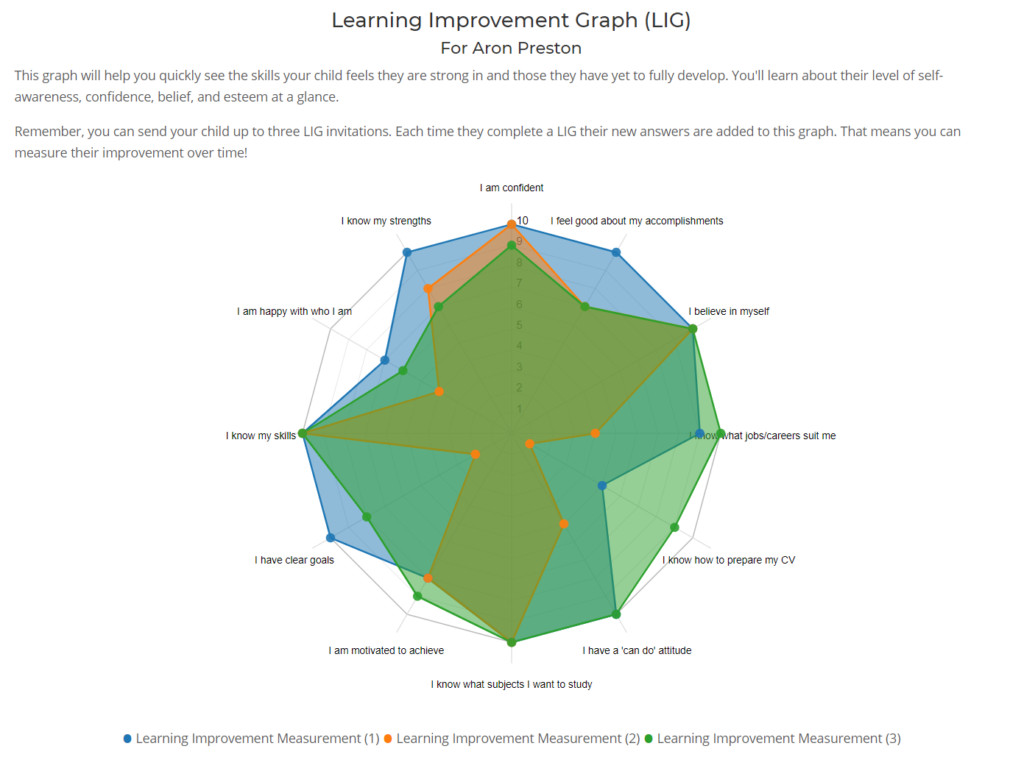
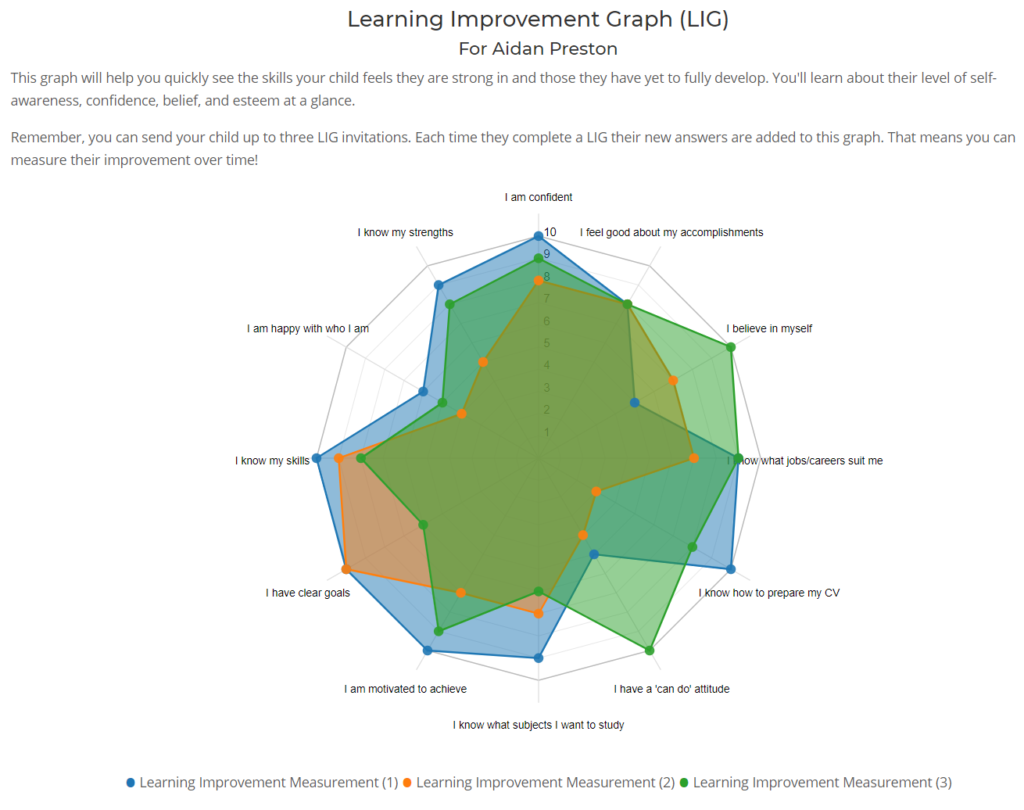
The boys had successfully completed all eight lesson plans and now it was time to complete their Learning Improvement Measurement (LIM) profiles one last time. The objective of easyFuture is to show the boys how much they have learned about themselves and encourage them to keep going, even after the lessons have finished.
The results were interesting and a stark contrast to the last LIM they completed.
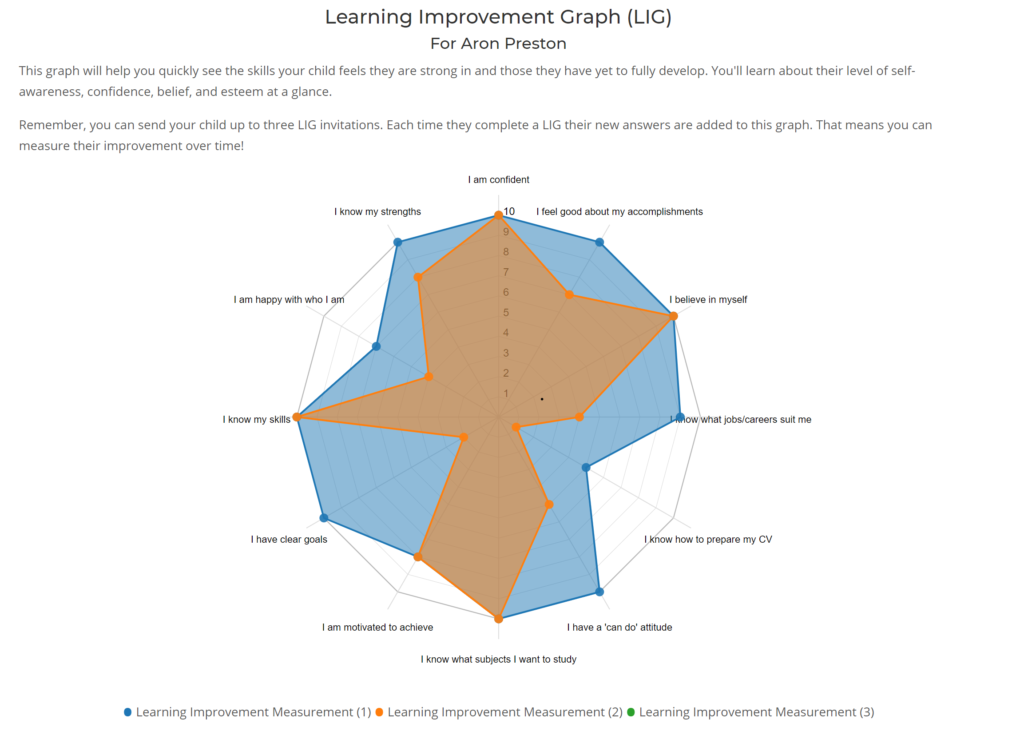
Aron showed a lot more confidence this time, scoring highly in motivation, knowing what subjects he wanted to study, what jobs/careers suited him, and he had more belief in himself. He has remained confident throughout but still struggled with being happy in himself. I asked him why that was and he said he didn’t know. I made a mental note to work on this, but the results were confusing, especially when he seemed confident and motivated to achieve.
He also scored lower in knowing his strengths and I think this was partly down to being overwhelmed with the selection of strengths he learned he had during his Mindscreen Experience. I told Aron that overall the results were still a vast improvement to when he completed his second LIM and that he should be proud of himself for what he has achieved in the last eight lessons. He said Mindscreen did make him feel happy and that he was looking forward to achieving his goals and ambitions.
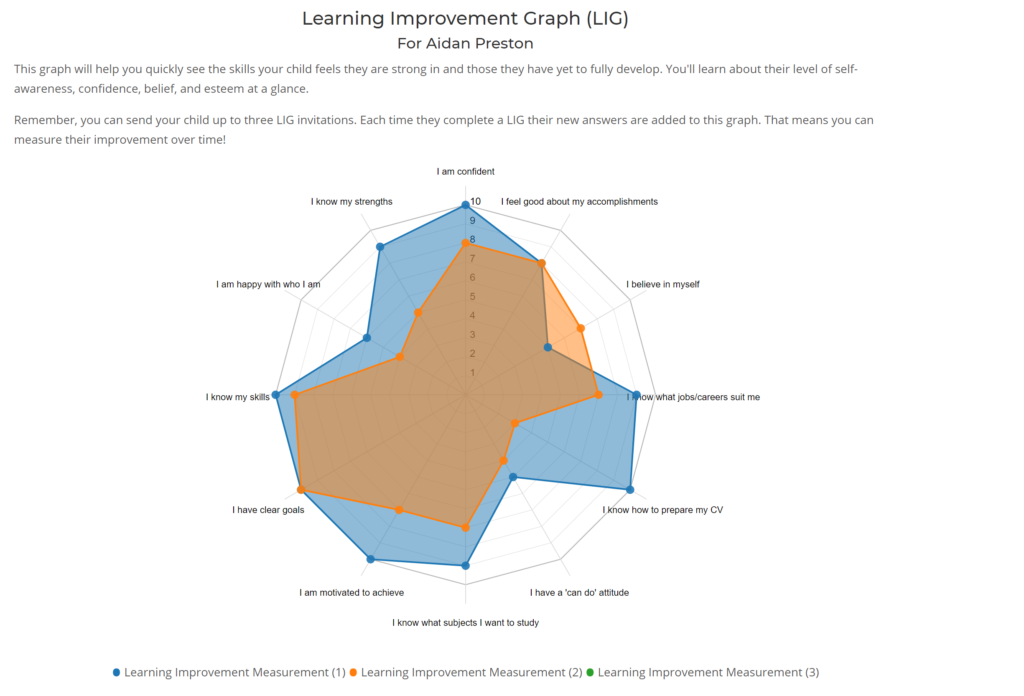
Aidan also saw an improvement in certain areas but also wasn’t too happy with who he was. He still didn’t know what subjects to study and what his clear goals were. But he said he felt a lot more confident this time and he now believes that he can succeed. He also said he knew how to prepare his CV.
I asked Aidan why he wasn’t happy with himself and he said he didn’t like his name or his size. He has taken an interest in diet and lifestyle and I wonder whether this has been down to the TV he watches or his peers at school. I made a mental note to work on building his happiness by spending more time with him on the subjects he enjoys and making him feel big and strong wherever and whenever I can. But this is a difficult subject to tackle as Aidan has always been sensitive to the emotions of others and what people say. So if someone has said something about his name or size, it would be difficult to help him forget.
How did we get on with Lesson 8, easyFeedback and easyFuture?
The very last lesson was an eye-opener for all of us. I think the boys finally understood why it was so important to know what they wanted to do in life and why it helps to have clear goals in mind to become successful. When we complete these lessons again in a few years time it will be interesting to compare the results as the boys are still quite young and haven’t thought about adulthood yet.
How long was the lesson supposed to be?
60 – 80 minutes depending on the number of children. Be mindful that engagement is important so the lesson might last longer.
How long it took us
Almost two hours. It’s a long lesson and the boys struggled with the visualisation part of the session. However, when it came to completing their LIM again, they enjoyed going over their results and even found it interesting that it was better than the LIM 2.
What did I want the boys to learn in this lesson?
Success has a recipe and you need all the vital ingredients to make that recipe a success. If the boys had a destination in mind it will help them search for ways to get here. Goals help them stay on course especially during those tough times and no one can set a goal for them.
They must be in charge of their own goals and dreams. I also wanted the boys to know that study and career choices that support their goals now can help them achieve their dreams more quickly.
What did I learn from this lesson?
I learned that my boys have a lot more complex thoughts and feelings than I thought they would have at their age and that it’s my job to handle these thoughts and feelings carefully, without knocking their confidence. I also learned that my boys are very smart and have a good head on their shoulders. So I’m even more proud of them than I was when we started this Mindscreen journey.
What did we learn from the Mindscreen Experience?
We learned so much! The boys learned that there is so much more to life than just being handed things on a plate. They learned that what they do now will affect what happens to them later and I learned that it’s never too early to get them involved in becoming accountable for their future, as long as you don’t overwhelm them with too much information too early.
Overall, I learned that there are so many steps to helping your child build their self-esteem and confidence that it’s a long road to happiness. But as long we are there to help them achieve what they want in life, offer undivided love and support, then there’s no reason why they can’t succeed.
I loved every moment of the Mindscreen experience and learned so much about my boys, as well as how to build confidence in myself too! The Mindscreen Experience is a fantastic way to bond with your kids while learning about how your children can achieve success later in life.
What’s next?
It’s over to you! I highly urge you to take the Mindscreen experience now with your child and sign up as soon as possible, so you can play a huge part in helping your children build their self-esteem and confidence.
Helping your child build a bank of personal unique skills – Mindscreen Review – Part 5
*This post and the proceeding/subsequent posts in the series are sponsored by Mindscreen – an online mental health and wellbeing tool which guides children towards higher self-esteem, at home or in the classroom.*
In Part 1 of our Mindscreen Self-Esteem Series, I talked about how to spot the signs of low self-esteem in your child by using an online tool called Mindscreen. If you haven’t done so already, please read the following articles in the series first:
In this article, we deep dive into Lesson 4, easySkills, which is about helping your child better understand what their unique skills are and how they use them. Help your child build a personal “bank” of unique skills they “know” they have.
Before you start
Please note – you need to purchase the Mindscreen Experience to access these lesson plans. Follow the link below to get 10% off your Mindscreen Package now.
We’re looking for your child’s unique personal skills and help them discover how to use them.
EasySkills
I introduced the lesson with the purpose of easySkills which is to help the boys build a big personal bank of skills so they know what their unique skills are and how they can use them to choose the correct career path in the future.
My skills
I asked the boys to open their Learner Diaries so they could answer the first question which was:
Think of something you did recently that you really enjoyed
I.e. playing a game, working, following a hobby, at school, developing friendships, learning something new etc. The boys could write their answers either in words and/or pictures.
Both boys picked playing in a football match.
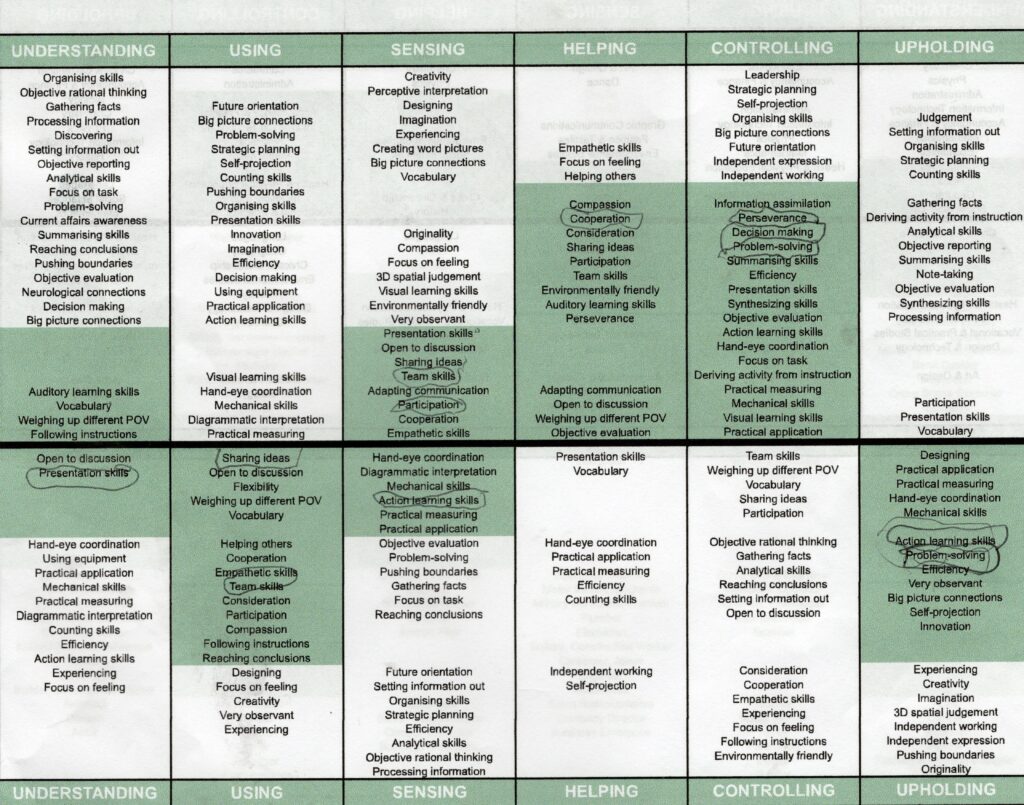
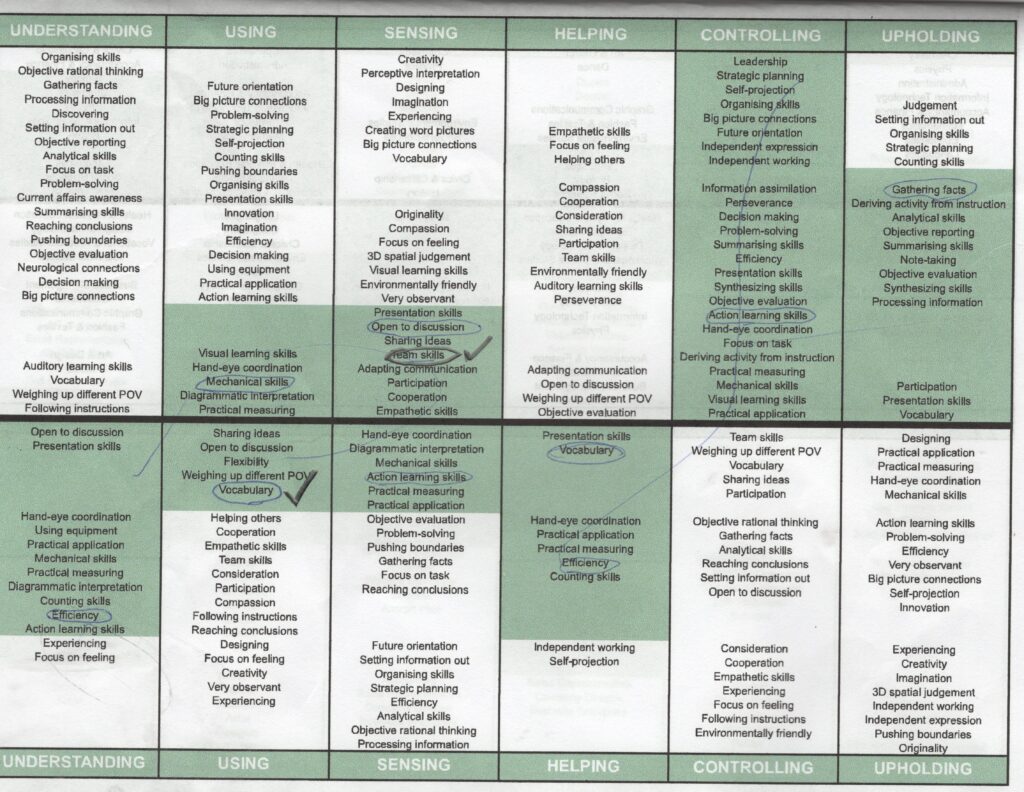
I then asked the boys to turn to the ‘My Skills’ insights page and circle any of the skills they saw in the shaded areas that they used during the activity of playing football. I asked them to try and circle a minimum of one skill from each column.
Aron circled the following:
Aidan circled:
Deep diving into the activity to find out which skills were used
I told the boys that we were going to have an interview, where I asked them some questions about the activity and they were to answer them on the spare piece of paper provided.
I combined the answers as the boys’ answers were very similar to each other.
The questions were:
1. Why did you pick this activity as something you really enjoy?
Skills, goals, tackles, saves. It’s fun. I like running around and kicking a football.
2. What is it that you liked about that activity so much?
Attacking and playing as a team and showing people using easyConfidence to stand to who I am. The intensity.
3. Was it because you used your mind a lot?
Not really. I don’t really think much when I play football.
4. And is it because when you’re losing you want to win?
Sometimes, but I prefer to play with my team so we all win.
5. It is because you want to be the best?
No, I will never be selfish, I would always play fair, I will always play as a team.
6. Did you find ways of moving the ball better?
Yes I can move the ball better now that I practice.
7. Did you learn a new technique?
I always learn new techniques every time I play.
8. Is it because you found ways of moving the ball around better?
Yes, I like moving the ball but I don’t like to be selfish, I pass the ball, so people aren’t annoyed with me.
9. Is it because you learned a new technique in the game and you learned new football skills?
Yes, I want to improve all the time on my football skills and techniques.
“Can you make this the last question please mum?” Aidan pleaded.
easySkills Activity Log
I told the boys that we were now going to go through the skills in their Mindscreen profile and in their Activity Logs they were to write a short description of how they used that skill.
This part of the activity was the longest bit and after going through about ten skills, the boys had enough. We managed to complete the activity log in the second session, but literally ticked through it. Some of the skills Aidan worked through were:
Skill
Definition
Activity
Active learning skills
Learn by doing
New techniques while practising
Adapting communication
Being able to describe what you’re saying so that other people who are different from you can understand
Communicating with sign language
Analytical skills
Being able to think about a situation, study it fully, and understand what the most important things about it are
No I will always follow the rules
Assimilation
Being able to take all the facts and make some sense of them
No I know football very well
Auditory learning skills
Listening to a skill or task being described and being able to learn how to do it yourself, from what you’ve heard
Nope I know all skills and I know how to to di it
Big picture connections
The ability to look at the whole picture from a distance and understand how actions affect the whole
No I make my decisions
Consideration
Being able to take the feelings or ideas of others into account
Yes I communicate
Cooperation
Being willing to work together with others, without wanting your own way all the time
Yes, I’m not selfish
Creativity
Having the ability to frequently come up with new ideas, ways of doing things, develop a solution. Can be in any area: practical, artistic, theory etc
Rabona flick
I asked the boys to pick two of their previously circled personal skills from their “My SKills Insights” page of their own Mindscreen experience® profile and invited them to open their Learner Diaries and complete the following statement:
“Two of the skills I used during the above activity are:”
Aidan picked – “Vocabulary” and “Team Skills”
“You use vocabulary during football?”
“Yes, the coach uses vocabulary when he shouts out football skills.”
“Team skills is where we work in a team”
Aron picked – “Perseverence” and “Participation”
Congrats, boys, these are your two main skills!
I reassured the boys that my two skills may be different to their skills but it didn’t mean they were any better or worse than theirs.
The last part of the activity was to get them to describe how they used these skills while playing football.
Aidan wrote – “Every time in games, the coach shouts out the vocabulary for football and we work as a team.”
Aron wrote – “By never giving up and by joining in.”
I told the boys that people who really enjoy their job are usually happy. That’s because the job they do is in tune with their skills and values and what they are interested in. This happiness on the job is more commonly referred to as “job satisfaction”.
“Why?” Aidan asked.
“Because they use their two main skills and values in their job. If you find a job that uses these skills, you will be happy. If you’re happy doing that job, it doesn’t feel like a job.”
Completing the Learning Improvement Measurement questionnaire for the second time
At the very beginning of the Mindscreen Experience, I invited the boys to complete a questionnaire to find out more about themselves – you can find more about this questionnaire in Part 1 here.
The time had come to complete their online statements again to find out how far they’d come after four lessons.
The results were very interesting – and unexpected!
Aron remained confident, but Aidan’s confidence went from a 10 to a 7.
Both boys seemed to also be less happy with themselves the second time round.
“Why is this, boys? Mindscreen is supposed to boost your confidence, not make it worse!”
“I don’t know what my strengths are anymore,” Aron responded.
“Because when I cry sometimes I say I can’t do it and then my confidence goes down,” Aidan added.
“Why do you tell yourself you can’t do it? The point is to tell yourself you can do it, remember? Self-belief!”
“I don’t even know what a CV means! I’m confused!”
“So, how do we build your confidence then?”
“I will just make it harder because it will give me more confidence. When I say I can’t do it, I can do it when it’s hard,” Aidan said.
“I have no idea what to study,” Aron said.
“That will come, don’t worry about that now. We are working step-by-step to help you figure out what you want to become. You have so much time!”
“I didn’t know what I was doing at the beginning, I just went ten, ten, ten, ten in the last questionnaire and I didn’t know what I wanted. I can’t just do that!” Aidan continued.
“I think now I know a bit more I have less motivation because I don’t know what I want and I’m not in the mood for working at school and at home.”
“I’m bored all the time,” Aron added.
“I don’t want to do school work. But I do want to get star of the week,” Aidan mused.
I don’t have any clear goals except getting star of the week and man of the match,” Aron added.
Oh, gosh! I didn’t realise that I had to work on the boys as much as I did! I think learning about themselves is making them more aware of what they can and can’t do and it may be overwhelming them. For the next four lessons, I’m going to concentrate on taking it a lot slower and not making them feel like they’re overloaded with work.
How did we get on with Lesson 4, easySkills?
The boys really struggled with the last part of the lesson where they had to go through all the skills to find out which of them they used in their football activity. There were 49 skills to go through and the boys’ concentration spans stopped at 10. So we had to do the lesson in two parts where we had to complete the last part of the activity on its own. Aron zoomed through his skills a lot quicker than Aidan and managed to capture the point of the activity. Whereas with Aidan, it was like pulling teeth!
How long was the lesson supposed to be?
30 – 40 minutes with one child or 60 – 80 minutes if you run the “My Skills” activity with two children.
How long it took us
Almost a frustrating two hours because the boys really dragged their heels in the “My Skills” part of the activity.
What did I want the boys to learn in this lesson?
I wanted the boys to learn and discover their skills and to understand how these skills could be used to help them pick out their chosen career/job path later. Knowing about yourself means knowing what you can and can’t do and that could be the difference to a happy professional future.
What did I learn from this lesson?
I received a shock after analysing the boys’ Learner Improvement Graphs to find that some characteristics had gone down. I get the feeling this may be because the boys are becoming more aware of their strengths and weaknesses and it may be overwhelming them a bit. It’s food for thought as to how I tackle the next four lessons, though, so I don’t end up pushing them the other way.
What’s next?
The next lesson we’ll be looking at Lesson 5, EasyStudyChoice, which is about helping your child choose subjects to study that line up with their own skills, personal interests, and what they value. This lesson will help them identify career ideas related to their study choice options.
How to encourage your child to build positive beliefs
*This post and the proceeding/subsequent posts in the series are sponsored by Mindscreen – an online mental health and wellbeing tool which guides children towards higher self-esteem, at home or in the classroom.*
In Part 1 of our Mindscreen Self Esteem Series, I talked about how to spot the signs of low self-esteem in your child by using an online program called Mindscreen. In Part 2 I discussed Lesson 1 of the nine-lesson plan, where I talked about why self-awareness is important to build your child’s self-esteem. I would recommend you read the below once you have read Part 1 and Part 2 first.
In this article, which is the second lesson in the nine-lesson plan, I talk about EasyBelief, which is all about encouraging your child to discover their own beliefs, dispel negative beliefs and build on positive beliefs.
Before you start
You need to purchase the Mindscreen Experience to access these lesson plans. Follow the link below to get 10% off your Mindscreen Package now.
This was a great lesson because the boys were a lot more engaged and therefore I was a lot less frustrated! They seemed interested in learning more about beliefs and how they are formed. So, we got started!
Lesson 2 – EasyBelief
I turned to my parent guide and informed the boys that in this lesson we are going to talk about self-belief and how their beliefs influence them and drive their behaviour.
What is self-belief?
I asked the boys what they thought the word, ‘belief’ meant and both stared blankly at me.
The Oxford dictionary defines ‘belief’ as:
1. ” A feeling that something exists or is true, especially one without proof.”
2. ” A belief in, trust or confidence in.”
“I have evidence that aliens are real.”
Aron (9)
“Oh, really? What’s the evidence?”
Me
“Aliens are people.”
Ok, interesting… let’s move on.
“What about God? People believe in God,” I ask.
“So do I,” Aron responded.
“Ah, but is there any actual evidence? There isn’t actual evidence but believers believe he exists and they live their lives through their belief.”
“There is evidence. He made us,” Aron responded quickly.
I move on quickly from the topic of God and explain to the boys that this lesson was about discovering how beliefs are formed and whether the beliefs they have are either self-limiting or self-enabling.
What is a self-limiting belief?
A self-limiting belief is when you believe you can’t do something or it stops you from doing something. For example, you believe you are too slow to run, so you don’t run. Or you think you can’t draw so you don’t even try. This is a self-limiting belief.
What is a self-enabling belief?
A self-enabling belief is a positive belief that allows or enables you to do something because you believe you can do it.
So, if someone tells you that you can’t draw, but you ignore them and believe you’re actually good at drawing, then this is a self-enabling belief. You encourage yourself to do better.
I told the boys they needed to understand the difference and that their beliefs drive the way they behave.
“So if you believe that people don’t like you then you’ll become antisocial and you won’t want to speak or spend time with anyone.”
“What does antisocial mean?”
Aidan (8)
“You don’t like to socialise or spend time with people.”
“Oh, I thought you meant like social distancing,” Aron replied.
“Well, the word social distancing comes from being close to people when you socialise with them. When you’re talking about hanging around people and socialising with them, there’s no distance between you so the government have asked you to distance yourself socially.”
“Do you understand the difference between a self-limiting belief and a self-enabling belief?” I ask.
“Self-limiting belief is when I tell myself I can’t do something and self-enabling belief is when I tell myself I can do something,” Aron replied.
“Nicely put, Aron! Let’s move on to The Dog Story so I can illustrate what I mean.”
The dog story
The purpose of The Dog Story is to help kids learn how their beliefs are formed and how they influence their behaviour.
I asked the boys to head to their Learner Diaries which is a document to record their findings in the lesson, and think about something they did recently that they believed they were good at and two give me two reasons why they believed they were good at this activity.
Aron wrote – “I am good at drawing.”
… and the two reasons why he believed he was good at this activity was:
“Because I am careful”
“I am neat”
Aidan wrote – “Do a great poster.”
… and the two reasons why he believed he was good at this activity was because:
“I’m stylish.”
“I’m creative.”
I told them the reason for this activity was to show them we become what we believe ourselves to be and some of our beliefs stop us from achieving while others help us to achieve.
“So I want you to imagine that you are a paperboy in this story.” I started.
“What’s a paperboy?” Aidan asked.
“A paperboy is someone who delivers newspapers to houses.
So you’re walking up a driveway towards a house with your papers and a big dog attacks you and bites your bum.”
Aidan gasps “Do you get rabies?”
“No. You feel some pain in your bum and then for the first time you’re having thoughts like, ‘some dogs bite’, or ‘why did this dog bite me?’
Imagine you go up to the next driveway and another dog bites you in the bum again, which is painful.
And your earlier thoughts were, ‘some dogs bite,’ but now this might change to, ‘quite a lot of dogs bite,’ or ‘why are these dogs biting me?’
Now imagine you’re walking up to a third driveway…”
“Oh-oh!” Aidan responds
And another dog bites you and your bum is now very, very painful. You might now begin to believe that all dogs bite. Now you got up to the fourth driveway. And the dog there is slavering, growling and he looks very angry.
Now on your piece of A4 paper, I want you to answer the following questions:
1. What have you begun to believe from hearing this story?
“That dogs bite.” Aidan said quickly
“He’s going to bite me. He’s going to make my bum numb,” Aron added.
2. How will you behave when you see that 4th dog getting angry, growling at you?”
“Run away!” Aidan shouted.
“Ok, so you can see that from this story and from your experience your belief has now been formed that all dogs bite. And the more often you have that thought and that experience and that emotion, the stronger that belief becomes. So the more dogs that bite you, the more you believe that all dogs bite.”
So, here I helped the boys visualise how a belief is formed from their thoughts and experiences and gave them another example.
“Now, imagine being told again and again that you are stupid by another person and they make you think you are stupid.”
“I’m not stupid.” Aidan said.
“I’m just using it as an example, I don’t think you’re stupid at all.”
“Ok, carry on.”
“If someone keeps telling us we’re stupid, we’re going to start to think we’re stupid.”
“No, I would say he is stupid for calling me stupid!”
“I will explode.” Aron said.“I wouldn’t listen to their comments. I know what I’m good at.”
I tell them that is important to understand that a self-limiting belief even if it comes from someone else, can stop the boys from doing or being the best they can be.
“In The Dog Story, the more we think dogs are aggressive. The more we will do what?” I continue.
“We’re going to keep thinking that dogs aggressive,” Aidan replied.
“Well you’re going to avoid them aren’t you? You won’t go anywhere near them. But the reality is that not all dogs are aggressive so this is a self-limiting belief because this belief will make you miss out on the opportunity to play with other dogs.”
“Change dogs to Ayla!” Aidan shouted.
“Ok, say that Ayla is aggressive, then you will start to avoid her and then you’ll miss out on playing with her because you think she’s aggressive. That is a self-limiting belief. It stops you from doing the things that you want to do. Do you understand what a self-limiting belief is now?”
“It’s when somebody says no you can’t do it because you’re stupid and you keep on believing that you are bad at it. It stops you from being yourself, and it stops you from having self-belief.” Aidan said.
“Beautiful, well done.”
I explain to the boys this is why we’re doing this activity, so they can understand the difference between a negative self-limiting belief and a positive self-enabling belief. I asked them to answer the question:
“How did my belief that I am good at this activity affect my behaviour?”
“Well I became more confident,” Aron said.
How do self-enabling beliefs help you achieve what you want in life?
I asked the boys to write down three people who have achieved something that really impressed them. I told them it could be anyone, from sports stars to real people, to a family member or friend.
“Martial because of his goals, Aron because he got star of the week and headteachers awards and mummy because you are mummy and you’ve had so many babies and you look after us. How do you do it!?” Aidan responded.
“Martial because he impresses me that he scored the most goals for Man Utd. My friend because he is the most intelligent in the class. Mummy, because you are the best mum in the world.” Aron said.
Ah, they both picked me as someone they were very impressed with – that really touched my heart!
“Are you an ah-but? Are you living with an Ah-but?”
“What is an ah-bot? Aidan asked.
“Ahhhh… but what?” Aron said with a smile.
There are two types of Ah-buts.
Type 1 – Can you remember a time when you had a really good idea and a voice in your own head said:
“Ah-but I can’t do it. Ah-but I’m not good enough.”
“Has that ever happened to you?”
“That’s just… yeah,” Aidan said, not amused that he didn’t get what Ah-but meant the first time.
“No I’ve never heard of it,” Aron said.
“You can’t think of any time when this happened to you?”
“Erm… I don’t know when! I don’t think I had one,” Aron pondered.
“Sometimes I have an Ah-but situation when I’m starting an article but a voice in my head says ‘Ah-but you don’t have the expertise to write this article.”
Type 2 – The other type of ah-but is when you had a really good idea and you shared it with someone else and that person said:
“Ah-but I don’t think you’re good enough to do it.”
Or,
“Ah-but I don’t think you’ll be able to do it.”
“Has this ever happened to you?”
“No,” the boys shouted in unison.
“Wow, good!”
“So, with those three people you picked, what do you think would have happened to them if they had listened to those Ah-buts? Do you think Martial would have scored that goal if he had listened to the Ah-buts? Do you think Aron would have had all those headteacher awards if he listened to someone who said, “Ah-but you’re not good enough?”
“No, but they wouldn’t listen to the Ah-buts, they’d do it anyway,” Aron said.
I told the boys that successful people in every walk of life achieved their success, including those billionaires that started their businesses and made lots of money because they believed in themselves and their own abilities. They didn’t listen to the Ah-buts. Self-made entrepreneurs, famous footballers, people who are happy in life, they are successful because they didn’t listen to the Ah-buts from themselves or from other people. An entrepreneur is an entrepreneur because he/she believed in their idea and went for it.
“I will never listen to the Ah-buts!” Aron responded.
You have the ability to be a great achiever. In whatever you choose to do. And whatever you believe, this is the whole reason for this lesson boys.”
“Aron, you want to become an illustrator, but if you listened to that Ah-but in your head or from someone else, what would happen?”
“I would say rubbish, I’m doing it! I am going to make a million pounds selling drawings to everyone,” Aidan chimed in.
“That’s right Aidan and why not!”
“Stupid Ah-buts!” He continued.
“In the Champions League, Phil Jones said to Martial that there’s no way you can score a hattrick. You don’t have enough experience. But, guess what. Martial scored a hattrick! Phil jones was stumped.” Aron said.
“Well, there you go! He didn’t believe the Ah-buts.”
I asked the boys to open their Leaner Diaries again and complete the following two statemetns:
Think about something you achieved recently and describe how you overcame the “Ah-buts.”
Think about something you haven’t achieved yet because of the “Ah-buts”. Describe how you can now defeat the “Ah-buts” and succeed.
Aidan wrote, “Scoring a hattrick in the football match.”
“Ok, but, how did you get over the Ah-buts?”
“I ignored it and scored the hat trick,” Aidan replied
“And think about something you haven’t achieved yet because of the Ah-buts and describe how you can defeat the Ah-buts and help you succeed.”
“Nope, whenever anyone has said an Ah-but I ignore it and achieve it.” Aron chimed in.
“Ok, very good Aron.”
I wanted the boys to take away the most important points of this lesson – that their beliefs are formed by their repeated thoughts, experiences and emotions and the more they have that thought, whether it is more painful or pleasurable of an experience, the deeper their feelings and thoughts become, and the stronger their beliefs are.
“And it is really important that you only share your beliefs with those who support you and not criticise you and limit yourself belief.”
Our beliefs can be constructive and they can be destructive
I wanted to talk to the boys about how their thoughts and feelings could either be constructive or destructive.
“Anytime you have a doubt about something, ask yourself this question – is the thought I’m having constructive, i.e. is it helping me or benefiting me, or is it destructive, i.e. self-limiting, so it’s not helping you?”
“I want to have a self-enabling belief,” Aidan said.
It is also vital to recognise when our thoughts and beliefs are destructive and replace them with constructive thoughts.
I told the boys that they can do whatever they put their minds to, so whenever they start to feel a destructive thought coming on, they should try to think of a way to make it constructive, i.e. Replace negative thoughts with something positive.
“I can even do a cartwheel inside a bag,” Aron said.
“I can even jump on the table and land on the ceiling,” Aron continued.
“So, what did you learn from this lesson?”
“I learned that I don’t want to listen to the Ah-buts, and I want to have a self-enabling belief and reach my destiny. I want to ignore what people think I can’t do; I want to be myself and my best,” Aidan replied.
“I have learned that I do not have any Ah-buts and ignore all the people who tell me I can’t do it. Because I can!” Aron said.
“Beautiful, we are done!”
How did we get on with Lesson 2, easyBelief?
I was surprised to see how engaging the boys were in this lesson, especially when Lesson 1 was trying throughout. I was also shocked to see how defensive the boys got when I ask them if they had any self-limiting beliefs and when I talked about the Ah-buts with them. But, as a result, I think I got through that we need to ignore the Ah-buts and believe what we want to believe. Aron has repeatedly told me that thoughts control him, so I hope he now sees that we control our thoughts and not the other way around. Fantastic lesson and I learned a lot about dispelling my own self-limiting beliefs, especially when it comes to tackling long projects at the beginning.
Equally I was surprised to see the inner strength coming from Aidan about reaching his destiny and being what he wanted to be. He showed a lot of energy and vigour in the lesson which comes from his strong desire to succeed. I hope I reinforced that his desire to succeed will enable him to succeed later in life.
How long was the lesson supposed to be?
30-40 minutes
How long it took us?
About an hour but we had a lot of discussion in between with limited distractions, so it didn’t feel too long.
What did I want the boys to learn in this lesson?
The most important part of this lesson is to help the boys understand the power of believing in yourself and when you have faith in yourself to succeed in what you’re doing and you have the belief in yourself that you can do it, you won’t listen to the Ah-buts, whether it comes from your mind or from someone else. I think I hit home not just the importance of believing yourself but why it is important to also believe in others too and don’t become an Ah-but yourself.
How important is believing in yourself?
Is it important to believe in yourself? Yes, absolutely! There are a myriad of benefits to believing in yourself and it’s important to encourage children to do the same.
But, does believing in yourself actually help with being successful? Believing in yourself is the first secret to success because it helps you achieve the goals you set out for yourself, ignoring the Ah-buts who says you can’t do it.
How do you start believing in yourself and your abilities to take on big life-changing goals?
Start small. Find out what’s causing the destructive thoughts and work through the steps above with your child to turn those negative thoughts into positive ones. The importance of self-belief is paramount when it comes to achieving the goals your child sets their minds to. And, they will come across those Ah-buts from everywhere. So arming them with the strength to say they can do it regardless of what others say, is a powerful tool they can use in the future.
Even getting your kids to say to themselves daily, “I believe in myself” can be enough to create a positive outlook for the day.
What’s next?
In Part 4, we will be going through Lesson 3, easyConfidence, which provides your child the opportunity to explore their own strengths and talents to build their self-confidence.