
*This post and the proceeding/subsequent posts in the series are sponsored by Mindscreen – an online mental health and wellbeing tool which guides children towards higher self-esteem, at home or in the classroom.*
In Part 1 of our Mindscreen Self-Esteem Series, I talked about how to spot the signs of low self-esteem in your child by using an online tool called Mindscreen. If you haven’t done so already, please read the following articles in the series first:
- Part 1 – How to spot the signs of low self-esteem in your child
- Part 2 – Lesson 1 – Why self-awareness is important to build your child’s self-esteem
- Part 3 – Lesson 2 – How to encourage your child to build positive beliefs and build confidence
- Part 4 – Lesson 3 – How to build on your child’s strengths and increase their self-confidence
- Part 5 – Lesson 4 – Helping your child build a bank of personal unique skills
- Part 6 – Lesson 5 – Helping your child choose subjects that suit their skills, hobbies and interests
- Part 7 – Lesson 6 – Teaching your child how to choose a career they will enjoy
In this article, we deep dive into Lesson 7, easyCV, which is about giving your child the opportunity to prepare the most important part of their CV, their personal statement. We will also go through the “dos” and “don’ts” in CV writing.
BEFORE YOU START
Please note – you need to purchase the Mindscreen Experience to access these lesson plans. Follow the link below to get 10% off your Mindscreen Package now.
Take the full Mindscreen experience now and get 10% off! CODE: save10%
In Part 2, I go through the general structure of the lessons, so please check out how it all works here.
What is a CV?
A CV (short for Curriculum Vitae and otherwise known as a resume) is a brief account of a person’s skills and characteristics, education, qualifications and previous occupations.
In this lesson, I helped the boys prepare their own personal statements using statements in their “About Me” section in their Mindscreen Profile. We also went through a simple CV template and how to write a CV (as well as how NOT to write a CV).
I explained to the boys that a CV includes:
- Personal statement
- Personal skills
- Characteristics
- Education
- Qualifications
- Previous jobs – (I assured the boys that they don’t have any jobs right now but when they’re older, they’ll be able to add to this part in their CV.
How do you write a personal vision statement?
We got straight into the lesson by explaining to the boys that we were going to write the personal statement part of their CV. A personal statement is the most important part of a CV because it shows employers what their skills are and tells the employer something that’s real about them. It also highlights their dreams and ambitions, i.e. what they aspire to be.
We wrote down a selection of jobs together and I invited the boys to select one job they would like to do from the list. I reminded them they could choose more career options in their “My Career Choice Insights” page in their Mindscreen experience profile.
Aron picked Police Officer and Aidan picked YouTuber.
About Me
The boys turned to their “About Me” section in their Mindscreen Profile and I asked them to pick three of their most positive statements related to the job they chose.
Aron picked:
“I want to be seen as a winner and I want to succeed.”
“I sometimes have big visions that seem extreme to other people.”
“I respect winners and those who achieve great things.”
I struggled with Aidan because he didn’t want to tell me what job he chose. Finally, after sitting down and chatting with him, he said he found the whole project very difficult. So we went through all the statements together. Eventually, we picked:
“I prefer limited supervision, therefore I like to be left to get on with the job.”
“I like to be in control of my own destiny and choose my own way in life.”
“I may get my own way more often if I learn to be less demanding and dominant.”
We then discussed how we were going to combine these three sentences to create our personal statement for the job they chose.
Eventually, we managed to write about Aidan’s skills (I wrote out a personal statement example for him) and we combined them into a personal statement for both.
What do I want to achieve in my life?
I asked the boys to think about what they wanted to accomplish in life and to answer the above question, “What do I want to achieve in my life?”
Aron – “Victory and proudness”
Aidan – “Self-belief”
I asked them more questions to help them answer this very difficult question.
“What do you see yourself doing as an adult?”
“Do you want to help people?”
“Do you want to solve crime?”
“Do you want to make the world a better place for your family?”
“Do you want to be rich?”
Aidan wrote “I want to achieve 500,000 subscribers”
Aron wrote, “I want to actually be able to get a house and have money to pay for my family.”
I then asked the boys how they would describe their goals and ambitions as part of their personal statement in a way that is relevant to the job they chose?
Aron wrote, “To achieve a crime license, I should study online and get paid to investigated who murdered people.”
Aidan wrote, “My goal is to get rich and get a house and a car.”
So, we were getting there slowly, but the boys still hadn’t grasped the point of a personal statement. I struggled with this part of the lesson because they knew what they wanted to do, but they found it very difficult to connect their skills to the jobs they chose.
We had a long chat about what CVs meant in the professional world as I had an inkling it was because the boys didn’t fully understand the point of the lesson. After about 20 minutes Aron got it and did a much better job of explaining how the personal statement worked by combining the three statements that Aidan picked and we eventually got Aidan’s personal statement sorted. Well done to Aron for explaining it in a way I couldn’t!
CV template
We moved on to look at a CV template that was provided by Mindscreen (see below).

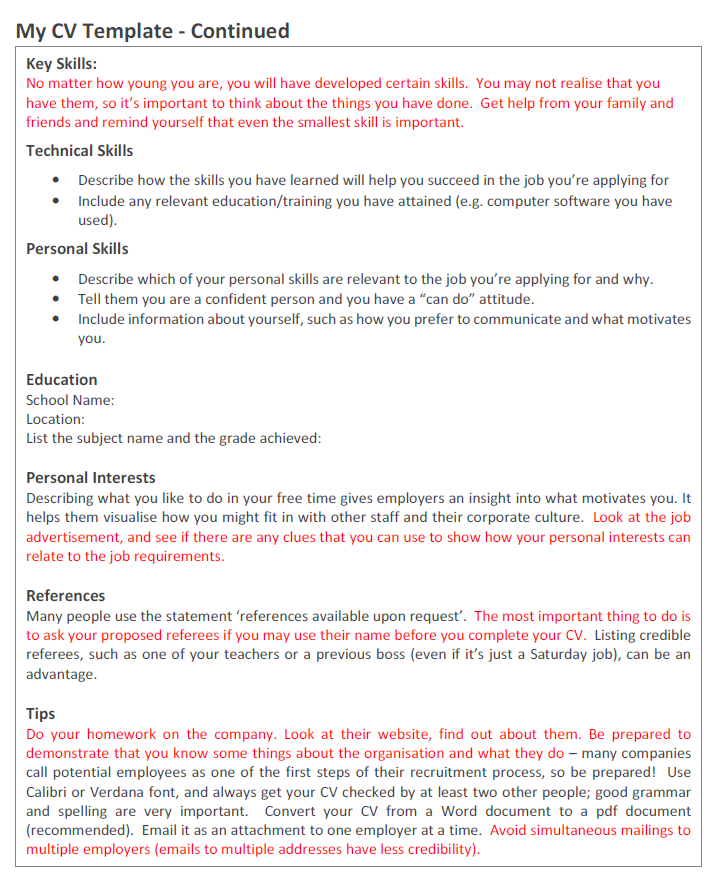
I showed the boys the above CV template and explained the structure as well as the do’s and don’ts for CV writing, for example, using a professional email address like your name rather than a silly one like above. The boys were fixated on the naughty email address though.
I then went through the job personal statement template. I advised the boys that it’s especially important to get the CV right because then they’d get invited to an interview. The example personal statement helped the boys put together what I had earlier taught in the lesson.
I explained that the boys’ job history may be empty now but under Personal Achievements and Key Skills, they can add transferrable skills like working on their website or working for mum until they populate their CV with jobs later. I also showed them how organising and tidying their rooms every day was a personal achievement because it showed they were focused and had a tidy mind.
I asked them to think about what other skills they had at home they could put on their CV. Aidan said changing Ayla’s nappy which was a great skill to have as it showed Aidan could be trusted with fundamental jobs in the workplace and Aron said looking after his siblings which I also explained was a fantastic skill to have. It showed that Aron was a leader and he could manage a team well.
We went through some important tips too like always doing your homework on the company you’re applying for and how to personalise the CV for the employer.
How did we get on with Lesson 7, easyCV?
We struggled at the beginning because the boys found it difficult to get in the lesson. I realised that the topic of CVs being a completely new phenomenon had something to do with that, and so I took the time to explain it (Aron explained it much better than me!) and they eased up afterwards. It was fun going through the CV with them and working out where they could add to their CV.
How long was the lesson supposed to be?
30 – 40 minutes depending on the level of engagement with your children and the number of children in the lesson.
How long it took us
It took us almost two hours to complete the lesson, but we had a slow start. Plus, we engaged in lots of discussions which I think is invaluable so your children fully understand why a CV is fundamental to success in their chosen careers.
What did I want the boys to learn in this lesson?
The boys need to understand that it’s not just about going out, finding a job then starting. For every role they apply for, there will be competition, so they need to ensure they have an attractive CV which accurately portrays who they are and what they can do on paper. Their personal statement is especially important when they are so young and they don’t have much/any work experience because it shows employers what interests them.
They want to display themselves in the best way possible to increase their chance to get invited for an interview. I assured them that me and their dad will be there to help them with their CVs whenever they’re ready.
Top tip – You must research your employer first and change your CV every time you apply for a job. You can also use the tips above for when filling out a university application too (or any other application for higher education).
What did I learn from this lesson?
I learned how to properly construct a CV! I wish I had a lesson plan like Mindscreen when I was growing up. I probably would have had far fewer rejections!
I also think kids should be given an introduction on how to write a CV at school and be taught how to write a personal statement for university and beyond, so they are prepared for life after education.
What’s next?
In the next lesson, we’ll be looking at Lesson 8, easyFuture and easyFeedback which is the last lesson in the Mindscreen series.
Watch out for that lesson coming soon!
Take the full Mindscreen experience now and get 10% off! CODE: save10%