

Helping your child choose subjects that suit their skills, hobbies and interests – Mindscreen Review – Part 6
*This post and the proceeding/subsequent posts in the series are sponsored by Mindscreen – an online mental health and wellbeing tool which guides children towards higher self-esteem, at home or in the classroom.*
In Part 1 of our Mindscreen Self-Esteem Series, I talked about how to spot the signs of low self-esteem in your child by using an online tool called Mindscreen. If you haven’t done so already, please read the following articles in the series first:
- Part 1 – How to spot the signs of low self-esteem in your child
- Part 2 – Lesson 1 – Why self-awareness is important to build your child’s self-esteem
- Part 3 – Lesson 2 – How to encourage your child to build positive beliefs and build confidence
- Part 4 – Lesson 3 – How to build on your child’s strengths and increase their self-confidence
- Part 5 – Lesson 4 – Helping your child build a bank of personal unique skills
In this article, we deep dive into Lesson 5, easyStudyChoice, which is about helping your child choose subjects that line up with their own skills, personal hobbies and interests, as well as what they value.
BEFORE YOU START
Please note – you need to purchase the Mindscreen Experience to access these lesson plans. Follow the link below to get 10% off your Mindscreen Package now.
Take the full Mindscreen experience now and get 10% off! CODE: save10%
In Part 2, I go through the general structure of the lessons, so please check out how it all works here.

What is easyStudyChoice?
easyStudyChoice is the 5th lesson in the Mindscreen series which helps your child choose study subjects that line up with their own skills, personal interests, and what they value. This lesson helped the boys identify career ideas related to their study choice options.
We started the lesson by recapping what we learned in easyAwareness, easySkills and easyConfidence.
We talked about what self-awareness is, i.e. learning about what your skills are and your natural and adaptive behaviour, and we went through the boys’ skills to find out how their adaptive behaviour changed their personality slightly to suit their environment.
We also touched upon self-belief, i.e. self-enabling belief which is a positive or encouraging belief that enables you to achieve the goal you want, and a self-limiting belief which is:
“A bad belief!” Aidan responded.
“A negative belief!” Aron added. “I’d rather be negative, though, you know why?”
“Why?” I asked, surprised.
“So, you don’t have COVID!” Aron laughed.
Moving on.
“But, seriously, I’d rather have a self-enabling belief.”
“Me too,” Aidan responded.
“Me three!” I added. “I’d rather think I’m good at something and practice it than think I’m bad at something and never try, right?”
“Right!” The boys shouted in unison.
I asked the boys if they remembered the ‘Ah-buts’.
“Yes, Ah-but I’m not doing enough or I’m not good enough so I’m not listening,” Aidan said. “In easySkills I said, ‘I can’t do this!’ but after learning I can do it I changed it.”
“Well done, Aidan!” What about easyConfidence? Remember the rope trick? If you’re feeling low what can you do?”
“Pull the rope up,” Aidan responded.
“And what does this show?” I slumped my shoulders.
“No confidence, you need to pull your rope up,” Aidan exclaimed.
“Agreed!”
I asked the boys if they remembered what skills they came up with – they didn’t. So we went through their skills quickly before we moved onto the actual lesson.
I recapped quickly what the boys learned, i.e. their skills, behaviour and confidence as well as how they could learn to be more aware of themselves in situations. In this lesson, we were now going to put that all together and come up with some study choices that lined up with their skills, personal interests and what they value. We were also going to take a look at positive hobbies and interests which is a great way to identify what careers they want to pursue, so they could be a happy adult later in life.
My Study Choice Insights
Aidan wants to be a YouTuber, footballer and a scientist while Aron wants to be a YouTuber, police officer and a footballer. So checked their Mindscreen Profiles to find out whether they had skills which matched their study subjects.
I asked the boys to circle two or more subjects they enjoyed the most in the shaded areas, in each of the six columns, so up to 12 subjects in total.
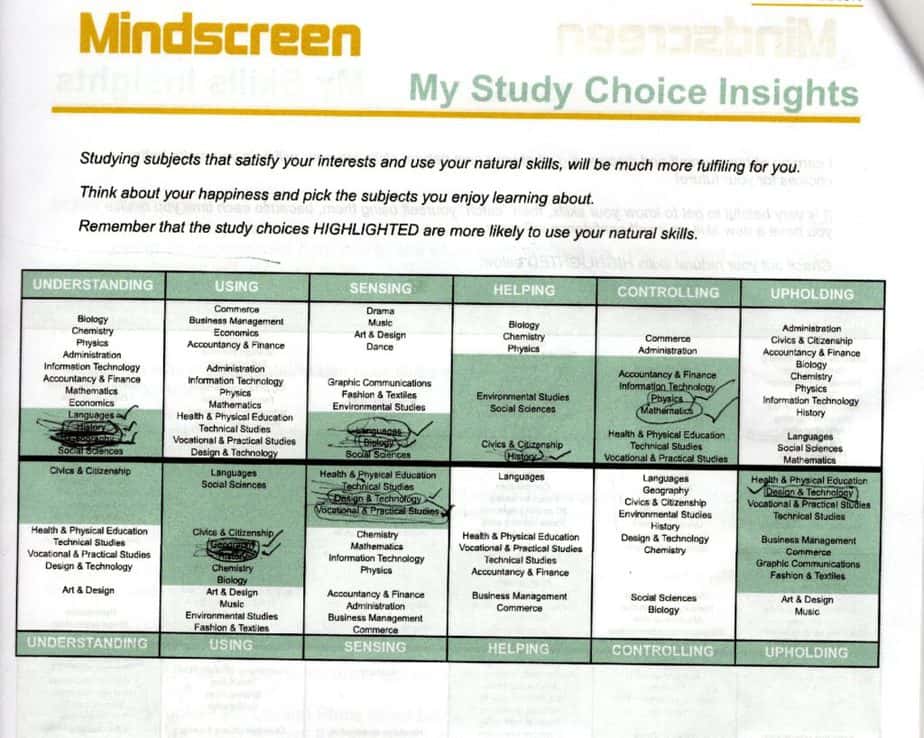
“I don’t do biology or social sciences,” Aron said.
“Just circle the ones you enjoy,” I responded.
I then asked the boys to turn to their Learner Diaries and write down their favourite subjects.
“I want to do my actual favourite subjects. I have none on here!”
“Ok, so just select the ones that appeal to you then, even if it’s less than 6.”
I asked them to concentrate on attractive hobbies and interests which could be related to a topic they’d like to study.
So Aidan selected Physics, Health and Physical Education, Biology, Technical Studies, Technology, Mathematics, and Languages.
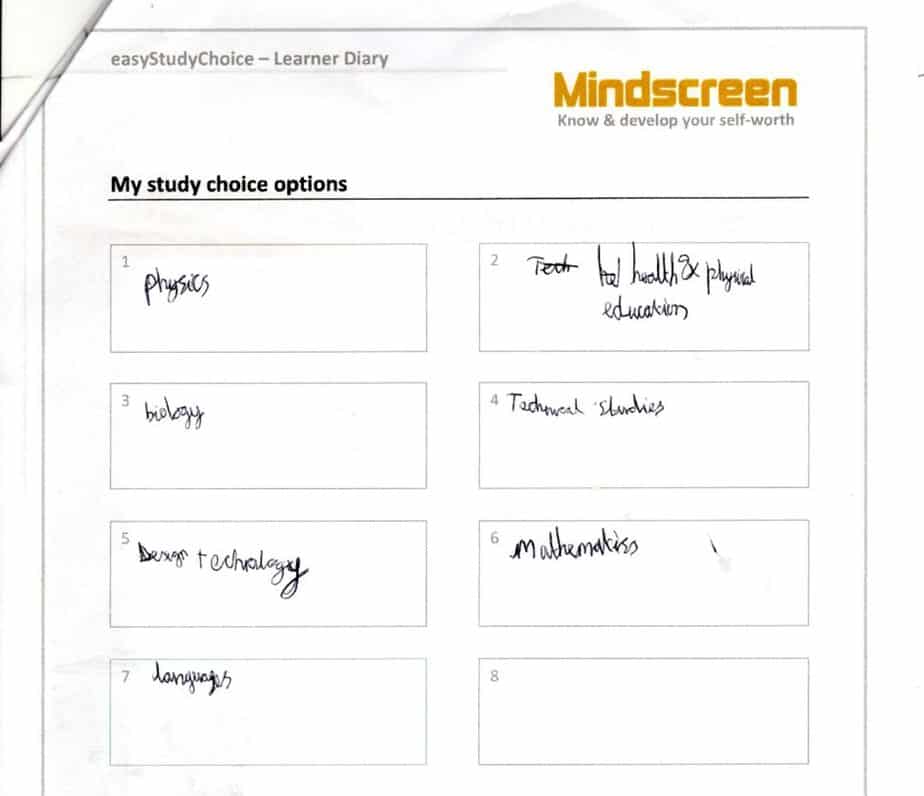
Aron selected D&T, History, Geography, Languages, Physics and Biology.
It was interesting to see which subjects they picked and how they were different from each other. I knew Aidan would pick something related to health as I’ve noticed a growing interest in physical health, diet and lifestyle. He won’t eat cake or too much chocolate because he thinks it’s too unhealthy – he’s 8! I found it most impressive that both boys picked languages as a favoured topic, especially as my no one in my very international family has tried to teach them another language yet.
I am Turkish Cypriot by origin but my Turkish is broken at best and their dad is Swiss and speaks five languages. We only speak English to the kids which is not a good thing I know, but it seems that the exposure from other members in our family speaking a different language to each other has rubbed off on the boys anyway.
I also didn’t realise the boys liked science subjects and so I made a mental note to concentrate more on science topics at home during homeschooling activities. I figured it was always maths, maths, maths with them both because that’s what they liked doing in their free time. But homeschooling has encouraged the kids to broaden their interests in the last two weeks, and I’ve noticed that during their spare time they like to get into art and even English. It’s amazing how much you can learn from your children when they’re with you 24 hours a day and you take an interest in their school work!
Interview time!
The next stage of the lesson was for me to interview the boys and ask questions to help the boys identify related careers from their chosen topics. I asked the boys to record all their ideas as well as list hobbies in their diary.
The boys turned to their “My Career Choice Insights” page in their Mindscreen Profile and I asked them a myriad of questions related to the careers that came up shaded on their profile.
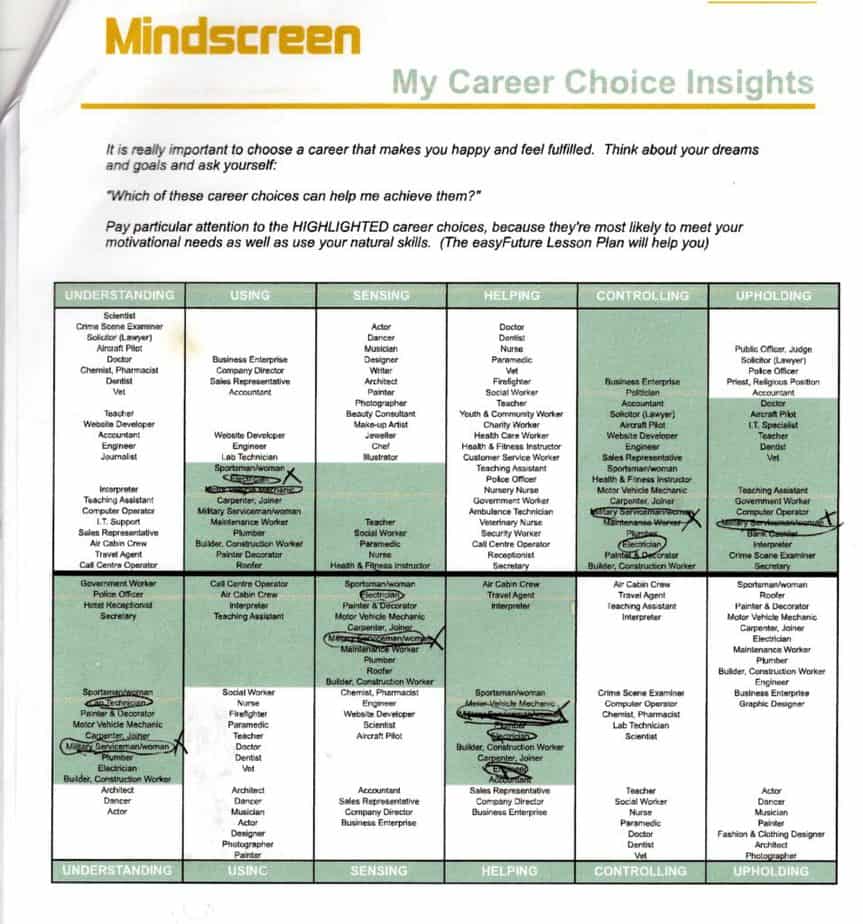
Aron picked languages because he wanted to learn Slovakian, which I found very interesting. But, once we delved deeper into the job of an interpreter as one of his possible options, he quickly realised that he would have to learn a language to a fluent level, so he would have to study the language properly during his career.
He somehow figured a language was something you simply picked up and in some cases that’s true, but to become an interpreter, you’d have to learn grammar and sentence structure and he was unwilling to do that. So, we abandoned the idea of becoming an interpreter.
Aidan wanted to do science experiments so I asked him about the job of a lab technician which he found interesting. Aron settled on a police officer role because he wanted to solve clues and examine bodies, like a crime scene investigator. We talked through the possible steps, from starting an office job to training on the job and Aron still wanted to put the role down. So this was a possible option for him.
Aidan also wanted to include maths in his career choices and he said that solving crimes was a bit like putting pieces together. I thought that was an interesting take on the role of a police officer so so I told him to write that down.
They both unanimously agreed to the sportsman role but didn’t know what else they would do apart from football. We talked briefly about team sports in general but they didn’t want to deviate from football. So they wrote football down.
Aidan was very interested in the businessman role; he has always wanted to own his own business and not work for a boss. We talked about his role in YouTubing as like owning a business because he was in charge of setting it up himself, creating content and getting the money coming in every day. He loved the sound of that.
Aidan also liked the idea of a website developer role as he got into coding during the last lockdown. I was quite excited at this prospect and told him that website developers can make a lot of money because they’re very skilled at what they do.
“Do footballers own their own business?” Aron asked.
“They are their own brand, so yes.”
So, Aron wrote businessman down too.
Both boys didn’t want to have a boss and I wondered whether that was my indirect influence on them after talking to them about my own journey into business. I read somewhere that entrepreneurs and business owners are more likely to work for themselves if a parent/guardian does too.
I always advocate starting your own business and following your unique path to life but I also reiterated to the boys that I had a long career in law first and I paid my dues working for someone else. I found the journey tiring, yet very informative and the lessons I learned from working in an environment not controlled by me was invaluable to when I did decide to work for myself.
You can right the wrongs you’ve seen and implement what you’ve learned when handling employees in your own business, should you be successful enough to branch out. The boys were very interested in learning more about how to do this.
Aidan wants to own lots of companies and build an empire but first he must have financial education and learn how to start a business. I told him I’ll help him do that and I have no doubt he’d put in the graft – he’s a very hard worker, especially when he puts his mind to something he wants.
So I asked them, out of all the careers they found on their My Career Insights page what sounded the most like what they wanted to do?
“Businessman,” Aidan replied.
“Police officer and businessman,” Aron said.
Why is it important to pick the career you love?
For your child to get the career they want, they must study the right subjects so they build on the right foundational skills to help them further their career. If your child wants to be a businessman/woman they must study business. If they want to be a police officer they must study crime. If they want to become a sportsman/woman, they must study for the sport at which they want to excel. And all this takes time, patience and a whole lot of love from their parents/guardian!
Can you imagine studying for a career you hate and how tedious that would be when you finally finish your qualifications and end up in a job that doesn’t suit you at all? It’s horrible and it could destroy your mental health.
The boys are 8 and 10 years old, so it’s almost inevitable they’ll change their minds along the way – and that’s ok! I’d rather they experiment now and when it comes to crunch time to choose their career path, they pick a subject they truly love and we as parents help them squeeze as much out of their chosen career as possible, whether that be a sportsman, a businessman or, dare I say it, a YouTuber.
Aidan wants to be a YouTuber because he wants to showcase his football skills, so at least he doesn’t want to play video games all the time! Perhaps, I could help him get there by assisting in setting up his YouTube channel and have that running in tandem with his football career. At the same time, he can be his own boss and he will do what he loves.
Aron wants to be a police officer and so I need to expose him to that kind of environment. Should he still want to be a police officer when it’s time to do out work experience, I will help him apply to work in a police department so he can get a real idea of what it takes to become a police officer.
HOW DID WE GET ON WITH LESSON 5, EASYSTUDYCHOICE?
The boys got stuck in going through all the topics and we had a great chat about how they saw their future. I learned a lot from them this lesson!
HOW LONG WAS THE LESSON SUPPOSED TO BE?
30 – 40 minutes with one child or 60 – 80 minutes if you run the “My Skills” activity with two children.
HOW LONG IT TOOK US
Just over an hour. We had lots of chats and really engaged in the lesson which I think is very important. If your child is slightly younger, they may not understand all the study and career options. So it’s a good idea to explain it to them and they get a sense of the subject first.
WHAT DID I WANT THE BOYS TO LEARN IN THIS LESSON?
I reiterated to the boys that it’s so, so important to pick a topic they love for their health and happiness. When I asked them what subject they loved doing the most every day and what excited them they said maths. So, there may be a chance they will change their career topics later.
I told them about my career in law and how unhappy I was working for someone else. I love the law, I still do; it’s why I work ad-hoc for a friend who owns an employment consultancy, so I can keep my foot on the legal pulse. However, in the banking and corporate department, I was miserable. It just wasn’t for me. So, when I decided to leave employment in 2010 and follow my passion for becoming a writer, I had to work really hard to get myself out there. But it never felt like a job because I was doing what I loved – writing.
Their father works in supply chain but his real passion is photography. And one day he says he will go full-time so he can do what he loves every day. We are working on that by trying to achieve financial freedom. I told the boys that this is real life, but not necessarily how it should be.
I also introduced the boys on how to build a CV, which we will talk about in a later lesson, and how to write a good cover letter to help them get the job they want. I briefly showed them some cover letter examples and resume examples, and how they could record their interests and hobbies in the interests section and hobbies section of their CV. We will talk about resume templates in Lesson 7, easyCV.
The earlier your kids start with finding their chosen career path, even if it changes later, the more successful they will be at achieving their hopes and dreams. It starts with a good work ethic and then it builds to knowing who they are and what they want. The rest comes naturally with hard work and perseverance. Keep your eyes and ears open for what your children truly desire – it may be the difference between a happy life and a miserable one.
WHAT DID I LEARN FROM THIS LESSON?
The boys are not quite old enough to know where they are at career-wise and what they want to be later – and I shouldn’t expect them to be at 8 and 10 years old. They have an idea which is great because the earlier they start pursuing their passion, the more successful they will be later in life if I help them stay on the path. I learned that they both don’t want to have a boss though – that much is clear!
WHAT’S NEXT?
In the next lesson, we’ll be looking at Lesson 6, EasyCareerChoice, which is about helping your child identify career options they are most likely to enjoy. This is an extension to the deep dive we did in this lesson on study options.
Click here to read Lesson 6, easyCareerChoice now!
Take the full Mindscreen experience now and get 10% off! CODE: save10%










One Comment