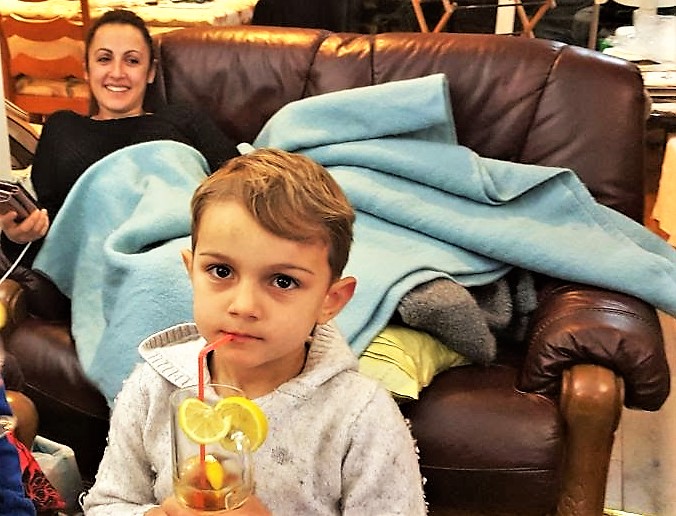
I will get onto the reason in a moment. But, you can probably guess what it is.
So, I’m going to issue a trigger warning now:
TRIGGER WARNING! THIS POST CONTAINS PERSONAL DETAILS ABOUT MY SECOND TRIMESTER MISCARRIAGE TREATMENT WHICH MAY UPSET READERS. PLEASE DO NOT READ IF YOU ARE SENSITIVE TO THIS TOPIC IN ANY WAY.
Get an insight into your fertility with an accurate at-home test and check your female hormone levels from the privacy of your own home. Code below!
So, to continue with the series, we’ll start from where we left off in Part 2. If you haven’t read any of the ‘Journey to getting my girl’ series, then may I suggest you start with Part 1 here, so you understand the backstory.
To summarise, the series talks about my husband and I following a non-invasive conception plan to get our girl, using Dr Verma from Urobiologics’ two tests, the PreGender Test which determines whether the female’s menstrual cycle favours a boy or a girl via non-invasive urine sampling and the FirstGender Test which determines the gender of the baby from conception, again, via a urine sample, which claims to be 95% accurate. Urobiologics discovered that just like there are two kinds of sperm, which determine the gender of the baby, women have alternating boy-girl specific menstrual cycles, which select the gender.
We had already sent our samples in and Dr Verma emailed us our conception plan to try for a girl soon after.
The conception plan was a long, hard slog. Hubby caught a nasty flu and was out for a week, which meant we missed one month. And there was a time when we thought we may have been pregnant, but I experienced a chemical pregnancy back in May 2017, which was very disheartening, so we didn’t try the subsequent month.
But we finally got pregnant in August 2017 and Dr Verma had been so responsive during those 13 months that it felt like we had a private doctor urging us on, providing tips and tricks to maximise pregnancy.
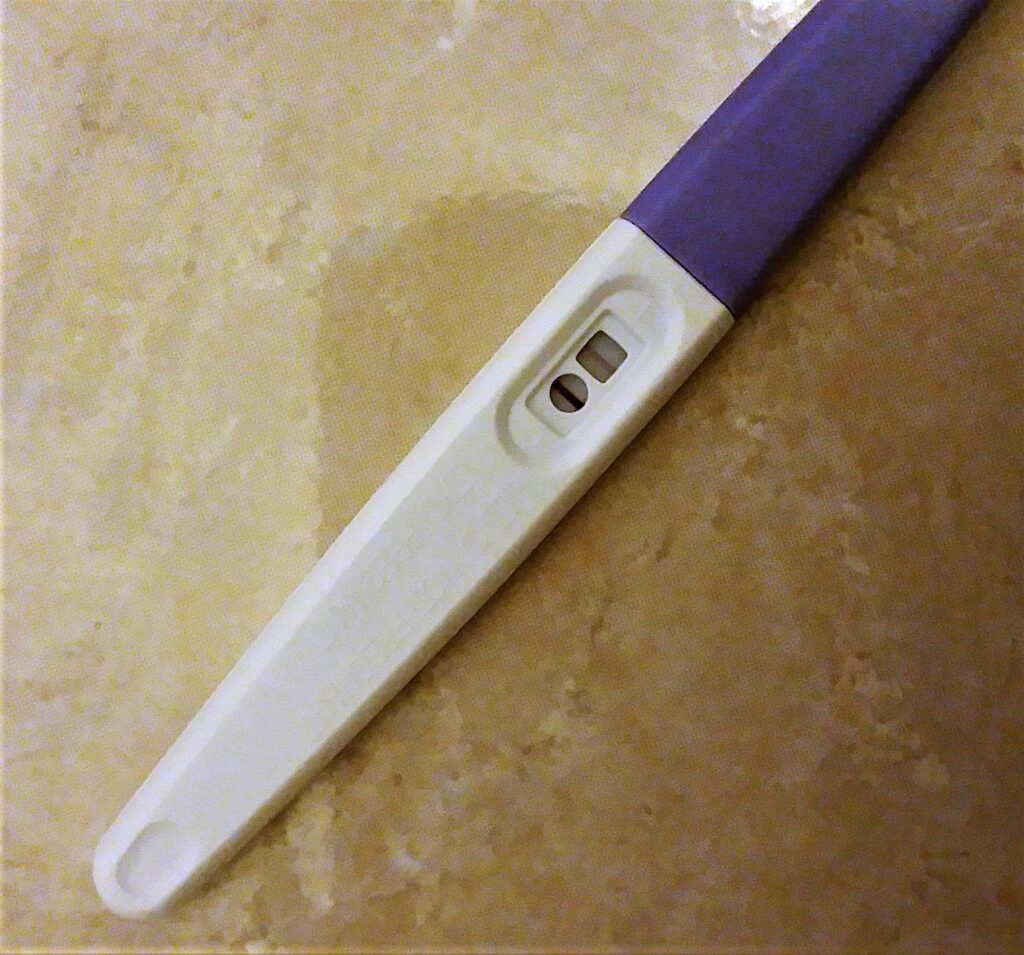
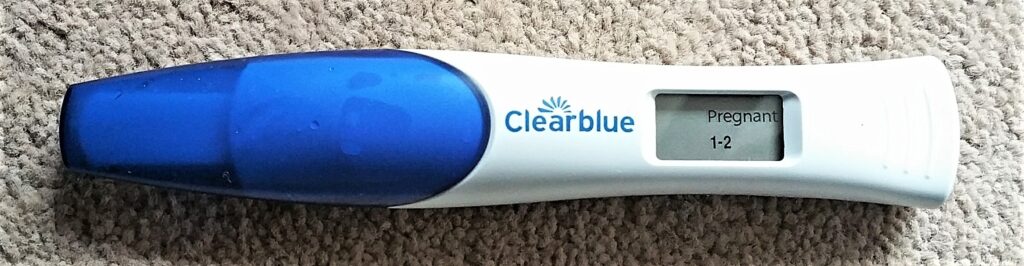
Positive pregnancy test!
When I sent Dr Verma a picture of our a positive pregnancy test, he was thrilled for us and urged us to collect samples for three nights and ship right away so we could start the next process which was the FirstGender Test.
What is the FirstGender Test?
As soon as you get your positive pregnancy test, you ship urine samples to Urobiologics who then test to find out the gender of the baby from day 1 of conception, with around 95.5% accuracy. And they email you the results within 48 hours of receipt of the samples. You can find more information about how to book the FirstGender Test here.
Dr Verma’s emails were very detailed, informing us exactly what we should do with our samples.
“Suppose you go to bed at 10pm. Do not collect that because it is diluted. Thereafter, anytime you go to the bathroom, let it go for 2 – 3 seconds, collect in a large vessel and pick up one spoonful and add to the bottle. Discard the rest. Repeat this the whole night until morning, included. Do not collect during the day. Repeat for two more nights and then ship the bottle.”
Dr. Verma, Urobiologics
Get a comprehensive picture of your hormonal health without the need for clinics or appointments. Easy testing, free shipping, and fast results.
I told Dr. Verma that I wanted to keep the entire process quiet until I passed 12-weeks gestation, which he agreed and understood.
I sent the sample off within days of the positive pregnancy test and despite a slight delay thanks to UPS, Urobiologics received the sample and got to work.
My best friend was so happy for me too, bless!
Good news!
Within a couple of days, we received the email from Dr. Verma:
Ms. Preston, We are proud to be the first one to say hello to Poppy. Welcome Poppy to your home. We have completed testing of the urine sample submitted by you. The baby’s gender, as evaluated from the urine sample believed to be from you appears to be FEMALE (GIRL) with around 95% confidence, without expressing or implying any warranty. This report should be read along with the disclaimers and terms & conditions displayed on our website.
Dr. Verma, Urobiologics
We were elated. We got our girl! But we kept it quiet until the 20-week scan, just in case there were any misreadings. We were quietly confident, however, that we had our girl and we couldn’t wait to tell our family and friends at 20 weeks.
The first trimester
However, from the moment I got pregnant, I felt like something was off.
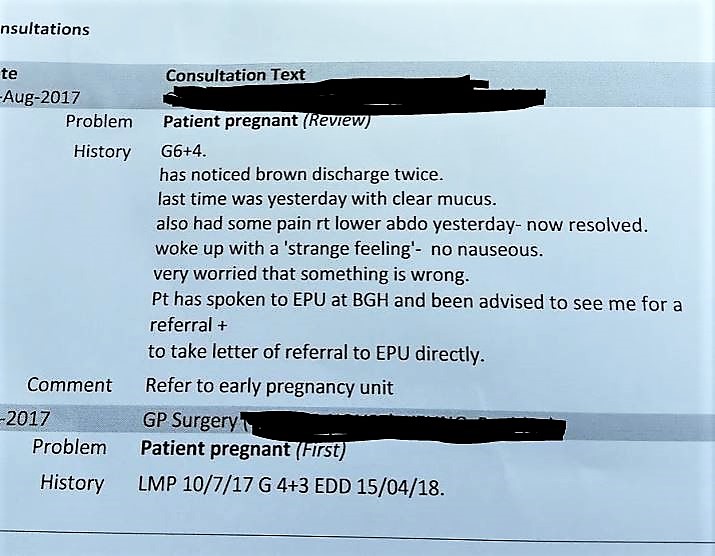
The first trimester was extremely difficult. I couldn’t eat or drink anything. I looked grey. I slept for 20 hours a day and I just felt poisoned. I struggled so much that my parents and hubby had to pick the boys up from school because I didn’t have the energy to get up. And I also had been spotting dark brown blood from week 7 to week 12 of the pregnancy.
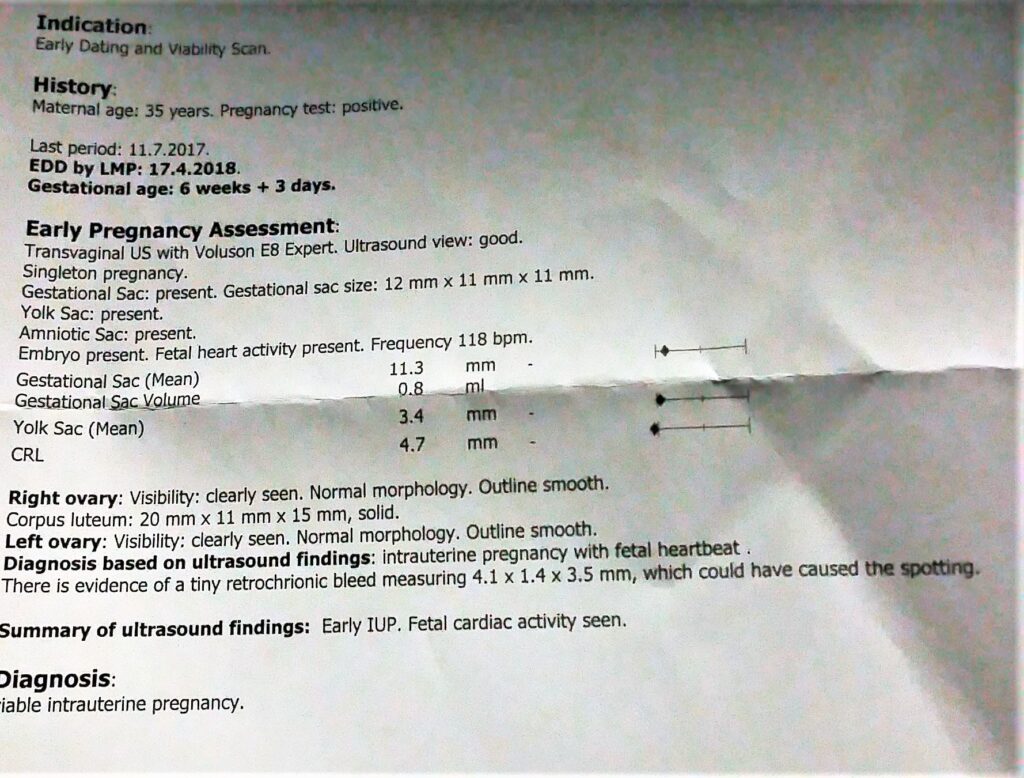
I had a transvaginal scan at week 6 to find out if everything was ok and I saw my little dot with her beautiful little heart beating (a vision of which years later, I still see in my mind)
I was really excited to see my teeny baby beating away and sent the scan picture to Dr Verma, who said you can tell the gender of the baby by its head size, bent body (girls have a curvier backbone than boys) and the angle of the nub. He said that all three parameters pointed to a girl.
Again, we were very happy to read Dr Verma’s conditional diagnosis of the scan confirming it was a girl, but, upon reading the scan notes, again I felt like something was off.
I kept thinking about whether the foetal heartbeat was a bit slow or that the size of the sac was on the small side. I thought about what that tiny retrochorionic bleed meant and why I hadn’t encountered anything like this with the boys. But the sonographer assured me it was probably down to the implantation and it would resolve itself in the second trimester. I was, however, to abstain from any form of exercise or sex and try to rest up as much as possible, which was all I could do anyway.
The second trimester
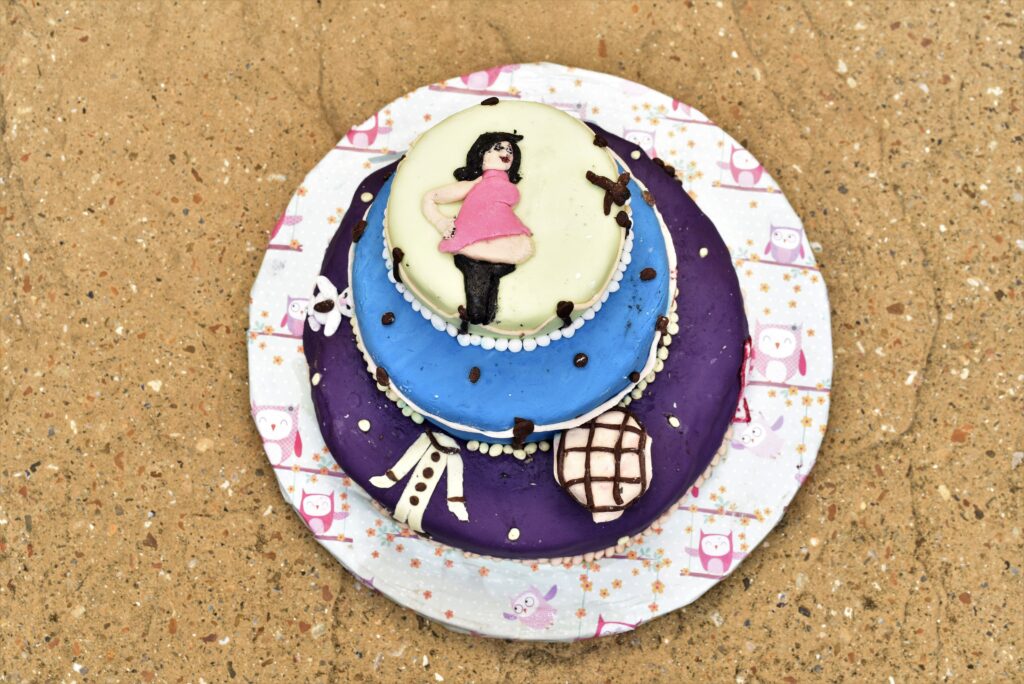
By week 13, I felt like a dark wave had lifted. The constant nausea had subsided, the spotting had stopped, and I felt more like myself again. I ventured out to Baby Shows, trips with the family and I even hosted my best friend’s baby shower – I even made a cake!
Again, I just felt off.
I was having dreams of my baby being stillborn, and friends around me were having miscarriages. I hadn’t even thought of miscarriage once with my two boys, so why was I thinking about it all the time? And, no matter how much my friends, family and doctors/midwives assured me that everything was ok, I kept thinking something was not ok.
Get an insight into your egg reserve with LetsGetChecked's Ovarian Reserve test.
At my 12 week scan, which happened late into my 13th week, the sonographer scanned me for around five minutes, refused to answer any of my questions and treated me as if I wasn’t in the room, despite me continuously asking whether my baby was ok and expressing my concerns about this feeling I had.
She said the baby was fine and so was the heartbeat and that was that.
I called Barnet Hospital after the scan to request another, but they told me they were fully booked and that I would have had to wait until my 20-week scan to check the baby.
22:00 – Thursday 26th October 2017
One night, I went to the toilet and a sudden gush of liquid poured out. I first thought maybe I had peed a lot, but as I carried on with my chores, I felt trickles come down my legs. I told hubby who advised me to stop worrying, and that we’d deal with it the next day when the kids were at school. But there was no way I could go to bed. We called my dad to pop over to stay with the boys, so hubby and I could head to Barnet Hospital’s triage unit.
Off to the triage at night
The triage’s tiny waiting area was packed to the brim with pregnant couples. Some heavily pregnant women had to stand up because there was nowhere else left to sit.
I busied myself on my phone, updating my best friend on our current situation, which was nothing because nothing was happening.
23:00 – Thursday 26th October 2017
No one saw us until about an hour later when a member of staff came over and shouted:
“So, who is the 15-weeker who lost their waters?”
Both hubby and I were shocked that she had blurted our situation out in front of everyone and hubby chastised her for being so insensitive to which she apologised, but did not seem to cast another thought about it. She walked us to a large vacant room where we were told to wait until a doctor tested my waters to find out whether I had indeed passed amniotic fluid or urine.
A doctor visited briefly to ask me some questions about my past births and current pregnancy and I was advised that I would likely stay the night and await a scan in the morning to find out exactly how much, if any, amniotic fluid had been lost.
I joined tons of Facebook groups related to this Preterm Premature Rupture of Membranes (PPROM) that I had Googled, but had never heard about in my life, and there were a lot of positive outcomes of babies being born with slight complications but could still thrive despite the mum losing her waters during pregnancy.
I learned about things like bacterial vaginosis, cervical insufficiency, polycystic ovary syndrome and vaginal bleeding being causes of miscarriage, but if I had only lost a little water, I might save my pregnancy.
I had renewed hope that maybe this pregnancy was salvageable and made a silent promise to my baby that I’d do anything to save her, despite the conflicting stories on Facebook. I only hoped that I had either only lost urine, or very little of my amniotic fluid, of which I read you could replenish if you drink lots of water.
So I drank. A LOT.
So this was me at 2am, after four hours of waiting to be seen (and four hours of Googling to find answers because I wasn’t getting any from the hospital!)
00:30 – Friday 27th October 2017
A doctor arrived with an assistant to test the liquid I lost and confirmed that I had passed amniotic fluid.
Ok. Not good news, but I told myself to stay positive. Now the hope was that I didn’t lose a lot.
We were told we would have to wait to be seen by a consultant obstetrician to find out what our options were and how much had been lost.
02:00 – Friday 27th October 2017
A Mister Consultant Obstetrician came to examine me further and provide antibiotics, which he advised was to prevent infection to me and the baby. Again I was told I would have to stay the night (at 2 am I bloody hoped so!) and that they would take me for a scan at 9 am the next morning to check how much waters had gone.
If there was only a little water lost, there may be a chance to save the pregnancy and stay on bed rest to protect the baby. But if all waters had gone, then it would become a fatal pregnancy and my only options as advised was a natural miscarriage, where I would have to wait for nature to take its course and I lose the baby, or a D&E which is a Dilation and Evacuation and I would lose the baby.
I later found out that very few doctors perform this surgery because of the size of the baby and that their bones would need to be broken for the evacuation to take place. This was explained to me by a doctor during my week in hospital by the way, which is so traumatising to hear! A D&C or Dilation and Curettage is not possible on babies over 12 weeks.
The thought of my baby being broken finished me and I spent the rest of the night crying into hubby’s arms. Either way, the outlook was bleak and so I hoped that my only chance was that not all waters had gone and that there was a way to save my baby whom I could feel move but the movements were getting slower and fewer and far between.
09:30 – Friday 27th October 2017
I was transferred to the Victoria Ward, which was the delivery suite where mothers were giving birth to newborn babies throughout the day and night. The sound of new babies being born was soul-destroying because I knew there was a good chance I wouldn’t get to see mine.
So, why were they keeping me in the delivery suite!?
11:15 – Friday 27th October 2017
Two doctors came to discuss my options again and urged me it’s safer to go into natural labour. After speaking with my best friend at length, who had a D&C after a missed miscarriage at 12 weeks, I decided I was going to take the D&E route to prevent traumatising my boys and to not risking haemorrhaging again (as I lost a lot of blood during my first two births). Plus, the thought of going into labour and not having a baby at the end was so depressing that it simply wasn’t an option for me.
I was still hoping that only a little water had gone, so I refused to talk about it until I had my scan. I willed my baby to pull through and that my body wouldn’t fail on me. I kept drinking and must have gone through at least four litres of water in the last few hours.
15:00 – Friday 27th October 2017
I was finally ready to be taken to the scanning room, despite being told this would be at 9am, to find out whether my baby was fighting strong and that the copious amounts of water I drank had miraculously replenished my amniotic fluid.
Funnily enough (not funny), it was the same sonographer who did my 12-week scan, and she hadn’t been any more vocal than before.
I couldn’t see the baby and asked her why. She said it was because there was no amniotic fluid left.
I burst into tears. I knew what this meant. There was no saving my baby anymore.
I told her that was enough. I couldn’t be here anymore because there was no positive outcome. And in response, she turned up the sound of my baby’s heartbeat to show me she was still alive, but then told me that the pregnancy would have to be terminated because there was no chance I could replenish something that wasn’t there.
I thought to myself, is this how medical staff treat mothers who are facing the prospect of losing their babies? All I got was pure indifference and sheer negligence. I was so distraught and told her to turn the heartbeat off. I put my hand up to the screen so I couldn’t see my baby. I just couldn’t see her. The thought of having to kill her was too much and I willed her to rest in peace in my tummy instead if there was no other way to save her.
I cried into the midwife who accompanied me – she was so lovely and stayed with me throughout until I was reunited with my husband. I kept reading the different stories from mothers who PPROMMed full waters at 15 weeks and the stories were not positive. In fact, I read that those babies who were born later after a full PPROM would be seriously disabled and die from stillbirth anyway.
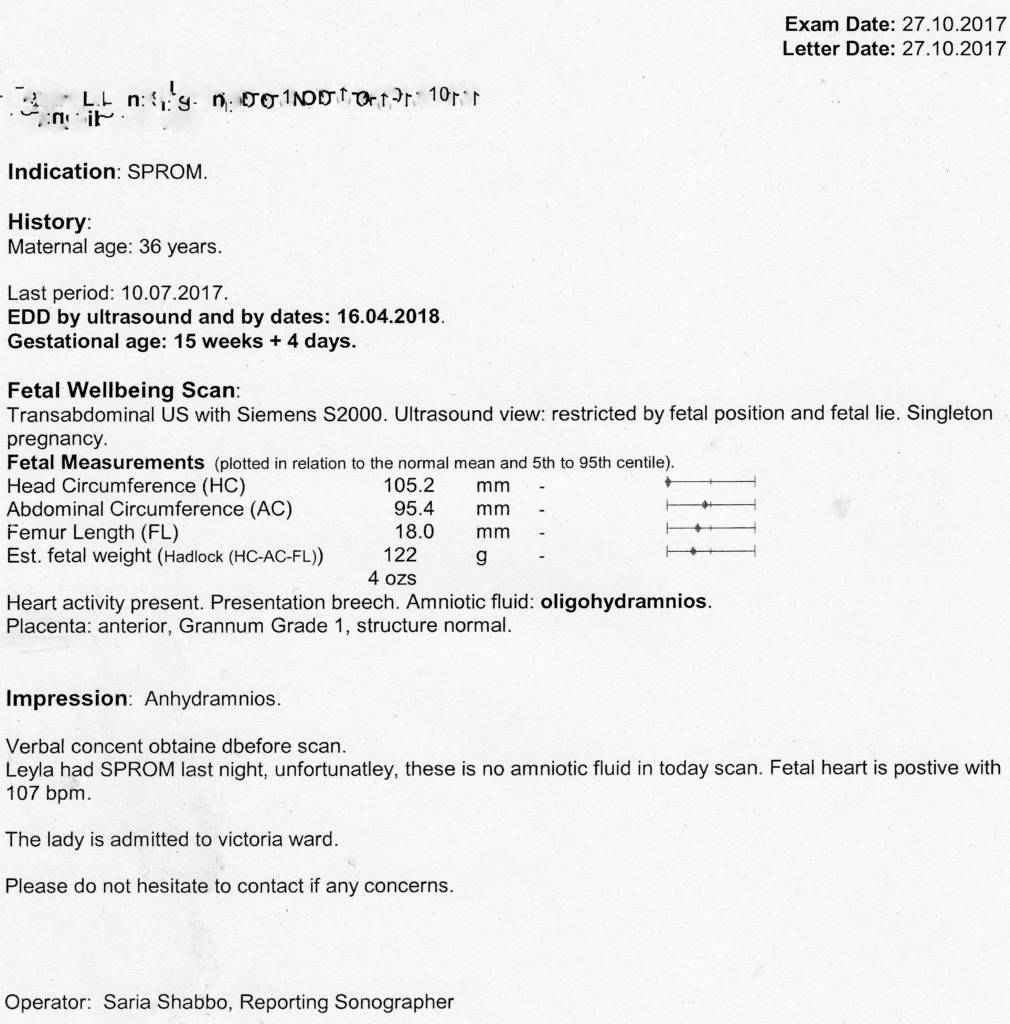
I was diagnosed officially with having a PPROM / oligohydramnios at 15 weeks pregnant and was provided with another two sets of antibiotics to prevent infection. My blood, urine and everything were checked and my baby kept moving as if to tell me she was still alive and there was hope still for us.
Yet medical staff around me was pushing me to go into natural labour because they didn’t think it was ethical to do a D&E. My hubby thought they were trying to free up the bed by offering a pessary to push things along. The whole time I kept hugging my baby.
And the whole time. I felt like a failure.
I failed my daughter.
18:10 – 27th October 2017
I was visited by another doctor to tell me the same thing again. There are complications with the surgery regarding removing the foetus and the bones splintering the womb.
18:30 – 27th October 2017
Again, another doctor came in to advise against medical surgery and that inducing labour was a safer option.
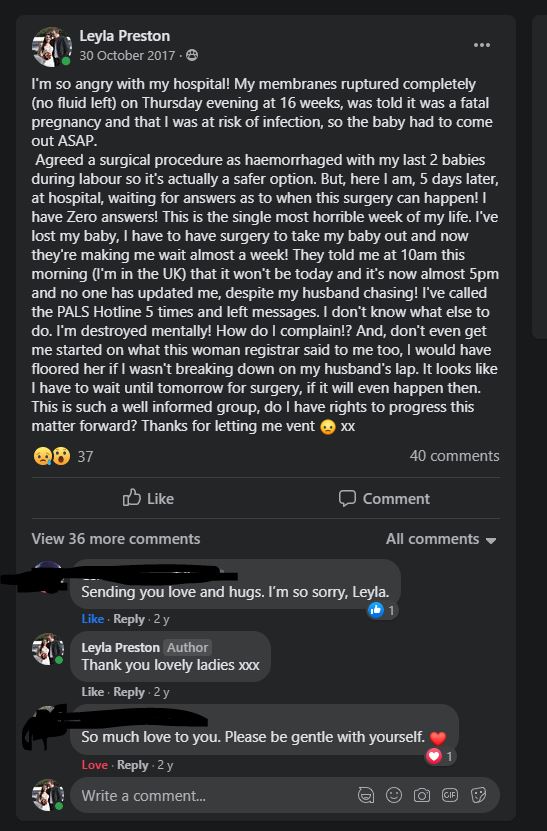
The treatment I had received throughout the weekend was shocking. I wasn’t allowed to go home to see my kids and that if I really wanted surgery, then I would have to wait until Monday, despite being warned that every day my ALIVE baby inside me was risking my health.
One of the junior doctors opined at how unethical it was to do a D&E because of the procedure and that I was better off letting labour take its course. When I mentioned to her, I had two boys at home who would be traumatised and that I had haemorrhaged during my last two births, her response was:
“Well, that’s an undesirable situation, isn’t it?”
That was it. Enough was enough.
For the first time since this entire ordeal began, I saw hubby lose his temper. The junior doctor cowered under his presence and ran off to get the surgeon.
20:00 – Friday 27th October 2017 to 08:00 – Saturday 28th October 2017
We were visited by a midwife after junior doctor after midwife at 20:00, then at 21:00, then at 22:00, then at 23:00.
02:00
04:00
06:00
06:30
08:00
They all asked. All checking to see if I had a temperature. All checking to see if I had changed my mind about the surgery.
10:45 – Saturday 28th October 2017
We officially complained.
There was no plan, no visit, no moving forward, nothing. Just doctor after doctor coming in and asking us the same questions. And all we got in response was apologies, and that the surgeon was very busy in the labour ward, but is aware of me and my situation.
11:15 – Saturday 28th October 2017
I was advised medical induction of labour again and that’s when I cracked.
“I don’t want a vaginal delivery! I want surgery, stop recommending it to me! I know my rights!”
12:50 – Saturday 28th October 2017
I was told that no one would do the surgery over the weekend and that they would have to defer me until Monday.
I was fed up and said I wanted to be discharged to go home. My baby was still holding on for dear life, I could feel her hugging me.
14:10 – Saturday 28th October 2017
I was finally discharged to go home and see my babies. It had been the longest time we were apart and as a result, my eldest was extremely anxious at seeing me. I later found out he thought I was dying with the baby, which still breaks my heart to this day.
After speaking to the top dog (Mister Rodin) who finally gave me the concern and attention that I deserved, he apologised for how long we had to wait to be seen by him. He had a few emergencies come up in surgery and he could not see us any sooner. He was one of the few doctors that could perform a D&E and that upon looking at my notes, this was the safest option because of the loss of blood observed in my last two births. A sideward glance from this wonderful doctor to the smarmy junior doctor provided us with a slither of justice.
He warned me there was no other way to keep the pregnancy and if my baby hadn’t gone to sleep before the surgery, he would have to inject her to help her go to sleep. I’m crying as I write this, but at the time I felt like waiting this long may have been a blessing because if my options were for her to go naturally or for me to kill her, I would have taken the former every time. But time was running out and the longer she stayed in my body, the longer both of us were suffering.
08:00 – Monday 30th October 2017
I was told to come back early on Monday morning to be the first on the list for surgery. But after waiting for a few hours in the reception room, hubby had heard the receptionist ask about where my notes were. It turned out that they couldn’t find my maternity notes and they had been missing since the weekend.
Plus, we were advised that there were no surgeries happening that day.
18:00 – Monday 30th October 2017
We were taken into a vacant room and bar being offered food, no one else visited us. At 6 pm a new doctor came in to tell me we had to go home and come back the next day when Mr Rodin would be available to perform the procedure. I had been nil by mouth since 12am that day so I was starving and extremely fed up. The doctor even had the audacity to advise that I should have attended a private clinic on Friday to do the procedure instead of waiting. I pointed out that Barnet Hospital had made me wait and didn’t advise this at all.
Hubby and I had McDonald’s and I stopped eating at 12am in anticipation of surgery the next morning.
We also mapped out our complaints procedure against Barnet Hospital and their rude and negligent staff.
Yet throughout all this, my baby was still moving but I could feel her getting slower and weaker. I knew my baby was on the way out, so I said goodbye to her before I slept and promised Poppy that I would never, ever forget her.
08:00 – Tuesday 31st October 2017
The next morning, we headed for surgery and I was given all the necessary medication to kick-start the surgery.
10:00 – Tuesday 31st October 2017
I was cramping and that’s when I felt my baby go. I don’t know how I knew or what made me feel like this, but I just knew she had finally gone to sleep and one last internal hug marked the end of my journey with Poppy. But I whispered to her she would always be my angel baby and that I was now a mother of three, just I wouldn’t be able to meet her in the flesh.
13:20 – 31 October 2017 – D&E Surgery – Goodbye Poppy
I woke up after vivid dreams of carving pumpkins with the boys and blinked at the flashing lights above me. For a moment, I had no idea where I was and I had forgotten all about what had happened before. Lights were being shone into my eyes, and I could hear beeping in the background.
A midwife welcomed me to the suite and asked me how I was.
“What happened?” I asked back.
“The surgery went well and we have your notes here. It states here you had a UTI and Group B strep.”
And with that statement, all thoughts of my Poppy came flooding back.
Poppy was gone.
I burst into tears.
“I have what?”
“It says here on your notes. But, please don’t be alarmed. I know you’re going through a lot. Group B Strep is very common during pregnancy. Around 40% of women have it.”
“Do you think this caused the PPROM?” I said through sniffles.
“I can’t answer that.”
“Because you don’t know?”
“Because Group B Strep can have adverse outcomes in pregnancy but it’s not causative.”
“So, you’re saying it didn’t cause it, but it may have been a factor? What about the UTI?”
“We can’t determine what may have caused your PPROM, I’m afraid, but we will refer you to a Bereavement Counsellor who can talk through with you about some options available for the funeral.”
I stared at the midwife in shock, then shook my head.
“Just go, please.”
I stared at the wall as the bereavement counsellor went through her script about how much support they’d offer me and that I had a choice about what I would like to do with my baby’s remains.
For five days I had begged for answers, got ignored, bullied into miscarrying naturally and being stared down rudely by oncoming staff because I was pacing up and down, stressed while waiting to go into surgery. Now I’m being asked what I would like to do with my baby’s remains, ten minutes after waking up from surgery, which hoovered my broken baby from my tummy.
I mean, really?
Shame on you, Barnet Hospital. Shame on you.
I thought long and hard about writing this article. I wrote to PALS who never wrote back. I left voicemail messages and got a call from someone a week later.
And guess what? Oh, yes, the good news just keeps on coming (!)
A year later, I was sent a letter from Barnet Hospital to inform me that my baby was buried in the communal funeral area, despite me checking the box AND telling the bereavement counsellor that I wanted to have tests done to find out what happened and to use her remains for further research.
All I say is, thank goodness I have kids to go home to because heaven help those poor first-time mums if they had to endure the same treatment and experience this kind of torture from a well-known North London hospital.
And, I’m not blaming the NHS – my mum works in NHS and not all hospitals are the same. Some hospitals, as you will find out in Part 4, are amazing.
But, Barnet Hospital was a nightmare, so much so, that if I decided to have another baby (hint, I did, but that’s for Part 4!) I would not touch Barnet Hospital with a barge pole.
First trimester loss, second trimester loss and third trimester loss are torturous and soul-destroying and you would expect to receive a standard level of care where you are treated as if you matter, even if staff are too busy. I understood and respected that the surgeon was helping others in worse positions than me. But to leave me in a room and offer no answers about my situation is unacceptable.
And, for that, three years later, I felt I had to write about it and share with the world, in case others had been treated in the same way.
It is not ok.
Post-surgery recovery
After the surgery, I felt numb. I had to go home and make Halloween treats for the boys so they could go out trick or treating. But I didn’t put a pumpkin out that year. I wanted to be alone and just stare into the void for a bit.
The following week we went for a very long walk in our neighbourhood park and hubby just let me walk on my own for a bit while he tended to the boys.
I felt empty most of the time, like I had lost a huge part of me.
The boys asked lots of question about Poppy and I had to break it to them they would never get to see her again, but she would still be their sister. My middle one, who was five at the time, amazed me by saying:
“It’s ok, mummy, as long as you’re ok, we’re ok.”
However, it hit my eldest (six) very hard and I saw him retreat inwards. His anxiety was exacerbated by the void he felt too, and he started to slip at school. My eldest was so heavily invested in looking after his sister, talking about her every day and planning how he was going to read to her. And now she was gone.
It then dawned on me that miscarriages don’t just affect the parents, they affect the whole family. And kids don’t understand why these things happen and so for them, it’s even worse. The boys thought they would meet their sister in April and now they aren’t. How do you explain to a five and six-year-old why that is?
During fireworks my son asked me if he could have just one present for his birthday.
“Of course. What would you like for your birthday?”
“Another sister.”
“New year, new start, ” I forced a smile through gritted teeth.
And, with that, I set about finding a way to live with the pain of losing my third child.
And every year, I light a candle for little Poppy during Baby Loss Awareness Week (9th to 15th October) and celebrate her birthday privately every 18th April. She would have turned four this year.
But, lighting a candle, helps me get through the pain of not being able to hold her as every mother should hold their babies but sometimes can’t.
And, now I realise that losing a child is the hardest pain to manage because it never ends. But we learn to live with it.
LetsGetChecked can help you understand your hormonal health with their female fertility testing options. Collect your sample from home and you'll receive accurate results within 2-5 days of the lab receiving your sample
Have you ever lost a child? How do you get through the day?
Some tips to managing baby loss
Time makes it easier to manage the pain, but you will have down days. Have a strong support network around to pick you up during those days.
It’s good to talk about it with someone close to you. Even if they have nothing to say, just venting helps the grieving process.
Male partners deal with loss differently. If your partner gets through it by pretending your baby never existed, then don’t chastise them. Leave them to it to deal with it in their own way. Every person deals with grief differently. But stay united.
First trimester miscarriages tend to be based on chromosomal abnormalities and second trimester miscarriages may be related to maternal infection. Neither miscarriage is your fault!
Share your miscarriage story with us at Motherhood Diaries to stop this subject being taboo. Miscarriage is unfortunately extremely common, with 1 in 4 experiencing a miscarriage. It’s even rarer to experience 2nd trimester miscarriage, with 1-2 out of every 100 experiencing a late miscarriage. So, we need to share with other women that we’re there for them and we support each other through these horrible times.
It’s hard to spot the signs of miscarriage in the second trimester, but if you are worried about anything during your pregnancy, whether that be abdominal cramping or spotting, visit your GP straight away, even if it’s a minor ailment.
Try to stay away from Google when you’re searching for answers. The conflicting information will frustrate and overwhelm you.
But join Facebook groups for the support. If I hadn’t confided in the Facebook groups I joined I would have felt much, much more alone. It’s a group we never want to join, but it’s one of the most welcoming and supportive if you, unfortunately, end up having to do so.
If you would like to share your first or second trimester miscarriage and stillbirth stories on Motherhood Diaries, please click on the link here to access the form. The more we share, the more we support each other, especially during Infant Loss Awareness Month, Baby Loss Awareness Week and World Mental Health Day which is today.
I joined Birmingham Women’s Hospital to #Take10At10 to support those affected by baby loss and the creation of Woodland House, a standalone bereavement centre that will help so many families:
*Links marked with a ‘*’ are affiliate links which means I may earn a small commission on qualifying purchases
Survival tips for kids that they should know
How many times have you said to yourself:
“If I only knew then what I know now?”
It takes time to develop our knowledge and gain life experience, and what we learn we should pass on to our kids, so they possess basic survival skills to protect them against this unpredictable world. And if heaven forbid, our children are left to fend for themselves in some weird, horrible turn of events, they are armed with a handful of survival tips and tricks, even if it’s just to get to the phone and ask for help. So, here are the ultimate survival tips for any situation that your child should know now:
How to call for help
Whether this means running out of the house and to the neighbours to ask for help, or picking up the phone and dialling 999, kids need to know how to survive when there is a crisis. Ingrain into their heads your phone number, address, and medical details, if they’re old enough to retain that information. Teach them how to call for an ambulance or the police and keep reminding them that whatever happens, they are to call the police/ambulance first. They should know where family and friends live so they can run away from imminent danger.
How to feed themselves
If kids find themselves on their own, they need to know how to make food and feed themselves until help arrives. I have taught my boys how to make toast and cereal and grab things out of the fridge and cupboard. I’ve also shown them what spoiled food looks like and to smell the food before they eat it. My husband has taught them the basics of what not to eat from the bushes and trees. Teach them things like food storage too so if they’re stranded for hours they know where the food is kept and how it should be stored.
How to practice safe hygiene
Since they were old enough to use their motor skills, I have drummed the importance of hygiene into my boys’ brains. They still forget now and again, but washing hands is fundamentally important to minimise harmful germs entering their systems and making them ill. The adage, “what won’t kill you will only make you stronger,” isn’t exactly correct. If you’re sick, your body takes a huge knock which it almost never recovers from. The more of these knocks you get the weaker your body becomes. It’s great to build up your baby’s immunity but within reason. They are naturally building their immunity from the air they breathe and the things they touch. There’s no need to add extra germs that might make them very ill.
How to stay strong and healthy
We are a very active family who practices eating healthy and staying positive. Since the boys could walk, they were on scooters and then bikes. Now, at eight and nine, they take part in a multitude of sports, including football, gymnastics and swimming. We have also bought them skateboards and in-line rollerblades for their birthdays because it’s very important to make sports fun and to teach them that exercising and staying fit and healthy is vitally important to surviving in the outside world if the forces of nature are against you. Since the boys were babies, they watched me exercise at home, so I’m hoping that this ethic will be instilled into their heads and keep it up into adulthood. Plus, sports and physical activities foster outdoor survival. Unstructured outdoor play is much more beneficial than structured indoor play, so make sure you take your kids to the local park/playground to enhance their mental and physical development.
It’s also a good idea for you to learn first aid so you can teach them basic skills, in case they are faced with a decision that may require basic first aid knowledge. It is also important to teach them about ailments they may face or injuries that require urgent attention. Any injuries to the brain, like brain contusions, need to be dealt with straight away, so they should call 999 as soon as possible.
How to self-medicate themselves
Kids should ideally take a mini medi-kit with them when you’re venturing about to new places. That way, if anything happens and they sustain an injury they can self-medicate themselves, either by cleaning the area with a wound spray and wound healing ointment and protecting the area with antibacterial water resistant plasters or bandages. ELASTOPLAST have a great selection of protective bandages and plasters for children so it’s worth checking them out.
How to keep warm
If your child isn’t old enough to generate heat from fire or they don’t have the supplies then they need to learn other ways to keep warm, like using their body heat or insulating their clothes. Teach them to tuck their trousers into their socks and shirt into their trousers, so heat doesn’t escape from the gaps on the body. They can also fill up their clothing with items they can see outside like dry leaves and plants. Make sure they know which plants to avoid so they don’t stuff their clothes with anything poisonous like poison ivy or poison oak.
If they are separated and likely will spend the night alone, then you should teach them survival tips in the woods/wild by learning how to create a bed from nearby leaves and branches.
How to make money
Unfortunately, money makes the world go around and, even though it may not directly bring you happiness, it buys you choices. Being poor hurts and constantly grafting for money hurts the family. So, I try to teach the boys entrepreneurial skills so they can watch out for gaps in the market and find their own way of making money. I am also instilling in them a good work ethic. They do chores around the house, so they learn the value of the pound and I am teaching them to save money rather than spend it. If you haven’t started doing this yet, it’s never too late. The earlier you teach them, the more likely they are to become savers rather than spenders later on in life.
How to create their own survival kit to survive the wilderness
You could make it a project with the kids to create their own survival kit so they can learn how to survive in the wild. The survival kit could include:
Duct tape
Char cloth
Glow sticks
Plastic bag
Compass to show where the north star is
Aluminium foil
A bottle/jug to collect water
Some kind of water filter and a way to boil water
Something that can create a smoke signal using waterproof matches
Small whistle
Pen knife (make sure the kids are thoroughly trained on how to use a penknife!)
Arm them with a survival guide
Next time you’re at the library or book shop, get your kids a book on how to survive in the wilderness or an outdoors survival guide which teaches them how to survive the outdoors and also includes:
Swimming may not be an outdoor sport, but it is a survival skill. In case of an emergency, the boys need to swim to safety. We take the boys swimming every week, and they have come on leaps and bounds with their swimming skills. We also kit them well in swimming gear from Simply Swim and take them even during the winter. We just make sure they’re thoroughly dry and wrapped up warm when they come out.
There are many other survival skills to teach kids how to thrive in this world, like working hard, being responsible for themselves and making them aware of their surroundings at all times. As they get older, it’s useful to teach kids about how to make a fire, shelter, and fetch water, as well as cook over the fire too. Another important skill is to judge the change in weather and teach them how they to protect themselves during harsh seasons. Some schools in the US are now integrating a weather curriculum that helps children collect and analyse weather data. This is so they can understand what the weather changes mean and how they can work with them, especially thunder and lightning, which can be dangerous if you’re not in a safe environment. Technology that includes lightning detection helps children to predict further changes in weather patterns so they are better prepared during climate changes. Plus, it’s a great way to get them interested in how nature and the environment work.
The important point to note is that in a survival situation, kids should be able to think on their feet and armed with the survival tips above, they should be able to fend for themselves in case we are not around to help them. What other survival tips and tricks do you think is useful for kids to learn when learning how to survive the wilderness? Share in the comments below.
*Collaborative feature post with Simply Swim and ELASTOPLAST
The importance of getting fit while pregnant
Being pregnant is a fitness journey in its own right, and a learning curve, of which no one pregnancy is the same.
Some women try to stay on their feet for as long as they can, while others prefer to sit back/sleep on an orthopaedic pillow and rest for the duration. How you handle your pregnancy is your prerogative. But if your doctor has given you the green light, then you should try to incorporate gentle exercise into your daily routine because the more fit you are during pregnancy, the stronger your body is at dealing with the hormonal and physical changes – and the easier it will be to get back into shape after birth. It has also been proven that staying active helps you cope with labour too.
You should aim to get around thirty minutes of physical activity per day for optimal pregnancy health, depending on the level of exercise you were doing before you got pregnant and your doctor’s advice. Always check with your doctor first before you start any new form of exercise.
If you're pregnant, grab your free pregnancy pack now - details inside!
You shouldn’t try to lose weight during pregnancy or stay in shape. In fact, NHS’ advice states most pregnant women should gain between 10kg and 12.5kg (22lb to 26lb), putting on most of the weight after week 20. Too much or too little weight gain could lead to complications for you and your baby including gestational diabetes and preeclampsia, so it’s worth making sure you are maintaining your weight throughout and not trying to lose weight when pregnant.
So how can you stay fit during pregnancy, from the first trimester to your due date (or beyond) without losing body fat while pregnant, especially when you’re feeling nauseous, tired and fed up?
How to stay fit during pregnancy
Staying fit during pregnancy means incorporating exercise naturally into your lifestyle, either by walking the extra few steps to the shops instead of driving/using public transport or by taking the stairs instead of the lift. A good rule of thumb to follow is if you cannot maintain a conversation during physical activity, you’re doing too much.
So, what are the benefits of getting fit during pregnancy?
Apart from making you feel great on the inside and giving you that much-needed boost in energy, there is a multitude of benefits to staying fit while pregnant. Here are a few reasons why fit pregnant women cope better during pregnancy.
Improves sleep
Trying to find a comfortable position to sleep in when you have a burgeoning baby bump protruding from your stomach can prove quite a challenge. Working out helps you to drift off to sleep at night because you’re burning off excess energy, leaving you exhausted enough to sleep almost instantaneously when you hit the hay. If you get into a good habit of practising some easy relaxation techniques before you go to sleep, then you will find that your body will wind down a lot easier and you’ll sleep better at night.
Exercise eases pregnancy pains
Exercise strengthens your muscles. The stronger your muscles are the higher your pain threshold becomes. Stretching is also a great way to iron out knots and unwanted aches and pains, especially back pain. Walking improves your blood circulation and helps to avoid any unwanted varicose veins as well. Swimming is a great form of exercise, especially during pregnancy, as it gently strengthens your stomach muscles, which helps to support the weight of the growing bump.
Exercise gives you an energy boost
Being tired is one of the biggest drawbacks of being pregnant. Fatigue is especially common during the first and third trimesters and one of the first signs of pregnancy too. But, when you strengthen your muscles through exercise, you will feel stronger and, coupled with a healthy diet, you will also get that extra energy boost that combats that drowsy feeling.
Exercise prepares your body for birth
Giving birth requires energy and stamina, two things that increase with regular exercise. Keeping a regular exercise routine can also help to shorten the length of labour, as mentioned above, and increase your chances of a quick birth as well. If you’re not a regular fitness buff, start slow and gently and keep at it. From a daily walk in the park to prenatal yoga, every little bit counts. Don’t forget your kegel exercises too!
Reduces the chances of pregnancy complications
Pre-eclampsia can be critical for both mother and child if not diagnosed early enough. Exercising regularly throughout the pregnancy does help to reduce the risk of pre-eclampsia if you are at risk of developing the condition. In some cases, if you are not careful with what you eat and you do not exercise regularly, you are also at risk of getting gestational diabetes as well. Exercise helps you manage your all-important blood sugar levels when combined with a healthy diet.
Gets rid of the blues
Exercising releases endorphins into the body which provides you with “feel-good” chemicals. Prenatal yoga is one of the best forms of exercises that keep your stress levels down during pregnancy because it is so calming – a happy mum leads to a happy baby.
So what kind of exercise should you try during pregnancy?
Golf
Not many people think of golf as a form of exercise but it can prove very advantageous to pregnant women. For starters, the game is played at a leisurely pace and isn’t too strenuous on the body, so you can’t do too much damage to both yourself and your unborn child. Secondly, you are getting in that much needed fresh air into the system. The golf course can clear your head and you get to enjoy a lovely green view while exercising too.
Swimming
Swimming is a great way to keep fit during pregnancy. The water is a place where you can clear your head and have some ‘me’ time while working all your muscles. Swimming also strengthens the core, which helps to carry the weight of the baby more easily. This favoured water sport can improve your heart and lungs as well for better oxygenation levels, which encourages toxins to leave the system too. Backstroke is particularly beneficial because it improves your muscular resistance gently and eases the body of unwanted aches and pains that are caused by bad posture during pregnancy – i.e. rounded back and protruding stomach.
Walking
Walking is easily accessible and the most popular form of exercise for all kinds of expecting mums. You can mix it up by taking a leisurely stroll down or the road or, if you’re feeling energetic, you can go for a power-walk in the park. Walking also improves oxygenation levels and blood circulation, whilst gently working on your joints, which can sometimes stiffen during pregnancy. Try to avoid difficult terrain and steep slopes because you don’t want to place unnecessary stress on your back. Also, make sure you wear proper shoes to prevent aching feet, backache, and to improve your balance. When buying shoes it is advised to get a pair half a size bigger, as your feet and legs may swell during pregnancy.
Light Gym
Yoga is a great way to stay flexible and to stretch out all those painful joints. However, do remember that you are pregnant and not your usual supple self, so only go for pregnancy-friendly yoga moves that avoid twisting and stretching the abdomen area. Remember to always keep your core tight and pulled in when doing any form of exercise, to protect the baby and reduce the risk of displacing your muscles.
Water Aerobics
Water aerobics has all the benefits of Yoga but it is less demanding on the body because the buoyancy of the water makes it easier to hold the poses and the weight of the baby. Finding a water aerobics class, especially one specifically tailored to pregnant women, will not only ensure that you’re working your muscles properly and safely, but you will also get to meet other pregnant mums who are in the same position as you.
by Kenny Holston 21
Don’t forget your pelvic floor!
Pelvic floor exercises count as exercise during your pregnancy because they strengthen the pelvic floor muscles which may weaken during pregnancy and birth due to the pressure of the baby and the act of birth itself. You can find more information on how to exercise your pelvic floor during pregnancy here.
Workouts to avoid while pregnant
It is very important to avoid contact sports during pregnancy like football or rugby, as you don’t want the unnecessary impact on the baby. Also avoid hazardous exercises where if you fall you can seriously injure yourself and the baby, like ice skating, skiing and rock climbing.
You also don’t want to make any sudden movements or raise the body temperature up too high. You should aim to keep your heartrate under 130 to avoid overheating and dehydration. Always rehydrate before and after any form of exercise.
There are so many benefits to exercising when pregnant, both for you and your child. But always remember to listen to your body and not overdo any kind of exercise, even if after you’ve had the baby. Consult your doctor before you start any new exercise regime and make sure you keep your heart rate and body temperature down at all times too.
If you're pregnant, grab your free pregnancy pack now - details inside!
This post is deeply personal and very difficult to write but I feel compelled to share our experience as miscarriage is so common and so many women suffer in silence, with 1 in 4 pregnancies ending in a miscarriage.
The missed period and the blue lines confirmed I was pregnant! The time had come for my maternal instincts to kick in and for me to start my own family. According to the Association of Miscarriages, if there’s a heartbeat at 8 weeks, the chance of a continuing pregnancy is 98%(!).
So we booked a 9-week private scan to check-in. I broke down when I heard the heartbeat – they were tears of joy and relief that there was a life growing inside me. I left very hopeful that we were having a baby.
Due to COVID, I had to attend my NHS 12-week scan all alone. I sensed something was wrong as soon as I couldn’t hear the heartbeat. Whilst the nurse was taking the measurements she confirmed with the dreaded words:
“I’m so sorry, but I can’t find a heartbeat.”
All alone, in complete shock, and desperately wishing Damian was with me, the tears came flooding. She confirmed the baby’s heartbeat had stopped at 10 weeks. I couldn’t understand it. Everything had been fine at the 9-week scan. We had been together holding hands, with tears of joy, as we’d heard the heartbeat and a few weeks later the baby was now lifeless. I had to call Damian to break the devastating news. He broke down. He made a sound I have never heard in the 7 years we have been together. The magnitude of the pain at this moment was made so much worse by having to be apart. I just wanted to be in his arms. One minute I was pregnant and the next minute I’d had a missed miscarriage!? I just couldn’t make sense of it.
A missed miscarriage is when your body still thinks it’s pregnant and doesn’t miscarry naturally despite the baby’s heart no longer beating.
I opted for a surgical procedure (D&C) which has been painful, both physically and emotionally. The cramps have been really painful and my recovery has been so much slower than anticipated. For context, walking has been difficult. My hormones are all over the place. I can’t get over the fact that I have lost my baby. The baby I felt growing inside my body for the last three months. The baby we had started to plan our lives around.
The baby we wanted.
The stats are so high, yet regardless of being older, more pragmatic, more ‘prepared’, I didn’t realise the reality I would be facing. A process of grief, pain, loss, anger, a lot of anger, sadness, hormones, emptiness, and so much more.
I am slowly finding my strength but also giving myself time to process and accept the pain and loss. Miscarriage is a total head f*** and a really lonely process to go through. I am sharing my experience in the hope that I can offer support to women who have had to endure this painful and very emotional journey – you are not alone.
To also educate those who haven’t been through it about the reality of what can happen.
And last but not least, to call for the government to change the COVID rules and allow partners to attend these all pregnancy appointments!
How the no fault divorce UK system is changing the picture for divorcee children
No-fault divorce will eliminate the need to blame one spouse for a divorce, but how will this affect the children of divorced couples?
The UK has a system of divorce that requires one spouse to prove the other acted in a way that caused the breakdown of the marriage. That said, with no fault divorce, there’s no need for proof, and divorce can be granted by consent alone.
This new system hasn’t been introduced yet but will likely become law by autumn 2021. The question is, how will this new no fault divorce system affect the children of divorcees?
Today, we’re going to give you a brief overview of no fault divorce and how it’s different from the current system. We’ll also dive into how this will affect the children of divorced couples, before giving you some advice on whether you should wait for the law to come in before you get divorced.
What is no fault divorce?
As we mentioned in the introduction to this post, no fault divorce is a new system of divorce that allows couples to end their marriage without proving one spouse is at fault. Under the current divorce system in England and Wales, one spouse must file for divorce, and accuse their partner of misconduct if they want to dissolve the marriage. There are three reasons you can use to end your marriage:
Unreasonable behaviour
Adultery
Desertion
Once the spouse has filed for divorce, their partner needs to respond, and if they disagree, the person who filed the proceedings will need to provide proof of their initial claim of misconduct. If they can’t provide this evidence, the court might rule that the two must live apart for two or five years until they are able to get divorced.
After several cases of people being forced to stay with a partner because they weren’t able to prove misconduct, the government created a no fault divorce bill. This has now made it through its parliamentary journey and is ready to be passed into law.
This new bill means that, instead of blaming your partner for misconduct to end a marriage, a couple can claim ‘irretrievable breakdown’ as the reason the marriage is ending. Then, they can get a divorce without having to suffer any painful separation periods.
How will no fault divorce change the picture for children?
So, now that we’ve covered the main difference between no fault divorce and the current system, it’s time to discuss what impact this type of divorce/family law will have on children. This section will serve as a sort of no fault divorce pros and cons debate. There are two primary views on whether the new bill is a good or bad idea for children…
Pro – Removes the toxic environment of fault-based divorce
Instead of parents having to blame each other for the breakdown of their marriage, no fault divorce can end it amicably and quickly. This prevents any long, drawn-out arguments over whose fault the divorce is, and just the general tension caused by them having to stay married any longer than they want to. It also avoids the parents coercing the child to take sides; no blame means no sides to take.
The less fighting between the couple, the less their children will be subjected to it. Ultimately, although their parents will be divorced, at least the child didn’t have to witness the breakdown and further resentment caused by their parents being stuck in a toxic marriage.
The Justice Secretary, MP Robert Buckland, said: “The institution of marriage will always be vitally important, but we must never allow a situation where our laws exacerbate conflict and harm a child’s upbringing. By sparing individuals the need to play the blame game, we are stripping out the needless antagonism this creates so families can better move on with their lives.”
Buckland’s sentiments were mirrored by Aidan Jones, the CEO of relationships charity, Relate, who told The Independent newspaper:
“Our current divorce laws encourage increased animosity between parting couples because they are led to decide who is ‘at fault’ and why. This can be difficult to navigate – especially when there’s already a lot of bad feelings and conflict between partners,” he says. “Even when things have been relatively amicable up until that point, the process of having to apportion blame can turn things sour pretty quickly.”
Aidan Jones, CEO of Relate
Relate also released research showing that conflict between parents damages children more than anything else during a divorce. This suggests that no fault divorce is a more compassionate system than the current one.
Con – More children will have divorced parents
Keeping in mind that conflict between parents damages children more than anything else during a divorce, the avoidance of divorce itself is the aim of those who disagree with no fault divorce.
One thing that the current divorce system has in its favour is that it tries to encourage married couples to stay together. The marriage has to have undergone grave misconduct for a divorce to be granted, as most other things are considered small enough for the couple to recover from.
With no fault divorce, couples will be able to get divorced on a whim over a minor disagreement or issue, which could lead to more children having divorced parents.
Also, with divorce proceedings happening at a higher speed, there isn’t much time to discuss how the parenting will be organised after the divorce. Because of this, the child might be dragged through a painful child custody battle.
This sentiment was expressed in a letter written to the Telegraph by several MPs who asked the government to focus their attention on helping couples reconcile instead of introducing no fault divorce. The MPs also claimed that enacting the no fault divorce bill would be poor timing, as COVID-19 has already made couples more fragile and on the verge of filing for divorce.
One of the MPs, Fiona Bruce, said of the bill:
“This bill is a bad bill. It sends out the wrong message at the wrong time. No-fault divorce is really state-approved unilateral divorce.
“Ministers like to say that it is all about the divorce process and not about marriage. They are wrong. The removal of fault sends out the signal that marriage can be unilaterally exited with no available recourse for the party who has been left.”
Fiona Bruce, MP
Should you wait for no fault divorce to happen?
The Divorce, Dissolution and Separation Bill made it through the House of Commons on 17th June. It’s now on its way to receive Royal assent, and will need to have additional amendments made to it by the House of Lords.
Unfortunately, for those of you waiting for no fault divorce to be passed, the bill will not come into force until autumn 2021. So, it may be a waiting game for those wanting to part ways without a cause.
So, is it worth waiting until next year for no fault divorce to pass?
If you’re in a marriage that isn’t working, and you’re sure that you’re going to get divorced anyway, it might be worth filing for divorce now. Especially if you have children who have to watch the breakdown of your marriage over the next year, why not nip it in the bud.
However, it’s a good idea to make sure you have evidence of misconduct, or a partner who won’t contest the misconduct, before you file for divorce. If you don’t have this, you’ll have to wait at least 2 years to get divorced anyway, so you might as well wait for the no fault divorce bill to be passed.
Change is inevitable
Today, we’ve managed to cover what no fault divorce is and how it differs from our current system. We’ve also delved into the two sides of the coin on how it will affect children, and shared some advice on whether you should wait a year for the bill to be passed into law.
Depending on whether you believe no fault divorce will cause more divorces or not changes the way this new bill affects divorcee children. If the level of divorce doesn’t go up too much, then no fault divorce was the right choice. However, if it goes up a lot it, could mean that many more children end up with divorced parents than under the previous system.
The main thing to remember is that this bill has now been passed and will be put in place in 2021. We have to hope that the benefits of reducing the pain of divorce for children outweighs the possible increase in divorce rates.
Hopefully this post has shed some light on the topic of no fault divorce. Leave a comment down below if you have any insight into the topic, and thanks for reading!
*Collaborative feature post*
Back to school preparation tips for a smooth first day back
The time is coming to think about how to get ready for back to school again. And the earlier back-to-school preparation for parents starts during the summer the better, so kids don’t face such a shock when they’ve not had the routine of school runs, homework, reading and putting on their school clothes every morning.
Kids who have not prepared for school in advance can often become anxious when school starts, especially if they are transitioning from infants to juniors or when your child is starting reception for the first time.
The key is to start school preparation slowly and organise your child’s school supplies list in advance, so your kids know what’s coming when they start a whole new school year. I have laid down some back-to-school tips for parents, with an essentials list in the first part of this article and the second part will discuss preparing for back to school (geared towards the transition between nursery and reception).
Back to school essentials
You won’t need all the items in your back to school preparation checklist as some schools’ requirements are different. So, if anything is missing, please pop your list on how to get ready for going back to school in the comments below this post. Older kids may require more items, so I am basing my essential list for kids and back-to school tips for elementary students.
Backpack
Some schools require you to purchase a branded school bag for the infant stages, but when the kids get to the Juniors (Year Three to Year Six), they can bring their own backpack into school.
Back to school organisation tips should include a good sturdy backpack that is school-proof, and make sure the bag has pockets for items like their water and pencil case, and perhaps a separate section for their lunchbox if they’re not having school dinners. Make sure the bag is big enough to pack school-related books (school folders, notebooks, homework books, reading books etc.) with enough space for other bits and bobs like snacks and items they collect on the way.
I sometimes find leaves, rocks and all sorts of memorabilia in my boys’ backpacks, which brings me to another one of my school organisation hacks – make sure they are waterproof and breathable with durability that gives the backpack longevity. Your child’s school bag will be dragged across the floor, swung onto the shoulders, thrown into a corner and waded through the four seasons of weather. So, make sure it’s built to last!
Here are some great backpacks for kids from Amazon:
Marvel Spiderman Denim Compact Backpack 2 Wheels Blue 32 x 45 x 21 cm Polyester 30.24L. Buy from Amazon here*
Kipling FASTER, Ergonomic Kids Backpack, 28 cm, 7 L, True Pink. Buy from Amazon here*
Disney Encanto Casita Los Madrigal Backpack Nursery Multicoloured 21 x 25 x 10 cm Microfibre 5.25L, Multicoloured, Daycare Backpack. Buy from Amazon here*
Lunch box
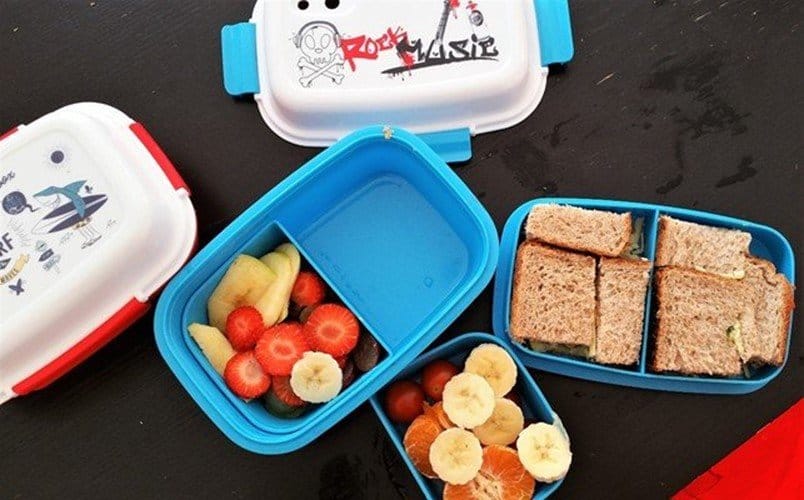
If your child is not having school dinners, then use sturdy lunchboxes to keep their food fresh and drinks cool. You can opt for a lunch bag with a strap branded by their favourite character, or you can go for one of those old school hardback lunchboxes. Bento-style boxes are great because they contain different departments to carry all your child’s favourite lunch items. You can find some great food ideas for lunchboxes here. Variety is the spice of life when thinking about how to prepare for going back to school!
Water bottle
Water is massively important to keep your kids hydrated during the day, and the school may not always provide water or have liquids to hand. So, when preparing for school, I pack the boys with disposable water bottles, but if you would prefer your child to keep the same bottle then make sure that the bottle fits in your child’s backpack or school book bag and it keeps water cool and fresh during the day, especially in the summer. An easy top cap and lid opening system is a must so kids can grab a quick drink while they’re running about the school.
Homework area at home
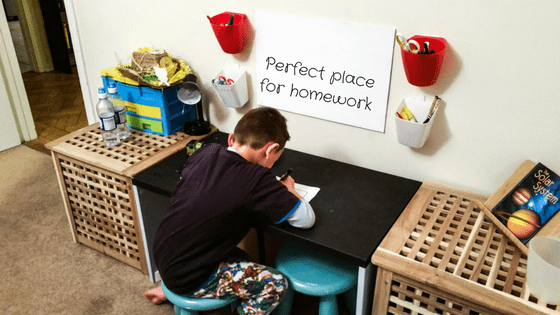
To be ready for back to school, prepare your child’s bedroom with a homework area at home, so they have somewhere where they can complete their homework or read their books. A homework area doesn’t need to be expensive. I created one for just under £40, and even though the boys are getting too big for the table, they still used it for a good few years. Click here to find out more about my homework area challenge.
Warm jacket/raincoat
September can still be warm, but by October it can get cold quite quickly. A warm jacket/raincoat is an absolute must, and there are several things to think about when buying a coat for school. Whether you walk to school or take the car, your child will inevitably need to wear a jacket.
Make sure the coat is easy to put on and take off, and leave out fancy buttoning-up systems and complex layers. Opt for a 3 in 1 coat, which is breathable, waterproof and insulated, so your child can wear it for most of the school year, although, undoubtedly they will grow out of it very quickly. Make sure to pick a coat with translucent stripes or one that glows in the dark during those school runs when it gets dark quickly. But don’t worry if you can’t find a coat with special stripes. You can buy glow in the dark tape to affix to your child’s coat so cars can spot them in the dark.
Back to school clothes
You may be requested to purchase special branded jumpers and summer clothes/dresses, but you can find very cheap school shirts and trousers in all the major stores these days for as little as £1.50. Make life easy for yourself and go for the crease-free version, so there’s less ironing to do every day and make the clothes durable as kids will no doubt wear them out quite quickly with all that running, falling and scraping they’ll do every day! Purchase underwear and socks that are 100% cotton too so that they’re breathable and easy to wear as kids will sweat during warmer weather. A non-exhaustive list can include:
Shirts* (long-sleeved and short – go for crease-free)
Sweaters, cardigans and fleece jumpers (you may have to purchase the branded version from a specialised school uniform shop)
Trousers and shorts (make sure you pick creased-free and the right colour for your school)
Socks and tights (go for 100% cotton as it’s the kindest on your child’s skin)
Underwear (again go for 100% cotton)
Hair accessories if required
Apron
You may be required to purchase a waterproof apron for arts and crafts. However, an old shirt will do if you’re saving money. But, make sure to pack it in your essentials list, so your child’s school clothes don’t get ruined!
Small umbrella and wellies
We live in a country where all four seasons could potentially happen in one day. This means that we need to prepare for any weather. Buying a small child-sized umbrella and wellington boots can ensure they prepare for the rainy season when it hits.
Hats scarf and gloves set
As we get into the winter season, the weather will turn icy and cold. Protect your kids on the school run with woolly hats, scarves and glove sets, which you can find branded with your child’s favourite character or hobby.
Sun cream / Sun hat / sunglasses
You should apply sun cream to your child throughout the year and sunglasses worn even during cloudy weather. It’s important to protect your child’s skin and eyes to prevent skin cancer. Kids tend to have an aversion to sunglasses, so it’s important to educate them on why it’s so important and hope for the best that they wear during the school day!
PE Kit
The school provides us with a special PE Kit list which generally includes a coloured shirt, black shorts, jumper and tracksuit bottoms. You should also pack a pair of trainers and plimsoles so kids can alternate between outdoor PE and indoor PE. As the kids get older, you may be required to provide football boots and shin pads as well, with long football socks.
Teachers may also require you to pack football trainers for indoor football.
Electronics
If your child is older, they may require to bring electronics like a laptop or iPad. Check with your teacher whether this is the case and make sure you pad the electronics correctly and their backpack can comfortably house them too.
Indoor shoes are very important so as not to bring the outside dirt into the classrooms. Make sure you opt for an indoor shoe which is comfortable as your child will be in those shoes for most of the day. Opt for Velcro or buckled style shoes so that it’s easy to put on and take off.
Outdoor shoes
Outdoor shoes are a must, especially if your child is walking to and from school every day. Kids will play on all different terrains, so make sure the shoes are durable and comfortable.
Pencil case
Not all kids will require a pencil case to go to school. In my boys’ school, so from Year 3 onwards, the kids are required to pack a pencil case, which includes the following:
Pencil case
Pencil
Pencil sharpener
Eraser
Ruler
Pritt Stick
Your teacher may request that your child pack other items like scissors, index cards, post-it notes, and highlighters. Ask your teacher before you leave school for the summer, so your child is prepared on the very first day back at school.
Back to school labels
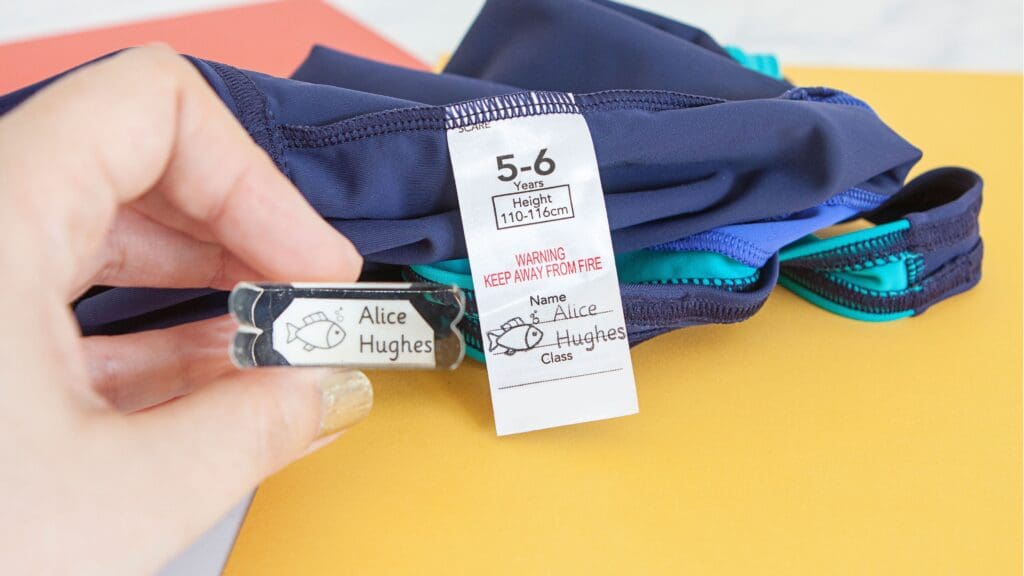
Label all of your child’s clothes clearly because kids are notorious for going home in other children’s clothes or somehow along the way from home to school to back home, their clothes magically disappear. You can purchase iron-on labels or mark your kids’ clothes with Sharpie so it’s permanent. You can purchase some great custom labels for kids at Sticker You.
Use stamps to label your kids’ clothing
You can also use stamps to label your kids’ clothes. They’re a bit more reliable than labels and they last longer too! We have a personalised stamp from Stamptastic which is so easy to use, lasts 50 washes and there’s no need for ironing too! You can buy a School Names Deluxe Bundle here which includes a Personalised Name Stamp, a Stamptastic Ink Pad and a White Fabric Pen.
How to prepare for the first day of school
If your child is starting elementary school for the very first time, then this monumental transition will be just as nerve-racking for them as it is for you. Starting school is a massive change, especially when during the pandemic, most children had to complete distance learning. So when preparing for back to school after covid, it’s important to not only teach them how to get ready for school but to prepare them in advance and ease them into their first day slowly. Here are some tips for preparing your child for school:
Help your child to be social and make new friends
Your child may already have friends coming to school with them from nursery, in which case their friends are a great way to ease them into a big new school with lots of strangers. However, if they are coming on their own, then it is important to encourage their social skills and expose them to as many other kids and playdates as possible.
If your child has a settling-in session, it’s a great idea to bring them with you, so they get a feel for their new school and learn some new faces before September. You may even want to buddy up with some other parents and encourage online WhatsApp or Facebook groups so you can arrange playdates for your kids in advance.
Practice how to say goodbye
Your child may find it easier to settle to school if they have already been to preschool or nursery, as they have gotten used to saying goodbye to you, even if only for a couple of hours. But, if your child has never left you, then it’s important to practise saying goodbye now to prepare for when school starts. School should implement a staggered start system to help kids learn how to get prepared for school slowly.
In reception, kids only come for a few hours, and then the week after, they stay for lunch, and then finally they stay for the entire duration of the school day. Get into the habit of saying things like, “Goodbye, I’ll pick you up at 3.15pm, when school finishes”, “I’ll pick you up after football” or something along those lines so that your child knows when you will be back. Stick to terms that your child will understand so they’re not confused as they may not know how to tell the time yet.
Practice the school run
If you can, then it would be a great idea to practice doing the school run with your child, so they know what to expect on their first day. Practising the school run will also provide them with a sense of security and help you work out how long you will have to get you and your child ready in the morning without any stress or rushing around.
Help your child to develop good hygiene skills and independence
One of the most important rules when learning how to get ready on the first day of school is self-hygiene. The school will expect your child to know basic hygiene, for example, going to the toilet, flushing the toilet and then washing their hands. Teach them how to wash their hands properly with soap and water, and this will reduce the chances of them catching nasty school bugs too.
Help them practice using a knife, fork and spoon as well and encourage them to take the initiative in certain situations. For example, if their nose is running, they get a tissue and wipe their nose, then throw the tissue away. Other skills are to make sure they always wash their hands before eating as well.
Encourage your child to have a healthy appetite
Encouraging your child to eat a variety of foods can be tough, especially if your child is a fussy eater. However, you can inspire a healthier attitude to food when you adopt a healthy attitude yourself. Encourage eating together and incorporate lots of fruit and veggies in your diet as you set the example of how to eat at home.
Prepare them for the range of choices they will face during school dinners by introducing a few unfamiliar foods at home or taking them out for a meal at a restaurant in the run-up to school. Try not to stress or rush your child with eating. If they genuinely can’t eat a certain food, then don’t force them. Offer up the food, and if they don’t eat it, then they don’t eat it.
How to prepare for school the night before
One of the most important tips on how to get ready for the first day of school is to pack your child’s back to school essentials the night before, so that you don’t rush in the morning. Wash and iron school clothes ready with socks and underwear so that when your child wakes up, they can put them on straight away. Also, set the alarm clock so they know when to get up
The aim is to have more time to check in with your child and prepare them for the day ahead, rather than rushing around hunting for last-minute bits and ushering them out of the house in a negative and stressed manner.
Of course, it is a lot easier to say it if your child may not want to go to school or they are taking their time to get ready, with the clock ticking. But, the extra time you save by preparing the essentials the night before can be spent talking to them about their worries, so they feel more at ease before they start the day.
Let your child take the necessary steps to get ready for school by themselves in the morning
It may take some practice to help them get into their clothes, but it’s a great skill if they can get ready by themselves because they may have to change for PE or put on their coat during break time. They may even jump at the chance to act independently and relish the chance to show mummy and daddy how grown up they are, so encouraging them to build on this skill set is invaluable.
Teach them how to pull up a zip, fasten buttons and brush their hair, as well as put on their shoes and give them the chance to practice putting on their uniform and taking it off before school starts.
Chat to them about school the night before or read a book about it
The key is to prepare your child for school by making them understand as much as possible about what they will expect. Take out some books from the library about starting school and read them with your child during the night, so they feel more comfortable about what to expect the next day.
Show them how fun it will be to meet lots of new people, make new friends and that they will be in a class of approximately 30 kids with one teacher. Speak to them about the rules of the school, i.e. listen to the teacher, and speak to an adult if they are not feeling comfortable or happy etc.
Keep it fun at home
Just because your child is starting school, it doesn’t mean that the fun should stop at home. It’s important that they still get lots of fun in, as teachers in reception won’t expect your child to work solidly for hours on end. Learning through play at this age is essential, and their teacher will encourage more arts and crafts and outdoor style games to help them ease into the subsequent years.
Try to include this style of play at home too, for example, do some painting with them and encourage them to fetch the paints and then put them away. Help them to put on their apron and if they’re playing with toys, get them to put the toys away when they’re finished. These skills are building blocks to having an easier time at school.
Stay relaxed!
One of the ways to prepare for back to school calmly is to keep your emotions in check. Your child will pick up stressed vibes from you and then they will get stressed. If you’re worried about your child starting the school season, they will also pick up on this and feel nervous.
Perhaps find time to learn how to prepare yourself for the first day of school too. Show them how happy and excited you are that your child is growing up and starting big school, even if you find this super difficult because they’re going to start school regardless of how you feel Think about how to prepare to go back to school in a way that doesn’t include negative emotions. It’s better to instil confidence in them rather than nerves – I promise you will be pleasantly surprised at how well their first day will go!
Back to school tips for high school students
Transitioning from primary school to secondary school can feel like the biggest change in a pre-teen’s life. Click here for some tips on how to transition from primary school to secondary school and teach your tween how to get ready to go back to school.
*Collaborative feature post which includes affiliate links”
Simple breastfeeding tips to keep baby feeling full for longer
During each first year of breastfeeding (I have three babies), I had an oversupply of breastmilk, especially foremilk, and it often felt like I was feeding for hours on end. I remember one particular incident when I breastfed my eldest for almost three hours while watching two movies back to back. Two hours later, he was hungry again.
Very first breastfeeding experience after Aron’s birth
If you’re breastfeeding and you feel like a human milk bottle, then let me introduce you to Jacqui Nancey who is a Registered Midwife, Lactation Consultant and Baby care/Sleep Specialist!
Jacqui has created Nature’s Four Course Beginner Breastfeeding Tips and Tricks, which are simple breastfeeding latching tips to help your nursing baby feel full for longer. As well as teaching mothers how to breastfeed successfully, Jacqui also offers advice on the following:
“How do I satisfy my breastfeeding baby? Why does my 6+ week old keep waking every 45-60 mins after feeding for ages on both breasts, yet he wants to feed again each time I think he is asleep and I try to settle him down in his crib? I am exhausted from feeding him constantly and totally sleep-deprived, yet my baby’s appetite keeps growing every passing day and week.”
Walking robotic mum
This mum’s reality of accruing mental stress, daily sleep deprivation, and psycho-social fatigue, is a major risk factor for:
recurring negative mood swings which could lead to postpartum depression, or even escalate to maternal psychosis should the mother be susceptible to mental health risk factors if not properly supported
slow postnatal recovery, or even morbidity after childbirth
the potential for marital conflict and challenging family dynamics
poor mother and baby parenting skills and emotional attachment…
Does stress affect breastfeeding?
Breastfeeding for new moms can be stressful, but increased levels of the stress hormone cortisol can also reduce overall breast milk supply, and delay the let-down reflex of milk release.
Mental, physical, and emotional stress can also have a negative impact on breastmilk supply and quality, as well as hinder the normal function of your breastfeeding hormones, prolactin, and oxytocin, which are produced by your brain’s hypothalamus. Stress can affect the delicate balance between your milk production, milk release, breast milk supply, and the quality richness of your milk.
Benefits of a stress-free experience when breastfeeding a baby
Breastfeeding is meant to relax the mind, soothe the body, and be a comfortable experience overall for mother and baby.
However, if you are feeling moody, tired, or mentally fatigued, then the actual quality and volume of your breast milk will eventually be compromised, from a creamy baby milk texture to a very light and unsatisfying breast milk quality. You may also find it difficult for your baby to latch-on easily at the start of some feeds throughout the day or night time feeding sessions.
Therefore, the more relaxed nursing mothers are, the better their mood and psycho-social well-being will contribute to the creamy QUALITY density and volume of breastmilk, which increases the chances of breastfeeding success.
Here are some other benefits of breastfeeding:
Being happy has a positive impact on breastmilk supply and quality
Happy hormones in your bloodstream are released into your breastmilk, which can directly contribute to your baby’s sense of relaxation and satisfaction from the creamy density of your milk supply. Plus, the sleep-inducing effect of the natural morphine hormone is found in your HIND-breast milk, so you need to make sure baby is feeding for longer enough to get to that back milk.
Follow a good breastfeeding diet and encourage positive family dynamics
Your breast milk volume plus rich quality in terms of its nutritional value, creamy density and baby satisfaction can be improved and sustained by ensuring you are:
➢ Well rested and psycho-socially at peace with your inner self and home environment
➢ Practically well-supported by your immediate family
➢ You eat and drink nutritional meals, foods and snacks
The following brief will focus on three breastfeeding tips (for first-time mothers especially), to experience relaxed breastfeeding from day one:
1. Soothing Breast-Softening massage
The best mind and body-relaxing pre-feed preparation tools for mums
2. Pain-free baby latching
The latch is extremely important to encourage the baby to suckle and enhance breast milk let-down. Latch also ensures breastfeeding enjoyment, so the milk comes easily. Make sure to wipe the baby’s face gently after each feed to prevent a milk rash forming.
3. Satisfying baby at every feed
Use the four-course breastfeeding tricks to satisfy your breastfeeding baby
1. Breast-softening massage
Always start your day with the side your baby does not naturally seem to prefer. By nursing this way, you will naturally ensure that both breasts have a good supply on both sides of your breasts.
Start the breast-preparation massage to relax, soften and ease the breast skin and ducts into pain-free breastmilk release and nursing
Sit comfortably in a well-supported comfy chair. Have a clean hand towel on your lap, plus a bowl of edible sunflower or olive oil next to you if there are no familial allergies
Half-strip only by taking the blouse and nursing bra off on one side of your chest. Start with the breast that produces the lesser from the two. This is because one breast always seems to have bigger ducts than the other, which explains why most babies naturally prefer the faster-flow breast side than the one with the slower flow or narrower ducts
Use a gentle oil salve and rub some oil in both your palms. Gently salve all over the breast tissue
Place one of your wrists within the crest of your torso – to provide leverage with your open palm for the breast to be massaged. ALWAYS MASSAGE ONE BREAST AT A TIME, as massaging both will leave you soaking in breastmilk from the side your baby would not be suckling on.
With the other palm, use the ball of the palm to gently massage the side of your breast from the arm-pit to the areola five times
After these initial 5X armpit massages, use that same palm as leverage on that side of the breast. Then proceed the same gentle massage 5X with the other palm from crest to the areola
Move one palm to support by cupping the underside of that same breast. Then use the other palm to gently massage – always using the ball of your palm – from the shoulder blade to the areola X5
For the finale, simply use the shoulder blade massaging palm to support the entire top-side of the breast. Then use the other ball of the palm to likewise massage the entire underside of your breast by starting from the rib-cage muscle, breast underside right up to the same breast areola
Best times for your breast massage
You can massage your breast any time you feel full and engorged, i.e. from your 3 am – 11 am feeds, as this is usually the time when your breasts will be full, hard, engorged and probably painful to touch
Soft breast skin and a pliable areola means that it is a lot easier for your hungry baby to suckle from your areola
2. Pain-free baby latching
Pain-free breastfeeding starts with the correct attachment of the baby’s mouth around your areola, instead of the baby’s lips and jaws clamping onto your tender nipple tissue.
A good breast-feeding latch-on means that the soft and massaged breast tissue, makes it a lot easier for your baby to open their mouth much wider around the areola, instead of focussing on the nipple alone.
Babies are clever and will quickly notice when the breast is hard to suckle. They will get frustrated because they will find it difficult to fit a hard and engorged balloon into their mouth, hence why they seem to naturally clamp onto your nipple alone, each time you try to nurse them – with full and hard breast tissue.
Parenting Tip: Baby Gas or Colic Relief
Should your baby suffer from the two tummy discomforts, you could offer them some Woodwards gripe water tonic.
Mix 5mls in 3oz of warm boiled water and offer your baby 1oz 30 mins before the 6/7 am feed, 10/11 am and the 5 pm feeds.
3. Satisfying baby at every feed
The Four-Course Breastfeeding Approach is the easiest way to make sure the baby gets to the rich HIND milk during and after every breastfeeding session. The result is a baby who feeds lustily from start to finish and is satisfied after every feeding session. Thus, they have a full tummy and is happily settled plus sleeping well during the day or night breastfeeding sessions. Otherwise, when the baby keeps waking up for small, frequent and short breastfeeding feeding sessions, this type of commonly adapted breastfeeding approach is known as the:
SNACK breastfeeding method.
SNACK-breastfeeding means that although your baby feeds frequently, their overall appetite is not fully pacified, hence why they keep waking up every 45-60 mins throughout the day or night.
Yet for most healthy six-week-old babies, born at term gestation and with no compromising psycho-social risk factors, you would expect to start sleeping for at least 2-3 plus hour intervals in between their day or night feed, which can result in an ongoing cycle of stress and parental sleep-deprivation, the older their baby gets.
However, the Four-Course Breastfeeding Approach is nature’s way to satisfy your baby’s appetite from day one.
If you have ever expressed breast milk and left it to settle for later use in the fridge, you can see the three stages of your breast milk quality ‘titrate’ or separate themselves into three noticeable layers.
When breastmilk is made by the breast milk-making cells known as the acinar cells, the result is a release and increase of breastmilk supply which comes as a combination of three types of breastmilk densities as follows:
Stage 1 – TOP milk
This is the thirst-quenching feed-starter
Stage 2. MIDDLE milk
This is the semi-skimmed milk appetiser
Stage 3. HIND-milk
This is the toffee-rich super creamy nectar
Significantly, even though ALL breastmilk is nutritious, it seems like it is naturally released in three stages, which naturally changes from Stage 1 to Stage 3, as the feed progresses to pacify your baby’s appetite.
Mothers who use the Four-Course Breastfeeding Approach, find that from start to finish, a typical breastfeeding session would naturally last at least 45 minutes of the active baby nursing, taking burping breaks after every 10 mins when needed.
Stage 1 – TOP milk -Thirst-quenching feed-starter
Have you noticed how most babies wake up in a feeding frenzy? This is because they aree feeling both thirsty and super-hungry at the same time.
So nature designed this initial Stage 1 milk to assuage their thirst first. Stage 1 breast is found at the very base of your milk ducts, located at the front of your breast anatomy/areola. This TOP breast milk is very light in colour, thin in density and often has a chalky-greyish hue.
Although it makes up as much as 60-70% of your entire breast milk supply and is very nutritious, its thin density is NOT very satisfying for babies. Which explains why switching sides at the moment your baby stops nursing, will leave most exclusively fed nursing babies feeling constantly peckish – hence the frequent baby-feeding bouts and very limited sleeping episodes.
Quick Tip – COLIC-Relief baby-burping Massage
Once your baby starts falling asleep on the breast after the first ten minutes of their thirst-quenching initial feed, it is your cue to wake them up gently by applying the COLIC-Relief baby-burping massage.
As soon as you have applied the baby-burping colic-relief massage, your baby will immediately wake up and route for a feed. The baby-burping massage naturally quickens the release of breastfeeding into the stomach, instead of the usual 45+ mins it normally takes for this milk to reach the baby’s stomach from the feeding tube.
The beauty of the colic-relief baby burping massage is that it will keep your baby avidly interested, happy, and awake throughout your entire breastfeeding session from start to finish – hence why it is naturally done in-between each of your baby’s breastfeeding sessions.
Instead of switching sides, you are encouraged to latch your baby onto the same side for this second time.
You will also notice that your baby will not be as frenzied in their suckling as in the initial Stage 1 milk intake. This is because your baby is at least 3/4s full from the Stage 1 milk.
Also, Stage 2 milk is creamier in density than the skimmed density of Stage 1 milk. As seen by its light yellowish colour and it is also more satisfying for the baby’s appetite than Stage 1 milk.
Stage 2 milk is therefore called the semi-skimmed breast milk appetizer, since it’s quality of milk richness falls between the very light Stage 1 milk quality of skimmed milk density and the very rich Stage 3 toffee milk.
It is not only the QUANTITY and VOLUME of breast milk that satisfies baby, but it is the QUALITY and RICHNESS of any given feed that pacifies both your baby’s hunger and feeding urges.
Hence why adapting the Four-Course Breastfeeding Approach, results in your baby starting to calm down after another 8-10 mins of taking the Stage 2 milk.
Usually, your baby’s Stage 2 milk intake will last between 8-10 mins of a medium-slow baby feeding pace, unlike the frenzied rapid feeding, pace witnessed at stage 1.
Towards the end of Stage 2 milk, your baby’s feeding pace will eventually slow down significantly until they get to what we call the intermittent baby feeding pace when you will notice your baby begin to feed in bits of tiny suckles in a drowsy state before literally falling off the breast half asleep.
Medical caution
If your baby is unwell, dehydrated or on any kind of medical fluid balance assessments, then very often the volume aspect of your baby’s feeds will be the priority to follow as per your paediatric advice.
Stage 3 – HIND-milk – Toffee rich super creamy nectar
Have you ever noted how thick and creamy this milk density is!
Every single baby loves this Stage 3 milk quality and though every breastfeeding session has it in different measures throughout any 24hr time frame – you can get most of this Stage 3 milk between the 3 am – 12 pm breastfeeds.
It is generally full fat in density, has a sticky texture and is super-sweet, hence why its called ‘toffee sweet’. It also comes with a natural dose of ‘morphine’ properties that are naturally designed to make your baby have a deep sound sleep after every Four-Course breastfeeding session.
Given the rich density and satisfying quality of this Stage 3 breast milk, this session usually lasts only 5-8 mins in total, before your cherub looks pretty dazed and super sleepy.
This is also your cue to change your baby’s nappy immediately after the burping massage. A soothing and gentle warm water nappy change will immediately wake up your drowsy baby enough to keep them contented and alert, before your Fourth Course breastfeeding finale – which will occur from your second breast.
If you try to feed your baby straight after the aesthetic nappy change, your baby will be reluctant to feed so soon, or simply spit up when fed that soon. Hence the 15-20 min mini-break.
Therefore, settling your baby in a recliner, while you grab a snack, shower, or check on your emails gives you that much-needed break away from the feeling of constantly feeding over the last 30 minutes.
Quick Tip
Settling your baby in a gentle recliner will ease your baby’s digestion for about 15-20 mins
Fourth Course – Change Breastfeeding side
Generally, most babies from age 0-3 months post-partum can only stay awake for 1-hour in-between feeds before falling into a deep 2-3 hour sleep, depending on your breastfeeding technique and family home psycho-social dynamics.
This way we start the 3-stage breastfeeding technique on one side A, to begin with, which normally lasts for 30 minutes. By the end of this 30 minutes on breast A, your baby would be at least 80% full and looking like they are ready to sleep soundly.
After 15-20 mins mother and baby take a break, and your baby will start to get visibly restless, sleepy, and unsettled. This is your baby’s cue to let you know they are now ready to resume the Fourth-course stage of their entire breastfeeding session.
You can now SWITCH sides by offering your baby the now massaged Breast B, because it would be naturally so full and engorged by now. Besides, after taking the rich density of the HIND-milk quality, your baby will naturally need the thirst-quenching milk to wash it.
This final stage will only take 5-10 minutes on the new side before your baby is ready for a good two+ hour’s sleep.
Conclusion
While we understand how draining the reality of exclusive breastfeeding can be for most postnatal mums’ mental and physical faculties, we hope that the practical breastfeeding for newborn support tips shared in this brief will offer you a much easier breastfeeding experience instead of the chronic weariness when trying to satisfy a ‘snack-fed’ baby.
Toddler bedroom ideas on a budget
A toddler room will become your baby’s palace. They will sleep, play and eventually study in their personal space, so giving them a great bedroom will breathe new life into their haven.
When looking into room décor, think about the space you have available and the theme you want to create. Have an overall outlook first when considering the room and interior design ideas for toddler bedrooms. Your toddler will likely change their interests over time, so think about an overall theme that can be enhanced upon again and again.
Also, consider what you want to change and the space you have available. Do you want to paint the walls? Which items do you want to display? Which necessary pieces of furniture should stay and which should be thrown out?
Depending on your child, you may come up with toddler boy room ideas for your little boy or little girl kids’ room ideas for your princess. Or you can keep it unisex and allow the room to grow with your child’s fluctuating interests.
Overhauling your kids’ rooms doesn’t have to cost the earth. So, grab a notepad, pen and a cup of something fancy because today we’re going to discuss some toddler bedroom ideas on a budget!
What are your toddler’s hobbies and interests?
When embarking on the road to decorating a toddler’s bedroom, it’s important to consider their hobbies and interests first. Do they love books? If so, think about incorporating an easy-to-reach bookcase* and a nice beanbag* for them to sit down.
Toddler rooms don’t need fancy shelving, so you could just create an affordable reading corner by using a bunch of throw pillows and some fairy lights to create a place of Zen too.
If they’re sporty (and let’s face it, most, if not all toddlers are), then adopt a more minimalistic approach (which is also cheaper), so you can open up space for them to run around and play.
Perhaps hang up a small basketball hoop to practise their hand-eye coordination in bed and finish the look with a unique rug or look into funky carpets to bring life to the open floor.
If you’re stuck for ideas, head to Ikea as they have readymade Ikea toddler rooms which you can buy in bulk or just pick out your favourite bits of that room and piece something more unique together for your toddlers bedroom ideas.
Humble Crew, Grey/White Kids Book Rack Storage Bookshelf, 4 Tiers – Buy from Amazon here*
Labebe Baby Wooden Bookshelf, Kids Bookshelf with Wheels for 1 Year Up, Book Rack Wood/Kid Bookcase/Children Bookshelf/Toddler Book case/Children Book Display Self/Infant Book Toy Storage White – Buy from Amazon here*
SEIRIONE Kids Book Rack, 4 Sling Bookshelf, 2 Storage Boxes and Toys Organizer Shelves, Beige – Buy from Amazon here*
Soothing Company Stuffed Animal Bean Bag Chair for Kids – Extra Large Empty Beanbag – Kid Toy Storage Covers for Your Child’s Stuffed Animals and Blankets | Premium Cotton Canvas (38″, Pink Flowers) – Buy from Amazon here*
Aubliss Stuffed Animal Storage Bean Bag Chair Cover Only for Plush Toys, Blankets, Medium 32″-Canvas Dinosaur – Buy from Amazon here*
Aubliss Stuffed Animal Storage – Unicorn Bean Bag Chair – Velvet Cover Only – Large Stuff and Sit for Kids Toy Storage (38″, Purple) – Buy from Amazon here*
Go for a bigger bed
Ensure longevity of your child’s room by opting for a larger size bed. While your child may be small now, they’re going to get bigger – in just a blink of the eye! If you have the space, choose a double mattress over a single. Your kid will enjoy feeling like a grown-up, and it will last them right through their teenage years.
What is your focal point?
A toddler room design should have at least one focal point, and in a toddler’s bedroom, this should be the bed. If you have a lot of space, you can go for a fancy race car bed or any other character-based bed that comes with different compartments like a desk, a cupboard and a sleeping area.
But if you have a small space, then regular children’s bunk beds would suit best as they only take up one side of the room and you can build up rather than out into the small area. You can find very affordable bunk beds for under £500 like the Jubilee Bunk Bed in Ivory White which is on sale for £355 at the moment.
It’s a lovely sturdy bed with a slim footprint, which means it can fit into small bedrooms. It has a low bunk with an easy to reach top bunk so you can tuck your little one in without having to stretch.
You can also split the bunk bed into two three-foot single beds so when your little ones grow up wanting to be in separate beds or rooms then you can offer them two beds without having to fork out for another.
You can find mattress offers when you buy beds from Room to Grow so you will make a further saving too!
Other toddler room ideas boy toddlers and girl toddlers include:
Treehouse
Slide
Narnia style wardrobe
Swing
Trap door
Glass ceiling
A stage
Jungle
Space rocket
Pirate ship
Decalmile Animals Tree Wall Decals Owl Fox Deer Wall Stickers Kids Bedroom Baby Nursery Wall Decor – Buy from Amazon here*
Use the walls and windows to decorate the room
If you have no more space in the room to decorate, then you can move onto the walls and windows for ways to bring the colour out in the room. Whether you are coming up with toddler girl room ideas or just looking for regular toddler room décor, it is quite easy to do up the walls without it costing an arm and a leg.
Removable wall transfers* are very affordable, and there are tons of patterns and styles from which to choose. They work like tattoos, and you can get your toddler involved in affixing them to the wall as well. And, the plus side is the damage is reversible!
An alternative to wall transfers could be to add colourful bunting around large pieces of furniture. It’s a brilliant way of decorating any toddler room, and you can coordinate the colours with the area you’re decorating.
Other ideas can be to paint a landscape scene with animal prints if they are animal lovers, or use stencils to draw in their favourite characters to the wall. You can add framed prints*, their favourite painting or a photo of the family for extra decoration, which will help to make bare walls pop with personality.
You can add a gallery wall or floating shelves too which will enhance the walls nicely.
A chalkboard wall would be great too and it’s easy to do. You can paint your own with chalkboard paint which isn’t that expensive either and it’s a great way to get toddlers decorating their own wall, as it’s so unique and interesting.
Fairy lights add a magical appeal to any room and toddlers will love them because they can provide a soft light around certain room features like bed frames or chairs to accent them further.
They also look great strung up on walls and they’re not too bad for the electricity bill, as the bulbs are much smaller. You can even find battery operated fairy lights too to enhance the lighting in the bedroom.
Don’t stop there, use curtains or blinds to keep to the theme of the room. Blinds can be very cheap and can double up as blackout blinds for toddlers to sleep easy and can create that pop of colour to enhance the room.
Blackout blinds can cost as little as £14.39 and bring colour to a room. Try the Chelsea Blackout Roller Blind in Flame for a red-themed room or the Primary Blackout Roller Blind in Noir which costs as little as £11.99, which are both made to measure, and include chain control, metal fixing brackets and a child safety device to prevent any risk or injury to children.
You can choose the side you control the cord when placing your order too. Blackout blinds can help children to sleep at night, so opt for blinds that block out the sun, especially when the days are longer in the summer to prevent any disruption to your toddler’s sleep pattern.
Storage should be at the top of your list when coming up with bedroom ideas for toddlers because they are a fantastic way to limit space, especially when you have a smaller than average room.
Always be sure to include a decent amount of storage in your child’s room. Whether this be under bed storage, or a standalone option like an ottoman or chest of drawers, having a place to put things away will help keep the room tidy and clutter-free.
Optimising your toddler’s bedroom with hidden storage space is also a sneaky way to keep the mess away from your field of vision and helps to keep your child’s bedroom tidy.
Whether it be storage boxes underneath their bed or a bed with storage built into it like the thuka cabin beds, just make sure that whatever you are hiding away is easily accessible to your toddler. The last thing you want is your toddler throwing everything all over their room trying to find what they are looking for.
Allocate different areas for toys, clothes and books and train your toddlers to return things when they’re finished with them. Learning how to stay organised early on will set them up for their work and personal life later.
If you’re short on money, create a storage space with what you have at home. Bean bags can double up as storage items too, especially for toddlers. You can find the best stuffed animal bean bags over at supermompicks.com, as well as other ideas on how to maximise storage space.
Encourage artistic tendencies
When I was a young teenager, I wanted my room to be hot pink and sunrise yellow (don’t ask why!) Dad even left an edgy white border (probably where the wallpaper border was supposed to go) and my crazy, bright room turned into a real jazzy, Latino-style summer bedroom.
Dad did a brilliant job and, most importantly, I got to help decorate too. The whole project took about two days, and I had to sleep in my sister’s room temporarily, but, as a result, I received a fully refurbished bedroom, which finally felt like a little haven and a true reflection of my personality.
Ok, so I was a teenager, but you can easily get your toddler to help decorate their room, even as young as their age because it will massively enhance their imagination and encourage them to look after their room because they helped do the hard work to create it.
Does your child like to paint or draw? If so, then you can enable them to express themselves with toddler suitable paint or a whiteboard mounted onto the wall. That way, they can not only be creative, but you can wipe it off, and they can draw on it over and over again.
Get them to pick out themed decorations and encourage them to display how they’d like to see the toddler room decor (with a bit of adult help of course).
Getting the toddlers stuck in with helping create their bedroom will encourage confidence and creativity for when they are ready to take the lead in creating their themed bedroom when they’re older.
When my kids were four and five, below is how they wanted to decorate their rooms:
“Children typically create little things, but the bedroom is the first real, permanent thing that they can influence. Involving a child helps them to establish their own inner space and the image they want to project to others. And for parents, working together with their children can help to establish a stable, respectful relationship.”
Dr Sam Wass, Expert Developmental Psychologist, University of East London
Keep it at eye level
When designing, it’s easy to think of things from our perspective, but try not to make the various elements unreachable for your toddler. Keep storage containers and shelves at his or her level so the room is designed specifically for them.
Literally, get on your knees and try to view your toddler’s room from their perspective – height-wise at least! Doing this may completely change your opinion of how best to organise the room.
Often, we use furniture that is more suited to adults when it comes to rooms for toddlers but this shouldn’t be the case. Smaller hands find it difficult to manage furniture like dresser drawers that they are liable to trap their fingers in – and will, therefore, be afraid to use.
Keep the room bright
If possible, use large windows and some lights to add some vibrancy to the room. Toddlers do much better when exposed to the world outside, and they will love having a room that is bright and cheerful.
(Our new nursery which was home to the boys for five years)
Don’t forget safety!
Safety should be your main concern when decorating your toddler’s room. Concentrate on making every area of the room clean and safe. For example, don’t expose any electrical outlets and cover sockets with socket protectors. Also, don’t place heavy or breakable items in easy to reach places and secure furniture to the wall.
These are just a few suggestions, but common sense and parental instinct will help you ensure your toddler’s room is safe.
Teach the toddlers how to keep their rooms clean
Encouraging toddlers to clean their room now will teach them how to value their things when they’re older. But they’re very young, so you will need to show them how it’s done.
Go through the process of cleaning their room with them and, most importantly, talk about what you are doing. A little independent helper in the house is always a good thing anyway.
Make it clear that everything has its own place and that’s where it should go when they’ve finished using it. For example, toddlers store lots of games in their bedroom. So, their new place should be in one of the storage areas in their big storage shelf that houses their books.
Make friends with your labels
Putting labels on items is a sure-fire way to make sure things are kept neat and organised in your new toddler bedroom. You can make it fun by using illustrations in-keeping with the style of your toddler’s room.
Combining illustrative labels with word labels can help to influence your toddler’s learning as well (they’re a great baby room idea too), which is always a good thing! You can find a range of kids name labels at stickeryou.com, and you can enlist your toddler in labelling their own items before they put their things away in the right place (so it makes for a great kid room idea too.)
There are tons of great labels for kids to choose from like home labels to organise storage boxes, which house different items. We have created storage space for the kids’ main toy categories, for example, Lego, vehicles, characters and other memorabilia.
Keep the future in mind
Perhaps the most important tip when decorating your child’s room: always look to the future. Think about how your child will grow alongside the furniture you choose, and perhaps how it can be adapted to suit their changing needs. For instance, does the desk have a hutch that could be added to provide extra shelving once they transition from watercolour paintings to writing essays? By keeping the future in mind, you can ensure you’re always one step ahead for maintaining an inspiring and functional space for your child.
Coming up with toddler bedroom ideas for small rooms or on a budget needn’t be hard. Take your toddler’s lead and allow them to make choices by offering them two options and they select by instinct what they want to see in their room. The most important aspect of creating a toddler’s bedroom is to offer them a sanctuary in which to play and a safe haven where they can feel safe and happy. If you have younger children transfer these ideas into babies room ideas and you can have kid room designs suitable for children of all ages!
Do you have any toddler girl bedroom ideas for small rooms? Equally, do you have room ideas for boy toddlers too? What are your favourite tips for decorating a toddler room? Share with us in the comments below!
*As an Amazon Associate I earn from qualifying purchases
The Truth about Pregnancy and Childbirth
Always wanted the lowdown on a whole range of birth and parenting matters from the horses’ mouths? Below is the no-holds-barred, warts and all truth about pregnancy and childbirth that the books don’t tell you!
“The total exhaustion of the first trimester. Feeling so tired and falling asleep at 4 pm in the afternoon.”
“They don’t tell you about the things that could go wrong during birth! Be prepared for unforeseen incidents like complications in childbirth or your child being born with a health condition or disability that makes their life significantly more difficult (see this Tyler Erb’s palsy lawyer).”
“I snored dreadfully when I was pregnant. I wasn’t expecting that and I don’t think my poor sleep-deprived husband was either!”
“I dribbled at night so uncontrollably that I had to turn my pillow over several times each night (I can only assume it was due to pregnancy, as I don’t do it now!).”
“I was so surprised how quickly my sense of smell became heightened. I knew I was pregnant when I was literally five days pregnant because I couldn’t stand the smell of pies at the football match.”
“How tired you feel. I fell asleep at the cinema whilst watching a very noisy film.”
“How acute your sense of smell can be. I couldn’t stand strong smells. Tar was the worst one, it made me feel really sick. I also couldn’t bear the smell of lavender which was rather unfortunate as most of the pregnancy lotions and potions are lavender based.”
“I had really vivid and bizarre dreams during both my pregnancies. Some were funny but others were quite upsetting and unpleasant. It happened to a lot of my friends too so I guess it must be fairly common.”
“Complete strangers feeling they had the right to pat or rub my bump and complete strangers telling me ‘oh it’s definitely a boy’”
“Protruding haemorrhoids while pregnant making it sore going to the loo and sore for about 10 weeks after the birth.”
“Feeling so proud of my bump.”
“My friend had really bad genital varicose veins during her pregnancy, which caused her a lot of discomfort and caused her to haemorrhage after the birth due to an internal tear – she had to have a blood transfusion. I too had one in my groin – this is something I’d never heard of before.”
“My feet grew and all my old shoes now kill my feet!”
“I guess I didn’t expect to be throwing up all the way through the pregnancy.”
“How awful morning sickness can be! I remember reading that one may feel nauseous in the first trimester and that eating ginger biscuits could help alleviate this. What they didn’t say was that you could be projectile vomiting at any time during the day for the first and SECOND trimester!”
“I didn’t expect to love the baby so fiercely even while inside. I knew I would love him but it’s just something that goes way beyond our imagination. And the most amazing thing is that my husband feels the same way.”
“As a chap, the one thing I did not expect was finding my partner so attractive the more pregnant that she became. Previous to the pregnancy I used to find pregnant ladies rather incongruous to look at, but ever since the birth of our first, I have found all pregnant ladies beautiful to look at (makes me sound like a lech). But I think it is because I can relate to the fact that sometime soon that person is going to be holding a new bundle of life, and I just recall the thrill of holding both our children when they were born.”
“My waters broke with a sharp pain (similar to period pain but deeper) and a gush of liquid. What I was never told was that the body would continue to replenish the lost waters until the baby was born – in my case, 36 hours later. I think I got through all those maternity pads pre-bought in the first day and had to send my husband out to buy some more – and then even more for once the baby was born!”
“I thought when your waters broke, everything came out at once. Mine broke at 9.30 am, completely painlessly and with a sensation like wetting myself. Nothing like the ‘gush’ I’d been expecting. What really took me by surprise was the fact that I leaked gradually and was still leaking as I walked to the theatre for my c-section at 2.30 pm.”
“My waters trickled for 2½ days, I was expecting a gush.“
“Throwing up after my waters were broken for me (it was the first and last time during my pregnancy).”
“Falling asleep in between each contraction after being given Pethidine.”
“I didn’t expect to give birth without pain relief! Antenatal classes are so focussed on all the options for pain relief that even now I don’t really tell people in case they regard me as some sort of weird hippie.”
“The breathing IS really useful to prevent unnecessary strain as the baby negotiates the curve. And let’s face it, it’s the ONLY thing you have control over so covet it!”
“I was surprised – and embarrassed – at how much I screamed during labour. I didn’t realise I was making quite so much noise until the midwife reassured my rather scared-looking husband that it was perfectly normal. I tried to blame my sore throat the following day on the gas-and-air but my husband assured me that it was the yelling that caused it.”
“I had a very heavy ‘show’ which resulted in me being taken to hospital by ambulance and having to have the baby monitored internally for the entire labour. I had never heard of this before but basically, I bled buckets! All turned out all right in the end despite my disappointment at not being able to move around during the birth process”
“If you don’t practice your Kegels/pelvic floor, then chances are you will leak when you laugh, sneeze, or even jump. Urinary incontinence is no joke and you may feel like you don’t need to practice your pelvic floor muscles during pregnancy. I didn’t with my first two pregnancies and I’ve had my fair share of oooops moments! During my third pregnancy, I started right at the very beginning and I feel like my pelvic floor muscles have become very strong! There’s a guide from HARTMANN Direct about what urinary incontinence is and how to treat it. Don’t delay!
“Managing to have a drug free birth (only gas and air) then ending up with a manual placenta removal and a spinal – and how long it took to recover from it. Took me about two months before I could walk any distance yet it felt like such a minor procedure in theatre.”
“A 12lb 9oz baby for my first born in foot down breech position. I think that was the biggest shock.”
“Having numbness in my legs for almost three months after the epidural.”
“Feeling like all your bits were going to fall out after giving birth.”
“Not being able to hold your ‘wee’ (or wind!!) for a few days after giving birth!!!”
“I didn’t realise that going to the loo would be quite such an ordeal after giving birth. A plastic jug of water was my best friend – anything to ease the stinging!”
“A bit gruesome but shortly after the delivery, in something of a daze, I got up to go to the loo and once in the bathroom a huge clot fell out of me. It measured 500ml and fell out like a lump of liver. I remember not having a clue what to do with it but somehow scooped it into one of those cardboard dishes they so obligingly leave in the loos. And then diligently gave it to the nurse. She seemed unphased and keen to check the volume of it!!!”
“I think, the first time around, I was really surprised at what I felt about the little bundle I had just delivered. She was tiny, perfect, my firstborn, and yet, there was no immediate rush of love. I felt something, yes, and the love came very fast – over a couple of days. But the real feelings were of being overwhelmed and “now what?” The love took a few days. No one told me that it wasn’t automatic, or that other feelings came first.”
“The utter and overwhelming need to protect that weeny baby from everything took me by surprise. I did not experience a tidal wave of love but certainly was overwhelmed by protectiveness! To the extent that we had our first new parent fight when loading Ellie into the car to take her home and the sun shone into her eyes for three seconds. I was jumping around like an idiot in case the light troubled her in any way!!! Poor husband.”
“I didn’t expect to miss being pregnant. I spent most of the pregnancy whingeing about how uncomfortable it was, and then afterwards really wanted my bump back (not that I didn’t love the baby).”