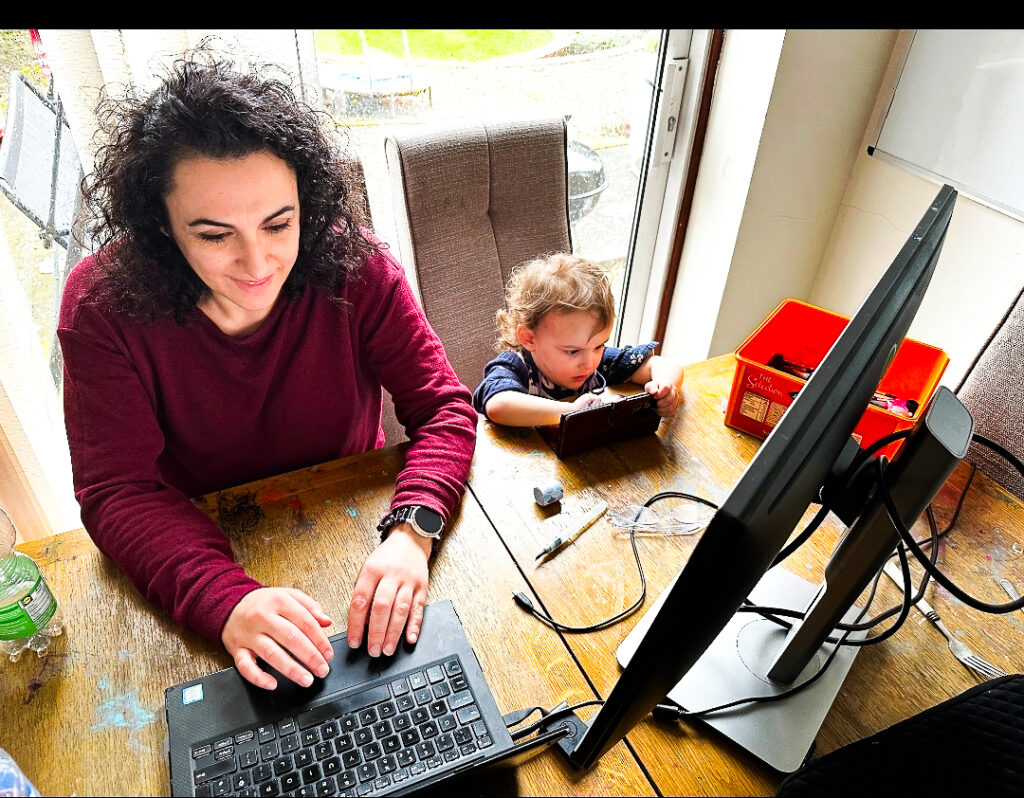
Empowering mums with essential IT tech tools and services
In today’s digital age, technology is an integral part of our daily lives, and for mums like me, it can be a powerful ally in managing both personal and professional responsibilities. From coordinating family schedules to managing remote work, you can benefit significantly from leveraging the right IT support and tech tools. This article explores the essential tech tools and services that can empower you, making your life easier and more organised.
The modern mum’s tech landscape
Modern mums juggle a myriad of responsibilities, often balancing career demands with family duties. In this context, technology can offer solutions that simplify and streamline everyday tasks. Whether it’s organising family activities, ensuring kids’ safety online, or managing household finances, the right tech tools can be game-changers.
Essential tech tools for mums
1. Calendar and scheduling apps
Keeping track of multiple schedules can be challenging. Calendar and scheduling apps like Google Calendar, Cozi, and Microsoft Outlook are invaluable for managing appointments, school activities, work meetings, and social events. These apps allow you to create shared family calendars, set reminders, and sync schedules across devices, so everyone stays on the same page.
2. Task management tools
Managing a household involves countless tasks, from grocery shopping to paying bills. Task management tools like Todoist, Trello, and Wunderlist help you stay organised by allowing you to create to-do lists, set deadlines, and prioritise tasks. These tools can also be shared with family members, so you can collaborate and ensure everyone contributes to household chores.
3. Meal planning and grocery apps
Planning meals and managing grocery lists can be time-consuming. Apps like Mealime, Yummly, and AnyList simplify meal planning by offering recipe ideas based on dietary preferences and generating grocery lists. These apps help you save time, reduce food waste, and ensure healthy meals for the family.
4. Parental control software
Ensuring children’s safety online is a top priority. Parental control software like Norton Family, Qustodio, and Kaspersky Safe Kids helps monitor and manage kids’ online activities. These tools allow you to set screen time limits, block inappropriate content, and track your child’s online behaviour, providing peace of mind.
5. Financial management tools
Managing household finances is crucial for maintaining a balanced budget. Financial management tools like Mint, YNAB (You Need a Budget), and Personal Capital help you track expenses, create budgets, and monitor savings goals. These apps offer a clear overview of financial health, enabling better decision-making and financial planning.
IT support services for mums
Beyond individual tech tools, access to reliable IT support services is essential for addressing technical issues and ensuring smooth operation of devices and software. Here are some key IT support services that can benefit you:
1. Technical support helplines
Technical support helplines, provided by companies like Geek Squad, Best Buy, and local IT service providers, offer assistance with troubleshooting, device setup, and software installation. These services are particularly useful for resolving technical issues that may arise unexpectedly, ensuring minimal disruption to daily activities.
2. Remote IT support
Remote IT support services allow technicians to diagnose and fix issues remotely, providing convenience and quick resolution. Companies like TeamViewer and LogMeIn offer remote support solutions that enable you to receive technical assistance without the need for in-person visits, saving time and hassle.
3. Cybersecurity services
Protecting personal and family data is critical in an increasingly digital world. Cybersecurity services, such as those offered by Norton, McAfee, and Bitdefender, provide comprehensive protection against viruses, malware, and online threats. These services include antivirus software, secure browsing tools, and identity theft protection, safeguarding sensitive information.
4. Device maintenance and optimisation
Regular maintenance and optimisation of devices can extend their lifespan and improve performance. IT support services often include routine check-ups, software updates, and performance optimisation to ensure devices run smoothly. This proactive approach helps prevent technical issues and maintains the efficiency of devices.
5. Tech education and training
Understanding how to effectively use technology can empower you to make the most of available tools. Tech education and training services, such as online courses from platforms like Coursera, Udemy, and Khan Academy, offer tutorials on various software, apps, and digital skills. These resources help you stay informed and confident in using technology to its full potential.
The benefits of empowering mums with IT support
Empowering you with the right tech tools and IT support services offers numerous benefits:
1. Enhanced efficiency
Tech tools streamline daily tasks, allowing you to manage your time more effectively. Scheduling apps, task management tools, and meal planning apps reduce the burden of organising multiple responsibilities, leading to increased efficiency.
2. Improved safety and security
Parental control software and cybersecurity services protect children online and safeguard family data. These tools provide peace of mind, knowing that safety measures are in place to mitigate potential risks.
3. Financial savings
Financial management tools help you maintain a balanced budget, track expenses, and achieve savings goals. Effective financial planning can lead to significant cost savings and improved financial stability.
4. Reduced stress
Access to reliable IT support services minimises the stress associated with technical issues. Knowing that help is available for troubleshooting and device maintenance ensures that technical problems are resolved quickly and efficiently.
5. Increased confidence
Tech education and training empower you with the knowledge and skills to use technology effectively. This increased confidence translates to better management of both personal and professional responsibilities.
Final thoughts
In today’s fast-paced digital world, using essential tech tools and IT support services is crucial for managing the complexities of parenthood and professional life. From scheduling apps to cybersecurity services, the right technology can streamline tasks, enhance safety, and provide peace of mind. By leveraging these resources, you can navigate your daily responsibilities with greater ease and efficiency, ultimately leading to a more balanced and fulfilling life.
*Collaborative feature post*
The best outdoor infant toys for development
Outdoor play is an essential part of early childhood development, offering babies the chance to explore, learn, and grow in a stimulating environment. Introducing outdoor infant toys such as baby garden swings and trampolines can significantly enhance their coordination, balance and mental growth. In this article, we will explore the benefits of these toys and suggest equipment you can incorporate into your garden to create a baby-friendly play zone.
The importance of outdoor play for babies
Outdoor play is incredibly beneficial for babies, offering them fresh air, natural sunlight, and a sensory-rich environment to stimulate their developing brains. The variety of textures, sounds, and sights outdoors enhances sensory development, promoting curiosity and exploration. Plus, outdoor play is great for physical activity, crucial for developing motor skills, muscle strength, and coordination. It also provides wonderful opportunities for social interaction with siblings, parents, or other children, fostering social and emotional growth.
Baby swings: a gentle introduction to outdoor play
Introducing your baby to outdoor play can be as simple as setting up a garden swing. These swings provide a soothing, rhythmic motion that babies find comforting and enjoyable, helping develop their sense of balance and coordination. Baby swings come in various types: bucket swings with safety features like a high back and leg openings, cradle swings for a reclined position perfect for very young babies, and full bucket swings with trays or harnesses for added safety and convenience. The benefits of baby swings are extensive—they help develop the vestibular system, strengthen core muscles, and offer rich sensory input through the swinging motion combined with the sights and sounds of the garden.
Trampolines: bouncing towards development
While trampolines might seem like they’re just for older kids, specially designed baby trampolines offer a safe and enjoyable way for infants to develop physical skills. These smaller trampolines have soft surfaces and often include handles for support. They come in various designs: small, cushioned trampolines for babies and toddlers, trampolines with stable handlebars, and enclosed trampolines with safety nets to prevent falls. The benefits of baby trampolines include developing coordination and balance, strengthening leg muscles, and boosting confidence through successful bouncing, encouraging babies to try new physical activities.
Creating a baby-friendly play zone in your garden
To maximize the benefits of outdoor play, consider creating a dedicated baby-friendly play zone in your garden. Essential items to include are a baby garden swing, a soft-surface baby trampoline with a handlebar or enclosure for safe bouncing, and a playhouse or tent for imaginative play and shade. Additionally, a sand and water table allows babies to explore different textures and engage in sensory play, while soft play mats provide a safe surface for crawling, sitting, and playing. Ride-on toys help develop coordination and motor skills, and outdoor activity centers with slides, climbing frames, and tunnels offer a range of physical challenges to stimulate active play.
Safety considerations
When setting up a baby-friendly play zone, safety should be your top priority. Always supervise your baby during outdoor play and ensure all toys and equipment are suitable for their age and developmental stage. Make sure all equipment, especially swings and trampolines, are securely installed and regularly checked for wear and tear. Use soft mats or grass to cushion any falls and reduce the risk of injury. Provide shaded areas to protect your baby from the sun and ensure they stay hydrated during playtime.
Final thoughts
Incorporating outdoor toys like baby garden swings and trampolines into your garden can offer substantial developmental benefits for your baby. These toys enhance coordination, balance, and muscle strength, while also providing rich sensory experiences and opportunities for social interaction. By creating a safe and stimulating play zone in your garden, you can give your baby the chance to explore, learn, and grow in a fun and healthy environment.
Remember, the key to successful outdoor play is ensuring all activities are age-appropriate and safe. With the right equipment and supervision, your baby can enjoy countless adventures in the great outdoors, laying the foundation for a healthy and active childhood.
FAQ
Popular and appropriate toys for infants
Q: What toys are currently popular for infants?
A: Some of the NEW Baby Toddler Toys that are popular for infants include Simplay Young Explorers Indoor Outdoor Activity Climber and Simplay Young Explorers Indoor Outdoor Discovery Playhouse. These products are often found under the new arrivals section in many shops, where you can also check for sales and gift cards options for additional savings.
Q: Which toy is appropriate for an infant?
A: Appropriate infant outdoor toys include those designed for safety and developmental benefits. Options like baby garden toys and outdoor baby toys are excellent choices. Always check the details on the product page for age recommendations and safety information.
Q: What toys should a newborn have?
A: For newborns, featured baby summer toys and backyard toys for babies that promote learning and sensory development are ideal. Outdoor toys for infants should be safe and engaging, helping them to explore their environment.
Outdoor play and toys
Q: How do you play with a baby outside?
A: Baby outdoor activities can include using baby garden toys, outdoor toys for infants, and engaging in infant outdoor play. Setting up a Foot WonderWave Outdoor activity climber or a garden playhouse can make outdoor playtime both fun and educational.
Q: What types of toys are suitable for outdoor play and helping babies connect with nature?
A: Outdoor infant toys such as baby outdoor toys and infant outdoor toys are perfect for helping babies connect with nature. Products like the Simplay Young Explorers Indoor Outdoor Activity Climber offer excellent opportunities for outdoor activities infants will enjoy.
Q: What are some engaging outdoor toys for children to enjoy?
A: Engaging outdoor baby toys and baby outdoor activities include Foot WonderWave Outdoor products and Simplay Young Explorers Indoor Outdoor Discovery Playhouse. These items are designed to keep children entertained while promoting physical and cognitive development.
Q: What are some outdoor toys for summers and where can I find them cheap?
A: During summer, baby summer toys like outdoor toys for 8-month-old and outdoor toys for 10-month-old are in high demand. Look for sales in shops and save with gift cards or free shipping offers.
Q: What are some must-have outdoor toys games to have for a two-year-old only child?
A: For a two-year-old, NEW Baby Toddler Toys such as Simplay Young Explorers Indoor Outdoor Discovery Playhouse and baby garden toys are must-haves. These products support active and imaginative pretend play.
Q: What are the best outdoor toys for 1-year-olds?
A: The best outdoor toys for 1-year-olds include baby garden toys and outdoor toys for babies. These items, often found in the Months Outdoor Toys category, promote learning and physical activity.
Q: What are the best outdoor toddler toys for hot summer days?
A: For hot summer days, baby summer toys and outdoor baby toys like Foot WonderWave Outdoor are perfect. These toys help keep toddlers cool and entertained.
Q: What are the best outdoor toys for 5-year-old kids?
A: Outdoor baby toys and baby outdoor activities for 5-year-olds include larger play structures like the Simplay Young Explorers Indoor Outdoor Activity Climber. These toys provide more challenging play options suitable for their age.
Q: How can I encourage outdoor play and exercise for my baby during winter without exposing them to extreme cold?
A: Encouraging baby outdoor activities during winter can be achieved with indoor-outdoor toys like the Simplay Young Explorers Indoor Outdoor Discovery Playhouse, which allows for safe play regardless of the weather.
Q: What are some ideas to do outside activities with toddlers outside?
A: Ideas for baby outdoor activities include using outdoor infant toys and infant outdoor play setups like baby garden toys. These activities support physical and cognitive development while enjoying the fresh air.
Benefits and development
Q: What are the benefits of outdoor toys for children’s overall development?
A: Outdoor baby toys and infant outdoor play contribute significantly to physical, cognitive, and social development. Learning through play helps with muscle growth, coordination, and social skills.
Q: What are the best toys you bought your 1-2 year old to keep them busy, entertained, and developing?
A: The best toys for this age group include outdoor infant toys and baby garden toys. Products like the Foot WonderWave Outdoor series keep toddlers engaged and support their development.
Q: What are the best types of toys for 1-year-olds?
A: The best types of toys for 1-year-olds include outdoor toys for babies and infant outdoor toys. These toys are designed to be safe and stimulating, promoting learning and physical activity.
Safety and selection of toys
Q: How can I choose toys that are safe for my baby to play with?
A: To choose safe toys, look for featured products with good reviews and safety certifications. Always check the details and age recommendations on the product page.
Q: What should I look for when choosing toys for my baby’s age and stage of development?
A: Choose toys from the Months Outdoor Toys category that match your baby’s developmental stage. Look for NEW Baby Toddler Toys and pretend play options that are age-appropriate and safe.
Q: As parents, how do you decide what toys to purchase for your infants and toddlers?
A: Parents should consider factors like the price, safety, and developmental benefits of toys. Look for sales and free shipping options to save money while purchasing high-quality products.
Educational toys
Q: What are some educational toys that are suitable for babies?
A: Educational toys like outdoor toys for infants and baby garden toys are excellent for promoting learning and development. These toys often feature bright colors and interactive elements that engage babies’ senses.
Q: Could you recommend age-appropriate educational toys for infants and toddlers?
A: For infants and toddlers, NEW Baby Toddler Toys and Simplay Young Explorers Indoor Outdoor Discovery Playhouse are ideal. These products support cognitive and physical development through interactive and imaginative play.
General toy suggestions
Q: What are some suggestions for baby toys?
A: Suggestions for baby toys include outdoor infant toys and baby outdoor products. These toys are designed to be safe, engaging, and educational.
Q: What kinds of toys should I buy for the kids that come to visit my house?
A: For visiting kids, consider outdoor toys for babies and infant outdoor play setups. Items like Simplay Young Explorers Indoor Outdoor Activity Climber are great for keeping kids entertained and active.
Q: Which toy is the best to help a baby learn to walk?
A: Toys that support walking include outdoor infant toys and push toys like the Simplay Young Explorers Indoor Outdoor Discovery Playhouse. These toys help babies develop balance and coordination.
Q: Where can you get activity toys for your kids?
A: Activity toys can be found in shops that offer NEW Baby Toddler Toys. Look for sales and free shipping offers to save on your purchase.
Q: What are the hot toys for kids this summer?
A: Hot toys for this summer include baby summer toys and outdoor baby toys like the Foot WonderWave Outdoor series. These toys are perfect for keeping kids cool and entertained.
Miscellaneous
Q: How often should I rotate my baby’s toys to keep them engaged?
A: Rotating baby outdoor toys every few weeks can keep your baby engaged and interested. This helps prevent boredom and encourages continuous learning and exploration.
Q: What is your opinion on plastic baby toys?
A: Plastic baby toys can be durable and safe if they meet safety standards. Always check the details on the product page to ensure they are free from harmful chemicals.
Q: Why do babies play with everything but their toys? We opened a little shop to create toys in this niche but need some help with understanding the psychology.
A: Babies are naturally curious and often explore their environment. Designing baby outdoor toys that are visually stimulating and interactive can capture their interest. Understanding their developmental stages can help in creating engaging toys.
Q: What types of baby toys are available?
A: Various types of baby toys are available, including outdoor infant toys, infant outdoor toys, and baby outdoor activities sets. These toys cater to different developmental needs and play preferences.
Q: What are some tips for going outdoors with a baby in cold weather?
A: When going outdoors in cold weather, dress your baby warmly and consider outdoor activities infants can enjoy in a sheltered area. Using toys like Simplay Young Explorers Indoor Outdoor Discovery Playhouse can provide a safe and warm environment.
Q: What are the best toys for children under 1 year of age?
A: The best toys for children under 1 year include outdoor toys for 8-month-old and outdoor toys for 10-month-old. These toys should be safe, engaging, and support sensory and motor development.
Kegel8®: pelvic floor exercises postpartum to regain strength
Having a baby comes with so many surprises, some of which you may not have prepared for, like the uproar of hormones, your droopy stomach, and how your downstairs feels like a runaway freight train that’s collided with a wall.
However surprising these symptoms are, they’re actually quite common. You could experience pelvic floor weakness even a few years after giving birth, and even if you’ve had a C-section and preserved your front bottom from being stretched like a balloon animal at a kid’s party, the pressures, hormonal changes and age can still affect your pelvic floor.
But, it’s important to note that even though over 60% of women in the UK and more than 15 million women in the U.S. suffer from a weak pelvic floor, it isn’t normal to suffer like this. There are ways you can strengthen your pelvic floor, so you don’t have to worry about leaving the house without a toilet nearby (something which I suffered with for years). Practising your pelvic floor exercises postpartum to regain strength can prevent and treat weaknesses that cause these accidents and make you feel confident to take on the world as well (honestly, you’ll be surprised at how much a strong pelvic floor makes you feel like a superwoman!)
As a mother of four (with the last two being vaginal births) my pelvic floor felt broken and even three years postpartum, I struggle to hold my bladder when I’m dying for the loo. This is known as urge incontinence, which I’ll go through in more detail later, and it has caused so much frustration, anxiety and even depression too. I can’t just decide to go for long walks because I have to think about where the nearest toilet would be. And, without realising, I’ve only ever worn black leggings because I think if I have an oops moment, hopefully no one would notice.
Not a way to live, is it?
Well, we don’t have to live like this anymore!
I teamed up with Kegel8®, the leading brand in electronic pelvic floor trainers and Amanda Savage MCSP MSt, a chartered physiotherapist, women’s health specialist and an expert in pelvic floor health, to dig deep into the science behind our pelvic floor muscles and trial the Kegel8® Ultra 20 V2 Toner* and Kegel8®, Biofeedback Pelvic Trainer Vaginal Probe for three months, to see if I can improve my pelvic floor.
The results have legit been astonishing!
Plus, I have an exclusive 10% discount code for Motherhood Diaries’ readers because I want you to try these amazing Kegel8® Ultra 20 V2 Toners*. I can wholeheartedly say that everything has changed since I’ve used it.
So, let’s muscle on (:D) with the article and I’ll share how I got on.
Welcome to your post-pregnancy body
Childbirth changes your body in many ways and the postpartum period can leave you feeling a bit low. If you’ve suffered injuries during birth, then the recovery process may take a little longer too. Perhaps you had an assisted vaginal delivery which resulted in a tear or you had C-section. Even if you came out with no scars, the weight of a baby could have had some bearing on the lower half of your body. Injuries suffered during birth are common, but with the right interventions and a gradual recovery program, you should be able to bounce back from them. Consistent exercise, a healthy diet, and proper pelvic floor exercises can help your body recover and regain strength.
These changes don’t happen overnight, though, and the age-old adage is generally true – it took nine months to make a baby, and so it will take at least that long to get back into shape again.
What about your pelvic floor?
“Don’t make me laugh or I’ll pee myself!”
I’m sure you’ve heard that saying multiple times in your life. That’s your pelvic floor making you leak when you laugh because of the stress laughing puts on those muscles – the one area we overlook and the one muscle we so wish we had exercised when it’s too late.
I’m guilty of forgetting to do my pelvic floor and, even though I and 90 per cent1 of ladies know the importance of doing our pelvic floor post-pregnancy (it improves your sex life too by the way!), still, 61 per cent of us are not training these muscles when we know we should be. According to research from lights by TENA, one in three2 women in the UK experience light bladder weakness and this is a common occurrence for 69 per cent3 of pregnant women and new mums.
So, you’re definitely not alone.
This leaky bladder after pregnancy is so common that over 200 million people worldwide suffer from incontinence. And, the problem is that women suffer from low mental health because of this symptom, but we are too ashamed to talk about it.
Can I just grin and bear it?
Well, yes, you can. But, do you want to live in fear of accidents all your life? And if you’re sexually active, don’t you want increased sensation? Also, a weakened pelvic floor can lead to more serious concerns if not treated, like urinary incontinence (we’ll go through the different types below), which is also a prevalent issue amongst women, as pregnancy exacerbates this problem. Pregnancy hormones relax the muscles and the increasing baby weight adds to the pressure on the bladder and pelvic floor, which results in accidental urine leakages. One other well-known side effect of pregnancy is constipation, which can also overstretch the pelvic floor muscles, weakening them even further.
So, you must recognise whether you have an issue with your pelvic floor and then take the steps to exercise and strengthen the muscles to prevent any further unnecessary leakages.
But, how do you do that?
By understanding exactly what your pelvic floor is!
So, let’s get down to the science:
Below are your pelvic floor muscles
The pelvic floor is a group of muscles and connective tissue that spans the area underneath your pelvis. These muscles form a hammock-like structure from the pubic bone at the front to the tailbone (coccyx) at the back and from one sitting bone to the other. They support the bladder, uterus (womb), and bowel (colon), helping maintain control over the bladder and bowel movements, and play a crucial role in sexual function.
“Since giving birth, many women notice a change in sexual sensation and satisfaction, which can be related to pelvic floor weakness. Exercising these muscles brings blood flow to the area, tones and tightens the muscles, and can improve the ability to feel the vaginal walls during sex, often leading to easier and more powerful orgasms.”
Amanda Savage, MCSP MSt, chartered physiotherapist, women’s health specialist, pelvic floor health expert
Your pelvic floor stretches under a lot of weight and springs back up again. You can see above that these groups of muscles (called the pelvic floor muscles or ‘levator ani muscles’) are sitting directly under the weight of your growing baby.
During pregnancy, the muscles and tissue can become overstretched and exhausted from bearing the burden for so long, which is why it is massively important to exercise and strengthen your pelvic floor muscles before you get pregnant, throughout your pregnancy and after birth, too. Did I listen to the experts tell me this, though?
No, I didn’t. These pelvic floor muscles are often overlooked, especially postpartum. And, despite the common belief that having a C-section might protect the pelvic floor from damage, many women still experience pelvic floor weakness due to various factors as mentioned above, i.e. hormonal changes, the pressure of carrying a baby and ageing.
“Childbirth is one of the most predictable influences on pelvic floor condition but it is a muscle just like others in the body so can be affected by incidences later in life too – maybe a further muscle deconditioning due to another event, like things that can sneak up on you such as weight gain, chronic cough, constipation or having treatment for another condition like cancer.
Amanda Savage, MCSP Mst, chartered physiotherapist, women’s health specialist, pelvic floor health expert
Recognising pelvic floor weakness
Recognising you need to strengthen your pelvic floor is the first step to treating it. There are actually different types of incontinence, the most common being stress incontinence (pee leaks out when your bladder is under pressure) and urge incontinence (Pee leaks out when you feel the sudden urge to pass urine – or soon afterwards). More details below:
Stress incontinence
Pee leaks out when your bladder is under pressure, for example, when you cough, sneeze or laugh, and is usually the result of a weakening or damaging of the pelvic floor muscles used to prevent urination. Symptoms can stem from or be exacerbated during pregnancy and vaginal birth.
“Stress incontinence is particularly common after childbirth, as the pelvic floor muscles may be weakened or damaged during the process. It’s important to start pelvic floor exercises as soon as possible after birth to help strengthen these muscles and prevent further issues.”
Amanda Savage, MCSP MSt, chartered physiotherapist, women’s health specialist, pelvic floor health expert
Urge incontinence
Pee leaks out when you feel the sudden, intense urge to pass urine – or soon afterwards. This is usually the result of an overactive bladder due to the detrusor muscles, which control the bladder. Obesity, a family history of incontinence and age, can increase the chances of bladder weakness (although, this is not an inevitable side effect from ageing).
How to recognise you have a weakened pelvic floor
There is a common misconception that you think you have a weak bladder because you’ve leaked urine after you’ve coughed, sneezed, laughed, lifted heavy items or done anything which has resulted in having the sudden urge to go to the loo. But what 5.4 million women in the UK thought was a weak bladder was in fact weak pelvic floor muscles that were not holding the bladder and urethra in the correct position.
But, what if you want more children?
Each person and their pelvic floor are unique. Problems do not necessarily change further with each pregnancy or delivery. However, there are risk factors such as maternal age, your collagen type, family history, size of babies’ heads, and type of delivery. Some are in your control but many are not.
No one would want you to limit the size of your family through fear of body changes. But everyone decides on their family size with many factors in mind: financial, mental, and physical coping capacity.
They are developing tools to help women and doctors predict better and help make birth/delivery choices (e.g., UR CHOICE), but these are not well developed yet. If you have a traumatic delivery or suffer with incontinence or prolapse symptoms after childbirth, you will be offered time to discuss your plan for your next delivery with your midwife and/or a consultant.
If you feel that your pelvic floor is vulnerable, perhaps take a bit more of a break between pregnancies to allow yourself to get strong again. It can take 18 months to rebuild vitamin and mineral levels and similarly pelvic floor strength.
Amanda Savage, MCSP MSt, chartered physiotherapist, women’s health specialist, pelvic floor health expert
Do you need to pee a lot?
Remember, you don’t have a weak bladder. You have weak pelvic floor muscles.
“An overactive bladder is a common condition. The bladder muscle becomes more sensitive and contracts too often, even before the bladder is full. Symptoms include peeing more than seven times a day or more than once at night (nocturia), and a sudden, urgent desire to pass urine. It can happen in conjunction with leakage or without.”
Amanda Savage, MCSP MSt, chartered physiotherapist, women’s health specialist, pelvic floor health expert
Do you feel like you can’t get to the loo in time?
Again, that feeling is not related to a weak bladder; it’s your pelvic floor muscles.
Do you feel you can’t fully empty your bladder?
If you’re straining to pee and it feels difficult to fully empty your bladder, this is more likely due to your pelvic floor muscles rather than your bladder itself.
Do you accidentally leak sometimes?
If you sneeze, cough, laugh, jump or do any heavy lifting and experience an unintentional leak, then you may have stress incontinence. These actions put stress on the bladder, and if your pelvic floor muscles are not tightening enough, this will cause an involuntary leak, which is the most common form of female incontinence.
Do you have pelvic pain?
Tension or problems in the pelvic floor muscles can cause pelvic pain after pregnancy, but this may also be a sign of infection. Visit your doctor as soon as you feel any pelvic pain after childbirth or pubic pain after birth in the area.
Do you feel a loss of sensation during sex?
A weakened or damaged pelvic floor may mean that you experience a loss of enjoyment during sex. However, those who can squeeze and relax their pelvic floor muscles correctly experience more intense orgasms – need there be any more reason to exercise your pelvic floor!
Do you leak during sex?
A large proportion of women with incontinence experience leakage during sex due to a weak pelvic floor because sexual activity puts pressure on the bladder or urethra.
Do you accidentally pass wind?
The inability to hold wind is another sign of a weakened pelvic floor because it supports the bowel as well as the bladder and so is responsible for all the openings.
Do you have backaches or bad posture?
Another sign of weak pelvic floor muscles is poor posture or suffering from backaches. An exercised pelvic floor should support the entire core, a stronger midsection and a flatter tummy, as well as better posture.
You may be thinking you’re doomed, but you’re not. It’s never too late to strengthen your pelvic floor muscles and stop any unwanted leakages.
But, why should you strengthen your pelvic floor muscles?
Suppose you don’t strengthen already weakened muscles, then your pelvic floor will get weaker and could lead to incontinence or worse, pelvic organ prolapse, which is when one or more of the organs (womb (uterus), bowel, bladder or top of the vagina) in the pelvis slip down from their normal position and bulge into the vagina. A prolapse can cause postpartum pain and discomfort, but it isn’t life threatening. Other symptoms may include faecal incontinence, which is the inability to control your bowels.
I do my pelvic floor exercises post-pregnancy, but I still have a weak pelvic floor
Did you know that 50% of women in the UK cannot activate their pelvic floor muscles correctly, so any exercises they do already are ineffective and can lead to postpartum pelvic pain? Don’t worry, we’ll show you how to do your pelvic floor muscles correctly and even show you how to use a device (Kegel8® Ultra 20*) which can do it for you if you are post-12 weeks postpartum!
How to strengthen your pelvic floor after birth
You can strengthen your pelvic floor by either physically exercising them every day, multiple times a day, using pelvic floor physical therapy through strengtheners, or treatment options by a pelvic floor physical therapist/physiotherapist and devices you can use at home. We’ll go through exercising your pelvic floor muscles yourself first.
You should be able to locate your pelvic floor muscles
To use your pelvic floor muscles correctly, you need to know where to find them. As mentioned before, the pelvic floor muscles start from your pubic bone and run through to the tailbone at the back.
You are often told to think about holding your wee in mid-stream to connect with your pelvic floor muscles, but a better way is to imagine stopping the wind from your back passage and then stopping a wee from the front. You then pull these two points in and up together. Doing it this way will help you learn where they are and therefore, connect to them better if you get problems.
So, to use your pelvic floor muscles correctly, you:
Imagine stopping the wind from your back passage
Then stop the wee from the front
Pull these two points in and up together
The above three steps are the correct way to exercise your pelvic floor muscles and avoid pelvic problems after pregnancy.
Did you know that exercising helps to strengthen your pelvic floor muscles too?
The more active you are during pregnancy, the easier it will be for your body to adapt to the weight gain and increased pressure. Exercising also helps strengthen your core and encourages you to feel emotionally and physically strong – this includes your pelvic floor too.
Recruit your entire pelvic floor when exercising
Muscles should have strength, length, and balance. So, you should not only think about contracting the muscle but letting it relax too. A great way to do this is to imagine you are pulling your pelvic floor muscles up through 5 floors – like a lift going up.
Then, you go back down through the levels before you lift up again.
Work your pelvic floor the hardest
Focus predominantly on your pelvic floor muscles when exercising, so they can strengthen over and above the other muscles that take over, like the glutes (the bum) and the abs.
Do not hold your breath
Holding your breath creates tension in the body that can cause pressure, increasing stress on some muscles, including the pelvic floor. While exercising your pelvic floor muscles, take deep breaths and, as you inhale, try to relax and feel your pelvic floor.
Lifestyle changes can also help
You can make certain lifestyle changes to help prevent the onset of bladder weakness and pelvic pain after delivery. These may include:
Losing weight and cutting down on alcohol and caffeine
Train your bladder to wait a little longer between needing to urinate and passing urine.
Use an award-winning muscle re-trainer like the Kegel8® Ultra 20* below, which stops you from worrying about your bladder by re-training the pelvic floor muscles.
Regardless of whether you have a weakened pelvic floor, get into the habit of exercising your pelvic floor muscles every day. But suppose you still find you are not exercising the muscles correctly, especially when you’re in a rush or forget altogether, there is another very awesome way to ensure you exercise your pelvic floor muscles correctly every time.
Introducing the Kegel8® Ultra 20 V2 Electronic Pelvic Toner!
The Kegel8® Ultra 20 Toner can do the pelvic floor exercises postpartum for you!
Pelvic floor strengtheners ensure you’re doing your pelvic floor exercises properly, so you can achieve quicker results. And as this article is all about the very awesome Kegel8® Ultra 20 V2 Electronic Pelvic Toner (Kegel8® Ultra 20*), let’s dig into how this amazing contraption got me from leaking the moment my bladder was half full to walking five miles with a full bladder and managing to get home with no leakage in sight!
The Kegel8® Ultra 20 is a sophisticated device designed to strengthen and rehabilitate weak pelvic floor muscles in the comfort of your own home. Created especially for women, the Kegel8® Ultra 20 is a safe and effective neuromuscular stimulator (STIM) that works by producing electrical pulses that gently stimulate the muscles and nerve fibres in your pelvic area and automatically activate these muscles, even if you can’t do them manually.
This was my first time using a STIM device, so I was apprehensive about using it. The box comes with wires and cables, but I can assure you, once you read the manual first and follow the instructions for proper use, it is so easy and very comfortable to use.
What do you get in the box?
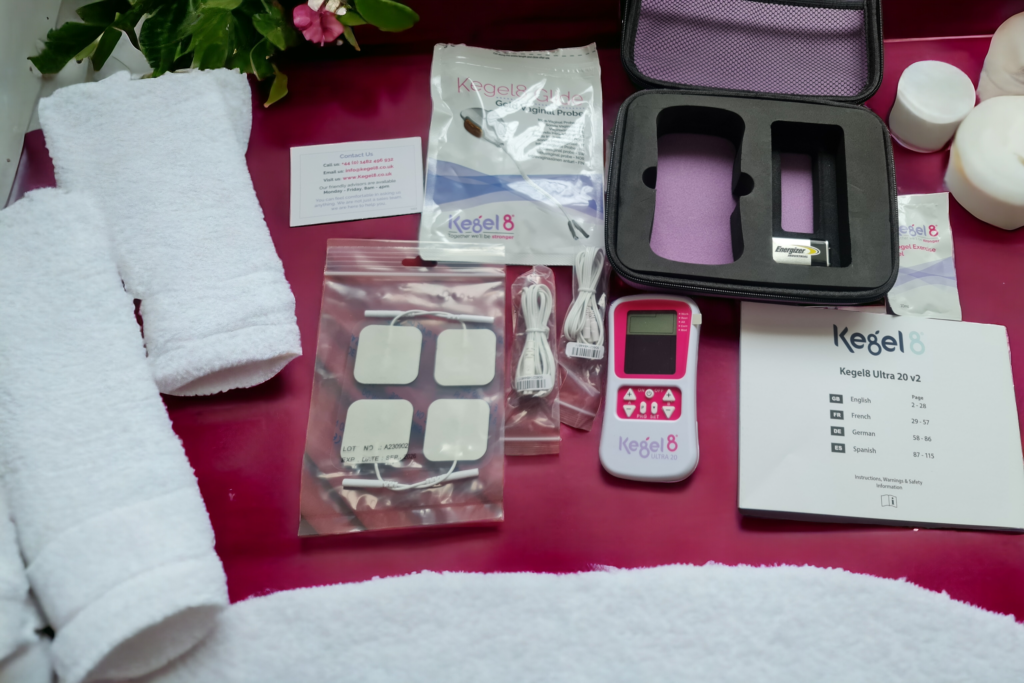
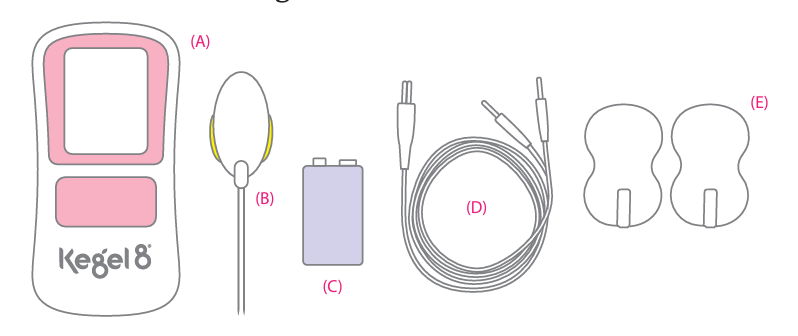
Your package should contain the following items:
1 x Kegel8® Ultra 20 device (A)
1 x Kegel8® Ultra 20 Probe (B)
1 x 9 Volt Battery (C)
2 x Kegel8® Ultra 20 Lead Wires (D)
4 x Kegel8® Ultra 20 Electrode Pads (E)
1 x Kegel8® Ultra 20 User Manual
Who can use the Kegel8® Ultra 20?
You can use the Kegel8® Ultra 20 if you have the following issues:
Stress urinary incontinence
Overactive bladder
Faecal incontinence
Pelvic and back pain
Natural ageing
Painful intercourse
Lack of sensation during sex
Who shouldn’t use the Kegel8® Ultra 20?
You should not use the Kegel8® Ultra 20 at home without the guidance of a medical professional if you fall under any of the below categories:
You are pregnant
If you are fitted with a demand-style cardiac pacemaker
If you have an undiagnosed pain condition
If you have an undiagnosed skin, vaginal, or rectal condition
If you have active pelvic cancer
If you don’t understand the user instructions – don’t worry, the manual is super easy to understand
If you are immersed in or near water
If you are connected to a high-frequency device
If you are operating a motor vehicle or potentially dangerous machinery
Let’s get started!
If you can use the Kegel8® Ultra 20 after checking off the above criteria, then let’s move on to the fun part – using the toner to get those pelvic floor muscles nice and tight!
Once you’ve read the manual fully, you’ve completed the initial set-up, i.e. inserted the battery and connected the probe/electrodes to the Kegel8® Ultra 20 Device (Insert the lead wire into Channel A at the top left of the device and connect your probe/electrodes to the lead wire connectors), turn on your Kegel8® Ultra 20 Device by pressing the on/off button once.
Consult your manual to learn how to set up your Kegel8® Ultra 20 for the first time. Make sure you clean your probe with warm water before and after use or spray with an antibacterial spray, then store your Kegel8® Ultra 20 in the carrying case you receive conveniently with the device. You should never share your probes or electrodes with anyone else – this device is just for you to use!
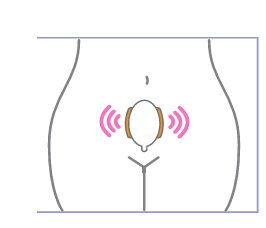
Insert your probe by applying a small amount of Kegel8® Conductivity Gel on the metal parts of the probe. Insert the probe into your vagina, with the metal sides facing “hip-to-hip”. Avoid placing it in too deep; you should be able to touch the base of the probe with your fingertip still, approximately one knuckles depth inside the entrance to the vagina.
If you’re using electrodes (I never used these personally), place them in the desired position and make sure they’re stuck on properly.
Selecting a programme
The tingling/knocking sensation means that the programme is starting to work. You should keep at this level for your sensation test (more on that below) and the first week of your routine before increasing the mA level by 1-2 mA’s every 1-2 weeks. Don’t set the mA level too high as this may cause the pelvic floor and surrounding muscles to overwork and create discomfort. You can pause a programme at any time by pressing the P button. When you’re ready to continue press the + button.
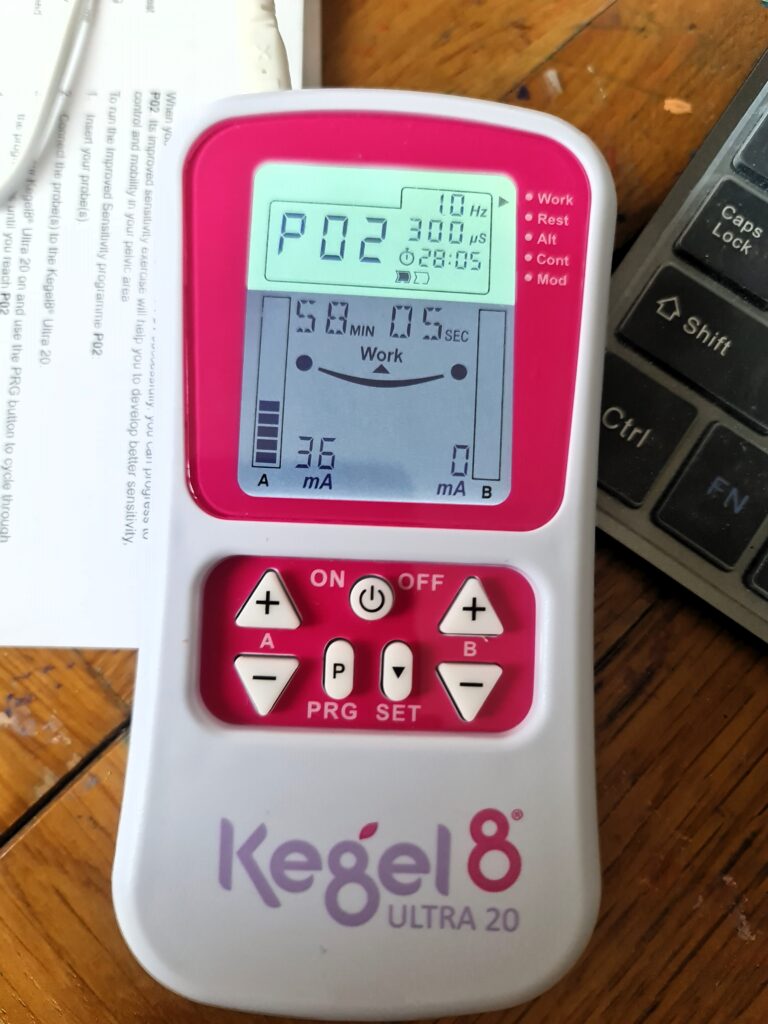
You can choose a programme by pressing the PRG button until the screen shows which programme you want to use. When you’ve selected the programme you want, press the A+ button to increase the intensity (displayed as mA, which means milliamps). If you feel the sensation is too strong, then you can decrease it by pressing the A- button. The amount of current you need to stimulate your pelvic floor muscles will vary. So, starting from 0 mAs, consider increasing the mA power to the level where you can feel the effects of the electrical pulse without any discomfort.
The aim is to gradually increase until you feel the muscles contract and relax with the electrical cycles, but it should never be painful. Some programmes have different phases, but you can play with the intensity level by using the + and – to increase and decrease the mAs back to a comfortable level.
What programmes should I start with?
With the Kegel8® Ultra 20, you get 20 pre-set programs and 3 customisable options. These programs are designed to target the various conditions above, which include urinary and bowel incontinence, light bladder weakness, overactive bladder, pelvic pain and, of course, postpartum recovery. We’ll go through what programmes you get and then what you should start with, depending on your situation. For this article, we will be focussing on postpartum recovery.
Functional Continence Training (with skin electrodes)
2
9
P14
PNC1
Postnatal / Post-Surgical Care 1
2
35
P15
PNC2
Postnatal / Post-Surgical Care 2
2
30
P16
BOW1
Bowel (Faecal) Incontinence 1
2
10
P17
BOW2
Bowel (Faecal) Incontinence 2
2
40
P18
PAIN
Chronic Pain Relief (with skin electrodes)
1 or 2
∞
P19
CIRC
Pelvic Floor Circulation
1 or 2
60
P20
RELX
Pelvic Floor Relaxation
2
20
List of 20 Pre-Set Programmes to use with the Kegel8® Ultra 20
What the different programmes mean
Looking at the table above, you can place the programmes into three distinct categories. These are:
Sensation tests
P01 and P02 are designed to test your sensation levels. If this is your first time, you should start with the P01 Sensation Test 1, to find out whether you can feel the current safely. If you can’t feel the current, use P01 at 50mA once a day for 4 weeks before you progress onto P02.
Muscle exercises
The following programmes are muscle exercises for strengthening your pelvic floor muscles:
P13 – Functional Continence Training (with skin electrodes)
P14 – Postnatal/Post-Surgical Care 1
P15 – Postnatal/Post-Surgical Care 2
P16 – Bowel (Faecal) Incontinence 1
P17 – Bowel (Faecal) Incontinence 2
Neuromodulation programmes
The following programmes are for calming overactive nerves, circulation, relaxation and pain relief:
P08 – Sensory Modulation (TENS)
P09 – Overactive Bladder Neuromodulation
P12 – Mixed Incontinence
P18 – Chronic Pain Relief (with skin electrodes)
P19 – Pelvic Floor Circulation
P20 – Pelvic Floor Relaxation
How to start the road to postpartum pelvic floor recovery
You’ll find in the guide there are lots of tailored condition guides by Amanda Savage, who is a specialist physiotherapist4, that address specific issues. These condition guides combine several pre-set Kegel8® Ultra 20 programmes. These are:
More Effective Pelvic Floor Exercises
Bladder Weakness & Stress Incontinence
Uncontrollable Gas/Wind & Bowel Control
Menopause, Perimenopause & Postmenopause
Pelvic Organ Prolapse
Pelvic Pain
Postpartum Recovery
Vaginal Looseness & Lack of Sensation
Rehabilitation After Gynaecological Surgery
In this section, we’ll go through the advised process for pelvic floor exercises postpartum to regain strength. I will coincide this section with my journey too, so we can see real-life action results and find out whether the Kegel8® Ultra 20 actually works (hint, it does!)
If you want more information on the other condition guides, please consult the manual.
Month 1 – The beginning of the postpartum pelvic floor journey – Testing the sensitivity
If you have given birth less than 12 weeks ago, you need to start with the physical pelvic exercises without using a STIM device first. If you have given birth more than 12 weeks ago, you are safe to continue.
Here’s a video on Instagram, introducing my journey and partnership with Kegel8®:
The programme guide suggests you start with P01 – Sensation Test 1 to test whether you can feel the current safely. So this is what I did.
Use the + button on the same side you are plugged into the machine to turn up the mA current. If you can feel a sensation, like a warm tickling, below 50mA then you can progress to the second sensation test P02.
If you can’t feel a tickling sensation below 50mA, it can be a sign of nerve damage or difficulty conducting messages. This is quite common after childbirth or surgery.
P01 can be your treatment programme to help you recover, at 50mA (or less), once a day for four weeks before progressing onto P02. If you can’t feel any sensation returning after one month, then you should consult a medical professional for advice.
I was impressed I could feel something at 30mA which meant I still had feeling down there, so I felt I could move nicely onto P02 – the second sensitivity test.
Progressing onto P02 – Second sensation test
This second test introduces new frequencies and if you can feel a sensation from the internal probe below 50mA on P02, you can progress to one of the Kegel8 treatment programmes (P03-P20).
If you can’t feel a sensation below 50mA it can be a sign of nerve damage. Use P02 at 50mA once a day for a further four weeks. Again, if you do not feel any sensation returning, contact your doctor or physiotherapist for advice.
P02 was a full 60 minutes long, a length of time a mother of four doesn’t have the luxury of enjoying, so I decided to discreetly train my pelvic floor as I sat at my desk working and no one was none the wiser! I cranked it up to 36mA and thought that was a great place to start. I did this for a few days before I felt I could move forward with P14. It’s important to note that the higher the mA the stronger the current, but not necessarily a stronger pelvic floor. The effectiveness of the mA depends on how the muscles respond to the stimulation. Some muscles might contract more effectively with lower currents, while others might require higher currents. Quality and proper engagement of the muscles during the practice is what matters here.
Week 1 – “Find and Feel” your pelvic floor muscles with P14 – Postnatal / post-surgical care 1
Once you’ve taken the sensitivity tests, it’s time to move on to a 25-minute gentle exercise programme, which is designed for vulnerable mums after childbirth.
Phase 1 is a 20-minute continuous low-frequency current that improves the awareness of the muscle position, blood flow and nerve sensitivity. The point of this program is to relax as much as possible.
Phase 2 is 15 minutes and uses a higher frequency current to stimulate the fast and slow pelvic floor muscle fibres by contracting for 6 seconds and then relaxing for 18 seconds. This is because you need long rest phases when your muscles are learning to work again. Much like exercising your core after pregnancy.
It’s important to allow the sensations to come and go and for you to learn where your pelvic floor muscles are. Use this program on alternate days until you get used to the probe.
I cranked the mA up to 40mA and was happy I could complete the program quite easily at this stage.
Week 2 – Continue then take a rest – P14 – Postnatal / post-surgical care 1
If you were comfortable in Week 1, then use the Kegel8® Ultra 20 every day for six days, then take a rest day. If you’re feeling particularly uncomfortable or irritable internally then take an extra rest day, or do alternative days.
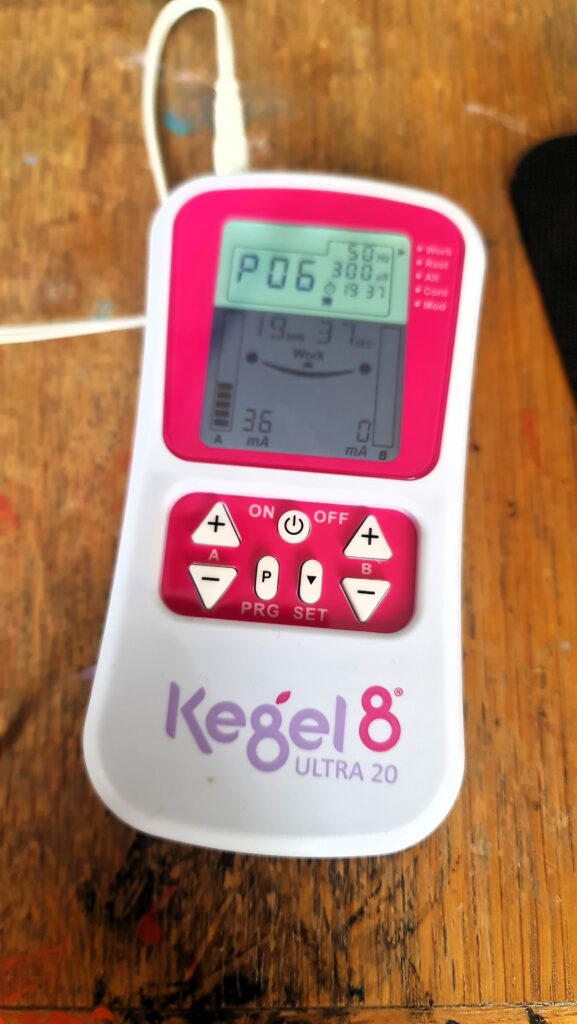
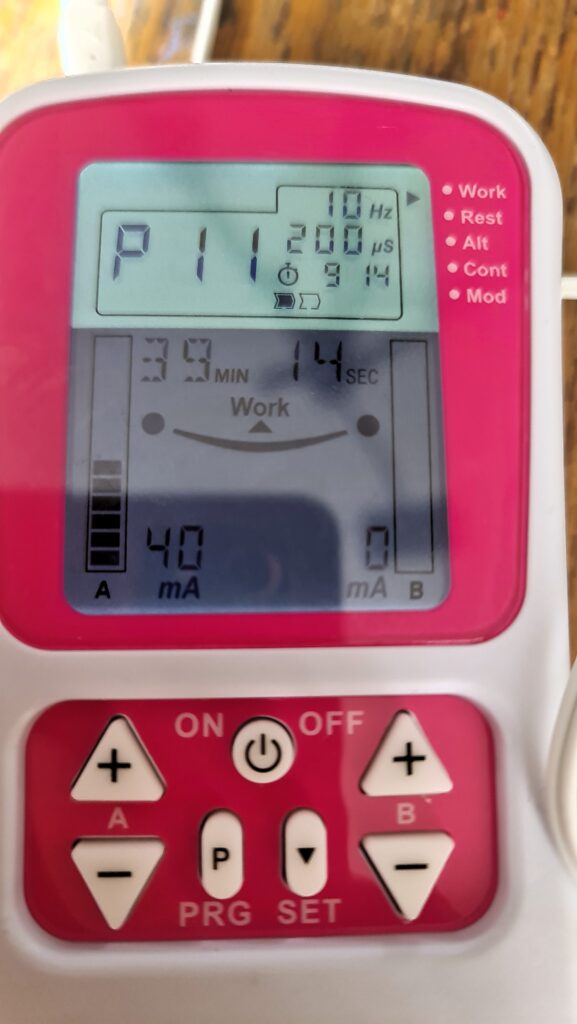
I have to say, I got bored with P14 as I was three years postpartum so I wasn’t ‘vulnerable’ down there. So I went off on a tangent at this point and started messing about with all the programs. I tried P11 – Gentle incontinence program and cranked it up to 40mA. Then I went for P06 – Increased sensitivity program. In this program I could really feel the muscles working on the sides of my walls, even at 36mA! I even took a work call while doing my exercise – that’s multitasking for you! I could feel the pressure towards the back passage too, so I felt I had worked them enough in this program.
It was actually during this month I realised I didn’t have stress incontinence, but urge incontinence. So I also hit P09 – Overactive Bladder Neuromodulation on 40mA because it’s only twenty minutes long. I actually found this easy.
P03 exercises your muscles for a longer 45 minutes, with a shorter recovery time between muscle contractions. Phase 1 has a low frequency at 15 minutes and then Phase 2 hits a higher frequency for 30 minutes. I found this a tad more challenging but still sailed through at around 36mA. I did this for a couple more days before the end of the month hit and my period was nigh.
End of month 1 update
Three days before my period and coming up towards the end of the month, I tried P09 – Overactive Bladder Neuromodulation and I couldn’t even get it to 30mA! I wondered whether everything down there was more sensitive just before your period. This is a very interesting point. I decided to consult ChatGPT which said:
“Yes, it’s actually quite common for women to experience increased pelvic floor sensitivity and even some changes in pelvic floor function during different phases of their menstrual cycle. In the days leading up to your period, hormonal fluctuations can make tissues more sensitive, and you may retain more fluid, which can affect how comfortable electrical stimulation feels. This could be why you’re having difficulty reaching the usual intensity on your device. It’s completely normal to need to adjust the intensity of your Kegel8® device throughout your cycle. Listen to your body, and only use a level of intensity that feels comfortable and effective for you.”
At the end of the month, I didn’t notice any physical improvements yet, but I fell in love with doing my pelvic floor exercises with the Kegel8®, especially I could feel the device working my pelvic floor muscles without me having to knowingly remember, thanks to my scatty brain! So, I’m sure whatever is happening down there is progression. And practice makes progression!
Month 2 – Weeks 1 – 4 – Do more of the same, but with longer muscle contractions now
In month 2, you now use P04 – Pelvic Floor Muscle Exercises 2 which features longer muscle contraction times (8 seconds) with a similar long rest time in each cycle. There are four phases to change between stimulation frequencies more often, which is often the case when working your body through fitness as well. You want to trick the muscles and make them work differently so they don’t get tired or bored. I totally understood why this was indeed the case for the pelvic floor muscles too – and I felt it as well!
In this phase, you also needed to get your brain involved in this process and ‘join in’ with some of the stimulation cycles. You can do this by trying to work your pelvic floor muscles in your mind, by drawing in and up when you feel the stimulation (as we showed above in the three-step process – remember hold in the wind, then hold in the pee, then go up 5 levels on the lift, and then back down again while breathing normally). Follow these movements when doing the pelvic floor muscles yourself. And, don’t worry if you can’t do all the seconds at this stage. We’re still new in the process and that’s absolutely fine. Just do what you can and let the machine do the rest.
I actually didn’t find this easy at all. I kept missing the mark and then moved up too quickly, or held my breath. I even kept holding my glutes or tummy. So it took me a while to isolate the muscles and follow the stimulation cycles. By the end of the program, I got it and when I got to the of the month, I had mastered the process and found I could hold all the way through. I was so tired by the end though. It felt like a proper workout!
Using the Kegel8® Biofeedback Pelvic Trainer to monitor results
I was also gifted the Kegel8® Biofeedback Pelvic Trainer which I used to monitor my results. You can use the Biofeedback to take the guesswork out of Kegels because you squeeze and it measures your results. At this stage, I used it to test how well I was doing on my daily practice with the Kegel8® Ultra 20 because I wasn’t strong enough to do the practice yet. You do this by using the test function, which squeezes and relaxes your pelvic floor repeatedly for 45 seconds. It then gives you a level score, so you can track your progress.
The Biofeedback practice phase tends to come in handy when your pelvic floor muscles are a bit stronger and you can do the squeezes yourself. I plan to use the practice phase of the Biofeedback once I’ve hit level 2 on the test phase.
Biofeedback Trainers and Muscle Stimulation Devices like the Kegel8® Ultra 20 can offer different approaches, as you can use the practice phase of the Biofeedback to practice your pelvic floor yourself as well. Here’s a comparison to help you understand their differences and how to incorporate them into your routine:
For very weak or fatigued muscles (Oxford Scale < 2)
Functionality
Provides visual or audio cues for muscle identification, practice, and motivation Use the trainer to identify your pelvic floor muscles in different positions
Uses electrical impulses to stimulate muscle contraction and brain-muscle coordination
Benefits
Helps identify pelvic floor muscles in different positions – Ensures correct practice of contraction and relaxation – Enhances endurance, coordination, and brain skills
Assists the brain in identifying pelvic floor muscles – Stimulates different muscle fibres – Allows for assisted and independent muscle contraction – Supports learning of muscle control during breathing or movement – Can calm bladder overactivity (neuromodulation)
Daily Use
Typically used for 10-15 minutes, once or twice a day, focusing on both quick and sustained contractions.
Recommended for 10-60 minutes daily, depending on the program and muscle condition
Frequency
Can be used daily or as needed to track progress and practice
Often used daily for initial strengthening and can be adjusted based on progress
Examples of Use
Daily tracking to improve muscle strength over 12 weeks – Real-time display of muscle strength during exercises – Real-time feedback allows you to monitor your progress and adjust exercises as needed.
20-60 minutes daily sessions – Programs for stress incontinence, overactive bladder, muscle endurance, and more
My end of month 2 update
I definitely felt a difference during this month. I used the Biofeedback trainer and I went from Level 0 to Level 1 – I was so pleased! I also found out at this point that the mA electrical pulses don’t really tell you how much you’re improving. It’s not about the strength of the mA, it’s more about how you feel down there. When you use the Biofeedback trainer’s test, you can see that you are improving and it really boosts your confidence. The test is about 45 seconds long and the program flexes and relaxes your muscles repeatedly and then it gives you a score at the end,
It’s the little things I’ve noticed now like I don’t leak when I hold my pee in, which has given me a huge confidence boost. This month, I decided to try the programs that alternate between increased sensitivity (P06) and urge incontinence settings (P12). I cranked it up to 40mA which was fine but I was worried I wasn’t feeling it as much. A part of me did wonder if I had created nerve damage from doing too much too soon. But I figured, it’s fine and I’ll just go for it.
Also, I’ve noticed when I have my period and I walk, my period cup stays in rather than slips out. My core feels stronger and I just feel better in myself. What a difference since last month. I’m so eager to keep going!
Month 3 – It’s all about developing more pelvic floor skills now
Weeks 1 – 4 – Use P10 – Stress incontinence 1
Now is the time to work yourself a little harder in phase 2, by joining in with the machine more and having shorter rests between contractions.
Phase 1: First, you enjoy 10 minutes of continuous low-frequency current to improve awareness of the muscle position, blood flow, and nerve sensitivity. You can relax in this phase.
Phase 2: Now comes the work! Do 30 minutes medium frequency current to stimulate the fast and slow pelvic floor muscle fibres, by contracting for 5 seconds and then relaxing for 5 seconds in cycles. Try to join in with some of these contractions, and aim to contract for the entire 5 seconds. Join in for 1 minute then let the machine do the work for 1 minute or count joining in for 6 cycles, then letting the machine do 6 cycles.
Use 6 days out of 7 (or alternate days if your internal tissues are sensitive).
Ongoing maintenance – P05 – Weekly maintenance
Once you’ve completed three months with the Kegel8® Ultra 20, you should see a vast improvement in your pelvic floor. At this stage, ask yourself:
How do you feel now compared to how you felt in Week 1?
Have some of the problems you suffered with gone?
Do you have any of the same concerns?
What’s still bothering you?
My end of month 3 update
For me, I have noticed a huge difference after month three. So here are my answers to the below questions:
I feel so much more confident now than I did in Week 1. My tummy feels flatter, my period is lighter, my cup stays in and I don’t leak
I can hold my bladder for quite a while now and I don’t have to worry about leaking – this was my biggest concern.
Absolutely hand on heart, no concerns right now.
My droopy stomach is still bothering me, but that’s for another article! For now, I know I’m improving, just like my whole body fitness is too – so onwards and upwards and no more giving up.
So, now we move to maintenance!
P05 – Pelvic Floor Muscle Exercises 3 is a maintenance program which contains a mix of frequencies to maintain fast and slow twitch muscle fibres. You can then use P20 – Pelvic Floor Relaxation for 20 minutes once a week to relax and refocus on sensations when you are feeling tense, stressed or disconnected. I have been doing this religiously for a while now and the biggest difference is how long I can tense the muscles now, which makes me feel like Hercules!
Follow the Let’s Get Started Guide for more details on the above Postpartum Recovery process or follow any one of the other guides related to your current condition, to exercise those pelvic floor muscles into fighting fit status! You can download the Let’s Get Started guide here –> Let’s Get Started User Guide
Discover pelvic health with Kegel8®’s free eBooks
Kegel8® has an exclusive eBook library of resources aimed at enhancing your understanding of pelvic floor health. These eBooks are meticulously crafted by Kegel8®’s team of experts to address a wide array of pelvic health conditions and topics.
Whether you’re seeking to strengthen your pelvic muscles or your partner is interested in improving bladder control and intimate wellness their range of eBooks provide valuable information, practical advice, and step-by-step guidance. These resources cover everything from basic pelvic floor exercises to more specialised advice on managing pelvic pain, prolapse, and sexual intimacy.
Available eBooks Include:
Leaks
Postnatal Care
Pelvic Pain
Sexual Intimacy
Prolapse
Men’s Pelvic Health
Each eBook is readily available for download, offering expert insights to help you improve your pelvic health. Click here* or on the banner below to visit their library.
As technology advances, what’s the future of pelvic floor rehabilitation?
As technology advances, pelvic floor rehabilitation is evolving. Amanda perceives certain future trends to include:
Devices that interact with a therapist so you get the best of both worlds: working at home while having someone able to review your results and coach you remotely.
Smaller devices, although this may be tougher for those suffering from eyesight issues.
Non-invasive methods to affect or measure the pelvic floor, like a magnetic chair, although it’s not very portable or affordable for home use.
Final words of encouragement from Amanda Savage
“Remember that YOU are amazing. Your body is hugely capable, adaptable and resilient. Your body wants to heal and restore itself – but it may need your help and encouragement. And it will need is your time and every tiny step will add up.
Rehabilitation results can feel slow… but progress will continue for YEARS ahead. These problems have arisen during the phase of life when you have the most demand on your time, your sleep, and your energy. And when you have the most extra load on your body. Believe it or not, a time will come when your children can get in the car independently and carry their own stuff. You will sleep through the night. And have a bit more time for your own needs.
Right now to do the best you can in your personal circumstances, seek professional help if you have an inkling that you don’t know what you are doing – or what you should be doing – or if DIY isn’t going to be enough. Make a promise to your future self that when you find your mothering load a little lighter your first re-focus won’t just be on your career or a new external project – you will make sure you come back to your body first to cross the t’s and dot the ‘is that might have to be a little skipped out at present.”
Final words from me
It has taken me almost three years to accept my body after four kids – and it is still a work in progress! I know how overwhelming the postpartum recovery journey can be. But, with the right tools and guidance, you can learn to love yourself again.
Thanks to the Kegel8® Ultra 20, I feel stronger, fitter and more confident. I know longer wear baggy clothes or black leggings because I’m afraid to pee on the street. It’s a long game, but the rewards are so totally worth it!
Stay committed to your pelvic floor exercises like you do with regular fitness and listen to your body. When you are ready to move to the next step why not try my postpartum core exercises and share your recovery journey with me over at @motherhooddiaries.
Can I use the Kegel8® Biofeedback Trainer and Kegel8® Ultra 20 during my period?
Amanda advises you can use the Kegel8® Biofeedback Trainer and Kegel8® Ultra 20 during your period, though it can be a bit messy, so most women choose to take a break. Remember that hormone changes can make your pelvic floor less responsive just before your period, so don’t be disheartened if your performance varies throughout the month.
Pelvic floor issues and recovery
I have a tight pelvic floor after birth. What does this mean?
“A shortened or tight muscle may be just as incapable as exerting force as a long or loose muscle. Being tight does not mean your pelvic floor is strong. Neither tight nor loose are healthy or desirable.”
How long does it take for your pelvic floor to recover after childbirth? How long does it take for your pelvic floor to heal after birth? How long to regain pelvic floor after birth?
“It’s important to exercise your pelvic floor postpartum. Pelvic floor recovery time takes up to 6 months. The change in the area of the levator hiatus with Valsalva reflects the stiffness of the pelvic floor; that is, its ability to withstand the increased abdominal pressure accompanying pelvic loading.”
What happens to your pelvic floor after birth? Does our pelvis get bigger after giving birth?
“After giving birth, it might look wider than it did before and could feel looser, softer and more open. It might also look and feel bruised or swollen. But all of this should settle in a few days. You may also find that your vagina feels drier, especially if you are breastfeeding.”
I am experiencing pelvic pain after birth. What do I do? How do I know if I have postpartum pelvic pain syndrome? Does pelvic floor pain go away after birth?
“A trained pelvic floor physical therapist can help you teach your muscles how to function optimally again. In particular, Kegels are helpful for muscle strengthening and endurance. They’re especially important for women with urinary or anal incontinence and pelvic floor weakness.”
“To strengthen your pelvic floor muscles, sit comfortably and squeeze the muscles 10 to 15 times. Do not hold your breath or tighten your stomach, bottom or thigh muscles at the same time. When you get used to doing pelvic floor exercises, you can try holding each squeeze for a few seconds.”
I have no pelvic floor muscles after birth. What can I do?
Follow the tips above and consult your doctor about a plan to start retraining them again. Slow and steady wins the race!
What is pelvic floor therapy after birth?
“Pelvic floor therapy is a type of physical therapy that helps with problems involving the group of muscles that – along with surrounding ligaments and tissues – hold your pelvic organs in place. The pelvic organs include the bladder, urethra, intestines, rectum, uterus, cervix, and vagina.”
“Urinate in a warm shower. Run water in the background. Place your hand in cold water as you empty your bladder. Your pelvic floor muscles are important for healthy bladder function.”
How long does it take for your belly to go back to its normal size after giving birth? Do women get their bodies back after pregnancy?
“It takes six to eight weeks for your uterus to return to its normal size, but for some mums, it may take much longer for their post-pregnancy belly to return to ‘normal.’ For other new mums, they may find that their bellies take on a permanently different new appearance.”
“Birth and parenthood are likely to change the kind of sex you have and how often you have it. For women, interest in sex can return 1-3 months after having a baby, but it’s normal for it to take longer. Unless your doctor has advised otherwise, you can have sex again when you feel ready.”
Did anyone else get diastasis recti after laparotomy abdominal surgery?
You can find an answer to this question here: Quora
Do you have any home remedies for pelvic floor dysfunction?
“Self-care. To reduce strain on your pelvic floor muscles, avoid pushing or straining when using the bathroom. Relaxation techniques such as yoga and stretching can also help to relax your pelvic floor muscles. Taking warm baths is another useful technique.”
My pelvic floor muscle is always tight it is as if I am always trying to hold myself from going to the bathroom even when I am not going.How can one strengthen a weak or damaged pelvic floor muscle without physical therapy?
Are there any effective home exercises for this?
How can pelvic floor physiotherapy benefit women’s health and what are some effective exercises to strengthen the pelvic floor muscles?
How long does it take for pelvic floor muscle exercises to make you feel better or notice any change in pain levels?
Is holding my pelvic floor muscle for 2-3 minutes while taking deep breaths a good or bad exercise to strengthen it?
How can you tell if you have weak pelvic muscles and what are some ways to strengthen them?
What are some recommended exercises for women with incontinence?
What are some ways to strengthen the pelvic muscles after giving birth?
Do Kegel exercises work?
Can you get too good at it that it becomes painful for your partner?
What are the best exercises and lifestyle choices to support strong pelvic floor muscles?
What exercises can help improve pelvic floor strength and function while running?
For all these questions, the following advice applies:
“To strengthen your pelvic floor muscles, sit comfortably and squeeze the muscles 10 to 15 times. Do not hold your breath or tighten your stomach, bottom or thigh muscles at the same time. When you get used to doing pelvic floor exercises, you can try holding each squeeze for a few seconds.”
Amanda Savage is a member of the Professional Network of Pelvic Obstetric & Gynaecological Physiotherapy and a graduate of the University of Cambridge. ↩︎
*Links marked with a ‘*’ are affiliate links, which means, as an Amazon Associate I may earn a small commission at no extra cost to you for qualifying purchases.
*Sponsored by Kegel8®, but all thoughts and opinions are my own
Newborn baby bathing products: a step-by-step guide
Your beautiful little one has arrived into this world and now you’re faced with the overwhelming task of bathing them. But how do you start? Where do you bath them? Which newborn baby bathing products do you use? And should you bath them every day?
Bath time for babies is more than just cleaning; it’s a special moment to connect with your little one. It can even help your baby’s brain grow and make bedtime smoother, as long as you’ve got the right approach.
This comprehensive guide is designed to walk you through the process of bathing your baby, from preparation to the actual bath and beyond, so you can make sure your little one is comfortable, clean, and ready for a good night’s sleep. We’ll cover everything you need to know about setting up for bath time, the best practices while bathing your baby, and tips on helping them settle down afterwards for a restful sleep. Here’s what we’ll cover:
Choosing the Right Time and Place: Learn the best settings and times to make bath time relaxing for both of you.
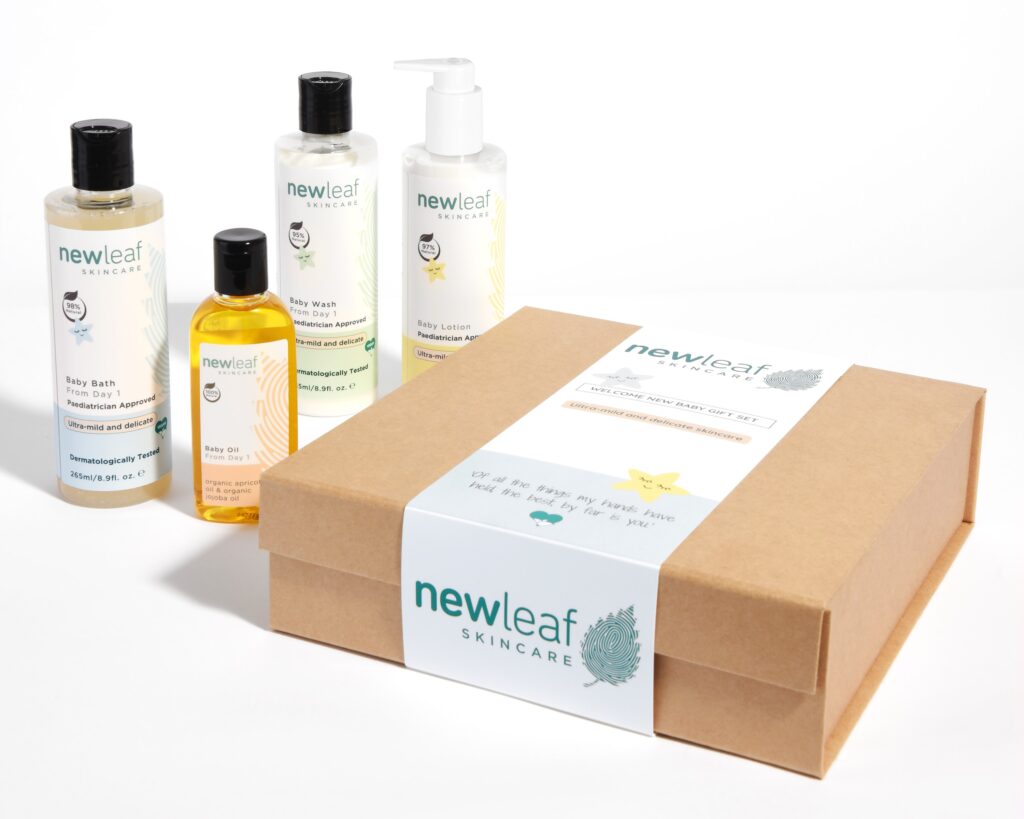
Essential Bathing Products: Discover why the New Leaf Essential Baby Gift Set approved by paediatricians and made with over 95% natural ingredients, is perfect for your baby’s delicate skin.
Gentle Washing Techniques: Find tips on how to gently cleanse your baby, to ensure their comfort and safety.
The Importance of Moisturising: How New Leaf’s Baby Lotion and Baby Oil can protect and nurture your baby’s skin, keeping it soft and hydrated.
Creating a Soothing Environment: We offer suggestions for a warm and calm bath time that will help your baby feel secure and loved.
After Bath Care: We’ll finish up with some advice on wrapping up bath time with soothing massages and a peaceful bedtime routine.
What newborn baby bathing products do I need for a newborn?
For a newborn, you’ll want to gather a few essential bath products designed specifically for their delicate skin. These should include:
Baby wash or Baby bath
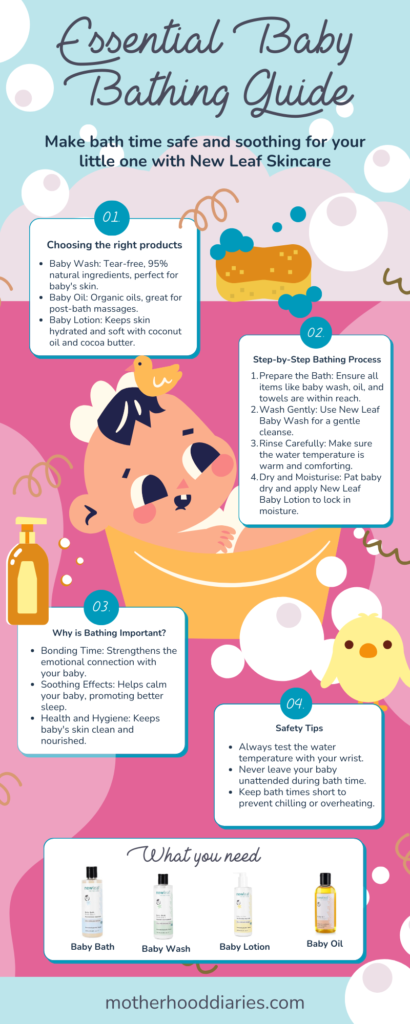
Look for a gentle, tear-free baby wash or baby bath like New Leaf’s Baby Wash or Baby Bath.that’s free from harsh chemicals and fragrances. It should be mild enough for daily use, even on newborn skin.
Baby shampoo
If your baby has hair, a mild, tear-free baby shampoo can help. Like the wash, it should be gentle and free from any irritants.
Soft washcloths
Soft, gentle washcloths are better for your newborn’s skin than sponges, which can be too abrasive.
Baby bathtub or support
A specially designed baby bathtub or support pad can help keep your newborn safe and comfortable during bath time.
Hooded baby towels
Soft, absorbent, and with a hood to keep your baby’s head warm, these towels are perfect for wrapping up your baby after their bath.
Baby Lotion, Oil or Moisturiser
After bathing, a gentle baby moisturiser can help keep your newborn’s skin soft and prevent dryness. Look for products specifically formulated for babies, free from dyes, perfumes, and parabens. New Leaf offers two exceptional products for this purpose: the Baby Oil and the Baby Lotion. The Baby Lotion, enriched with coconut oil and cocoa butter, provides deep moisturisation while ensuring the skin’s natural barrier is protected.
For a more intensive care option, the Baby Oil, crafted with organic oils from day one, is perfect for nurturing and soothing baby’s skin, making it an ideal choice for baby massage or for treating dry spots. Both products are formulated without harmful additives, ensuring your baby’s skin receives the gentlest care.
Bath thermometer
To ensure the water is at a safe temperature for your newborn, consider using a bath thermometer. The ideal water temperature is around 37°C (98.6°F). If you haven’t got a bath thermometer, then the best place to check the temperature is on the wrist or elbow. These areas are more sensitive to temperature changes than your hands and can give you a better sense of whether the water will be comfortable for your baby.
When choosing bath products for your newborn, prioritise items that are designed to be gentle and safe for their sensitive skin. Products like those found in the New Leaf Baby Gift Set are formulated with organic and natural ingredients, making them an excellent choice for newborns.
Newborn baby bath products to avoid
Avoid using regular soaps, bubble baths, or any products not formulated for babies, as these can be too harsh and strip the natural oils from your newborn’s skin. The New Leaf Essential Baby Gift Set, for example, includes baby bath products for newborns, so they are gentle enough while still keeping your baby clean and comfortable.
Why is bathing important for babies?
Bathing your baby isn’t just about keeping them clean; it’s a key part of their care that does so much more. It’s also a chance to bond with your little one, which is so important for their emotional growth. Plus, bath time is great for their brain development, thanks to all the new sensations they experience with water and the way you engage with them during bath playtime.
When it comes to taking care of your newborn, picking the right baby bath time products is a big deal. Babies have super sensitive skin that can easily react to harsh chemicals found in some products. That’s why we recommend going for organic options like the ones in the New Leaf essential Baby Gift Set. These products in the newborn baby bath set are made with gentle, natural ingredients that are safe for your baby’s skin, reducing the chance of any irritation or allergies.
It is generally advised that you allow your newborn’s skin to only come into contact with water for the first few weeks before you introduce external products, but New Leaf’s bath products for babies are suitable from birth.
For the first six weeks, particularly for dry areas, midwives recommend using oil. This is where New Leaf’s 100% natural Baby Oil comes into play, blending organic apricot and jojoba oils. Ideal for post-bath moisture retention or baby massages, it’s also a favourite among mothers for reducing stretch marks post-pregnancy. After three months, you can switch to the Baby Lotion, which features coconut oil, cocoa butter, and glycerine for deep hydration, safeguarding the skin’s delicate barrier and leaving it smooth and nurtured.
Should I bathe my newborn everyday?
You don’t have to bath your newborn every day, as they don’t get very dirty. In fact frequent bathing can actually dry out their delicate skin. But it is important to keep their face, neck, hands, and nappy area clean between baths, which can be done with a sponge bath or wipes. As your baby grows and becomes more active, then you can bath them more frequently. Always use gentle, baby-specific products that are kind to their sensitive skin, like those found in the New Leaf Essential Baby Gift Set.
What are the best baby bath products for bathing a newborn?
Choosing the right bathing products for babies is key to keeping their delicate skin protected and healthy. Look for gentle, hypoallergenic, and fragrance-free products designed specifically for babies. The New Leaf Essential Baby Gift Set offers organic options that are safe for your baby’s sensitive skin. This set includes the Baby Oil, Baby Lotion, Baby Wash, and Baby Bath, all formulated without harsh chemicals, so your baby can have a safe and soothing bath time.
The New Leaf Baby Wash is ideal for newborns’ delicate skin and hair. Crafted with shea butter and camellia seed oil, it locks in moisture and protects against dry skin conditions, ensuring your baby’s skin and hair are cleansed gently. This 95% natural formula is paediatrician approved and dermatologically tested, making it safe for use from the very first bath. Suitable for newborns 3kg and up, it’s a one-stop solution for hair, head, and body, offering peace of mind with each use.
Remember, the best bath products for baby are those that clean effectively while being gentle on your baby’s skin, to avoid any unnecessary irritation or dryness. The New Leaf Baby Bath is fragrance free with emollient-rich oat extract, while shea butter softens and moisturises.
Where do you bathe a newborn?
You can bathe your newborn in several safe and comfortable places, depending on what works best for you and your baby. A small baby bathtub (we used this one*) is a popular choice because it’s designed to support a newborn’s head and body. You can place the baby bathtub on a flat, stable surface like the counter, the floor, or even inside your own bathtub to make it easier to manage water and supplies.
You may prefer using a sink, especially in the early weeks. Just make sure the sink is clean and use a sink liner* or a soft towel at the bottom for extra comfort and to prevent slipping.
Wherever you choose to bathe your newborn, it’s advisable to keep everything you need within arm’s reach, and make sure the room is warm. Also, never leave your baby unattended, not even for a second. Comfort, safety, and being prepared are key to a safe and successful newborn bath time.
Preparing for newborn bath time
Before you start bathtime, set up your environment first, which should be a soothing and secure environment that promotes bonding and maximises baby’s comfort and safety. So, let’s explore how you can set the scene for a perfect bath time experience and what newborn bath time essentials you’ll need.
Set the scene
Start by creating a calming atmosphere for a stress-free bath time. Here are some tips on how to make bath time a serene experience:
Use dimmed lights or candles out of reach
Soft lighting helps soothe your baby, making the bath time experience more relaxing. Bright lights can be overstimulating for your little one’s sensitive eyes, so using dimmed lights or placing candles safely out of reach can create a soothing environment that mimics the warmth and comfort of the womb.
Put on light classical music or sleep meditation music in the background
The gentle flow of classical music or the soothing tones of sleep meditation music can have a calming effect on both you and your baby. Music stimulates babies’ brain development, soothes their emotions, and can make bath time feel like a peaceful retreat from the day’s excitement. It’s a simple way to enhance the sensory experience of bath time, making it more enjoyable for everyone involved.
Choose a time when the baby is awake and happy
Timing is everything. A well-rested baby who is alert and in a good mood is more likely to enjoy the bath. So, observing your baby’s daily patterns will help you choose a time when they are most receptive to new experiences.
Try not to bathe your baby straight after feeding or when they’re hungry/tired
Bathing your baby immediately after a meal can cause discomfort or fussiness due to their full stomach. Similarly, a hungry or overly tired baby may not enjoy bath time and become more difficult to soothe, as mentioned above. Wait for a while after feeding and make sure your baby isn’t hungry or too tired before you start the bathtime process.
Keep the room temperature nice and warm
Babies lose heat more quickly than adults, and a chilly room can make bath time an unwelcome shock. Keeping the room warm ensures your baby remains comfortable and prevents the cold air from causing distress. And a warm room will make the transition from bath to towel more gentle for your baby’s delicate body.
An ideal room temperature for bathing a baby should be around 75°F (24°C) to help create a cosy environment and minimise the risk of your baby feeling chilled.
Have all your bath essentials for baby within distance
Having everything you need within arm’s reach is crucial for a smooth and safe baby bath time. This includes New Leaf’s Baby Oil, Baby Lotion, Baby Wash, and Baby Bath. Additionally, prepare soft washcloths, a clean towel, a fresh nappy, and any other bathing accessories you might need. We’ll go through each of these in more detail in a moment but organising these items beforehand ensures you can always keep one hand on your baby at all times.
Please remember to keep all skincare products out of reach of infants at all times.
A soft towel or cushion to protect your knees
Your comfort is just as important as your baby’s. Using a soft towel or cushion to kneel on can reduce strain on your knees and back, making bath time more enjoyable for you as well. When you’re comfortable, you’re more likely to be patient, which in turn helps your baby stay relaxed.
Bathing your newborn step-by-step
Now for the actual bath experience!
For the initial months, your baby’s bath should be a gentle affair. Here’s what you’ll need:
A bowl of warm water maintained at a cosy temperature close to the baby’s body temperature, around 37°C (98.6°F).
Soft cotton towels for drying your baby after the bath.
Cotton wool balls for cleaning delicate areas gently.
A fresh nappy and a set of clean clothes.
A nappy bag for conveniently disposing of used cotton wool.
Topping and tailing is a great way to introduce bathing
If the idea of a full bath seems daunting initially, consider topping and tailing — a simpler method focusing on cleaning the baby’s face, neck, and nappy area. This method allows you to gradually get accustomed to handling your baby during bath time. The steps include:
Holding your baby on your knee or laying them on a changing mat.
Removing clothes, leaving the vest and nappy, and wrapping your baby in a towel.
Using damp cotton wool to clean the baby’s eyes, ears, face, and neck gently.
Changing the nappy and cleaning the baby’s bottom with fresh cotton wool and warm water.
When you’re ready to transition to the baby bath
Bathing your baby need not be a daily routine, but it’s such a great way to bond with your baby. Here’s how to bathe a newborn baby:
Make sure the bath water is warm, using your wrist or elbow to test the temperature.
Begin by cleaning your baby’s face, as done in topping and tailing.
Carefully wash your baby’s hair with plain water, supporting their head and neck.
Gently lower your baby into the bath, using one hand to support their head and shoulders.
With the other hand, gently splash water over your baby’s body, avoiding any direct pouring of water on the face.
When you’re finished, carefully lift your baby out of the bath, and pat them dry, focusing on getting the folds of the skin dry to prevent irritation.
When you’re ready, you can start to introduce bathing products to the bath routine
Bath time dos and don’ts
Do: Use just plain water for the baby’s skin in the initial weeks until your baby’s skin gets used to its environment.
Don’t: Leave your baby unattended during bath time.
Tip: If your baby isn’t enjoying bath time, try joining them in the bath to make them feel more secure.
Enhance bathtime fun with music and eventually bath toys
Enhancing bathtime with music and, as your baby grows, introducing bath toys, can turn a routine activity into a great learning and bonding experience. Soft music and singing to your baby can not only soothe them, but support emotional connection and language skills. As they get older, introducing toys designed to boost hand-eye coordination and visual tracking, such as floating toys or those in high-contrast colors like black, white, and red, adds fun and encourages developmental milestones. Light-up toys offer visual stimulation, making bath time both entertaining and educational.
Beyond bathtimes – what to do after the bath
What happens after bathtime isn’t just about getting dry; it’s a whole new chapter of care for your baby. In this part, we’ll share tips on feeding, burping, and how to make baby massage a soothing ritual. Plus, we’ll talk about the importance of regular nappy changes and setting up a cosy bedtime routine.
Creating a soothing bedtime routine
Creating a soothing bedtime routine is all about consistency and calmness. Start with a quiet activity, like reading a gentle story or playing soft music, to signal that it’s time to wind down. Make sure the sleeping environment is comfortable, with dim lights and a cosy temperature. Incorporating a predictable sequence of steps, such as a bath followed by massage and then feeding, helps your baby understand that sleep time is near. The key is regularity; doing the same activities in the same order every night can significantly improve your baby’s sleep patterns. Here are some things you can include in your routine before bedtime.
Grooming time
Grooming your baby after bath time is crucial for comfort and safety. It’s essential to take care of their nails to prevent them from scratching themselves accidentally, which means using special baby nail scissors or a fine emery board designed for their delicate nails. Make sure you’re working in a well-lit area and hold your baby’s hand gently but firmly. You may find it easier to cut their nails when they are asleep.
The benefits of baby massage
Baby massage is a soothing practice that has several benefits, including promoting relaxation, aiding digestion, enhancing parent-baby bonding, improving sleep patterns, and stimulating neurological development. It’s also known for its role in strengthening the immune system, reducing crying, and easing muscle tension.
Starting around one month old, gently massage your baby with safe oils like New Leaf Baby Oil. Here’s a simple guide:
Choose a quiet, warm room and a comfortable surface.
Warm a small amount of baby oil in your hands.
Begin with gentle strokes on your baby’s feet, moving upwards towards the legs, tummy, chest, arms, and back.
Use soft, circular motions and avoid any sensitive areas.
Maintain eye contact and softly talk or sing to your baby, enhancing the bonding experience.
This calming routine can aid in your baby’s sensory development and sleep quality.
Nappy changing essentials
Regular nappy changes are essential to keep your baby’s skin healthy and prevent irritation and nappy rash. Using gentle wipes or water during changes helps clean the skin softly without causing dryness or discomfort. Setting up an organised changing station ensures everything you need—like nappies, wipes, and rash cream—is within reach. Creating a comfortable and well-equipped changing area can make nappy changes a smoother part of your daily bathtime routine.
Establish a feeding and burping routine
Establishing a feeding and burping routine after bathtime can help soothe and prepare your baby for a good night’s sleep. Create a comfortable space for feeding, by utilising supportive pillows and/or nursing chairs, so there’s no rush for you and baby. For burping, gently patting or rubbing your baby’s back in an upright position can help release trapped air and ease any discomfort. If you’re breastfeeding, you can find some great tips on how to do this here.
Final thoughts
As we conclude our guide on newborn care during bathtimes, it’s evident that the steps from bathing to establishing a soothing bedtime routine are crucial for your baby’s health and wellbeing. The New Leaf Essential Baby Gift Set offers a foundation of gentle and organic care for your baby, ensuring comfort and protection from the beginning.
It’s so important to embrace these nurturing moments with your baby, as they are fleeting. When you’re ready to get started, participate in our competition below for a chance to win the New Leaf Essential Baby Gift Set and arm yourself with the tools you need for a fantastic bathtime experience with your baby!
Baby bath essentials – Printable checklist
If you’re looking for more, I have a baby bath essentials list, which you can use when you’re preparing for bathtimes for your baby. You can either pin this baby bath supplies checklist or print it out and stick it on your bathroom wall.
FAQ
Choosing baby bath products
Can I use regular soap or body wash on my newborn or do I need to use specific baby products?
What products should a parent be using to bathe their newborn?
Which are the best products for babies? What products do newborn babies need?
Should I use soap or body wash for my 3-month-old baby?
Is it necessary to use baby products on babies or can we use regular body wash?
How do I choose baby wash for babies?
Which is the best baby lotion and baby soap for newborns?
What are some alternative bath care products for babies instead of Johnson & Johnson?
Are there any natural ways to bathe a baby without using chemical-filled shampoo and soaps?
What should I avoid in bath products for a baby?
What are the best types of baby shampoo and body wash for a newborn’s sensitive skin?
When choosing bath products for your newborn, it’s crucial to select items specifically formulated for their delicate skin. Regular soaps and body washes designed for adults may contain harsh chemicals and fragrances that could irritate a baby’s sensitive skin. Instead, opt for gentle, hypoallergenic baby bath care products free from harmful substances.
For newborns, consider using products that are mild and have been dermatologically tested for baby skin. Products like the New Leaf Baby Gift Set offer a range of organic skincare items, including baby wash, lotion, and oil, ensuring your baby’s skin is nurtured from day one without the risk of irritation.
When selecting a baby wash or shampoo, look for ones that are free from parabens, sulfates, and phthalates, and prioritise those with natural ingredients. The best bath products for babies are those that clean gently without stripping the skin of its natural oils. For babies over three months, you can start introducing products like a gentle shampoo if your baby has more hair, but always ensure they are suitable for sensitive skin.
For parents seeking alternatives to mainstream brands like Johnson & Johnson, organic and natural product lines, such as those offered by New Leaf, provide excellent options that focus on using ingredients that are safe and beneficial for baby’s skin. Many parents are turning towards natural ways to bathe their babies, using products with organic ingredients that offer a gentle cleanse without the use of harsh chemicals.
It’s advisable to avoid bath products that contain strong fragrances, dyes, and potential allergens. Instead, look for products with soothing ingredients like aloe vera, chamomile, and oatmeal, which are known for their gentle properties on sensitive skin.
In summary, choosing the right baby bath products involves looking for gentle, safe, and hypoallergenic options that cater to the unique needs of a newborn’s skin. Brands like New Leaf offer a range of products designed with these criteria in mind, providing parents with safe and nurturing choices for their baby’s bath time.
Specifics on soap and shampoo
How important is it to use soap for newborns?
Can I use soap for my newborn baby?
Is it safe to use regular baby shampoo and lotion when bathing a newborn?
Which soap is good for a one-month-old baby to bathe?
What’s the best bath products for newborns?
When can I use baby bath products on my newborn?
When bathing your newborn, using soap may not always be necessary, especially in the first few weeks. Newborns don’t get very dirty, so washing with warm water alone can often suffice for their face, hands, and nappy area. However, if you choose to use soap, opt for a very mild, fragrance-free soap formulated specifically for babies. Regular baby shampoo and lotion can be introduced, but it’s essential to ensure they are suitable for newborns, meaning they should be free from harsh chemicals and fragrances that could irritate their delicate skin.
For a one-month-old baby, a gentle, hypoallergenic baby soap or wash is ideal. Products that contain natural ingredients like aloe vera or chamomile can be soothing for a baby’s skin. The New Leaf Baby Gift Set offers excellent options for newborns, including baby wash and shampoo that are designed to be gentle on sensitive skin.
You can start using baby bath products on your newborn from the first bath, but it’s crucial to choose products designed for their delicate skin. In the early days, you may wish to limit the use of products and gradually introduce them as your baby gets older and their skin becomes more accustomed to bath time.
The best bath products for newborns are those that clean gently without drying out the skin or causing irritation. Look for organic, natural products that are specifically formulated for newborns, like those in the New Leaf Baby Gift Set, which are designed to nourish and protect while being gentle on your baby’s skin.
Baby bathing essentials
What are some baby bathing essentials?
What baby bath products do I need?
What do I need to bath my baby?
What’s your favourite baby bath product that makes bath time fun?
When preparing for baby bath time, there are several essentials you’ll need to ensure a safe, soothing, and enjoyable experience for both you and your baby. The basics include:
A baby bathtub or a bath support pad – A secure space designed for your baby makes bath time easier and safer. Consider features like non-slip surfaces and ergonomic designs that support your baby comfortably.
Gentle baby wash – A tear-free, hypoallergenic baby wash that’s formulated for sensitive skin is essential. It should clean without stripping natural oils from your baby’s skin.
Baby shampoo – Similar to baby wash, a mild baby shampoo that doesn’t irritate the eyes is crucial for keeping your baby’s hair clean and soft.
Soft washcloths – Use gentle washcloths to clean your baby’s body. Avoid rough materials that could irritate their sensitive skin.
Hooded baby towels – After bath time, wrap your baby in a soft, absorbent hooded towel to keep them warm and dry their skin gently.
Baby lotion or oil – Moisturising your baby’s skin after a bath can prevent dryness. Look for products specifically formulated for infants, such as those included in the New Leaf Baby Gift Set.
A bath thermometer – Ensuring the water temperature is just right (around 37°C or 98.6°F) is crucial for your baby’s comfort and safety.
Fun bath toys – As your baby grows, introducing safe, age-appropriate bath toys can make bath time an enjoyable experience, encouraging play and development.
Among these essentials, a favourite product that adds fun to bath time is bath toys designed for little hands. Toys that float, squirt water, or are easy to grip can turn bath time into an enjoyable playtime, making it an experience your baby looks forward to.
*This post is sponsored by New Leaf*
Red light therapy for hair loss after birth: does it work?
Losing hair can feel like losing a piece of your identity, especially after birth when you need to put your baby first. My thick, curly hair had always grown back except after my fourth, where clumps came out in my hands and there was no sign of regrowth. I was devastated! Maybe it’s down to my age, in which case, I’m scared my hair won’t ever grow back. It’s not just about vanity; it’s about how you see yourself and, in many ways, how you believe the world sees you. The psychological impact can be significant.
For those experiencing postpartum hair loss, this feeling is all too familiar. You’ve just brought a new life into the world, and as you navigate this beautiful yet challenging journey, you’re also dealing with changes to your own body, including your hair.
Enter red light therapy for hair loss – a glimmer of hope for us postpartum mums, as it’s non-invasive, and there’s science to back up its claims. The CurrentBody Skin LED Hair Growth Helmet* is a prime example of this technology in action. As someone who’s walked the path of trying to reclaim not just the fullness of my hair but also a piece of myself, I’ve decided to share my personal experience with this device. From the anticipation of unboxing to the day-to-day routine of wearing the helmet, I’ll take you through every step of my journey.
But first, let’s dig a little deeper into what causes hair loss, with a special focus on the postpartum hair-shedding rollercoaster. We’ll explore why red light therapy, particularly through devices like the CurrentBody Skin LED Hair Growth Helmet* is worth considering. Along the way, I’ll unpack the science behind red light therapy, how it compares to laser treatments, and its specific role in tackling postnatal hair loss.
Understanding hair loss
Losing hair can hit harder than just seeing more strands in your brush. So, understanding why hair falls out, how it affects us, and what we can do about it is the first step in dealing with it. Maybe your hair’s getting thinner all over, you’re spotting some bare patches, or it’s just coming out easier than before. By looking into how hair normally grows and what throws it off track, along with all the ways to tackle the issue, from doctor-recommended treatments to simple tweaks in how we live, we start to peel back the layers of this tricky problem. Let’s dive in and find some light at the end of the tunnel.
What causes hair loss?
You may start to lose hair due to genetics, hormones going haywire, not getting the right nutrients, too much stress, or even some kinds of medical treatments. Sometimes hair loss is just for a little while; other times, it might stick around, depending on what’s causing it.
One of the most common reasons people lose their hair is something called androgenetic alopecia. It’s mostly about your genes and it can affect anyone, but men usually have it more visibly. Other issues like thyroid problems, autoimmune conditions like alopecia areata, and even how you live your life – like what you eat and how much stress you’re under – also have a big impact.
Losing hair after having a baby, is actually pretty common. After the baby arrives, the big drop in pregnancy hormones can make a lot of hair start to fall out. It sounds scary, but most of the time, it gets better on its own in a few months.
When does postpartum hair loss start and stop?
Losing hair after having a baby, otherwise known as postpartum telogen effluvium, is something new parents go through. It’s all because of the big hormone changes that happen after you give birth. While you’re pregnant, you’ve got more oestrogen floating around, which makes your hair grow more and not fall out as much, giving you that great pregnancy hair. But after the baby comes, those hormone levels drop, and suddenly a lot of hair starts to shed.
So, when does this all start? Usually, about three to four months after you have your baby. It might be a bit different for everyone, but essentially your body is trying get back to how it was before you were pregnant.
And when does it stop? Don’t worry, this isn’t forever. Most of the time, your hair will get back to how it was by the time your baby’s blowing out their first birthday candle. You should see things getting back to normal anywhere from six to twelve months after you start noticing the loss.
It’s really important to remember that this kind of hair loss is totally normal and just part of the process. But, if you’re still seeing a lot of hair falling out after a year or it seems like too much, it might be a good idea to talk to a doctor or a skin specialist just to make sure everything’s okay. Eating well, being kind to your hair, and maybe some supplements can all help your hair get back to its pre-baby state.
How to treat postpartum hair loss?
Tackling hair loss after having a baby is all about taking care of yourself in different ways, as mentioned above, from what you eat to how you treat your hair and even managing stress. Plus, some specific treatments can help, like red light therapy. Let’s break down what you can do:
Eating right
If you’re dealing with hair thinning, make sure you’re eating a balanced diet. Getting enough iron, zinc, vitamin D, and those B vitamins is important for keeping your hair healthy. If you’re not sure you’re getting all the nutrients you need from your meals, talking to your doctor about supplements might be a good move, especially if you have certain foods you can’t eat.
Be kind to your hair
When it comes to looking after your hair, the gentler, the better. Try to steer clear of tight hairstyles that pull on your hair, harsh chemicals, and use a lot of heat to style your hair. A shampoo that adds volume and a conditioner that’s moisturising can make your hair look thicker and keep your scalp happy. Use a decent hairdryer like the mdlondon BLOW hairdryer that has a cool setting, so the direct heat doesn’t damage the hair.
Keep stress in check
Stress can actually make hair loss worse, so finding ways to relax and stay calm is really important. Things like yoga, meditation, or just getting in some regular exercise can help keep stress levels down.
Watch your hormones
After having a baby, it’s normal for your hormones to be all over the place, but they usually settle down on their own. If you’re worried your hormones are still out of whack and it’s affecting your hair, it might be worth chatting with your doctor to see what’s going on.
Medical treatments
Sometimes your doctor might suggest trying topical treatments like minoxidil, also known as Rogaine. It’s important to chat about whether these treatments are safe, particularly for parents who are breastfeeding.
Consulting with a specialist
If you’re losing a lot of hair after your baby arrives and it’s not getting better, it might be time to see a dermatologist. They can take a closer look at what’s going on and recommend the best way to tackle it. This might include checking whether red light therapy is a good fit for you. We will focus on red light therapy in this article.
What is red light therapy for hair?
Red light therapy is a spotlight solution for hair loss that’s been creating quite the buzz. This innovative approach involves a device that emits a soothing red light, aimed at revitalising your scalp right down to the follicles, by boosting blood flow and cranking up energy production.
How does it work?
The magic of red light therapy lies in its ability to nudge dormant hair follicles back into action, propelling them from the lazy days of their resting phase into the bustling growth phase. This not only encourages new hair growth but can also enhance the health and vitality of your scalp.
Recommended by healthcare professionals, these at-home devices are user-friendly, requiring just a few minutes of your time, a couple of times a week.
Is red light therapy a good choice?
There are quite a lot of studies out there suggesting red light therapy can help with growing hair back, and the best part is it doesn’t come with scary side effects. But, just like anything else, what works for one person might not work for another. Listening to what healthcare pros suggest and following how you’re supposed to use these gadgets is pretty much the golden rule here.
Let’s dive a little deeper
The cool thing about red light therapy is that it goes straight to the source – your hair follicles. By boosting blood flow and kicking metabolism into higher gear right at the scalp, it gets the growth of new hair going. It also increases ATP, that all-important cell energy, encouraging more hair to sprout. Plus, if you’ve got inflammation on the scalp, this therapy can help calm things down, creating a better environment for hair to grow and stick around longer in the growth phase.
Who should give it a try?
If you’re struggling with pattern hair loss, noticing your hair isn’t as thick as it used to be, or you’re a new mum dealing with hair falling out after birth, then red light therapy could be a good choice.
What’s the difference between laser therapy and red light therapy?
A lot of people think red light therapy is laser therapy, but actually the two are quite different. Let’s break down the difference between red light therapy and laser therapy.
Red light therapy
Red light therapy uses red LED lights that shine at certain wavelengths, usually between 630nm and 700nm.
The devices for red light therapy have a wide beam that covers a bigger area but with a softer touch than lasers.
It’s great for surface-level stuff because the light only goes a few millimetres deep into the skin, making it perfect for improving skin health, speeding up wound healing, and helping your hair grow.
Low-Level Laser Therapy (LLLT)
LLLT includes red light therapy but also brings low-level lasers into the mix. They use gentle lasers or LED light to wake up the cells in your hair follicles.
While LLLT often gets talked about in the same breath as red light therapy for hair growth, it’s actually a bigger umbrella that covers more types of light therapy.
Laser treatments
These treatments use lasers that are more focused and powerful, and they can zero in on specific tiny spots and go deeper into your body.
You’ll find lasers being used for medical situations, like surgeries, clearing up acne, and helping with deep tissue issues.
Because lasers are so intense, you’ll usually see a doctor or another healthcare pro if you’re getting a laser treatment done.
So, in a nutshell, red light therapy is like a soft, wide light blanket for surface-level issues, while laser therapy is more like a high-powered, precision light pen for deeper or more specific problems.
The CurrentBody Helmet and Red Light Therapy
The CurrentBody Skin LED Hair Growth Helmet* uses red light therapy to tackle hair loss head-on. It shines red light at the sweet spot of 640nm wavelength, which is just the right kind of light to wake up the hair follicles, boost blood flow, and get more oxygen and nutrients moving to your scalp. This specific wavelength is good at getting through to your scalp without being too intense. It has been proven to be the right wavelength (not too strong and not too gentle) to help your hair grow.
How does red light therapy help with postnatal hair loss?
Red light therapy can help address postnatal hair loss because it’s non-invasive, pain-free, and effective to support hair regrowth and scalp health.
Calming inflammation
If your scalp’s feeling a bit inflamed after childbirth, you’re not alone. This inflammation can make hair loss even worse. Red light therapy can help create a more fertile ground for your hair follicles to thrive and produce new hair.
Helping with hormone changes
While red light therapy doesn’t directly juggle your hormones back into place, it supports a healthier scalp. And a happy scalp means it can better handle whatever hormonal changes come its way, helping your hair grow back stronger.
Why it’s great for new parents
Red light therapy is a safe and hassle-free way to address hair loss. It’s gentle, non-invasive, and doesn’t come with nasty side effects, making it a perfect match for the postpartum period. Plus, using red light devices at home, like hair growth helmets, means you can treat your hair without adding another appointment to your already packed schedule.
The CurrentBody Skin LED Hair Growth Helmet experience
Diving into the world of red light therapy for hair loss, let’s talk about an industry game-changer: the CurrentBody Skin LED Hair Growth Helmet.* This neat gadget brings the power of red light therapy right into your living room, offering an easy and effective way to help with thinning postpartum hair.
You can use the CurrentBody Helmet in the comfort of your own home. This means you get all the fancy benefits of red light therapy without having to step foot outside, making it convenient for busy parents.
Cracking open the box of the CurrentBody Skin LED Hair Growth Helmet is like discovering something from another world. The box is like a gift package, opening from the centre. Once opened you’re greeted by the helmet itself, a pretty hefty piece of kit that smells like it just came straight from a lab. Inside, you’ll find everything you need to get started:
The CurrentBody Skin LED Hair Growth Helmet comes in a small/medium size (you can also get a larger size, but there’s a handy size guide included to make sure it fits you just right.)
A Protective Non-Charging Base where your helmet can rest when you’re not using it, keeping it safe and sound.
A USB Charging Cord to power up your helmet. Just a heads up, there’s no wall plug in the box, so you’ll need to have one handy.
The User Manual is your go-to for all the details on how to use the helmet properly. It’s packed with everything you need to know to get the most out of your new hair growth buddy.
How to use the CurrentBody Helmet
Getting started with the CurrentBody helmet is pretty easy and fits right into your daily routine. Here’s a quick guide to get you going:
Setting It Up: First things first, pop the helmet onto its protective base. Then, grab the USB cord it came with and plug it in to give it a full charge before you use it for the first time.
Before You Start: Make sure your hair’s clean and completely dry. This helps the LED light do its thing without anything getting in the way, like oils or moisture.
Turning It On: Now, put the helmet on your head and find the screen on the side. Hit the start button, and you’ll see a 10-minute timer pop up on the display, along with some cool red light starting to glow.
Killing Time: To make those 10 minutes fly by, you can connect your phone to the helmet using Bluetooth and listen to your favourite podcasts or tunes. Pretty neat, right?
While It’s Working: You’ll feel a slight warmth while the helmet’s on—it’s just the LED lights doing their job on your scalp. It’s made to be comfy, so just relax and enjoy the warmth.
Wrapping Up: When the helmet beeps after 10 minutes, that means it’s done. It’ll turn itself off, so you just take it off, put it back on its resting port, and go about your day. Easy peasy!
First impressions and setup
The initial unboxing and setup process is impressively user-friendly. The futuristic design of the helmet, coupled with its clinical smell, immediately sets it apart as a sophisticated piece of technology. Setting up the device is intuitive, thanks in part to the clear instructions provided in the user manual. The ability to connect to Bluetooth for entertainment during treatment is a thoughtful addition, enhancing the overall user experience.
How often should you use the CurrentBody Helmet for red light therapy?
It really depends on what kind of red light therapy device you’ve got, how serious your hair loss is, and how your body reacts to the treatment. You can use the CurrentBody Helmet for just ten minutes a day and experts say you should see visible results in four months. But don’t worry, there’s a general game plan you can follow to get the most out of red light therapy for growing your hair:
Starting Out: Most of the time, if you’re using a red light therapy device meant to help your hair grow back, you’ll want to use it around 3 to 4 times a week when you first start. This helps wake up your hair follicles without overdoing it.
How Long for Each Session?: Expect to spend about 10 to 30 minutes per session, based on what CurrentBody recommend. It’s important to stick to their advice to keep things safe and effective.
Keeping It Going: After you’ve been at it for at least three months—and you start noticing some good changes, you might dial it back to just once or twice a week to keep those gains without needing to do as much.
But wait, there’s more:
Follow the Manual: Each red light therapy device can be a bit different, so make sure you’re doing what the manual says. The company that made your device should tell you how often and how long to use it, based on the kind of light it uses and how it works.
How Much Hair You’re Losing: If you’re losing a lot of hair, you might need to use red light therapy more often at first.
Your Personal Results: Everyone’s different. You might need to use it more or less often, depending on how your hair responds.
Mixing Treatments: If you’re using red light therapy with other hair loss treatments, the number of red light therapy sessions you do might change based on what else you’re doing.
Keeping it safe and effective
Red light therapy is usually pretty easy on you, but don’t go overboard to avoid irritating your scalp.
Stick with it regularly, according to the schedule. It’s better than trying to cram all your sessions into a shorter time frame.
Talk to a professional
Before you jump in with red light therapy, chat with a dermatologist or a hair loss expert, so they can give you advice tailored just for you, making sure red light therapy is a good fit.
While the typical advice is to aim for 3 to 4 therapy sessions a week for hair loss, remember to check out your device’s instructions and maybe get some professional guidance to figure out the best plan for you. With the CurrentBody Helmet, you can use it for ten minutes daily.
What can you start to see results with the CurrentBody helmet?
Here’s what your journey might look like:
First few weeks (0 to 4 weeks)
At the start, the LED light in the helmet gets busy boosting blood flow to your scalp, waking up hair follicles that weren’t doing much. It’s also putting the brakes on DHT, a hormone that’s no friend to your hair. You might not see changes right away, but it’s laying down the groundwork for new hair to grow.
The middle stage (4 to 8 weeks)
Now, things get exciting. That improved blood flow starts to rejuvenate sleepy follicles, and your scalp begins to feel like a more hair-friendly place. Those follicles are ready to switch from chill mode to grow mode.
Seeing changes (8 to 16 weeks)
This is when the magic happens. From about two months in, you’ll start noticing new hair. Studies show that by week 16, you could see a 33% boost in the number of hair follicles. Keeping up with the treatment is key to getting and keeping those gains.
How does the CurrentBody Helmet stack up against other treatments?
Against Finasteride – The helmet can ramp up hair growth by 126% in 16 weeks. Finasteride, a hair loss drug, doesn’t match up to this without continuous use.
Compared to laser treatments – It’s also been found to be way more effective than some laser treatments, outperforming them by 126%.
Versus Minoxidil – Against the topical solution Minoxidil, the helmet brings 62% more new hairs, minus the daily hassle and potential skin issues.
So, if you’re eyeing the CurrentBody helmet as your choice against hair loss, it looks like it could be a pretty solid option.
Personal and customer reviews of initial experiences
With 34 reviews averaging 4.5 out of 5, people really like the CurrentBody Helmet for its solid build and how easy it is to use. While the scores on seeing results dip a bit, it’s key to stick with it for about four to six months to start seeing your hair come back. Christine K. from Canada was hoping for quicker results in just three months. The team at CurrentBody, with Zubda leading the charge on beauty tech advice, stresses sticking it out for about six months to really see the difference.
People like JCS and Liz O. are happy about how well red light therapy works and how top-notch the helmet feels. Hadas from Israel and Nils P. from the Netherlands have seen their hair get thicker and healthier. Though Hadas did point out that it can snag your hair, tossing your hair into braids seems to fix that right up.
On the expert front, Craig Ziering, a big name in hair restoration, promotes using red light therapy to get those hair follicles moving and bumping up hair density without the downside of harsh side effects. Celestine Gitau also favours using red light therapy alongside good eating, keeping stress in check, and taking care of your scalp to tackle hair loss.
CurrentBody helmet results: before and after
Lots of people who’ve stuck with using the CurrentBody Skin LED Hair Growth Helmet* have seen some real changes. Their hair feels thicker and denser, and their scalp seems healthier too. Everyone’s experience is a bit different, but the before and after pictures people share usually show a pretty big decrease in how much their hair is thinning. Most agree that if you keep up with it regularly, just like the manual suggests, you’re more likely to see good results.
My before and after
As I’m only on Week 1 of using the CurrentBody Skin LED Hair Growth Helmet* I can’t show you any actual results yet. But watch this space as I will be updating my journey here and via social media too. I’m very hopeful!
Where can I buy the CurrentBody Skin LED Hair Growth Helmet?
Lots of research out there is giving a thumbs up to red light therapy for dealing with hair loss, with a whopping 128% boost in how fast hair grows back, meaning people are seeing thicker, stronger hair after sticking with red light therapy for a while. And compared to options like minoxidil or finasteride, which might irritate your scalp or lead to other side effects, red light therapy is pretty chill with hardly any downsides reported.
Pros
No Surgery Required: Red light therapy doesn’t involve any cutting or poking, making it a gentle choice for many.
Easy on You: Side effects are pretty rare, especially if you’re comparing it to drugs for hair loss.
Do It at Home: You can get your red light therapy session in without having to step out, thanks to gadgets you can use in your living room.
Happy Scalp: It’s not just about more hair; red light therapy can make your scalp healthier, cutting down on problems like inflammation.
Cons
Time: You’ve got to commit to using it regularly over a long stretch to see results, which might not be everyone’s cup of tea.
Costs Upfront: Getting your own red light therapy setup at home can be a bit pricey at the start, though it could save you money down the road compared to other treatments.
Mixed Results: How well it works can really depend on the person. Some might see big changes, while others might only notice a little difference.
Beyond the Helmet: Are there any hair loss treatment alternatives to red light therapy?
Stepping out from under the CurrentBody Helmet, let’s look at other options to tackle hair loss if red light therapy isn’t your go-to.
Medications
Minoxidil (Rogaine): You can grab this topical treatment you massage into your scalp at your local pharmacy. It’s got a thumbs up for both men and women, but you’ve got to keep at it without a break to keep the gains.
Finasteride (Propecia): More of a behind-the-counter pick, this pill slows down hair loss and might even invite new growth. This is aimed at men, though, and it’s not without its set of potential side effects, especially in the bedroom department.
Medications bring results, no doubt, but they’re not free of side effects. Red light therapy, on the other hand, keeps things gentle and non-invasive.
Platelet-rich plasma (PRP) therapy
You utilise your own blood, which is processed to concentrate platelets, so PRP therapy injects it into the scalp. This method aims to stimulate hair growth by enhancing tissue repair and cellular functions.
PRP therapy requires clinical visits and is more invasive, potentially accompanied by discomfort and higher costs. Red light therapy, alternatively, offers a non-invasive, pain-free treatment option that can be conveniently administered at home, though PRP may provide faster results for some people.
Hair transplant surgery
Hair transplant procedures, such as Follicular Unit Extraction (FUE) and Follicular Unit Transplantation (FUT), offer permanent hair loss solutions by redistributing hair from denser to sparser areas.
While hair transplant surgery delivers immediate and targeted results, it involves significant financial investment, recovery time, and surgical risks. Red light therapy is a gentle alternative or a complementary treatment to support healing and enhance hair growth without the need for surgical intervention.
Microneedling
Microneedling for hair loss involves a process where very fine needles create tiny punctures on the scalp. This action is meant to kickstart the skin’s healing process, potentially encouraging hair growth. It’s often used alongside other treatments to help them penetrate deeper and work more effectively. You can use the CurrentBody Helmet device in conjunction with microneedling if you wanted to.
Compared to the simplicity of red light therapy, microneedling is more direct, with a bit of discomfort due to its invasive nature. While it can be effective, especially when combined with other hair loss treatments, red light therapy offers a gentler, non-invasive alternative that’s easy to use regularly at home.
Both approaches have their place in the array of hair loss treatments available, from the straightforward application of medications to advanced techniques like red light therapy. Each method offers different benefits, and the best choice can depend on your individual needs, preferences, and the specific condition being treated.
Final thoughts, recommendations, and guidance
The CurrentBody Skin LED Hair Growth Helmet is a pretty cool tool in the fight against hair loss, mixing smart tech with everyday hair care. It’s got a thumbs-up from both science and real users, making it a solid pick for handling hair loss right at home. This helmet is all about using light in a gentle way to help out thinning hair without any fuss. If you’re thinking about giving it a try, here’s what you might want to keep in mind:
Do Your Homework: Take a closer look at how red light therapy works and why it might be good for your hair. Look for solid research and trials to back up what the helmet promises. Places like PubMed or NIH are great for finding trustworthy studies.
Check What You Need: Think about how much hair you’re losing and if this kind of therapy fits your situation. Sometimes, other conditions might need a different approach.
Weigh the Costs: Consider what you’re spending upfront against what you’ll save by not having to keep buying treatments or going for more drastic measures.
Listen to Others: Check out what people who’ve been in your shoes have to say about their experience with the helmet.
Look for FDA Approval: Especially in the U.S., knowing the device is FDA-cleared can give you a bit more peace of mind about its safety and effect.
Check the Warranty: Make sure you know what kind of support and warranty comes with it, so you’re covered if anything goes sideways.
Be Patient: Remember, good things take time. Consistent use is key to seeing a real change, so stick with it as recommended.
Track Your Journey: Taking before and after photos can be a great way to really see the difference over time.
Keeping these points in mind, the CurrentBody helmet seems like a pretty smart pick for those looking to tackle hair loss head-on. It offers you a non-scary way to help your hair out, backed by science and good reviews from users. Just like with anything big in healthcare, chatting with a pro and thinking it through can help you decide if it’s the right move for you.
FAQs
Is red light therapy for hair loss safe?
Absolutely, red light therapy is generally considered safe for hair loss. It’s non-invasive and doesn’t come with the scary side effects some treatments might have. Just make sure to follow the guidelines for your device to keep things smooth.
Can red light therapy make hair loss worse?
There’s no evidence to suggest that red light therapy worsens hair loss. In fact, it’s known for its benefits in stimulating hair growth and improving scalp health. If you’re concerned, chat with a healthcare professional.
Is red light therapy for hair painful?
Not at all. red light therapy is a gentle, pain-free treatment, so if you’re not a fan of the ‘ouch’ that comes with some other treatments, red light therapy could be up your alley.
Can red light therapy reverse grey hair?
Red light therapy is more about encouraging hair growth and improving the health of your scalp and hair. There’s not much out there to say it can bring back your original colour if you’re going grey.
I’m thinking of buying a red light lamp for my fiancé who has back pain and hair loss – would any red lamp work?
It’s best to look for a device specifically designed for the issues you’re tackling. Red light therapy devices for hair loss and back pain might have different specifications, like wavelength, so picking one that’s meant for hair loss is your best bet for seeing results.
Can an LED mask with red light also be used on the scalp for hair loss treatment?
Some LED masks are versatile enough to be used on different parts of the body, including the scalp. A normal LED mask will help a little as it does penetrate the skin at a cellular level. But it’s important to choose a device that has the correct wavelengths to reach the follicles, which is usually a different wavelength than the face LED masks. So the hair-focused helmet will work better, as it will reach the correct level. Just check the manufacturer’s recommendations to ensure it’s safe and effective for hair loss treatment.
Does light therapy stop hair loss, or is it just for regrowth? Can it replace Finasteride if you do it every day?
Red light therapy is known for both halting hair loss and encouraging regrowth by stimulating the follicles. As for replacing finasteride, it’s a bit of an apples and oranges situation. Red light therapy offers a non-drug, side-effect-free method, but whether it can replace finasteride for you depends on your specific situation and what your healthcare provider suggests.
Resources for further reading and understanding
Systematic reviews and meta-analyses
“Effects of Low-Level Laser Therapy on Male and Female Pattern Hair Loss“: A systematic review and meta-analysis in Lasers in Medical Science (2014) examining the efficacy of LLLT in treating pattern hair loss. The study concluded LLLT to be an effective and safe treatment, noting significant improvements in hair density and thickness.
Clinical trials
“Treatment of Androgenetic Alopecia with LLLT“: Published in the Journal of Cosmetic and Laser Therapy (2013), this study involved individuals with androgenetic alopecia treated with LLLT and reported significant improvement in hair count and density after 26 weeks.
“LLLT for Women with Androgenetic Alopecia“: A study in Lasers in Surgery and Medicine (2014) highlighted the positive effects of LLLT in increasing hair density in women, compared to placebo groups.
Comparative studies
“Comparing LLLT with Minoxidil“: Published in The American Journal of Clinical Dermatology (2014), this study found LLLT to be as effective as a 5% minoxidil solution in promoting hair growth in men with androgenetic alopecia.
*This post is sponsored by CurrentBody but all thoughts are 100% my own. Please note that links marked with a ‘*’ are affiliate links, which means I may earn a small commission when you click through at no extra cost to you.
Make money: Stay-at-home mum opportunities to earn now!
Working from home – it’s a phrase that’s become increasingly relevant in our connected world. As more people upskill via online courses and explore ways to get paid from home, the allure to earn extra income from the comfort of one’s own living space has never been stronger. Many are finding ways to earn extra cash and income, looking beyond traditional employment to the digital landscape’s opportunities.
In Britain, various surveys show that 90% of workers in the UK dislike the nine-to-five regime, opting instead for part-time jobs from home. Real work-from-home jobs allow you more control over your hours while avoiding the long commute, which can improve your work/life balance (if there is such a thing!). For those who want to make money stay at home mum opportunities are everywhere, it’s just about finding them because there are so many more ways to make money as a stay-at-home mum from when I started 14 years ago!
The online marketplace has exploded with options for those looking to make money from working at home. Platforms such as Etsy and Shopify have made it simpler than ever for stay-at-home mums to monetise their crafts or curate an online storefront, capitalising on the trend to make money from home.
As businesses increasingly explore remote work opportunities, don’t overlook the role of Artificial Intelligence (AI) in enhancing efficiency and productivity. AI technologies, such as machine learning and automation, are revolutionising various aspects of business operations. For example, companies are leveraging AI-powered Industrial Vision Systems to enhance quality control and streamline manufacturing processes. These advanced systems utilise machine vision technology to ensure high standards and improve operational efficiency. By integrating AI into their workflows, businesses can maintain competitive advantages and adapt to the evolving market demands.
If you’ve just had a baby, The Maternity and Parental Leave Regulations 1999 protects you when you require a career break to look after a newborn. But whether your priorities have changed or you want to take a different career path, It’s time to make money working from home.
In addition to exploring various avenues for earning from home, you shouldn’t overlook the financial perks directly associated with remote work setups. One notable aspect is the potential to claim money back for working from home. For those new to this concept, many governments offer tax relief or reimbursements for employees who work from home, covering expenses such as electricity, heating, and internet usage. This benefit aims to reduce the overhead costs of maintaining a productive workspace within your home.
It’s worth investigating your eligibility for such claims, as it can lead to substantial savings, further enhancing the financial viability of working from home. To make the most of this opportunity, be sure to keep records of relevant expenses and seek advice on how to properly file for these benefits according to your local tax laws.
So, let’s get started on our journey to working from home!
Make money stay at home mum opportunities on top of your main job
Having over one job to supplement your income is becoming increasingly popular in recent times, with one in five workers in the UK – especially within the millennial generation – considering a second or third job.
Over 16 million Brits in the UK use their side job to help cover the cost of living, either through earning per hour, per month or payment in kind (for example, being paid with Amazon gift cards) Either way ‘job loyalty’ appears to be ending as Brits strive to find their dream role to enhance job satisfaction. For most, having an extra income is a necessity with almost a quarter of people in the UK claiming they don’t earn enough monthly income because of inflation rising by three per cent in the last couple of years.
The hustle culture has infiltrated the modern workforce, and even those who primarily earn money working online from home are finding creative side gigs. These ventures range from freelance writing to managing social media accounts, presenting a plethora of opportunities for extra money working from home.
But it’s not always about money. Finding a supplemental job can also be a great way to get your foot into your preferred profession, either by opening doors to a reputable company or by helping you to become your boss.
You can use your secondary role to get into the creative or technical sector as these industries offer more freedom to showcase your skills to companies while enhancing your CV. Graphic designers, Ad creator specialists, website developers, and writers are prominent in the freelance world, with third-party sites like UpWork and Fiverr providing a great platform to gain work and reputation. You can also build your clientele to prepare for transitioning to a full-time business while staying flexible in your work schedule. And you can bid on jobs interesting to you, while not being committed to a particular style of work or client.
Have you done your research?
These days you can work in pretty much any industry, thanks to technological advances, online tools, and more flexible mentalities. However, it is not as straightforward as picking what you want and getting to work. For specific roles, there are legalities to follow to make your part-time business a success. For any source of regular income, you must get your taxes and insurance in order and your trading allowance – initially set up to help eBay sellers – can allow you to turnover up to £1,000 tax-free. Any extra funds earned will be taxable after this tax-free amount.
And don’t forget about insurance. Dog walkers, for example, must take out a dog walking insurance policy to protect themselves if the dog gets hurt on their watch. Childcare is another example of where insurance is a necessity and buying and selling goods, where it is not enough to think about the legal implications of selling the product. You should ensure that the place you store your merchandise is up to standard as well.
If you’re storing goods at home, make sure you have taken out the necessary insurance and made HMRC aware that your home is now a place of business. If you’re storing goods at a storage place, are your goods protected by a third-party venue? You can find storage places around the UK with built-in insurance and protection for your products. Some places, like Shurgard Self-Storage Gypsy Corner, even offer extras like a storage calculator and a virtual tour video where you can look inside the different storage units, so it’s worth researching your chosen sector before you embark upon your business opportunity.
Going into self-employment full-time
You may find that your side hustle is doing better than expected or you are unhappy in your primary job. Setting up a business can be financially draining at the beginning, with eight out of ten new companies ceasing to exist within 18 months. However, with the right idea and strategy, going full-time can be an excellent option for a lucrative work-at-home position. Some advantages are:
You can dictate your work/life balance
Working for yourself can help you control your work/life balance more effectively, including choosing your work hours or being able to delegate tasks to a capable colleague so you can spend more time with the family or work on other areas in the business. You can better prioritise your personal life, which will help you focus on work-related issues with a clearer mind as you divide your time to suit your unique work/life situation.
Pursuing a business idea about which you’re passionate will encourage a healthy mental attitude both in your personal and work life because it won’t feel like you’re doing work, which is a great place to be in life.
“I do consumer research projects, online focus groups and interviews, through companies like Usertribe, Respondent and Angelfish.”
You can choose a business that suits your lifestyle
If you travel a lot or you are stuck at home, then an online business can be easily managed from many locations or the comfort of your own home, as opposed to a business that would need you to attend to customers face-to-face. There would also be fewer start-up costs to think about as you wouldn’t have to fork out for a venue to host your business. Think about your daily routine and fit your business into your lifestyle.
You can earn money from doing something you love
There are lots of small business opportunities out there, but for you to decide to start a business in your field of interest, you must be prepared for this business to take up most of your time.
Make a list of what you’re passionate about and find a gap in the market where you can fulfil a need or a desire. Remember that you are competing with a saturated environment of entrepreneurs from all walks of life, so make sure you have a USP (Unique Selling Point), meaning that you need to offer a unique benefit that stands you out from your competitors.
If you have always wanted to start a cleaning company because there is a shortage of cleaners in your area, research what the current cleaners are doing and try to offer more flexible hours, cheaper rates, or a higher quality of service. Don’t be afraid to get out there and do your market research. If you always wanted to become a yoga teacher, find out whether there is space for your services and offer a more competitive price.
Hearing what your potential customers want from their opinions is an invaluable asset as a basis for what your business will become.
You can choose the people to work within your business
When you’re employed, you may not have a say in who your colleagues are, but when you own your business, you can choose your team and surround yourself with like-minded individuals that not only get you but your business too.
You can give something back to the community
You may enjoy being able to give back to your community by using charitable donations or even creating work for your local area. Nothing will motivate you more than the pride you feel when you can give something substantial back and feel you’re making a difference in this world.
You learn how to manage people
Owning your own business comes with a learning curve and being in this position forces you into a place where you learn to govern the actions of your employees should you have any. You may make mistakes along the way, but you will gain valuable experience.
Starting as a small business and slowly increasing will allow you to see how a company and its personnel operate through the growing stages and its transitions from each step.
“I’ve been teaching English online for the last three years. Always paid in USD which is annoying but I get to spend lots of time with my three year old.”
Ways to make money from home – the best jobs for stay-at-home mums
Embracing the remote work trend, many people are discovering the freedom of earning money by working at home. This section unveils various innovative and practical ways to earn money working from home, opening doors to financial independence without stepping out the front door.
Whether it’s through remote employment, entrepreneurship, or passive income streams, we’ll delve into how stay-at-home parents and aspiring home-based professionals can transform every corner of their residence into a potential source of income.
Go back to studying
Learning a new skill by going back to school or university may send you on a different career path or help you become more qualified in a job where you already work. Either way, it is a chance to increase your income. With certain degrees, you can improve your earning power with your profession by increasing your qualifications, i.e. from a bachelor’s to a master’s to, ultimately, a doctorate. Not all jobs allow for this same progression, but you need to ensure that you are placing your money into your study, which will gain you more return on capital.
If going back to school isn’t a route you wish to take, then consider going back to college to grow your collection of certificates for your chosen field of work. Often, this may be less time-consuming, less expensive, and can help you to earn more money. Plus, you can do all of this online. Reed Courses offers a diverse range of online courses that cater to your career aspirations or personal growth. From digital marketing to project management, you can find a course that aligns with your goals. Explore Reed Courses now and take the first step towards your next big opportunity. Some of them are free!
“I ran a successful eBay business for many years, importing goods from China and selling to the UK.”
Investing in property can significantly increase your rental income and help secure your financial future. Some investors boost their income by using houses of multiple occupations (HMOs), which are rental properties occupied by three or more unrelated people forming one household. Typically, an HMO property will have a shared kitchen, living and bathroom facilities, and the tenant pays for each bedroom separately using different rents. You can find these types of features often through property investment specialists like RW Invest, and this avenue allows you, as an investor, to increase your rental yields and income.
It makes financial sense to live in an HMO. Therefore, young professionals and students are being drawn towards this living. Returns on HMOs across the UK have acted as rivals to traditional buy-to-let properties over the years, although both forms of investment stand as a lucrative cog in the property business.
Investing in property like HMOs is a solid move, but what if you’re not sitting on a pile of cash to get started? If you’re wondering how to make money from real estate with no money, then there are clever ways to get into the real estate game. Think about teaming up with someone who’s got the funds but not the time to manage property. Or, consider a lease option, where you rent a place with the option to buy it later. These ideas can open doors to the property market without needing a big stash of money upfront. Just do your homework and get the details right before diving in.
Taking the leap into real estate investment requires solid knowledge and preparation. Reed Courses offers tailored courses that cover everything from business planning to property management. Equip yourself with the necessary expertise by exploring what Reed has to offer.
“Dog walking, babysitting or minding, proofreadiaing, ghostwriting, market research, social media manager to name a few! And of course, blogging.”
“I’m an ex-journalist so do some freelance writing alongside my blog. I have no childcare so means I fit it in during nap time or late at night, but it keeps me sane amidst the chaos of looking after a four-year-old and two-year-old twins!
The writing industry is probably one of the most prominent part-time work-from-home jobs in the current market and offers excellent financial benefits for those who are good with words. Journalists and PR experts can work in this environment as well, thanks to technological advancements and even work through their maternity leave.
Blogging has exploded in the last twenty years, and if you can find a niche, you’re good at or passionate about, you can stand to make some serious cash from home. A lot of bloggers and small business owners earn passive income through affiliate marketing or creating digital products, so they can earn while they are sleeping or working on the more important parts of their business.
If you’re looking to dive into freelance writing or design, enhancing your skills with specialised courses from Reed can set you apart. if you have a passion for writing and graphic design, or even want to start your own blog but feel you lack the expertise, Reed’s “Level 2 Certificate in Understanding Coding“ or their courses on “Graphic Design“ could equip you with the foundational skills needed to kickstart your journey. These courses are designed with flexibility in mind, allowing stay-at-home mums to learn and grow without compromising their family time.
Whether you’re starting a blog or offering graphic design services, the right course can elevate your work and appeal to a broader client base. Find your next course on Reed here and start your journey to freelance success.
Graphic designers can work during maternity leave and offer their services to small businesses that can’t afford to hire full-time employees. Sign up to sites like Fiverr and UpWork and look for work that you can pick up to build your contact list. You can also write to businesses in your area of expertise and ask if they need help with graphic design for their business.
“Bookkeeping. I worked in accounts in a previous life and considered bookkeeping from home for local self-employed people.”
“I have friends who are brilliantly creative and make children’s clothes and teething necklaces which they sell online. Personally I’m not very talented in that arena, but I make a living blogging and writing content for business websites on a freelance basis. There are loads of websites like peopleperhour and you can use your blog as a portfolio to get you started.”
If you have a skill you can teach or add value by giving people an insight into your life then the best way to make money from home is to set up a blog. A blog is an opinion-based website about pretty much anything you want. Once established, you can earn money through affiliate sales (advertising products or services that are not your own) or sponsored posts, banner advertising, or selling your products.
The more income streams you have, the more successful you will become as a blogger. Some bloggers can earn £1,000s just through affiliate sales via platforms that offer incentives, such as earning a commission when they suggest people sign up to their website. It can become a lucrative job if you have the audience to back you up. I use a platform called Adtraction, which is a great place to get started with earning an affiliate income. You can sign up here to get started (I will earn a commission for suggesting you if you make a sale within your first three months, win-win! :-))
Do data entry
Data entry work is a practical choice for those seeking a straightforward way to earn from home. It appeals particularly to individuals looking for flexible hours with no advanced technical skills. The essence of data entry involves inputting information into databases, spreadsheets, or specific software, making accuracy and attention to detail crucial.
While the work might seem monotonous to some, it offers a reliable source of income, with opportunities available across various industries, including healthcare, finance, and retail. To get started, you need a computer, a reliable internet connection, and basic typing skills. Exploring reputable job boards and freelancing sites can lead you to legitimate data entry jobs, paving the way for a steady, work-from-home career path.
Become a virtual assistant
Becoming a virtual assistant offers a dynamic way to work from home, catering to those who excel in organisation and communication. Virtual assistants provide administrative support to businesses or entrepreneurs from afar, handling tasks like email management, scheduling, social media, and more. This role is perfect for adaptable individuals with a knack for multitasking and a proactive approach to solving problems.
As businesses increasingly move online, the demand for virtual assistants continues to grow, offering flexible hours and the opportunity to work with a diverse range of clients. To succeed, you’ll need strong digital skills, effective communication abilities, and a reliable internet connection. Starting as a virtual assistant can be as simple as setting up a profile on freelancing platforms or reaching out to your network to offer your services, making it a feasible entry point into the digital workspace.
Manage social media accounts
In the vibrant world of social media, where every like, share, and comment counts, managing social media accounts has emerged as a lucrative way to make money from the comfort of your home. This role is perfect for those who live and breathe hashtags and trends and are adept at navigating the ever-changing landscapes of platforms like Instagram, Twitter, and Facebook.
As a social media manager, you’ll have the opportunity to work with brands and individuals looking to enhance their online presence, engage with their audience, and drive their social media campaigns to success. It’s all about crafting compelling content, scheduling posts at just the right time, and analysing engagement to guide strategy adjustments. Whether you’re a creative thinker, a strategic planner, or a trendsetter at heart, managing social media accounts opens the door to a world of possibilities and allows you to turn your digital savviness into a rewarding career or side hustle.
Buying a franchise
Buying a franchise may sound like a lot of work, but it may be more beneficial than you think. If you have attended baby classes with your child in the past, then these classes tend to be franchised, and the great news is that you have the flexibility to run as many classes as you want while taking your little one to work with you too!
“I do a range of things and make a full-time living from home. These include blogging, website testing, completing surveys and studies online and I also used to have an online store selling fashion accessories!”
“I have a friend that makes money from ironing for other people. She finds it relaxing! If there’s something you enjoy doing that others don’t then there may be money to be made!”
You can turn a profit by making easy money working from home being as creative and hands-on as you like, especially with the buy-and-flip market. With a keen eye for bargains and trends, you can snag underpriced apparel and home goods from thrift stores, garage sales, or online marketplaces, then spruce them up for resale. It’s all about spotting the potential in a piece others might overlook.
Whether it’s revamping a vintage jacket or repurposing a rustic coffee table, you add value with a little investment of time and creativity. Then, it’s time to market your finds to eager buyers looking for that perfect, unique addition to their wardrobe or home. With each successful flip, you’re not just making a profit; you’re breathing new life into pre-loved items.
Print on demand
Print on Demand (POD) offers an exceptional route for stay-at-home mums and dads to delve into e-commerce with minimal risk. By creating custom designs that can be printed onto apparel, accessories, or home goods, you can generate extra money working from home. This online store model requires no upfront investment in inventory, making it a fantastic way to make money from home with no money. As you design and list your products online, every sale means earning money.
POD services handle the production and shipping, so you can focus on the creative side and marketing—perfect for those wondering how to make money online working from home. With each unique design sold, you’re essentially making your money make money, and it’s all doable without stepping away from your family duties. Whether you aim to make extra cash or build a steady source of income, POD is a scalable remote job that aligns well with the goal to make money as a stay-at-home mum or dad. Plus, it can be a side hustle idea for stay-at-home mums to complement other jobs, maximising ways to earn extra money while working full-time or managing household tasks.
Selling homemade items
Selling homemade items combines the joy of crafting with the thrill of entrepreneurship. Whether it’s hand-knitted scarves, bespoke jewellery, or even your secret recipe hot sauce, there’s a market out there for products made with love and care. Start by identifying your niche and what makes your creations stand out. Then, consider where to make and sell crafts; online marketplaces like Etsy are great for reaching a wide audience. High-quality photos and engaging product descriptions will help showcase your items. Remember, it’s not just about making sales but also about building relationships with your customers. Share your story and the passion behind your work to truly connect with your audience and turn your hobby into a flourishing business.
Open an in-home daycare
For those with a nurturing touch, in-home day care services provide a pathway to making money for stay-at-home mums. This not only offers a solution to your own childcare needs but also turns your home into a productive, income-generating space.
Starting an in-home daycare could be the perfect blend of passion and profession for those who love being around children. It’s a chance to create a warm, safe space right in your home where kids can learn, play, and grow. Before diving in, you’ll need to tick off a few boxes, like making sure your home is childproof and meets all the safety standards.
Plus, getting the right certifications and licenses is key to making it official. Once you’re all set, you can enjoy the flexibility of running your own business while making a real difference in the lives of children and offering peace of mind to their parents. It’s all about planning fun activities, serving nutritious meals, and giving lots of TLC.
Online customer service support
Many start-ups and established companies require people to connect with their customers and outsource this role to a third party. This way to earn money working at home means you can respond to incoming emails and support requests through online systems and especially social media in your own time or at an agreed schedule.
“I have a number of friends who are VAs (virtual assistant). They do everything from admin to social media scheduling and all from home. Meetings with clients can easily be done through an online conference call.”
There are lots of ways to make money as a stay-at-home mum or dad, like completing surveys for money, becoming a virtual assistant, data entry, or typing work from home, but the above tend to be popular roles to start your work-from-home journey quickly. Look on job boards and don’t be afraid to contact businesses directly to find out whether they accept home-based flexible jobs. You never know, you may encourage a business to open up a brand new remote position just for you!
“I’ve got a friend who marks exams every year. GCSEs. Hard work each year but a nice little earner I’ve been told!”
Pet sitting is the perfect gig for animal lovers looking to earn extra cash while doing something they enjoy. It’s more than just watching pets; it’s about providing a comfortable and safe environment while their owners are away. Whether it’s taking dogs for their daily walks, ensuring cats have their playtime, or simply giving pets the attention and care they need, pet sitting can be incredibly rewarding.
Start by spreading the word among friends, family, and neighbours, or sign up on reputable pet-sitting platforms. Remember, trust and reliability are key in this role, so always communicate openly with pet owners and treat their furry friends as if they were your own. Not only is pet sitting a way to make money, but it also offers the joy of furry companionship, making it a win-win situation.
Another way to make money you might want to consider is babysitting if you have the skills, but you may have to travel to other people’s houses which doesn’t make this a work-from-home situation. However, you can be more flexible with your hours and choose your job to when it suits you.
Rent your car or home
Renting out your car or home can turn your assets into a source of passive income, ideal for those looking to capitalise on resources they already own. With platforms like Airbnb for your home or Turo for your car, getting started is straightforward. For your home, consider renting it out when you’re away on holiday or if you have an extra room that’s rarely used. With your car, think about times it’s often parked unused.
Ensure your belongings are insured and you understand the terms and conditions of the rental platforms. Communicating clearly with renters and maintaining your property or vehicle will ensure a positive experience for both parties. This approach not only helps you make money but also maximises the utility of your possessions.
How to make money in the stock market with little money
Think the stock market is just for the big players with thick wallets? Not at all! Even with a modest budget, you can start investing. It’s like planting a seed and watching it grow over time. Start small with what you can afford—many apps and platforms let you buy fractional shares of bigger companies, so you don’t need the price of a full share to get started. The key is consistency; regularly adding a little to your investment pot can potentially grow into something significant. Remember, it’s not about striking it rich quick; it’s about building up your nest egg bit by bit.
The legalities – how to maximise success within your business
Whether you want to operate as a sole trader or as a limited company, you need to work out the legalities first before setting your business up to run. Below are some things to think about before you start trading.
Create a business plan first
Business plans are necessary to stay on track and help you realise your goals. So, make sure you have your ideas mapped out on paper and use a business plan roadmap to keep you focused on your targets ahead. Don’t be afraid to make changes as you go along, as the business industry is a fickle and ever-changing environment and if you can’t move with the times, you may get stuck with the old and the outdated.
Fail to plan, plan to fail.
Create an audience profile by finding out who would be using your business. Get specific, down to the hair colour so that you can draw up an actual image of a person in your head. Then cater your business for them every time.
Think about your brand identity
How do you want to be identified? Do you have a theme and unique brand colours? What will distinguish your business from other competitors? Have you picked a name? Make sure your business name is unique otherwise, you may be looking at a costly settlement taken out by existing businesses of the same name, which includes legal fees. To minimise the chances of someone else having the same name, launch an investigation. Use a search engine like Google to find similar names to your business idea. Then check using the following websites:
Once you have found your business name/logo, you should protect it by registering it as a trademark.
What is a trademark?
A trademark is any sign which is capable of distinguishing goods or services of one undertaking from those of others. A trademark can consist of letters, numbers, graphics, 3d shapes, sounds, and even smells.
Trademark registration
Investing in registering your business name and logo as a trademark could save your business money and avoid unnecessary costs. Also, you will be able to protect your name from someone else using it too.
The ® mark shows customers and competitors that your name has been trademark registered, which also tells people that you are serious about your business and its intellectual property.
Create your business cards and get out there
Business cards are a great way to get your business out there, especially when you’re out and about.
Include information like your address, phone number, email, and website, but also think about adding a logo, and a corporate message or motto to place a unique stamp on your business. Use the reverse side of the business card to offer something different, like perhaps a quote, image or a calendar for appointments. Your business card should reflect your USP and message, so the design is critical. Keep it relevant, catchy and straightforward.
If you don’t want to go through all that then you can even share e-business cards! Just design on Canva and share away.
Take hold of opportunities to network and find a way to soft-sell your business without sounding too sales-y – you never know when an opportunity might show itself.
How to make money on your money
Navigating the world of finance doesn’t have to be a maze. When it comes to the best way to make money on money, it’s all about making smart choices that work for you. Think of your money as your personal team of workers, where every dollar is an opportunity to earn more.
Whether it’s opening a high-yield savings account, diving into the world of investments, or even starting a side hustle, the aim is to put your money into opportunities that offer returns. It’s like a garden — with the right seeds sown into fruitful ventures, your money can bloom into a lush canopy of wealth. Remember, the goal is to work smarter, not harder, and let your money do the heavy lifting.
You are never too old to start a business
Starting a business can be daunting at any age, but it can be even more intimidating if you’re considering taking the plunge after a change of career, lifestyle or other unforeseen circumstances. As people are continuously facing the prospect of being forced out of their jobs or the market is not as favourable as it once was, more people are biting the bullet and becoming their boss.
But, that’s not to say you have more obstacles within your path than a budding 20-something-year-old entrepreneur that’s fresh off the back of university and ready to take on the world. Making money as a stay at home mum is better suited to the young-at-heart rather than a particular age group, and there are tons of profitable business ideas out there to get you started.
The older you start, the more experience you have in life. If you’re transitioning from a past job to a new business in the same industry, you may also have built up a good reputation and a contact list. Age should not be a barrier to make money online working from home– if you are mentally and physically fit, there should be nothing that stands in your way. The list below of small business owners who became highly successful after the age of 35 should be inspirational enough to start at any age – it’s better late than never!
Vera Wang – started her career as a designer at 40
Stan Lee – Created first comic title, “The Fantastic Four” just shy of his 39th birthday
Gary Heavin – Opened first “Curves” fitness centre when he was 40
Samuel L Jackson – Landed the award-winning role “Jungle Fever” at 43
Henry Ford – Created the revolutionary Model T car at 45
Momofuku Ando – Invented instant ramen at 48
Charles Darwin – Created “On the Origin of Species” at 50
Ray Kroc – bought McDonald’s and made it into a franchise at 52
Harland Sanders – Better known as Colonel Sanders, was 62 when he franchised Kentucky Fried Chicken – he sold it for $2 million 12 years later.
Jamie Spencer – Built a website teaching people to create a blog aged 35
Take a look at this guide to see how seniors are starting businesses and find out how you can make it happen today.
And if you need more tips for making money as a stay-at-home mum or dad, check out YourParkingSpace’s article on The Best Side Hustle and read business owners’ tried and tested tips on how to get started.
As we conclude our exploration of work-from-home strategies, remember that the avenues to make money as a stay at home mum or dad are as varied as they are viable. From monetising a blog to tapping into affiliate marketing, the potential to generate a respectable income from the confines of your abode is both real and rewarding. Don’t give up!
FAQ
Starting out and basic Strategies
Can I get paid for being a stay-at-home mum?
Can you get money as a stay-at-home mum?
How do I make money as a stay at home mum while looking after the kids?
How do stay at home mums make money?
How can a stay at home mum make money?
I’m a working mum and I’m still struggling. What are some quick and easy ways to make money?
For stay-at-home mums looking to earn, consider leveraging your existing skills and finding flexible work that can be done around your childcare responsibilities. Options range from remote jobs and freelancing to starting a small online business. Utilise platforms like Etsy for crafts, or look into remote customer service positions that can offer a steady income.
Online earning opportunities
How can a stay at home mum earn income online especially in West Africa?
As a stay home mum which online work can I do that I will get money every week?
How do I make money online as a stay at home mum or dad?
Should every stay at home mum learn how to make money online?
How can a stay at home mum make money on YouTube?
I’m 30 years old. Mother of 2 girl babies. How can I earn money by working from home?
The internet offers numerous avenues to earn, from blogging and affiliate marketing to online tutoring and freelance opportunities in writing, design, and virtual assistance. Websites like UpWork and Fiverr are great places to start for freelance work, while YouTube can be a platform for those looking to create content. Consider what skills you have that can be offered as services online or what knowledge you can share through a blog or YouTube channel. The best jobs for stay at home mums with no experience
Earning specific amounts
How can a stay-at-home mum make $2000 a month?
What can a sit at home mum do to earn $400 monthly?
Achieving specific income goals, such as making $2000 a month or $400 monthly, can be possible through a mix of freelancing, online sales, content creation, or part-time remote work. The key is diversifying your income streams and consistently looking for opportunities to grow your earnings through different channels.
Creative and freelance work
How could a stay at home mother earn extra money by working from her home computer?
How can I earn more money being a mother?
Mothers with a knack for creativity can find freelance work in writing, graphic design, and other digital services. Platforms like Fiverr, UpWork, and Freelancer.com can connect you with clients needing your skills. Blogging is another path where you can monetise your expertise or interests through affiliate marketing, sponsored content, or your own products and services.
Making money without a job
How can I make extra money while working full time?
How can I make money without working?
How can you make money without working?
How do I make money without working?
How do you make money without working?
For those aiming to make money outside of a traditional job, consider passive income streams such as investing in stocks or real estate, creating digital courses or ebooks, or earning through affiliate marketing on a blog or social media. These avenues require upfront effort but can yield returns over time without active work.
Income on a single income and passive earnings
How to be a stay-at-home mum on one income?
How do you make a passive income?
Living on a single income requires careful budgeting and financial planning. Generating passive income can supplement your household income, through investments, rental properties, dividend stocks, or creating content online that continues to earn over time.
Diversification is key to financial stability, prompting many to investigate how to make your money make money. This might mean investing in stocks, starting a blog, or even creating online courses that align with your professional expertise or personal passions.
Specific roles and opportunities
How to make money from home as a stay at home mum?
How can I make money from home as a mum?
How can stay at home mums and dads make money?
How much money does a foster parent make?
Specific roles such as online tutoring, virtual assistant work, customer service, and content creation are excellent ways for stay-at-home parents to earn. Each role has its own set of requirements and potential earnings, with some offering more flexibility and others requiring specific time commitments. Research and finding a niche that matches your skills and interests are crucial.
*This is a sponsored post which contains affiliate links*
10 easy dishes for family dinner party fun
Hosting a family dinner party evokes a mix of excitement and anxiety in even the most seasoned hosts. Bringing friends and family together for an evening of easy meals for large family gatherings is thrilling, yet the thought of preparing a menu without spending the entire day in the kitchen doesn’t sound so easy. The key to a memorable dinner party lies in finding that sweet spot—easy dishes for family dinner party entertainment that look and taste sophisticated but are deceptively simple to prepare. With this in mind, we’ve curated a collection of 10 easy dishes for family dinner party fun that will wow your guests without leaving you frazzled.
Charcuterie board
The charm of a charcuterie board lies in its simplicity and versatility, making it a perfect example of casual dinner party menu ideas. There’s no cooking involved, just the artful arrangement of cheeses, meats, nuts, fruits, and crackers on a large platter. This starter not only caters to a range of dietary preferences but also sparks conversation as guests explore the varied delicacies. To make your board stand out, include a mix of textures and flavours, such as creamy brie, sharp cheddar, salty prosciutto, sweet grapes, and crunchy almonds. The charcuterie board is an effortless way to set the tone for the evening, promising indulgence with every bite – perfect for easy cheap family dinner ideas!
Creamy shrimp risotto
Risotto has a reputation for being labour-intensive, so we formulated a simple shrimp risotto recipe your guests will love and keep coming back for more. The key to delicious, plump Arborio rice is the broth, creating that signature creamy texture. Toss in succulent shrimp for a protein-packed dish that feels indulgent yet is straightforward to prepare. This risotto acts as a versatile canvas, allowing you to adapt the recipe with vegetables or other proteins to suit your guests’ tastes, making it a simple but elegant dinner party menu item.
Caprese salad skewers
Transform the beloved Caprese salad into a finger-food delight with Caprese salad skewers. This no-cook appetiser threads cherry tomatoes, mozzarella balls, and fresh basil leaves onto skewers, offering a burst of flavour in each bite. Drizzle with balsamic reduction before serving to add a touch of sweetness and acidity that elevates the dish. These skewers are not only a breeze to prepare, but also add a touch of elegance to your appetiser lineup, allowing guests to mingle with no plates and forks, embodying the spirit of easy dishes for a family dinner party.
Garlic butter roasted chicken
Nothing says hearty elegance quite like a beautifully roasted chicken. This recipe which is also our comfort food at home, calls for slathering a whole chicken in a mixture of garlic, butter, and herbs, then roasting it to perfection. The result is a dish with crispy skin and tender, flavourful meat that practically falls off the bone. It’s a main course that requires minimal hands-on time, giving you the freedom to enjoy your guests’ company. Serve alongside roasted vegetables or a simple salad for a complete, crowd-pleasing meal – an easy meal for 10 people.
Vegetable Tian
A vegetable Tian is as visually impressive as it is delicious and a favourite among weeknight family meal ideas. By layering thinly sliced zucchini/courgette, tomatoes, potatoes, and onions in a dish, then sprinkling with cheese and baking, you create a side dish that’s brimming with flavour and nutrition. The presentation is stunning, with the colours and patterns of the vegetables taking centre stage. This dish not only complements a variety of mains with its subtle flavours but also adds a dash of sophistication to your dinner party spread, aligning with make-ahead dinner party main course recipes.
Quinoa salad with lemon vinaigrette
For a lighter side that’s packed with flavour, look no further than a quinoa salad dressed in a zesty lemon vinaigrette. This salad combines the nuttiness of quinoa with the freshness of your choice of vegetables—think bell peppers, cucumbers, and cherry tomatoes—and the brightness of a homemade lemon dressing. It’s a refreshing counterpoint to richer mains, and its versatility allows you to adjust the ingredients based on what’s in season or your guests’ preferences. Plus, it can be made in advance, leaving you more time to mingle.
Parmesan garlic knots
Imagine the aroma of freshly baked bread wafting through your home as guests arrive, setting the scene for an evening of warmth and camaraderie. Parmesan garlic knots offer this experience with little fuss, using either homemade or store-bought pizza dough twisted into knots, baked until golden, and then brushed with a garlic butter and Parmesan mixture. These delectable bread knots serve as the perfect accompaniment to a range of appetisers and mains, and their pull-apart nature makes them a fun, interactive addition to your table.
Baked salmon with honey mustard glaze
Salmon, with its rich flavour and health benefits, is cheap dinner party food that never fails to impress and one of our favourite dinner party recipes for stress-free entertaining. This baked salmon recipe, glazed with a mixture of honey and mustard, strikes the perfect balance between sweetness and tang, creating a main dish that’s both sophisticated and unpretentious. The simplicity of this preparation allows the natural flavours of the salmon to shine through, complemented by the glaze’s subtle complexity. Pair with a side of lightly steamed green beans or a crisp salad for a meal that’s elegant yet effortless.
Chocolate fondue
Dessert is often the course that guests look forward to the most, and a chocolate fondue provides a sweet finale that’s both delicious and interactive. Melted chocolate becomes a velvety pool for dipping an array of fruits, marshmallows, and cake pieces, inviting everyone to partake in the fun.
Lemon sorbet
After a meal of diverse flavours, a lemon sorbet offers a refreshing palate cleanser that prepares guests for the dessert course or serves as a light dessert option itself. Its bright, citrusy flavour cleanses the palate, while its icy texture provides a cool respite. Serving the sorbet in elegant glasses or natural lemon halves elevates the presentation, ensuring this simple dessert leaves a lasting impression.
The 10 easy dishes for family dinner party fun will be a feast to remember
Crafting a dinner party menu that delights yet remains easy to execute is an art form. The dishes highlighted here are designed to inspire hosts to embrace the joy of entertaining without the stress traditionally associated with preparing a multi-course meal. From the opening appetiser to the final dessert, each recipe is chosen for its ability to combine simplicity with elegance, ensuring your next dinner party is remembered for its delicious food and the relaxed, joyful atmosphere.
The best dinner parties are those where the hosts can enjoy their own event, mingling with guests and savouring the meal right alongside them. With these easy dinner party recipes, your next dinner party is guaranteed to be a stress-free success, leaving both you and your guests eagerly anticipating the next gathering.
FAQ
For small to large gatherings
What are some good meal ideas for a small dinner party for grownups who want to cook a meal at home that is not Mac and cheese or fish sticks?
What’s a good meal to cook for a small dinner party (5-6 people) as a relative beginner?
What is a quick and easy dinner recipe to use for a small party with 8 to 10 people?
What are some good main course dishes to make for a small party of 10-15 people?
What is a dish I can make for 20 family members at a get-together that they will remember and talk about for years?
What to cook for a large family gathering?
For dinner recipes that will feed a crowd, from intimate to large, consider easy big family dinner ideas that offer both ease and elegance, like the Creamy Shrimp Risotto or Garlic Butter Roasted Chicken. These dishes for entertaining can scale well depending on the size of your party and are sure to impress without requiring advanced culinary skills.
Budget and preparation
What are some cheap easy-to-make meals that can feed a large family?
What is the cheapest food to make for a party?
How do you feed 50 guests on a budget?
What would be a dinner party for someone on a budget?
Focusing on dishes that maximise flavour while minimising cost, such as Vegetable Tian and Quinoa Salad with Lemon Vinaigrette, can feed a large number of guests without a hefty price tag. Both can be prepared in large quantities and offer a nutritious, satisfying meal.
Dinner party planning – easy dinner party recipes for stress-free entertaining
What are some good ideas of dishes to bring to family gatherings? What are some good ideas of dishes that can be made ahead of time yet still taste delicious at any kind of event like this?
What food to take for a dinner party?
What are dinner party meals that can be prepared in advance?
For dishes that travel well and can be prepared ahead of time, Caprese Salad Skewers and Parmesan Garlic Knots are perfect. They are not only delicious but also easy to transport, making them ideal for bringing to gatherings or preparing in advance.
Unique and memorable meals
What can I cook for a very sophisticated dinner for 8 people? Meat will be a strong consideration.
What is an easy recipe to make for a large family dinner that tastes good and looks nice?
What is the simplest meal a non-cook can put together for a dinner party of four?
What’s a cheap but impressive meal to cook for dinner parties?
For a sophisticated yet straightforward meal, Baked Salmon with Honey Mustard Glaze stands out. It’s easy enough for a non-cook to prepare, looks stunning on the table, and won’t break the bank.
Everyday and special occasions
What is a good dish for an everyday dinner for a family in Germany easy to cook and not too expensive for students?
What are some quick and easy recipes for a busy weeknight dinner?
What are some ideas for unique family meals?
What do you tend to cook when you are having a dinner party?
What is your go-to recipe when inviting guests over for a dinner party?
What is a good recipe for a meal that can be cooked and sent to friends and family?
Quinoa Salad with Lemon Vinaigrette serves as a versatile dish that fits both a quick weeknight dinner and a unique dinner party recipe to share with friends and family. It’s also budget-friendly, making it ideal for students – perfect when thinking about dinner ideas for friends coming over.
Ideal Menus and Favorite Dishes
What would be your ideal menu for an elegant sit-down dinner party including dessert?
What is a popular dish to bring to a family reunion potluck?
What’s a quick meal to make for a 6-person dinner?
What is the best easy and quick recipe for dinner parties?
What are some fun meals to share with friends and family?
Imagine you’re hosting a dinner party for friends and family. What’s the one dish you’re known for that you’d proudly serve as the star of the meal?
What is a good one-dish meal to make for a group of people?
What are some cheap dinner ideas for six adults?
An ideal menu could start with Charcuterie Board, follow with Creamy Shrimp Risotto, and end with Chocolate Fondue for dessert. These dishes are versatile, suitable for various occasions, and can be adapted based on the size and preferences of the group.
*Collaborative feature post*
Packing, lifting and nesting: tips for moving while pregnant
Moving homes is a pivotal moment, especially when coupled with the anticipation of a new family member. As a mother of four, I have moved three times when pregnant and each time wasn’t easy – but it was doable! This guide aims to ease the journey for you and help make the transition to your new home a more comfortable one during pregnancy. Here are our tried and tested tips for safely moving while pregnant.
Plan to move at the right time
Moving when pregnant requires thoughtful timing, particularly to accommodate common pregnancy symptoms such as abdomen pain during pregnancy and aching back during pregnancy. During the first trimester, the aches and fatigue can be challenging, so it’s essential to plan your move when you have the most energy.
I’ve always moved during my third trimester and I found it really difficult because I was too heavy to help anyone and I was exhausted. However, many pregnant women have said moving during their first trimester was the most difficult because of the extreme fatigue and nausea they felt throughout. The second trimester is often the sweet spot for such a significant change because you’ll have more energy and mobility to take on the mammoth task of moving house.
While moving is often the last thing on your mind, the excitement of creating a new space for your growing family can be both invigorating and overwhelming. But, is moving harmful during pregnancy? It doesn’t have to be! Here are some tips on moving during each trimester:
Moving while pregnant – first trimester
It’s vital to avoid heavy lifting and minimise the risk of abdominal cramps during pregnancy. Prioritise rest and hydration to mitigate aches during pregnancy, and delegate tasks where you can. You can create a detailed checklist to ensure nothing is overlooked during this delicate time
Moving while pregnant – second trimester
Take advantage of the typically higher energy levels, but proceed with care to avoid abdominal tightness during pregnancy. Start by packing non-essential items early and book a trusted moving company to handle the logistics. (For those moving to Florida, go for a trusted Florida moving company like Solomon & Sons Relocation Services, known for their reliability and family-friendly services).
Moving while pregnant – third trimester
Your moving day plan should focus on comfort and safety to prevent ab pain during pregnancy. Finalise details with your movers and make sure they are aware of your condition. Considering preparing an “essentials” bag with items like maternity wear, avoiding any abnormal pain during pregnancy from last-minute rushes.
Create your moving timeline
Once you have a clearer picture of your ideal moving window, draft a detailed timeline that includes the following:
Research phase
Allocate time to research a reputable moving company that accommodates your pregnancy needs. This research should also extend to healthcare facilities in your new area to ensure a smooth transition of medical care.
Packing phase
Begin packing non-essential items early on, gradually moving to daily-use items as the moving date approaches. Consider tagging boxes with priority levels for unpacking, keeping in mind the items you’ll need immediately upon arrival, like maternity clothes, baby essentials, and important documents.
A good moving company can provide valuable services such as packing and unpacking, significantly reducing the burden on the family. Ensure the mover you choose has experience with family/pregnancy relocations and check their reviews from other families to gauge their suitability for your needs.
Moving week
Designate the week before the move to double-check arrangements with your moving company, confirm travel plans, and ensure your new home is ready for your arrival. It’s also a good time to assemble a small “essentials” bag that will stay with you, containing items you’ll need during the move and the first few days in your new home.
Post-move care
After the move, plan for a week of minimal activity to rest and acclimate to your new surroundings. Schedule a check-up in your new location to ensure continuity of prenatal care without interruption. We will talk more about the post-move part below.
Stay flexible
While having a plan is crucial, it’s equally important to remain flexible. Pregnancy is unpredictable, and circumstances may change. Keep communication lines open with your moving company to adjust plans if needed and emphasise the importance of choosing a service that offers flexibility and understanding of your unique situation.
Packing tips when you have a baby on board – how to move while pregnant –
Packing when pregnant, especially when you have other children, can be a daunting task, but with the right approach, it can also be an opportunity for everyone to be involved in the move. Start by making a detailed inventory of your belongings to keep track of what you have. Encourage family members to pack a personal box with their favourite toys, books, and comfort items, explaining that these will be with them in their new room. Emphasise safety when packing with children around, keeping hazardous materials out of reach and considering child-proofing essential items during the packing process.
Prioritise safety by breaking down tasks into manageable parts. Professional packing services and storage, offered by your chosen moving services, can significantly reduce the physical strain, allowing you to focus on your wellbeing and the excitement of anticipating your baby’s arrival.
Saying goodbye
It’s not just about moving to a new place, goodbyes are an essential part of the moving process, so you can experience closure from your old place. Organise a small farewell gathering with close friends and family to celebrate the memories made. If you have other children give them a chance to visit their favourite places one last time and encourage them to take photos or collect mementoes for a memory book. These activities can help you all process your feelings about the move and look forward to making new memories.
Setting up your new home
When you reach your new home, prioritise creating spaces that offer comfort and tranquillity. The nursery, your bedroom, and living areas should top the list, so you can foster a nurturing environment from the get-go. This setup phase is not just about unpacking boxes but laying the foundation for your family’s future memories.
Keeping a routine
Maintain a consistent routine if you have other children can significantly help them adapt to the changes that come with moving. Try to keep mealtimes, bedtimes, and other daily activities as regular as possible during the move. If your family had a game night every Friday or a special weekend breakfast tradition, continue those in your new home. Adjustments may be necessary, but the familiarity of routine provides a sense of stability.
Finding new schools/nurseries/childminding
The search for a new childcare if you need it, should begin well before the move, especially if the quality of education is a top priority for your family. Use online resources, reviews, and rankings to narrow down your options, and if possible, visit the places personally to get a feel for the environment and culture. Once you’ve made your choice, make sure all necessary enrollments are completed in advance to avoid any last-minute rush. If you need to, prepare your child for the transition by discussing what the new school might be like and emphasising the positives of making new friends and learning new things.
Exploring the new neighbourhood
Once you’ve settled into your new home, take the time to explore your new surroundings. This could mean taking walks, visiting local parks, finding the nearest library, or discovering a new favourite restaurant. Getting to know the neighbourhood not only helps everyone feel more at home but also provides opportunities to meet new people and begin integrating into the community. Consider joining local clubs, sports teams, or other activities that match your interests to further establish connections and roots in your new area.
Health care transition
A smooth healthcare transition is paramount when moving while pregnant. Research and establish connections with healthcare providers in your new area ahead of the move. This forward-thinking approach ensures you have immediate access to prenatal care in your new community and offers you peace of mind during this transitional period.
Listen to your body
Throughout the moving process, listen to your body’s cues. Embrace the support offered by your moving team, so you can maintain a focus on health and relaxation. This support system is not just logistical but also emotional, underscoring the importance of selecting a moving company attuned to the needs of expecting families. Stop what you’re doing when you experience the following and consider speaking with your healthcare provider if you’re concerned:
Lower abdominal pain when moving while pregnant
Pain when moving legs while pregnant
Sharp pains when moving while pregnant
Aching hips during pregnancy
Emotional support
Moving while pregnant can stir up a mix of feelings, from excitement to a bit of worry. It’s important to talk about what you’re going through with people close to you and start making connections in your new area. These steps create a strong circle of support that can really help during this big change.
Final thoughts
Moving while you’re expecting certainly comes with its challenges, yet with careful planning, a trustworthy mover, and a circle of support, it can turn into a delightful part of growing your family. Every move you make is a step forward into settling into a new home where you’ll bring your newest family member into the world.
FAQ
Is it bad to move while pregnant?
Moving isn’t inherently bad during pregnancy, but it does require extra care. It’s crucial to avoid heavy lifting and high-stress activities, which can put both you and your baby at risk. Always consult with your healthcare provider before making any significant decisions about moving during pregnancy.
Is moving furniture safe while pregnant?
Other questions asked were:
Is it safe to move furniture while pregnant?
Is it ok to move stuff while pregnant?
Should I move while pregnant?
It’s generally recommended to avoid moving furniture while pregnant, especially as your pregnancy progresses. Heavy lifting can strain your muscles and increase the risk of injury. If moving furniture is necessary, seek help and use proper lifting techniques to protect yourself.
I am moving while 8 months pregnant. Do you have any tips on how I can move comfortably without affecting the baby please?
At 8 months, it’s crucial to prioritize your comfort and safety. Avoid lifting heavy objects, stay hydrated, and take frequent breaks. Arrange for professional movers, if possible, and communicate your needs clearly to those helping you.
I have a high-risk pregnancy. Can I move while pregnant?
High-risk pregnancies require special consideration. Discuss your moving plans with your healthcare provider to understand the risks and get personalized advice. It might be recommended to postpone moving if it involves significant physical strain or stress.
Some religions have views about moving during pregnancy. What are these religious reasons for not shifting house during pregnancy?
Other questions asked were:
Is it bad to move around alot while pregnant?
Some beliefs hold that moving during certain stages of pregnancy could bring bad luck or negatively impact the mother and child’s wellbeing. The specifics can vary greatly across different cultures and religions. It’s essential to consult with community elders or religious leaders for guidance if this is a concern.
Can sudden movements cause miscarriage?
Sudden movements themselves are unlikely to cause miscarriage. Most miscarriages occur because of underlying issues, such as chromosomal abnormalities in the foetus. However, you should still be cautious with your activities. You should avoid sudden, jerky, or high-impact movements, especially if they strain the abdomen or could lead to falls or injury. It’s always best to discuss any concerns about physical activity with a healthcare provider, as they can offer personalised advice based on your pregnancy’s specifics and any potential risks.
I am moving states while pregnant. What do I need to know before I move?
When moving states, consider the timing of your move and its proximity to your due date, transferring your medical records, establishing care with a new healthcare provider, and understanding your new state’s maternity leave policies and health coverage options.
What positions should you avoid while pregnant?
Avoid positions that involve heavy lifting, bending over for prolonged periods, or lying flat on your back, especially after the first trimester. These can reduce blood flow to the baby and put unnecessary strain on your body.
*Collaborative feature post*
Working from home without childcare – the impact on families
Since the pandemic, the trend of parents working from home has skyrocketed. The COVID-19 era has completely transformed the workforce outlook, with employers increasingly adopting a ‘work from home’ policy and offering ‘flexitime” to cater to working parents.
However, this gradual and welcome change hasn’t come without its challenges.
With the current cost-of-living crisis in the UK, compounded by rising childcare costs, some parents, including myself, have fallen into a precarious balancing act of working from home without childcare.
While remote work offers some semblance of flexibility, some have had to do so while keeping their children at home – often in violation of workforce policies not designed to accommodate the working parent reality and rising childcare costs. This situation causes excess stress for parents and highlights a critical gap in supporting both employers and government policies.
In this article, we discuss what it’s really like to work from home without childcare, as well as what our kids think of our balancing act, why this is happening in developed countries like the UK, and how to manage both work and looking after kids if you find yourself in this position too. As the founder of Motherhood Diaries, I started my journey working without childcare back in 2010, so I’d like to start by explaining why I’m qualified to talk about this topic and how I can help working parents stay sane during these trying times.
My journey of working from home without childcare for over a decade
My journey started when I was pregnant with my first (A1) back in 2010 and had to make the life-changing decision of leaving my long-term employment carving out a career in law. By February of that year, I left with a settlement and no Plan B (because of several serious issues at work). By April, I found out I was pregnant and struggled to find work, as I wasn’t the most desirable candidate anymore. After various interviews and a temp job in Mayfair that lasted only until July, when I was almost five months pregnant, I had no choice but to find some work-from-home jobs.
What happened then was purely by chance. During my temp job, I suffered from terrible gas and morning sickness and the person next to me wouldn’t stop talking or asking questions about why I had to go to the loo all the time. I was miserable. At one particular lunch break, I brought in my first Bounty pack and inside was a small diary from Emma’s Diary. No one in my vicinity was pregnant, so this diary was all I had to refer to about pregnancy symptoms and what to expect.
I thought, what if I could do all this myself and look back on it later when my baby was older? I always loved writing, so why not try some writing therapy to boost my very low mental health? I Googled, ‘How to start an online diary’ and found WordPress (the rest of this story can be found here).
When my temp job ended, I continued this online diary, with only my best friend, mum and hubby viewing it. But I needed a job. We couldn’t live on one salary and I was about to have a baby with no maternity leave or allowance in sight. Plus, my settlement was being depleted due to our flat renovations. I Googled work-from-home jobs and found transcriptionist work. I applied to become a sole trader, set up a mini office, and typed away, earning a decent wage. I felt I had hit the jackpot and not one part of me wanted to go back to the 9 to 5.
My very first mini office in our new home back in 2010
Once I had the baby, I was working during naps, even sometimes into the night. But, I couldn’t keep up with the transcription work and it involved me having to put earphones on and listen carefully to audio – something which was not only dangerous but impossible with a newborn!
Working on my blog – 2011
So I reluctantly let the transcription work go, knowing in my mind that I’d prefer to put my efforts into my baby while he was still so young. Hubby advised me to live out the rest of my maternity allowance and we’d cross the employment bridge again when he’s older. I secured a job at a small law firm for the following September, but when my surprise second arrived just 15 months later (A2), I knew my chapter in employment was over.
Trying to find work in 2012 / 2013I was forced to work in the corner because we hadn’t set up a proper office after rearranging the lounge
So I dug deeper. All I knew about was law, so I emailed thousands of law firms, set up a law consultancy and offered low-level casework for a fraction of the price. All while continuing with my Motherhood Diaries pregnancy blog.
The whole virtual law firm industry blew up that year, so I felt I could be onto something and stuck with it. The pressure was awful, though, and I burnt out.
Flitting between laptop and PC so I can keep an eye on the boys – 2014Working on the stove while I cook/clean!Boys using the desk as racetracks for their cars
I felt like an utter failure. We looked at childcare fees so I could put the boys into a nursery and focus entirely on my business. However, for just a morning session every day, it was around £1,200 per month – money we didn’t have, as it wouldn’t be enough time for me to work. My husband was commuting to and from South London, literally the other end of the Northern line, and I had the boys 24/7, so he couldn’t provide childcare for me.
Multitasking – crafting with my toddler and working at the same time – 2015Doing the best we can with the space we have
I was suffering from sleep deprivation and couldn’t give my clients the deadlines they wanted. I felt everything was a juggling act, and I didn’t sleep for four years; the flat was a state. I was constantly extending deadlines just so I could get some sleep during the day, and after a nasty email from a client who said, ‘Either put your kids into childcare or get off the business train!’, my nerves and my confidence were shot, and I reluctantly called time on my consultancy.
But I never gave up on my pregnancy blog.
I had found a way to blog on my phone every evening when breastfeeding or putting the boys to sleep. I felt that if I kept up with my diary, I could use that to vent, as hubby was too tired to take on any of my problems. He was struggling with the daily commute and his own workload.
However, throughout this difficult time, he kept telling me to stop and just be there for the kids. He would find a way to look after the finances. But we lived in an expensive area and he was working such long hours that I wanted to help him financially. I contacted the owner of the transcriptionist company and they were eager to take me back.
We moved house and the commute got easier for hubby. We had room for a proper office and, one day, I received a random email from a Motherhood Diaries reader. They wanted to know what had happened next with the pregnancies. What did I eat? Was I going to publish any more stories? Did I want to publish their birth story? I had suffered a security hack in 2013, which meant I had lost all my content, which thankfully a friend found years later for me via archive.org. So I had little content to hand at the time, but that’s when inspiration hit me.
Experimenting with the office area in our new place – 2015Settled on an office with a view
I’d turn Motherhood Diaries into a business! It was my passion and people were actually reading it.
So I started the long hard slog of working for free to rebuild content with no childcare, all while working a few hours a day on the transcription job. But, this time, I had found a way to work with the boys. I reviewed products while the boys were using them, which allowed me to incorporate my kids into my business. We went to many family events, and I wrote about them, and slowly but surely, brands contacted me to pay me to write about them. But I still found opportune places in the house to work, even though we now had an office!
Working at the end of the bed – 2016Working in my new favourite place – the kitchen!To date, my favourite office ever! 2017Still multitasking with a curious childMy beautiful office with a view! 2018Sick child, so back to multitasking again!
I had another baby so back to working on the couch with a laptop – 2019
New house, new office – Really miss my old one! – 2020Back to working where I can without childcarePregnant with number four and managing three curious kids – 2021Working with a toddler who also likes working!My new normal with the birth of number fourThis one doesn’t like to leave my side! But also very chill 😀
Taking calls in style on my new dining table office – 2022
Getting harder to work with a new toddler in the house – 2023New office space yay!But constantly occupied by the kids
Fast forward to today (2024) and I have four children now and multiple websites. I have even created an online portfolio of my achievements via leylapreston.com. I always worked without childcare until the boys went to nursery/school from 2014 to 2015 and my third (A3) could get 30 hours free (2023). Now my fourth (A4) is going to school in September, which means we can open up more childcare hours.
But has it been easy? Not in the slightest!
My new office space in the dining room, working on this article! Strategically placed so I can still see the kids in front of me- 2024While hubby takes over the office for his new photography jobOur new normal – I wouldn’t have it any other way 😀
But I wouldn’t have it any other way.
There are no set work and personal times, even though we try to carve out time for pure work and family fun. But when you don’t have childcare, you’re working wherever your kids are and whenever you can, mostly when you’re not at your best because you have one eye on them the whole time. You’re much less productive and you are always ‘on’. There is no such thing as ‘me’ time because you either have deadlines or, if you’re self-employed, then if you don’t work, you don’t get paid, and that pressure travels around with you everywhere.
Fourteen years on, I have learned some tricks about how to balance work and children and I will share my tips with you in a moment. However, first, I want to talk about why we are in this position in the first place and how this balancing act has impacted our children.
How has working from home affected my kids?
My kids have seen me behind a laptop/PC more days than most and the mum guilt has been powerful on the days I have deadlines. Sometimes I’ve sat behind a laptop all day while leaving my kids to their own devices (I even started a second website, all about helping kids balance screen time, because we weren’t achieving a healthy balance between caring for the children, the house, and working).
But, when I asked my kids what they thought I did, I was shocked at their responses!
“You do some online business stuff, right? Kinda simple, doesn’t seem like too much work—until I see how hard you actually work. It’s cool you’re home more; we learn a lot from you. But when you’re glued to your laptop, it’s like you vanish into another world. You do stress over work and I think you want more outdoor time. Setting work hours might help, so you’re not always on ‘work mode’ with us. Once A4 starts nursery, you’ll have better work time, and we can have more fun times with you. Just need a good schedule, and we’re all set.”
A1 – 13 years old
“You do cool stuff like helping people and helping children learn stuff that they should be learning, I think? I like having you work from home because I can still spend time with you. It doesn’t annoy me that you’re always on the laptop. I think it’s cool. I think you also do cool things on Canva, right?”
A2 – 12 years old
“You do exercising on the laptop.” (my eyes widen) “I don’t know, you tell me what you do.” (I tell her what I do). “Wow, that is so cool! But I don’t like it. I’m sad when you work on the laptop. I want more mummy time.” (I tell her I will focus on spending more time with her) “Yay! Ok bye!”
A3 – 4 years old
“Work! You’re working!”
A4 – 2 1/2 year old
What other kids thought their parents did
My son tells people that I “play on my computer all day” and “chat to people all around the world”.
https://www.welshmum.co.uk/
My younger kids think I play with toys, eat chocolate and use the computer a lot.
https://thestrawberryfountain.com/
I was surprised… my 8 year old says I edit photos and videos and write about things we’ve been doing.
https://travelwiththeohallorans.com/
Why are parents trying to work without childcare?
For many parents, the decision to work without childcare support isn’t made lightly. Financial constraints play a significant role, with parents opting to forgo the substantial childcare costs to balance work and personal life on their own, and weighing the real value of their income after accounting for childcare expenses.
Then, there’s the matter of personal choice. Some parents feel a strong pull to be closely involved in their child’s daily life and development, so they can integrate work and parenting in a way that allows them to witness fleeting moments firsthand. This was my pull. When I was going through the worst of my mental and physical exhaustion, my ‘WHY’ got me through it because all I wanted to do was be with the kids, not work the long and arduous hours I had worked at my previous corporate employment.
However, even if the funds and desire align, the simple lack of quality childcare options presents a barrier. In many areas, especially those that are that are underserved or rural, finding accessible and reliable childcare is one of the toughest decisions parents can make. These reasons, combined, sketch the complex landscape that parents navigate as they tackle both work and childcare, often with little to no external support.
What must the mental health risks be like for parents working without childcare?
Navigating the challenges of working from home without childcare has highlighted feelings of burnout and isolation. Women, in particular, face heightened risks because of the disproportionate time they spend on childcare and household duties, compared to men.
However, thanks to the evolving dynamics of parental roles, particularly with the increasing uptake of paternity leave, the landscape is shifting, and it’s making a big difference for dads’ mental health too because it helps reduce the chance of feeling down after their baby is born. A study mentioned by Nature Mental Health found that fathers who take time off when their baby arrives are less likely to experience this feeling than those who do not. For more details, you can check out the study here.
This study shows that taking paternity leave is great for both dads and gender equality. Still, it’s not that simple, because taking a short paternity leave might inadvertently make things harder for mothers. Additionally, working from home can make parents already feel tired and less productive, and they may feel like they’re not doing a good enough job overall. Feeling lonely because they’re not around other adults much can make these feelings even worse, too.
Another issue with working from home is that when you select your own hours, you no longer have the 9-to-5 mentality, so you are less likely to ‘switch off’. It isn’t easy to set time boundaries when you are constantly thinking about that draft email or the deadline that needs to be met while the kids are asleep. Unlike my husband, who works very hard during the day and so switches off when he comes home at night, I feel like I am always ‘on’ when working.
However, having said all the above, I wouldn’t change working from home for the world. Working for myself means I can drop off and pick up the kids from school, and I no longer have to commute on the busy tube. I can sometimes work in my pyjamas at the kitchen table, or I have the flexibility to work at my favourite cafe once a week, or even in the garden when the kids are playing. It is for these reasons that I would never go back to working in an office, although I do miss the social office banter.
Tips on how to work from home without childcare
Fighting off the strain that comes with juggling work and home life, especially without childcare, isn’t easy. But some handy tips can help. From leaning on your tribe for support to prioritising mindfulness and self-care, here are some tips I’ve picked up in the last fourteen years of winging it without childcare and work.
Embrace the new remote work norm
Switching to remote work allows us to set our own schedules and choose where we work, which is pretty cool, but also tricky if you’ve been in an office or employed long-term. Whether you’re working for yourself or benefitting from flexitime, you need to stay on track without the usual office setting and make sure your work doesn’t consume your whole life. Creating a dedicated space at home for work and stepping away to take breaks are key. Plus, staying connected with colleagues online can benefit you. Being flexible, willing to learn, and reaching out for help are super important as we figure this all out with kids around.
Balance work and childcare at home and find your productive stride in chaos
Juggling work and looking after kids at home means fitting your work around their needs and schedules. And if you’re employed and working from home, this may not always align with your employer’s demands, especially if your employer is unaware that childcare is not in place. That means you have to be super productive with your time and work smarter, not harder and longer.
Whatever you can prepare the night before will help the next day feel a little more organised. If you have multiple kids, with some at school and nursery, do all the lunches, school bags and school clothes before and set them out ready for the morning. Batch cook meals and write a to-do list of the most critical work items you need to get done that day and keep it separate from household and family tasks. I would recommend just adding five of each or you’ll feel overwhelmed. Whatever you don’t get done, roll over for tomorrow. It’s a you problem tomorrow, not today. The key here is to not overload yourself, or you won’t be able to do anything.
I’ve always used the Eisenhower Matrix for smart prioritising my to-do list based on their urgency and importance, i.e. tasks to do immediately, tasks to schedule for later, tasks to delegate and tasks to delete. I have massively improved my productivity, just by using this method. Spend some time the night before doing this while everyone is asleep, so your days are spent working on the actual tasks. It helps to have a plan, even if the plan changes, which it inevitably will.
You will eventually find your flow and a semi-structured plan will fall into place. I find getting up an hour before the the kids, throwing a load in the wash and doing the dishwasher before the day has started helps me to get into work mode. But, find out what works for you.
Make sure to take regular breaks and try to spend at least one hour in the day not thinking about work. It doesn’t sound like a lot, but when you’re working from home, unless you’re in a job that shuts down at 5pm regardless, you’ll find yourself thinking about it long into the night.
I make a note to turn off the laptop at 9pm and be asleep by 10pm, so I get a good sleep and I switch off before bed. I also make sure I spend time with the kids that don’t involve any screens, so my eyes get a break too. It’s hard to create a clear divide between work and kids, especially if you have a baby and you have no choice but to work when they’re on your lap. So as long as you’re designating time to switch off, then that’s enough for now until they get older.
Remember, flexibility lets us be there for the important moments—like morning breakfasts, after-school activities, and even those unexpected little adventures that pop up. This means we can be more involved in our family’s day-to-day life, not just on the sidelines. Plus, when we manage to balance work and family time better, it makes us happier and more productive at work too. Being flexible means we’re not missing out on family moments for work, and we bring a happier, more focused version of ourselves to our jobs. It’s all about making work fit our life, not the other way around.
Make your workspace work for you
I cannot understate the importance of a comfortable and supportive workspace, especially when work and family life are blended under one roof.
I’ve spent the last 14 years huddled over my laptop using makeshift chairs and now I’ve developed a tiny little hump which I’m trying to correct with one of these*.
Investing in high-quality office chairs and home office chairs from Office Furniture Online is a game-changer. Not only do they provide the ergonomic support needed during long hours of work, but they also symbolise the professional aspect of a home office, distinguishing between ‘the parent work zone’ and ‘play areas’, even when children are literally running rings around you.
For a quieter, more comfortable environment all year round, consider upgrading your home with new windows and doors from Ecoline Windows. This can enhance your home’s energy efficiency and help reduce noise, so you can focus on getting work done (at least until snack time!).
‘Switch off’ and set boundaries
Like I mentioned before, it’s very easy to overlap work and family life, especially when you don’t have designated times for each. It may feel impossible to set boundaries but as you get into a natural flow, this becomes increasingly important for your sanity. I always put the phone away when I’m not working, especially if I’m out with the kids. They already see me behind a screen long enough, so when I can’t work, I unplug completely.
It takes some getting used to but when you do, it’s liberating knowing that you can’t be contacted and you’re cut off from the outside world. You’re with your kids/family/partner/friends and they get 100% of your attention. When your working life revolves around a screen, then disconnecting for precious human interaction isn’t just fun, it’s necessary for your health,
Build a support network
Building a support network is crucial so you don’t fall into the loneliness trap or become a total recluse with your kids. This network can be a mix of people you work with, friends who understand your work-life balance struggles, and family members ready to step in when you need them. Having this kind of support makes a huge difference. because it means you’re not alone in juggling tasks and responsibilities – it takes a village, right?
But creating such a safety net of trusted individuals can be challenging if you don’t have extended family around, live in a rural area, or work for yourself. But it’s definitely doable with the right approach.
Start by looking within your existing networks—think about friends, colleagues from previous jobs, or even neighbours who share similar values or lifestyles. Joining online communities and local groups focused on your interests or industry can also connect you with people who understand what you’re going through. Try social media platforms, forums, and professional networking sites to start conversations and find support too.
You can also consider attending workshops, conferences, or local meetups related to your work or hobbies. These can be excellent opportunities to meet like-minded individuals. Don’t underestimate the power of volunteering or joining a club either, which can broaden your social circle and introduce you to potential tribe members.
Remember, building a tribe is about quality, not quantity. Look for people who are supportive, understanding, and in a similar phase of life or career path. It’s more important to create meaningful connections with people who can offer mutual support, whether that’s sharing advice, providing a listening ear, or helping each other out in practical ways. Over time, these connections can grow into a strong support network that feels just like an extended family.
Arm yourself with the right tools
Equipping yourself with the right tools is essential to survive and thrive in the evolving landscape of remote work, especially when juggling work and childcare. As mentioned above, having a dedicated workspace becomes more than a luxury—it’s a necessity. As well as a comfortable chair an a decent table, you need to consider how much technology plays a pivotal role.
Reliable internet, a functional laptop or desktop, and necessary software are the basics. But don’t overlook the power of digital tools and apps designed to streamline your workflow and keep you organised—task management apps, digital calendars, and communication platforms become your allies in managing both your professional and parenting roles seamlessly.
The following are just some of the tools I use, and I won’t deviate from them (unless something better comes along):
Emails
Microsoft Outlook
Tasks / ToDo List
Microsoft ToDo
Notes/Journal
Microsoft OneNote
Website hosting
Creative Her Hosting
Design and editing
Adobe InDesign Adobe Lightroom Canva
Keyword research
Keysearch KDP Rocket
Invoicing software
Quickbooks Online
Ideas and prompts
ChatGPT
Creating a child-friendly setup can help manage your children’s presence too. This might include a small play area within your sightline, so you can work while keeping an eye on them, or setting up schedules that align your focus times with their naps or independent play.
Adopting these strategies doesn’t eliminate the challenges of working from home without childcare, but it does provide a skeleton framework to make this balancing act more manageable. The goal is to create an environment where you can be productive in your work while being present and available for your children.
Prioritise self-care and mindfulness
I learned quite late in the game that self-care is one of the most fundamental factors to surviving the constant juggling act between working and looking after children.
I now prioritise thirty minutes of exercise every day and, if the day allows, at least a thirty-minute walk every day. It’s also great for the kids as it breaks up their day being indoors and I can get them involved in my workout too. Now they’re so used to watching me exercise they leave me to it. Sometimes they even use me as an obstacle course while I’m exercising! But we get it done and then they know it’s outside time afterwards.
We are lucky to live right next to a park, so we do a loop around the park if the weather allows for it and then it’s back to work for me and back to play for them in their designated play area as mentioned above.
I also now incorporate a refreshing facial massage during my morning and evening skincare, and I always put on my makeup and get dressed. It seems like a lot but for me, it means I can switch my brain to professional mode. Also, getting some outside time in the morning, if you can, increases your productivity.
A study discovered that just 29 minutes of fresh air can boost work productivity by 45%. Additionally, 63% of employees feel significantly better after being outdoors. The research suggests that short outdoor breaks can really boost your mental wellbeing and productivity at work – so take that thirty-minute walk, if you can!
I massively believe that being outside, even for a short while, makes everything better because when it’s the holidays and I haven’t even washed my face or had fresh air, I have brain fog and feel very sluggish. So, when the sun is out, I drop everything if I can and take a walk, either with or without kids. The sun rejuvenates the mind and spirit, so try to get at least 25 minutes of vitamin D on your skin on a sunny day if you can. It’ll break up the day and you’ll feel better.
Navigate childcare solutions
When you’re working from home and juggling parenting without childcare, it’s all about making the most of the resources available to you. Here are a few tips to help you navigate childcare solutions available while working from home:
Decide your childcare budget
First, assess your finances to see how much you can dedicate to childcare. Figure out what you need and what you can afford.
Explore childcare options
With your budget in mind, you can look into various childcare solutions. Maybe it’s part-time daycare, hiring a nanny for a few hours, or joining a childcare co-op with other parents. A little bit of organised childcare can significantly boost your ability to focus on work.
Leverage government and community support
In the UK there are government initiatives like free childcare hours to help ease the burden. Starting April 2024, parents with two-year-olds qualify for 15 hours of free childcare each week. And by September 2025, this will extend to younger children, too. There’s also the option of 30 hours of free childcare for three and four-year-olds if both parents are working, but applying by the 31st March deadline is crucial. Don’t forget to explore local community resources, too; sometimes, shared childcare arrangements and playgroups can be a great help.
Align work schedule with childcare
Try to match your work hours with your childcare arrangements. It might mean tackling high-focus tasks during daycare hours or while your child is at a playgroup.
Integrate childcare into your work-from-home plan
If full-time childcare isn’t an option, try to arrange for childcare during critical work times. This way, you can give undivided attention to work when it’s most needed.
Remember, it’s about finding a method that works for you and your family. And don’t overlook the government’s support with childcare, which is part of the most extensive childcare support expansion by the UK government. Plus, from September, there will be even more support with wraparound care, making it easier for parents to work.
For UK residents, here’s an overview of the available free childcare opportunities:
Eligible working parents in England have until 31st March 2024 to apply for the following benefits:
Up to 15 hours of weekly childcare for two-year-olds, across 38 weeks annually.
Up to 30 hours of weekly childcare for three and four-year-olds, also across 38 weeks annually.
Starting from September, the 15-hour childcare support is expanding to include parents of children aged 9 to 23 months.
It’s essential to secure your childcare code by April to access these benefits.
These hours can be combined with other childcare support schemes, such as Tax-Free Childcare or Universal Credit Childcare.
The allocation can be split across two different childcare providers daily, with eligibility at various establishments including nurseries, childminders, and preschools.
Certain providers might offer the flexibility to ‘stretch’ these hours over more weeks by using fewer hours, offering greater flexibility.
Arrangements for using your childcare hours might vary, including term-time only options or specific hourly blocks. It’s advisable to verify these details with your provider.
Tax-Free Childcare or Universal Credit Childcare can also subsidise before and after-school care, known as wraparound childcare.
For information on how to apply and to receive your childcare code, visit this link.
Can you work from home and take care of kids?
The feasibility of the working from home without childcare setup largely depends on the type of job you have. Some roles, particularly those that offer flexible scheduling or project-based work, lend themselves better to juggling parental responsibilities alongside professional tasks. Technology, creative fields, and freelance work often provide the adaptability needed to work around a child’s schedule.
Many parents have adapted to this lifestyle and found innovative solutions to manage their workload while being present for their children. For example, some structure their work hours early in the morning or late at night when their children are sleeping, making use of quiet hours for focused work. Others create a dedicated workspace that allows them to be near their children during work hours, integrating play areas into their home office or setting up workstations that keep distractions at a minimum, yet allow for supervision. This is me.
A common thread among these stories is the importance of setting boundaries and maintaining a routine. Clear communication with employers and clients about availability and realistic turnaround times helps manage expectations on all fronts. Meanwhile, involving children in the scheduling process, when age-appropriate, can help them understand and respect work time.
Ultimately, successfully working from home with kids is about flexibility, creativity, and patience. It’s about finding a balance that works for your unique family situation and being willing to adjust as circumstances change. While it may not be without its trials, the opportunity to witness and participate in your children’s daily lives more fully is a rewarding experience that many parents cherish.
Final thoughts
While the idea of working from home and not paying for childcare sounds like a win-win situation, the journey is not without its challenges. But it’s also an opportunity for growth, bonding and mastering the art of multitasking.
Make time for yourself, find your tribe to support you when you are stuck and utilise childcare support where you can to help manage your dual world. Pair it with a designated workspace, a play area for the kids, and accept plans can change at any time, and you will not just survive this new normal but thrive too.
As you find your natural flow, your kids will grow up and you will get more free time to work. So make sure to embrace your time with your kids and fit work around them, not the other way around.
You’ve got this!
FAQ
Balancing work and childcare
How can a single mom of two with no job and no help to babysit her kids get a job in these times without leaving home?
I’m a single mom with no family or friends of any kind and I can’t afford a babysitter of any kind with my job. How am I supposed to work with no babysitter?
Other parents who work from home full-time and take care of the kids and home 90% of the time, how do you manage? I have a 4-month-old and I feel like I am constantly failing even though I know people do it somehow.
As a working mother of a newborn, how can I manage work at home without a nanny and family support?
How do you manage your own childcare needs whilst also working full-time?
Navigating work from home without childcare is a reality for many of us. It’s definitely a balancing act that requires flexibility and a solid plan.
Check out the article above but here are some tips that can help too:
Flexibility Is Key: Adapt your work schedule around your children’s rhythms and needs. Early mornings, nap times, and evenings might become your most productive work periods.
Create a Supportive Environment: Having a network, whether it’s through online communities, neighbours, or colleagues, can provide emotional support and practical advice. You’re not alone in this journey.
Define Your Workspace: A designated area for work helps mentally separate work from family time, making it easier to focus and then disconnect.
Leverage Available Resources: Look into any governmental or community support for childcare, even if it’s just a few hours a week. It can make a significant difference in managing your workload.
Prioritise Self-care: Incorporating even brief periods of exercise or mindfulness into your day can boost your well-being and productivity.
Work-from-home challenges
How do I make money without working? I’m a single mom of two kids. I can’t afford a babysitter or daycare. My family members don’t want to help. What should I do? My children’s father is a deadbeat.
Extremely frustrated. What are options for single parents when schools start back remotely? Not everyone has the luxury of working from home. No child care. What are we supposed to do, quit our jobs?
Are there any legitimate work from home jobs for a stay at home mom with zero child care options and no quiet place to work? I can’t buy or sell anything?
Can you work from home and look after a child?
Can you work from home without childcare?
Addressing the challenges of working from home without childcare, especially as a single parent or with limited support, requires both creative and practical strategies. Here are some insights:
Generating Income Without Traditional Work: Exploring passive income sources or flexible online jobs can be a start. Consider freelancing in skills you have, such as writing, graphic design, or digital marketing, which allow you to work around your children’s schedule. Online tutoring or teaching languages online are also options if you have expertise in a specific subject or are fluent in a language.
Single Parents with Remote Schooling Challenges: This situation is incredibly tough. One approach could be to coordinate with other parents in similar situations to create a support network where you can take turns supervising the children. Some employers may also be open to flexible working hours or part-time work to accommodate your parenting responsibilities.
Finding Work from Home Opportunities: Look for remote jobs that offer asynchronous work, meaning you can complete tasks at any time, rather than being required to be online at specific hours. Content creation, data entry, and transcription work can fit into unpredictable schedules. Utilise job boards dedicated to remote and flexible jobs, and don’t underestimate the power of networking in social media groups or platforms like LinkedIn to find opportunities.
Working from Home with a Child: Yes, it is possible, though it comes with its set of challenges. The key is to establish a routine that accommodates both work and childcare, using early mornings, nap times, and after bedtime as focused work periods. Having a dedicated workspace, even if it’s small, can help mentally separate work time from family time.
Managing Without Childcare: It’s about finding balance and being kind to yourself regarding what you can realistically achieve. Break tasks into smaller, manageable chunks, set realistic daily goals, and celebrate the small wins. Use engaging and safe activities to keep your child occupied while you work, and consider swapping playdates with other parents to get blocks of focused work time.
Remote work with infants and toddlers
I have a baby and I work from home. She is 6 months and takes all my time. What can I do?
How can I work if I don’t have daycare of a babysitter?
If I can’t afford a babysitter, can I do a work from home job?
Is it possible to work from home with an infant?
Can you work from home and take care of a toddler?
How can I watch my toddler while working from home?
Working from home with infants and toddlers presents a unique set of challenges, but with the right strategies, it’s possible to create a manageable routine. Here’s how you can approach it:
Work During Nap Times: Babies and toddlers have their sleep schedules. Try to align your work tasks with their nap times, which can provide you with uninterrupted work periods.
Create a Safe Play Area: Setting up a dedicated, child-proof play zone within your line of sight can allow your child to play safely while you work. This setup helps you keep an eye on them without needing to pause your work frequently.
Use Babywearing: For infants, babywearing can be a lifesaver. It allows you to keep your baby close and content while keeping your hands free to work, especially during calls or while managing emails.
Flexible Scheduling: If your job allows it, work during early mornings or evenings when your partner or a family member can watch over the child. Flexibility is key to managing both responsibilities.
Set Realistic Goals: With a baby or toddler at home, your productivity might not be the same as it was pre-child. Set achievable work goals and communicate with your employer or clients about your situation to manage expectations.
Interactive and Educational Activities: For toddlers, consider activities that can keep them engaged for longer periods. Educational toys, puzzles, or even a short educational video can provide you with a window to focus on work tasks.
Establish a Routine: While it might seem challenging with a young child, establishing a daily routine can help. Regular meal times, playtimes, and naps can create a structure that allows you to plan your work around their needs.
Take Breaks: Working from home with a child means you’re multitasking to a significant degree. Remember to take short breaks to spend quality time with your child. These moments can recharge both of you and make it easier to focus when you return to work tasks.
Seek Support: If possible, arrange for a family member or friend to watch your child for a few hours a week. Even a small break can significantly increase your productivity and reduce stress.
Stay Connected with Other Parents: Join online forums or local parent groups where you can share tips and support each other. Knowing you’re not alone in this situation can be incredibly reassuring.
Childcare alternatives and legal questions
Should employees without a babysitter be allowed to bring their children to work? Why or why not?
Can I collect unemployment if I have no childcare?
Can an employer fire you for not having child care?
I need to work but can’t afford childcare. What are my options?
Navigating childcare while working poses tricky questions, especially when traditional options aren’t accessible. Here are some considerations for common concerns:
Bringing Children to Work: Letting employees bring kids to work can work out well in some workplaces, especially those that are laid-back and open to mixing work with a bit of family life. But in places where the work is very structured or could be dangerous, having kids around might not work. Companies have to think carefully about what’s best for the business and for their teams, so it may not always be possible to be so flexible.
Collecting Unemployment Due to Lack of Childcare: To get unemployment benefits, you usually have to be ready to take a job and be looking for one. If you can’t work because you don’t have someone to watch your kids, you might not be able to get these benefits. But, there have been some changes, especially with the pandemic, that have made more people eligible. It’s a good idea to check the rules in your area to see if they offer any help with childcare issues.
Employer Termination Over Childcare Issues: Job laws differ depending on where you are, but usually, bosses expect you to do your job. If you’re struggling because you don’t have childcare, it’s important to talk to your boss to figure something out. Some places have laws that help workers with family issues, but not everywhere. Make sure you understand what your rights are and what your company’s rules say.
Alternatives When You Can’t Afford Childcare: Looking into work setups that can bend a bit, like changing your hours or working from home, might be a good first move. Also, check if there are any government aids, community help, or family support that could make childcare a bit easier on the wallet. Sometimes, teaming up with other parents to share the kid-watching can help everyone. And if you can find a job that fits when you’ve got childcare covered—like when the kids are at school or a gig that lets you work from home—that could be a big help, too.
Productivity and workspace management
What can a working from home mother do to keep her kids occupied and not disturb her?
If one parent works from home, why do they have to leave their children at daycare?
Should employees be allowed to work from home to look after their children?
Can work-at-home parents manage their baby without a babysitter or nanny?
How can you work from home without kids?
Is remote work not a substitute for childcare?
Navigating productivity and workspace management while working from home, especially for parents, involves finding a balance between professional obligations and childcare needs. Here’s how to address these questions:
Keeping Kids Occupied: Utilise a mix of scheduled activities, educational apps, and toys to keep children engaged. Consider setting up a daily routine that mirrors your work schedule, with planned breaks to spend time together.
Daycare Decision: Even if one parent works from home, utilising daycare can be necessary to maintain productivity, meet work obligations, and ensure children receive social interaction and developmental activities.
Work-from-Home and Childcare: Establish boundaries and a routine to manage both effectively. Companies offering remote work should encourage a balance, understanding that flexibility doesn’t equate to constant availability.
Managing Without a Babysitter: It’s challenging but possible with adjustments. Structuring your workday around your child’s sleep schedule and setting up a safe, engaging space near your workspace can help. Open communication with your employer about your situation is also crucial.
Working from Home Without Kids: For those without children, creating a dedicated workspace, maintaining regular work hours, and setting boundaries for work-life balance are key strategies for productivity.
Remote Work as Childcare Substitute: While remote work offers flexibility, it isn’t a direct substitute for childcare. It can reduce childcare hours but maintaining a focused, productive work environment often requires separate childcare arrangements, especially for younger children who need constant supervision.
Navigating no support systems
If both parents worked full-time jobs and had no family around them, if they lived far away how would a mother handle taking care of her children?
How do I raise a kid without anyone’s support while working in an IT company work from home?
How can a mom of a 1-year-old go to work without any help from in-laws, parents, and no daycare?
Navigating work and childcare without a support system is an immense challenge, but it’s not insurmountable. Here are strategies for parents in these situations:
Flexible Work Arrangements: Seek flexible working arrangements with your employer, such as adjusted hours, compressed workweeks, or part-time work. Being open about your situation can lead to more understanding and accommodation.
Utilise Online Communities: Online communities can offer both support and practical advice. They can also be a source for networking with other parents in similar situations, potentially leading to creative childcare solutions, like shared babysitting among parents.
Explore All Childcare Options: Research all available childcare options within your budget, including less traditional ones like nanny shares, parent co-ops, or even part-time daycare that can provide some relief without the full cost of full-time care.
Create a Routine: Establish a structured daily routine that includes dedicated work blocks, playtime, and rest. Consistency can help your child adjust and provide you with predictable work periods.
Safe, Independent Play: Invest in educational toys and activities that encourage safe, independent play. Setting up a child-friendly workspace within your view allows you to supervise while working.
Government and Community Resources: Look into government assistance programs that may offer financial aid for childcare or access to affordable childcare options. Community centres and non-profits may also have resources or suggestions for balancing work and parenting.
Prioritise and Plan: Prioritise your tasks, both work-related and personal. Use planning tools like calendars and to-do lists to manage your schedule, ensuring you allocate time for essential activities and deadlines.
Self-Care: It’s easy to overlook your well-being in the hustle of managing everything. Remember, taking care of yourself is vital for sustaining your ability to care for your children and perform at work. Even short breaks, exercise, or a moment of quiet can rejuvenate your energy.
Seek Virtual Assistance: For tasks like meal planning, grocery shopping, or even some aspects of your job, consider if there are ways to automate or delegate virtually to save time and reduce stress.
*This post is sponsored by Office Furniture Online