What is keratosis pilaris in children and how can you treat it?
*This post is sponsored by Ameliorate but all thoughts and opinions are 100% my own
For those who have experienced bumpy skin or ‘chicken skin’, as keratosis pilaris is otherwise called, then you will know exactly what this article will be about. But what is keratosis pilaris in children and how can you treat it?
We will go through what keratosis pilaris is, what the symptoms are, what causes keratosis pilaris in toddlers and children, and how to treat the skin condition using a fantastic tried and tested moisturiser called the Transforming Body Lotion from Ameliorate* that is shaking the nation of keratosis pilaris sufferers due to its proven results.
Keratosis pilaris is a harmless and very common skin condition that appears as small bumps on your skin, often in patches on your arms (sometimes just the upper arms), thighs or buttocks. They can appear in other places too and can last for a long time. The bumps can also be itchy, red, white, skin-toned or darker than your skin.
You may find that symptoms improve in the summer and worsen in the winter when it’s colder and your skin is dryer.
What causes keratosis pilaris?
Contrary to what people think, keratosis pilaris doesn’t happen because of a build-up of oil or bacteria. It actually occurs when the hair follicles become blocked with a build-up of keratin, a protein that is naturally occurring in your skin, hair and nails to help form a protective layer and strengthen the skin. There isn’t much evidence on why this protein builds up on the skin and causes keratosis pilaris.
Recent studies suggest that a deficiency in vitamin A, which is crucial for skin health and regeneration, could contribute to the severity of keratosis pilaris. The skin’s inability to shed dead skin cells efficiently leads to these rough patches, making ‘retin’ based treatments potentially effective.
Is keratosis pilaris contagious?
Keratosis pilaris is not infectious so you cannot spread it to anyone else or catch it from anyone.
What is it like to have keratosis pilaris?
Sufferers say it’s like having dry skin which is bumpy to the touch. Some parents say their baby’s skin feels like goosebumps. Keratosis pilaris on the arms can look red and inflamed and some people say they seem to appear where people can see the skin, so cheeks and legs too.
Sufferers can often feel self-conscious and are bothered by the appearance of their skin.
Is keratosis pilaris genetic?
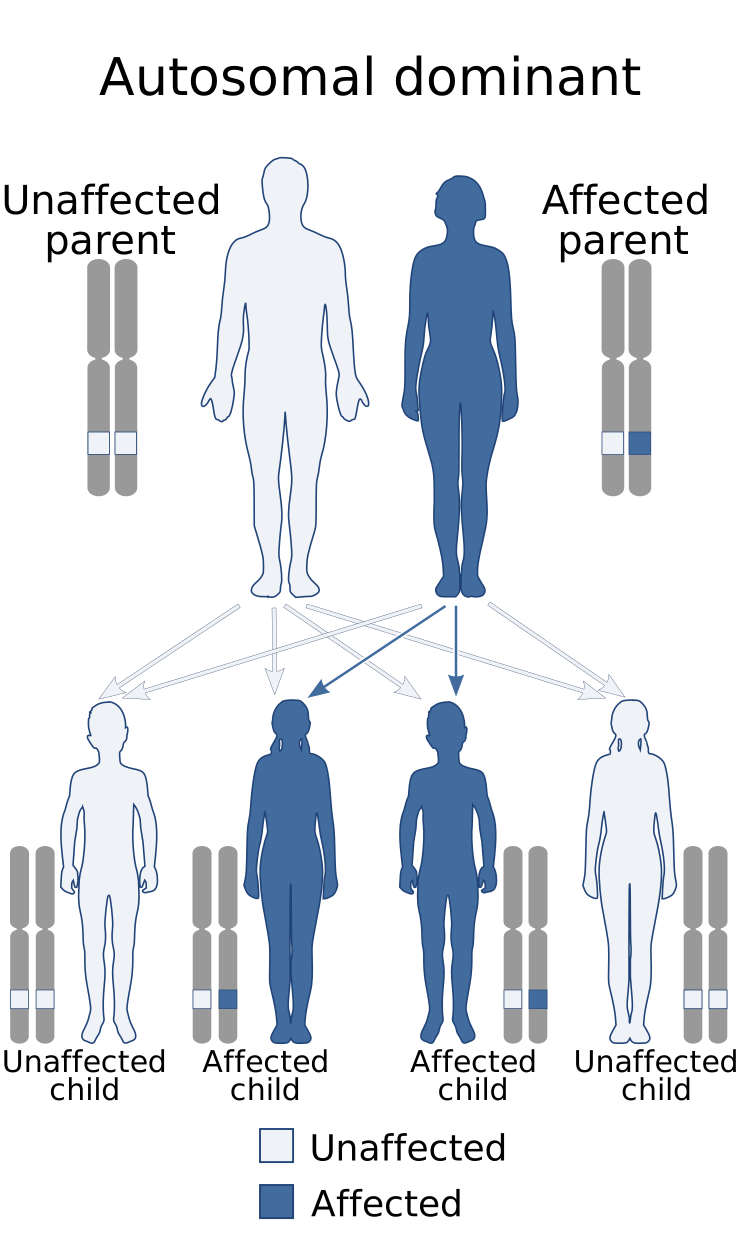
Science suggests that family trends follow an autosomal dominant pattern which means each child of an affected parent has a 1 in 2 chance of inheriting the condition. Research also indicates a link between keratosis pilaris and atopic conditions such as asthma and hay fever, suggesting that genetic predisposition to these conditions may also influence the development of keratosis pilaris.
There is currently no known cure for keratosis pilaris but there are ways to manage keratosis pilaris if the skin condition is bothering you by becoming itchy or inflamed. Your pharmacist can recommend certain creams or lotions to help your skin and whether you need to visit your GP or health clinic for medical advice.
The NHS have some dos and don’ts for improving the appearance of keratosis pilaris. These are:
Moisturise your skin – having a good cleansing skincare routine can help
Use mild and unperfumed soaps and bathing products
Exfoliate/scrub your skin with a washcloth or mitt
Have cool/lukewarm showers and baths
Pat skin dry instead of rubbing after washing
Do NOT scratch, pick or rub your skin
Keratosis pilaris can often (but not always) clear up during adult life.
“
“Been using Ameliorate for months now and will continue to use it. It has made my skin smoother and softer. I recommend this Body Cream and now you can purchase it with different (light) fragrances. Inexpensive too, in my opinion.”
19/02/21 by Alexandria
Why is there no cure for the skin disorder keratosis pilaris?
There is no treatment available for reducing the over-production of keratin in your skin but you can improve the condition temporarily using emollients or moisturisers. More on what you can do to manage keratosis pilaris below.
Moreover, the American Academy of Dermatology notes that while there’s no cure, understanding the underlying factors, including a potential vitamin deficiency and associated conditions like ichthyosis vulgaris, is essential for effective management.
Keratosis pilaris typically begins in childhood and gets worse during puberty. Some people find that keratosis pilaris clears up in adulthood but not always. We’re going to go through what you can do to help your child manage keratosis pilaris.
Is there any keratosis pilaris treatment around which is effective?
Yes! And we will go into treatment in more detail below using a step-by-step skincare routine that can also be used for your child from the age of three.
For more stubborn cases, dermatologists might recommend retinoids. Topical treatments such as tretinoin, adapalene, and tazarotene help by promoting cell turnover and reducing the cohesiveness of keratinocytes in the follicles.
Step 1 – Cleanse
Cleanse using tepid showers/baths and use non-soap cleansers rather than soap, which can dry out the skin. Your GP will recommend a suitable cleanser for children.
“I love this [AMELIORATE Transforming Body Lotion], I always use it after my shower and paired with the exfoliator it produces amazing results.”
18/11/20 by NikiFr – VERIFIED PURCHASE
Step 2 – Exfoliate and Moisturise
Gentle exfoliation can help to remove dry dead skin, but make sure you exfoliate gently to not irritate the skin further. Creams containing lactic acid and/or urea are more effective than emollients and can be purchased over the counter or obtained on a prescription by the doctor. Other treatments can be used but are not offered on the NHS.
Treatment often involves a comprehensive skincare routine. The key to this routine is moisturisation, but not just any moisturizer will do. The Transforming Body Lotion from Ameliorate, containing lactic acid, is formulated to not only hydrate but also exfoliate the skin, tackling the accumulation of dead skin cells. However, for those looking for an alternative or an addition to their exfoliation process, salicylic acid offers a potent solution.
Salicylic acid, a beta-hydroxy acid, is renowned for its ability to penetrate deep into the pores and dissolve the keratin and dead skin cells that contribute to keratosis pilaris. By incorporating a salicylic acid-based product into your regimen, you can enhance the exfoliating efficiency, making it an excellent complement to the Ameliorate Transforming Body Lotion. Together, they can provide a more comprehensive treatment approach, addressing both the surface and deeper layers of the skin.
It’s a groundbreaking solution that’s gained traction for its efficacy among those battling keratosis pilaris. When using products containing salicylic acid, it’s essential to monitor your skin’s response, especially if it’s sensitive, and adjust usage as needed to avoid irritation.
Physical exfoliation with a loofah can be effective, but gentle use is advised to avoid irritation. Furthermore, avoiding tight clothes can reduce friction and irritation, contributing to symptom relief.
Some home remedies and lifestyle adjustments, such as using humidifiers to add moisture to the air or choosing loose-fitting clothing to reduce friction, can also support skin health.
AMELIORATE Transforming Body Lotion has been proven to be very successful at treating and managing keratosis pilaris
Containing optimum levels of Lactic Acid, which is a naturally occurring Alpha Hydroxy Acid, the Transforming Body Lotion exfoliates and renews skin cells while drawing moisture into the skin. The Hydrating Sweet Almond Oil softens and protects the skin while enhancing the natural moisture barrier.
The great thing is that the AMELIORATE Transforming Body Lotion* is suitable for children aged three years and over and can be used on the face. Plus, 87% of sufferers agreed that the appearance of their skin had improved and felt softer and smoother! (The product was tested on 77 people with rough, dry, bumpy ‘ chicken skin’ (Keratosis Pilaris) in a four-week independent consumer trial).
“I purchased this [AMELIORATE Transforming Body Lotion] after it being recommended on a Facebook forum. I have had keratosis pilaris all my life. Felt like I tried everything and nothing worked. In summer I refuse to wear vest tops as I’m so embarrassed by them. My 5-year-old daughter has recently started looking like she has the same issue starting on her upper arms so I started to look again for something.
Well, I am so glad I found this product. Both of us have been using it for a fortnight and the results are amazing. Much smoother skin and the redness in some of the bumps have greatly reduced. Both of us are keeping up the skincare routine and seeing results! I actually think this might give me the confidence to actually wear a vest top this summer. Highly recommend.
29/03/21 by Diane – VERIFIED PURCHASE
For persistent keratosis pilaris, laser treatments like pulsed dye laser and YAG laser have been explored for their efficacy in reducing inflammation and improving skin texture, according to studies cited by the American Academy of Dermatology.
If you have keratosis pilaris how do you control picking it?
Picking your bumps will only cause irritation so it’s important to never pick, scratch or attempt to pop the keratin plugs. Control picking by exfoliating, cleansing and moisturising regularly to reduce the appearance of bumps and irritation.
I have keratosis pilaris. Will my child get it?
More than half of people who are affected by keratosis pilaris inherited the condition from their family, so it is deemed to be genetic. It is also much more common in adolescence and can be made worse in cold weather when the skin is lacking in moisture.
I’ve had keratosis pilaris on my face ever since I was born. Does anyone know of any treatments that could help make it less visible make the bumps less rough?
Yes! The AMELIORATE Transforming Body Lotion* has been tried and tested and 87% of sufferers have noticed a marked improvement. Plus the lotion is suitable for the face.
I’ve had tiny raised bumps on my arms and chest for a while I can’t figure out how to get rid of them. Could it be caused by food intolerance?
There is no scientific evidence to support a link between food allergies, intolerances and keratosis pilaris. Some people believe that eliminating gluten from their diet improved keratosis pilaris, but there isn’t any scientific evidence to support this.
Having said that, if you believe your child may have an intolerance or insensitivity it’s worth checking it out with the doctor to see if eliminating/reducing the food group from their diet may improve symptoms. Make sure you see a medical professional to properly diagnose and treat the issue.
Does the arrival of keratosis pilaris on my nine-year old’s arms mean she will suffer from acne?
Not necessarily. Acne spots are filled with an oily substance called sebum rather than keratosis pilaris spots are a build-up of keratin, so the two are not linked.
How do you cope with having keratosis pilaris and without losing confidence?
The best way to cope with keratosis pilaris is to adopt a great skincare routine by cleansing, exfoliating and moisturising regularly, which has been proven to work. Try the AMELIORATE Transforming Body Lotion* as this is a tried and tested product that has been specifically designed for keratosis pilaris sufferers.
Will my keratosis pilaris go away with age? I am 16 and have had it for four years.
Keratosis pilaris has been known to get better by the age of 30, but not in all cases.
How do I cure keratosis pilaris on my butt and tailbone area?
Use a good skincare/moisturising routine and regularly ensure you remove and exfoliate the skin.
What is the best way for a teen to treat keratosis pilaris?
AMELIORATE Transforming Body Lotion* is suitable from the age of three. Use non-perfumed soap and soft exfoliation to cleanse and exfoliate the skin. Then the AMELIORATE Transforming Body Lotion* can moisturise the skin which has been known to improve and even treat keratosis pilaris.
I have keratosis pilaris but its so bad that it gets itchy and it looks like really bad whiteheads. How do I get rid of it?
Again, use a good skincare routine to and avoid picking it as this could cause an irritation.
What are the best ways of getting rid of keratosis pilaris caused by shaving?
Keratosis pilaris isn’t caused by shaving, it is caused by a build-up of keratin in the skin. Use a non-perfumed shaving gel and always moisturise after shaving with AMELIORATE Transforming Body Lotion*
Switching from shaving to alternatives like waxing may help some people avoid exacerbating their keratosis pilaris, as it reduces the risk of causing additional irritation or lesions in the affected areas.
Can you get a tattoo over keratosis pilaris? How does that affect the quality of the tattoo?
You can get a tattoo, which won’t be affected, but you’re only tattooing over bumpy skin and it won’t treat the bumpy skin.
It’s important to note that with everything, keeping up a good routine is key. For keratosis pilaris suffers from all ages, this is a good skincare routine. So make sure you are cleansing using tepid water and an unperfumed cleanser. Exfoliate gently and moisturise use proven moisturisers like the AMELIORATE Transforming Body Lotion* which can help to treat and even help clear bumpy skin.
Start early with children so they are used to establishing a good skincare routine to improve chances of growing out of KP when they’re older.
Recent evaluator-blind studies, such as evaluator-blind study published in ‘J Dermatolog Treat’ in Aug and Apr, by researchers Pongprutthipan M and Saelim P, have shown promising results in the treatment of keratosis pilaris with newer methods like the pulsed dye laser and YAG laser, offering hope for those seeking alternative treatments.
*Links marked with a ‘*’ are affiliate links which means I may earn a small commission when you click through to buy at no extra cost to you”
*This article is sponsored by Ameliorate
The effects of poor personal hygiene
Getting children into the habit of washing themselves, brushing their teeth, and even grooming their hair can be tricky. Many children find this to be a dull chore, or cannot fully grasp the importance of keeping clean and establishing proper hygiene. Yet, without cleanliness, they open themselves up to many bacteria and infections that can impede their ability to go about their usual daily activities.
But what are the effects of poor personal hygiene?
To help your children make the most out of life and avoid as many unpleasant experiences as possible, it is vital that you get them into a solid hygiene routine as soon as possible.
What is personal hygiene and why is it important?
The definition of personal hygiene as per encyclopedia.com is:
“… Maintaining cleanliness of one’s body and clothing to preserve overall health and wellbeing.”
So fulfilling a certain number of self-care activities every day can ensure your children are on top of personal hygiene. Making sure they wash their hands after using the toilet and before eating, grooming and dressing up with clean clothes, and bathing are all top examples of how to have good hygiene.
What are the effects of poor personal hygiene on health and well being?
But what are the consequences of poor personal hygiene?
Lack of hygiene can impact your health and wellbeing negatively to where it could lead to serious health problems. For example, not brushing your teeth can lead to plaque buildup and gum disease. Plus, poor hygiene habits can affect your self-esteem and mental health. We’ll discuss these in more detail below.
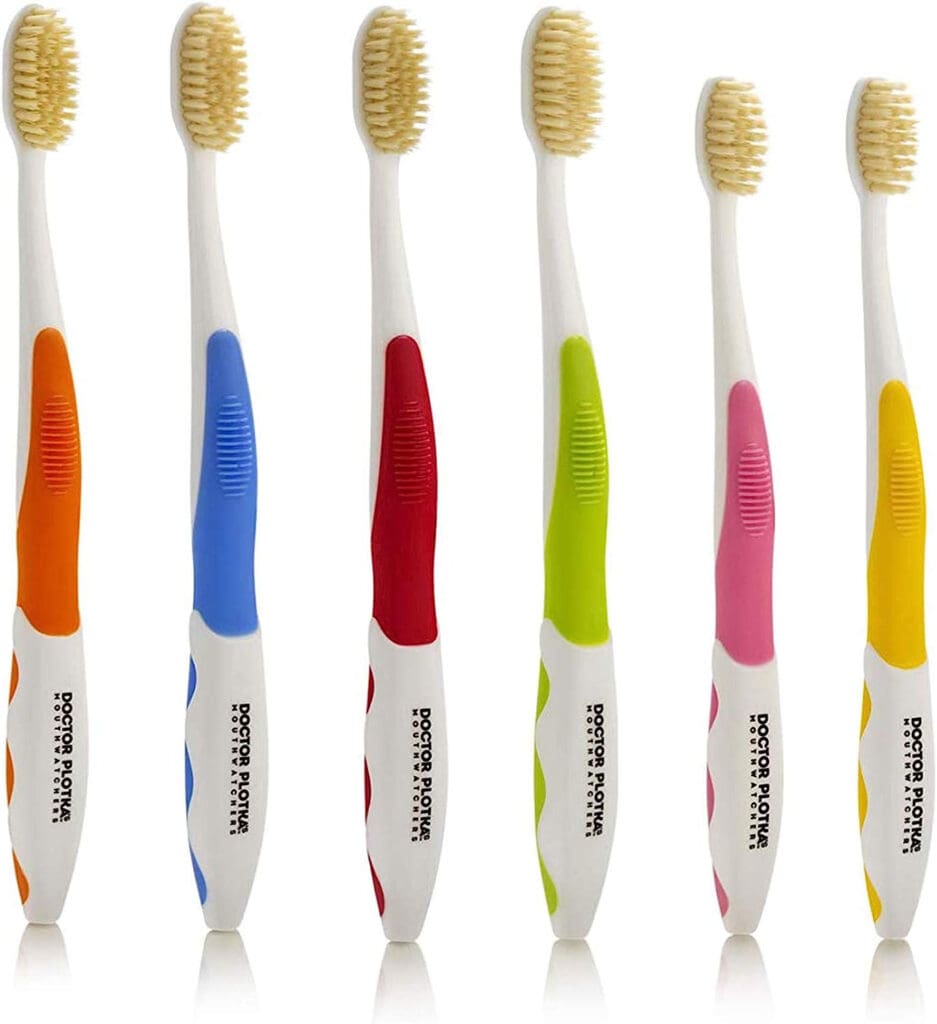
Doctor Plotka’s Mouthwatchers Antimicrobial Floss Bristle Silver Toothbrush, Family, 6 Pack. Buy from Amazon here*
What are the negative social effects of poor personal hygiene?
If you’re not taking good care of yourself and have bad personal hygiene, you may find that you will receive negative reactions from people around you, and this can affect social interaction with your loved one and other friendships. Your child may be subjected to a certain stereotype, rejection, or prejudice, as well as negative influence, which can impact your child’s quality of life.
Kids can be cruel, often chanting nasty things like, ‘Ooh you’re smelly!’ for example. This can cause a detrimental impact on your child’s mental and emotional psyche, so it’s important to ensure that your child looks and feels their best, starting with good personal hygiene as the first step towards a healthier and happier life.
Below, you can find poor personal hygiene examples people suffer from and which have been medically reviewed as causes of serious diseases if not treated promptly.
I will also talk about personal hygiene types and practices which can help children to understand the importance of being healthy and hygienic.
Bad hygiene examples – styes
AllAboutVision explains what a stye is in more detail but we will touch on the basics here. Styes look similar to pimples and are commonly located around the eye area. They can be sore and affect adults and children alike, but thankfully they are not classed as contagious. Warmth can help to get rid of some swelling, and painkillers can reduce the soreness your child might feel.
Keeping hands clean and limiting the number of times your child touches their face can not only help to prevent styes but also speed up the recovery process. This may seem difficult, especially if the eye area is itchy, but it is imperative.
Remind your child to not touch the affected area and use cooled boiled water, clean cotton wool and properly washed hands to treat the area every day. Some people say tea helps with certain eye conditions like conjunctivitis that may result from styes, but be sure to practice good hygiene yourself first to minimise the risk of more bugs transmitting into the affected eye area.
Examples of poor hygiene – stomach bugs
Even though stomach bugs and the stomach flu might do the rounds at your child’s school or day-care centre, there are ways you can limit their presence in your home. Spraying services with germ-killing cleaners, and washing your hands with antibacterial soap, can help kill off any viruses.
Ensuring your children gets into the habit of washing their hands after touching high-traffic surfaces, as well as after using the toilet, coughing, or blowing their nose, can also help to prevent infections.
Signs of poor personal hygiene – headlice
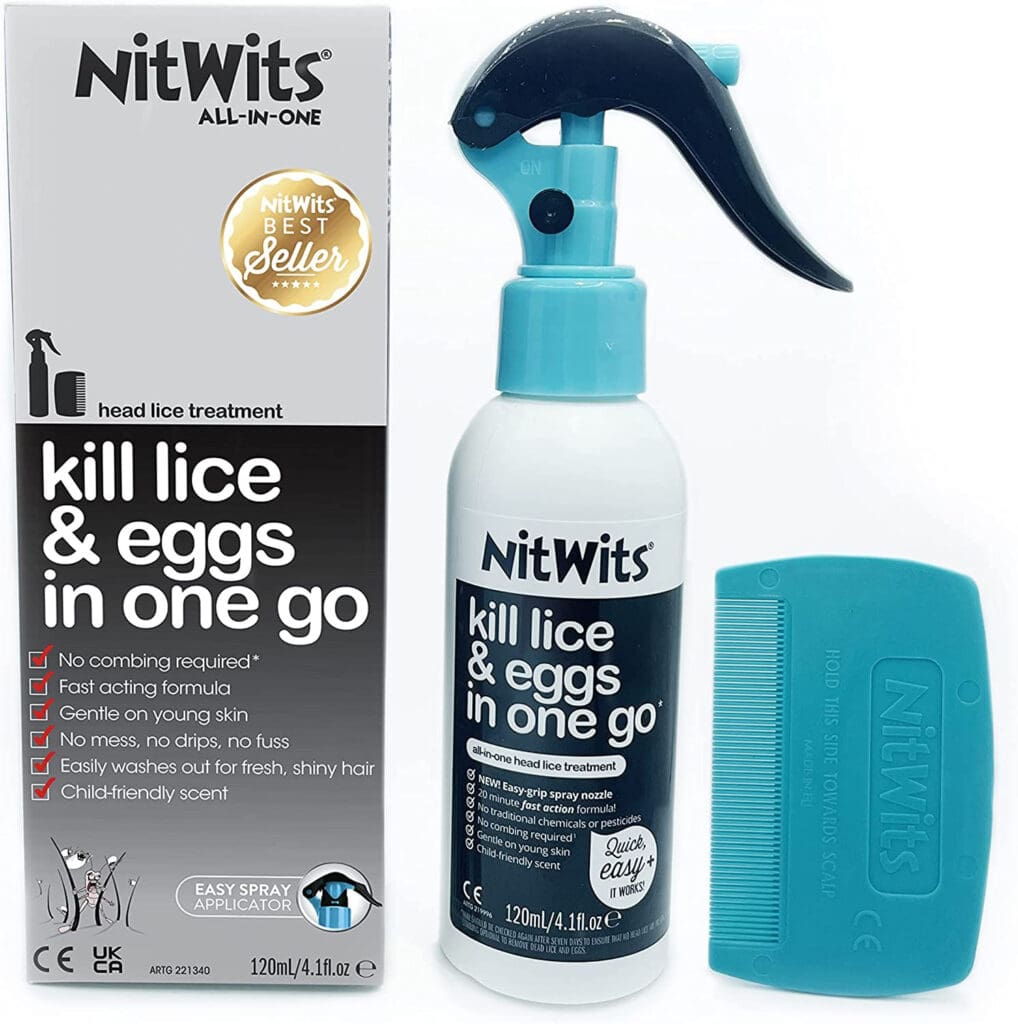
Headlice, or nits, (they can sometimes be called body lice if found elsewhere on the body) can become a problem when your child is often around other children. These little insects can cause seriously itchy scalps and can spread quickly. Using a nit comb regularly can help you detect the signs of headlice early on, as well as clear the scalp.
If your child does have head lice, inform their school, so they can be kept away to prevent the spread. Tying up long hair and washing and combing the hair frequently can also help tremendously. Another preventative measure is to make sure belongings are stored separately, and items such as towels or bedding are not shared among different members of the household. Use a nit comb regularly through conditioned hair to make sure you’ve caught all the nasty critters before you send them back to school.
Not treating head lice can lead to skin infections, so make sure you act quickly!
Oral hygiene is massively important and the earlier you teach kids about dental hygiene, the fewer problems they will have later in life. Poor oral hygiene can lead to many problems, including tooth decay, bad breath or gingivitis and gum disease.
Gum disease is caused by plaque, a form of sticky bacteria that builds up on your teeth. Build-up can first start with gingivitis but if not treated straight away can lead to bleeding and swollen gums, receding gum line, bad breath and loose teeth. Eventually, if not treated, your teeth can fall out.
Gum disease doesn’t present itself straight away, which is why it’s massively important to visit the dentist regularly to spot any signs early.
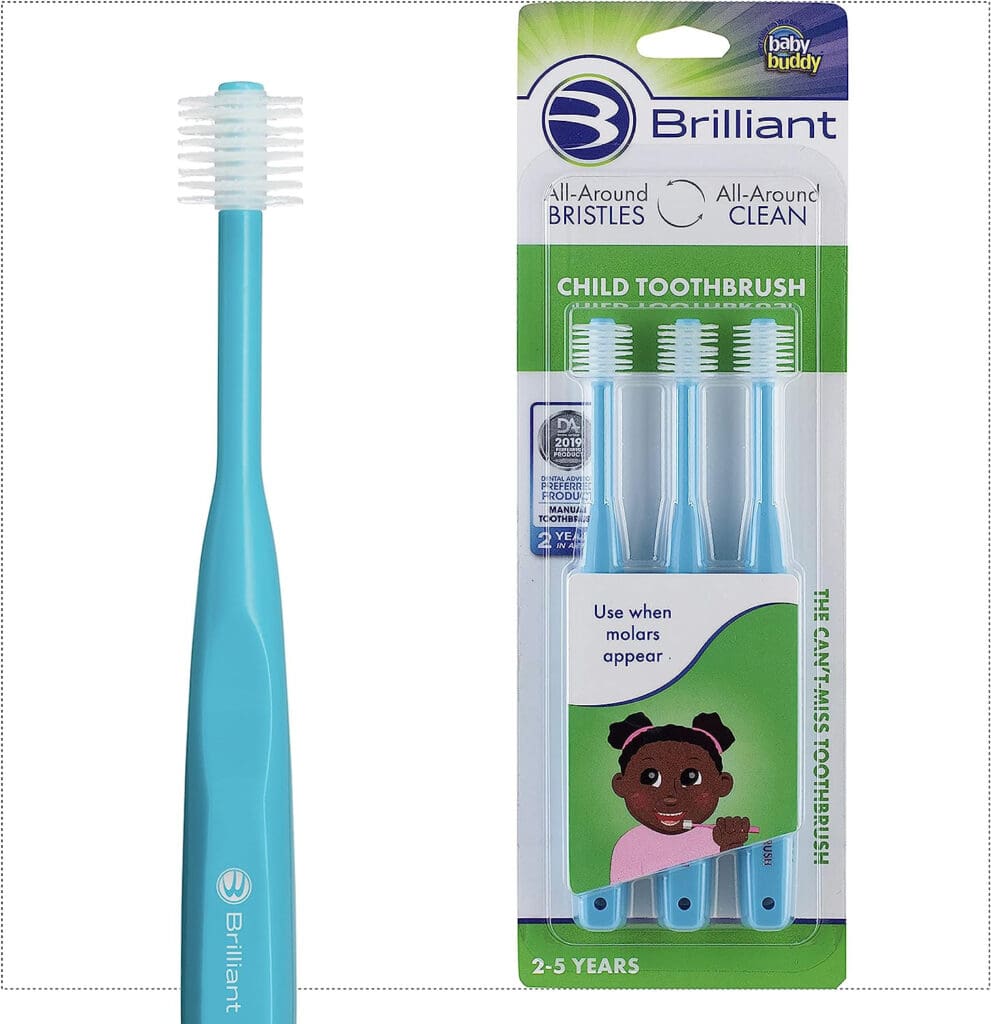
Make sure your children brush their teeth twice daily, morning and night, and up to the gums too, for at least two minutes. Using an electric toothbrush will help to ensure teeth are brushed properly.
Skincare and hygiene is very important. Not washing your skin regularly can lead to a condition called dermatitis neglecta, which leads to an accumulation of corneocytes, sebum and sweat. Clean your skin properly and regularly to avoid skin complaints.
Signs of bad hygiene – food poisoning
The consequences of poor personal hygiene when handling food are food poisoning. Food poisoning is an illness that is caused by poor personal hygiene in the kitchen or eating contaminated food, either from unwashed hands or from not properly cooked or washed food.
In most cases, food is contaminated by bacteria such as salmonella, E.coli or the norovirus. Food can become contaminated at any stage during production, processing or cooking, for example:
Not cooking food properly
Not correctly storing food that needs to be chilled at below 5C
Leaving cooked food for too long at warm temperatures
Not reheating previously cooked food properly
If you’re ill or have dirty hands and you touch the food
Eating food that has passed its “use by” date
Bacteria spreading between contaminated foods (cross-contamination)
Practice proper hand washing before you put anything in your mouth. I often tell the boys, if their hands are going anywhere near their face, wash them! Poor personal hygiene with food can cause weight loss or, worse, fatal illness.
What is the cause of unhygienic food?
Bad or not hygienic food can lead to heart disease if not properly treated, which is one disease caused by poor personal hygiene. So it’s important to lead a healthy lifestyle and teach your kids about the dangers of eating unwashed and improperly cooked food as early as possible.
It’s important to identify the cause and effect of poor personal hygiene on health and food safety and educate yourself and your kids so you can prevent serious illness.
Undergarment hygiene healthy practices to follow
It’s important to practice proper hygiene with your underlayers. Ways to have good hygiene with your undergarments include:
Change your undergarments every day to minimise risk of bacteria from vaginal discharge and sweat
Opt for breathable, natural material to prevent fungal and bacterial infections
Wear the right size – too tight can cause UTI
Wash your undergarments properly to avoid any buildup and hidden bacteria
Can TB occur due to lack of personal hygiene?
Lack of personal hygiene can increase the risk of tuberculosis infection. If you or your child has TB, then it’s very important to maintain personal hygiene to reduce the risk of transmission to other people living with them.
Your healthcare professional can provide medical advice on how to combat TB as it’s a long treatment process.
Bad hygiene habits that are way worse than you thought
Here are some regular bad hygiene habits which people don’t realise can be quite bad for you:
Not regularly brushing or flossing your teeth – can lead to gum disease and tooth decay
Not showering regularly – can lead to skin problems and infections
Going to bed with your makeup on – can lead to clogged pores and even eye damage
Not washing your bedding regularly – can lead to infection
Leaving your contacts in – can lead to corneal damage
Not washing your underwear regularly – can lead to infection
Sharing your items, like razors, toothbrushes and towels – can lead to transmission of diseases and infections
Reusing towels – can lead ot infection
Walking barefoot in public showers – can lead to fungal infections
Not washing your produce – can lead to food poisoning
Using your sponge for too long- can lead to poisoning
Leaving in tampons for too long – can lead to toxic shock syndrome
Reusing plastic bottles – can even lead to cancer!
Does ADD affect personal hygiene?
This is an interesting question. An association has been found between ADHD and living a less healthy lifestyle. Children with ADHD are almost twice as likely to have fewer healthy lifestyle behaviours like consuming less water, drinking more sweetened drinks and exercising less.
What is the difference between hygiene and grooming?
Hygiene is a set of practices that preserve healthy living and cleaning the body to prevent germs while grooming is the art of caring for and maintaining parts of the body. Poor grooming can cause poor physical appearance which can be linked to bad hygiene.
Are there any disadvantages of personal hygiene?
Health and hygiene are paramount to living happy and healthy lives, but there are some negative side effects of over-cleaning like skin irritation and Obsessive-Compulsive Disorder. Maintain a healthy balance of cleanliness and lifestyle enjoyment and model that on your children. If you have certain health concerns and complexes yourself, be mindful not to pass these on to your child.
What are some great examples of personal hygiene?
Types of personal hygiene practices that you can encourage your child to do now are:
Helping your child establish a personal hygiene routine
Ensuring that your child has a face wash each morning
Making sure your child has a good shower or bath in the evening to remove dead skin cells and body odour. This act of washing themselves can go a long way towards improving their health and reducing the chances of cross-contamination of bacteria.
Personal hygiene habits will help prevent any nasty smells or, with cleaning their teeth, cavities or premature tooth loss.
Spend the time to teach them how to clean themselves effectively so they are set up for life with positive routines, while also minimising the likelihood of illness within your home
Don’t forget that good personal hygiene practices can boost mental health too!
What are your thoughts regarding personal hygiene? Are you put off by BO? What do you think about poor hygiene practices and their effects from a social standpoint? What are your own personal hygiene habits? Do you have any bad hygiene habits you need to fix? Share your opinions with us in the comments below about how you practice good hygiene.
Frequently asked questions
What does poor personal hygiene mean?
Other questions asked were:
What is poor personal hygiene a sign of?
What is bad personal hygiene?
How to address poor personal hygiene?
What is hygiene poverty?
What does poor hygiene mean?
What does it mean to have bad hygiene?
What is bad hygiene?
“Poor personal hygiene arises from either intentional or unintentional neglect of your body’s cleanliness and health requirements. Your body begins to look unhealthy, you experience unwanted health concerns, and your overall well-being is affected.”
Can you provide examples of poor hygiene bad habits you should avoid?
What are signs of poor hygiene?
Four examples of poor personal hygiene include:
Body odour from not washing regularly
Bad breath from not brushing teeth
Recurring infection from not washing hands properly
Dishevelled, dirty appearance from poor grooming
What causes poor personal hygiene?
Other questions asked were:
What does poor personal hygiene cause?
What are the causes of poor personal hygiene?
What are the causes of poor hygiene?
What problems does poor personal hygiene cause?
What are the Longterm effects of poor hygiene?
“Poor hygiene often accompanies certain mental or emotional disorders, including severe depression and psychotic disorders. Dementia is another common cause of poor hygiene. Other people may develop poor hygiene habits due to social factors such as poverty or inadequacy of social support.”
“It is more common for women to get UTIs because the urethral opening is close to the vagina and anus. Poor hygiene and wiping ‘back to front’ (rather than front to back) after going to the toilet can enable bacteria from the bowel and vagina to enter the urethral opening to the bladder more easily.”
Continuous poor hygiene, especially in the female area, can cause sepsis and septic shock, like toxic shock syndrome can result from anywhere in the body, even a UTI. Sepsis and septic shock can result from an infection anywhere in the body. Sepsis is a medical emergency that requires urgent treatment.
“Personal hygiene issues can cause significant problems in the workplace. Not only do they make the environment unpleasant for others, they can also cause difficulties for businesses where staff are interacting with the public”
How does poor personal hygiene affect your personality?
“Poor hygiene habits can also affect your self-esteem. Looking and feeling presentable can give you a confidence boost and a sense of pride in your appearance. Other conditions may be prevented or the risk minimized by practicing good personal hygiene.”
How can poor personal hygiene affect relationships?
How can poor personal hygiene cause harm to others?
Why does bad personal hygiene affect others?
Having a high standard of personal hygiene improves personal and professional relationships because it reduces the risk of social rejection which may lead to bullying, low confidence and low self-esteem.
How can poor personal hygiene lead to foodborne illness?
Other questions asked were:
What is poor personal hygiene in food?
“Good personal hygiene is essential for any food handler and minimises the risk of food contamination. Most people carry harmful bacteria on their bodies and can unwittingly transport them to food. Touching your mouth, nose, hair or even your clothing can spread bacteria and cause contamination.”
How does poor personal hygiene affect your health?
What are the impacts of personal hygiene on your health?
“For example, not washing your hands after you use the toilet, handle food, or touch dirty surfaces can spread bacteria, viruses, and parasites. These can lead to infections and diseases, like food poisoning, gastroenteritis, cold and flu, and hepatitis A — just to name a few.”
washing your hands with soap after going to the toilet.
brushing your teeth twice a day.
covering your mouth and nose with a tissue (or your sleeve) when sneezing or coughing.
washing your hands after handling pets and other animals.
https://www.healthdirect.gov.au/personal-hygiene
Is poor personal hygiene a sign of depression?
Yes. Mental health can impact hygiene and depression may make you not want to get up every day and make the effort to clean.
Is it necessary to practice personal hygiene everyday?
It’s good to get into the habit of performing basic personal hygiene every day. For example washing your hands multiple times of the day will prevent germs from entering your system.
How to maintain hygiene at the workplace?
Regularly clean your desk. Stop infections from spreading, and dust from gathering, by cleaning your desk.
Sanitise your hands at least once day. …
Regularly wash your cups, mugs, plates and cutlery. …
Keep a box of tissues on your desk.
https://employsure.com.au/blog/workplace-hygiene/
Is poor personal hygiene a sign of abuse?
In some cases, elder abuse has been found in care homes which has resulted in residents having poor hygiene standards. The same goes for children in a neglected home. However, a lot of the time it is down to lack of education on why hygiene matters for your health and the effects of good personal hygiene on health.
*Collaborative feature post
The baby gadgets worth having in 2021
The modern parent has well and truly embraced new technology and the array of products that continually head our way in what is an innovative world we now live in. It’s not uncommon for expecting parents to snap up an array of baby gadgetsduring pregnancy before the little one arrives. In fact, it’s a growing trend.
Not every baby product is useful. As is the case in other sectors, the occasional gimmicky invention is thrown our way, which offers limited functionalities or simply doesn’t improve on something we already do by ourselves without the need for a little gadget. Most products do perform a worthwhile task, though. In fact, many of the gadgets available today offer more than ever before. Some internet-connected devices help your child drift off to sleep more easily, while others might assist your child with feeding time. The options are certainly vast.
Innovation has certainly reached new heights. One look at our smartphones highlights the dramatic growth technology is showing. We’ve gone from chunky devices which resembled bricks and offered limited games like Snake to sophisticated smartphone devices capable of taking high-quality images and hosting augmented reality games like Pokemon Go, while also being able to use our devices to make mobile payments for access to slot games or to purchase food online via an app. We’re living in a golden age in that respect.
With baby gadgets showing the same type of improvements, we thought we’d go through some of the best products available in 2021.
Snuza Hero
Ideal for parents who are keen to monitor their baby’s sleep patterns while they’re tucked up in bed, the Snuza Hero features a motion sensor that detects even the slightest of movements. A useful way to prevent SIDS in particular, if your baby remains still for 15 seconds, the Snuza Hero will rouse your baby with a small vibration. If there is then no further movement for five seconds after the small vibration, then an alarm will go off.
https://www.youtube.com/embed/BlwG9PQa3lM
ZoLi Buzz B Electric Nail Trimmer
Little claws can grow fast but trimming them isn’t always the easiest of tasks, especially if you have a child who simply hates having their nails trimmed. To make it a more smooth process, consider purchasing the ZoLi Buzz B Electric Nail Trimmer. This gadget is ideal for cutting fingernails thanks to its four different cushioned pads, with each design specifically made for different stages of your baby’s growth.
The iBaby Air is an air quality monitor and purifier of the highest standard. In order to make sure your baby is breathing the best quality air, this top of the range device is worth purchasing. It comes with the capabilities to detect the likes of benzene, alcohol, hydrogen, methane, carbon monoxide, cigarette smoke, and a whole lot more. It contains an ion purifier, too.
Baby Shusher Sleep Miracle Soother
https://twitter.com/BabyGear_USA
Shushing a baby to sleep is a tried and tested method, but it isn’t always a successful one for some parents. If you’re keen to try an alternative, consider buying the Baby Shusher Sleep Miracle Soother. Acting like a sound machine, it provides between 15 and 30 minutes worth of shushing sounds to help your child drift off to sleep. It’s small and easy to carry around while on holiday also.
Hatch Baby Grow
More than just a changing pad, the Hatch Baby Grow will monitor your little one’s weight and height. This clever product made of wipeable foam can also keep track of your baby’s sleeping and drinking patterns, as well as offering an insight into diaper changes.
When choosing a baby gadget, make sure it actually plays a part in helping you parent your child, and overtake your duties because nothing trumps a parent’s love, no matter how many hours you shave using tech!
Thanks to flexible working and the freedom to start your own business in the UK, parents are coming up with tons of business ideas like turning to the buy-to-let property investment market to either supplement their income, pay the mortgage or make a living from it. Starting out as a landlord/landlady, however, can be overwhelming. You’re probably thinking, ‘How can I start a rental business with no experience?’ or ‘What does it take to start a rental business?’ You need to think about screening your tenants, preparing your property for collecting the rent and taking care of maintenance issues – it’s not an easy gig. With a high level of attention to detail and experience, however, this job can be both gratifying and lucrative. If you’re just starting out, you might need a bit of guidance. Read on for tips on how to start a rental business.
What you need to do before you rent out your home
There are lots of reasons to start a rental property business. You may be buying your dream home finally but you are not ready to part with your old house just yet. Or you’ve bought an investment property or rental properties, and you’re looking to go into real estate investing and create a side income. Real estate investment and property management is a great small business to earn a regular income, open up cash flow and long-term profits, and it’s also a good stepping stone into the prosperous property sector, which can offer you significant savings both now and later on in retirement. But there are a number of things you need to think when starting a rental business, like the type of equipment you’ll need (rent tools), where to start a rental business, what you need to start a rental business and the below which we’ll go into in more detail.
Weigh up your finances
What some business owners and property managers don’t realise about renting is that it can cost you, especially when it’s a new business and you’re just starting out as a landlord or a real estate investor. You must take into consideration things like taxable rental income with rental businesses, which will depend on how much you’re receiving. You may also need to consider your mortgage payments, although the monthly income you receive should help you pay it off much quicker than you intended. Check out this article here for more information on how to start a rental property business with no money.
You also need to think about maintenance and repairs costs, and whether you will offer these services to your tenants. Seasoned landlords would advise you to include it within the tenancy agreement, as this will prevent the tenants from causing any unnecessary damage to the property. If you’re not qualified to complete tasks like plumbing or other types of maintenance, you would have to factor in handyman wages. Outsource projects like commercial paving, tiling and general fix-ups. And, to make life easier for yourself, invest in couriers to acquire the materials needed, so you can spend your time tending to the more important matters at hand – your rental income!
Maintenance issues happen—you don’t want to scramble to find the funds to pay for them. Before you become a landlord, you need to make sure you have a financial cushion in place. If you find yourself underwater on your property, you’ve gone against any financial gains you were hoping to make. Besides things like burst pipes, roof damage, and other inevitable fixes, you might encounter nightmare tenants who don’t pay the rent. While you pursue legal action against them to recoup the rent, you’ll still be expected to pay. Take out insurance where necessary (compare landlord insurance here) and create a business plan so you’re prepared for the pitfalls that will inevitably ensue.
Prepare your property
Before letting out your property, consider making some necessary changes that will make your home stand out to potential tenants. You first need to register your rental business (check here for how to register a rental property business. The process will be different depending on whether you are renting commercial properties to start your business or operating from home.) You may need to conduct some repairs to ensure everything is working as it should when you open up the house for viewings. You should also maximise your space, especially if you’re offering to rent your home fully furnished, as you can move furnishings around and enhance the decor to make the property appear more airy and spacious.
If you want to entice younger tenants, take some inspiration from contemporary apartments like those available at RW Invest. These feature everything from modern furnishings and minimalist decor to smart lighting and communal gardens. Essentially, it is what millennials are looking for in a property, which is why they have been selling like hotcakes and gained so much interest.
Choose your tenants wisely
Once your property is prepared and ready to rent, you can then start your people search. In recent years, it has become much easier to seek tenants due to the introduction of websites and apps which allow tenants and landlords to connect and find the perfect tenancy match. Social media is also a great way to check out the tenant’s social life and find out whether they’ll be partying until 3am every night or whether they’re a family who just need a place to live while they buy their own.
Once you’ve dwindled down a few tenant applications, it is imperative that you perform tenant screening. This includes checking their current and previous employment to establish whether their income is steady, which will offer you reassurance about monthly payments. Take advantage of credit reports for landlords from SmartMove to examine their financial credibility. Your background check should show criminal history as well; if a misdemeanour pops up, you can go with your gut on that one (depending on how serious it was and how long ago). However, you will likely want to avoid any tenant with a felony in his or her background.These checks are.// essential to protect both your home and yourself to avoid damage to your property or any issues throughout the tenancy.
If you live far away from your rental property, you will need to outsource this anyway. You might even consider hiring a property manager to handle the collection of rent, maintenance issues, and more.
Go high-tech in rent collection
Automating rent collection will give you and your tenant peace of mind.
“Whether you buy an online solution pre-made or hire a developer to create it, set up a payment system that accepts credit or debit cards, or even automatic bank transfers.”
Most not only prefer the above way of paying rent, but they’d also like the option of paying with their phones. Some landlords are hesitant, however, because of the fees that can be associated with online payments. According to this HuffPo article, Stripe.com is a good alternative. This service processes the tenants’ online payments, and the charge is the same as PayPal’s fee. Where it’s better than PayPal is that it offers a free subscription service to automatically bill your tenants.
Establish an appropriate relationship with tenants
We’ve all heard the nightmare stories about the landlords who love to “pop in” on their tenants. This is never okay, even if you’re tempted to catch them doing something you disapprove of. You should trust that you have thoroughly screened them and, thus, make appointments anytime you want to discuss anything with them—it’s the law. Conversely, you can be friendly and approachable and go the extra mile with special touches. A holiday gift basket can go a long way in making a good impression, especially if it’s coming to the time for them to decide whether to renew their lease for another year. It’s very important to read up on how to start a rental business properly and learn how to be a good landlord so you can continue to achieve success in your properties.
If you’ve gone above and beyond during your tenant screening process, you’re already likely to enjoy a long and productive tenant/landlord relationship. However, you can follow the above tips on how to start a rental property management business and ensure that your landlord duties will go smoothly over the years.
If you are in the rental business yourself, what are your tips for a successful buy-to-let property business? Or if you’re wondering how to start a rental business yourself but your questions haven’t been answered yet, post your questions in the comments below and we’ll build the answers into the article.
*Collaborative feature post*
Making memories: How to preserve memories of childhood
Any parent will tell you that childhood seems to go by in a flash. One minute your kids are begging you to join in their game with them and the next they’re demanding privacy and retreating to their bedrooms. Watching your children grow is a privilege, but it’s important to preserve those wonderful childhood memories in as many ways as you can. Do you remember your first memory?
Children will start to make their first memories at around two to three years old, however, will have childhood amnesia, often remembering the feeling and perhaps another sense, like smell or taste instead. Of course, there will be some unforgettable childhood memories which will stay with us for life, but we often lose a lot of our fond memories as a child if it’s left to just our brains to remember. Capturing these memories immortalises those precious moments which you can share with your child again and again.
Here we’ll explore interesting ways to preserve those precious childhood moments.
Canvas prints
They’re eye-catching, effortlessly stylish and create a precious focal point in any room. Canvas prints of your happiest photographed moments are a stunning way to preserve those earliest memories and milestones. You can buy framed canvas prints or floating style designs, all available in various sizes and finishes. Canvas prints are designed to last, and you can use them to decorate and complement your home. Whether you choose to display your child’s first steps along a carefully curated gallery wall, or you want to show off their first smile above the mantelpiece, or capture the first time they ate ice cream, canvas prints are the perfect way to preserve and enjoy those precious moments.
Create an artwork portfolio
All those carefully scribbled lines, bizarrely drawn stick men and colourful blobs that are supposed to look like you usually end up stuffed in a drawer or left to overflow on the sideboard. It’s a shame that these works of art ultimately end up in the trash. However, if you’re looking to preserve those early year’s drawings to follow your child’s artistic journey, then why not gather them together and create a cute portfolio instead? Whether you keep the hard copies or scan them in and keep them digitally is up to you, but it keeps the clutter down and they’re always fun to look back on. As your child gets older you can even work on this project with them, talking through the first time they drew a dog or when they learned how to paint. They’ll love to take the trip down memory lane with you when they’re older.
Immortalise their quotes
Kids say the funniest things, don’t they? Chances are your child has said something that has left you clutching your sides with laughter or stifling your glee in a public place. Annoyingly, it’s both inevitable and incredibly frustrating when we can’t remember what they said. Immortalising their quotes by writing them down and storing them in a notebook or journal is fun and eye-opening to look back on. Or, you could consider having their wise or downright hilarious words featured on a canvas and hung with pride in your home. Reach out to hellocanvas.co.uk for more inspiration.
Your child can get involved in the projects too
Did your child do something special at school, like create a building or a fantastic drawing? Did they write an elaborate story? Get them to create a scrapbook of what happened at school and their favourite achievements do they don’t forget what they accomplished. Buy the class photos and write down the name of the people your child went to school with. They can then look back and reminisce about who they went to school with and even have the option to find them on social media if they wanted to. Also, don’t be afraid to talk about a certain childhood memory with them too, so they can build on who they are and what made them into the adults they will be in the future.
And finally, remember to preserve moments with elders
When collecting and preserving these memories of childhood, don’t forget to include your kid’s grandparents. There’s no bigger regret than failing to make and preserve any tokens of your children with your parents, as when they’re gone – the moment is missed. Whether you schedule a playdate or a day out with grandparents, or you’re having a family meal, take plenty of photos and ask them to gather mementoes of the day for you to keep and preserve in a memory box or in an album. You’ll be so glad you did. And don’t forget to talk to your children about your parents too, to keep their grandparent’s memories from childhood last a lifetime!
*Collaborative feature post*
How to have a happy child and parent relationship
A few years ago I attended a very special event at The Centre for Child Mental Health, to learn about how to build the best possible relationship with my children. Armed with an open mind and my then four-year-old son, I travelled to Central London to learn about how to grow an already great bond with my child and, ultimately, the best possible relationship with my two boys (now 8 and 10 years old).
Arriving at The Centre for Mental Health
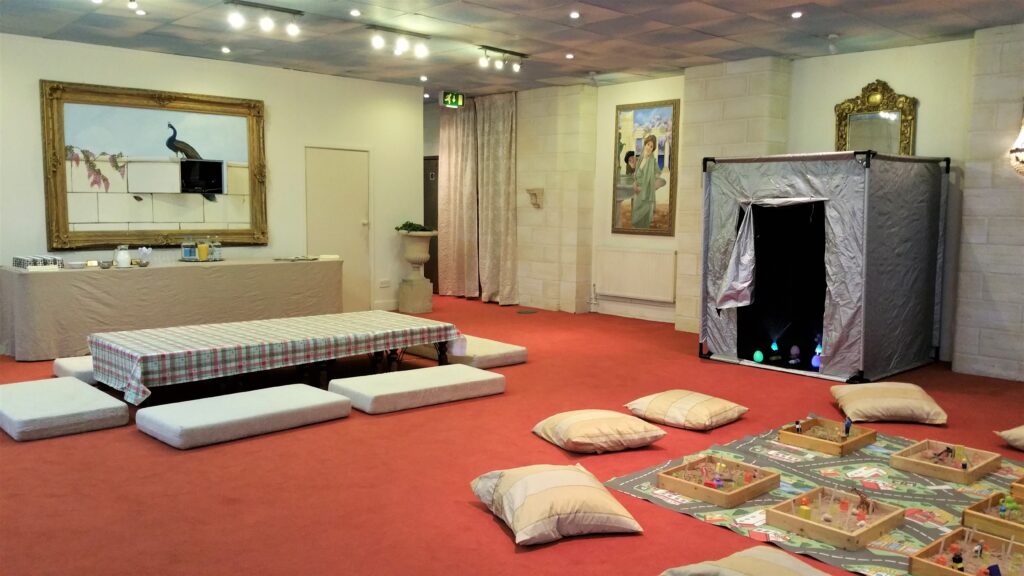
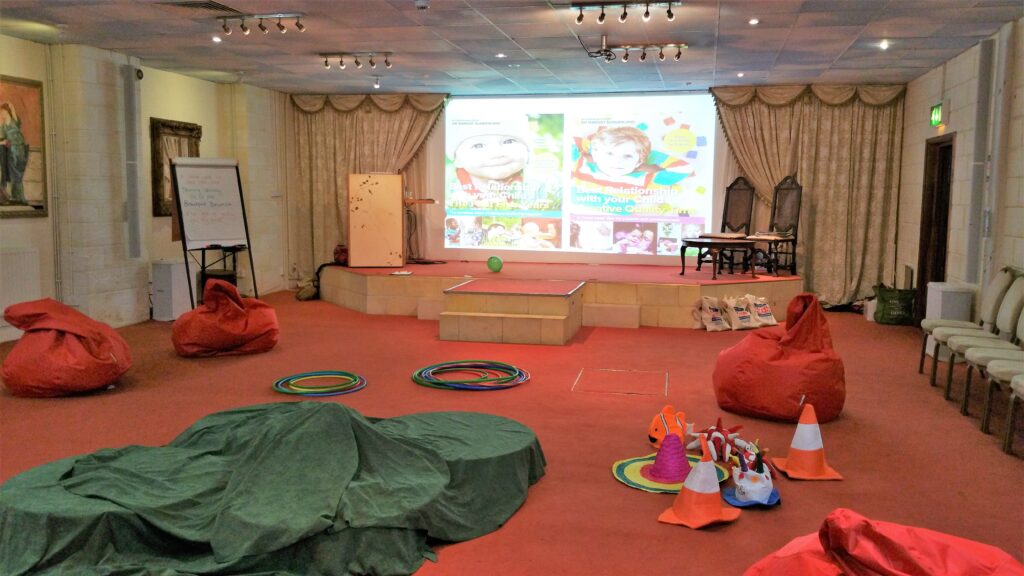
As soon as we arrived, we were guided into a decorated room that housed an array of interesting activities, as well as an eating area that included hot and cold beverages and some biscuits to snack on throughout the morning. The activities out on display included:
A grey sensory tent, complete with sensory items
A seating area in front of an overhead projector, a whiteboard and a podium
Seven sandpits
A racing car mat with cushions
Tables that were covered with a green tablecloth
Large Lego blocks
Hula hoops
Cuddly toys and costumes
And a separate dark sensory room lit up with a range of lava lamps and sensory toys
Emily, who assisted in the event, expertly kept all the kids entertained as we seated ourselves in front of the overhead projector, ready to start our learning journey on attachment play and creating the best possible bond with our children.
I later found out that Emily was an only child and she believed that her deep connection with children was probably down to never having the chance to play with siblings. I found this interesting that even as an adult if you miss out on important child’s play, so you may look for it later in your adult life. This was just a taste of psychology and science to come during the day!
We were introduced to Dr Margot Sunderland, an interesting woman with a number of accreditations under her belt. Dr Margot Sunderland is a child psychologist and gentle parenting expert who has written a neuroscience book called, ‘What Every Parent Needs To Know’ and brought out three DVDs, the subjects of which this event was about. The DVDs are:
Best Relationship with your Child: The First Five Years
Best Relationship with your Child: Creative Quality Time (for babies and children up to the age of eight)
Best Relationship with your Child: Age Five to Twelve
“These three films in the Best Relationship with your Child series are designed to equip parents with tools, skills and practical ideas to strengthen their attachment relationship with their child.”
Dr Margot Sunderland
Having the best relationship with your child
There are so many resources out there on how to get your child to behave. But, recent studies have shown that parents want so much more than this. We want to know how to have the best possible relationship with our children.
Modern parents deal with so many tasks and troubles; the washing, cleaning, preparing meals, the school/nursery run and rushing off to work. All those gorgeous bonding moments with our babies take a backseat when our children get older and school takes them away from us.
Scientific research shows, however, that the special relational bonding time with mummy and daddy is just as important for our five-year-olds as they are for our five-month-olds. And, it’s not just vital for bonding but for our child’s brain development.
Recent studies also show that the average quality time should be one hour a day for fathers.[1]
Over a third of parents don’t spend enough time with their child.[2] 6 out of 10 parents occasionally play with their child. 1 in 6 fathers confesses that they don’t know how to play with their child. Just 1 hour a day from the mother or 35 minutes from the father a day is enough for the child to experience a great attachment and connection with their parents.
Providing undivided and engaging attention to your child is important
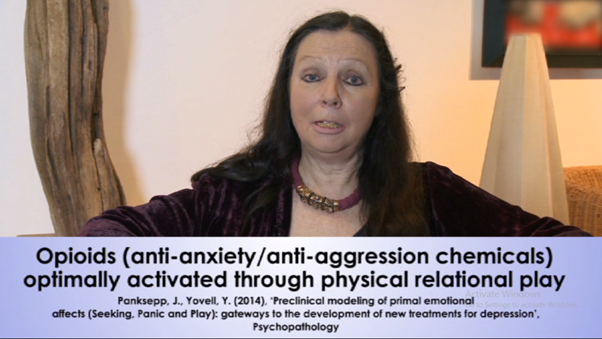
During the event, we learned that engaged and attentive play develops the brain. Providing your full attention during the child’s play increases their opioid and dopamine levels, which decreases depression and provides an energised engagement in life. Teenagers have less dopamine, hence why they want to mope around and play video games. But, if these chemicals are established in the brain as early as possible then this kind of attunement actually shows up thirty years later in their adult life.
So, how do we increase our children’s dopamine and opioid levels and what does it all mean?
We’re going to tackle the brain science and the games together to illustrate how both go hand in hand to develop a child’s brain and to strengthen the bond between parent and baby.
Strategies to aid and maximise attachment play
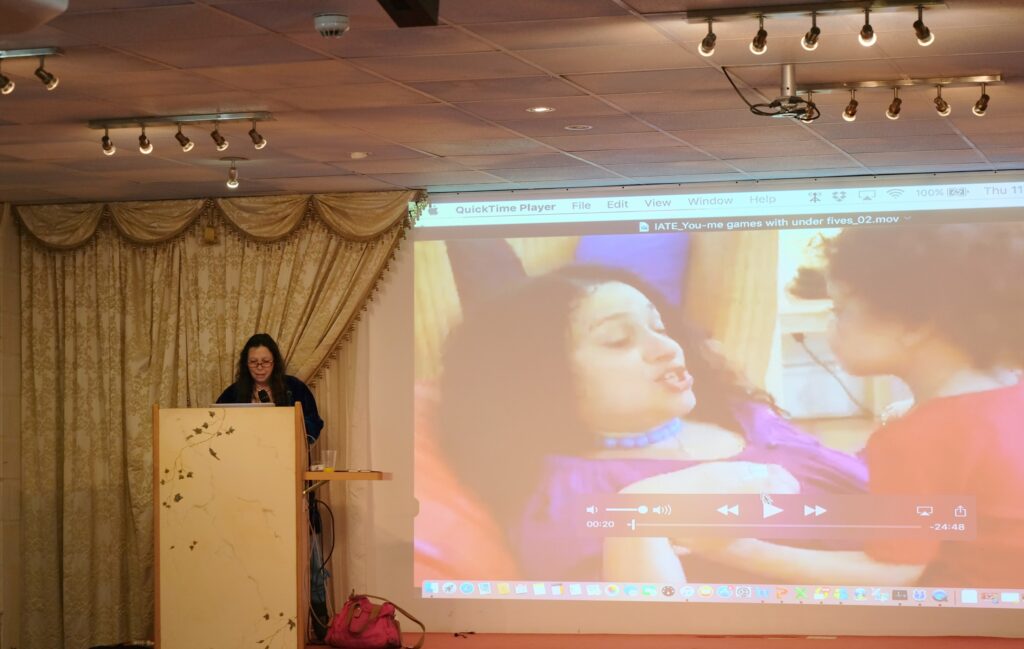
We watched a clip from one of the movies about adopting an ‘Owling’ strategy, which Dr. Margot Sunderland further explained as ‘Observe, Wait and Listen.’
Observe, Wait and Listen
Observe the child without intervention during play.
Wait to seeft how they respond, make eye contact and understand their manner and behaviour
Listen and then respond accordingly
This strategy is perfect for children from six months old onwards and the result actually encourages the child’s entrepreneurial side because you are allowing the child to lead the play and the next step of the journey. Being too invasive during play can actually lead to mental health problems later in life.
The commenting strategy
The formula for the commenting strategy is:
4 comments and 1 question
The commenting strategy during play is a key strategy for enhancing the child’s self-esteem. Commenting, rather than questioning or demanding actually makes the child believe that:
“What I am doing is really important.”
We are commenting on the child’s actions rather than criticising them. The verbal attention (the correct scientific term is ‘focus behaviour’) means that the child is far more able to have goal-directed behaviour. Accompanied play with an adult is key and just as important as solitary play.
Solitary play vs accompanied play
Solitary play is just as important as accompanied play as it allows the child to enter into his/her own realm where that child is the star of his/her world. However, through solitary play, the child only has his/her own encouragement and the play can then become quite short due to their short concentration span.
Commenting through accompanied play encourages them to continue being the star of their world where you become a part of their journey and the child revels in your awe and encouragement. Sometimes a child needs help to engage and explore a certain activity and this focus behaviour develops the child’s ability for sustained attention through attachment play.
Demonstrating the commenting strategy through play
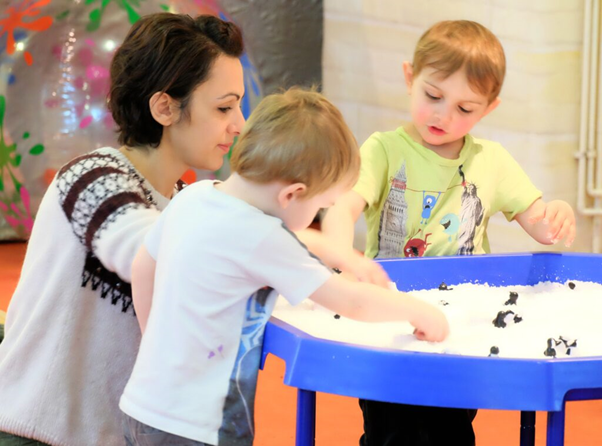
We were guided to a play area in the room where there were large snow table tops, filled with white and pink snow. Inside the snow table were penguins and cups and I observed Aidan creating a snowstorm. I listened intently to him excitedly call out a snowstorm and I responded accordingly with my comments.
“Ooh, it’s a snowstorm!”
This kind of play triggers dopamine levels and encourages the child to use their imagination to create a story, for which you are a character. If I noticed Aidan’s energy drop, I subtly commented and suggested a certain action, and then left him to lead the way.
“Imagination is more important than knowledge.”
Albert Einstein
Copying strategy
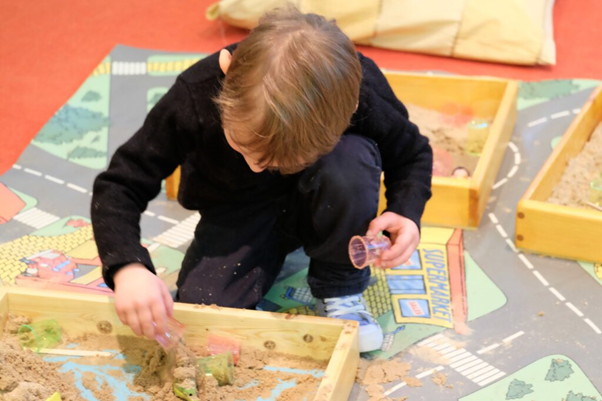
The copying strategy is another key strategy which helps you to get a better understanding of the child’s world. We further explored this strategy through sand and sand tools at the event.
If you put a two-year old in front of a sand-pit and say ‘play’, they won’t know what to do. It’s up to you to enhance their learning and imagination.
“Logic will get you from A to Z. Imagination will get you everywhere.”
Albert Einstein
The key here is to stay animated, copy the expression the child is using and any actions that may follow. For example, if the child goes under the table, you follow them. We watched a clip from one of the DVDs, where the mother was copying the child’s movements and the child was giggling with enthusiasm.
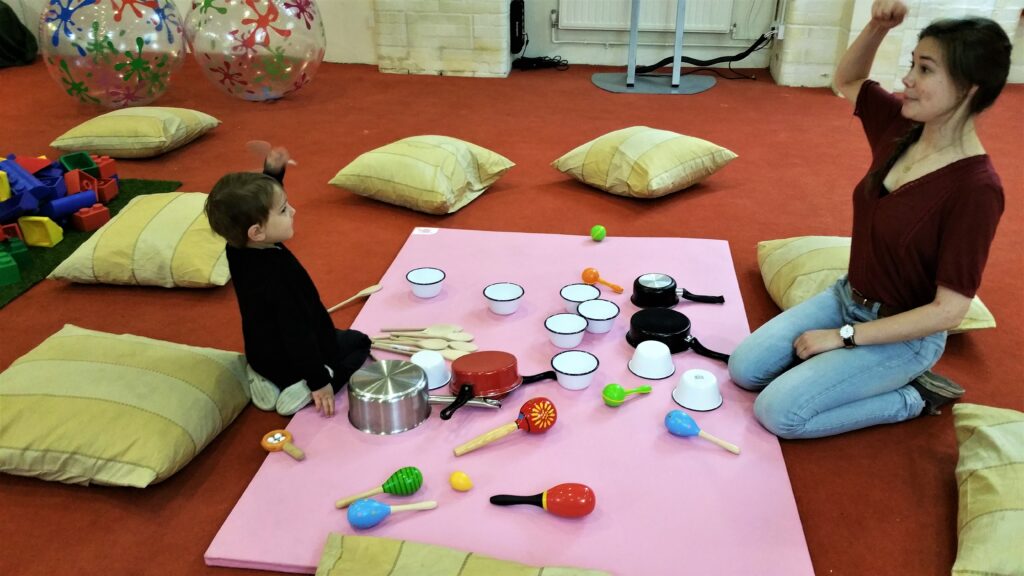
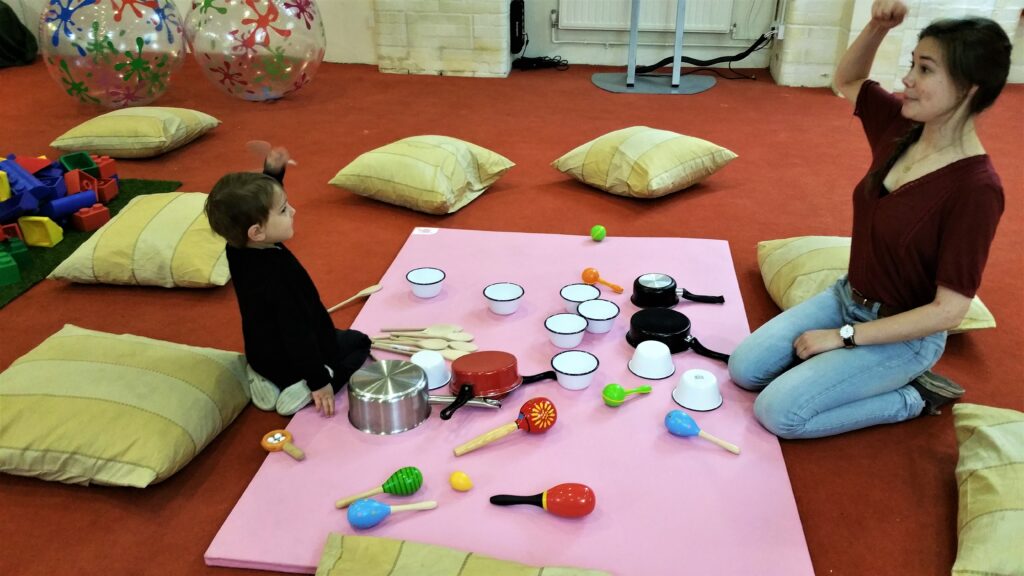
We were guided to have a go at the drums and explore the power of music at the event. I listened to Aidan drum a beat and then I copied him.
Music, especially drums, are a great way to bond with your child and create beautiful music together. Plus, drums are a hit with kids of all ages, including us adults! And, one hour of quality time is all that is needed to engage with your child and maximise their enjoyment in life.
We stopped at lunchtime for a brief bite to eat from an impressive array of jigsaw sandwiches and a fruit/veg selection. Post-lunch we talked about the use of drums, a beanie bag, and my favourite of all, the sensory room, which I am desperate to build for my children. It is a place of calm and special ‘you and me’ time.
We entered a very dark room in the corner of the main area and immediately entered a state of relaxation as the soft melodic music played in the background. Our eyes were drawn to an array of colours from lava lamps and other sensory toys. You can build a sensory room from TTS’s website for £50, so I will definitely have a go at doing one myself.
We also practised our ‘five-finger’ rule, which is the commenting strategy of five comments and one question as explained above. The first comment should be a suggestion or invitation to the play and the question should be an open question to encourage play of which you don’t know the answer.
Parent-child physical play
We ended our afternoon with lots of examples of physical play, for example:
Animal rides (a dinosaur ride to bed which will actually help to speed the process of bedtime along, although I haven’t tried this yet)
A bit of rough and tumble is very important for growth, but make sure to be the referee when things go a bit too far.
At the end of the event, Aidan and I left with a renewed bond and an increase in dopamine and opioid levels in our brains, as well as a lovely goodie bag of the three DVDs, two books, some finger puppets and chocolates for the boys.
The science
Dr Margot Sunderland explains the science behind all the activities shown in each of the DVDs and then demonstrates this through scenarios by a carer/parent and a child, in various you-me and relational games, suitable from newborn to twelve years.
“With all the pressures of modern-day parenting, quality time with your baby or child has never been more precious. Many parents want something deeper and more significant than the usual going to the park, the playgroup or watching TV together. [The DVDs] are packed with ideas for together times to strengthen your relationship in enduring ways, offering the richest shared experiences. The creative activities for quality time are designed to transport you into the world of sensation, imagination, wonder, delight and shared laughter. Using the latest brain science research, and featuring footage of the loveliest parent-child connections, the film aims not only to enrich your relationship now but to create memories for life.”
Why adult accompanied play?
Solitary play allows the child to play in his/her own world and brings about an important withdrawal time. However, the child’s attention span is a matter of minutes, so accompanied play with adults allows for sustained attention and encourages exploratory and social skills.
When a child engages with an adult they also learn important language skills, perhaps learning words through play that they may not have learned through solitary play. The vital commenting strategy also develops their communicative and exploratory skills and this leads to goal-directed behaviour. Becoming a character in a play where our child is the star also results in the child becoming inspired to create business ideas later in life.
Who doesn’t want an entrepreneurial child?
Utilising that imagination with the use of tools helps to develop a story and build up excitement. This kind of play increases the child’s dopamine levels, which develops their passion for learning and engaging life in an energised way.
For a child of three to four years old, start the story and let them develop. Suggest something and then leave for them to develop the story further. For example, use the sand like a rock for lions. Suggest a party and invite friends to make the party. Wait for the child to get excited and develop the story further. You can also bring in the use of other animals as additional characters to the story.
Games to play at home with your child
At the event, Dr Margot Sunderland introduced a few games that we could play with our children (up to nine years old) at home, which enhanced brain development. I got to try these games out with Aidan, but he wasn’t very receptive, opting to play with the other equipment in the room.
Dr Margot Sunderland urged us not to force our children to play, instead, allowing them to lead the way and gently guide them to these types of games should the opportunity arise, i.e. when they showed an interest.
Parent-child puppet play
Communicative tools like puppets enhance the parent-child relationship and can be used as an aid to help the child think about their feelings, instead of ‘behaving’ their feelings. Use the puppets as a way to reflect what that child is feeling if they don’t want to talk to you. There are many ways you can utilise puppet play to really enhance engaged play.
You can make puppets together and then take them on a journey.
Create ‘feeding’ puppets. Allow the child to feed the puppet and create some play around it. It’s better to not show the child that you are taking food out of the puppet’s mouth in order to keep the imaginative play seem real (paradoxically).
Use puppets to bring story books alive. Act out some of the parts in the story, making the puppet a particular character in the book.
Other props you can use for play
Other props can be used as communicative tools with the child and help to explore a fantasy journey. These can include plants, foods, cushions and blankets. Incorporating messy play has tons of psychological benefits and enhances brain development. Messy play and small world play when other people are involved trigger amazing brain growth fertilisers.
“Imagination grows by exercise.”
Somerset Maughan
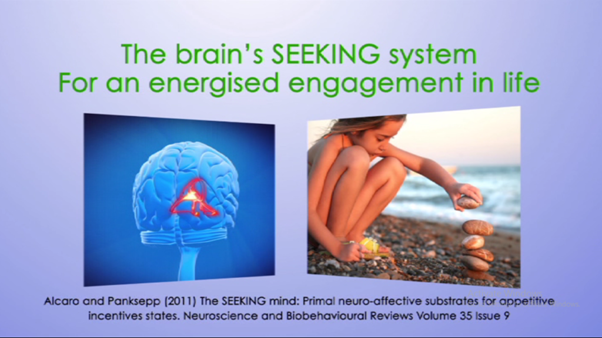
The SEEKING system is a part of the brain that your child needs to work really well if they’re going to learn how to be kind and empathetic to others. It also helps to enjoy good relationships and live life to the full. Brain fertilisers enhance brain development, which is critical for physical and mental health.
“Just as plant fertilisers make plants grow better, brain fertilisers make the brain function better.”
Dr Margot Sunderland
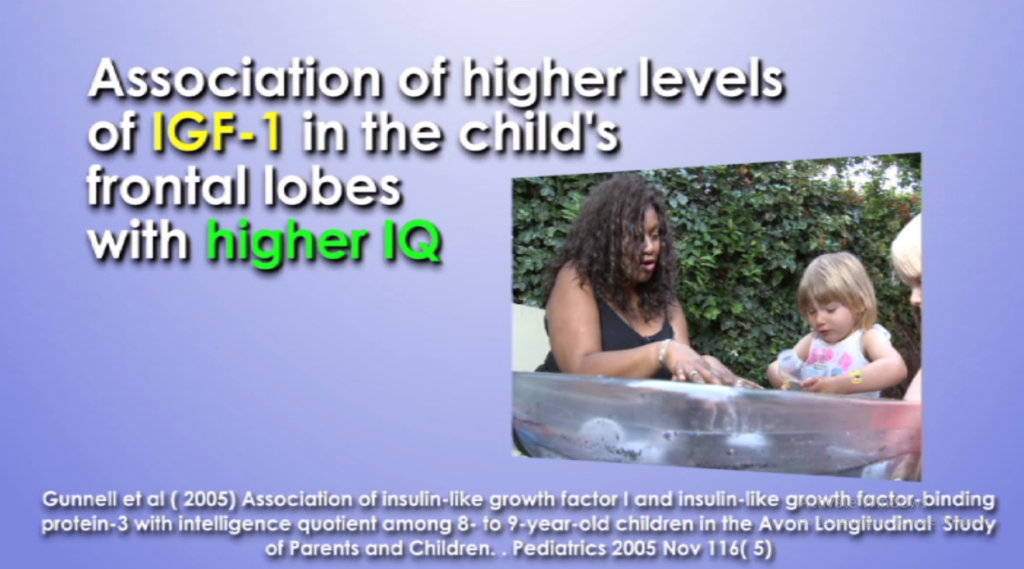
The Brain-Derived Neurotrophic Factor (BDNF) and the Insulin-like Growth Factor 1 (IGF1 -1)
BDNF and IGF1-1 promote growth in the frontal lobe so positively that they affect the human functions, i.e. the ability to learn, problem-solve, to attend and concentrate, as well as to handle stress well. [3]
In fact, research on five-year-olds showed an association of higher levels of the brain fertiliser IGF1-1 in the frontal lobes of those with a higher IQ.
The number of brain connections (dendritic spines) in the frontal lobes is significantly higher in the child who has experienced the enriched environment, i.e. more connections.
Impacts on the Hippocampus, which is the key memory system in the brain, helps your child to learn.
What is an enriched environment?
An enriched environment has four key elements to it. Messy play and small world play are great examples of an enriched environment because they engage the child’s:
Thinking (cognitively)
Movement level (physically)
Social intelligence (you’re there with them)
Sensory skills (you’re helping them and playing alongside them)
“Every child is born blessed with a vivid imagination. But just as a muscle grows flabby with disuse, so the bright imagination of a child pales in later years if he ceases to exercise it.”
Walt Disney
If you give the child the same thing everyday for a month, it ceases to be amazing.
There must be a novelty for the advantageous brain effects of enriched environments. Brain fertilisers will be activated with a novel environment when combined with social interaction.
Messy play – the three key stages
“There are three stages of messy play: dry, soft and wet.”
Denise Tulloch Johnson, Senior Play Leader and Communication Specialist at The Institute for Arts in Therapy & Education
You can start at the baby stage with dry messy play, like raw pasta and colouring pencils. Once the baby starts to enjoy them, you can move them onto soft messy play, like playdough and cooked or play pasta. After that stage, you move on to wet messy play, which is water and cornflour.
Not every child will enjoy messy play, but it is important to just follow their lead and join in with them. It would be very helpful for the parent to join in too. If they see that you are enjoying the messy play, they will too.
Some ideas for messy play
Active world tray with stand (TTS Educational Resources – www.tts-group.co.uk
Rectangular tray (TTS Educational resources)
Gelli Baff – have spoons, ladels, cups etc (find at TTS Educational Resources)
Snowflakes in water – teapots and stuff to pour from
Shaving foam without scent – play jelly games
Crazy soap (to blow bubbles at each other or put on head)
Rainbow sparkles (use ladles to pour into measuring jugs and other cups – it makes a lovely sound and feel). You can also move your hands through the sparkles for a great sensation.
Rice and food colouring – uncooked (use blue and red colours side by side where children can mix and the texture feels great)
Cornflakes – you can eat them and play with them. Cornflakes provide an auditory sensation. Add other animals.
What to do when a child doesn’t enjoy messy play
You can always use tools to encourage messy play if the child doesn’t want to touch directly, i.e. spades, spoons and straws. Allow them to watch the messy play, which helps them to prepare themselves for what’s to come. Ideas to encourage messy play is to add some flour, mix with a spoon and add water with different colours. Don’t forget to use the commenting strategy when helping the child prepare for messy play, for example, “Oh, you were adding blue!”
Messy play is good for fussy eaters
Encourage your child to become more open to trying new food by allowing them to play with it. Create messy food play, using spaghetti with pots and pans and cereal with water and spoons. You can use oats with warm (sterilised water) for younger children. The child will gain the opportunity to smell, squeeze, roll, flick, squash, feed or taste the food. Ultimately, food becomes more natural for them. So, as long as it’s safe for them to eat then it’s fine for them to play with.
Messy play and small world play engages all the child’s senses
If you just isolate one of those key elements, it wouldn’t work. So, all senses have to be present and engaged in the activation of those fantastic brain fertilisers.[4]
“The play environment must feel new to the child. But, you can’t keep running to the toy shop because it’s far too expensive. So, we are going to show you lots of different ways of creating new stimulating messy play and small world play environments with little expense.”
Dr Margot Sunderland
Key ways of communicating with your child
Dr Margot Sunderland talks about how to communicate with your child, i.e. make your voice interesting, observe, wait and listen (owling) and then respond accordingly. Using eye contact shows respect and it helps you to pay attention, as well as recognise your child’s needs.
Get down onto the child’s level, so you can maintain that eye contact and communicate clearly with them. Positioning is important too. Sit in front of the child, so they can watch, observe and communicate your lips and facial expression.
When something new or potentially frightening happens to a child then it’s very important to help the child reflect on it, ideally before it happens. You can use little dolls and set up the scenario. For example, if mummy is having a baby then you can set up the doctor talking to mummy about having a baby.
When you’re talking about something serious or important, often the child would be distracted and their attention will be elsewhere.
With dolls, you can get their attention and help them focus on what’s going to happen so they’re prepared. It’s like they’ve almost had a rehearsal of what will happen and they’re not sent into a terrifying shock state.
Copying strategy
We touched upon the copying strategy above, but it is another key strategy to help you get a better understanding of your child’s world. Copying them helps them to own the play. With babies, you can copy their sounds to develop communication and build self-esteem. For example, if the child goes under the table, follow them into their world.
Communicating strategy
Communication is key because it enhances self-esteem and potency – it makes the child believe they are doing something right.
Commenting strategy
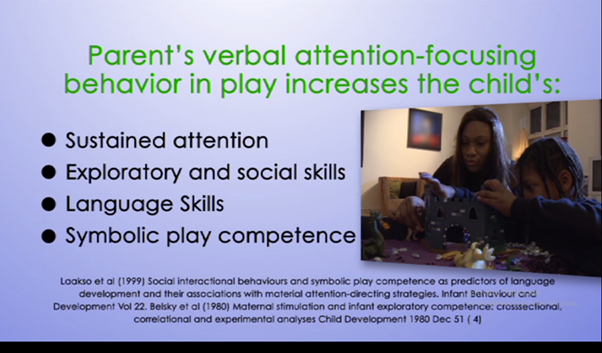
Also known as ‘adult verbal attention-focused behaviour’, the commenting strategy is proven to develop a child’s cognitive creative ability [5]
If you don’t comment, often the child loses energy and enthusiasm. Commenting keeps up the child’s flow and go-getting attitude and develops that proactive go-getting attitude later in life. The commenting strategy:
Develops the capacity for goal-directed behaviour later in life
Aids language development
Helps the child make a connection between verbal communication and play
For example, when they are playing with a toy, talk to them and comment about that toy.
“Oh, the elephant is grey! That elephant has a big long tusk.”
Asking the child a question may pressurise them into answering you without knowing the answer, so it’s best to use what is called, ‘The 5 finger rule’ (which we touched upon above.)
The 5-finger rule
For every question, you do ask (you must not know the answer) comment four times. If you don’t know the answer, you can ask a question.
Follow the child’s lead and the child will stay attentive if they set their own game. If you don’t follow the child’s lead then if it’s no longer about them, they may lose interest. It must be all about the child.
You can take turns for example, ‘I talk, you talk, I talk, you talk’.
Don’t overstimulate or under-stimulate
The play environment should not have too many toys or the child will lose focus and not maintain attention.
Choose your child’s favourite toys and teach through play how to share and take turns. You can use OWL skills to set out an environment appropriately.
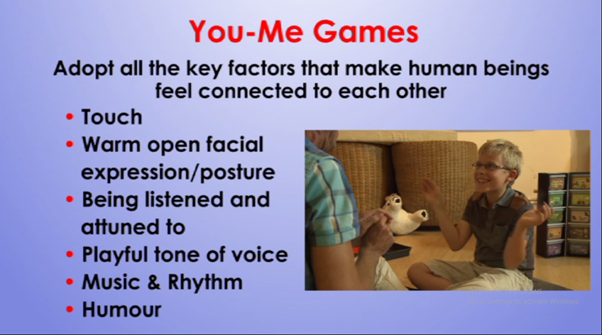
You-me games
You-me games adopt all the factors for the parent and child to connect with each other. They are deeply intimate face-to-face times which is so beneficial for brain development and protects against depression later in life too because they adopt all key factors that make them human beings.
There are different types of you-me games. These are:
You-me lap games
You-me music games
You-me sensory games
You-me physical games
You-me hand games
You-me balls, quoits and hoop games
You-me imagination games
You-me games bring out a state of the interpersonal synchrony: a delicious feeling of oneness with each other [6].
Use warm open facial expressions/posture and a playful tone of voice. Incorporate music rhythm and humour in your you-me games so the child feels listened to. Relational play can also bring about new brain growth in the Hippocampus (key memory system in the brain). [7]
“You-me games optimises the chances of real moments of meeting between the parent, the carer of the child.”
Dr. Margot Sunderland
“When a [child] sees their specialness reflected in their eyes so they see it in themselves.”
Helen Reiss[3]
Avoid teaching, criticising or commanding as this kills off the play. Instead, use lots of encouragement and praise and suggest rather than teach or command. It’s all about the power of suggestion.
Shimmy shimmy coco-pap
Sit with your child and incorporate lots of interesting voices, including facial and hand contact during play.
“Shimmy, shimmy coco-pap. Secret animal on your back. Which animal crawled up your back? Shimmy. shimmy coco-pap. Spider, spider up your back! Which finger did that?
And then other poke them or tickle them on the back.
Make an animal noise and wait for your child to answer. If they don’t answer straight away, answer for them.
Bang and shake
You will need:
Shakes
Pans
Wooden spoons
Funky background music
You-me messy play
Don’t make the mistake of thinking that messy play is just for the under fives. It’s an ‘enriched environment’ triggering brain fertilisers and enhancing cognitive development. So, don’t deprive your over-fives of quality messy-play time!
Can I visit your castle?
You will need:
Clay
Clay tools
Small natural objects like leaves, buttons, shells and feathers etc
You can create little sections which are divided into subjects such as the zoo, the fair, the seaside or shopping. The boxes should be labelled as such.
Ask the child to tell you a story. Or if they prefer, you can tell them the story. Use the five-finger rule to comment on their story or how they’re playing and then ask a question, of which you shouldn’t know the answer.
Making sock puppets together
You will need:
Two socks
Buttons for eyes
Wool for hair
A good glue
A timer (optional)
You can play one-minute finger puppet games and come up with a range of finger puppet characters.
You can also create a miniature puppet theatre which is a great way to enhance parent-child physical play.
You-me games for middle childhood
Pitta Patta Polt
“Pitta patta polt, to shoe a little colt, to shoe a little colt, pitta patta polt”
You-me hand games
Poking games
“A sailor went to sea, sea, sea. A great big shark that gobbled up little boys/girls!”
Then think of an animal that has a touch sensation.
Breakfast bonanza
“Potato, potato, break the egg, break the egg. Stir the beans, and eat the breakfast!”
Then pretend to eat the child.
Cycling song
“Cycling, cycling down the road. Whoops, watch out there is a toad! Cycling, cycling up the hill. Thrill!”
Use hands/arms first and then feet to mimic cycling.
You can use any animal but you mime the animals venturing the obstacles on the tray.
Drum hat
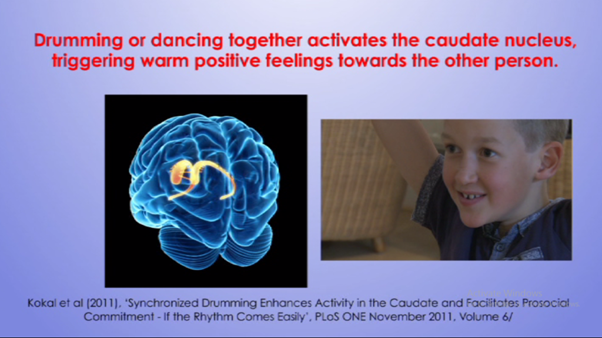
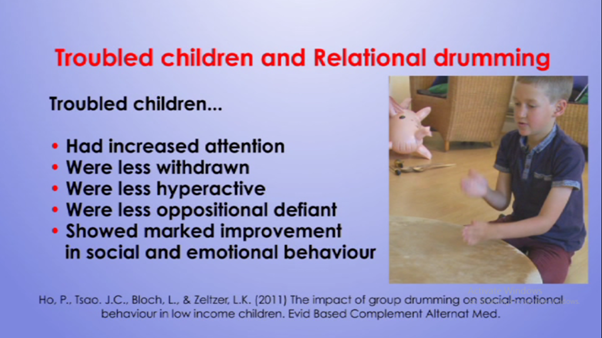
The caudate nucleus, the part of the brain that is activated through drumming or dancing triggers warm positive feelings towards the other person. [8]
Relational drumming also enhances a calm and meditative state and boosts the immune system, making the child less hyperactive and aggressive.
You will need:
two silly hats
A large floor/gather drum
You bounce the ball onto the drum for the child to catch in the hat and then vice versa. As the child becomes more confident you build up a rhythm
Great you-me games with baby
Where’s Mr Sausage Dog?
Hide a sausage dog under a towel and then ask the child where he is? Make woofing noises to help the child find the toy. This is a great game for a baby too.
Silly sock
“I’ve got a silly sock on my head!”
Put something silly, bright and colourful on your head and comment with enthusiasm
Music band
Suggest and then OWL (Observe, wait and listen) – then praise. Use funky background music and a big drum. Encourage baby to hit the drum to different rhythms and sounds. You might even be able to trigger and “call and response” drums to hold baby’s attention more than other toys.
Dancing delight and cuddle dancing
Hold baby close. Daddy can get involved with sway dancing too.
Sand box and sand
Sand is great for sensory play. Place baby’s feet in the sand and sprinkle. Hide feet and show surprise when they appear.
Splishy splashy
Use a water container and add ducks (use the copying strategy here to ensure baby is in charge of the play). Get some sponges too
Foil crunching
Use a foil blanket from a camping shop. Sit baby opposite and use the copying strategy, so when they ‘crunch’ the foil, copy them with the same energetic tone. Be careful not to up-stage them.
Scarf peekaboo
Use a sheer scarf, cover them and then say peek a boo!
Hide toys
Hide the toys and then ask baby where the toys have gone. Help them find it if they’re lost.
Ready steady arms
Gently hold baby’s arms and rhythmically say “ready, steady, go!” On “go” lift his/her arms over their head and make your voice interesting.
Face tracing
Hold your baby’s hands to your face and trace down the sides of your face three times rhythmically with humming sounds. End with a large cheek pop. Repeat.
Up to the sky
Place baby up in the sky and then down again to the ground.
Playing ball
Roll the ball to baby and wait for baby to roll back. Stay animated to activate dopamine levels in the brain
You-me tickling games
Some great you-me tickling games with baby are:
Simple tickling
Chica-boo-boo (thumb and two-finger to tickle tummy and toes)
Freddy frog and ruby rabbit – introduce them by tickling and give them names like FF & RR
Tummy time
Tummy time from day one is essential for helping baby to sit up, crawl, roll over and develop upper body strength.
Place your baby on a mat and then prop him/her up on a rolled up towel or tummy time pillow with arms out in front. Lie down opposite your baby so ou are at their level.
You-me games for under fives
Some great games for under-fives that I’ve mentioned before are:
Breakfast bonanza
Cycling story
Ice cream song
And other songs like the Grand old Duke of York
A sailor went to sea
Tick tock – bounce the child the number of times that you strike the clock, for example. ‘Now I’m striking 3 o’clock!’ Bounce the child three times on the ground.
I’ve got jelly on my knee. Lay your child on the knee and use music for movement. Use other animals and objects.
Bang and shake
Ball and big drum
Drum hat
Dancing delight and cuddle dancing
You-me ball games
Rainbow ice cream and pizza making
You-me imagination games using objects like puppets. Puppets can eat all sorts of things which you can mime
Little beach, big beach
You will need:
Two large beach balls
Small sand traay with small beach props (people, sea creatures, etc)
Begin by playing together at the beach. When someone says “big beach” go play with big beach balls. When someone says “little beach”, you go back to the sandpit.
Mummy (or daddy)’s sleeping game
The child helps you to sleep and wake up. Encourage your child to think of different ways to wake you up.
Cooking for mum and dad
Use real or imaginary items to cook for mum and dad. Repeat ingredient and recipe ideas. Use the commenting strategy here and keep the comments positive.
Animal telephones
You can use a talking tube set. Encourage the child to talk to an animal or be an animal.
Castle visit
Use clay, clay tools and small natural objects and become a small person in their world. Ask to visit their castle and get in with them. Sit facing them at all times. Use small world toys, plastic pouring jugs, bubbles etc.
You-me sensory play
“Parent-child sensory plays allows you with your child to have a very intimate time where awe and wonder are at the fore.”
Dr Margot Sunderland
Sensory den
You will need to set up a darkened area in the house. It could be a blanket over two chairs or a wigwam or tent inside and inside you have lots of lovely special lights, which you would use at the same time as the child.
As well as it being sensory, you’re actually emotionally regulating them at the same time and meeting them in these states of awe.
Children can become overwhelmed with cognitive tasks during the day so they need sensory breaks to help them learn. Maybe the stress of being at school can take over and they start behaving in difficult ways. Encourage them to go and have some special time in the magic cave. It’s not just about going into the sensory zone and playing though, it is an emotionally regulating event.
When you’re playing with them in the sensory zone, relate at the same time. Use this time to be calm and keep the child in a calm state. The autonomic nervous system is in a far better state when it’s calm and it makes it easier for the child to go back to the classroom in a regulated sate and engage in cognitive tasks. Enable the child to enter into states of awe and model that awe and wonder so they can see.
Have two of everything so you can do it together and keep calm! They need to borrow your imagination and mature brain function. So when a child picks up an item, you pick one up too.
For an older child of three or four, let their imagination run wild, for example, “These are magnificent trees and they only live in a magic forest!” Echo and amplify positivity to what they’re doing. Tell them a story.
“Once upon a time there were three magical eggs.”
Then, what happens next? If you are afraid to tell a story, it’s important to still try as imagination tends to take over lights that respond to sound. It’s great for relational play and echoing with your voice activates oxytocin. The release of oxytocin (anti-anxiety brain chemical) from the warm lights, the sound of your calm voice and soothing background music are very calming for a child.
Social play using roleplay
Adding the idea of roleplay events like Giggleverse can enhance laughter and fun play and bring families closer. Giggleverse is a special place filled with fun adventures and offers different fun areas for kids to explore, like fairy lands and pirate worlds, making it great for playing and having a good time. This magical world helps parents and kids enjoy happy moments together, strengthening their bond. Whether it’s going to fun events or just playing together, Giggleverse is all about creating happy memories with lots of laughter.
Why are these games good for the brain?
These you-me games are hugely powerful because they activate a brain fertiliser called brain-derived neurotrophic factor or BDNF for short.
You-me play develops a key part of the brain where Dopamine Pathways are activated to enhance learning and concentration, emotions, motivation, and energised engagement in the world.
What happens if your child has low levels of dopamine?
Your child will procrastinate and they won’t really know what they want. They have a lack of motivation and will rarely carry something through or finish what they started. They just can’t be bothered or they will seem ‘lazy’.
“It’s never too late to activate these chemicals and one of the key ways is relational play.”
Dr Margot Sunderland
How do opiods help?
Opioids are anti-anxiety, anti-aggression chemicals which are optimally activated through physical relational play. Opioids give us a wonderful sense of wellbeing. The more these chemicals are activated in a relationship, the more the brain habituates to them – so “emotional states become personality traits” [9]
“Can a fully social brain-emerge without play or will it remain socially stunted for life?”
Professor Jaak Panksepp 2007 World Leading affective neuroscientist
Games like ‘rough and tumble’ can develop these chemical systems.
What is ‘rough and tumble’ play?
Rough and tumble is about meeting a child in an intense arousal state.
“If we can’t meet the world with energised engagement, the problem is that sometimes we don’t feel passionate about learning and we don’t feel passionate in love. So it’s a key time where you can actually meet the child in an energised engagement which can be then transferred into skills to meeting life with energised engagement.”
Dr Margot Sunderland
Rough and tumble helps develop brain systems and increase dopamine levels
Interactive physical play turns on the brain fertiliser BDNF and helps develop brain systems which are key for attentive learning. Physcial play can also help you reconnect with a child during/after difficult times.
“Sometimes, if you haven’t, as a parent, had relational play, it is a bit difficult to know what to do.”
Dr Margot Sunderland
There will, of course, be times when your parent/child relationship is fraught and you’re fed up of each other. Physical play breaks the ice and brings you back together after a conflict.
So what are some great ‘rough and tumble’ games to play to enhance opioids?
Sausage roll
Up and down together game
Lap rides (over fives can enjoy too!)
(Place the child on your lap and playfully move them around according to the method of transport that you have chosen.)
“I’ve got a train/I’ve got a tractor/I’ve got a choppy boat.” Etc
Rescue games
Animal footsteps
Rucksack (walking up the parent!)
Good old pillow fights!
Animal rides (child chooses which animal you will be)
Sandwich time
Mummy into the river
Breakfast bonanza
(Mime the words and show breaking the egg and mixing the beans.)
“Break the egg, break the egg, mix the beans, mix the beans/stir the pot, stir the pot.”
And then pretend to eat the child with lots of fun eating noises and actions.
Safety first!
Make sure to take off any jewellery
Make sure there isn’t anything in the room that is sharp or where the child can hit their head.
Be aware of tummy and organs through thumps!
Make a rule to keep games safe
Use a comfortable seat for seated games
Be a hands-on referee if things get too rough!
When to play you-me games
You can play these you-me games whenever you have spare time. Some examples could be:
When you’re waiting for the bus. Suggest, “How about we play x, y, z games?”
Make blocks of quality time available
Before you send them to school, use the moments to connect
When the kids are going to bed, take them on your back. Turn them into a dinosaur, a rocket or you can become a helicopter ride.
What happens if your parent/child relationship is weak or there is a conflict?
It’s quite normal for your child to do something provocative and all of you feels like wanting to say:
“Don’t you talk to me like that!”
But, actually what the child is doing is not a big deal and your negative reaction could really rupture the two of you, i.e. crossing the transaction and refusing the power play and go into humour. It is a deeply intimate thing to do and physical play will connect you. But really tune into the child’s non-verbal cues in terms of whether they are enjoying the game or not.
Playful parenting brings about far better behaviour than punishing parenting. Maintain eye and physical contact. Use lots of moments during the day to tell the child you delight in them, even during those stressful days.
Playful parenting activates:
Anti-anxiety chemicals
Anti-aggression chemicals (so children grow up not interested in fighting) [10]
Stress hormone activates aggressive and bad behaviour in a child.
The above games are just some of the games that will help you to build that special bond with your child. Use your imagination and create a world where only you and your child live and allow the child to lead the play while you bask in the delight of spending time with them. Spending the time to play with your child this way will encourage your child to have a happy and healthy life well into adulthood!
For information on events and updates at The Centre for Child Mental Health, please check out their Facebook and Twitter page
Resources
[1] – Sevilla, A (2014) Economic and Social Research Council Britain June 2014
[2] – Parent-Play survey, Playmobil UK 2013
[3] – Mohammed et al (2002) Environmental enrichment and the brain Chapter X in Progression in Brain Research Vol 138 Hofmn et al (Eds)
[4] – Pang et al (2013) Enhancement of cognitive function in models of brain disease through environmental enrichment and physical activity Neuropharmacology.
Sale et al (2014) Environmental and brain plasticity: towards an endogenous Pharmacotherapy. Physiology Review.
[5] – Belsky et al 1980 and Laakso et al 1999
[6] – Grelli et al (2014) Interpersonal Synchrony increases pro-social behaviour in infants Developmental Science 2014
[7] – Wohr et al (2009) New Insights into the relatinosihps or neurogenesis and effect: neuroscience 2009 vol 163
[8] – Kokal et al (2011), ‘synchronised drumming enhances activity in the Caudate and facilitates prosocial commitment – if the rhythm comes easily,’ PloS ONE November 2011, Volume 6
[9] – Bruche Perry Child Trauma Academy (famous neuroscientist)
[10] – Panksepp and Biven (2012) The Archaeology of Mind Chapter 10 Playful Dreamlike Circuits of the Brain
Disclaimer: Motherhood Diaries was invited to attend this event for free, but all opinions are 100% my own.
Epilepsy in childhood
You never really think that your child will be ill and you are just happy, if a little tired, to have a new baby crawling around. I was at work one day when our daughter was 8 months old and I received a call from the health clinic. At first, I was a little confused as I get many calls and thought it was to do with an existing client at work. The health worker said not to panic, which isn’t the best thing to say as you always start to panic straight away, that my daughter had a seizure whilst at the health centre and they had called for an ambulance. My wife then came to the phone which didn’t help the situation as she was very distressed and not explaining things properly.
“What happened to her?”
“She turned blue and started shaking, get to the hospital now.”
That’s the only thing I remember her saying and was focusing on all the way home:
“She turned blue”.
I stared at my computer screen for what seemed like ages, hoping that I hadn’t really heard what I just did. Somewhat dazed I left work immediately and got the train home, picked up the car and drove to the hospital. All I could think about was the worst thing possible – I couldn’t live without my little baby. When you haven’t got any information as to what has happened you feel sick and overwhelmed with emotion and don’t think logically. I just panicked all the way to the hospital.
I got to the hospital children’s emergency ward then saw my baby lying on a hospital bed with a load of wires taped to her, which was a terrible thing to see.
Amelia on arrival at the hospital
The doctor on call confirmed that she had a seizure. He explained that the most common type of seizure seen in children Amelia’s age was a febrile convulsion, caused by a high temperature. But Amelia’s temperature had been normal at every check, so she needed to be kept in for further tests. As with many things in life, it is the fear of the unknown that brings the greatest anxiety. Once the doctors had spoken with us about the situation and why they were doing the tests, the worry was still there but I felt a bit more in control, just by understanding the process and knowing what to ask next. The next morning, my daughter seemed fine and the doctors couldn’t find anything wrong with her. We were told that everyone is allowed one seizure throughout their life and it might never happen again, and we went home.
Several weeks later I was at home when she had a second seizure where she just went limp. We laid her on the floor and she started shaking, not violently but it was horrendous to see a tiny baby shaking. I phoned the ambulance panicking and cannot remember what I said, but if it wasn’t through my wife putting our daughter in the recovery position and being calm I am not sure what I would have done. I always thought I would be calm in an emergency situation, but it is different when the reality hits you and it’s your own child there shaking on the floor. When we got to the hospital we were asked the same questions constantly by many different doctors, which we didn’t mind as we had been told that there are over 40 different types of seizure and how the body shakes if one side of the body shakes more, where the eyes look etc, can all determine a diagnosis. However, I was so panic-stricken at the time I couldn’t really remember how her seizure developed or if her tongue came out – all I was doing was telling the ambulance person to get her quickly!
The hospital then took more blood samples and carried out further tests. They told us that Amelia might have a tendency towards seizures (epilepsy) and that most epilepsies have no known cause, but as there are other underlying conditions that can trigger seizures they would need to refer her for certain tests to eliminate these first. She was referred for ECG and EEG tracing and also for an MRI scan where she had to be sedated and went into a scanner. This is when we really started to get scared. When we were told they had to check she didn’t have a brain tumour, I think that was the worst moment, and having the scan on New Year’s eve meant it just played on my mind constantly for the four weeks we were off beforehand. How could we deal with news like she had a brain tumour, and then going through numerous operations and more worry – or worse?
An anxious wait for results
Also when they said she could have delayed development from the seizures it made me cry, but thankfully she was always active several hours after her seizures and there hasn’t been a worry since. I suppose the doctor has to tell you the worst possible outcomes, but when you are dealing with children who cannot tell you how they feel there are times when I just wished they wouldn’t.
In between the tests and after the third seizure she was put on anti-epileptic medication (sodium valproate) and we had an epilepsy nurse visit which reassured us somewhat. She suggested that if Amelia had another seizure we film it, as strange as that sounds, as it could help them diagnose it better. She had a mild seizure shortly after seeing the nurse, though as she was on the medication this took the edge of it. My wife filmed part of the seizure when she knew my daughter was safe which really helped the consultant paediatrician. Her medication has been increased since the last seizure and thankfully she has not had one since.
Recovered well at the Tree House unit, Stepping Hill Hospital
We have been told that the majority of children with epilepsy either grow out of it in later life or have the condition well controlled by medication, which is really reassuring. The doctors also told us that most epileptic seizures are not damaging to the person having them and are scarier for the person watching. If she doesn’t have a seizure in two years they can look at taking her off the medication. We are so grateful that she is well now and if she continues to have seizures in the future we are better prepared and more knowledgeable thanks to all the help and support we have received from our local hospital and epilepsy support nurse.
Childhood Epilepsy Facts
(from “Epilepsy – a Parent’s Handbook” by Nina Solomon, Young Epilepsy, 2011)
Epilepsy is defined as “repeated seizures of cerebral origin”
The condition affects approximately 1 in 200 children
Epilepsy can be caused by damage to the brain, but in most cases, the cause is not known
Epilepsy can be inherited, but in most cases, there is no family history of seizures
Only about 5% of children with epilepsy are sensitive to flashing or flickering lights (photosensitive epilepsy)
75% of children either grow out of their epilepsy or have the condition well controlled by medication
What to do if a child is choking and your first aid steps
*This post is not sponsored or gifted. This article is about raising awareness to parents on the importance of learning basic first aid skills, so you can help a child if they are choking. For more information on any of the points raised below, please visit the British Red Cross’ website and the links within the article for extra reference.*
*Please also note that the information included here is intended for parents or relatives to learn so they can help their little ones in an emergency. Anyone looking after children in a professional setting is required to be qualified in first aid – visit here to find out more about your legal requirements*
Last year I conducted a mini informal survey with parents on what their biggest fear was related to their child and the subject that came up the most was choking.
This fear was further realised when a friend’s two-year-old daughter tragically passed away from choking on a piece of food at nursery. I have never felt so much grief for the family and the strength and support they’ve received has been nothing short of amazing. As a result, Sadie’s parents triggered a petition for sausages and grapes to be banned at nursery and a fundraising page has been set up for children’s intensive care charity COSMIC.
“It’s important that [nursery] staff are trained, are able to react quickly and have the confidence to respond to any incidents.”
Purnima Tanuku, Chief Executive of National Day Nurseries Association (NDNA)
Choking has been my biggest fear, especially when my middle one choked on a lollipop when he was 18 months old and I almost broke his back getting it out. Thankfully, I was successful and the reason for this was that I had learned basic first aid just a few months prior. I am so grateful for the first aid I learned because if I hadn’t known what to do, I dread to think what may have happened.
Three out of four parents in the UK would not be able to save their baby from choking.*
Research by British Red Cross
So, Motherhood Diaries is raising awareness on the importance of learning basic first aid skills so you know what to do when a baby or child is choking. Nobody wants their child in an emergency situation, but learning simple first aid steps can give parents and parents-to-be the confidence to be able to help and save their child.”Babies can be very curious and love to explore their surroundings by putting things in their mouths, especially when they’re teething. No parent wants to be in the situation where their baby is choking and they don’t know what to do, but helping is easy when you know how.”
British Red Cross’ survey of parents across the UK also found that 20% of mums and dads have never learned first aid through any means, with a third of parents of babies under 2 have never been on a first aid course.
This article sets out the first aid procedures needed when helping a baby under the age of one who is choking and how to help a child over the age of one who is choking.
“The steps are the same for all age groups except for a child under one, so it makes it pretty easy to remember in an emergency.”
Stella Jenkins, Paramedic Clinical Tutor for the London Ambulance Service.
What should you do if a baby is choking? (Under one year old)
A choking baby will not be crying, coughing, breathing or making any noise, so as soon as you spot that something has been lodged in their throat, the steps are:
Step 1 – Give up to five back blows
Hold the baby face-down along your thigh with their head lower than their bottom.
Hit them firmly on their back between the shoulder blade up to five times. If back blows do not dislodge the blockage, move onto step 2.
Step 2 – Give up to five chest thrusts
Turn the baby over so they are facing upwards. Place two fingers in the middle of their chest just below the nipples. Push sharply downwards up to five times.
Step 3 – Call 999 if the object does not dislodge from their airway
Continue with the cycles of back blows and chest thrusts until the object dislodges or help arrives.
A choking infant may need hospital care after medical help arrives.
Check out the video and the step-by-step instructions below on what to do if baby is choking:
https://youtu.be/ePodw7L_mFM
Helping a child over the age of one who is choking
A child who is choking may be clutching at their chest or neck but will be unable to speak, breathe or cough. Follow the first aid steps and emergency action plan below to help dislodge the object:
Step 1 – Give up to five back blows
Hit them firmly on their back between the shoulder blades. If back blows do not dislodge the object, move onto Step 2.
Step 2 – Give up to five abdominal thrusts
Hold the child around the waist and pull inwards and upwards above their belly button.
Step 3 – Call 999 if the object does not dislodge
Continue with cycles of back blows and abdominal thrusts until the object dislodges or help arrives.
Check out this video for step-by-step instructions on what to do if a child is choking:
What else can you do to help?
Stay calm
Try to stay calm and think clearly. It’s difficult not to panic in emergency situations, but try to remember that simple actions can be all you need to make a huge difference. If you do need to ring 999, remember the call handler will also be able to help you and guide you through the actions to take.
Learn more with the free British Red Cross Baby and Child First Aid app
Carry around the first aid skills you need by installing the British Red Cross’ Baby and Child First app, which provides you with easy-to-learn skills to help a baby or child in a first aid emergency. You’ll get:
Useful tips
Animations and video clips
Test your knowledge with quizzes
Record your child’s medication needs and any allergies
You don’t need an internet connection to access the app info either!
You can enhance your knowledge by heading online and building on your basic first-aid knowledge. Head here for more information.
First aid courses are available. However, they are not operating at the moment due to Covid-19. You can stay updated here to find out when the course will be up and running again.
Children can learn first aid too
Kids from ages 5-18 can learn first aid via British Red Cross’ brand new online resource, First aid champions.
First aid education is now on the RSE and Health curriculum in England so First aid champions can be used by all schools in the UK to teach kids and young people how to save a life. Parents can also use First aid champions to help their children learn essential skills at home.
First aid champions feature films, roleplays and quizzes to help children learn first aid skills in a fun way so they can feel confident to act when they need to. They can also learn about kindness as well as how to cope during pressure and keep calm while they keep safe too.
FAQ and recap
What is the definition of first aid?
First aid is the first and immediate assistance given to any person suffering from either a minor illness or injury, which includes choking.
How do you know if a child is choking?
They will maybe holding their throat or clutching at their chest but they will not be able to speak, breathe or cough.
What do you do if your infant child started to choke on something they picked up off the floor?
Follow the emergency action plan steps above depending on your child’s age (for under one follow the first aid action plan for a baby and for a person over one, follow the emergency action steps.)
Why is first aid training important?
Knowing basic first aid guidelines and procedures means you will know what to do if your baby/child is choking to increase your chances of helping the child to safety, whether the object comes out or you call for help.
What are the best resources for learning first aid techniques?
The British Red Cross contain a bank of resources for all types of first aid, so your best place to start is to visit their website here.
How can you be equipped to handle an emergency situation with no first aid supplies?
When it comes to a baby or child choking, you only need to be by your phone to call 999 for medical help if the object doesn’t come out. You don’t need any other first aid supplies.
What is the best way to perform first aid on a choking toddler?
Follow the first aid response plan above to perform first aid on a child choking over the age of one years old.
Is the handling of people who are choking the same between teenagers and children?
You do the same first aid steps as you would for any child over the age of one year old. Learn how to help someone who is choking here.
If you find yourself in a situation where your baby or child is choking, stay calm, follow the action plan steps above and educate yourself on what to do in first aid on British Red Cross’ website online. There are plenty of tips and resources to help you build your knowledge so you are armed and ready should the situation ever present itself.
*Nationally representative online survey of 2008 UK adults, carried out in April 2017 by Critical Research. Only 24% of mums and dads were confident and knowledgeable enough to help a choking baby.
Encouraging your kids to eat vegetables in their diet
*This post is sponsored by the Sea & Eat Project, which is funded by EIT food, to encourage children to eat a greater variety of vegetables in their diet. For more information on the Sea & Eat Project, please do read on!*
My three children have unanimously preferred fruit over vegetables, probably because it was easier for me to incorporate fruits into their diet as early as the weaning stage, when we generally started with fruits like banana and apple. My youngest baby started eating at 4 1/2 months and wolfed down a banana as her very first food. However, at 14 months old, I’ve only just managed to get her to try spinach and broccoli.
Why? Because children are hard-wired to enjoy sweet foods, and parents just want our kids to eat. So we encourage them to try the sweeter foods to whet their appetite, hoping they will naturally transition to vegetables later.
But a move to vegetables may not always happen because some kids may end up avoiding vegetables altogether and it can then become a long, hard slog to open their palates to new types of foods.
The truth is, all children are different and whereas my boys eat everything now anyway, including veg, my daughter is a lot fussier and has to try certain vegetables a dozen times before she trusts me and eats them. She’s the only one of the three kids who eat avocado and olives, though!
What are the advantages of eating vegetables in a child’s diet?
Vegetables are high in vitamins, minerals and fibre so eating a rainbow of vegetables provide the easiest route to a rich diet full of antioxidants which promote good health, protect against disease and keeps your child healthy and strong. There is strong evidence to show that the nutrients found in fruits and vegetables can prevent chronic diseases such as cardiovascular diseases. Vegetables are high in fibre and protein too so they help your child’s digestive system to work properly and prevent constipation, as well as reduce blood pressure.
How many servings of vegetables do we need each day?
The NHS say that 5-a-day of fruit and veg is a good start, but 10 is better to cut your risk of early death. A study found that people who regularly ate 800g of fruit and veg a day – 10 portions – had a significantly lower risk of chronic diseases such as heart disease. The good news is almost all fruit and vegetables count towards your 5-a-day, so it’s easier than you think for you and your child to get the recommended daily amount of veg into your diet.
So, why should we eat a variety of vegetables?
It is very important to have a variety of vegetables in yours and your child’s diet, which is referred to as the rainbow diet as they contain a myriad of vitamins and minerals to boost and maintain your immune system.
Why are some children more averse to vegetables than fruits?
Vegetables can be particularly hard to introduce into a child’s diet because not all vegetables are sweet – some taste quite bland actually – and they come in intimidating shapes and sizes.
Other reasons may be that some parents may not be educated on the variety of vegetables out there or give up trying to offer vegetables if the child continues to refuse them. A lot of the times vegetables tend to be these unknown foods of which both children and parents aren’t even aware exist in the world.
Knowledge is power, therefore we need to educate ourselves and our kids that vegetables are not only fundamental in a diet, but they can be super tasty too.
So, how do we do that?
We teach our kids how to know and love their vegetables!
How to make eating vegetables fun using the See & Eat project
The See & Eat project, which is funded by the European Institute of Innovation and Technology (EIT) Food, led by Professor Carmel Houston-Price at the University of Reading, and supported by partners including the British Nutrition Foundation (BNF), seeks to familiarise children with vegetables before trying them.
Following a successful initial launch date in 2019, research showed that visual familiarity in the form of picture books is an effective way to change a child’s liking and willingness to try new vegetables.
So the new See & Eat website launched to enable more families across Europe to access 24+ vegetable picture eBooks (available in English, Italian, Polish, Dutch and French) and to encourage pre-school children to try new vegetables. These eBooks are accessible via a smartphone or tablet and are interactive, so they can be viewed and edited (via audio, videos and pictures) using the Apple/Android app ‘Our Story 2’.
Part of the eBook on Broccoli!
Parents have found that it’s easier to get children to eat their veg after looking at the See & Eat books. If you’re interested in learning more about the research behind See & Eat, you can visit the University of Reading’s Kid’s Food Choices page here.
Your child can also enjoy books about brussels sprouts, the root vegetable sweet potatoes and broad beans, to name a few, as well as the very important leafy vegetables like the leafy green spinach.
See & Eat also created evidence-based activities and resources section on their website here where families can browse and download fun free activities to do together to encourage both parents and kids to get familiar with vegetables and healthy eating.
What else can you do to help encourage your child to eat vegetables?
You could play games with your children while they eat their veggies like ‘What are some vegetables that start with the letter C?’ or ask them to name as many orange veggies as they can and see how many they can come up with.
Then you can talk to them about the benefits of eating orange vegetables, I.e. because they are high in beta-carotene and vitamin A which regulates our immune system and maintains good vision. It’s also a great way to teach kids that there is a variety of vegetables out there of which they may not have ever heard before!
You can even confide in them about certain lunch ideas and see what they come up with. Get creative!
How many types of vegetables are there?
We can’t quantify exactly how many different types of vegetables there are in the world because it is estimated there are over 20,000 different types! But what is a good variety of vegetables to include in the diet? The amount of vegetables we eat is negligible to what is actually out there, so ensuring we eat a rainbow of vegetables is enough to ensure our children have a healthy attitude towards eating their recommended daily allowance of veg which will set them up for a lifetime of good health later.
Some of the different types of vegetables you can eat as part of a healthy diet, to name just a few, are:
Green vegetables
Dark vegetables
Salad vegetable types
Root vegetables
Red and orange vegetables
Of course, there are other types of vegetables available, but start with the above and move on to more exotic vegetables once your child becomes more adventurous.
Which vegetables are the least nutritious?
Vegetables that are fairly light in colour tend to have the least nutritional content, but they do contain vitamins that we lack in our diet. Iceberg lettuce has almost no nutritional value in it. Celery is a similar colour to the Iceberg Lettuce but is very high in fibre plus it helps you burn more calories, so it’s important to encourage your child to eat all types of vegetables.
Your child will not know all the vegetables names in this list, but it’s a great way to see the different vegetables on the menu! This list comes from World Cancer Research Fund and is not exhaustive.:
Vegetables are very versatile. You can get books on how to roast a variety of vegetables, you can get recipes on how to bake a variety of vegetables and some can even be eaten raw!
Can you eat too many vegetables?
It’s hard to over-indulge on vegetabls because of their low calorie count, but you should limit starchy vegetables like potatoes, corn, beans and peas. Eating too many vegetables can have a negative effect due to the excessive fibre which can lead to diorrhoea, and digestive problems.