Teaching your child how to choose a career they will enjoy – Mindscreen Review – Part 7
*This post and the proceeding/subsequent posts in the series are sponsored by Mindscreen – an online mental health and wellbeing tool which guides children towards higher self-esteem, at home or in the classroom.*
In Part 1 of our Mindscreen Self-Esteem Series, I talked about how to spot the signs of low self-esteem in your child by using an online tool called Mindscreen. If you haven’t done so already, please read the following articles in the series first:
In this article, we deep dive into Lesson 6, easyCareerChoice, which is about helping your child identify career options that they are more likely to enjoy. We will also go through helping them recognised the importance of taking action to achieve their aims and career goals.
BEFORE YOU START
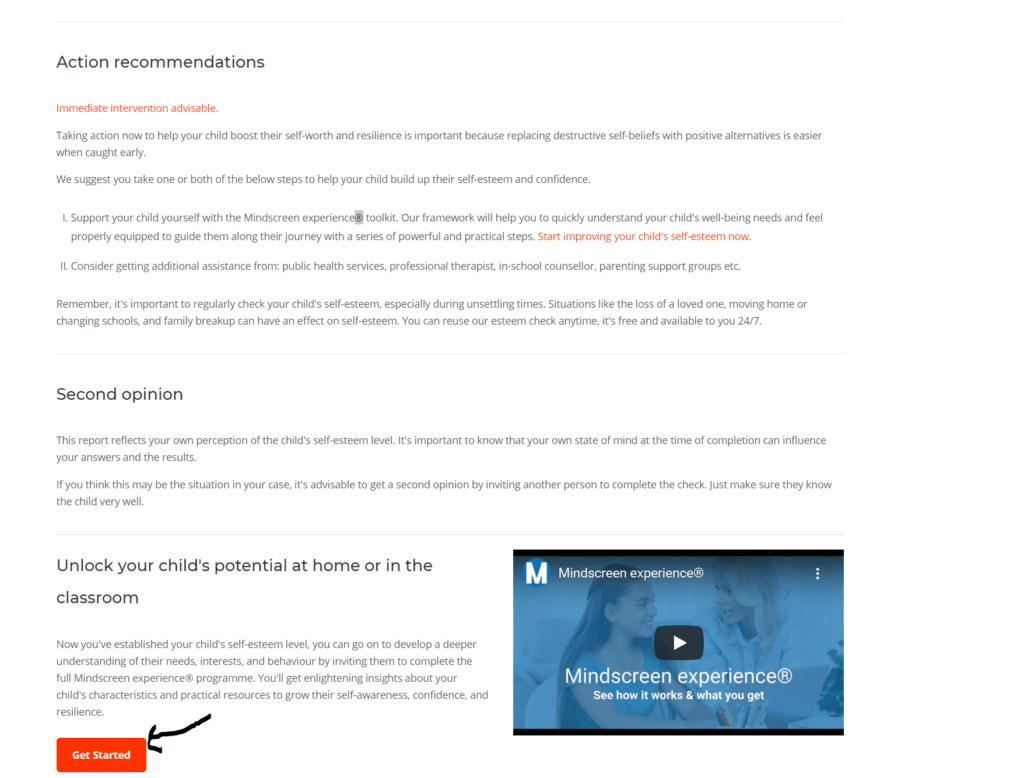
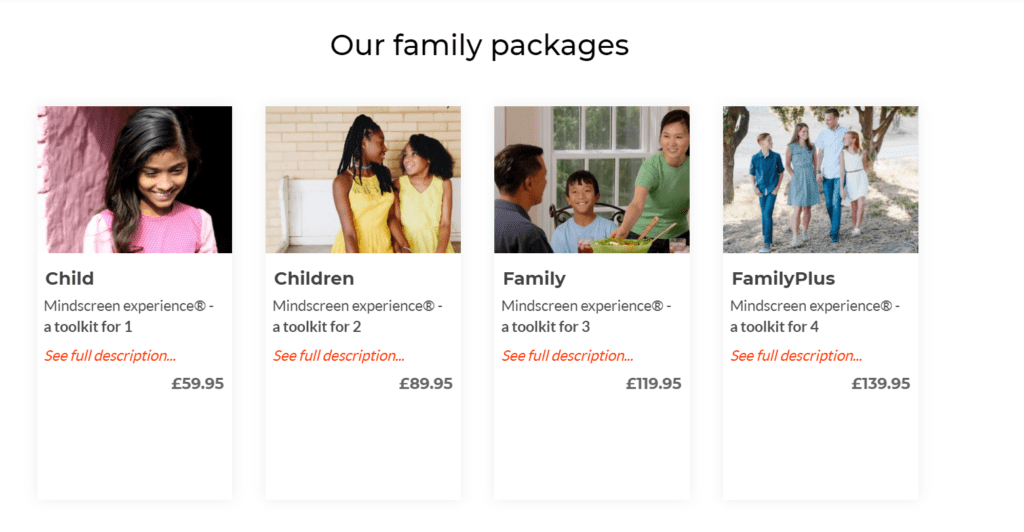
Please note – you need to purchase the Mindscreen Experience to access these lesson plans. Follow the link below to get 10% off your Mindscreen Package now.
easyCareerChoice is an extension of easyStudyChoice which helps your child identify career options they are more likely to enjoy. This lesson will also assist them in recognising the importance of taking action to achieve their aims and career goals.
“To find the job that suits you and the right options to use,” Aidan responded.
I advised that this lesson was a continuation of what they learned in Lesson 5, but in this lesson, I was going to help them pick their career options based on their skillsets.
I also reminded them not to stress about not knowing what career they wanted to choose yet because they are still very young. But it was a good idea to have something in mind and be actively thinking about it already – the younger they start pursuing their careers, the more successful they will be later on.
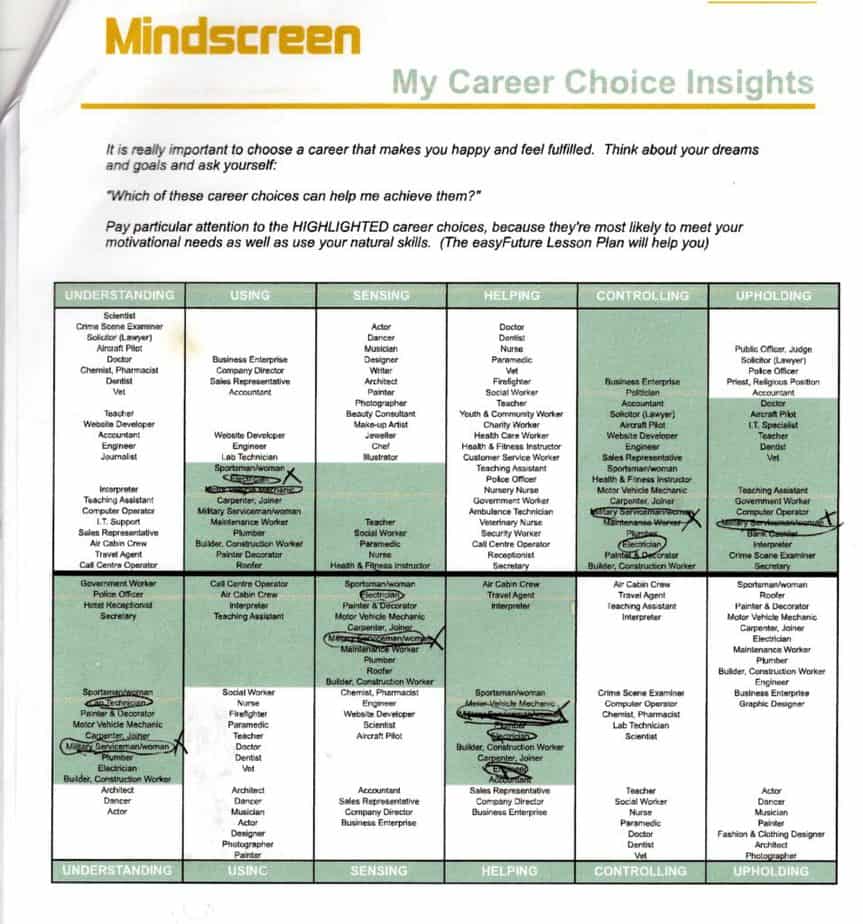
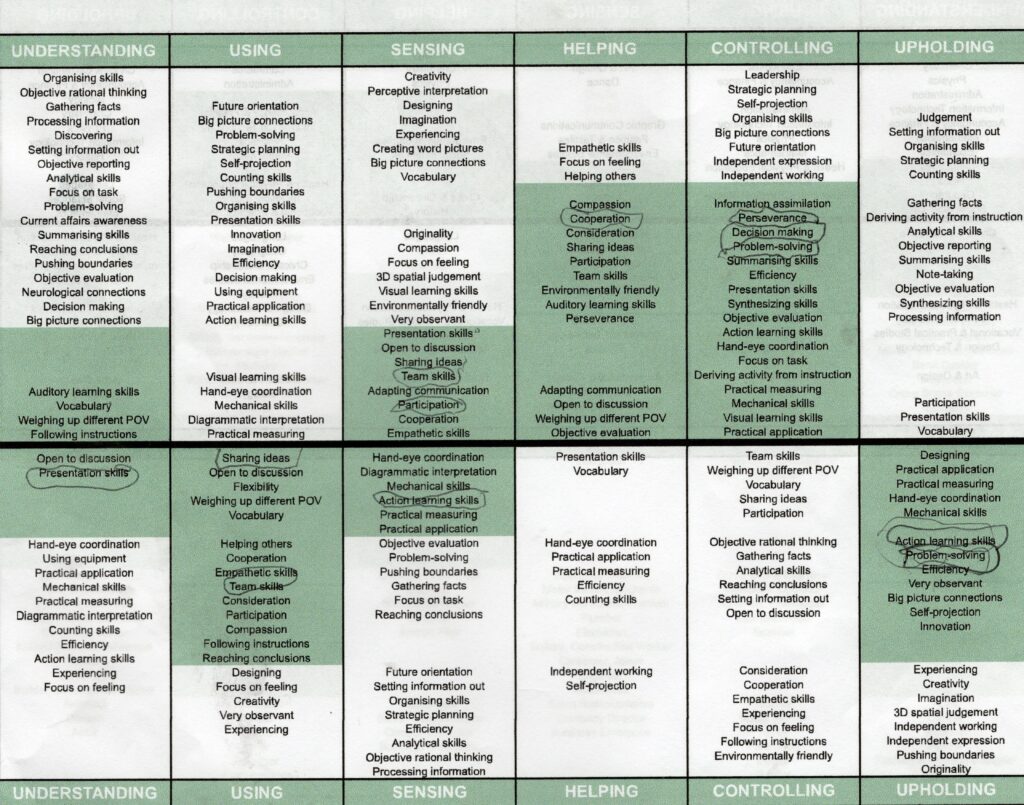
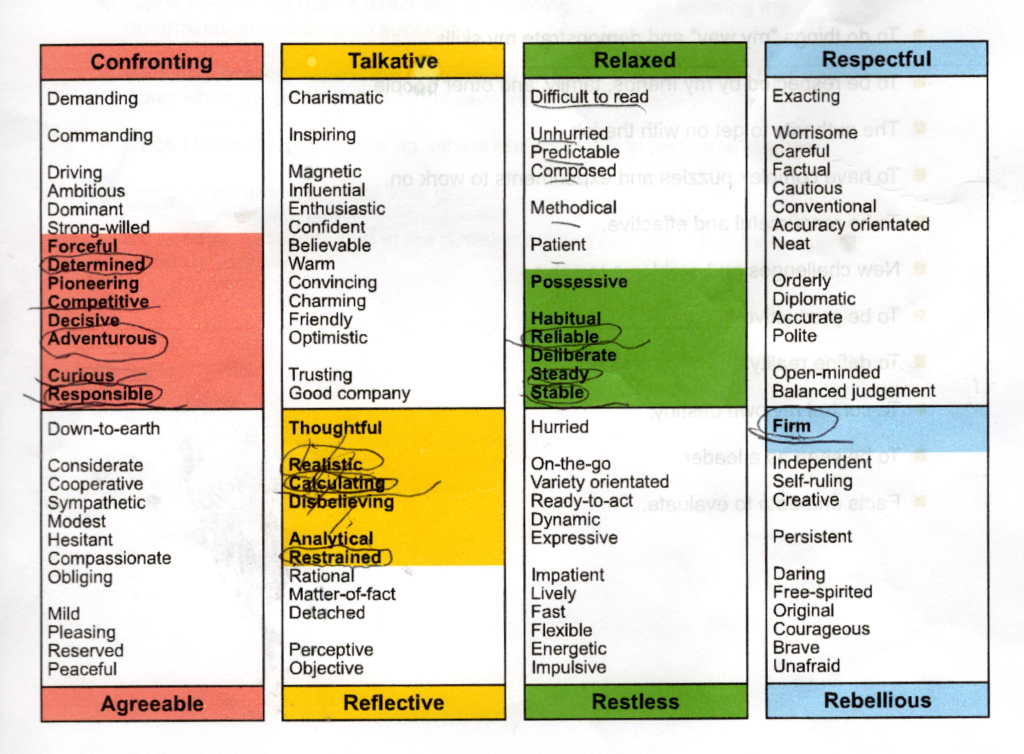
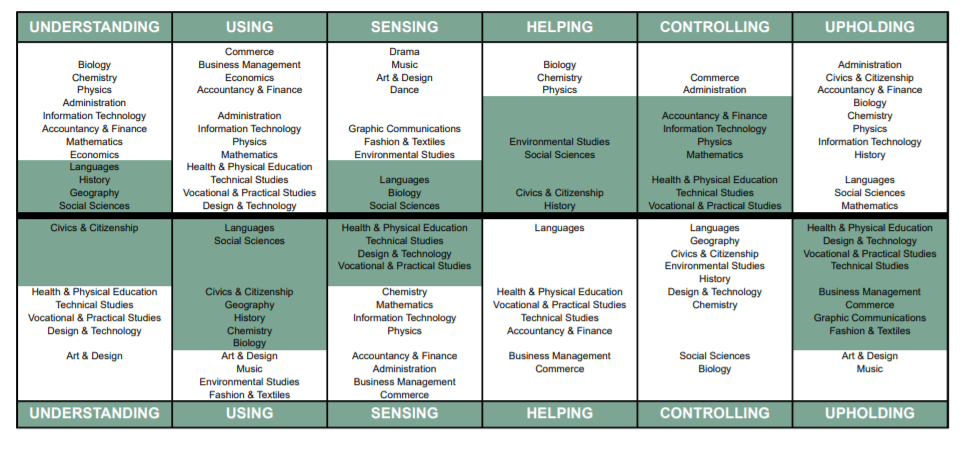
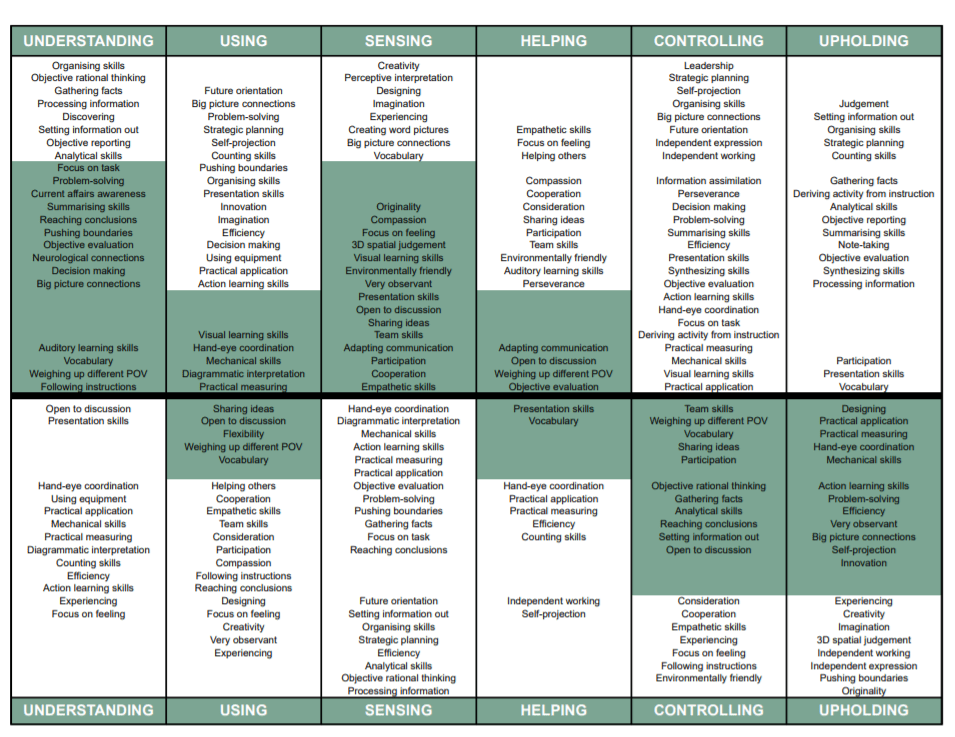
I asked the boys to turn to their Mindscreen Profiles so they could take a look at their ‘My Career Choice Insights’. I then asked them to circle two careers they were interested in, in each of the shaded areas in the six columns provided.
We talked about the different career options and both seemed interested in the military serviceman role. But after I explained what they had to do, i.e. getting up early to exercise and being prepared to head to war at any given moment, Aron changed his mind. Aidan was still considering it.
The boys picked one career in each column they found interesting and recorded six of their chosen careers in their Learner Diaries:
Aidan wrote three – Military Serviceman, Electrician and Lab Technician. He felt the other career options weren’t for him.
Aron picked Police Officer, Roofer, Sportsman, Painter and Decorator and Firefighter, which were interesting subjects to pick! Aron loves drawing and painting, so the Painter and Decorator role seemed like a suitable career option to keep in mind should he want to pursue his painting career.
I then asked the boys to select just one of the career options from their chosen selection. Aidan picked Military Serviceman and Aron picked Police Officer.
Interview time!
Instead of me interviewing the boys, the boys would get the chance to be interviewer and interviewee this time, and ask each other questions related to why they picked that certain career option.
Aron went first.
“So why did you pick military serviceman?”
Aidan – “Because I like the sound of it?”
Aron – “Do you know what skills you need to do?”
Aidan – “To be brave, to be careful.”
Aron – “But why did you pick military serviceman?”
Aidan – “Call of Duty?”
Aron – “The game?”
Aidan – “It got my mind to it.”
Aron – “Can you use a gun?”
Aidan – “No.”
Aron – “Well, Call of Duty is not like Military Serviceman. You will have to use a real gun.”
Aidan – “I don’t want to use a real gun.”
Aron – “Then I don’t think the Military Serviceman is for you.”
Aidan – “No.”
Aron – “Do you want to pick something else?”
Aidan – “I don’t want to be an electrician though!”
Me – “Ok, well let’s leave it for now. Why don’t you interview Aron?”
Aidan perked up – “Ok!”
“What did you pick?”
Aron – “Police officer.”
Aidan – “Why did you pick police officer?”
Aron – “It’s because I can be a good detective.”
Aidan – “What skills do you need?”
Aron – “To find out the mystery.”
Aidan – “And what would you use the mystery for?”
Aron – “To write everything down. So, for example, if someone killed someone, they were trying to get out of it by making up a story. I would write everything down and work it all out. So, say if they said, ‘my battery ran out and then I went to this alleyway and found a dead body,’ I would say, but if your battery ran out, how would you call me?”
Aidan – “But what would you use to find out though?”
Aron – “A magnifying glass, a pen and a notepad.”
Aidan – “But what kind of skills do you need to be a detective?”
Aron – “I will use my magnifying glass to search for a weapon.”
Aidan – “And what about how many doughnuts you’re going to eat?”
Aron – “1,500!”
Aidan – “But why did you pick that career?”
Aron – “I want to solve crimes.”
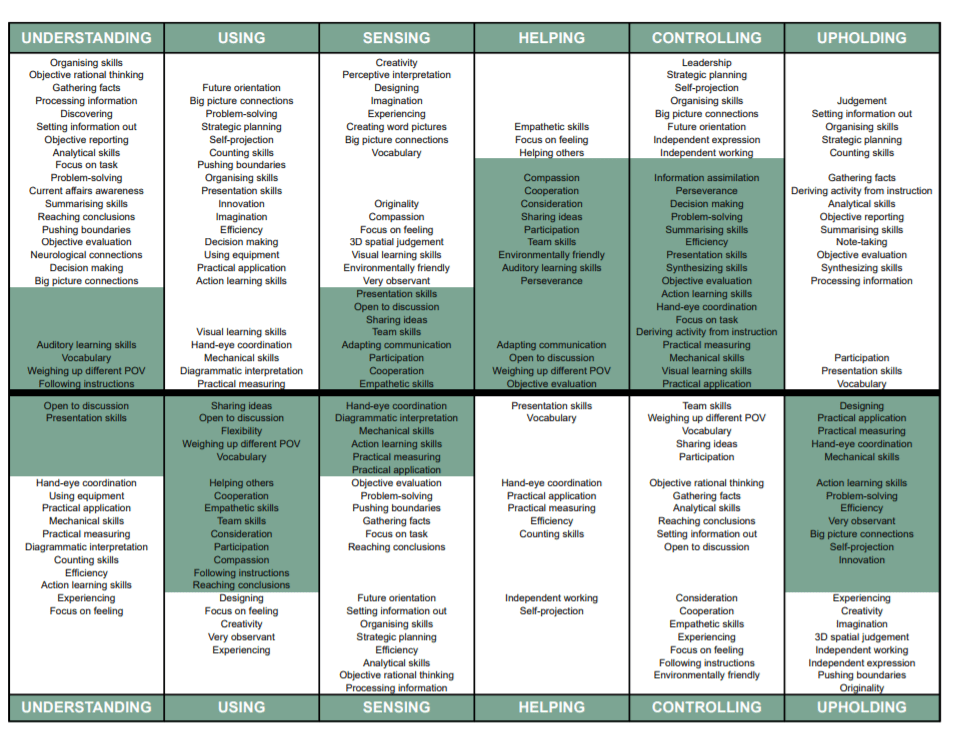
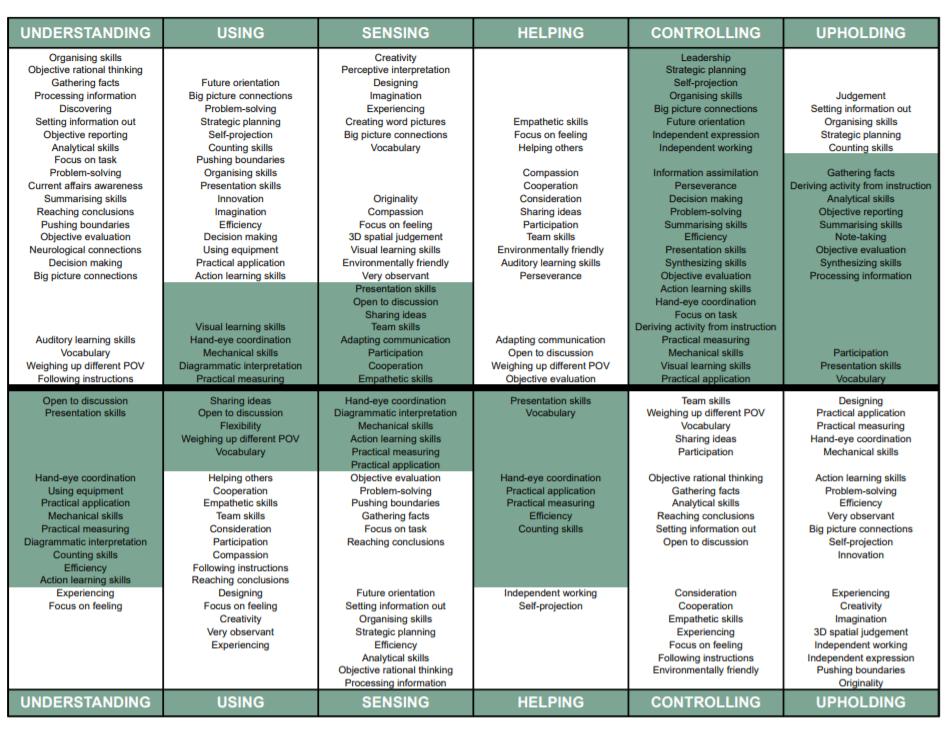
The boys did a great job interviewing each other and once they were done, I asked them to turn to the ‘My Skills Insights’ in their Mindscreen Profiles, so they could take a look at the shaded areas and check which skill suited their favourite career.
Aron picked out skills like problem-solving and decision making which were great choices, while Aidan picked out skills like leadership and efficiency. I asked them to record the skills they picked in their Learner Diaries.
Where can you find more information about your chosen career choice?
We discussed where the boys could find more information about their chosen career options and they came up with some great ideas:
Google it
Job Centre
Government careers website
Police website
Speak to people already in the job
I asked the boys to think again about whether their chosen career suited them. Did it sound like their type of career? Did it suit their skills?
Just do it!
The last activity in the lesson was all about showing the boys that determination is the key to success.
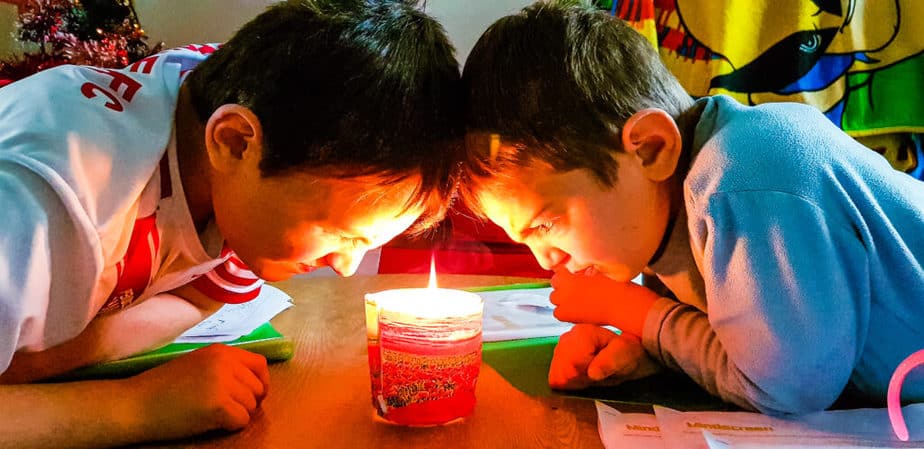
We humans are highly intelligent beings and have a brain no computer in the world can ever reproduce. To prove what I meant, I lit a candle and asked the boys to use their brains to put the candle out without blowing it out.
They first stared at the candle for a few seconds then they started to think smart. They took a piece of paper and fanned the air around the candle. They also blew through their nose and used pieces of plastic. Aron finally put the candle out by waving his hands to create wind.
I asked them if they knew what the candle activity represented.
Aidan – “It means that our brain is smart and if we use our minds to think of something we can put it out.”
If you know someone who has a great idea but they never did anything about it, putting out that candle is taking action. And you have to take action to achieve your aims.
We played the candle experiment a few more times before we closed the lesson with a review of what we learned today, which was to take action on your career and to not just expect it to fall on your lap.
Aidan – “Can I tell you why it’s really important? Say you pick a job and then you get really bored with it and you’ve had to pay all that money to go somewhere else then you’ll be sad. So you have to think of a job you want to stay in and take action so you actually do that job!”
Aidan got it.
How did we get on with Lesson 6, easyCareerChoice?
It was another great lesson with minimal resistance from the boys. They especially loved the candle experiment and enjoyed using their brains to put the candle out in as many unique ways as possible.
How long was the lesson supposed to be?
30 – 45 minutes depending on the level of engagement with your children.
How long it took us
Over an hour but we engaged in a lengthy discussion which was needed to explain some of the career choices.
What did I want the boys to learn in this lesson?
I wanted the boys to learn that it’s really important to choose a job that matches their skills and interest so it’s therefore fundamental they know what they’re good at so they can choose the right job for them. If they pick the right job then it won’t feel like work and they’ll be happy later in life because they followed their passion. It’s also important that they know how to get information about their careers and work hard to achieve their goals.
What did I learn from this lesson?
The boys were really interested in working in the army at first which I did not expect. But, I’m not fully convinced they understood what being in the army really entailed. I also was surprised to see how engaging they were in this lesson. I thought career choices would go over their head because they’re so young, but they got the importance of picking the right career to help them live a happy and fulfilled life later. I’m proud of them for being so grown already.
What’s next?
In the next lesson, we’ll be looking at Lesson 7, EasyCV, which is about providing your child with the opportunity to prepare the most important part of their CV, their personal statement. We’ll also go through the “dos” and “don’ts” in CV writing.
Helping your child choose subjects that suit their skills, hobbies and interests – Mindscreen Review – Part 6
*This post and the proceeding/subsequent posts in the series are sponsored by Mindscreen – an online mental health and wellbeing tool which guides children towards higher self-esteem, at home or in the classroom.*
In Part 1 of our Mindscreen Self-Esteem Series, I talked about how to spot the signs of low self-esteem in your child by using an online tool called Mindscreen. If you haven’t done so already, please read the following articles in the series first:
In this article, we deep dive into Lesson 5, easyStudyChoice, which is about helping your child choose subjects that line up with their own skills, personal hobbies and interests, as well as what they value.
BEFORE YOU START
Please note – you need to purchase the Mindscreen Experience to access these lesson plans. Follow the link below to get 10% off your Mindscreen Package now.
easyStudyChoice is the 5th lesson in the Mindscreen series which helps your child choose study subjects that line up with their own skills, personal interests, and what they value. This lesson helped the boys identify career ideas related to their study choice options.
We talked about what self-awareness is, i.e. learning about what your skills are and your natural and adaptive behaviour, and we went through the boys’ skills to find out how their adaptive behaviour changed their personality slightly to suit their environment.
We also touched upon self-belief, i.e. self-enabling belief which is a positive or encouraging belief that enables you to achieve the goal you want, and a self-limiting belief which is:
“A bad belief!” Aidan responded.
“A negative belief!” Aron added. “I’d rather be negative, though, you know why?”
“Why?” I asked, surprised.
“So, you don’t have COVID!” Aron laughed.
Moving on.
“But, seriously, I’d rather have a self-enabling belief.”
“Me too,” Aidan responded.
“Me three!” I added. “I’d rather think I’m good at something and practice it than think I’m bad at something and never try, right?”
“Right!” The boys shouted in unison.
I asked the boys if they remembered the ‘Ah-buts’.
“Yes, Ah-but I’m not doing enough or I’m not good enough so I’m not listening,” Aidan said. “In easySkills I said, ‘I can’t do this!’ but after learning I can do it I changed it.”
“Well done, Aidan!” What about easyConfidence? Remember the rope trick? If you’re feeling low what can you do?”
“Pull the rope up,” Aidan responded.
“And what does this show?” I slumped my shoulders.
“No confidence, you need to pull your rope up,” Aidan exclaimed.
“Agreed!”
I asked the boys if they remembered what skills they came up with – they didn’t. So we went through their skills quickly before we moved onto the actual lesson.
I recapped quickly what the boys learned, i.e. their skills, behaviour and confidence as well as how they could learn to be more aware of themselves in situations. In this lesson, we were now going to put that all together and come up with some study choices that lined up with their skills, personal interests and what they value. We were also going to take a look at positive hobbies and interests which is a great way to identify what careers they want to pursue, so they could be a happy adult later in life.
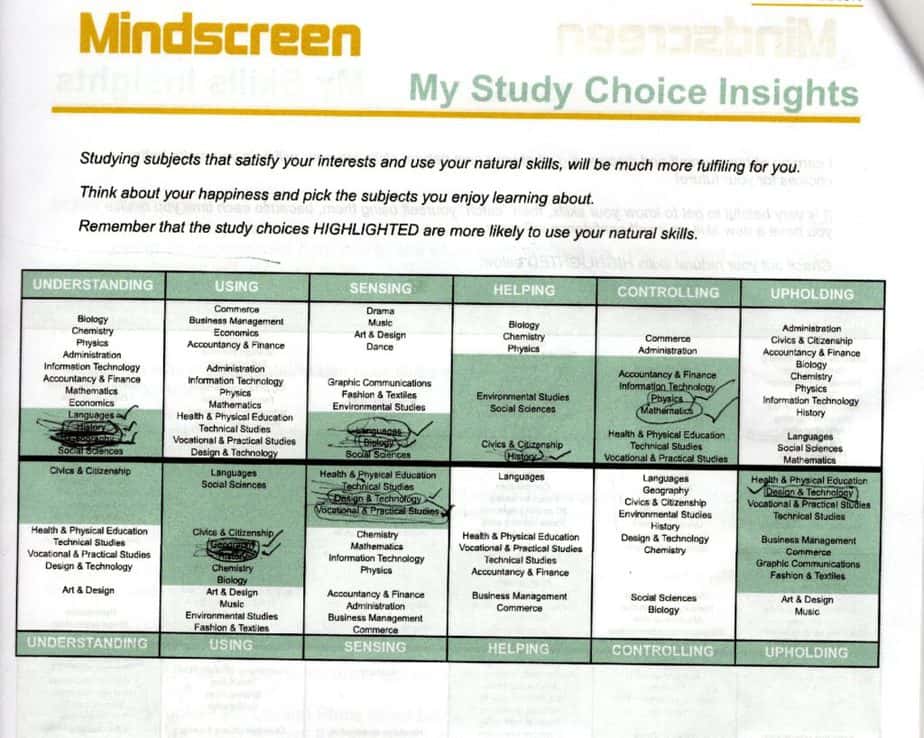
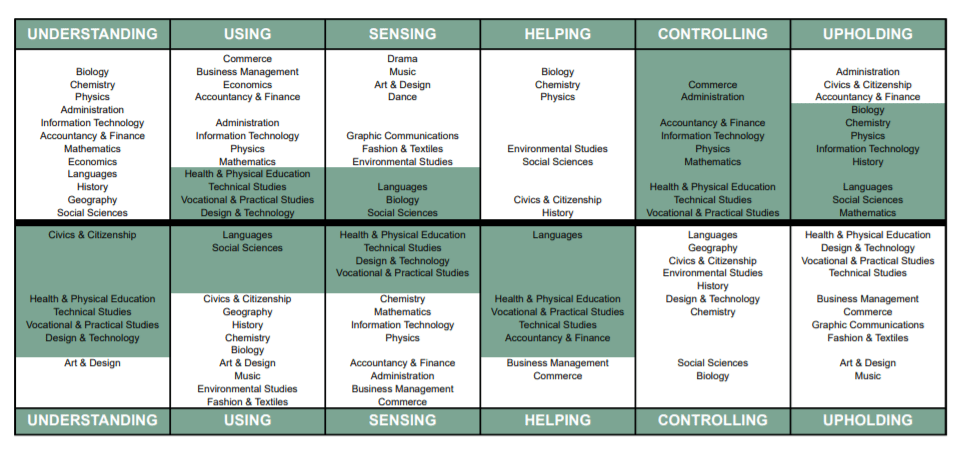
My Study Choice Insights
Aidan wants to be a YouTuber, footballer and a scientist while Aron wants to be a YouTuber, police officer and a footballer. So checked their Mindscreen Profiles to find out whether they had skills which matched their study subjects.
I asked the boys to circle two or more subjects they enjoyed the most in the shaded areas, in each of the six columns, so up to 12 subjects in total.
“I don’t do biology or social sciences,” Aron said.
“Just circle the ones you enjoy,” I responded.
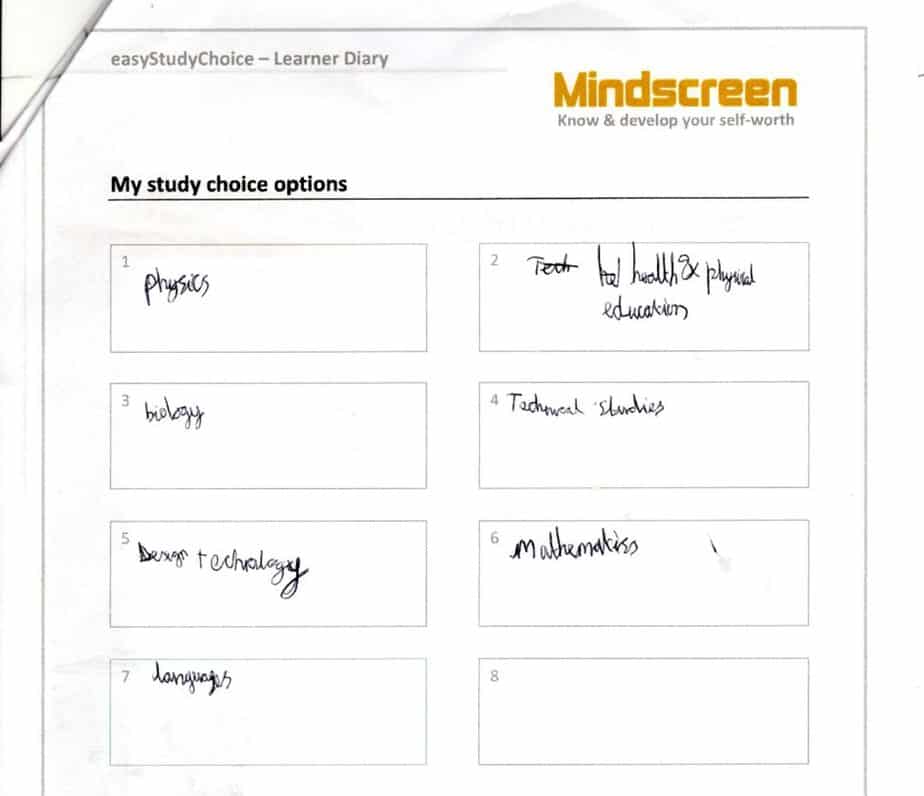
I then asked the boys to turn to their Learner Diaries and write down their favourite subjects.
“I want to do my actual favourite subjects. I have none on here!”
“Ok, so just select the ones that appeal to you then, even if it’s less than 6.”
I asked them to concentrate on attractive hobbies and interests which could be related to a topic they’d like to study.
So Aidan selected Physics, Health and Physical Education, Biology, Technical Studies, Technology, Mathematics, and Languages.
Aron selected D&T, History, Geography, Languages, Physics and Biology.
It was interesting to see which subjects they picked and how they were different from each other. I knew Aidan would pick something related to health as I’ve noticed a growing interest in physical health, diet and lifestyle. He won’t eat cake or too much chocolate because he thinks it’s too unhealthy – he’s 8! I found it most impressive that both boys picked languages as a favoured topic, especially as my no one in my very international family has tried to teach them another language yet.
I am Turkish Cypriot by origin but my Turkish is broken at best and their dad is Swiss and speaks five languages. We only speak English to the kids which is not a good thing I know, but it seems that the exposure from other members in our family speaking a different language to each other has rubbed off on the boys anyway.
I also didn’t realise the boys liked science subjects and so I made a mental note to concentrate more on science topics at home during homeschooling activities. I figured it was always maths, maths, maths with them both because that’s what they liked doing in their free time. But homeschooling has encouraged the kids to broaden their interests in the last two weeks, and I’ve noticed that during their spare time they like to get into art and even English. It’s amazing how much you can learn from your children when they’re with you 24 hours a day and you take an interest in their school work!
Interview time!
The next stage of the lesson was for me to interview the boys and ask questions to help the boys identify related careers from their chosen topics. I asked the boys to record all their ideas as well as list hobbies in their diary.
The boys turned to their “My Career Choice Insights” page in their Mindscreen Profile and I asked them a myriad of questions related to the careers that came up shaded on their profile.
Aron picked languages because he wanted to learn Slovakian, which I found very interesting. But, once we delved deeper into the job of an interpreter as one of his possible options, he quickly realised that he would have to learn a language to a fluent level, so he would have to study the language properly during his career.
He somehow figured a language was something you simply picked up and in some cases that’s true, but to become an interpreter, you’d have to learn grammar and sentence structure and he was unwilling to do that. So, we abandoned the idea of becoming an interpreter.
Aidan wanted to do science experiments so I asked him about the job of a lab technician which he found interesting. Aron settled on a police officer role because he wanted to solve clues and examine bodies, like a crime scene investigator. We talked through the possible steps, from starting an office job to training on the job and Aron still wanted to put the role down. So this was a possible option for him.
Aidan also wanted to include maths in his career choices and he said that solving crimes was a bit like putting pieces together. I thought that was an interesting take on the role of a police officer so so I told him to write that down.
They both unanimously agreed to the sportsman role but didn’t know what else they would do apart from football. We talked briefly about team sports in general but they didn’t want to deviate from football. So they wrote football down.
Aidan was very interested in the businessman role; he has always wanted to own his own business and not work for a boss. We talked about his role in YouTubing as like owning a business because he was in charge of setting it up himself, creating content and getting the money coming in every day. He loved the sound of that.
Aidan also liked the idea of a website developer role as he got into coding during the last lockdown. I was quite excited at this prospect and told him that website developers can make a lot of money because they’re very skilled at what they do.
“Do footballers own their own business?” Aron asked.
“They are their own brand, so yes.”
So, Aron wrote businessman down too.
Both boys didn’t want to have a boss and I wondered whether that was my indirect influence on them after talking to them about my own journey into business. I read somewhere that entrepreneurs and business owners are more likely to work for themselves if a parent/guardian does too.
I always advocate starting your own business and following your unique path to life but I also reiterated to the boys that I had a long career in law first and I paid my dues working for someone else. I found the journey tiring, yet very informative and the lessons I learned from working in an environment not controlled by me was invaluable to when I did decide to work for myself.
You can right the wrongs you’ve seen and implement what you’ve learned when handling employees in your own business, should you be successful enough to branch out. The boys were very interested in learning more about how to do this.
Aidan wants to own lots of companies and build an empire but first he must have financial education and learn how to start a business. I told him I’ll help him do that and I have no doubt he’d put in the graft – he’s a very hard worker, especially when he puts his mind to something he wants.
So I asked them, out of all the careers they found on their My Career Insights page what sounded the most like what they wanted to do?
“Businessman,” Aidan replied.
“Police officer and businessman,” Aron said.
Why is it important to pick the career you love?
For your child to get the career they want, they must study the right subjects so they build on the right foundational skills to help them further their career. If your child wants to be a businessman/woman they must study business. If they want to be a police officer they must study crime. If they want to become a sportsman/woman, they must study for the sport at which they want to excel. And all this takes time, patience and a whole lot of love from their parents/guardian!
Can you imagine studying for a career you hate and how tedious that would be when you finally finish your qualifications and end up in a job that doesn’t suit you at all? It’s horrible and it could destroy your mental health.
The boys are 8 and 10 years old, so it’s almost inevitable they’ll change their minds along the way – and that’s ok! I’d rather they experiment now and when it comes to crunch time to choose their career path, they pick a subject they truly love and we as parents help them squeeze as much out of their chosen career as possible, whether that be a sportsman, a businessman or, dare I say it, a YouTuber.
Aidan wants to be a YouTuber because he wants to showcase his football skills, so at least he doesn’t want to play video games all the time! Perhaps, I could help him get there by assisting in setting up his YouTube channel and have that running in tandem with his football career. At the same time, he can be his own boss and he will do what he loves.
Aron wants to be a police officer and so I need to expose him to that kind of environment. Should he still want to be a police officer when it’s time to do out work experience, I will help him apply to work in a police department so he can get a real idea of what it takes to become a police officer.
HOW DID WE GET ON WITH LESSON 5, EASYSTUDYCHOICE?
The boys got stuck in going through all the topics and we had a great chat about how they saw their future. I learned a lot from them this lesson!
HOW LONG WAS THE LESSON SUPPOSED TO BE?
30 – 40 minutes with one child or 60 – 80 minutes if you run the “My Skills” activity with two children.
HOW LONG IT TOOK US
Just over an hour. We had lots of chats and really engaged in the lesson which I think is very important. If your child is slightly younger, they may not understand all the study and career options. So it’s a good idea to explain it to them and they get a sense of the subject first.
WHAT DID I WANT THE BOYS TO LEARN IN THIS LESSON?
I reiterated to the boys that it’s so, so important to pick a topic they love for their health and happiness. When I asked them what subject they loved doing the most every day and what excited them they said maths. So, there may be a chance they will change their career topics later.
I told them about my career in law and how unhappy I was working for someone else. I love the law, I still do; it’s why I work ad-hoc for a friend who owns an employment consultancy, so I can keep my foot on the legal pulse. However, in the banking and corporate department, I was miserable. It just wasn’t for me. So, when I decided to leave employment in 2010 and follow my passion for becoming a writer, I had to work really hard to get myself out there. But it never felt like a job because I was doing what I loved – writing.
Their father works in supply chain but his real passion is photography. And one day he says he will go full-time so he can do what he loves every day. We are working on that by trying to achieve financial freedom. I told the boys that this is real life, but not necessarily how it should be.
I also introduced the boys on how to build a CV, which we will talk about in a later lesson, and how to write a good cover letter to help them get the job they want. I briefly showed them some cover letter examples and resume examples, and how they could record their interests and hobbies in the interests section and hobbies section of their CV. We will talk about resume templates in Lesson 7, easyCV.
The earlier your kids start with finding their chosen career path, even if it changes later, the more successful they will be at achieving their hopes and dreams. It starts with a good work ethic and then it builds to knowing who they are and what they want. The rest comes naturally with hard work and perseverance. Keep your eyes and ears open for what your children truly desire – it may be the difference between a happy life and a miserable one.
WHAT DID I LEARN FROM THIS LESSON?
The boys are not quite old enough to know where they are at career-wise and what they want to be later – and I shouldn’t expect them to be at 8 and 10 years old. They have an idea which is great because the earlier they start pursuing their passion, the more successful they will be later in life if I help them stay on the path. I learned that they both don’t want to have a boss though – that much is clear!
WHAT’S NEXT?
In the next lesson, we’ll be looking at Lesson 6, EasyCareerChoice, which is about helping your child identify career options they are most likely to enjoy. This is an extension to the deep dive we did in this lesson on study options.
Helping your child build a bank of personal unique skills – Mindscreen Review – Part 5
*This post and the proceeding/subsequent posts in the series are sponsored by Mindscreen – an online mental health and wellbeing tool which guides children towards higher self-esteem, at home or in the classroom.*
In Part 1 of our Mindscreen Self-Esteem Series, I talked about how to spot the signs of low self-esteem in your child by using an online tool called Mindscreen. If you haven’t done so already, please read the following articles in the series first:
In this article, we deep dive into Lesson 4, easySkills, which is about helping your child better understand what their unique skills are and how they use them. Help your child build a personal “bank” of unique skills they “know” they have.
Before you start
Please note – you need to purchase the Mindscreen Experience to access these lesson plans. Follow the link below to get 10% off your Mindscreen Package now.
We’re looking for your child’s unique personal skills and help them discover how to use them.
EasySkills
I introduced the lesson with the purpose of easySkills which is to help the boys build a big personal bank of skills so they know what their unique skills are and how they can use them to choose the correct career path in the future.
My skills
I asked the boys to open their Learner Diaries so they could answer the first question which was:
Think of something you did recently that you really enjoyed
I.e. playing a game, working, following a hobby, at school, developing friendships, learning something new etc. The boys could write their answers either in words and/or pictures.
Both boys picked playing in a football match.
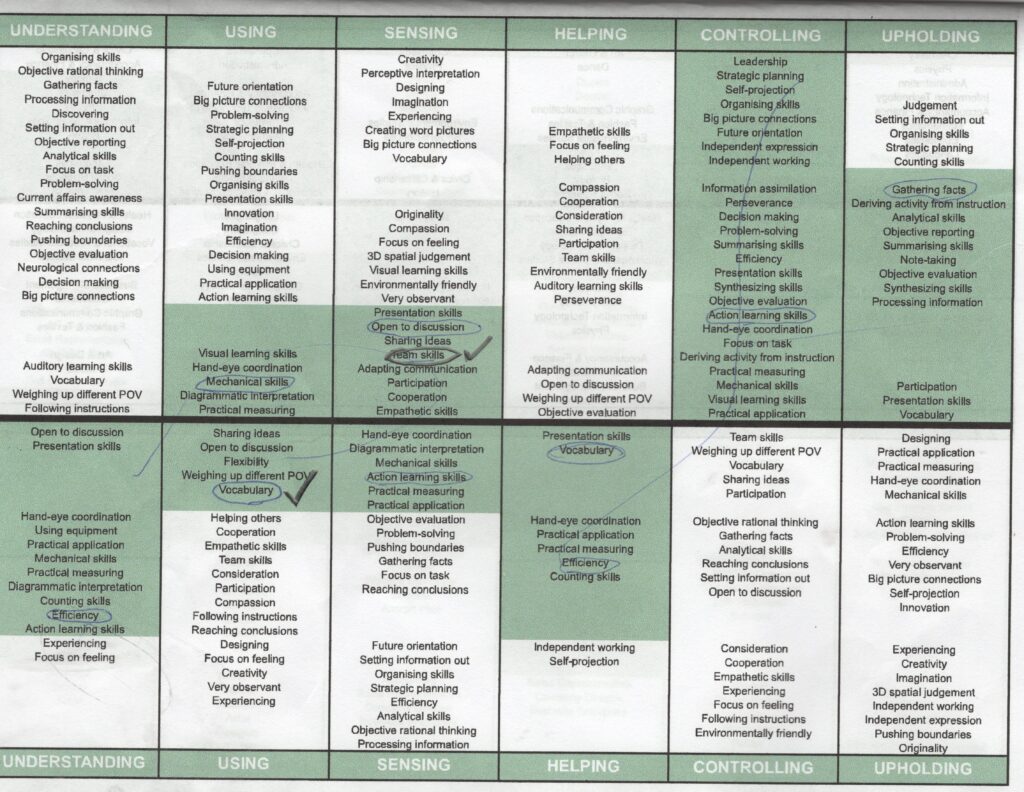
I then asked the boys to turn to the ‘My Skills’ insights page and circle any of the skills they saw in the shaded areas that they used during the activity of playing football. I asked them to try and circle a minimum of one skill from each column.
Aron circled the following:
Aidan circled:
Deep diving into the activity to find out which skills were used
I told the boys that we were going to have an interview, where I asked them some questions about the activity and they were to answer them on the spare piece of paper provided.
I combined the answers as the boys’ answers were very similar to each other.
The questions were:
1. Why did you pick this activity as something you really enjoy?
Skills, goals, tackles, saves. It’s fun. I like running around and kicking a football.
2. What is it that you liked about that activity so much?
Attacking and playing as a team and showing people using easyConfidence to stand to who I am. The intensity.
3. Was it because you used your mind a lot?
Not really. I don’t really think much when I play football.
4. And is it because when you’re losing you want to win?
Sometimes, but I prefer to play with my team so we all win.
5. It is because you want to be the best?
No, I will never be selfish, I would always play fair, I will always play as a team.
6. Did you find ways of moving the ball better?
Yes I can move the ball better now that I practice.
7. Did you learn a new technique?
I always learn new techniques every time I play.
8. Is it because you found ways of moving the ball around better?
Yes, I like moving the ball but I don’t like to be selfish, I pass the ball, so people aren’t annoyed with me.
9. Is it because you learned a new technique in the game and you learned new football skills?
Yes, I want to improve all the time on my football skills and techniques.
“Can you make this the last question please mum?” Aidan pleaded.
easySkills Activity Log
I told the boys that we were now going to go through the skills in their Mindscreen profile and in their Activity Logs they were to write a short description of how they used that skill.
This part of the activity was the longest bit and after going through about ten skills, the boys had enough. We managed to complete the activity log in the second session, but literally ticked through it. Some of the skills Aidan worked through were:
Skill
Definition
Activity
Active learning skills
Learn by doing
New techniques while practising
Adapting communication
Being able to describe what you’re saying so that other people who are different from you can understand
Communicating with sign language
Analytical skills
Being able to think about a situation, study it fully, and understand what the most important things about it are
No I will always follow the rules
Assimilation
Being able to take all the facts and make some sense of them
No I know football very well
Auditory learning skills
Listening to a skill or task being described and being able to learn how to do it yourself, from what you’ve heard
Nope I know all skills and I know how to to di it
Big picture connections
The ability to look at the whole picture from a distance and understand how actions affect the whole
No I make my decisions
Consideration
Being able to take the feelings or ideas of others into account
Yes I communicate
Cooperation
Being willing to work together with others, without wanting your own way all the time
Yes, I’m not selfish
Creativity
Having the ability to frequently come up with new ideas, ways of doing things, develop a solution. Can be in any area: practical, artistic, theory etc
Rabona flick
I asked the boys to pick two of their previously circled personal skills from their “My SKills Insights” page of their own Mindscreen experience® profile and invited them to open their Learner Diaries and complete the following statement:
“Two of the skills I used during the above activity are:”
Aidan picked – “Vocabulary” and “Team Skills”
“You use vocabulary during football?”
“Yes, the coach uses vocabulary when he shouts out football skills.”
“Team skills is where we work in a team”
Aron picked – “Perseverence” and “Participation”
Congrats, boys, these are your two main skills!
I reassured the boys that my two skills may be different to their skills but it didn’t mean they were any better or worse than theirs.
The last part of the activity was to get them to describe how they used these skills while playing football.
Aidan wrote – “Every time in games, the coach shouts out the vocabulary for football and we work as a team.”
Aron wrote – “By never giving up and by joining in.”
I told the boys that people who really enjoy their job are usually happy. That’s because the job they do is in tune with their skills and values and what they are interested in. This happiness on the job is more commonly referred to as “job satisfaction”.
“Why?” Aidan asked.
“Because they use their two main skills and values in their job. If you find a job that uses these skills, you will be happy. If you’re happy doing that job, it doesn’t feel like a job.”
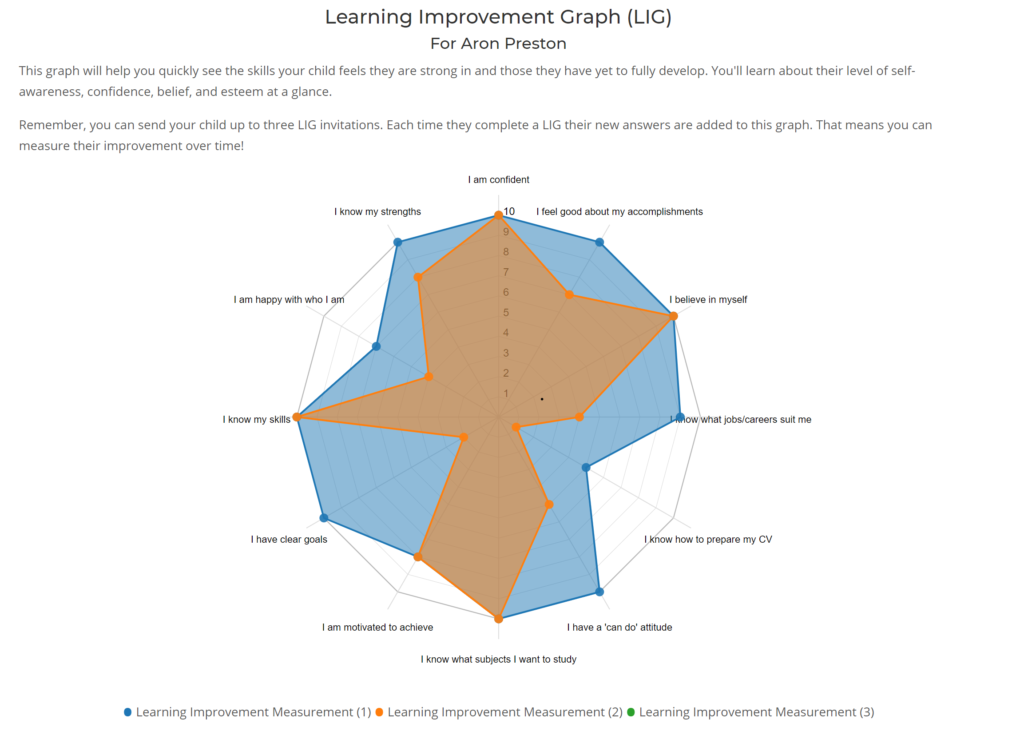
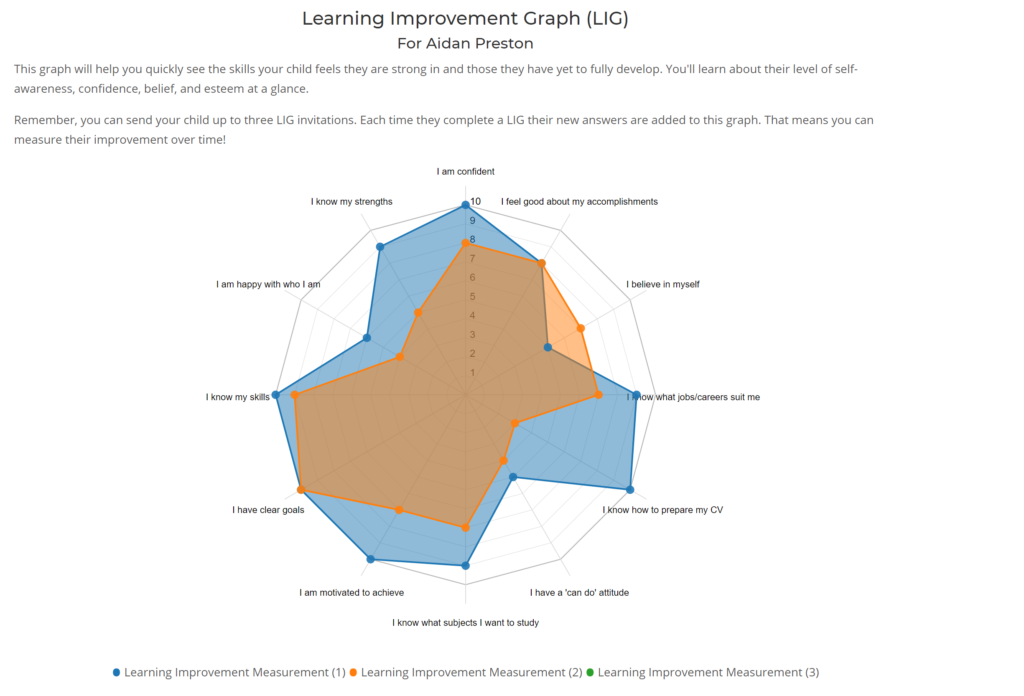
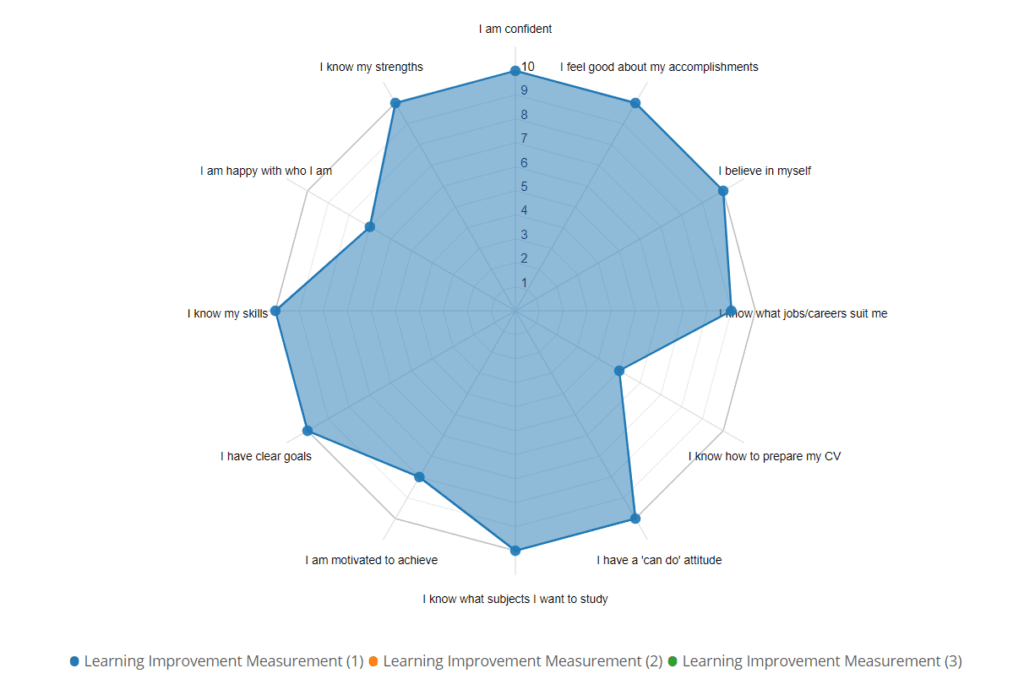
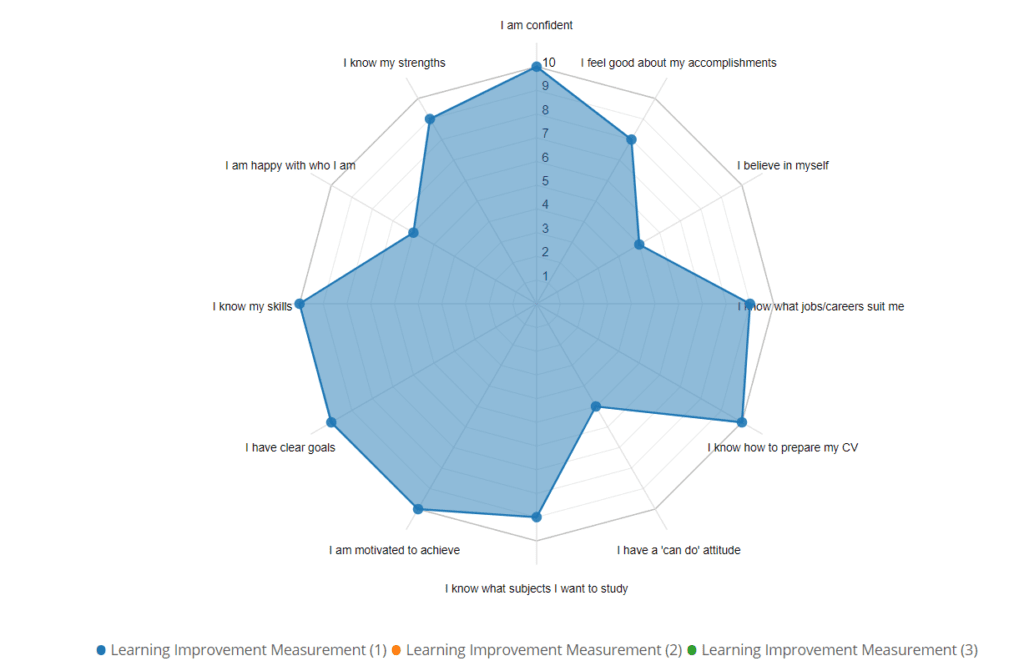
Completing the Learning Improvement Measurement questionnaire for the second time
At the very beginning of the Mindscreen Experience, I invited the boys to complete a questionnaire to find out more about themselves – you can find more about this questionnaire in Part 1 here.
The time had come to complete their online statements again to find out how far they’d come after four lessons.
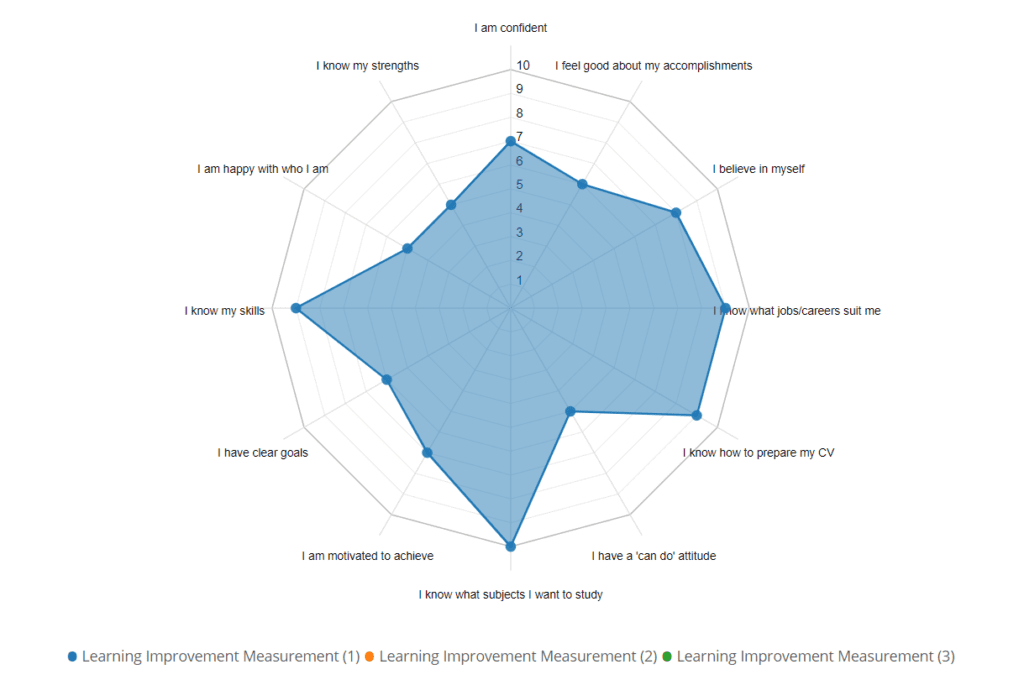
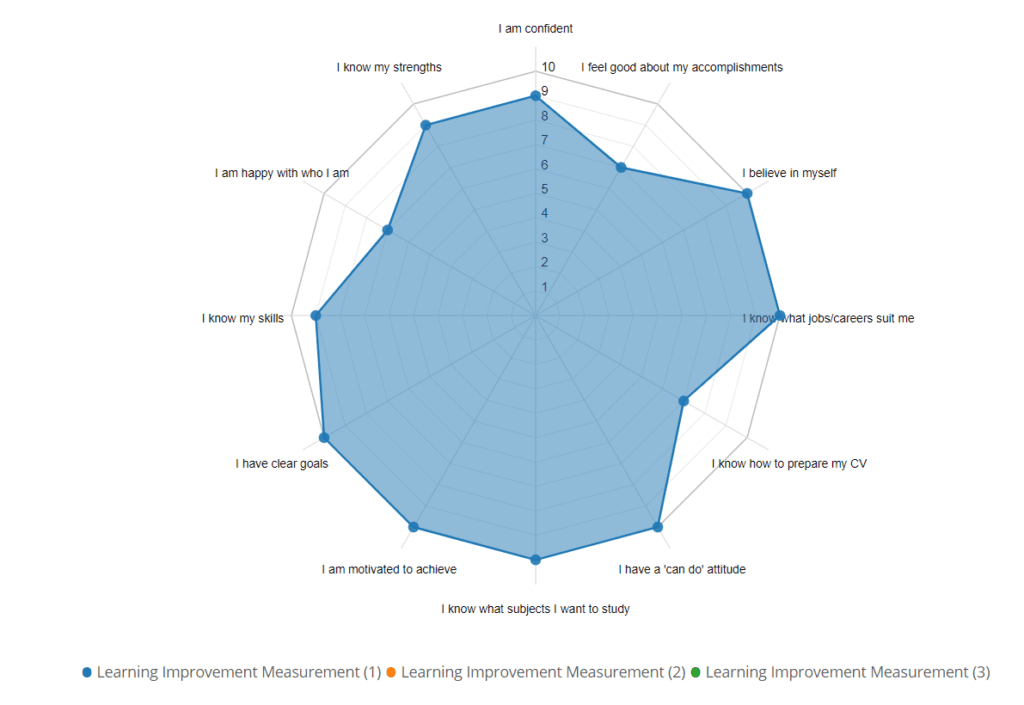
The results were very interesting – and unexpected!
Aron remained confident, but Aidan’s confidence went from a 10 to a 7.
Both boys seemed to also be less happy with themselves the second time round.
“Why is this, boys? Mindscreen is supposed to boost your confidence, not make it worse!”
“I don’t know what my strengths are anymore,” Aron responded.
“Because when I cry sometimes I say I can’t do it and then my confidence goes down,” Aidan added.
“Why do you tell yourself you can’t do it? The point is to tell yourself you can do it, remember? Self-belief!”
“I don’t even know what a CV means! I’m confused!”
“So, how do we build your confidence then?”
“I will just make it harder because it will give me more confidence. When I say I can’t do it, I can do it when it’s hard,” Aidan said.
“I have no idea what to study,” Aron said.
“That will come, don’t worry about that now. We are working step-by-step to help you figure out what you want to become. You have so much time!”
“I didn’t know what I was doing at the beginning, I just went ten, ten, ten, ten in the last questionnaire and I didn’t know what I wanted. I can’t just do that!” Aidan continued.
“I think now I know a bit more I have less motivation because I don’t know what I want and I’m not in the mood for working at school and at home.”
“I’m bored all the time,” Aron added.
“I don’t want to do school work. But I do want to get star of the week,” Aidan mused.
I don’t have any clear goals except getting star of the week and man of the match,” Aron added.
Oh, gosh! I didn’t realise that I had to work on the boys as much as I did! I think learning about themselves is making them more aware of what they can and can’t do and it may be overwhelming them. For the next four lessons, I’m going to concentrate on taking it a lot slower and not making them feel like they’re overloaded with work.
How did we get on with Lesson 4, easySkills?
The boys really struggled with the last part of the lesson where they had to go through all the skills to find out which of them they used in their football activity. There were 49 skills to go through and the boys’ concentration spans stopped at 10. So we had to do the lesson in two parts where we had to complete the last part of the activity on its own. Aron zoomed through his skills a lot quicker than Aidan and managed to capture the point of the activity. Whereas with Aidan, it was like pulling teeth!
How long was the lesson supposed to be?
30 – 40 minutes with one child or 60 – 80 minutes if you run the “My Skills” activity with two children.
How long it took us
Almost a frustrating two hours because the boys really dragged their heels in the “My Skills” part of the activity.
What did I want the boys to learn in this lesson?
I wanted the boys to learn and discover their skills and to understand how these skills could be used to help them pick out their chosen career/job path later. Knowing about yourself means knowing what you can and can’t do and that could be the difference to a happy professional future.
What did I learn from this lesson?
I received a shock after analysing the boys’ Learner Improvement Graphs to find that some characteristics had gone down. I get the feeling this may be because the boys are becoming more aware of their strengths and weaknesses and it may be overwhelming them a bit. It’s food for thought as to how I tackle the next four lessons, though, so I don’t end up pushing them the other way.
What’s next?
The next lesson we’ll be looking at Lesson 5, EasyStudyChoice, which is about helping your child choose subjects to study that line up with their own skills, personal interests, and what they value. This lesson will help them identify career ideas related to their study choice options.
How to build on your child’s strengths and increase their self-confidence – Mindscreen Review – Part 4
*This post and the proceeding/subsequent posts in the series are sponsored by Mindscreen – an online mental health and wellbeing tool which guides children towards higher self-esteem, at home or in the classroom.*
In Part 1 of our Mindscreen Self-Esteem Series, I talked about how to spot the signs of low self-esteem in your child by using an online tool called Mindscreen. If you haven’t done so before, please read the following articles in the series first:
In this article, we deep dive into Lesson 3, easyConfidence, which provides your child with the opportunity to explore their own strengths and talents and build their self-confidence.
Before you start
Please note – you need to purchase the Mindscreen Experience to access these lesson plans. Follow the link below to get 10% off your Mindscreen Package now.
When you are self-confident you don’t have any doubts about your ability or knowledge to do something. You are certain you can manage any situation by yourself. You have self-confidence in the following areas:
To provide your child with a simple technique to help them present a confident image
To help your child investigate why it’s useful to know about personal strengths and weaknesses
My invisible rope
I got straight into the lesson which was about helping your child learn how their confidence level is displayed through their body language. The idea is to learn to recognise the difference in posture when they are low in confidence versus when they are full of confidence.
If their shoulders are slumped, it shows they have a lack of confidence, if their shoulders are pulled back and the child stands up tall, it shows they have confidence.
I asked the boys to stand.
“Can you show me what lack of confidence or unhappiness looks like, please?”
“Ok, say I want to calculate 31 x 31. Ah, I can’t do this it’s too hard! That is lack of confidence,” Aidan (8) said.
“Ok, great, but can you show me with your body?”
Aidan slumps his shoulders and bows his head. Aron does the same.
“Well done! Now can you show me what self-confidence and happiness look like, please?”
“I can do this, I am ready for it!”
Aidan stands up really tall and pulls his shoulders back.
“Fantastic! Can you tell me what the differences were between the two postures, please?”
“Confidence is when you’re up! You’re ready to do it, and you’re not scared,” Aron (9) said.
“So unconfidence is where you can do it but you don’t think you can, and you don’t give yourself a happy mindset,” Aidan said.
“What about with your body language and not words? Do you know what I mean by body language?”
The boys shook their heads.
“Ok, it means you’re talking with your body rather than your words.”
I showed Aidan an example of me crossing my arms and frowning.
“What am I showing you right now?”
“You’re angry.”
“Exactly. You see? You read my body as angry. My body spoke to you. If I’m doing this, what does it show you?”
I slumped my shoulders and bowed my head.
“Not confident.”
“And what about this?”
I pulled my shoulders back and lifted my head high.
“Very confident.”
“You see? Did you see the difference in my body language?”
“Yeah, so I should be like this,” Aidan said and pulled his shoulders back and stood up very straight, head lifted up high.
“Just by showing someone your body language, you can change the way they look at you.”
“I want to show you a trick. I want you to imagine there’s an invisible rope attached to your chest and there is some invisible force that is pulling it up.”
“I know this. It pulls you up when you’re confident and pulls you down when you’re not confident,” Aron said, smiling.
I demonstrated what I meant.
“If you’re feeling low in confidence, you’re worried, nervous or upset. I want you to think about that invisible rope. Because the way you change your body language will change the way you think.”
“Say you’re passing a group of big boys and you’re nervous and worried. Walking past with the rope up will show you’re confident, right?”
Aidan started talking about bullying and went into a demonstration but I didn’t understand what he was talking about.
I asked the boys to turn to their Learner Diaries and answer the question:
“Think of something you achieved recently and think about how succeeding in this activity gave you a confidence boost.”
“Maths test at school,” Aron replied.
“Well done, Aron. How did this maths test help you boost your confidence?”
“It gave me a confidential feeling.”
“Confidential means private.”
“Oh, a confident feeling.”
Aidan wrote, “I tried to work out 31 x 31 and I thought I didn’t know but then I got confident and I knew the answer.”
Aron wrote, “The maths test at school. It gave me a confident feeling because it looked hard, I felt confident. It felt bedazzling when I finished and passed the test.”
“Well done boys.”
I wanted to show the boys that what their strengths are and what they are good at will help them feel good about themselves. But it’s important that they know what their weaknesses are too, so they can avoid them or, even better, improve on them as well.
I asked the boys to open their Learner Diaries again and brainstorm two questions, by writing their thoughts into their diaries:
It’s good to know about my weaknesses because…
It’s good to know about my strengths because…
Aron wrote, “If you could learn them you can then improve them.”
“I could carry them on and improve them even more.”
Aidan wrote, “It’s a good thing if I get on with my weaknesses. Wrong mistakes are actually better than the real answer because you at least tried instead of showing off.”
“Because I can do what I can do and I can do and be positive because I can do it.”
I asked the boys if they understood why being confident is the key to success. It makes them feel like they can do it, but if they know what their weaknesses are they can use these weaknesses to improve on them.
“Can you tell me one positive reason why it’s important to know about your weaknesses?”
“So you can avoid them in the first place,” Aron said.
“Instead of avoiding them what could you do?”
“You could learn?” Aron continued.
“You could stop running in circles?”
“What about practising and improving on your weaknesses?”
“Because if you make mistakes you can make it better,” Aidan said.
“Knowing other people who may be strong where you may have that weakness, teaming up with them will help you be better too, right?” I continued.
“What if there is a bully and the bully tries to bully someone but doesn’t know how to spell bully?” Aidan said.
“Imagine if a 15-year-old teaches a 3-year-old but can’t spell bully himself,” Aron said.
“Why is he telling a 3-year-old if he can’t even spell bully?” Aidan shrugged.
“Ok, let’s continue.”
“We become what we think about. So that’s why it’s really important to develop positive thoughts about yourself because, boys, you become what you think. So if you have positive thoughts that you will do well, you will do well.”
“What do you think will happen if we have positive thoughts about ourselves?”
“It might go too far and it will stop,” Aron said.
“What about if you have a positive thought about how funny you are?”
“I’m not funny,” Aron said.
“If you said to yourself, ‘I’m funny, I’m going to make people laugh today,’ what do you think will happen?”
“I don’t know.”
“You will make people laugh!”
I reiterated to the boys that we become what we think about.
Positive statements about me
I asked the boys to open their Mindscreen Experience profile to the “About Me” section and tick all the statements they strongly agreed with.
“Why did you sign up with Mindscreen?” Aron asked.
“Because I wanted to learn more about you. What makes you tick. What makes you sad.”
“Do you know more about us now?” Aidan asked.
“I do and it helps me to plan the way I teach you things, so we don’t get upset or frustrated with each other.”
“You teach it really well,” Aron continued.
“Ah, thank you!”
These boys!
Aidan ticked:
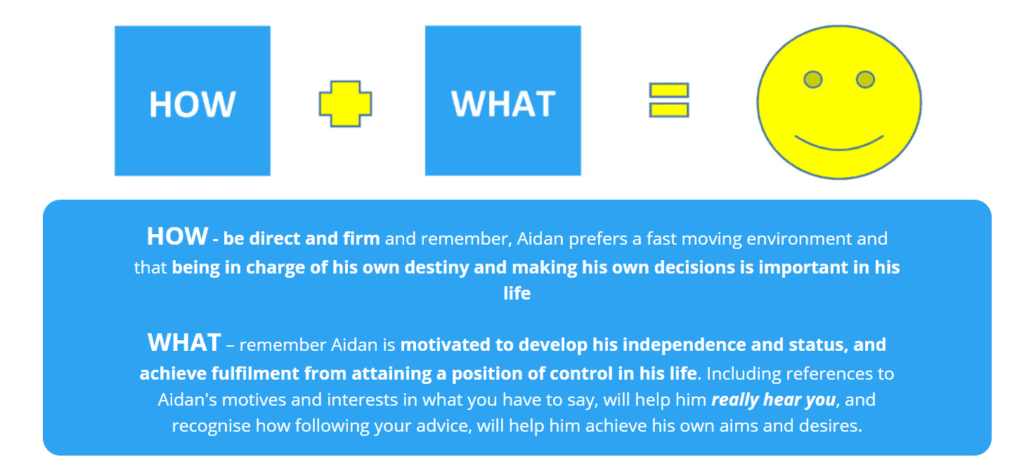
Sometimes I resist advice from others because it threatens my desire to control my own future.
I prefer limited supervision, therefore, I like to be left to get on with the job.
I like to be in control of my own destiny and choose my own way in life.
I can be very determined and respect powerful, strong-minded people.
I may get my own way more often if I learn to be less demanding and dominant.
Even if I am young, I think I am capable of making up my own mind about things that affect me.
I play to win. If I have to take a risk to win, I usually will take that risk.
Some people see me as very direct and to the point. I generally like to say what is on my mind, then take action.
Some people see me as direct and demanding. I am just showing my determination and drive to succeed.
When confronted, expect me to stand my ground. In other words, I will not back down when my point of view is different from someone else’s.
I respect people who stand their ground.
Do not ask me to take part in the decision making process if you have already made up your mind.
I asked Aidan why he picked the statements above.
“Because I like being alone and I do my work independently and normally In Year 4 we do it independently, we don’t do pairs very much.”
“I always focus.”
Aron ticked:
I like to have an opportunity to experiment and try new things each day.
I am usually very challenging and consider “my way” to be the best way.
When involved in a disagreement, I am motivated to win.
I sometimes have big visions that seem extreme to other people.
When confronted, expect me to stand my ground. In other words, I will not back down when my point of view is different from someone else’s.
Sometimes I say things just to change the conversation towards something more interesting for me.
I like it when people congratulate me and tell me how important I am and how well I have done.
I respect winners and those who achieve great things.
At times, I get bored when dealing with repetitive or routine activities. I like to try new things.
I like to work and socialise with people who want things done quickly.
I like the attention that comes with success.
When I win, I like to be acknowledged and be seen as the champion.
I like to talk about what I have achieved and about my ambition for the future.
Aron declined to comment on why he chose the above statements.
I asked the boys to look at the statements they ticked and to now underline three statements they thought were the most positive ones and which gave them the biggest confidence.
Aidan selected:
I love adventure and to explore new places
Even if I am young, I think I am capable of making up my own mind about things that affect me.
I respect people who stand their ground.
I asked Aidan why these three statements felt the most positive to him.
“If people are strong I will respect them always. Like a few of my friends make me feel happy because they can back me up when I’m getting bullied.”
“Ok, are you getting bullied at the minute?”
“No, but if I did they will be helpful.”
“The second one because I am happy because I love going to the woods, I can ride the bike, I can make a den out of sticks,” Aidan continued.
Aron selected:
I am usually very challenging and consider “my way” to be the best way.
I respect winners who achieve great things.
I like new and challenging activities.
I asked Aron why he selected these statements.
“Because I always want to find the answer, I like to keep my mind busy and I like to work on really hard things because it keeps my mind busy.”
I then asked the boys to go to their Learner Diaries and write two positive statements that made them feel the most confident.
Aidan wrote – “I love adventure and to explore new places” and “I respect people who stand their ground.”
Aron wrote – “I am usually very challenging and consider ‘my way’ to be the best way.” and “I respect winners who achieve great things.”
I then asked the boys to write down how these positive statements about them would help to build their self-confidence.
Aidan wrote – “I can become more of an explorer and I can be better with my kindness.”
Aron wrote – “So, I would be more confident by thinking about positive things and I can catch myself using them and plan my activities around my strengths.”
I reiterated to the boys so it hit home that their body language shows other people their level of confidence and it is very important to present a confident image. I also advised that knowing what their strengths were and catching themselves using those strengths can help them achieve success, which can ultimately help boost their self-confidence.
“Do you understand that?”
“I’m going to catch myself exploring, respecting people, and then think, ‘that’s great, I’m doing it!'” Aidan responded.
“That’s great, Aidan! We are all different and we all have different strengths – and these statements you’ve picked are your unique strengths.”
How did we get on with Lesson 3, easyConfidence?
Aidan really took charge of this lesson while Aron sat back a bit more and listened. I could see that being self-confident resonated with Aidan a lot because he has this natural tendency to want to be the best and that comes from a great sense of self-belief, which we learned all about in Lesson 2. I enjoyed this lesson because I learned a lot about the boys’ strengths. I was less surprised about Aron’s strengths because he has always been one to take charge and lead the conversation, but pleasantly surprised that Aidan took the reins for once and showed me that he was indeed made of really strong stuff too!
How long was the lesson supposed to be?
30-40 minutes
How long it took us
90 minutes but we engaged a lot in discussion and I deep dived into their unique statements in the About Me section because I wanted to learn more about my babies and what made them tick.
What did I want the boys to learn in this lesson?
I wanted the boys to understand how important body language is and how it can show people their level of confidence. I also wanted them to learn more about themselves by looking at their positive statements and showing how the skills and qualities they have can be played to their strengths. Aidan really engaged this segment of the lesson and was eager to learn about what else he was good at, while Aron seemed to know about himself anyway and paid less attention.
What did I learn from this lesson?
I learned that from reading my kids’ About Me statements, how to describe your child’s strengths and weaknesses is actually very important. Aron is going into Year 6 next year so we’re focusing on getting him ready for the 11+ exams, so it’s important to ask questions like:
What are your child’s strengths in school?
What are your child’s strengths academically?
What are some emotional strengths of a child?
I also learned something which I didn’t expect to learn as a parent. Motivational based parenting, i.e. spinning negative statements into positive ones, for example, “You aren’t good at that,” becomes, “Your strengths are in subject X,” or “Don’t do that,” becomes, “If you do that, this will happen.” I noticed that being armed with these kinds of skills can really change the way your child thinks too, i.e. they become more positive with themselves which builds on their confidence because we’re not bringing them down all the time with passing negative statements.
And what’s the best way to determine your strengths and weaknesses as a parent? Taking the Mindscreen Experience yourself and comparing your own strengths and weaknesses with your child! Also, finding out what motivates your child can help to work towards them building their confidence through their unique strengths.
What’s next?
In Lesson 4 we will be talking about easySkills, which is a great transition from easyConfidence as it will help your child to better understand their unique skills and how they can use them. We are going to build a personal “bank” of skills they “know” they have and learn how to utilise them to pick career choices that will make them happier in the long run.
How to encourage your child to build positive beliefs
*This post and the proceeding/subsequent posts in the series are sponsored by Mindscreen – an online mental health and wellbeing tool which guides children towards higher self-esteem, at home or in the classroom.*
In Part 1 of our Mindscreen Self Esteem Series, I talked about how to spot the signs of low self-esteem in your child by using an online program called Mindscreen. In Part 2 I discussed Lesson 1 of the nine-lesson plan, where I talked about why self-awareness is important to build your child’s self-esteem. I would recommend you read the below once you have read Part 1 and Part 2 first.
In this article, which is the second lesson in the nine-lesson plan, I talk about EasyBelief, which is all about encouraging your child to discover their own beliefs, dispel negative beliefs and build on positive beliefs.
Before you start
You need to purchase the Mindscreen Experience to access these lesson plans. Follow the link below to get 10% off your Mindscreen Package now.
This was a great lesson because the boys were a lot more engaged and therefore I was a lot less frustrated! They seemed interested in learning more about beliefs and how they are formed. So, we got started!
Lesson 2 – EasyBelief
I turned to my parent guide and informed the boys that in this lesson we are going to talk about self-belief and how their beliefs influence them and drive their behaviour.
What is self-belief?
I asked the boys what they thought the word, ‘belief’ meant and both stared blankly at me.
The Oxford dictionary defines ‘belief’ as:
1. ” A feeling that something exists or is true, especially one without proof.”
2. ” A belief in, trust or confidence in.”
“I have evidence that aliens are real.”
Aron (9)
“Oh, really? What’s the evidence?”
Me
“Aliens are people.”
Ok, interesting… let’s move on.
“What about God? People believe in God,” I ask.
“So do I,” Aron responded.
“Ah, but is there any actual evidence? There isn’t actual evidence but believers believe he exists and they live their lives through their belief.”
“There is evidence. He made us,” Aron responded quickly.
I move on quickly from the topic of God and explain to the boys that this lesson was about discovering how beliefs are formed and whether the beliefs they have are either self-limiting or self-enabling.
What is a self-limiting belief?
A self-limiting belief is when you believe you can’t do something or it stops you from doing something. For example, you believe you are too slow to run, so you don’t run. Or you think you can’t draw so you don’t even try. This is a self-limiting belief.
What is a self-enabling belief?
A self-enabling belief is a positive belief that allows or enables you to do something because you believe you can do it.
So, if someone tells you that you can’t draw, but you ignore them and believe you’re actually good at drawing, then this is a self-enabling belief. You encourage yourself to do better.
I told the boys they needed to understand the difference and that their beliefs drive the way they behave.
“So if you believe that people don’t like you then you’ll become antisocial and you won’t want to speak or spend time with anyone.”
“What does antisocial mean?”
Aidan (8)
“You don’t like to socialise or spend time with people.”
“Oh, I thought you meant like social distancing,” Aron replied.
“Well, the word social distancing comes from being close to people when you socialise with them. When you’re talking about hanging around people and socialising with them, there’s no distance between you so the government have asked you to distance yourself socially.”
“Do you understand the difference between a self-limiting belief and a self-enabling belief?” I ask.
“Self-limiting belief is when I tell myself I can’t do something and self-enabling belief is when I tell myself I can do something,” Aron replied.
“Nicely put, Aron! Let’s move on to The Dog Story so I can illustrate what I mean.”
The dog story
The purpose of The Dog Story is to help kids learn how their beliefs are formed and how they influence their behaviour.
I asked the boys to head to their Learner Diaries which is a document to record their findings in the lesson, and think about something they did recently that they believed they were good at and two give me two reasons why they believed they were good at this activity.
Aron wrote – “I am good at drawing.”
… and the two reasons why he believed he was good at this activity was:
“Because I am careful”
“I am neat”
Aidan wrote – “Do a great poster.”
… and the two reasons why he believed he was good at this activity was because:
“I’m stylish.”
“I’m creative.”
I told them the reason for this activity was to show them we become what we believe ourselves to be and some of our beliefs stop us from achieving while others help us to achieve.
“So I want you to imagine that you are a paperboy in this story.” I started.
“What’s a paperboy?” Aidan asked.
“A paperboy is someone who delivers newspapers to houses.
So you’re walking up a driveway towards a house with your papers and a big dog attacks you and bites your bum.”
Aidan gasps “Do you get rabies?”
“No. You feel some pain in your bum and then for the first time you’re having thoughts like, ‘some dogs bite’, or ‘why did this dog bite me?’
Imagine you go up to the next driveway and another dog bites you in the bum again, which is painful.
And your earlier thoughts were, ‘some dogs bite,’ but now this might change to, ‘quite a lot of dogs bite,’ or ‘why are these dogs biting me?’
Now imagine you’re walking up to a third driveway…”
“Oh-oh!” Aidan responds
And another dog bites you and your bum is now very, very painful. You might now begin to believe that all dogs bite. Now you got up to the fourth driveway. And the dog there is slavering, growling and he looks very angry.
Now on your piece of A4 paper, I want you to answer the following questions:
1. What have you begun to believe from hearing this story?
“That dogs bite.” Aidan said quickly
“He’s going to bite me. He’s going to make my bum numb,” Aron added.
2. How will you behave when you see that 4th dog getting angry, growling at you?”
“Run away!” Aidan shouted.
“Ok, so you can see that from this story and from your experience your belief has now been formed that all dogs bite. And the more often you have that thought and that experience and that emotion, the stronger that belief becomes. So the more dogs that bite you, the more you believe that all dogs bite.”
So, here I helped the boys visualise how a belief is formed from their thoughts and experiences and gave them another example.
“Now, imagine being told again and again that you are stupid by another person and they make you think you are stupid.”
“I’m not stupid.” Aidan said.
“I’m just using it as an example, I don’t think you’re stupid at all.”
“Ok, carry on.”
“If someone keeps telling us we’re stupid, we’re going to start to think we’re stupid.”
“No, I would say he is stupid for calling me stupid!”
“I will explode.” Aron said.“I wouldn’t listen to their comments. I know what I’m good at.”
I tell them that is important to understand that a self-limiting belief even if it comes from someone else, can stop the boys from doing or being the best they can be.
“In The Dog Story, the more we think dogs are aggressive. The more we will do what?” I continue.
“We’re going to keep thinking that dogs aggressive,” Aidan replied.
“Well you’re going to avoid them aren’t you? You won’t go anywhere near them. But the reality is that not all dogs are aggressive so this is a self-limiting belief because this belief will make you miss out on the opportunity to play with other dogs.”
“Change dogs to Ayla!” Aidan shouted.
“Ok, say that Ayla is aggressive, then you will start to avoid her and then you’ll miss out on playing with her because you think she’s aggressive. That is a self-limiting belief. It stops you from doing the things that you want to do. Do you understand what a self-limiting belief is now?”
“It’s when somebody says no you can’t do it because you’re stupid and you keep on believing that you are bad at it. It stops you from being yourself, and it stops you from having self-belief.” Aidan said.
“Beautiful, well done.”
I explain to the boys this is why we’re doing this activity, so they can understand the difference between a negative self-limiting belief and a positive self-enabling belief. I asked them to answer the question:
“How did my belief that I am good at this activity affect my behaviour?”
“Well I became more confident,” Aron said.
How do self-enabling beliefs help you achieve what you want in life?
I asked the boys to write down three people who have achieved something that really impressed them. I told them it could be anyone, from sports stars to real people, to a family member or friend.
“Martial because of his goals, Aron because he got star of the week and headteachers awards and mummy because you are mummy and you’ve had so many babies and you look after us. How do you do it!?” Aidan responded.
“Martial because he impresses me that he scored the most goals for Man Utd. My friend because he is the most intelligent in the class. Mummy, because you are the best mum in the world.” Aron said.
Ah, they both picked me as someone they were very impressed with – that really touched my heart!
“Are you an ah-but? Are you living with an Ah-but?”
“What is an ah-bot? Aidan asked.
“Ahhhh… but what?” Aron said with a smile.
There are two types of Ah-buts.
Type 1 – Can you remember a time when you had a really good idea and a voice in your own head said:
“Ah-but I can’t do it. Ah-but I’m not good enough.”
“Has that ever happened to you?”
“That’s just… yeah,” Aidan said, not amused that he didn’t get what Ah-but meant the first time.
“No I’ve never heard of it,” Aron said.
“You can’t think of any time when this happened to you?”
“Erm… I don’t know when! I don’t think I had one,” Aron pondered.
“Sometimes I have an Ah-but situation when I’m starting an article but a voice in my head says ‘Ah-but you don’t have the expertise to write this article.”
Type 2 – The other type of ah-but is when you had a really good idea and you shared it with someone else and that person said:
“Ah-but I don’t think you’re good enough to do it.”
Or,
“Ah-but I don’t think you’ll be able to do it.”
“Has this ever happened to you?”
“No,” the boys shouted in unison.
“Wow, good!”
“So, with those three people you picked, what do you think would have happened to them if they had listened to those Ah-buts? Do you think Martial would have scored that goal if he had listened to the Ah-buts? Do you think Aron would have had all those headteacher awards if he listened to someone who said, “Ah-but you’re not good enough?”
“No, but they wouldn’t listen to the Ah-buts, they’d do it anyway,” Aron said.
I told the boys that successful people in every walk of life achieved their success, including those billionaires that started their businesses and made lots of money because they believed in themselves and their own abilities. They didn’t listen to the Ah-buts. Self-made entrepreneurs, famous footballers, people who are happy in life, they are successful because they didn’t listen to the Ah-buts from themselves or from other people. An entrepreneur is an entrepreneur because he/she believed in their idea and went for it.
“I will never listen to the Ah-buts!” Aron responded.
You have the ability to be a great achiever. In whatever you choose to do. And whatever you believe, this is the whole reason for this lesson boys.”
“Aron, you want to become an illustrator, but if you listened to that Ah-but in your head or from someone else, what would happen?”
“I would say rubbish, I’m doing it! I am going to make a million pounds selling drawings to everyone,” Aidan chimed in.
“That’s right Aidan and why not!”
“Stupid Ah-buts!” He continued.
“In the Champions League, Phil Jones said to Martial that there’s no way you can score a hattrick. You don’t have enough experience. But, guess what. Martial scored a hattrick! Phil jones was stumped.” Aron said.
“Well, there you go! He didn’t believe the Ah-buts.”
I asked the boys to open their Leaner Diaries again and complete the following two statemetns:
Think about something you achieved recently and describe how you overcame the “Ah-buts.”
Think about something you haven’t achieved yet because of the “Ah-buts”. Describe how you can now defeat the “Ah-buts” and succeed.
Aidan wrote, “Scoring a hattrick in the football match.”
“Ok, but, how did you get over the Ah-buts?”
“I ignored it and scored the hat trick,” Aidan replied
“And think about something you haven’t achieved yet because of the Ah-buts and describe how you can defeat the Ah-buts and help you succeed.”
“Nope, whenever anyone has said an Ah-but I ignore it and achieve it.” Aron chimed in.
“Ok, very good Aron.”
I wanted the boys to take away the most important points of this lesson – that their beliefs are formed by their repeated thoughts, experiences and emotions and the more they have that thought, whether it is more painful or pleasurable of an experience, the deeper their feelings and thoughts become, and the stronger their beliefs are.
“And it is really important that you only share your beliefs with those who support you and not criticise you and limit yourself belief.”
Our beliefs can be constructive and they can be destructive
I wanted to talk to the boys about how their thoughts and feelings could either be constructive or destructive.
“Anytime you have a doubt about something, ask yourself this question – is the thought I’m having constructive, i.e. is it helping me or benefiting me, or is it destructive, i.e. self-limiting, so it’s not helping you?”
“I want to have a self-enabling belief,” Aidan said.
It is also vital to recognise when our thoughts and beliefs are destructive and replace them with constructive thoughts.
I told the boys that they can do whatever they put their minds to, so whenever they start to feel a destructive thought coming on, they should try to think of a way to make it constructive, i.e. Replace negative thoughts with something positive.
“I can even do a cartwheel inside a bag,” Aron said.
“I can even jump on the table and land on the ceiling,” Aron continued.
“So, what did you learn from this lesson?”
“I learned that I don’t want to listen to the Ah-buts, and I want to have a self-enabling belief and reach my destiny. I want to ignore what people think I can’t do; I want to be myself and my best,” Aidan replied.
“I have learned that I do not have any Ah-buts and ignore all the people who tell me I can’t do it. Because I can!” Aron said.
“Beautiful, we are done!”
How did we get on with Lesson 2, easyBelief?
I was surprised to see how engaging the boys were in this lesson, especially when Lesson 1 was trying throughout. I was also shocked to see how defensive the boys got when I ask them if they had any self-limiting beliefs and when I talked about the Ah-buts with them. But, as a result, I think I got through that we need to ignore the Ah-buts and believe what we want to believe. Aron has repeatedly told me that thoughts control him, so I hope he now sees that we control our thoughts and not the other way around. Fantastic lesson and I learned a lot about dispelling my own self-limiting beliefs, especially when it comes to tackling long projects at the beginning.
Equally I was surprised to see the inner strength coming from Aidan about reaching his destiny and being what he wanted to be. He showed a lot of energy and vigour in the lesson which comes from his strong desire to succeed. I hope I reinforced that his desire to succeed will enable him to succeed later in life.
How long was the lesson supposed to be?
30-40 minutes
How long it took us?
About an hour but we had a lot of discussion in between with limited distractions, so it didn’t feel too long.
What did I want the boys to learn in this lesson?
The most important part of this lesson is to help the boys understand the power of believing in yourself and when you have faith in yourself to succeed in what you’re doing and you have the belief in yourself that you can do it, you won’t listen to the Ah-buts, whether it comes from your mind or from someone else. I think I hit home not just the importance of believing yourself but why it is important to also believe in others too and don’t become an Ah-but yourself.
How important is believing in yourself?
Is it important to believe in yourself? Yes, absolutely! There are a myriad of benefits to believing in yourself and it’s important to encourage children to do the same.
But, does believing in yourself actually help with being successful? Believing in yourself is the first secret to success because it helps you achieve the goals you set out for yourself, ignoring the Ah-buts who says you can’t do it.
How do you start believing in yourself and your abilities to take on big life-changing goals?
Start small. Find out what’s causing the destructive thoughts and work through the steps above with your child to turn those negative thoughts into positive ones. The importance of self-belief is paramount when it comes to achieving the goals your child sets their minds to. And, they will come across those Ah-buts from everywhere. So arming them with the strength to say they can do it regardless of what others say, is a powerful tool they can use in the future.
Even getting your kids to say to themselves daily, “I believe in myself” can be enough to create a positive outlook for the day.
What’s next?
In Part 4, we will be going through Lesson 3, easyConfidence, which provides your child the opportunity to explore their own strengths and talents to build their self-confidence.
Why self-awareness is important to build your child’s self-esteem – Mindscreen Review – Part 2
*This post and the proceeding/subsequent posts in the series are sponsored by Mindscreen – an online mental health and wellbeing tool which guides children towards higher self-esteem, at home or in the classroom.*
In Part 1 of our Mindscreen Self Esteem Series, I talked about how to spot the signs of low self-esteem in your child by using an online tool called Mindscreen. Mindscreen offers insight into a child’s personality to spot the signs of low self-esteem and offer detailed lesson plans in key step-by-step areas to boost their confidence and ultimately their self-esteem. If you want to learn more about what Mindscreen can offer, please head to Part 1, which I urge you to read first before you continue with this article.
In this article, the first step of the Lesson Plan is to head to the first lesson of the Mindscreen Experience, easyAwareness, which is about helping your child build their self-awareness through discovering more about their unique characteristics.
So, let’s get started!
Please note – you need to purchase the Mindscreen Experience to access these lesson plans. Follow the link below to get 10% off your Mindscreen Package now.
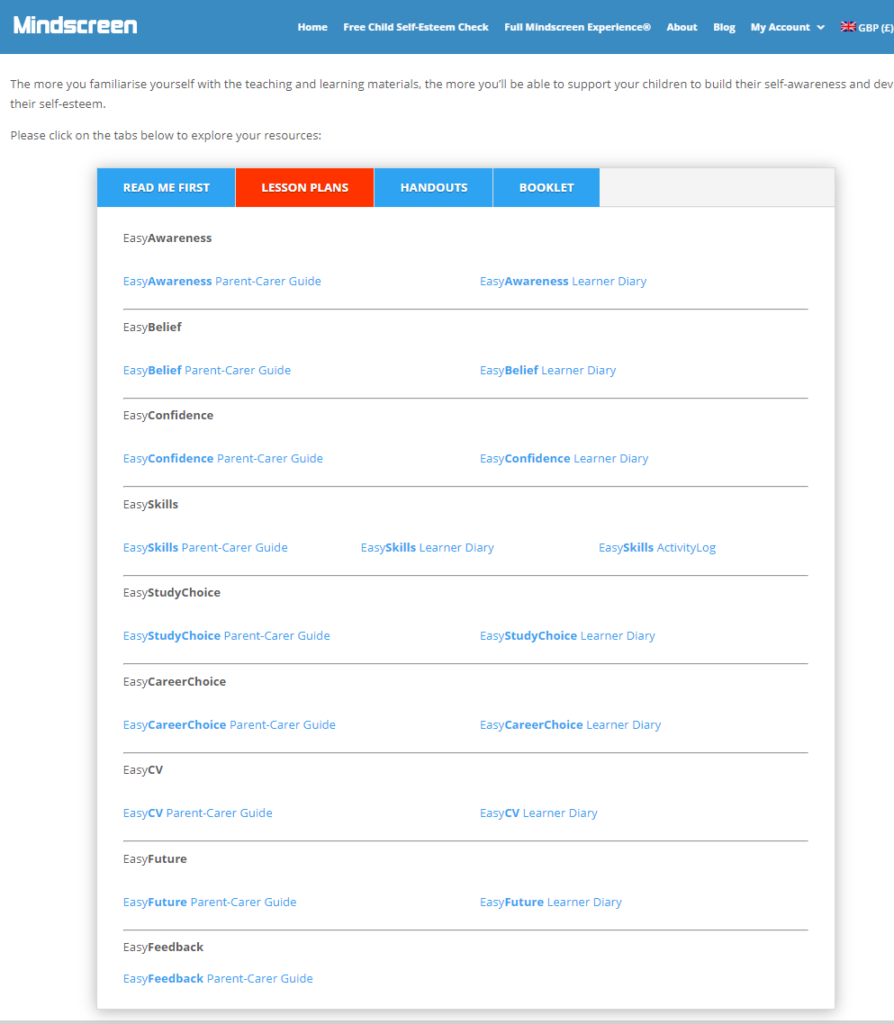
Each lesson plan will have a Parent-Carer Guide which you keep with you to prepare and host the lesson and a Learner Diary for the child to read and fill out during the lesson.
There are nine lessons, which are:
EasyAwareness
EasyBelief
EasyConfidence
EasySkills
EasyStudyChoice
EasyCareerChoice
EasyCV
EasyFuture
EasyFeedback
Each lesson lasts around 30-40 minutes (some last around 60-80 minutes depending on the number of children. If the lesson has a different duration it will specify how long it will take.) The parent guide provides enough detail for you to prepare for your lesson before you start, from detailing the lesson’s objectives to the resources needed and the order in which you take the lesson.
Lesson 1 – EasyAwareness
In this lesson, me and the boys discussed the importance of learning about their personal characteristics to build their self-awareness.
So, let’s get started!
What is self-awareness?
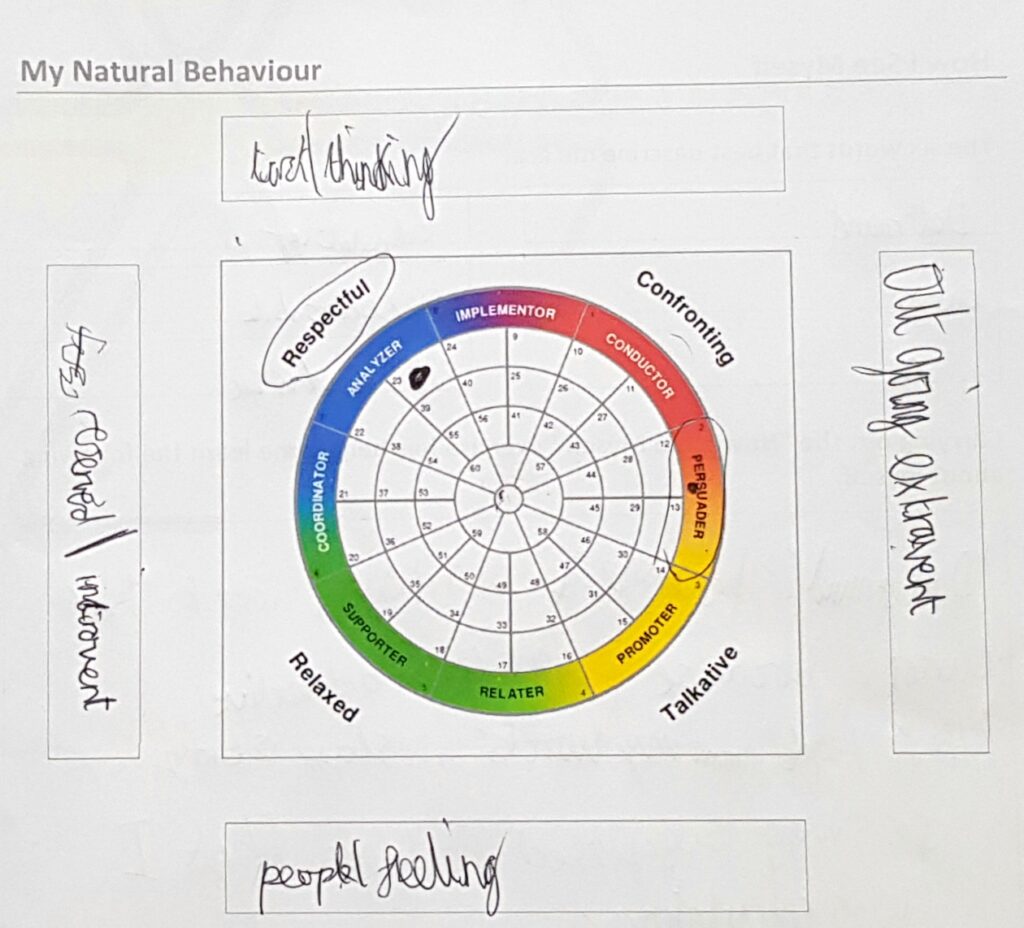
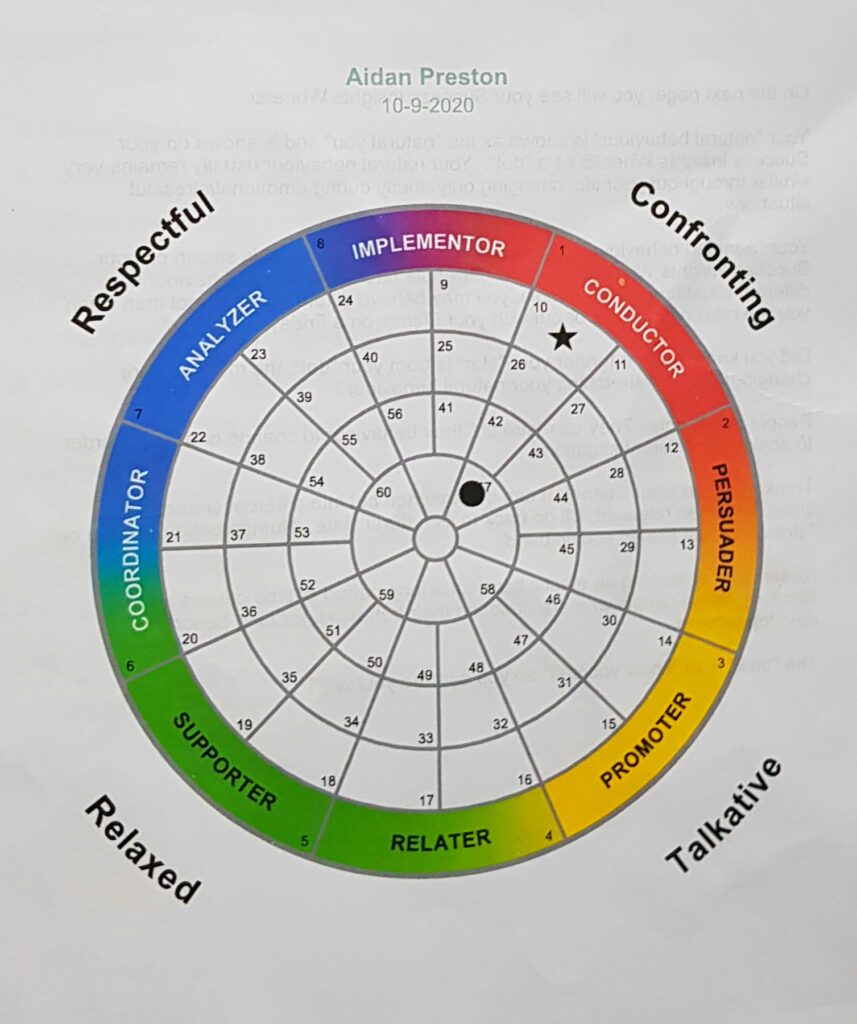
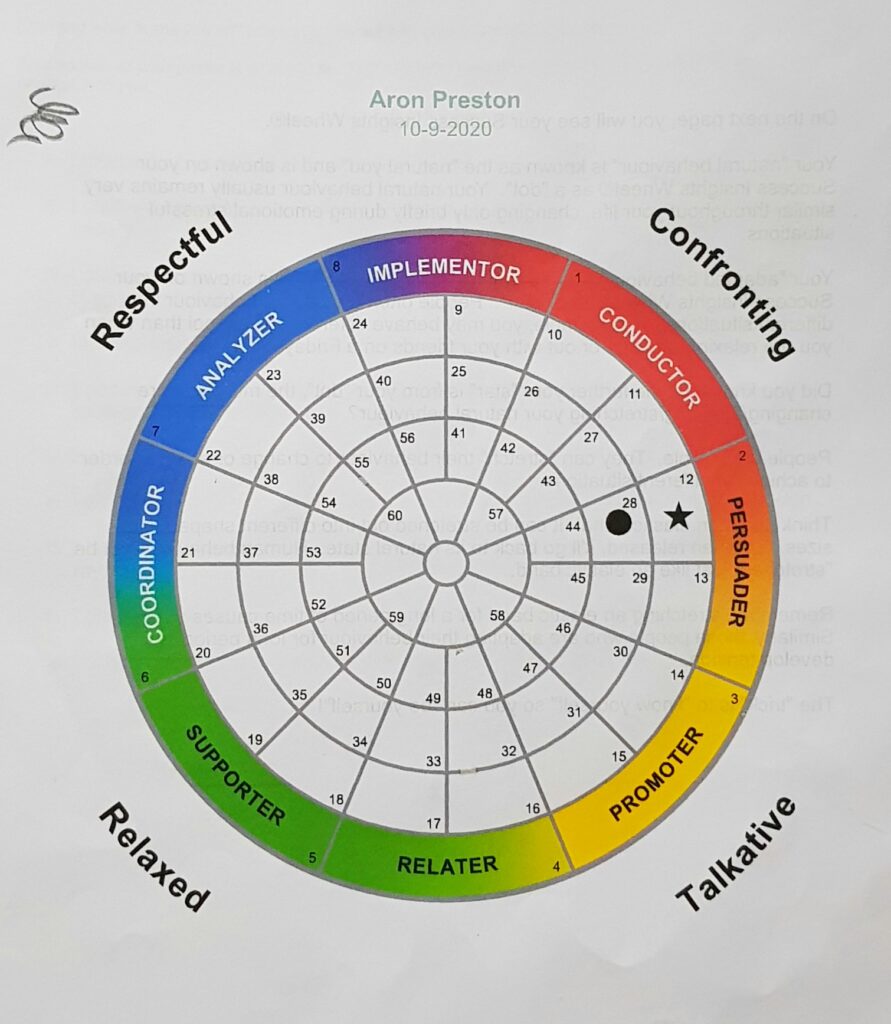
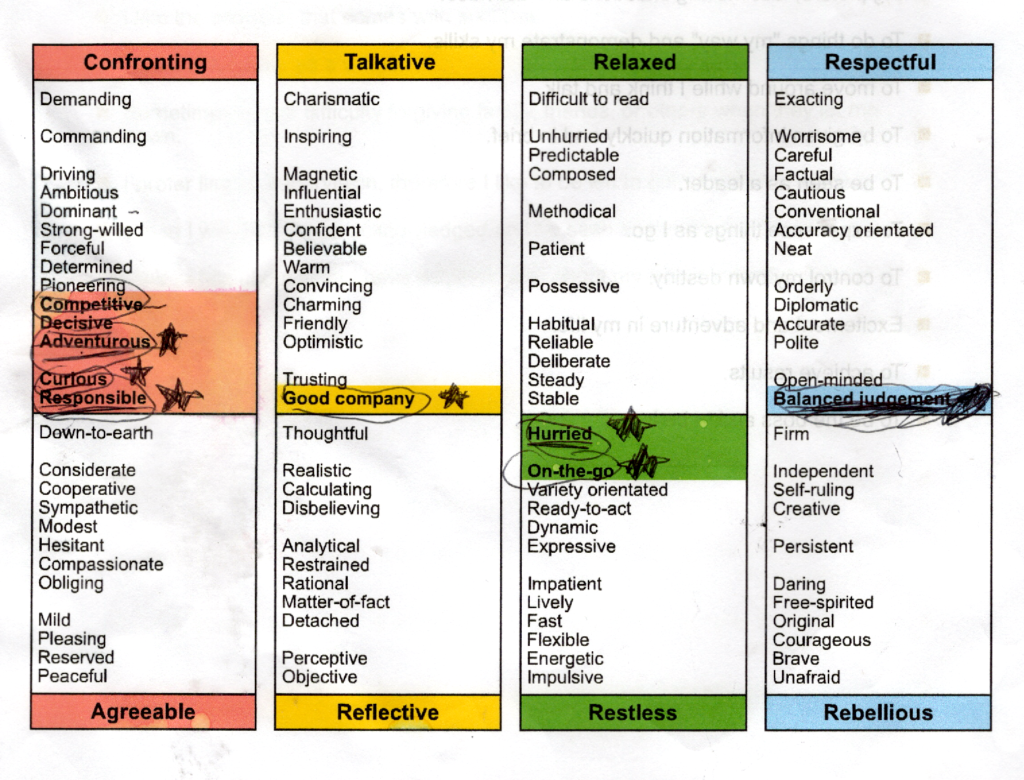
EasyAwareness is the first of the nine lesson plans which is all about providing your child with the opportunity to learn about their personal characteristics and begin building on their self-awareness. We want to help our children become more aware of their own natural behaviour and how others see them too.
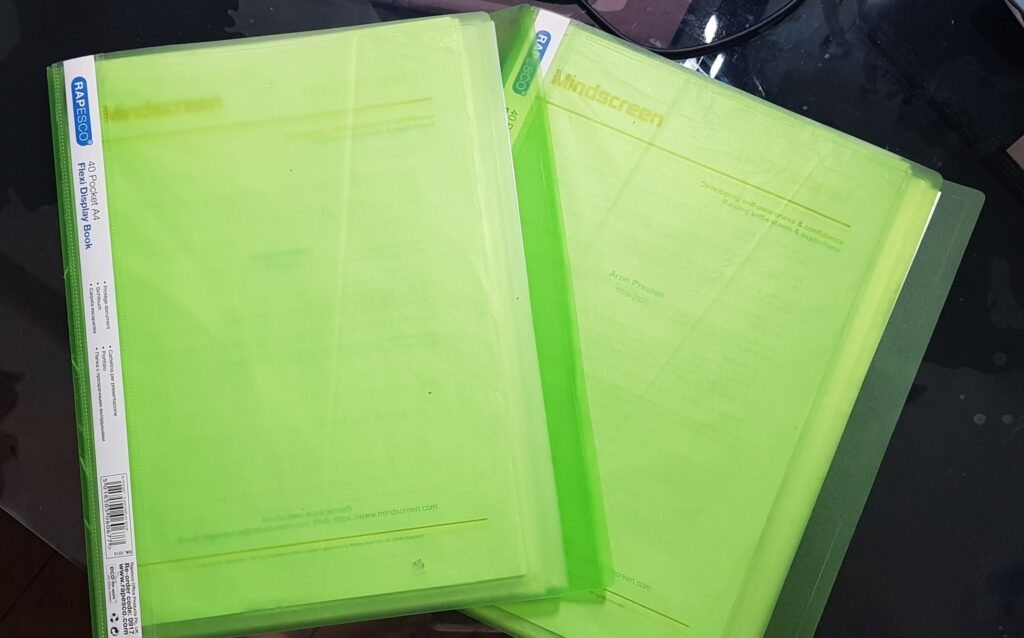
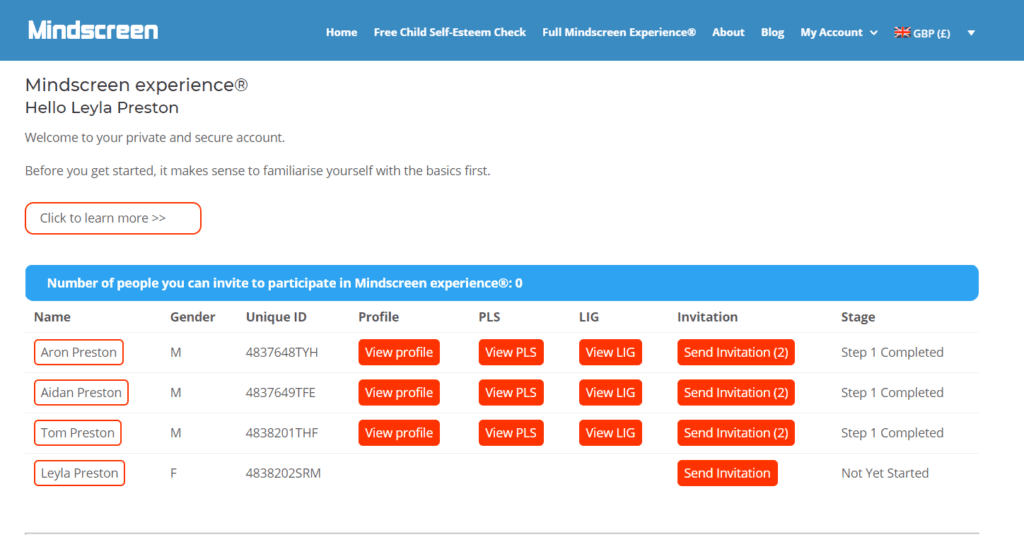
I showed the boys their folders which I created especially for their Mindscreen Experience. Each folder housed their Mindscreen Profiles and Learner Diaries.
The boys were very intrigued by their special green Mindscreen Experience folders and wondered what it had to do with them sitting down and having a lesson with me outside of school hours.
I introduced Mindscreen as the website they used to complete their questionnaire to find out more about themselves.
Aidan (8) chimed in.
“That’s not good, we are going to get reported!”
“Why?” I asked.
“Because people will steal our information!”
Ah! He thought we were going to write about his date of birth, address and phone number! At least he was on the ball with online fraud.
I reiterated the reasons why self-awareness is important, i.e. that finding out about themselves meant learning about natural skills and strengths, as well as weaknesses and building their emotional intelligence so they can build confidence and experience success in life – and this meant learning more about their personality and characteristics.
“But it’s still bad to give away that information.”
“No, Aidan, the information is related to you personally and won’t be shared with anyone else but us, and only if you want to, as well as the owner of Mindscreen who won’t share it with anyone else. The website is protected.”
Aidan sat back with a reluctant look on his face.
“How do I learn about myself?”
“Let me explain so you understand what I mean and I promise you will feel better about it. Paying attention will help!”
The boys stopped messing about with their baby sister and Aidan nodded his head in silence while Aron (9) darted his eyes between us like ping pong balls at a table tennis match.
“I promise you, this lesson is very interesting! Once you start going through your Mindscreen profile you will be shocked at how much you will find out about yourself. And knowing about yourself can help you become great leaders one day! Anything is possible, ok?”
The boys perked up a bit.
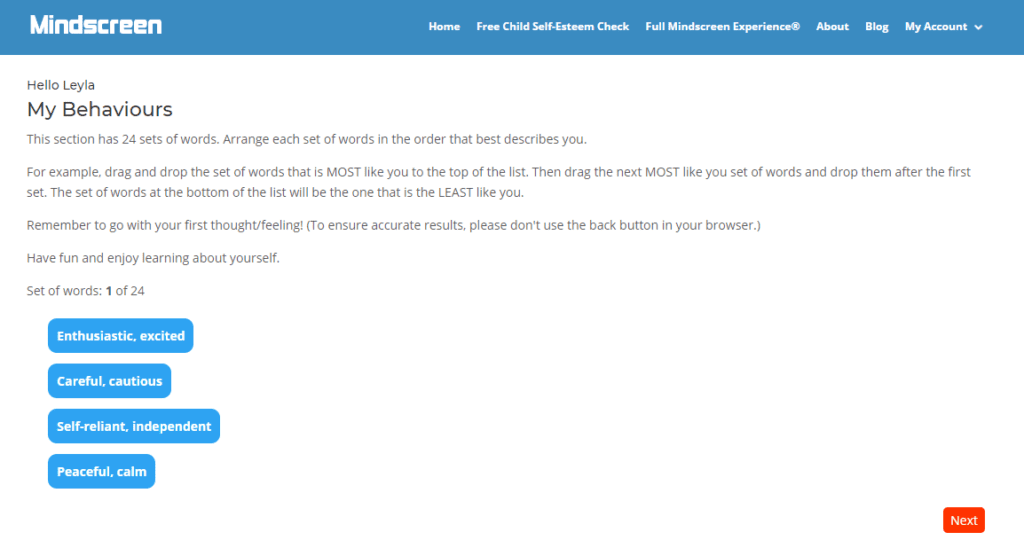
I asked the boys if they remembered completing the questionnaire, where they had to drag and drop boxed statements about themselves, with the most like you at the top and the least like you at the bottom, for example ‘I am energetic’, ‘I am fun’, ‘I like people to leave me alone’.
“I am fed up of working all time,” Aidan said.
“Yes, something like that,” I replied.
I opened up my parent guide and read through briefly what I needed to do (Both Mindscreen and I advise that you read and prepare the lesson before you get started, so you don’t waste time faffing about).
Your Mindscreen profile starts with the following:
“Ready, steady, go! Do not wait for a second longer! Start figuring yourself out now, while you are young!
Knowing yourself is vital because it helps you to recognise what you get passionate about and what you love to do. Doing what you love makes you happy! Learning about your own natural skills is important too because later you can choose study and career paths that use your skills! The more you know your strengths, the more your self-confidence and self-belief will grow!
Your Mindscreen experience® profile is UNIQUE TO YOU.
It is full of insights that will help you to better understand:
* Yourself – How your friends, family, and other people see you
* What your dreams and goals are
* What study and career paths you are more likely to enjoy
* What things make you happy and feel fulfilled
Remember, you can learn even more about yourself with these fun Lesson Plans: easyAwareness | easyConfidence | easyBelief | easySkills | easyStudyChoice | easyCareerChoice | easyCV | easyFuture”
Once we talked briefly about their Mindscreen profiles and what it meant for them specifically, I got into the first lesson, EasyAwareness, and showed them where they could find their learner diaries.
I asked them:
“Do you know who you are and what you want?”
“Yes, I’m Aron.”
“Yes, you know your name. But do you really know who you are?”
The boys looked confused.
“Are you aware of how you act and what your characteristics are? Are you aware of how you are different from other people? “
I explained that being different was a good thing and that the importance of self-understanding meant that you could understand yourself better – understand what makes you angry or anxious about things. It is about being aware of your behaviour, your motivations, your emotions, how you feel etc.
Being aware when someone upsets you and how you feel when you’re upset, and understanding why you behave in the way you behave. For example, If you are loud and talking too much and you notice that you may be upsetting people, you are self-aware. If you are doing a skill really well and noticing the results are positive then you are self-aware.
When you are self-aware you can make changes to your actions to better suit yourself and the situation.
“If you are shouting in a room and you can’t see that it’s upsetting others then you are less self-aware or unaware of what you are doing. Does that make sense?”
Both boys nodded.
Aron asked, “Mum, is this crisp-munching annoying?”
“No.”
“See? I’m aware that this crisp munching may be annoying to some, so I am self-aware!”
“Yes!”
I was getting through – yay!
So now I wanted them to open their minds and accept the lesson as an open lesson where we could talk, interact, discuss, and debate what we talked about. Most importantly, I wanted the boys to take in what was going on in this lesson and understand how important it is to be self-aware.
Ultimately, I wanted them to enjoy learning about themselves because it’s supposed to be a fun thing!
I also mentioned that once we talked about being self-aware there were sections in their learner diaries that they could fill out and keep as a record for reference later.
I asked the boys to go to their Mindscreen profiles and look at the “My Natural Behaviour” section.
“So, how do you get to know yourself?” I asked
Both boys stared at me with blank faces.
“Ok. Do you feel you are more reserved or more outgoing? And do you know what I mean when I say reserved and outgoing?”
Aron shouted “Outgoing! I’d rather play in the football match than be subbed.”
“No….”
“I’m outgoing! OUTGOING!” Aidan shouted.
“Reserved means that you’d rather keep to yourself than go out and socialise, for example. If you’re outgoing then you like to spend time with people, go out to parties and socialise that kind of thing.
“What if you don’t like to social distance?” Aron replied.
“Well, everyone should social distance, whether they’re outgoing or not.”
“But if you don’t want to social distance then you’re more outgoing, right?”
“Erm…”
“I don’t really like people, so I guess I’m reserved,” Aidan said
“I have lots of friends, so I’m definitely outgoing,” Aron said
“I have lots of friends!” Aidan cried “So I’m outgoing then!”
“But, even if you have lots of friends you can still be reserved because you may want to keep certain things to yourself and not share everything with your friends.”
“Oh no, now I don’t know what I am,” Aidan said.
“Ok, let’s move on to motivation. What motivates you? Do you know what that means?”
“I feel motivated to quit,” Aidan muttered.
“Ok, what keeps you happy? What makes you want to do the things you do?” I interrupted.
Both boys stared blankly at me again.
“I wake up in the morning and I want to do [blank]. Fill in the word that most applies to you.”
“Roblox,” Aron said.
“Think bigger.”
“Playing on the fields at lunchtime.”
“Think even bigger than that.”
“Being myself?”
“What motivates you in life?”
“Being outside,” Aron replied.
“Ok, we’re getting there. What is it about being outside that motivates you?”
“Playing football, fresh air, being free.”
“Ok!”
Triumph. Aron is motivated by being outside playing football – and being free.
Aidan looked at Aron and agreed that being outside and playing football motivates him too.
I then asked the boys to catch themselves reacting and behaving in certain situations, like when something upsets them, or in a stressful situation, they should note of how they react – catch themselves in the moment
In stressful situations, do you get stressed easily? Are you able to stay calm?
Both boys shouted no.
“Are you happy? Do you feel demotivated? Demotivated means you don’t want to do things.”
“And then ask yourself what caused me to feel this way. What is your current mood? As in your feelings/emotions?”
Aidan responded, “Right, now my feelings are that I want to finish these crisps and go outside.”
I asked the boys to become their own mirror and see themselves clearly.
“But, what if I walk past the bathroom and see myself naked?” Aidan said, looking shocked at Aron.
“Ok, I don’t mean an actual mirror – it’s a metaphor. The metaphor means not a real mirror, a pretend mirror where you are seeing yourself like you are the mirror. Think about what you are like right now. Can you see yourself joking around? What is causing you to feel that way?”
“Ayla [baby sister] is distracting me.”
“Ok, let’s move on to the lesson.”
In the parent guide, the lesson asks you to set the scene in the form of a respected psychologist from years ago, His name is Carl Gustav Jung and he was the first person to describe human behaviour simply. He recognised that, by creating an easy-to-understand behavioural model, people could begin to become more aware of their behaviour.
I told the boys that we will be using this model to help them better understand themselves and to reiterate that different and unique doesn’t mean good, bad, right or wrong. It just means different and unique.
I asked the boys to take out their learner diaries and look at the model that was created. I told them that the fun was about to begin and gave them a pen to get started.
The behavioural model
Aron immediately said, “I am a challenger I would do dangerous challenges like exploring a home where a tiger is.”
I asked the boys to write down ‘Reserved/Introvert’ on the left-hand side of the wheel.
In the right-hand box, I asked them to write ‘Outgoing/Extrovert’
At the top box on the wheel, I asked them to write ‘Task/Thinking’
At the bottom of the box, to write ‘People/Feeling.’
I then asked the boys to place their finger on the centre of the wheel. I again explained what reserved and introverted meant again to ensure they understood.
I asked them to move their finger either to the left if they felt they were more introverted or to the right if they felt they were more outgoing, The further to the end of the wheel they moved their finger, the more reserved or outgoing they were.
It took them ages to figure out what I was trying to say. Eventually, they moved and kept their fingers on the spot while I asked then to think about task/thinking, i.e. they are more task-focused if they liked to think things through, have lists to work through, and tick the tasks off when they are done.
And to move their finger more towards people/feeling if they prefer to be around other people, talk with other people, help other people etc. I asked them to move their finger either to the top or the bottom respectively. I had to remind them to move their fingers to the degree they thought they were either a little or a lot of each.
Aron ended up on the yellow area, i.e. between Outgoing/Extrovert and People/Feeling – right in the Talkative/Promoter section.
Aidan ended up on number 23 in the wheel, more towards the Task/Thinking section, up towards the Analyser/Respectfulblue area.
I asked them to put a dot where they ended up.
The comparison between how you see yourself and what is your natural behaviour and adapted behaviour
I asked them to turn to the “Wheel” page – The Natural & Adapted Me section in their Mindscreen profiles.
I wanted them to see the difference between how they saw themselves and where their questionnaires placed them on the wheel. I explained in the profile that the dot is their natural behaviour, the behaviour they carry with them throughout life, only changing very slightly to adapt to certain situations.
The star is their adapted behaviour. That means the behaviour they change when they are in different environments. For example, when they are at school their behaviour might be different from when they are at home. In a stressful situation, their adapted behaviour might be different from their natural behaviour.
The results were very interesting.
Aidan’s dot was further away from his star but in the same column. If the dot and star are further apart from each other, then Aidan seemed to be stretching his behaviour to adapt himself to certain situations to be more confrontational and controlling than he likely naturally was.
But Aron’s wheel showed no real change in his natural and adapted behaviour. He was who he was, whatever environment he was in.
Aidan shouted, “This is stupid. I am not argumentative!”
“Maybe not naturally, but perhaps you try to be in certain situations?”
“I don’t know, I’m confused! I don’t understand what any of this means!”
The elastic band metaphor
I asked the boys to think about an elastic band. The elastic band can stretch a little bit to adapt its surroundings, perhaps around a pot. But as the elastic band stretches further, what happens?
“It gets longer?” Aidan asked.
“No, Aidan, it will snap if you stretch it too much,” Aron responded
“EXACTLY!”
“It will snap?” Aidan responded looking like he was about to cry.
“Ok, let’s backtrack.”
I picked up the elastic band again and left it slack.
“Who you are is this. Now focus on the stretchiness.”
“I am not an elastic band!”
“No, but I want to imagine that your behaviour is like an elastic band.”
“What? How can my behaviour be the elastic band?”
“Ok,” I sighed.
“When the elastic band is left like this, is there any strain on it? Is it in its normal resting natural self?”
“Yes?” Both boys replied, still confused.
“Ok, so just pretend for a moment that this natural state is your natural behaviour. Your natural behaviour is like this elastic band. It’s not stretched, it’s in its most relaxed self. You are the most comfortable in your relaxed self.”
“Ohhhhhh….kkkkk?”
“Now look what happens when I stretch the elastic band a little bit. Is it ok still? Can it handle this stretchiness?
“It can handle a lot more stretching!” Aron replied
“Ok, so it’s happy to be stretched this much, right? Now, think about your behaviour stretching just a little bit and by that I mean, you’re adapting your behaviour a little bit to suit whichever environment you’re in, like at school or home etc. Makes sense so far?”
“Yes!”
“Now, think about what will happen if I do this.”
I stretch the elastic far to the point it’s very taut now and the boys wince.
“What do you think will happen?”
“It will snap!” the boys shouted.
“Ok, so the further you stretch your behaviour the more strain you are putting on yourself. Can you tell me why?”
“Because we are not being ourselves!”
“BINGO, ARON, BINGO!”
“And what happens when you are not yourself all the time?”
“We get sad because we just want to be ourselves.”
“HURRAH! You get it!”
“You see it’s not a bad thing to adapt your behaviour slightly to different situations because you’re reading the room and you’re responding in a way that helps the atmosphere of that room. For example, if you’re in a serious meeting, you act more serious to reflect the seriousness of the room. You don’t clown around and jump up on the table even if that’s what you want to do.”
“Now, think about when you are with a group of friends and they are all making fun of someone and you make fun of that person too because you want to fit in. But you like that person or you’re a nice person and it makes you feel sad inside.”
I held the elastic band in a very taut position.
“It hurts you inside that you are doing what you’re doing, but you are trying to adapt your behaviour to suit those so-called friends. Can you keep doing that again and again?”
I stretched the elastic band until it snapped. The boys gasped.
“Stretching the elastic band too far causes strain and it can only handle it for so long before it snaps. Sooner or later, you are going to get depressed. You are going to feel like you will snap because you are fighting to not be yourself, but you can’t do that forever. When you pick a job you hate and you have to work at that job every day then you will start to feel anxious, upset and stressed. Eventually, it will damage your health.”
I asked the boys if they’re the same at school as they are at home and what makes them different.
“I am the same,” Aidan replies, “I always act the same”
“Your wheel says different, though.”
“Maybe when you are at school, you’re a bit shyer so you try to act more strong by shouting?” Aron asked Aidan.
“Wow. Very good insight, Aron.” I reply.
“No. that’s not what I’m like.” Aidan replied with his arms crossed “I am number 57! Number 57!”
I look at the wheel and number 57 is in the centre, slightly towards conductor/confronting.
“Your wheel tells me that in some situations you try to be number 10, which is more confrontational.”
So I asked Aidan when he thought he could become a bit more argumentative than normal.
“What about when you’re on a stage and you’re being asked to present something on a stage?”
“I would just run away,” Aidan replied
“Do you think you might be a bit more serious? Confident?”
“No.”
“Why do you think your star and dot are far away from each other?”
“Because it’s rubbish.”
I finish the elastic band analogy by explaining to the boys they cannot change who they are but they can adapt, as long as they don’t try to change themselves for others.
It took us about an hour to get through this part of the lesson!
What did the boys learn about their natural behaviour?
I asked the boys to answer the question in their learner diaries about how this exercise had helped them learn what their natural behaviour was (i.e. were they more introverted, reserved, people/feeling focused?)
Aidan wrote, “I am a balance of implementer and get tasks done.”
Aron wrote “I am a persuader. I am more extrovert.”
How I see myself
I asked the boys to turn to the ‘how I see myself‘ section in their Mindscreen experience profiles and take a look at the highlighted words in each of the columns. These words reflect how they see themselves. I asked them to circle three words in the highlighted areas from each column which are accurate and positive statements about themselves.
The boys had to ask what some of the words meant, but after a while, they highlighted their three words.
Aron selected Competitive, Good Company, and Balanced judgement
Aidan selected Determined, Reliable and Firm
Then I asked the boys who wanted to be ‘Person A’ and who wanted to be ‘Person B’ where Person A looked at Person B’s profile and vice versa.
The boys were to underline six of the words that described how they saw their brother.
Both boys underlined ‘Responsible‘ for each other which I thought was sweet.
Aidan underlined ‘Adventurous’, ‘Curious’, ‘Responsible’, ‘Good Company’, ‘Hurried‘, and ‘On-the-Go’. Aidan explained that Aron was a nice brother and he was always loving and helpful, as well as very polite. He was also very fast and never stopped moving.
Aron picked ‘Responsible’, ‘Calculating’, ‘Reliable’, ‘Stable’, ‘Determined’ and ‘Firm’ for Aidan because he always wanted to be the best and get what he wanted. Competitive because he takes part in everything and always wanted to win. Responsible because you can rely on him and Calculating because he liked maths.
How I describe myself
I asked the boys to write down the six words that best described themselves.
Aidan wrote “Determined, calculating, curious, firm, responsible and realistic”
Aron wrote “Adventurous, curious, responsible, decisive, good company and on the go.”
I reminded the boys that these traits didn’t mean they were bad or weak, but that they made up their unique characteristics, which is a beautiful thing and being different is fantastic.
But the main lesson here is that if they learn more about themselves they can build their self-awareness, and keep these six words in mind so they can catch themselves when they are like that.
This is not just about working out who you are, it’s about catching yourself and how you’re like when you are at school, when you’re with your friends and when you’are at home.
What I’ve learned about how I see myself
I asked them to fill out the last box ‘Carrying out the “How I see myself” exercise has helped me learn the following about myself:’
Aron wrote “That I am a persuader with a curious mind. I’m so shocked that I’m hurried. It makes me feel shocked.”
Aidan wrote “Determined: because I am ready I can do this. Curious: because I want to be a detective. Firm: people mark my words, and I stay strong. I was surprised to learn that I was calculating. I feel happy when I learn new feelings about myself.”
How did we get on with Lesson 1?
I struggled to get their attention for most of the lesson – either they were distracted by each other or their baby sister who was running around pulling things off the shelf. I also found it difficult to get them to sit on the table with me and listen. They already had preconceived views that this lesson was going to be boring and it wasn’t until the last thirty minutes that they got into it and realised that learning about themselves was fun.
How long the lesson was supposed to be
30-40 minutes
How long it took us:
Over 1 ½ hours
I told the boys that I was looking forward to the next lesson, EasyBelief, because I enjoyed learning more about them. I explained that Lesson 2 will be about exploring how their own beliefs are formed and how those beliefs drive their behaviour.
It was tough but I really did enjoy learning more about the boys.
What did I want the boys to learn in this EasyAwareness lesson?
The most important part of this lesson, in my opinion, was that personal awareness is vital for growth and I really wanted to show them why self-awareness is important for professional development too. I also wanted to show them why self awareness is important in leadership, but at eight and nine years old, they would have had no idea what I meant if I had explained it in that way.
Instead, the importance of self-awareness is to learn how to be more aware of their natural behaviour in situations and how external factors can cause their behaviour to adapt, which is fine, as long as they’re not stretching their personalities and causing strain on their mental health. Why is self-awareness so important in mental health? Because we are most comfortable in our natural state and trying to be someone we’re not can damage us in the long run and lower our self-esteem because we may eventually end up thinking our natural behaviour is not good enough.
Why is it important to develop self-awareness? How can it help you balance your thoughts and feelings?
Why should people be aware of themselves? There are many benefits to self-awareness in humans because it can make us more proactive and encourage positive self-development (Sutton, 2016). Self-awareness also allows us to see things from the perspective of others, and practice self-control, as well as lead us to be better at our jobs and become better communicators too.
Why is self-awareness important in children?
If we can teach our children how to be self-aware when they’re young, we can help them to enhance their self-confidence early which is the whole point to this Mindscreen series. The earlier we start, the more chance they have in succeeding in the path they want to choose.
We also need to teach children how self-awareness is important to their personal growth as it can encourage them to be better people all-round.
What does self-awareness allow you to do that less self-aware people can’t?
Being self-aware can help you take better action towards life decisions and goals. Knowing about yourself means you can play to your strengths and improve your weaknesses – or avoid them altogether. Why is awareness important for children? You can help your child nurture their skills and ultimately find the job that’s better suited to them, allowing them more opportunity to succeed and be happy later in life.
What’s next?
In Part 3, we will be going through Lesson 2, EasyBelief lesson plan where me and the boys will explore how their own beliefs are formed and help them to understand how their beliefs drive their behaviour.
Fun kids activities for half-term which are pandemic-friendly
For some families, school holidays means squeezing in a quick sunny holiday abroad or visiting the extended family. As 2020 has other ideas for us half-term will be focussed on taking a well-earned break from the culture shock of school after a six-month hiatus (thanks to the pandemic).
Whichever way your family prefers to normally spend the one-week break, make this half-term a safe and socially distanced school holiday to remember and inject some mojo back into the kids’ school spirit for the second half term.
Financial planning firm Lemonade Money believes that, with some creative planning, parents can spend pennies rather than pounds and still enjoy some good quality time together during half-term.
So, below are some fun kids activities for half term which are pandemic-friendly.
Go camping in your backyard or in the park – if you can manage the cold weather!
A great way to spend half term with the family is to go camping together. However, as we’re unable to travel abroad or visit somewhere crowded, bring camping to your backyard or visit your local park to find out whether they offer open space camping in their vast fields. You could glamp up your camping experience and hire an RV or campervan, so you camp in style.
A great idea for this experience would be to choose a modern camping specialist provider which provides an array of options, such as self-catering mobile home holidays with style, quality and comfort. This is glamping at its best as you don’t need to get your hands dirty and pitch up a tent. These days, you can find places which provide every essential you need, like a home away from home. You will have electricity and running water, plus it’s safe as you’re the only ones inhabiting the camping spot. Find out whether the service provider has thoroughly cleaned the mobile home and what the safety rules are for when you have to leave.
Before you know it, you’ll be back to your new normal and one day you’ll be able to camp in peace in places like Costa Brava Holidays next year – here’s hoping!
Venture outdoors and explore your area
A busy half-term doesn’t mean you have to break the bank. If you’re a Google whizz, you can discover great places to go which doesn’t involve mixing in crowded places. You could be adventurous and explore your local parks, which, for the most part, should be free. You could afford to do something different every day during the seven-day break, as long as you keep to the social distancing rules.
And for transport, grab some great commuter scooters for the kids from skates.co.uk and ride around your local area with them. You can even try to keep up with them by riding on your own scooter or running alongside them for free exercise – if you can keep up! I generally can’t.
Check out www.free-events.co.uk and www.wherewecango.com for more half term kids activities. Just make sure the half term events comply with the current social distancing and safety rules before you set off and check if you need to book tickets in advance.
The UK is blessed with lots of beautiful country parks which remain open during the pandemic. So, if you’re looking for a family day out, why not take a picnic and enjoy some al fresco dining as a family. Some country parks offer open parks, nature trails and educational fun like the farm and playground centres. Check out Exploring Dorset’s local lovely country parks which are open during half-term.
Visit the extended family and friends virtually
Half-term is normally a time to catch up with the grandparents or the rest of the extended family. As some boroughs are in Tier 2 and some even in Tier 3, you aren’t able to mix in other households or hold get-togethers of up to six anymore. So this year is all about exhausting technology devices and virtually keep in touch with extended family and friends.
You can video call up to eight people and Zoom is great for hosting multiple rooms and functions. Create a family quiz and play games while including all participants in the creation and gaming process. It won’t replace them actually being in the room with you, but the little ones will love the break in routine to chat with their family in the comfort of their own home.
“We are doing a zoom quiz with the kids’ friends. We all have to make up ten questions with a certain theme and then take it in turns. It’s a great way to get everyone involved and they get to stay in touch with their friends over the holidays.”
You could start a building project or grab a large blank canvas and create a family painting. Projects are a great way to start the holiday, paired with clear goals for the kids and a lot of team-building fun.
You can find a great large canvas to start with from Amazon here.
Build a really large jigsaw puzzle
If you fancy another team-building exercise, jigsaw puzzles are at the top of the list. If adults join the party, try a 1,000-piece jigsaw puzzle together, which may last the week. It may be worth investing in a Portapuzzle, so you can put the jigsaw away when you’ve had enough. When you’ve completed the puzzle you can hang it up on your wall with some Jigsaw glue. I found this great tutorial on how to frame your jigsaw onto the wall here.
Alternatively, you can buy a 75 – 100-piece jigsaw puzzle just for the kids, which will keep them amused for a while and give you a little bit of a break. 100-piece jigsaws can also look great on the wall.
Encourage the kids to put on a show or indulge in some role play. Whether you are sailing the seven seas, pretending to be ninjas/princesses or making a whole imaginary world out of tea-stained paper and cereal boxes, there’s nothing more magical than getting creative with the whole family. Grab whatever you have in the house to make that den where you can hide from reality and step into the world of the child’s mind.
Autumn may be cold, wet and full of muddy puddles, but as Peppa Pig likes to chant throughout her shows, “If you want to jump in muddy puddles, you must wear your boots!” Don’t be afraid of the cold, that’s what coats, hats and scarves are for! So, grab your wellies and head to your nearest park (it’s free!) or wetlands centre for a fun half term for kids. Just remember to warm up with a nice mug of hot cocoa when you get back (yum!)
Rekindle those old games that you loved playing when you were a wee child and teach your own children how to play, so you can enjoy them together. If the weather is miserable outside, break out those cards and play simple games like ‘Snap!’ or ‘Go Fish’. Or, create some numbered boxes on the floor with chalk (or something washable) and play hopscotch until your legs get tired. Snakes and ladders, Guess Who? and Connect 4 are also some great games to get the whole family involved. If you are feeling competitive, perhaps an educational game of Monopoly might get the spirits up. You can even assign the youngest as the banker, so they learn about how to manage money. Learning maths through play is so much more interesting than simple addition and subtraction equations, right?
Children love to soak up new and exciting experiences like a sponge. So, satisfy your children’s curiosity by creating some great homemade science experiments by using the bits and bobs you have lying around in your house. YouTube has tonnes of half term ideas for kids on how you create some simple experiments for fun half term activities at home without spending a penny. Make notes on your findings and talk about them with your child afterwards, so they understand the results of your experiments. Why did the egg sink or float? How did the water turn into a tornado using just glitter and washing up liquid? These simple experiments will help your child grasp science so much better at school, so give them a good start at home.
“Drive-thru cinemas. 🙂 There seem to be loads popping up all over the UK at the moment. They seem to be showing Halloween themed films which would be ideal for this week.
The tray game is a great way to build up a child’s memory and it can be fun too if you place a lot of interesting items on the tray. Adjust the number of items, depending on the age and then cover with a towel. Then ask them to list off how many they could remember. Or, you could take an item away and ask them to write down or tell you which item you removed. There are lots of ways you can make this memory game interesting and you can offer one of the objects on the tray as a prize for the winner. Chocolate items may make the game a lot more interesting.
A great idea for a tray table which already comes with accessories from Amazon here.
Play tuff tray games
Use the same tray and create some tuff tray games for the kids to enjoy. If you’re unsure of what to put in a tuff tray, check out The Work Life Blend’s Tuff Tray Ideas to keep the kids busy. There are 50 half term activities to choose from and all look super fun for adults too!
If you’re based in or around Norfolk, then you could check out Norfolk Pumpkin Patches over half-term with the kids where you can go pick your own pumpkins and/or spend the entire day out. As it’s all outdoor fun, most places would be open during half-term and there is so much for the kids to do that you’ll need more than a day out to enjoy. Most places will have COVID precautions in place, so you should find something fun for your kids to enjoy. But make sure you call them up first to find out whether you need to book ahead first.
Once you’ve picked your pumpkin from above or from other areas near to you (check out Skinny Spending’s article here on other places you can find pumpkins, and set to work carving. Even if you can’t go trick or treating, you can still enjoy having your own pumpkin at home and use the rest to make delicious Pumpkin Pie!
From setting up your own party games to creating some spooky snacks for snacking in between apple bobbing and pinning the hand on the zombie, bring Halloween to you and make it a day/evening to remember. Check out some more tips from Mummy Est.2014 on how to bring Halloween to you at home.
You can find some Halloween decorations from Amazon here
“We plan on making our own chalk games like snakes and ladders and chess outside. We also do pin the tail on the donkey and throw bean bags into hoops.”
Get into the Halloween arts and crafts spirit and grab yourself an apple or a potato. Cut them up to resemble a pumpkin and then paint them in orange. Then just print on paper! Super fun.
Sticking to the topic of Halloween, paper crafts are great because they’re cheap and they build on motor skills. Plus, it’s a great way to get the family involved too. Kiddy Charts have some fantastic paper craft activities that kids of all ages can enjoy over the half-term!
Have a Halloween-themed movie night!
Round up some large bowls of popcorn and cuddle up with the family for some age-appropriate Halloween movies after you’ve exhausted yourselves from all the Halloween fun. Mom of Two Little Girls has a great list of Halloween movies which are perfect for kids here.
“We are forecast lots of rain next week so will be working our way through this list of kid-friendly Halloween movies.”
Rocks are a great tool with which to get creative because you can paint them and either decorate your backyard/driveway or you can hide them for others to find. It’s a lovely free present for a child to come across a painted rock and keep it for themselves. So paint some secret fun messages on the rocks and place them around your local area for the locals to find.
Invest in an activity box – or make your own!
The boys and I used to enjoy receiving our fortnightly Weekend Box and monthly Toucan Box in the post. But, sometimes, we were not always up for an afternoon of arts and crafts, especially when the kids were winding down after school. So, I stored the boxes away and when we had some spare time to get creative, I brought them out again for some indoor activity fun. Once we made a snowman over the Christmas holidays, courtesy of Toucan Box, which was so fun to make.
I just love how everything you need is so helpfully provided for you in exactly the right amount required for the activity. Plus, you get to build your own activity box of items that are leftover from each box. So, if you don’t want to buy or subscribe to an activity box, just use your own, along with all the wrapping and packaging you received over the festive period and keep it for holidays like half-term. It doesn’t matter if you don’t make anything super constructive, just the act of mucking in and achieving something together is well worth the bonding session and the brain cells used in the process!
The Halloween Toucan Box includes items like a special edition Halloween magazine and sticker sheet, as well as awesome Halloween craft projects, so the fright night fun goes on and on for your little one.
Head over to ToucanBox’s website here and get started at just £10.95 per month per box. You can also save money and subscribe to the 3-month, 6-month or 12-month plan and pay a cheaper price. Act fast to get your Halloween edition ToucanBox now. Suitable for Key Stage 1 and 2 and rated excellent on Trustpilot with 3,400+ reviews.
Plant a garden
Spring will be around before you know it, which means now is as good a time as any to start growing your own crops. Kids love to watch veggies grow, so make your own window garden box and introduce them to the world of plants. If you are looking for instant results, planting seeds like sunflower, cress and salad are great during the half term because they offer quick results. Gardening aids physical development and helps children to understand the world of nature. Check out how does your garden grow for more ideas on how to do a spot of gardening with the kids.
Spend a day crafting using microwave playdough, which is safe to put in the mouth, so our 13-month-old can get involved! Check out the recipe for microwave playdough here.
Go for long walks with the children
Walks are great because you get in much-needed exercise but you also get to enjoy nature and bonding with the family. I’ve always loved walking, either on my own or while walking with a pram and it’s kept me fighting fit during labour and birth because I walked almost every day. Now with two energetic boys and a newly walking baby girl, walks are perfect to spend some outdoor time together – plus it doesn’t cost a penny! Time and Pence have some great tips on how to walk with children here.
It’s also important to wear the right shoes and clothes when hiking to avoid injuries. Check out this post on what to wear when hiking.
“We will be doing lots of walking over this half and a visit to some of the English Heritage sites.”
After you have dinner with the family, why not take a break from the norm and head outside for a brisk night walk. Not only does walking in the fresh air after dinner helps you to digest your food, but it will help kids go to sleep easier. Walking after dinner also helps children stay asleep at night because their tummies are not too full or empty.
If you want to plan your walk, Google is your friend for researching organised bat or nocturnal animal spotting walks in your area. So, before the evenings get too light, grab some torches and hot drinks in travel-sized thermos’ and make your way down the road together. Make sure the route isn’t too perilous or you flash your torch at oncoming drivers and temporarily blind them on the road. Also, it would be very useful to wear high-visibility outerwear, so vehicles can spot you in the dark.
Make sidewalk art
If you have concrete in your garden or you are by a local park, why not grab your chalk and go wild on the ground! Don’t let the grotty weather get in your way, you can always roll out some lining paper or an old blanket and paint on top. Why not go one further and grab a massive canvas, some set of decoration equipment, like paint, materials, coloured pencils etc and paint to your heart’s content.
Find some nearby plants, leaves or twigs to add to the creativity too? You can have hours of fun creating some pretty amazing artwork that you could hang up in your home when you’re done. Imagine the results!
Use voucher sites to treat the family to a day out
Lemonade Money also suggests that If you are planning to treat the family to a day out, use sites such as Groupon, Wowcher and Voucher Cloud to secure great savings and sign up for weekly alerts to get the latest deals. These deals can save you a small fortune and if you take your own food and drink, you’ll spend even less. It helps to browse the net for deals and ideas whenever possible.
Create a boredom jar
If you’re still stuck for things to do in the half term, you can create a boredom jar if you’ve exhausted all options and your kids are still bored. Fill it up with some half term fun for kids when you feel like there’s nothing to do around the house. And, make it so all the suggestions are free, so you don’t add to any extra expense. Your Best Friend’s Guide to Cash offers some tips on how to create a boredom jar and other half-term lockdown survival ideas that may be of interest.
“Begin to make some homemade Christmas gifts, bath bombs, bookmarks, soaps keeping little hands busy and entertained”
It may be too early for Christmas, but that doesn’t mean you can’t to prepare now. It may be a virtual Christmas this year, but at least you can enjoy some festive fun, by preparing the Christmas decorations or even decorate the tree. Too early?
It looks like it’s set to rain for most of the week, so get your creative hats on and use this chance to spend some adventurous time together. Grab some of the ideas above or if you have any tips of your own, share with us in the comments below, so we can try them out too!
*Collaborative feature post*
*Skates.co.uk kindly gifted us two JD Bug Scooters, but all thoughts are 100% our own*
*As an Amazon Associate, I earn from qualifying purchases*
How to spot the signs of low self-esteem in your child
*This post and the subsequent posts in the series are sponsored by Mindscreen – an online mental health and wellbeing tool which guides children towards higher self-esteem, at home or in the classroom.*
Over the past 30+ years, it has become increasingly clear that kids’ mental health disorders are on the rise. This generation’s children are experiencing an upsurge in low self-esteem, depression and anxiety because of the negative effects of our current climate, i.e. excessive social media use, gaming, cyberbullying and, recently, the pandemic’s lockdown (amongst other environmental factors).
One can argue that 30 years ago we simply didn’t have the resources or the knowledge to diagnose and manage mental health disorders early in children. However, we still find that mental health problems are often under-recognised, overlooked and under-treated.
Identifying any form of mental health disorder as early as possible allows for more time to manage that disorder and even reverse its effects before the child heads into adulthood.
Severe and persistent behavioural problems starting before secondary school years, which go unsupported, can have a long-term impact on children’s mental health and life chances.
But how do mental health issues present themselves in children?
There are a range of low self-esteem symptoms to look out for that may signify your child’s mental health is out of whack, and these can span from subtle personality traits to extreme medical disorders, depending on the length and severity. Some mental health disorders don’t present themselves at all until later into childhood and can either be exacerbated by the child’s environment or an undiagnosed medical condition – or both. We will go into what these symptoms are a little later.
What is low-self esteem in children?
In this article, we will concentrate on environmental factors that may cause low self-esteem, low confidence, anxiety and depression in children, rather than medical factors (for example, ADHD and ASD) which is outside the scope of this article. However, the tips displayed below can help to manage certain medical traits too, but you would need to discuss management steps with your medical provider first.
Self-esteem, simply put, is the opinion we have of ourselves. If our self-esteem is high, then we have a more positive outlook on ourselves and life in general. If our self-esteem is low then we tend to become self-critical, have negative thoughts and are less able to take on the challenges life throws at us.
What causes low self-esteem?
Low self-esteem often begins when you are a child and stems from the environment and people in which/whom we surround ourselves, for example, our parents, siblings, friends, teachers and the news/media, wherein they continuously fire positive and negative messages at us. And if a particular message resonates with us, whether it be positive or negative, it can influence our self-esteem.
If a child is constantly praised for having a good work ethic, which is classed as a positive message, then they would likely adopt a positive outlook on themselves which are signs of high self-esteem. However, if a child’s intelligence is criticised, then this is classed as a negative message and could impact the child’s self-esteem.
If the child constantly receives the message they’re not good enough, then over time their self-esteem will be impacted, and this mantra often stays with them until adulthood. As a result, the child finds it difficult to take on challenging obstacles in life because they think they’re not good enough to overcome them.
You are who you hang out with
My granddad used to always say the above to me. What he really meant was that if you hang around with ambitious people, you become ambitious. If you hang around with confident people, you will become confident. If you hang around critical people, you will become critical of yourself.
While this is not 100% gospel, there may be some truth to it. As the saying goes:
“Toxicity breeds toxicity.”
If the person who is a constant in your life is continuously negative about themselves and you, you will eventually become negative and it will affect your self-esteem if you cannot break away from the ‘chain’ and ‘see the light’ so to speak. You will continuously keep comparing yourself with others and find a way to feel like you’re lesser than, even if it’s not actually the case. But, as an adult, we have the benefit of life experience which can give us the strength to break away from the toxicity and make our own choices about ourselves, keeping our self-esteem intact.
A child who is surrounded by people who are negative will more likely have their self-esteem affected because they are like sponges and soak up the traits and characteristics of the people they encounter every day. Plus, children do not have the benefit of life experience and will most likely take what people say as gospel.
Environment affects self-esteem too
Environmental situations like life events, serious illness and bereavement can also often have a negative impact on self-esteem. My boys were, naturally, very affected by my late miscarriage back in 2017 and as a result, they are very overprotective over their baby sister, who was born in 2019. Poppy’s death made the boys anxious about losing their sister, which caused them to lack confidence, despite myself and my husband constantly reassuring them they’re doing a great job in protecting her.
Of course, their sister’s birth was a positive event after such a negative chapter in our lives, and so, therefore, even though they are anxious at losing their sister, their self-esteem is boosted every time we praise them for being so protective. So over time, they are less likely to believe their sister will go away.
It just goes to show how the environment can drastically change around us and our self-esteem is constantly taking a hit as a result.
We find it tough. Imagine how our children feel.
Personality
Some people are just born worriers or can’t help but be more prone to negative thinking. Others set impossibly high standards for themselves or have a fear of failure and therefore are too scared to try in the first place. In this instance, they require more assistance in overcoming their worries, which tend to be unfounded and not based on any actual negative circumstance.
But how do you spot the signs of low self-esteem in a child?
As I’m no psychological expert or a medical doctor, but I am indeed a doting parent, I am going to enlist in the help of Mindscreen to figure out if my boys (aged eight and nine years old) have any issues with their self-esteem and if so, how to overcome low self-esteem using the tips and techniques supplied.
But, first. What is Mindscreen?
Mindscreen is an online programme built for 11- 16-year-olds (younger and older children can use the online tools if they can follow the questions and lesson plans) which helps children to recognise their skills, interests, talents and strengths. Mindscreen also provides parents with step-by-step tools and guides to support children to develop their mental health and wellbeing as well as resilience and confidence at school through to adulthood.
Instances of low self-esteem, anxiety, and depression in children are increasing and support services can’t cope. The good news is world leaders are aware of the challenges but we all know that a ship like the Titanic is slow to turn, meaning it could be years before high-level policy change filters through into our everyday lives… Our Mindscreen experience® toolkit for parents and teachers will help you support your children to develop their self-esteem and unlock their potential.
Gav Devereux, Founder of Mindscreen
But every child is different
Indeed!
Which is why it’s important to work out what your child’s motivation is first. And, by motivation I mean, what drives your child? What makes them happy and what causes negative feelings in them? Are they natural worriers or sensitive souls (my middle one) or do they remain nonchalant in the harshest of crises (my eldest)?
Mindscreen offers a tool called the FREE SELF-ESTEEM CHECK, which is a low self-esteem test and contains 36 quick-fire questions that you answer on behalf of your child, to help you identify any signs of anxiety, low self-esteem and depression.
You will be taken to a private dashboard where you can enter the details of your child’s first name and assess your child straight away to check how their self-esteem is doing. Each time you assess a child you will get a report giving you an insight about their self-esteem level.
The check is free. Your child is priceless!
Mindscreen
As mentioned, I am going to assess both my boys’ (Aron and Aidan) self-esteem, and as I’ve already filled out the FCSEC assessment for Aron (results below), I will go through the FCSEC with you for Aidan (I’m about halfway through).
Click on ‘Create New Assessment’ in red to start the check and then click on ‘Continue’
You get 36 questions where you will select the answer that best describes your child for each question. The FCSEC constantly reminds you to keep asking yourself:
“Do I see these reactions often, do they occur only occasionally or not at all?”
Aron’s and Aidan’s report was the same:
Aidan scored more than Aron with 50 against Aron’s 44. This means that, on paper, Aidan has lower self-esteem than Aron, which I thought would have been the other way around!
However, as both boys’ self-esteem levels were ‘SITUATIONAL’ this meant that:
They are anxious or depressed as frequently as they are happy.
The results from both reports advised that we as parents should intervene immediately and take action to boost our children’s self-worth and resilience with positive alternatives as soon as possible.
I was quite disheartened at reading the results because I have tried everything in my power to make sure my kids are happy and enjoy healthy living all the time. However, I have quickly come to learn that you cannot control their mindset 100% of the time and I am aware that environmental factors can skew our children’s mental health. So I’m glad I have caught it early and I am fully on board to take the necessary steps to develop my children’s self-esteem right NOW.
So, the first step is to take the full Mindscreen Experience® using the Mindscreen experience® toolkit, which is designed to equip you with powerful steps to improve your child’s self-esteem as soon as possible.
The other additional option, which you can take on its own or with the Mindscreen Experience®, depending on the severity of your child’s self-esteem, is to seek additional assistance from public health services, a professional therapist, in-school counsellor and/or parenting support groups.
What are the signs in your child which may indicate low self-esteem?
Is/does your child:
Apathetic and de-motivated?
Have less interest in things they used to like?
“Doubt” themselves?
Appear sensitive about other people’s opinions of them?
Make excuses or blame others a lot?
Behave inferior to others?
Unaware of themselves, their skills, strengths, wants and needs?
Unaware of how their words or actions affect others?
Use “inadequate” language when talking about themselves?
Worry a lot?
Seem unhappy?
Seem lonely?
Seem ashamed of themselves?
Appear anxious?
Withdrawn?
Have exaggerated emotional reactions to ordinary situations?
Have sudden outbursts?
Have unexpected contrasting mood swings?
Have trouble sleeping?
A change in their eating habits or weight?
Seem agitated, irritable or angry?
Disbelieve praise?
Defensive when confronted?
Appear uncertain and indecisive?
Overly apologetic?
Insecure?
Unhappy with their body size/shape?
Always on social media?
Had any negative statements posted about them on social media?
Have any unexplainable bruises/scratches?
Less interested in their personal hygiene/appearance?
Less interested in going to school or studying?
“Hiding away” from the world?
Have low expectations of themselves?
Dislike themselves, who they are and how they behave?
Avoid trying or they give up/give in too easily?
If your child frequently or always displays some or all of the above signs for low self-esteem then you should take action now to help your child boost their self-worth and confidence using the Mindscreen experience® toolkit.
What is the full Mindscreen Experience®?
For this article and subsequent articles in the series, we are going to go through the full Mindscreen Experience® and take the required steps to develop your child’s needs, interests, and behaviour by inviting them to complete the full programme.
The full Mindscreen Experience® will unlock tools and guides along with enhanced insights about your child’s characteristics and include practical resources to grow their self-awareness, confidence and resilience.
Once you have completed the FCSEC and you’re on the results page, head to the bottom of the page and click on ‘Get Started’:
You will be invited to choose your packages which are designed for families and teacher class groups.
Mindscreen kindly gifted us the FamilyPlus package which invites both my husband and I as well as our two children to complete the full Mindscreen experience® together and compare our results.
What do you get in the FamilyPlus Mindscreen Experience® package?
B. Smart, easy-to-use tools and lesson plans for you to help your children to:
Build their self-awareness
Develop their self-esteem & self-confidence
Choose study & career pathways they’re more likely to enjoy
Determine what their goals & aspirations are
Unlock their potential
C. A way for you to measure improvement in your children’s level of confidence over time.
Click on the video below to learn more about how the Mindscreen experience® can help you and your children. It’s useful to complete your own Mindscreen experience® as a parent as you’ll be able to see how you differ from your children and adapt to their individual needs.
https://youtu.be/zimId5IPTG4
Let’s get started with the FamilyPlus Full Mindscreen Experience®!
So, once you’ve selected your package (in our case we selected the FamilyPlus package) head over to your account and select Mindscreen Experience®
Depending on your package, your dashboard might look slightly different, i.e. for the FamilyPlus package, you are allowed to send up to four invitations to complete the Mindscreen Experience® profile.
Make sure you take a look around first and click on ‘Click to learn more’ to familiarise yourself with the process and what you will be required to do. Then, when you’re ready, start by adding your child.
Some points to note before you start:
Head over to “Teaching & Learning Resources” to get an idea of how the lesson plans and support materials look like
Complete your own Mindscreen Experience® profile before you invite your children, so you can get an idea of the process and what to expect. Don’t forget that the questions are designed for children around 11+ years old
Plan ahead before you start. How many times/days are you going to work together with your child to complete the activities? Each lesson lasts around 45 minutes so make sure you allow extra time to prep the work first
Make sure you read through your child’s Personalised Learning Style (PLS) and Learning Improvement Graph (LIG) because it’ll give you insights into how to connect with them on a deeper level and help them learn in their own unique way
Help your children to unlock their true potential! The point of this journey is to develop your child’s self-worth and confidence, so work through the steps with them and keep building on their profile after they complete each set of lesson plans, so they can follow their progress.
Involve your children in the journey and engage with them to make the Mindscreen Experience® an enjoyable and educational process for all!
We will go through the above points in more detail below.
Mindscreen have also provided me with a 10% off coupon code just for Motherhood Diaries readers so you can save money on each package!
Complete the Mindscreen Experience® yourself first
As you can see from our own personal dashboard that my husband and the two boys have all completed their own profiles and have received their PLS and LIG, so Step 1 has been completed! I have yet to do mine, so I will go through the Mindscreen Experience® with you:
When you click on ‘Send Invitation’ an invitation will be sent to the email address you provided when inputting your child’s details. So, it’s up to you to ensure your child opens and completes the questionnaire.
Once you’ve sent the invitation you or your child will see the following:
Click on the unique link provided and you are ready to start!
The profiling questionnaire starts with My Behaviours, a set of 24 questions designed to get you thinking about what best describes you. It’s a simple questionnaire – you just drag and drop the set of words that sounds MOST like you at the top and the words that are LEAST like you at the bottom.
The second set of questions are My Motivators and comprises of 12 statements.
The third section concentrates on My Self-Skills.
Be careful when selecting your answers, as it doesn’t allow you to go back and correct the mistake. So take your time when taking the test, there’s no time limit.
Once you’ve completed all the sections, you are greeted with a reminder to speak to the person to get involved and chat about the next steps, which is to take a look at their profiles, as well as their PLS and LIG results.
Your child’s profile
Once completed, head back to the dashboard and click on each of your profiles to get a deeper insight into the results.
You will get a PDF which digs deep into learning more about yourself and your child. The profile provides the following insights to help better understand:
Yourself
How your friends, family, and other people see you
What your dreams and goals are
What study and career paths you are more likely to enjoy
What things make you happy and feel fulfilled
The profile is split into the following key areas which coincide with their respective Lesson Plans to help develop that key area:
About me
The ‘About Me’ section will contain a list of statements that relate to your child.
You can develop your child’s self-awareness and self-confidence using the easyConfidence Lesson Plan (more information on the different Lesson Plans below)
Most of the statements rang so true about Aron I was shocked! Some very uncanny examples are:
I sometimes interrupt others because of my strong desire to let them know how I see things.
I am usually very challenging and consider “my way” to be the best way.
Aidan’s also rang very true:
I want to be seen as a winner
Sometimes winning becomes more important than how things should be done or how I play the game
I was impressed to see some of my husband’s statements were bang on as well:
I think I am good at promoting ideas or projects and getting other people involved.
I think I am good at “selling” ideas and projects to other people.
I always thought my husband was great at sales!
And, lastly, I learned a few home truths about myself:
I can easily and eagerly talk at length about things that excite me.
People who know me know this is 100% true.
I am very open and trusting and believe other people when they make a promise to me.
Unfortunately this is true and I have been burned many a time!
My Wants and Needs
The next section relates to your child’s motivational wants and needs and this is an important section because satisfying them keeps them happy!
Again, you are provided with a list of statements related to what your child needs to keep them switched on.
Aron had motivational needs like wanting to be given the big picture and to do things his way so he could demonstrate his skills. He also needed information to be given quickly and in brief, to experience things as he went and to achieve results.
Aidan wanted and needed targets to aim for so he could be rewarded when he hit them. He also wanted to make the decisions and direct the actions of others and have complex puzzles and experiments to work on. He also liked new challenges and problems to solve.
Tom wanted excitement and adventure in his life while I needed freedom from control and supervision.
My thoughts
I noticed that Aron is motivated by fun and excitement so sitting down to study subjects of which he has no interest is difficult for him. He also likes to have things done his way. So, I would need to find a way to inject some excitement into his Lesson Plans, while giving him a bit more responsibility to study on his own. He is very creative though, so it’d be great to build some creativity into his studies too.
Aidan wants clear goals and to concentrate on complex puzzles, which is great because he already completes fun and challenging puzzles in bed. I noticed that Aidan is productive and efficient and I do find that he is more motivated to work because he wants to always be the best. His work ethic is fantastic, so it’s all about building on his strengths here.
How I see myself
This was a very interesting section because it shows you how your child sees themselves. And the better they understand themselves, the more confident they will become. The highlighted statements in this section describe how your child sees themselves and will help them learn if they are more:
“Confronting” or “Agreeable” when challenged
“Talkative” or “Reflective” when interacting
“Relaxed” or “Restless” in your surroundings
“Respectful” or “Rebellious” regarding rules & procedures
This section works together with the easyAwareness Lesson Plan to help your child get to know themselves better. More information on the Lesson Plans below.
My thoughts
Very interesting results and I noticed that a lot of their traits are in the RED column which seems to be more on the confrontational scale. I have always joked that my boys are alpha males, but it’s definitely interesting to see that they’re not as different from each other as they’d like to think!
If your child knows what motivates them, then they’ll know better how to communicate and interact with others more confidently.
In this section, your child will receive a list of statements that shows the ways your child likes to engage with people.
Aron likes to experience things as he goes and express himself in a lively and open way.
Aidan likes to analyse everything and prefers other people to cover things in detail when interacting with him.
Tom likes to interact with people who recognise that taking risks is an important part of progress and change.
And I like to be around others and convince them in an enthusiastic way that what I am saying is exactly what they need.
Your child will get a list of statements that refer to how they’d like to engage so it’s important to go through the list and gauge their reaction to these statements.
My thoughts
Again, I noticed the overriding theme in Aron’s results were that he wanted fun and exciting interactions with peers but that he also didn’t have time to mess around, so he also needed people to get to the point. It’s made me wonder about how I speak to him actually. I like to explain myself in detail, but that may be where I am going wrong and why I often wonder why Aron is ‘ignoring’ me.
I read somewhere that children only really retain the first five words and then their mind wanders. So, I will make an extra effort to try and limit what I want Aron to do in five words or less!
Aidan’s seemed a lot more ‘grounded’ and ‘serious’. Aidan wants to-the-point conversations and to feel constantly challenged, but also be given the time to analyse and process what people have said to him. He needs to be more matter-of-fact and so I will make an extra effort to treat him more seriously and ‘give it to him straight’ when I need him to do something for me.
My interaction dislikes
This section is important because it’s essential to learn what your child dislikes in what people say or do when they interact with them.
Aron dislikes it when people repeat activities or discussions when they are dull.
Aidan dislikes following other people’s idea if he disagrees with them.
Tom dislikes when other people distrust in what he is saying and does not share his optimism and enthusiasm.
And I dislike it when people “box me in” with too many rules.
Your child gets a list of statements that refer to their dislikes so, again, go through the statements with them and ask them what they think!
My thoughts
Again, Aron’s dislikes were centred around keeping him in one place for too long and slowing him down. He needs things to be done quickly and is bothered by people who are too slow. He also doesn’t like it when people block him from expressing himself. So, this is a great food for thought when I do the lesson plans with him and I have made a mental note to give him the stage so he can express himself freely during lessons.
Aidan’s dislikes were surprisingly about people getting up close and personal with him and invading his personal space. I have noticed that Aidan is starting to pull away from my hugs and kisses and I thought this may be because he wants to act cool. But, I’ve noticed that he does keep people at arm’s length when he speaks to them, so I will concentrate more on respecting his boundaries and not forcing cuddles or kisses at the school gate as he clearly dislikes this interaction.
The Natural and Adapted Me
This next section talks about your child’s “natural behaviour” which is the behaviour that usually remains similar throughout their lives, only changing during brief emotional and stressful situations.
Their “adapted behaviour” relates to when your child adapts their behaviour in different situations. For example, they may behave differently at school than when they’re at home or out with their friends.
Your child perceives their adapted behaviour as the way they believe they should behave to fit into and succeed in their current environment.
Their natural behaviour is shown on a Success Insights Wheel® in the profile and is marked as a dot. Their adapted behaviour is shown as a star. The further the star is from their dot the more your child is adapting their natural behaviour to their environment.
Remember, while you can afford to be flexible, stretching your natural behaviour can cause strain, much like when an elastic band is stretched. Human behaviour can be “stretched” in different directions but will snap back to its “natural” state. And this is perfectly normal, provided your child doesn’t stretch themselves too much or too far.
Because what happens when an elastic band is stretched too far?
It snaps.
The behaviours on the right of the wheel (Confronting and Talkative) are more Outgoing/Extroverted while the behaviours on the left (Relaxed and Obedient) are more Reserved/Introverted.
The behaviours in the top half of the wheel (Obedient and Confronting) are more Task/Thinking focused and the behaviours in the lower half of the wheel (Relaxed and Talkative) are more People/Feeling focused.
My thoughts
It’s amazing how we are all so different.
Aron’s natural and adapted behaviour shows that he is Outgoing/Extroverted, which are close together, i.e. in the Persuader column. I felt this reflected Aron very well as he is quite strong-minded and rarely changes his behaviour to suit others. It seems he doesn’t feel the need to adapt his behaviour which is great! However, on some occasions adapting your behaviour may be useful to be a team player, which is something I find Aron does struggles with. He is a born leader for sure, but sometimes he needs to learn to play in a team.
Aidan’s results, however, were more interesting. I assumed he would sit in the ‘Implementor’ column rather than ‘Conductor’. But, I feel like perhaps his adapted behaviour is stretched to be more confrontational than he really is because he is often coaxed by others to speak up over his brother when sometimes he would rather leave the room and walk away. When speaking to Aidan about this he agreed and said that sometimes he just wishes his brother would leave him alone so he could live in peace.
If your child has stretched adaptive and natural behaviours you may find that their wants and needs will be different from the other sections as well. We all adapt our natural behaviour throughout our lives and this isn’t something to worry about.
What is more important is WHAT is causing them to adapt? Go through the “My Wants and Needs” section with your child and ask questions about what is going on in their lives. It’s a great section to connect with your child and help them work through any issues they may be focused on at the moment.
The Understanding your Child’s Profile guidance has some great questions that you could ask your child. These are:
Has something changed in school?
Has something changed at home?
What seems to be the most important thing on their mind right now?
Have you noticed any change in their behaviour?
My Success Tips
So, now we want to make sure our children get ahead in life! How do we do that?
We start with the future in mind!
Get your child to set goals and break them into manageable steps by using their Success Tips straight away.
The road to self-belief and higher self-esteem is a journey, not a destination, therefore it needs to be achieved through steps in a way your child can understand and achieve. And make sure to congratulate them when they do succeed in every step which will boost their self-esteem and confidence.
Use this section with the easyBelief and easyFuture Lesson Plans to help your child develop their Success Tips (more information on these below).
Some Success Tips for Aron included:
Get up early.
Study in the morning.
Switch from subject-to-subject every 30 minutes
Use an alarm.
Walk around while you’re thinking.
Tell yourself to take notes and write down your ideas immediately. This will open your busy mind up to receive other information. You will be more organised and improve your memory too.
I love these tips and I think they would work really well on Aron as he can’t sit down for too long! I have also noticed he is more switched in the morning. So I look forward to implementing these new routines with Aron.
Some Success Tips for Aidan included:
Detach yourself from interruptions when studying.
Use the library.
Study alone.
Make sure you have everything you need to analyse the data and facts.
When in group activities take every opportunity to be in charge and lead others.
Some Success Tips for Tom included:
Learn how to manage your time.
Get a pocket diary. Describe each activity you do and how long it took. Within a month you will know what you are spending your time on.
Draw pictures or diagrams of the ideas and concepts you want to learn. Leave out unnecessary words.
Some Success Tips for me included:
Remind yourself that not everyone is like you.
Tell yourself that “normal” is OK too.
Remember that regular people, like your teachers, can help you achieve your goals.
Use your rebellious nature to your advantage. Choose to study in your own creative way. Decide what your study rules are.
Make an agreement with yourself to follow your own rules.
Love this last tip!
Your child will have more Success Tips so make sure to go through them all and go through the respective Lesson Plans to ensure they action these Success Tips now.
My Skills, Study & Career Choice Insights
This next section is a big one and looks into what your child’s natural skills are and which study and career choices use those skills. This section is a great way for your child to discover which skills they didn’t realise they had and which they knew they were good at already.
Choosing the study and career path that is right for your child is essential because it will help them feel confident and fulfilled that they are in the right path in life.
Look at the Skills Insights graph first and take note of your child’s skills in GREEN in each of the six columns. These are your child’s natural skills.
Now look at the Study and Career Insights graphs and check out the highlighted study and career options most suited to your child.
These insights are great to get an idea of the types of study and career paths available, but they shouldn’t make the basis of your child’s decisions. Family and teachers can help to broaden your child’s sources of study and career pathways so your child has a full-rounded view of which path they’d like to take.
This section can be used in conjunction with the easySkills, easyStudyChoice, easyCareerChoice and easyCV Lesson Plans which we’ll go into more detail below.
Aron’s natural skills
Aron’s study choices
Aidan’s natural skills
Aidan’s study choices
Remember that the highlighted study choices are more likely to use your child’s natural skills and are not necessarily what your child would want to study as a career. Talk through the subjects with them and find out which if any they seem genuinely happy to try out.
My thoughts
I noticed that Aron’s skills were around vocabulary, presenting, and sharing ideas, as well as helping others and participating in conversations. I feel these suit Aron very well and I could see him thrive in an open environment where creativity is key. His favourite subjects are history and Maths so it was great to see both come up as a possible career pathways. He is also obsessed with football at the moment so he is definitely keen on pursuing Health & Physical Education if it’s a possible career choice for him.
Aidan, I’ve found has always been very practical, especially with his hands, so it was great to see Practical application, Practical measuring and Hand-eye coordination coming up as his natural skills. He is also a keen mathematician and I noticed he has a lot of mathematical, problem-solving and analytical skills. It was no surprise then to see the sciences come up, as well as maths and physical education as possible career choices, as Aidan is also very enthusiastic about football.
It’s great to see that both are already following the subjects they love the most, so it’s up to myself and hubby now to ensure we guide them down the right path so they can be the best they can be in the subjects and careers they love already.
The great thing about the Mindscreen Experience® is that the results can provide specific insights into your child’s PLS, which means knowing how your child wants to learn and what interests motivate them, so you can connect with them on a deeper level. That way you can engage your child fully when you mould your parenting style to match their PLS.
When you want your child to really listen to you and learn then focus on how you’re saying it as well as what you are saying.
As mentioned before in ‘My Thoughts’ that the way I need to speak with the boys need to be more direct and concise, something of which I’m not great at if I’m honest.
Your child’s Learning Improvement Graph (LIG)
Your child’s LIG is designed to help you quickly spot your child’s skill strengths and the ones that may need some help developing. It’s a great way to get a bird’s eye view of their self-awareness, confidence, belief, and esteem at a glance.
The full Mindscreen Experience® allows you to send your child up to three LIG invitations and each time they complete a LIG the new answers are plotted into the main graph, so your child can measure their progress over time.
Aron’s LIG
Aidan’s LIG
Tom’s LIG
My LIG
Again, amazing how we’re all so different.
Once your child (and/or you and other members of the family) has completed their profile and you’ve gone through their insights, PLS and LIG, it’s time to start developing their self-esteem using the tools and resources supplied under ‘My Account’:
The full Mindscreen Experience® – Teaching and Learning Resources
Click on Teaching and Learning Resources and you will head to the main dashboard as seen below:
Make sure you click on ‘Read Me First’ and check out the Lesson Plan Summary and Understanding your Child’s Profile, so you have an understanding about what’s coming up ahead.
Lesson Plan Summary
The Lesson Plan Summary provides an overview of the lesson plans and support materials that are available to you during the full Mindscreen Experience®, plus any additional tips you need to accelerate your child’s learning.
You will see the Lesson Plan Summary will have gone through everything I talked about above, but take this time to read through it and understand what each section means so you can relay them to your child in a way they can understand too.
There are nine lesson plans designed to be delivered in a particular order, which is:
EasyAwareness
EasyBelief
EasyConfidence
EasySkills
EasyStudyChoice
EasyCareerChoice
EasyCV
EasyFuture
EasyFeedback
Each lesson lasts around 30-40 minutes (some last around 60-80 minutes depending on the number of children. If the lesson has a different duration it will specify how long it will take.) The guides provide enough detail for you to prepare for your lesson before you start, from detailing the lesson’s objectives to the resources needed and the order in which you take the lesson.
For full details of each lesson, which look like so much fun, watch out for Part 2 coming soon!
A brief overview of each lesson
EasyAwareness
This lesson is designed to provide your child with the opportunity to learn about their own personal characteristics and begin building their self-awareness.
EasyBelief
This lesson provides your child with the opportunity to explore how their own beliefs are formed. You can help them to understand that their beliefs drive their behaviour, by providing simple techniques to help them dispel negative beliefs and encourage positive ones.
EasyConfidence
This lesson gives your child the opportunity to explore their own strengths and talents and build their self-confidence.
EasySkills
This lesson helps your child to better understand what their unique skills are and how they use them. Help your child begin to build a personal “bank” of skills they “know” they have.
EasyStudyChoice
This lesson helps your child to choose subjects to study that line up with their own skills, personal interests, and what they value. It also helps them to identify career ideas related to their study choice options.
EasyCareerChoice
This lesson helps your child to identify career options they are more likely to enjoy. Help them to recognise the importance of taking action to achieve their aims and career goals.
EasyCV
This lesson gives your child the opportunity to prepare the most important part of their CV, their personal statement. Help them understand the “dos” and “don’ts” of CV writing. Some children may be too young to fill out this lesson, but it’s worth giving it a shot to introduce them to the world of CVs later on.
EasyFuture
This lesson gives your child the opportunity to discover the “Success Recipe” and its “vital” ingredients. Help them understand the importance of starting with a destination in mind, and demonstrate how having a goal helps them stay on course, even in tough times. Also, help them to recognise which study and career options will help them achieve their goals. Support them to create their own goals.
EasyFeedback
Part A – (Invitation): The objective of part A of this lesson plan is to invite your child to complete either the “Learning Improvement Measurement 2” or “Learning Improvement Measurement 3” online statements. Part B – (easyFeedback): The objective of part B of this lesson plan is to show your child how much they have learned about themselves and encourage them to keep going.
Some tips to prepare your child’s learning
Print out and read the profiles so that you can go through them with your child. Take your time to discuss the results and avoid putting words into their mouth. It’s important to learn how THEY feel and not how you feel first.
Print and read Discovering More About Yourself and Others booklet, together with the self-awareness, self-esteem, and self-confidence handouts, before you start
Read through the “Lesson plan resources” section of each Parent/Carer Guide carefully and check you have all the resources you need
Provide your child with a folder and all guides and lesson plans together so your child can reflect on their learning every week.
Set a specific day and time, either once or more times a week and write it down on a notice/whiteboard or fridge so your child knows when they will be working on their self-development
Participatory learning (like the full Mindscreen experience®) helps children learn better than passive learning, which is reading, demonstration and listening to lectures. So make sure they are engaging in the lesson plans and actively participating.
Repeat the lesson plans with them because, even though participatory is the most effective approach to learning, our child will still only retain 50% of what they learn, so repetition is key!
Stick with the lesson plan order. There may be a time where your child shows an urgent need or a particularly low self-skill score. But all of the activities in the lesson plan are designed to positively affect your child’s mental health so keep going and resist the temptation to work out of order.
What to expect next?
In Part 2, I will go through the first lesson which is easyAwareness.
Pop a comment below and let us know how you feel about your child’s self-esteem. What do you worry about most regarding your child’s mental health? Would they benefit from the full Mindscreen experience®?
*Contains affiliate links which means that if you click through to Mindscreen’s website and purchase a package, I may earn a small commission at no extra cost to you.*
The importance of getting fit while pregnant
Being pregnant is a fitness journey in its own right, and a learning curve, of which no one pregnancy is the same.
Some women try to stay on their feet for as long as they can, while others prefer to sit back/sleep on an orthopaedic pillow and rest for the duration. How you handle your pregnancy is your prerogative. But if your doctor has given you the green light, then you should try to incorporate gentle exercise into your daily routine because the more fit you are during pregnancy, the stronger your body is at dealing with the hormonal and physical changes – and the easier it will be to get back into shape after birth. It has also been proven that staying active helps you cope with labour too.
You should aim to get around thirty minutes of physical activity per day for optimal pregnancy health, depending on the level of exercise you were doing before you got pregnant and your doctor’s advice. Always check with your doctor first before you start any new form of exercise.
If you're pregnant, grab your free pregnancy pack now - details inside!
You shouldn’t try to lose weight during pregnancy or stay in shape. In fact, NHS’ advice states most pregnant women should gain between 10kg and 12.5kg (22lb to 26lb), putting on most of the weight after week 20. Too much or too little weight gain could lead to complications for you and your baby including gestational diabetes and preeclampsia, so it’s worth making sure you are maintaining your weight throughout and not trying to lose weight when pregnant.
So how can you stay fit during pregnancy, from the first trimester to your due date (or beyond) without losing body fat while pregnant, especially when you’re feeling nauseous, tired and fed up?
How to stay fit during pregnancy
Staying fit during pregnancy means incorporating exercise naturally into your lifestyle, either by walking the extra few steps to the shops instead of driving/using public transport or by taking the stairs instead of the lift. A good rule of thumb to follow is if you cannot maintain a conversation during physical activity, you’re doing too much.
So, what are the benefits of getting fit during pregnancy?
Apart from making you feel great on the inside and giving you that much-needed boost in energy, there is a multitude of benefits to staying fit while pregnant. Here are a few reasons why fit pregnant women cope better during pregnancy.
Improves sleep
Trying to find a comfortable position to sleep in when you have a burgeoning baby bump protruding from your stomach can prove quite a challenge. Working out helps you to drift off to sleep at night because you’re burning off excess energy, leaving you exhausted enough to sleep almost instantaneously when you hit the hay. If you get into a good habit of practising some easy relaxation techniques before you go to sleep, then you will find that your body will wind down a lot easier and you’ll sleep better at night.
Exercise eases pregnancy pains
Exercise strengthens your muscles. The stronger your muscles are the higher your pain threshold becomes. Stretching is also a great way to iron out knots and unwanted aches and pains, especially back pain. Walking improves your blood circulation and helps to avoid any unwanted varicose veins as well. Swimming is a great form of exercise, especially during pregnancy, as it gently strengthens your stomach muscles, which helps to support the weight of the growing bump.
Exercise gives you an energy boost
Being tired is one of the biggest drawbacks of being pregnant. Fatigue is especially common during the first and third trimesters and one of the first signs of pregnancy too. But, when you strengthen your muscles through exercise, you will feel stronger and, coupled with a healthy diet, you will also get that extra energy boost that combats that drowsy feeling.
Exercise prepares your body for birth
Giving birth requires energy and stamina, two things that increase with regular exercise. Keeping a regular exercise routine can also help to shorten the length of labour, as mentioned above, and increase your chances of a quick birth as well. If you’re not a regular fitness buff, start slow and gently and keep at it. From a daily walk in the park to prenatal yoga, every little bit counts. Don’t forget your kegel exercises too!
Reduces the chances of pregnancy complications
Pre-eclampsia can be critical for both mother and child if not diagnosed early enough. Exercising regularly throughout the pregnancy does help to reduce the risk of pre-eclampsia if you are at risk of developing the condition. In some cases, if you are not careful with what you eat and you do not exercise regularly, you are also at risk of getting gestational diabetes as well. Exercise helps you manage your all-important blood sugar levels when combined with a healthy diet.
Gets rid of the blues
Exercising releases endorphins into the body which provides you with “feel-good” chemicals. Prenatal yoga is one of the best forms of exercises that keep your stress levels down during pregnancy because it is so calming – a happy mum leads to a happy baby.
So what kind of exercise should you try during pregnancy?
Golf
Not many people think of golf as a form of exercise but it can prove very advantageous to pregnant women. For starters, the game is played at a leisurely pace and isn’t too strenuous on the body, so you can’t do too much damage to both yourself and your unborn child. Secondly, you are getting in that much needed fresh air into the system. The golf course can clear your head and you get to enjoy a lovely green view while exercising too.
Swimming
Swimming is a great way to keep fit during pregnancy. The water is a place where you can clear your head and have some ‘me’ time while working all your muscles. Swimming also strengthens the core, which helps to carry the weight of the baby more easily. This favoured water sport can improve your heart and lungs as well for better oxygenation levels, which encourages toxins to leave the system too. Backstroke is particularly beneficial because it improves your muscular resistance gently and eases the body of unwanted aches and pains that are caused by bad posture during pregnancy – i.e. rounded back and protruding stomach.
Walking
Walking is easily accessible and the most popular form of exercise for all kinds of expecting mums. You can mix it up by taking a leisurely stroll down or the road or, if you’re feeling energetic, you can go for a power-walk in the park. Walking also improves oxygenation levels and blood circulation, whilst gently working on your joints, which can sometimes stiffen during pregnancy. Try to avoid difficult terrain and steep slopes because you don’t want to place unnecessary stress on your back. Also, make sure you wear proper shoes to prevent aching feet, backache, and to improve your balance. When buying shoes it is advised to get a pair half a size bigger, as your feet and legs may swell during pregnancy.
Light Gym
Yoga is a great way to stay flexible and to stretch out all those painful joints. However, do remember that you are pregnant and not your usual supple self, so only go for pregnancy-friendly yoga moves that avoid twisting and stretching the abdomen area. Remember to always keep your core tight and pulled in when doing any form of exercise, to protect the baby and reduce the risk of displacing your muscles.
Water Aerobics
Water aerobics has all the benefits of Yoga but it is less demanding on the body because the buoyancy of the water makes it easier to hold the poses and the weight of the baby. Finding a water aerobics class, especially one specifically tailored to pregnant women, will not only ensure that you’re working your muscles properly and safely, but you will also get to meet other pregnant mums who are in the same position as you.
by Kenny Holston 21
Don’t forget your pelvic floor!
Pelvic floor exercises count as exercise during your pregnancy because they strengthen the pelvic floor muscles which may weaken during pregnancy and birth due to the pressure of the baby and the act of birth itself. You can find more information on how to exercise your pelvic floor during pregnancy here.
Workouts to avoid while pregnant
It is very important to avoid contact sports during pregnancy like football or rugby, as you don’t want the unnecessary impact on the baby. Also avoid hazardous exercises where if you fall you can seriously injure yourself and the baby, like ice skating, skiing and rock climbing.
You also don’t want to make any sudden movements or raise the body temperature up too high. You should aim to keep your heartrate under 130 to avoid overheating and dehydration. Always rehydrate before and after any form of exercise.
There are so many benefits to exercising when pregnant, both for you and your child. But always remember to listen to your body and not overdo any kind of exercise, even if after you’ve had the baby. Consult your doctor before you start any new exercise regime and make sure you keep your heart rate and body temperature down at all times too.
If you're pregnant, grab your free pregnancy pack now - details inside!