A few years ago I attended a very special event at The Centre for Child Mental Health, to learn about how to build the best possible relationship with my children. Armed with an open mind and my then four-year-old son, I travelled to Central London to learn about how to grow an already great bond with my child and, ultimately, the best possible relationship with my two boys (now 8 and 10 years old).
Arriving at The Centre for Mental Health
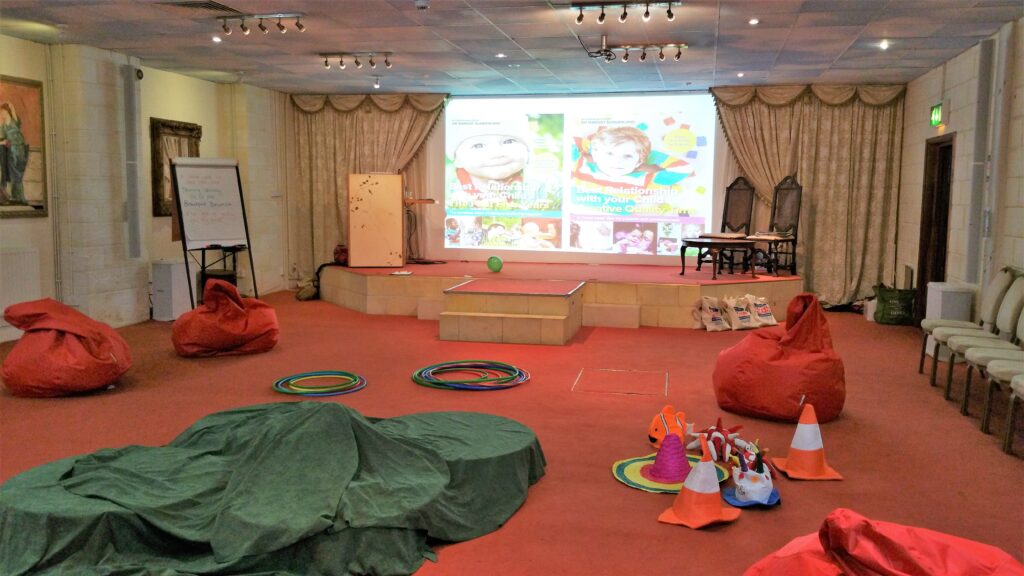
As soon as we arrived, we were guided into a decorated room that housed an array of interesting activities, as well as an eating area that included hot and cold beverages and some biscuits to snack on throughout the morning. The activities out on display included:
A grey sensory tent, complete with sensory items
A seating area in front of an overhead projector, a whiteboard and a podium
Seven sandpits
A racing car mat with cushions
Tables that were covered with a green tablecloth
Large Lego blocks
Hula hoops
Cuddly toys and costumes
And a separate dark sensory room lit up with a range of lava lamps and sensory toys
Emily, who assisted in the event, expertly kept all the kids entertained as we seated ourselves in front of the overhead projector, ready to start our learning journey on attachment play and creating the best possible bond with our children.
I later found out that Emily was an only child and she believed that her deep connection with children was probably down to never having the chance to play with siblings. I found this interesting that even as an adult if you miss out on important child’s play, so you may look for it later in your adult life. This was just a taste of psychology and science to come during the day!
We were introduced to Dr Margot Sunderland, an interesting woman with a number of accreditations under her belt. Dr Margot Sunderland is a child psychologist and gentle parenting expert who has written a neuroscience book called, ‘What Every Parent Needs To Know’ and brought out three DVDs, the subjects of which this event was about. The DVDs are:
Best Relationship with your Child: The First Five Years
Best Relationship with your Child: Creative Quality Time (for babies and children up to the age of eight)
Best Relationship with your Child: Age Five to Twelve
“These three films in the Best Relationship with your Child series are designed to equip parents with tools, skills and practical ideas to strengthen their attachment relationship with their child.”
Dr Margot Sunderland
Having the best relationship with your child
There are so many resources out there on how to get your child to behave. But, recent studies have shown that parents want so much more than this. We want to know how to have the best possible relationship with our children.
Modern parents deal with so many tasks and troubles; the washing, cleaning, preparing meals, the school/nursery run and rushing off to work. All those gorgeous bonding moments with our babies take a backseat when our children get older and school takes them away from us.
Scientific research shows, however, that the special relational bonding time with mummy and daddy is just as important for our five-year-olds as they are for our five-month-olds. And, it’s not just vital for bonding but for our child’s brain development.
Recent studies also show that the average quality time should be one hour a day for fathers.[1]
Over a third of parents don’t spend enough time with their child.[2] 6 out of 10 parents occasionally play with their child. 1 in 6 fathers confesses that they don’t know how to play with their child. Just 1 hour a day from the mother or 35 minutes from the father a day is enough for the child to experience a great attachment and connection with their parents.
Providing undivided and engaging attention to your child is important
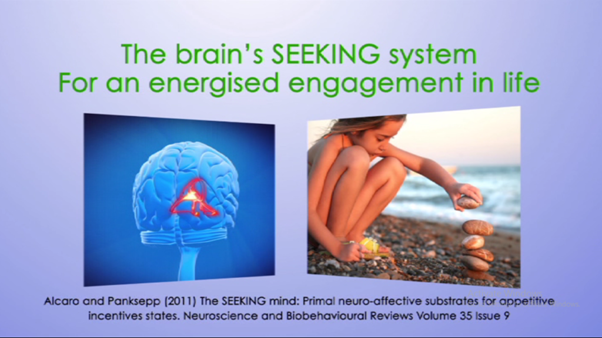
During the event, we learned that engaged and attentive play develops the brain. Providing your full attention during the child’s play increases their opioid and dopamine levels, which decreases depression and provides an energised engagement in life. Teenagers have less dopamine, hence why they want to mope around and play video games. But, if these chemicals are established in the brain as early as possible then this kind of attunement actually shows up thirty years later in their adult life.
So, how do we increase our children’s dopamine and opioid levels and what does it all mean?
We’re going to tackle the brain science and the games together to illustrate how both go hand in hand to develop a child’s brain and to strengthen the bond between parent and baby.
Strategies to aid and maximise attachment play
We watched a clip from one of the movies about adopting an ‘Owling’ strategy, which Dr. Margot Sunderland further explained as ‘Observe, Wait and Listen.’
Observe, Wait and Listen
Observe the child without intervention during play.
Wait to seeft how they respond, make eye contact and understand their manner and behaviour
Listen and then respond accordingly
This strategy is perfect for children from six months old onwards and the result actually encourages the child’s entrepreneurial side because you are allowing the child to lead the play and the next step of the journey. Being too invasive during play can actually lead to mental health problems later in life.
The commenting strategy
The formula for the commenting strategy is:
4 comments and 1 question
The commenting strategy during play is a key strategy for enhancing the child’s self-esteem. Commenting, rather than questioning or demanding actually makes the child believe that:
“What I am doing is really important.”
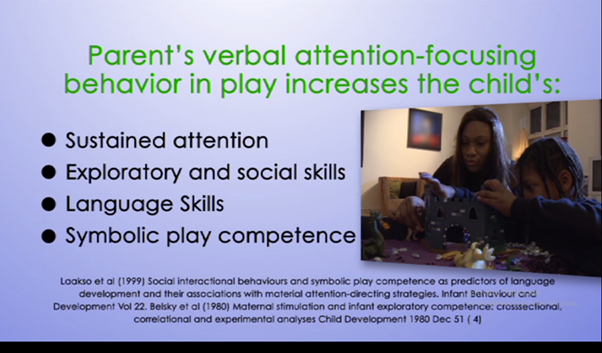
We are commenting on the child’s actions rather than criticising them. The verbal attention (the correct scientific term is ‘focus behaviour’) means that the child is far more able to have goal-directed behaviour. Accompanied play with an adult is key and just as important as solitary play.
Solitary play vs accompanied play
Solitary play is just as important as accompanied play as it allows the child to enter into his/her own realm where that child is the star of his/her world. However, through solitary play, the child only has his/her own encouragement and the play can then become quite short due to their short concentration span.
Commenting through accompanied play encourages them to continue being the star of their world where you become a part of their journey and the child revels in your awe and encouragement. Sometimes a child needs help to engage and explore a certain activity and this focus behaviour develops the child’s ability for sustained attention through attachment play.
Demonstrating the commenting strategy through play
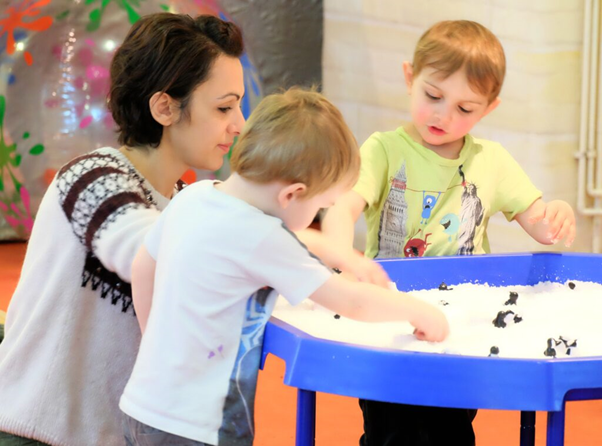
We were guided to a play area in the room where there were large snow table tops, filled with white and pink snow. Inside the snow table were penguins and cups and I observed Aidan creating a snowstorm. I listened intently to him excitedly call out a snowstorm and I responded accordingly with my comments.
“Ooh, it’s a snowstorm!”
This kind of play triggers dopamine levels and encourages the child to use their imagination to create a story, for which you are a character. If I noticed Aidan’s energy drop, I subtly commented and suggested a certain action, and then left him to lead the way.
“Imagination is more important than knowledge.”
Albert Einstein
Copying strategy
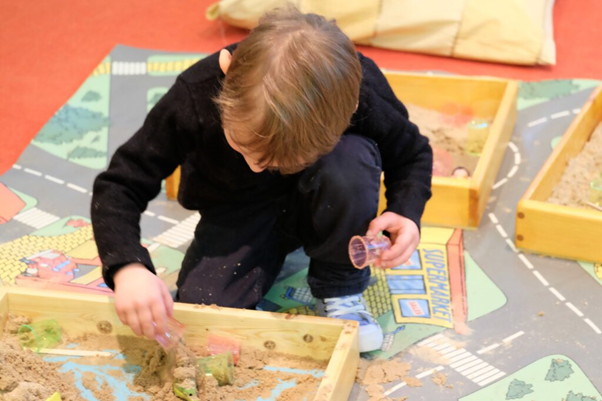
The copying strategy is another key strategy which helps you to get a better understanding of the child’s world. We further explored this strategy through sand and sand tools at the event.
If you put a two-year old in front of a sand-pit and say ‘play’, they won’t know what to do. It’s up to you to enhance their learning and imagination.
“Logic will get you from A to Z. Imagination will get you everywhere.”
Albert Einstein
The key here is to stay animated, copy the expression the child is using and any actions that may follow. For example, if the child goes under the table, you follow them. We watched a clip from one of the DVDs, where the mother was copying the child’s movements and the child was giggling with enthusiasm.
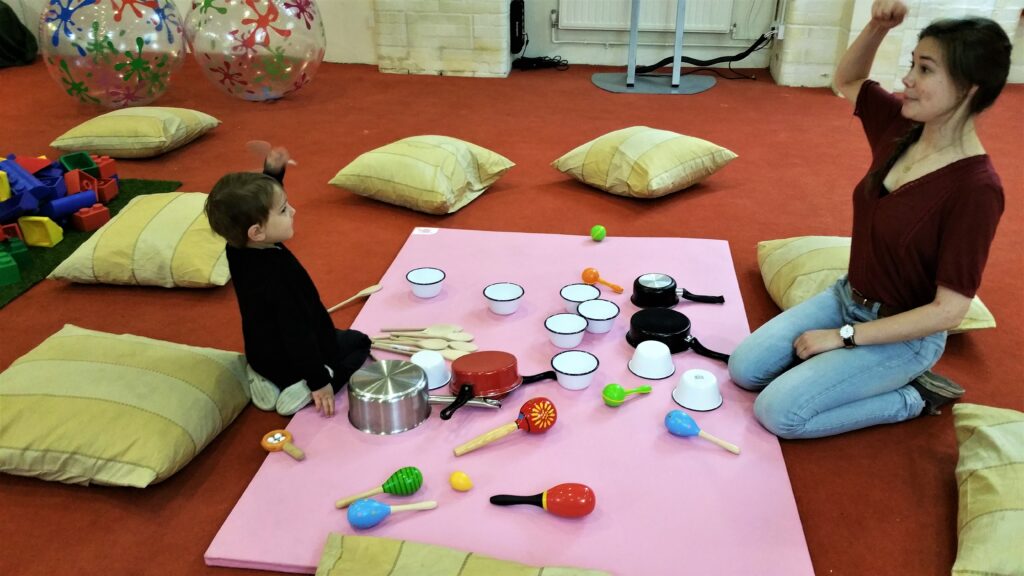
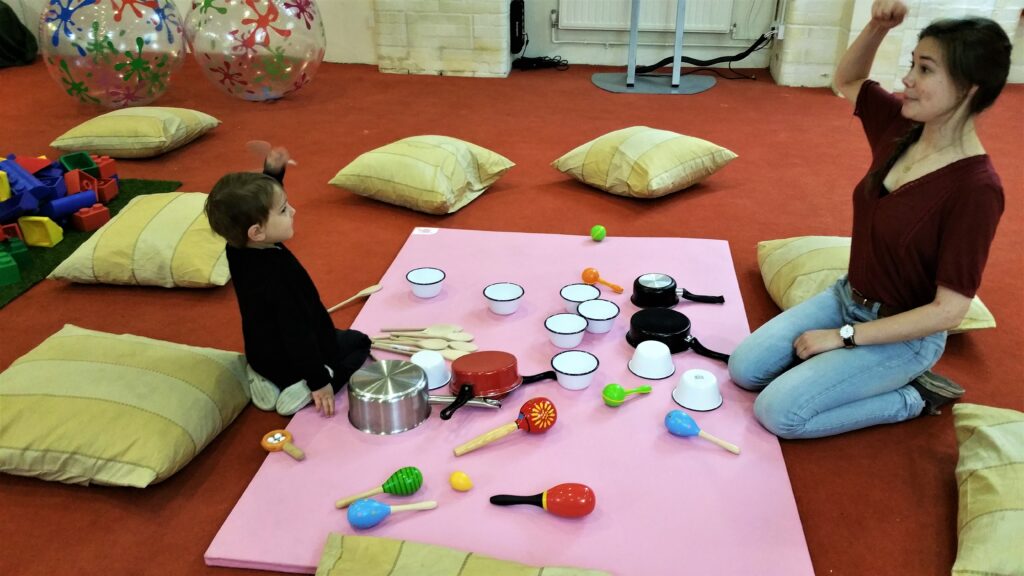
We were guided to have a go at the drums and explore the power of music at the event. I listened to Aidan drum a beat and then I copied him.
Music, especially drums, are a great way to bond with your child and create beautiful music together. Plus, drums are a hit with kids of all ages, including us adults! And, one hour of quality time is all that is needed to engage with your child and maximise their enjoyment in life.
We stopped at lunchtime for a brief bite to eat from an impressive array of jigsaw sandwiches and a fruit/veg selection. Post-lunch we talked about the use of drums, a beanie bag, and my favourite of all, the sensory room, which I am desperate to build for my children. It is a place of calm and special ‘you and me’ time.
We entered a very dark room in the corner of the main area and immediately entered a state of relaxation as the soft melodic music played in the background. Our eyes were drawn to an array of colours from lava lamps and other sensory toys. You can build a sensory room from TTS’s website for £50, so I will definitely have a go at doing one myself.
We also practised our ‘five-finger’ rule, which is the commenting strategy of five comments and one question as explained above. The first comment should be a suggestion or invitation to the play and the question should be an open question to encourage play of which you don’t know the answer.
Parent-child physical play
We ended our afternoon with lots of examples of physical play, for example:
Animal rides (a dinosaur ride to bed which will actually help to speed the process of bedtime along, although I haven’t tried this yet)
A bit of rough and tumble is very important for growth, but make sure to be the referee when things go a bit too far.
At the end of the event, Aidan and I left with a renewed bond and an increase in dopamine and opioid levels in our brains, as well as a lovely goodie bag of the three DVDs, two books, some finger puppets and chocolates for the boys.
The science
Dr Margot Sunderland explains the science behind all the activities shown in each of the DVDs and then demonstrates this through scenarios by a carer/parent and a child, in various you-me and relational games, suitable from newborn to twelve years.
“With all the pressures of modern-day parenting, quality time with your baby or child has never been more precious. Many parents want something deeper and more significant than the usual going to the park, the playgroup or watching TV together. [The DVDs] are packed with ideas for together times to strengthen your relationship in enduring ways, offering the richest shared experiences. The creative activities for quality time are designed to transport you into the world of sensation, imagination, wonder, delight and shared laughter. Using the latest brain science research, and featuring footage of the loveliest parent-child connections, the film aims not only to enrich your relationship now but to create memories for life.”
Why adult accompanied play?
Solitary play allows the child to play in his/her own world and brings about an important withdrawal time. However, the child’s attention span is a matter of minutes, so accompanied play with adults allows for sustained attention and encourages exploratory and social skills.
When a child engages with an adult they also learn important language skills, perhaps learning words through play that they may not have learned through solitary play. The vital commenting strategy also develops their communicative and exploratory skills and this leads to goal-directed behaviour. Becoming a character in a play where our child is the star also results in the child becoming inspired to create business ideas later in life.
Who doesn’t want an entrepreneurial child?
Utilising that imagination with the use of tools helps to develop a story and build up excitement. This kind of play increases the child’s dopamine levels, which develops their passion for learning and engaging life in an energised way.
For a child of three to four years old, start the story and let them develop. Suggest something and then leave for them to develop the story further. For example, use the sand like a rock for lions. Suggest a party and invite friends to make the party. Wait for the child to get excited and develop the story further. You can also bring in the use of other animals as additional characters to the story.
Games to play at home with your child
At the event, Dr Margot Sunderland introduced a few games that we could play with our children (up to nine years old) at home, which enhanced brain development. I got to try these games out with Aidan, but he wasn’t very receptive, opting to play with the other equipment in the room.
Dr Margot Sunderland urged us not to force our children to play, instead, allowing them to lead the way and gently guide them to these types of games should the opportunity arise, i.e. when they showed an interest.
Parent-child puppet play
Communicative tools like puppets enhance the parent-child relationship and can be used as an aid to help the child think about their feelings, instead of ‘behaving’ their feelings. Use the puppets as a way to reflect what that child is feeling if they don’t want to talk to you. There are many ways you can utilise puppet play to really enhance engaged play.
You can make puppets together and then take them on a journey.
Create ‘feeding’ puppets. Allow the child to feed the puppet and create some play around it. It’s better to not show the child that you are taking food out of the puppet’s mouth in order to keep the imaginative play seem real (paradoxically).
Use puppets to bring story books alive. Act out some of the parts in the story, making the puppet a particular character in the book.
Other props you can use for play
Other props can be used as communicative tools with the child and help to explore a fantasy journey. These can include plants, foods, cushions and blankets. Incorporating messy play has tons of psychological benefits and enhances brain development. Messy play and small world play when other people are involved trigger amazing brain growth fertilisers.
“Imagination grows by exercise.”
Somerset Maughan
The SEEKING system is a part of the brain that your child needs to work really well if they’re going to learn how to be kind and empathetic to others. It also helps to enjoy good relationships and live life to the full. Brain fertilisers enhance brain development, which is critical for physical and mental health.
“Just as plant fertilisers make plants grow better, brain fertilisers make the brain function better.”
Dr Margot Sunderland
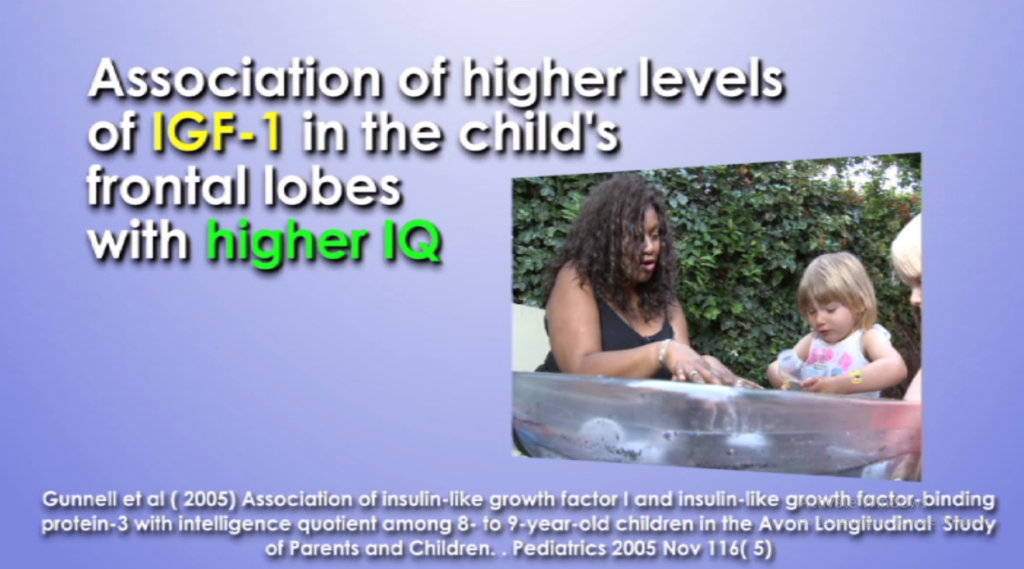
The Brain-Derived Neurotrophic Factor (BDNF) and the Insulin-like Growth Factor 1 (IGF1 -1)
BDNF and IGF1-1 promote growth in the frontal lobe so positively that they affect the human functions, i.e. the ability to learn, problem-solve, to attend and concentrate, as well as to handle stress well. [3]
In fact, research on five-year-olds showed an association of higher levels of the brain fertiliser IGF1-1 in the frontal lobes of those with a higher IQ.
The number of brain connections (dendritic spines) in the frontal lobes is significantly higher in the child who has experienced the enriched environment, i.e. more connections.
Impacts on the Hippocampus, which is the key memory system in the brain, helps your child to learn.
What is an enriched environment?
An enriched environment has four key elements to it. Messy play and small world play are great examples of an enriched environment because they engage the child’s:
Thinking (cognitively)
Movement level (physically)
Social intelligence (you’re there with them)
Sensory skills (you’re helping them and playing alongside them)
“Every child is born blessed with a vivid imagination. But just as a muscle grows flabby with disuse, so the bright imagination of a child pales in later years if he ceases to exercise it.”
Walt Disney
If you give the child the same thing everyday for a month, it ceases to be amazing.
There must be a novelty for the advantageous brain effects of enriched environments. Brain fertilisers will be activated with a novel environment when combined with social interaction.
Messy play – the three key stages
“There are three stages of messy play: dry, soft and wet.”
Denise Tulloch Johnson, Senior Play Leader and Communication Specialist at The Institute for Arts in Therapy & Education
You can start at the baby stage with dry messy play, like raw pasta and colouring pencils. Once the baby starts to enjoy them, you can move them onto soft messy play, like playdough and cooked or play pasta. After that stage, you move on to wet messy play, which is water and cornflour.
Not every child will enjoy messy play, but it is important to just follow their lead and join in with them. It would be very helpful for the parent to join in too. If they see that you are enjoying the messy play, they will too.
Some ideas for messy play
Active world tray with stand (TTS Educational Resources – www.tts-group.co.uk
Rectangular tray (TTS Educational resources)
Gelli Baff – have spoons, ladels, cups etc (find at TTS Educational Resources)
Snowflakes in water – teapots and stuff to pour from
Shaving foam without scent – play jelly games
Crazy soap (to blow bubbles at each other or put on head)
Rainbow sparkles (use ladles to pour into measuring jugs and other cups – it makes a lovely sound and feel). You can also move your hands through the sparkles for a great sensation.
Rice and food colouring – uncooked (use blue and red colours side by side where children can mix and the texture feels great)
Cornflakes – you can eat them and play with them. Cornflakes provide an auditory sensation. Add other animals.
What to do when a child doesn’t enjoy messy play
You can always use tools to encourage messy play if the child doesn’t want to touch directly, i.e. spades, spoons and straws. Allow them to watch the messy play, which helps them to prepare themselves for what’s to come. Ideas to encourage messy play is to add some flour, mix with a spoon and add water with different colours. Don’t forget to use the commenting strategy when helping the child prepare for messy play, for example, “Oh, you were adding blue!”
Messy play is good for fussy eaters
Encourage your child to become more open to trying new food by allowing them to play with it. Create messy food play, using spaghetti with pots and pans and cereal with water and spoons. You can use oats with warm (sterilised water) for younger children. The child will gain the opportunity to smell, squeeze, roll, flick, squash, feed or taste the food. Ultimately, food becomes more natural for them. So, as long as it’s safe for them to eat then it’s fine for them to play with.
Messy play and small world play engages all the child’s senses
If you just isolate one of those key elements, it wouldn’t work. So, all senses have to be present and engaged in the activation of those fantastic brain fertilisers.[4]
“The play environment must feel new to the child. But, you can’t keep running to the toy shop because it’s far too expensive. So, we are going to show you lots of different ways of creating new stimulating messy play and small world play environments with little expense.”
Dr Margot Sunderland
Key ways of communicating with your child
Dr Margot Sunderland talks about how to communicate with your child, i.e. make your voice interesting, observe, wait and listen (owling) and then respond accordingly. Using eye contact shows respect and it helps you to pay attention, as well as recognise your child’s needs.
Get down onto the child’s level, so you can maintain that eye contact and communicate clearly with them. Positioning is important too. Sit in front of the child, so they can watch, observe and communicate your lips and facial expression.
When something new or potentially frightening happens to a child then it’s very important to help the child reflect on it, ideally before it happens. You can use little dolls and set up the scenario. For example, if mummy is having a baby then you can set up the doctor talking to mummy about having a baby.
When you’re talking about something serious or important, often the child would be distracted and their attention will be elsewhere.
With dolls, you can get their attention and help them focus on what’s going to happen so they’re prepared. It’s like they’ve almost had a rehearsal of what will happen and they’re not sent into a terrifying shock state.
Copying strategy
We touched upon the copying strategy above, but it is another key strategy to help you get a better understanding of your child’s world. Copying them helps them to own the play. With babies, you can copy their sounds to develop communication and build self-esteem. For example, if the child goes under the table, follow them into their world.
Communicating strategy
Communication is key because it enhances self-esteem and potency – it makes the child believe they are doing something right.
Commenting strategy
Also known as ‘adult verbal attention-focused behaviour’, the commenting strategy is proven to develop a child’s cognitive creative ability [5]
If you don’t comment, often the child loses energy and enthusiasm. Commenting keeps up the child’s flow and go-getting attitude and develops that proactive go-getting attitude later in life. The commenting strategy:
Develops the capacity for goal-directed behaviour later in life
Aids language development
Helps the child make a connection between verbal communication and play
For example, when they are playing with a toy, talk to them and comment about that toy.
“Oh, the elephant is grey! That elephant has a big long tusk.”
Asking the child a question may pressurise them into answering you without knowing the answer, so it’s best to use what is called, ‘The 5 finger rule’ (which we touched upon above.)
The 5-finger rule
For every question, you do ask (you must not know the answer) comment four times. If you don’t know the answer, you can ask a question.
Follow the child’s lead and the child will stay attentive if they set their own game. If you don’t follow the child’s lead then if it’s no longer about them, they may lose interest. It must be all about the child.
You can take turns for example, ‘I talk, you talk, I talk, you talk’.
Don’t overstimulate or under-stimulate
The play environment should not have too many toys or the child will lose focus and not maintain attention.
Choose your child’s favourite toys and teach through play how to share and take turns. You can use OWL skills to set out an environment appropriately.
You-me games
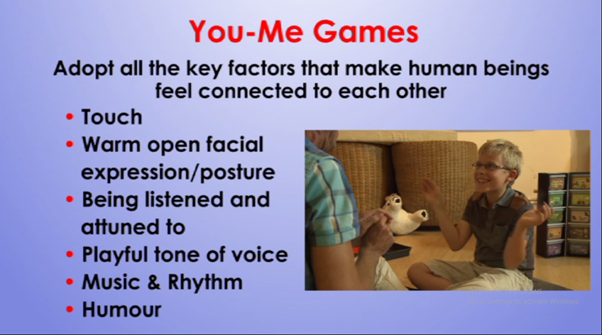
You-me games adopt all the factors for the parent and child to connect with each other. They are deeply intimate face-to-face times which is so beneficial for brain development and protects against depression later in life too because they adopt all key factors that make them human beings.
There are different types of you-me games. These are:
You-me lap games
You-me music games
You-me sensory games
You-me physical games
You-me hand games
You-me balls, quoits and hoop games
You-me imagination games
You-me games bring out a state of the interpersonal synchrony: a delicious feeling of oneness with each other [6].
Use warm open facial expressions/posture and a playful tone of voice. Incorporate music rhythm and humour in your you-me games so the child feels listened to. Relational play can also bring about new brain growth in the Hippocampus (key memory system in the brain). [7]
“You-me games optimises the chances of real moments of meeting between the parent, the carer of the child.”
Dr. Margot Sunderland
“When a [child] sees their specialness reflected in their eyes so they see it in themselves.”
Helen Reiss[3]
Avoid teaching, criticising or commanding as this kills off the play. Instead, use lots of encouragement and praise and suggest rather than teach or command. It’s all about the power of suggestion.
Shimmy shimmy coco-pap
Sit with your child and incorporate lots of interesting voices, including facial and hand contact during play.
“Shimmy, shimmy coco-pap. Secret animal on your back. Which animal crawled up your back? Shimmy. shimmy coco-pap. Spider, spider up your back! Which finger did that?
And then other poke them or tickle them on the back.
Make an animal noise and wait for your child to answer. If they don’t answer straight away, answer for them.
Bang and shake
You will need:
Shakes
Pans
Wooden spoons
Funky background music
You-me messy play
Don’t make the mistake of thinking that messy play is just for the under fives. It’s an ‘enriched environment’ triggering brain fertilisers and enhancing cognitive development. So, don’t deprive your over-fives of quality messy-play time!
Can I visit your castle?
You will need:
Clay
Clay tools
Small natural objects like leaves, buttons, shells and feathers etc
You can create little sections which are divided into subjects such as the zoo, the fair, the seaside or shopping. The boxes should be labelled as such.
Ask the child to tell you a story. Or if they prefer, you can tell them the story. Use the five-finger rule to comment on their story or how they’re playing and then ask a question, of which you shouldn’t know the answer.
Making sock puppets together
You will need:
Two socks
Buttons for eyes
Wool for hair
A good glue
A timer (optional)
You can play one-minute finger puppet games and come up with a range of finger puppet characters.
You can also create a miniature puppet theatre which is a great way to enhance parent-child physical play.
You-me games for middle childhood
Pitta Patta Polt
“Pitta patta polt, to shoe a little colt, to shoe a little colt, pitta patta polt”
You-me hand games
Poking games
“A sailor went to sea, sea, sea. A great big shark that gobbled up little boys/girls!”
Then think of an animal that has a touch sensation.
Breakfast bonanza
“Potato, potato, break the egg, break the egg. Stir the beans, and eat the breakfast!”
Then pretend to eat the child.
Cycling song
“Cycling, cycling down the road. Whoops, watch out there is a toad! Cycling, cycling up the hill. Thrill!”
Use hands/arms first and then feet to mimic cycling.
You can use any animal but you mime the animals venturing the obstacles on the tray.
Drum hat
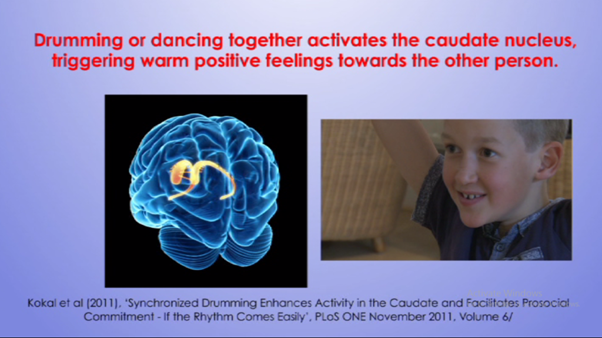
The caudate nucleus, the part of the brain that is activated through drumming or dancing triggers warm positive feelings towards the other person. [8]
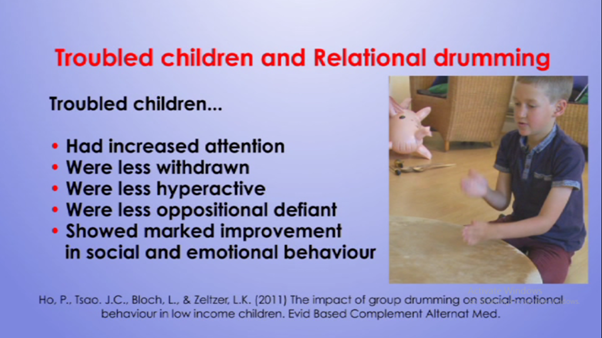
Relational drumming also enhances a calm and meditative state and boosts the immune system, making the child less hyperactive and aggressive.
You will need:
two silly hats
A large floor/gather drum
You bounce the ball onto the drum for the child to catch in the hat and then vice versa. As the child becomes more confident you build up a rhythm
Great you-me games with baby
Where’s Mr Sausage Dog?
Hide a sausage dog under a towel and then ask the child where he is? Make woofing noises to help the child find the toy. This is a great game for a baby too.
Silly sock
“I’ve got a silly sock on my head!”
Put something silly, bright and colourful on your head and comment with enthusiasm
Music band
Suggest and then OWL (Observe, wait and listen) – then praise. Use funky background music and a big drum. Encourage baby to hit the drum to different rhythms and sounds. You might even be able to trigger and “call and response” drums to hold baby’s attention more than other toys.
Dancing delight and cuddle dancing
Hold baby close. Daddy can get involved with sway dancing too.
Sand box and sand
Sand is great for sensory play. Place baby’s feet in the sand and sprinkle. Hide feet and show surprise when they appear.
Splishy splashy
Use a water container and add ducks (use the copying strategy here to ensure baby is in charge of the play). Get some sponges too
Foil crunching
Use a foil blanket from a camping shop. Sit baby opposite and use the copying strategy, so when they ‘crunch’ the foil, copy them with the same energetic tone. Be careful not to up-stage them.
Scarf peekaboo
Use a sheer scarf, cover them and then say peek a boo!
Hide toys
Hide the toys and then ask baby where the toys have gone. Help them find it if they’re lost.
Ready steady arms
Gently hold baby’s arms and rhythmically say “ready, steady, go!” On “go” lift his/her arms over their head and make your voice interesting.
Face tracing
Hold your baby’s hands to your face and trace down the sides of your face three times rhythmically with humming sounds. End with a large cheek pop. Repeat.
Up to the sky
Place baby up in the sky and then down again to the ground.
Playing ball
Roll the ball to baby and wait for baby to roll back. Stay animated to activate dopamine levels in the brain
You-me tickling games
Some great you-me tickling games with baby are:
Simple tickling
Chica-boo-boo (thumb and two-finger to tickle tummy and toes)
Freddy frog and ruby rabbit – introduce them by tickling and give them names like FF & RR
Tummy time
Tummy time from day one is essential for helping baby to sit up, crawl, roll over and develop upper body strength.
Place your baby on a mat and then prop him/her up on a rolled up towel or tummy time pillow with arms out in front. Lie down opposite your baby so ou are at their level.
You-me games for under fives
Some great games for under-fives that I’ve mentioned before are:
Breakfast bonanza
Cycling story
Ice cream song
And other songs like the Grand old Duke of York
A sailor went to sea
Tick tock – bounce the child the number of times that you strike the clock, for example. ‘Now I’m striking 3 o’clock!’ Bounce the child three times on the ground.
I’ve got jelly on my knee. Lay your child on the knee and use music for movement. Use other animals and objects.
Bang and shake
Ball and big drum
Drum hat
Dancing delight and cuddle dancing
You-me ball games
Rainbow ice cream and pizza making
You-me imagination games using objects like puppets. Puppets can eat all sorts of things which you can mime
Little beach, big beach
You will need:
Two large beach balls
Small sand traay with small beach props (people, sea creatures, etc)
Begin by playing together at the beach. When someone says “big beach” go play with big beach balls. When someone says “little beach”, you go back to the sandpit.
Mummy (or daddy)’s sleeping game
The child helps you to sleep and wake up. Encourage your child to think of different ways to wake you up.
Cooking for mum and dad
Use real or imaginary items to cook for mum and dad. Repeat ingredient and recipe ideas. Use the commenting strategy here and keep the comments positive.
Animal telephones
You can use a talking tube set. Encourage the child to talk to an animal or be an animal.
Castle visit
Use clay, clay tools and small natural objects and become a small person in their world. Ask to visit their castle and get in with them. Sit facing them at all times. Use small world toys, plastic pouring jugs, bubbles etc.
You-me sensory play
“Parent-child sensory plays allows you with your child to have a very intimate time where awe and wonder are at the fore.”
Dr Margot Sunderland
Sensory den
You will need to set up a darkened area in the house. It could be a blanket over two chairs or a wigwam or tent inside and inside you have lots of lovely special lights, which you would use at the same time as the child.
As well as it being sensory, you’re actually emotionally regulating them at the same time and meeting them in these states of awe.
Children can become overwhelmed with cognitive tasks during the day so they need sensory breaks to help them learn. Maybe the stress of being at school can take over and they start behaving in difficult ways. Encourage them to go and have some special time in the magic cave. It’s not just about going into the sensory zone and playing though, it is an emotionally regulating event.
When you’re playing with them in the sensory zone, relate at the same time. Use this time to be calm and keep the child in a calm state. The autonomic nervous system is in a far better state when it’s calm and it makes it easier for the child to go back to the classroom in a regulated sate and engage in cognitive tasks. Enable the child to enter into states of awe and model that awe and wonder so they can see.
Have two of everything so you can do it together and keep calm! They need to borrow your imagination and mature brain function. So when a child picks up an item, you pick one up too.
For an older child of three or four, let their imagination run wild, for example, “These are magnificent trees and they only live in a magic forest!” Echo and amplify positivity to what they’re doing. Tell them a story.
“Once upon a time there were three magical eggs.”
Then, what happens next? If you are afraid to tell a story, it’s important to still try as imagination tends to take over lights that respond to sound. It’s great for relational play and echoing with your voice activates oxytocin. The release of oxytocin (anti-anxiety brain chemical) from the warm lights, the sound of your calm voice and soothing background music are very calming for a child.
Social play using roleplay
Adding the idea of roleplay events like Giggleverse can enhance laughter and fun play and bring families closer. Giggleverse is a special place filled with fun adventures and offers different fun areas for kids to explore, like fairy lands and pirate worlds, making it great for playing and having a good time. This magical world helps parents and kids enjoy happy moments together, strengthening their bond. Whether it’s going to fun events or just playing together, Giggleverse is all about creating happy memories with lots of laughter.
Why are these games good for the brain?
These you-me games are hugely powerful because they activate a brain fertiliser called brain-derived neurotrophic factor or BDNF for short.
You-me play develops a key part of the brain where Dopamine Pathways are activated to enhance learning and concentration, emotions, motivation, and energised engagement in the world.
What happens if your child has low levels of dopamine?
Your child will procrastinate and they won’t really know what they want. They have a lack of motivation and will rarely carry something through or finish what they started. They just can’t be bothered or they will seem ‘lazy’.
“It’s never too late to activate these chemicals and one of the key ways is relational play.”
Dr Margot Sunderland
How do opiods help?
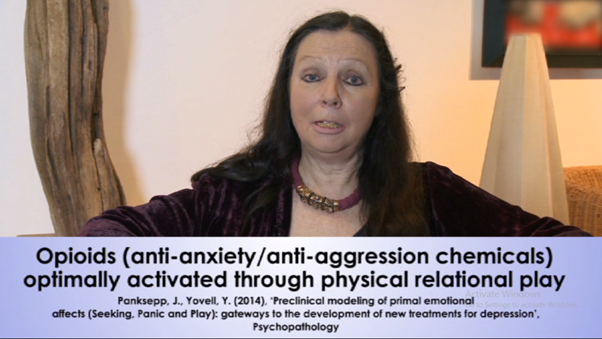
Opioids are anti-anxiety, anti-aggression chemicals which are optimally activated through physical relational play. Opioids give us a wonderful sense of wellbeing. The more these chemicals are activated in a relationship, the more the brain habituates to them – so “emotional states become personality traits” [9]
“Can a fully social brain-emerge without play or will it remain socially stunted for life?”
Professor Jaak Panksepp 2007 World Leading affective neuroscientist
Games like ‘rough and tumble’ can develop these chemical systems.
What is ‘rough and tumble’ play?
Rough and tumble is about meeting a child in an intense arousal state.
“If we can’t meet the world with energised engagement, the problem is that sometimes we don’t feel passionate about learning and we don’t feel passionate in love. So it’s a key time where you can actually meet the child in an energised engagement which can be then transferred into skills to meeting life with energised engagement.”
Dr Margot Sunderland
Rough and tumble helps develop brain systems and increase dopamine levels
Interactive physical play turns on the brain fertiliser BDNF and helps develop brain systems which are key for attentive learning. Physcial play can also help you reconnect with a child during/after difficult times.
“Sometimes, if you haven’t, as a parent, had relational play, it is a bit difficult to know what to do.”
Dr Margot Sunderland
There will, of course, be times when your parent/child relationship is fraught and you’re fed up of each other. Physical play breaks the ice and brings you back together after a conflict.
So what are some great ‘rough and tumble’ games to play to enhance opioids?
Sausage roll
Up and down together game
Lap rides (over fives can enjoy too!)
(Place the child on your lap and playfully move them around according to the method of transport that you have chosen.)
“I’ve got a train/I’ve got a tractor/I’ve got a choppy boat.” Etc
Rescue games
Animal footsteps
Rucksack (walking up the parent!)
Good old pillow fights!
Animal rides (child chooses which animal you will be)
Sandwich time
Mummy into the river
Breakfast bonanza
(Mime the words and show breaking the egg and mixing the beans.)
“Break the egg, break the egg, mix the beans, mix the beans/stir the pot, stir the pot.”
And then pretend to eat the child with lots of fun eating noises and actions.
Safety first!
Make sure to take off any jewellery
Make sure there isn’t anything in the room that is sharp or where the child can hit their head.
Be aware of tummy and organs through thumps!
Make a rule to keep games safe
Use a comfortable seat for seated games
Be a hands-on referee if things get too rough!
When to play you-me games
You can play these you-me games whenever you have spare time. Some examples could be:
When you’re waiting for the bus. Suggest, “How about we play x, y, z games?”
Make blocks of quality time available
Before you send them to school, use the moments to connect
When the kids are going to bed, take them on your back. Turn them into a dinosaur, a rocket or you can become a helicopter ride.
What happens if your parent/child relationship is weak or there is a conflict?
It’s quite normal for your child to do something provocative and all of you feels like wanting to say:
“Don’t you talk to me like that!”
But, actually what the child is doing is not a big deal and your negative reaction could really rupture the two of you, i.e. crossing the transaction and refusing the power play and go into humour. It is a deeply intimate thing to do and physical play will connect you. But really tune into the child’s non-verbal cues in terms of whether they are enjoying the game or not.
Playful parenting brings about far better behaviour than punishing parenting. Maintain eye and physical contact. Use lots of moments during the day to tell the child you delight in them, even during those stressful days.
Playful parenting activates:
Anti-anxiety chemicals
Anti-aggression chemicals (so children grow up not interested in fighting) [10]
Stress hormone activates aggressive and bad behaviour in a child.
The above games are just some of the games that will help you to build that special bond with your child. Use your imagination and create a world where only you and your child live and allow the child to lead the play while you bask in the delight of spending time with them. Spending the time to play with your child this way will encourage your child to have a happy and healthy life well into adulthood!
For information on events and updates at The Centre for Child Mental Health, please check out their Facebook and Twitter page
Resources
[1] – Sevilla, A (2014) Economic and Social Research Council Britain June 2014
[2] – Parent-Play survey, Playmobil UK 2013
[3] – Mohammed et al (2002) Environmental enrichment and the brain Chapter X in Progression in Brain Research Vol 138 Hofmn et al (Eds)
[4] – Pang et al (2013) Enhancement of cognitive function in models of brain disease through environmental enrichment and physical activity Neuropharmacology.
Sale et al (2014) Environmental and brain plasticity: towards an endogenous Pharmacotherapy. Physiology Review.
[5] – Belsky et al 1980 and Laakso et al 1999
[6] – Grelli et al (2014) Interpersonal Synchrony increases pro-social behaviour in infants Developmental Science 2014
[7] – Wohr et al (2009) New Insights into the relatinosihps or neurogenesis and effect: neuroscience 2009 vol 163
[8] – Kokal et al (2011), ‘synchronised drumming enhances activity in the Caudate and facilitates prosocial commitment – if the rhythm comes easily,’ PloS ONE November 2011, Volume 6
[9] – Bruche Perry Child Trauma Academy (famous neuroscientist)
[10] – Panksepp and Biven (2012) The Archaeology of Mind Chapter 10 Playful Dreamlike Circuits of the Brain
Disclaimer: Motherhood Diaries was invited to attend this event for free, but all opinions are 100% my own.
Epilepsy in childhood
You never really think that your child will be ill and you are just happy, if a little tired, to have a new baby crawling around. I was at work one day when our daughter was 8 months old and I received a call from the health clinic. At first, I was a little confused as I get many calls and thought it was to do with an existing client at work. The health worker said not to panic, which isn’t the best thing to say as you always start to panic straight away, that my daughter had a seizure whilst at the health centre and they had called for an ambulance. My wife then came to the phone which didn’t help the situation as she was very distressed and not explaining things properly.
“What happened to her?”
“She turned blue and started shaking, get to the hospital now.”
That’s the only thing I remember her saying and was focusing on all the way home:
“She turned blue”.
I stared at my computer screen for what seemed like ages, hoping that I hadn’t really heard what I just did. Somewhat dazed I left work immediately and got the train home, picked up the car and drove to the hospital. All I could think about was the worst thing possible – I couldn’t live without my little baby. When you haven’t got any information as to what has happened you feel sick and overwhelmed with emotion and don’t think logically. I just panicked all the way to the hospital.
I got to the hospital children’s emergency ward then saw my baby lying on a hospital bed with a load of wires taped to her, which was a terrible thing to see.
Amelia on arrival at the hospital
The doctor on call confirmed that she had a seizure. He explained that the most common type of seizure seen in children Amelia’s age was a febrile convulsion, caused by a high temperature. But Amelia’s temperature had been normal at every check, so she needed to be kept in for further tests. As with many things in life, it is the fear of the unknown that brings the greatest anxiety. Once the doctors had spoken with us about the situation and why they were doing the tests, the worry was still there but I felt a bit more in control, just by understanding the process and knowing what to ask next. The next morning, my daughter seemed fine and the doctors couldn’t find anything wrong with her. We were told that everyone is allowed one seizure throughout their life and it might never happen again, and we went home.
Several weeks later I was at home when she had a second seizure where she just went limp. We laid her on the floor and she started shaking, not violently but it was horrendous to see a tiny baby shaking. I phoned the ambulance panicking and cannot remember what I said, but if it wasn’t through my wife putting our daughter in the recovery position and being calm I am not sure what I would have done. I always thought I would be calm in an emergency situation, but it is different when the reality hits you and it’s your own child there shaking on the floor. When we got to the hospital we were asked the same questions constantly by many different doctors, which we didn’t mind as we had been told that there are over 40 different types of seizure and how the body shakes if one side of the body shakes more, where the eyes look etc, can all determine a diagnosis. However, I was so panic-stricken at the time I couldn’t really remember how her seizure developed or if her tongue came out – all I was doing was telling the ambulance person to get her quickly!
The hospital then took more blood samples and carried out further tests. They told us that Amelia might have a tendency towards seizures (epilepsy) and that most epilepsies have no known cause, but as there are other underlying conditions that can trigger seizures they would need to refer her for certain tests to eliminate these first. She was referred for ECG and EEG tracing and also for an MRI scan where she had to be sedated and went into a scanner. This is when we really started to get scared. When we were told they had to check she didn’t have a brain tumour, I think that was the worst moment, and having the scan on New Year’s eve meant it just played on my mind constantly for the four weeks we were off beforehand. How could we deal with news like she had a brain tumour, and then going through numerous operations and more worry – or worse?
An anxious wait for results
Also when they said she could have delayed development from the seizures it made me cry, but thankfully she was always active several hours after her seizures and there hasn’t been a worry since. I suppose the doctor has to tell you the worst possible outcomes, but when you are dealing with children who cannot tell you how they feel there are times when I just wished they wouldn’t.
In between the tests and after the third seizure she was put on anti-epileptic medication (sodium valproate) and we had an epilepsy nurse visit which reassured us somewhat. She suggested that if Amelia had another seizure we film it, as strange as that sounds, as it could help them diagnose it better. She had a mild seizure shortly after seeing the nurse, though as she was on the medication this took the edge of it. My wife filmed part of the seizure when she knew my daughter was safe which really helped the consultant paediatrician. Her medication has been increased since the last seizure and thankfully she has not had one since.
Recovered well at the Tree House unit, Stepping Hill Hospital
We have been told that the majority of children with epilepsy either grow out of it in later life or have the condition well controlled by medication, which is really reassuring. The doctors also told us that most epileptic seizures are not damaging to the person having them and are scarier for the person watching. If she doesn’t have a seizure in two years they can look at taking her off the medication. We are so grateful that she is well now and if she continues to have seizures in the future we are better prepared and more knowledgeable thanks to all the help and support we have received from our local hospital and epilepsy support nurse.
Childhood Epilepsy Facts
(from “Epilepsy – a Parent’s Handbook” by Nina Solomon, Young Epilepsy, 2011)
Epilepsy is defined as “repeated seizures of cerebral origin”
The condition affects approximately 1 in 200 children
Epilepsy can be caused by damage to the brain, but in most cases, the cause is not known
Epilepsy can be inherited, but in most cases, there is no family history of seizures
Only about 5% of children with epilepsy are sensitive to flashing or flickering lights (photosensitive epilepsy)
75% of children either grow out of their epilepsy or have the condition well controlled by medication
What to do if a child is choking and your first aid steps
*This post is not sponsored or gifted. This article is about raising awareness to parents on the importance of learning basic first aid skills, so you can help a child if they are choking. For more information on any of the points raised below, please visit the British Red Cross’ website and the links within the article for extra reference.*
*Please also note that the information included here is intended for parents or relatives to learn so they can help their little ones in an emergency. Anyone looking after children in a professional setting is required to be qualified in first aid – visit here to find out more about your legal requirements*
Last year I conducted a mini informal survey with parents on what their biggest fear was related to their child and the subject that came up the most was choking.
This fear was further realised when a friend’s two-year-old daughter tragically passed away from choking on a piece of food at nursery. I have never felt so much grief for the family and the strength and support they’ve received has been nothing short of amazing. As a result, Sadie’s parents triggered a petition for sausages and grapes to be banned at nursery and a fundraising page has been set up for children’s intensive care charity COSMIC.
“It’s important that [nursery] staff are trained, are able to react quickly and have the confidence to respond to any incidents.”
Purnima Tanuku, Chief Executive of National Day Nurseries Association (NDNA)
Choking has been my biggest fear, especially when my middle one choked on a lollipop when he was 18 months old and I almost broke his back getting it out. Thankfully, I was successful and the reason for this was that I had learned basic first aid just a few months prior. I am so grateful for the first aid I learned because if I hadn’t known what to do, I dread to think what may have happened.
Three out of four parents in the UK would not be able to save their baby from choking.*
Research by British Red Cross
So, Motherhood Diaries is raising awareness on the importance of learning basic first aid skills so you know what to do when a baby or child is choking. Nobody wants their child in an emergency situation, but learning simple first aid steps can give parents and parents-to-be the confidence to be able to help and save their child.”Babies can be very curious and love to explore their surroundings by putting things in their mouths, especially when they’re teething. No parent wants to be in the situation where their baby is choking and they don’t know what to do, but helping is easy when you know how.”
British Red Cross’ survey of parents across the UK also found that 20% of mums and dads have never learned first aid through any means, with a third of parents of babies under 2 have never been on a first aid course.
This article sets out the first aid procedures needed when helping a baby under the age of one who is choking and how to help a child over the age of one who is choking.
“The steps are the same for all age groups except for a child under one, so it makes it pretty easy to remember in an emergency.”
Stella Jenkins, Paramedic Clinical Tutor for the London Ambulance Service.
What should you do if a baby is choking? (Under one year old)
A choking baby will not be crying, coughing, breathing or making any noise, so as soon as you spot that something has been lodged in their throat, the steps are:
Step 1 – Give up to five back blows
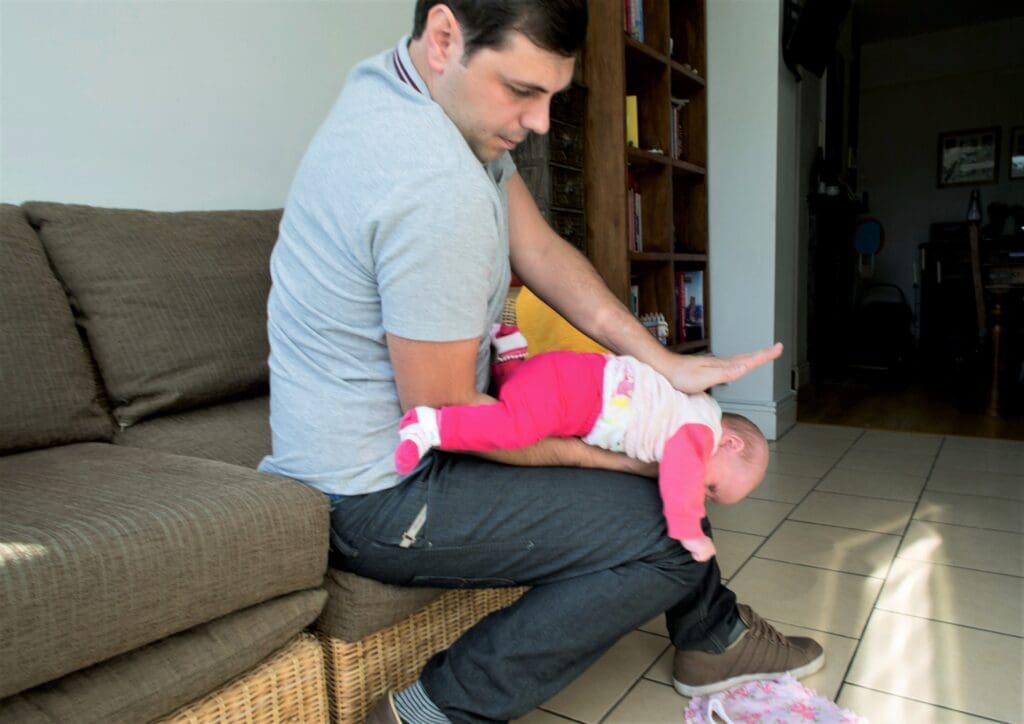
Hold the baby face-down along your thigh with their head lower than their bottom.
Hit them firmly on their back between the shoulder blade up to five times. If back blows do not dislodge the blockage, move onto step 2.
Step 2 – Give up to five chest thrusts
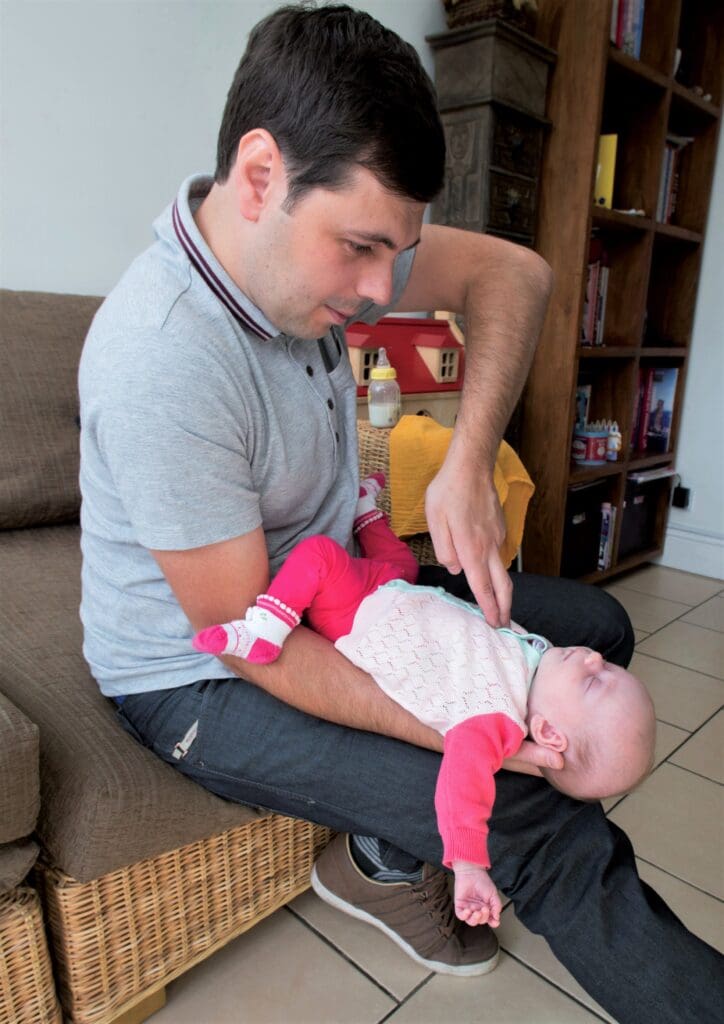
Turn the baby over so they are facing upwards. Place two fingers in the middle of their chest just below the nipples. Push sharply downwards up to five times.
Step 3 – Call 999 if the object does not dislodge from their airway
Continue with the cycles of back blows and chest thrusts until the object dislodges or help arrives.
A choking infant may need hospital care after medical help arrives.
Check out the video and the step-by-step instructions below on what to do if baby is choking:
https://youtu.be/ePodw7L_mFM
Helping a child over the age of one who is choking
A child who is choking may be clutching at their chest or neck but will be unable to speak, breathe or cough. Follow the first aid steps and emergency action plan below to help dislodge the object:
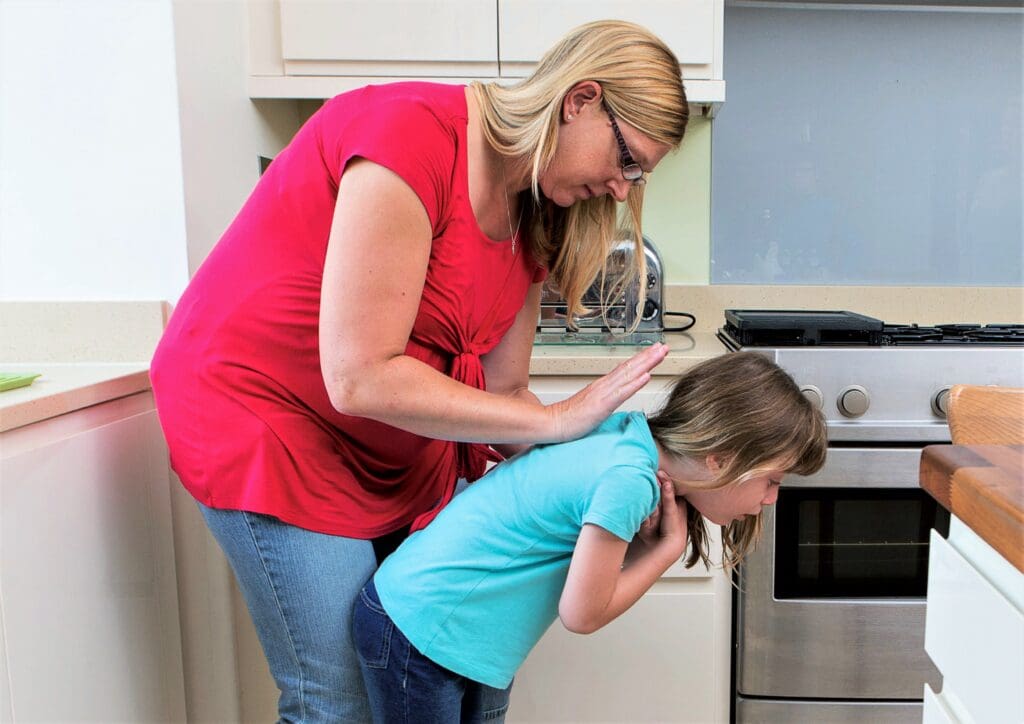
Step 1 – Give up to five back blows
Hit them firmly on their back between the shoulder blades. If back blows do not dislodge the object, move onto Step 2.
Step 2 – Give up to five abdominal thrusts
Hold the child around the waist and pull inwards and upwards above their belly button.
Step 3 – Call 999 if the object does not dislodge
Continue with cycles of back blows and abdominal thrusts until the object dislodges or help arrives.
Check out this video for step-by-step instructions on what to do if a child is choking:
What else can you do to help?
Stay calm
Try to stay calm and think clearly. It’s difficult not to panic in emergency situations, but try to remember that simple actions can be all you need to make a huge difference. If you do need to ring 999, remember the call handler will also be able to help you and guide you through the actions to take.
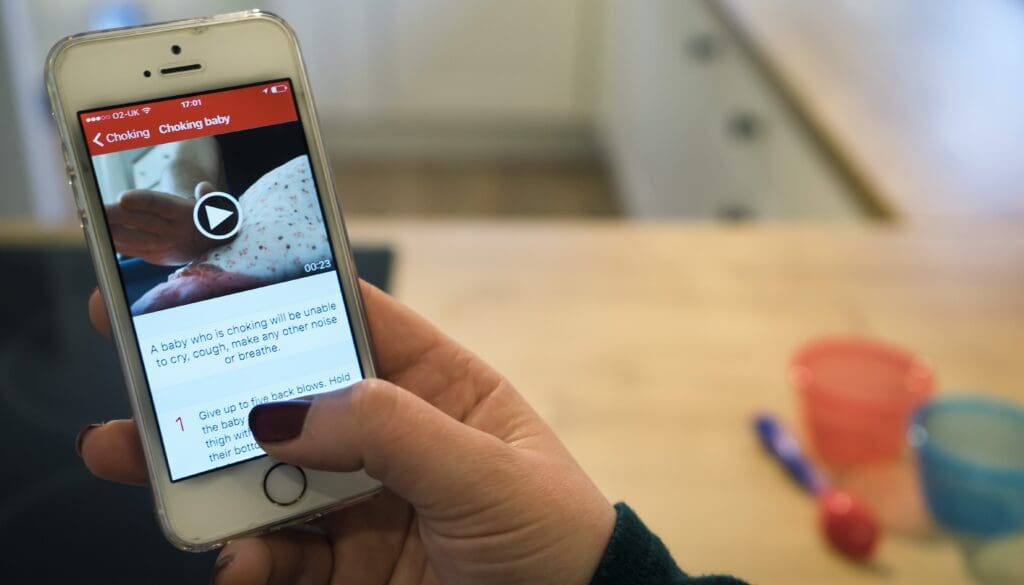
Learn more with the free British Red Cross Baby and Child First Aid app
Carry around the first aid skills you need by installing the British Red Cross’ Baby and Child First app, which provides you with easy-to-learn skills to help a baby or child in a first aid emergency. You’ll get:
Useful tips
Animations and video clips
Test your knowledge with quizzes
Record your child’s medication needs and any allergies
You don’t need an internet connection to access the app info either!
You can enhance your knowledge by heading online and building on your basic first-aid knowledge. Head here for more information.
First aid courses are available. However, they are not operating at the moment due to Covid-19. You can stay updated here to find out when the course will be up and running again.
Children can learn first aid too
Kids from ages 5-18 can learn first aid via British Red Cross’ brand new online resource, First aid champions.
First aid education is now on the RSE and Health curriculum in England so First aid champions can be used by all schools in the UK to teach kids and young people how to save a life. Parents can also use First aid champions to help their children learn essential skills at home.
First aid champions feature films, roleplays and quizzes to help children learn first aid skills in a fun way so they can feel confident to act when they need to. They can also learn about kindness as well as how to cope during pressure and keep calm while they keep safe too.
FAQ and recap
What is the definition of first aid?
First aid is the first and immediate assistance given to any person suffering from either a minor illness or injury, which includes choking.
How do you know if a child is choking?
They will maybe holding their throat or clutching at their chest but they will not be able to speak, breathe or cough.
What do you do if your infant child started to choke on something they picked up off the floor?
Follow the emergency action plan steps above depending on your child’s age (for under one follow the first aid action plan for a baby and for a person over one, follow the emergency action steps.)
Why is first aid training important?
Knowing basic first aid guidelines and procedures means you will know what to do if your baby/child is choking to increase your chances of helping the child to safety, whether the object comes out or you call for help.
What are the best resources for learning first aid techniques?
The British Red Cross contain a bank of resources for all types of first aid, so your best place to start is to visit their website here.
How can you be equipped to handle an emergency situation with no first aid supplies?
When it comes to a baby or child choking, you only need to be by your phone to call 999 for medical help if the object doesn’t come out. You don’t need any other first aid supplies.
What is the best way to perform first aid on a choking toddler?
Follow the first aid response plan above to perform first aid on a child choking over the age of one years old.
Is the handling of people who are choking the same between teenagers and children?
You do the same first aid steps as you would for any child over the age of one year old. Learn how to help someone who is choking here.
If you find yourself in a situation where your baby or child is choking, stay calm, follow the action plan steps above and educate yourself on what to do in first aid on British Red Cross’ website online. There are plenty of tips and resources to help you build your knowledge so you are armed and ready should the situation ever present itself.
*Nationally representative online survey of 2008 UK adults, carried out in April 2017 by Critical Research. Only 24% of mums and dads were confident and knowledgeable enough to help a choking baby.
Encouraging your kids to eat vegetables in their diet
*This post is sponsored by the Sea & Eat Project, which is funded by EIT food, to encourage children to eat a greater variety of vegetables in their diet. For more information on the Sea & Eat Project, please do read on!*
My three children have unanimously preferred fruit over vegetables, probably because it was easier for me to incorporate fruits into their diet as early as the weaning stage, when we generally started with fruits like banana and apple. My youngest baby started eating at 4 1/2 months and wolfed down a banana as her very first food. However, at 14 months old, I’ve only just managed to get her to try spinach and broccoli.
Why? Because children are hard-wired to enjoy sweet foods, and parents just want our kids to eat. So we encourage them to try the sweeter foods to whet their appetite, hoping they will naturally transition to vegetables later.
But a move to vegetables may not always happen because some kids may end up avoiding vegetables altogether and it can then become a long, hard slog to open their palates to new types of foods.
The truth is, all children are different and whereas my boys eat everything now anyway, including veg, my daughter is a lot fussier and has to try certain vegetables a dozen times before she trusts me and eats them. She’s the only one of the three kids who eat avocado and olives, though!
What are the advantages of eating vegetables in a child’s diet?
Vegetables are high in vitamins, minerals and fibre so eating a rainbow of vegetables provide the easiest route to a rich diet full of antioxidants which promote good health, protect against disease and keeps your child healthy and strong. There is strong evidence to show that the nutrients found in fruits and vegetables can prevent chronic diseases such as cardiovascular diseases. Vegetables are high in fibre and protein too so they help your child’s digestive system to work properly and prevent constipation, as well as reduce blood pressure.
How many servings of vegetables do we need each day?
The NHS say that 5-a-day of fruit and veg is a good start, but 10 is better to cut your risk of early death. A study found that people who regularly ate 800g of fruit and veg a day – 10 portions – had a significantly lower risk of chronic diseases such as heart disease. The good news is almost all fruit and vegetables count towards your 5-a-day, so it’s easier than you think for you and your child to get the recommended daily amount of veg into your diet.
So, why should we eat a variety of vegetables?
It is very important to have a variety of vegetables in yours and your child’s diet, which is referred to as the rainbow diet as they contain a myriad of vitamins and minerals to boost and maintain your immune system.
Why are some children more averse to vegetables than fruits?
Vegetables can be particularly hard to introduce into a child’s diet because not all vegetables are sweet – some taste quite bland actually – and they come in intimidating shapes and sizes.
Other reasons may be that some parents may not be educated on the variety of vegetables out there or give up trying to offer vegetables if the child continues to refuse them. A lot of the times vegetables tend to be these unknown foods of which both children and parents aren’t even aware exist in the world.
Knowledge is power, therefore we need to educate ourselves and our kids that vegetables are not only fundamental in a diet, but they can be super tasty too.
So, how do we do that?
We teach our kids how to know and love their vegetables!
How to make eating vegetables fun using the See & Eat project
The See & Eat project, which is funded by the European Institute of Innovation and Technology (EIT) Food, led by Professor Carmel Houston-Price at the University of Reading, and supported by partners including the British Nutrition Foundation (BNF), seeks to familiarise children with vegetables before trying them.
Following a successful initial launch date in 2019, research showed that visual familiarity in the form of picture books is an effective way to change a child’s liking and willingness to try new vegetables.
So the new See & Eat website launched to enable more families across Europe to access 24+ vegetable picture eBooks (available in English, Italian, Polish, Dutch and French) and to encourage pre-school children to try new vegetables. These eBooks are accessible via a smartphone or tablet and are interactive, so they can be viewed and edited (via audio, videos and pictures) using the Apple/Android app ‘Our Story 2’.
Part of the eBook on Broccoli!
Parents have found that it’s easier to get children to eat their veg after looking at the See & Eat books. If you’re interested in learning more about the research behind See & Eat, you can visit the University of Reading’s Kid’s Food Choices page here.
Your child can also enjoy books about brussels sprouts, the root vegetable sweet potatoes and broad beans, to name a few, as well as the very important leafy vegetables like the leafy green spinach.
See & Eat also created evidence-based activities and resources section on their website here where families can browse and download fun free activities to do together to encourage both parents and kids to get familiar with vegetables and healthy eating.
What else can you do to help encourage your child to eat vegetables?
You could play games with your children while they eat their veggies like ‘What are some vegetables that start with the letter C?’ or ask them to name as many orange veggies as they can and see how many they can come up with.
Then you can talk to them about the benefits of eating orange vegetables, I.e. because they are high in beta-carotene and vitamin A which regulates our immune system and maintains good vision. It’s also a great way to teach kids that there is a variety of vegetables out there of which they may not have ever heard before!
You can even confide in them about certain lunch ideas and see what they come up with. Get creative!
How many types of vegetables are there?
We can’t quantify exactly how many different types of vegetables there are in the world because it is estimated there are over 20,000 different types! But what is a good variety of vegetables to include in the diet? The amount of vegetables we eat is negligible to what is actually out there, so ensuring we eat a rainbow of vegetables is enough to ensure our children have a healthy attitude towards eating their recommended daily allowance of veg which will set them up for a lifetime of good health later.
Some of the different types of vegetables you can eat as part of a healthy diet, to name just a few, are:
Green vegetables
Dark vegetables
Salad vegetable types
Root vegetables
Red and orange vegetables
Of course, there are other types of vegetables available, but start with the above and move on to more exotic vegetables once your child becomes more adventurous.
Which vegetables are the least nutritious?
Vegetables that are fairly light in colour tend to have the least nutritional content, but they do contain vitamins that we lack in our diet. Iceberg lettuce has almost no nutritional value in it. Celery is a similar colour to the Iceberg Lettuce but is very high in fibre plus it helps you burn more calories, so it’s important to encourage your child to eat all types of vegetables.
Your child will not know all the vegetables names in this list, but it’s a great way to see the different vegetables on the menu! This list comes from World Cancer Research Fund and is not exhaustive.:
Vegetables are very versatile. You can get books on how to roast a variety of vegetables, you can get recipes on how to bake a variety of vegetables and some can even be eaten raw!
Can you eat too many vegetables?
It’s hard to over-indulge on vegetabls because of their low calorie count, but you should limit starchy vegetables like potatoes, corn, beans and peas. Eating too many vegetables can have a negative effect due to the excessive fibre which can lead to diorrhoea, and digestive problems.
Myopia in Children – How to spot if your child is short-sighted
Is your child running into a wall or squinting at objects further away from them? Then there may be a chance your child needs to have their eyes checked.
Myopia is a very common condition in children, and when diagnosed in time, it can be corrected with glasses in most cases. However, depending on the reason behind your child’s myopic condition, advanced treatments such as surgery might be required.
In this article, we’ll break down what myopia in children means and how to spot if your child is short-sighted and needs to visit the optician to correct their vision.
But, first.
What is myopia?
Myopia, otherwise known as short-sightedness is a very common cause of impaired vision where you will struggle to see distant objects clearly. But the closer the object is to you, the clearer your vision becomes. That’s why very short-sighted people (like my dad) tend to take off their glasses to look at microscopic objects very close to them, but need their glasses to talk to the person in front of them.
What are the symptoms of myopia?
To make the first step you will need to spot there’s an issue in your child’s vision, however, you should aim to get them to the optician as quickly as possible for an eye test to checks for signs of a refractive error, which is the most common cause behind myopia, as well as other eye conditions, like hyperopia, blurry, distorted vision, and presbyopia.
What causes myopia?
Myopia typically begins in childhood and occurs when the eyeballs are elongated, which causes the to light rays focus at a point in front of the retina rather than directly onto the surface of the eye. Myopia can also occur when the cornea and/or lens is too curved for its eyeball length. Children are more likely to be short-sighted if their parents are too, but will in most cases stabilises once they hit early adulthood.
Signs to look out for in children who may be short-sighted
To spot whether your child might have myopia, watch out for the following signs.
Squinting
Squinting is an assured sign of myopia if your child is doing frequently and especially while he/she is trying to focus on something that is at a distance. Teachers should be able to notice whether your child is struggling to see the board properly, so ask your child’s teacher to find out whether there have been any issues with squinting. If you see your child squinting or your teacher has noticed your child is struggling to see the board, make an appointment with the optician straight away.
Milky Eyes
If your infant child has milky or cloudy eyes without an eye infection, it is almost an assured fact that he/she is a victim of birth cataracts or congenital cataracts. The condition is rare, but not completely unlikely either. If a cataract is indeed the reason behind his/her myopia, your child will need cataract surgery as soon as possible. Without timely surgery, their vision just won’t be able to develop properly, due to the absence of adequate light exposure. This can lead to other complications such as topographical disorientation (inability of the brain to map and record terrain info), lazy eye, and in worst-case scenarios, permanent loss of partial or full vision.
About 30% of the children in the US suffer from myopia due to a number of underlying conditions. This is why doctors recommend getting a child’s eyes checked for the first time after the first 6 months post-birth. If no issues are found, another check at 3-years of age is advised.
*Collaborative feature post*
The importance of getting fit while pregnant
Being pregnant is a fitness journey in its own right, and a learning curve, of which no one pregnancy is the same.
Some women try to stay on their feet for as long as they can, while others prefer to sit back/sleep on an orthopaedic pillow and rest for the duration. How you handle your pregnancy is your prerogative. But if your doctor has given you the green light, then you should try to incorporate gentle exercise into your daily routine because the more fit you are during pregnancy, the stronger your body is at dealing with the hormonal and physical changes – and the easier it will be to get back into shape after birth. It has also been proven that staying active helps you cope with labour too.
You should aim to get around thirty minutes of physical activity per day for optimal pregnancy health, depending on the level of exercise you were doing before you got pregnant and your doctor’s advice. Always check with your doctor first before you start any new form of exercise.
If you're pregnant, grab your free pregnancy pack now - details inside!
You shouldn’t try to lose weight during pregnancy or stay in shape. In fact, NHS’ advice states most pregnant women should gain between 10kg and 12.5kg (22lb to 26lb), putting on most of the weight after week 20. Too much or too little weight gain could lead to complications for you and your baby including gestational diabetes and preeclampsia, so it’s worth making sure you are maintaining your weight throughout and not trying to lose weight when pregnant.
So how can you stay fit during pregnancy, from the first trimester to your due date (or beyond) without losing body fat while pregnant, especially when you’re feeling nauseous, tired and fed up?
How to stay fit during pregnancy
Staying fit during pregnancy means incorporating exercise naturally into your lifestyle, either by walking the extra few steps to the shops instead of driving/using public transport or by taking the stairs instead of the lift. A good rule of thumb to follow is if you cannot maintain a conversation during physical activity, you’re doing too much.
So, what are the benefits of getting fit during pregnancy?
Apart from making you feel great on the inside and giving you that much-needed boost in energy, there is a multitude of benefits to staying fit while pregnant. Here are a few reasons why fit pregnant women cope better during pregnancy.
Improves sleep
Trying to find a comfortable position to sleep in when you have a burgeoning baby bump protruding from your stomach can prove quite a challenge. Working out helps you to drift off to sleep at night because you’re burning off excess energy, leaving you exhausted enough to sleep almost instantaneously when you hit the hay. If you get into a good habit of practising some easy relaxation techniques before you go to sleep, then you will find that your body will wind down a lot easier and you’ll sleep better at night.
Exercise eases pregnancy pains
Exercise strengthens your muscles. The stronger your muscles are the higher your pain threshold becomes. Stretching is also a great way to iron out knots and unwanted aches and pains, especially back pain. Walking improves your blood circulation and helps to avoid any unwanted varicose veins as well. Swimming is a great form of exercise, especially during pregnancy, as it gently strengthens your stomach muscles, which helps to support the weight of the growing bump.
Exercise gives you an energy boost
Being tired is one of the biggest drawbacks of being pregnant. Fatigue is especially common during the first and third trimesters and one of the first signs of pregnancy too. But, when you strengthen your muscles through exercise, you will feel stronger and, coupled with a healthy diet, you will also get that extra energy boost that combats that drowsy feeling.
Exercise prepares your body for birth
Giving birth requires energy and stamina, two things that increase with regular exercise. Keeping a regular exercise routine can also help to shorten the length of labour, as mentioned above, and increase your chances of a quick birth as well. If you’re not a regular fitness buff, start slow and gently and keep at it. From a daily walk in the park to prenatal yoga, every little bit counts. Don’t forget your kegel exercises too!
Reduces the chances of pregnancy complications
Pre-eclampsia can be critical for both mother and child if not diagnosed early enough. Exercising regularly throughout the pregnancy does help to reduce the risk of pre-eclampsia if you are at risk of developing the condition. In some cases, if you are not careful with what you eat and you do not exercise regularly, you are also at risk of getting gestational diabetes as well. Exercise helps you manage your all-important blood sugar levels when combined with a healthy diet.
Gets rid of the blues
Exercising releases endorphins into the body which provides you with “feel-good” chemicals. Prenatal yoga is one of the best forms of exercises that keep your stress levels down during pregnancy because it is so calming – a happy mum leads to a happy baby.
So what kind of exercise should you try during pregnancy?
Golf
Not many people think of golf as a form of exercise but it can prove very advantageous to pregnant women. For starters, the game is played at a leisurely pace and isn’t too strenuous on the body, so you can’t do too much damage to both yourself and your unborn child. Secondly, you are getting in that much needed fresh air into the system. The golf course can clear your head and you get to enjoy a lovely green view while exercising too.
Swimming
Swimming is a great way to keep fit during pregnancy. The water is a place where you can clear your head and have some ‘me’ time while working all your muscles. Swimming also strengthens the core, which helps to carry the weight of the baby more easily. This favoured water sport can improve your heart and lungs as well for better oxygenation levels, which encourages toxins to leave the system too. Backstroke is particularly beneficial because it improves your muscular resistance gently and eases the body of unwanted aches and pains that are caused by bad posture during pregnancy – i.e. rounded back and protruding stomach.
Walking
Walking is easily accessible and the most popular form of exercise for all kinds of expecting mums. You can mix it up by taking a leisurely stroll down or the road or, if you’re feeling energetic, you can go for a power-walk in the park. Walking also improves oxygenation levels and blood circulation, whilst gently working on your joints, which can sometimes stiffen during pregnancy. Try to avoid difficult terrain and steep slopes because you don’t want to place unnecessary stress on your back. Also, make sure you wear proper shoes to prevent aching feet, backache, and to improve your balance. When buying shoes it is advised to get a pair half a size bigger, as your feet and legs may swell during pregnancy.
Light Gym
Yoga is a great way to stay flexible and to stretch out all those painful joints. However, do remember that you are pregnant and not your usual supple self, so only go for pregnancy-friendly yoga moves that avoid twisting and stretching the abdomen area. Remember to always keep your core tight and pulled in when doing any form of exercise, to protect the baby and reduce the risk of displacing your muscles.
Water Aerobics
Water aerobics has all the benefits of Yoga but it is less demanding on the body because the buoyancy of the water makes it easier to hold the poses and the weight of the baby. Finding a water aerobics class, especially one specifically tailored to pregnant women, will not only ensure that you’re working your muscles properly and safely, but you will also get to meet other pregnant mums who are in the same position as you.
by Kenny Holston 21
Don’t forget your pelvic floor!
Pelvic floor exercises count as exercise during your pregnancy because they strengthen the pelvic floor muscles which may weaken during pregnancy and birth due to the pressure of the baby and the act of birth itself. You can find more information on how to exercise your pelvic floor during pregnancy here.
Workouts to avoid while pregnant
It is very important to avoid contact sports during pregnancy like football or rugby, as you don’t want the unnecessary impact on the baby. Also avoid hazardous exercises where if you fall you can seriously injure yourself and the baby, like ice skating, skiing and rock climbing.
You also don’t want to make any sudden movements or raise the body temperature up too high. You should aim to keep your heartrate under 130 to avoid overheating and dehydration. Always rehydrate before and after any form of exercise.
There are so many benefits to exercising when pregnant, both for you and your child. But always remember to listen to your body and not overdo any kind of exercise, even if after you’ve had the baby. Consult your doctor before you start any new exercise regime and make sure you keep your heart rate and body temperature down at all times too.
If you're pregnant, grab your free pregnancy pack now - details inside!
Simple breastfeeding tips to keep baby feeling full for longer
During each first year of breastfeeding (I have three babies), I had an oversupply of breastmilk, especially foremilk, and it often felt like I was feeding for hours on end. I remember one particular incident when I breastfed my eldest for almost three hours while watching two movies back to back. Two hours later, he was hungry again.
Very first breastfeeding experience after Aron’s birth
If you’re breastfeeding and you feel like a human milk bottle, then let me introduce you to Jacqui Nancey, who is a Registered Midwife, Lactation Consultant and Baby care/Sleep Specialist!
Jacqui has created Nature’s Four Course Beginner Breastfeeding Tips and Tricks, which are simple breastfeeding latching tips to help your nursing baby feel full for longer. As well as teaching mothers how to breastfeed successfully, Jacqui also offers advice on the following:
“How do I satisfy my breastfeeding baby? Why does my 6+ week old keep waking every 45-60 mins after feeding for ages on both breasts, yet he wants to feed again each time I think he is asleep and I try to settle him down in his crib? I am exhausted from feeding him constantly and totally sleep-deprived, yet my baby’s appetite keeps growing every passing day and week.”
Walking robotic mum
This mum’s reality of accruing mental stress, daily sleep deprivation, and psycho-social fatigue, is a major risk factor for:
recurring negative mood swings which could lead to postpartum depression, or even escalate to maternal psychosis should the mother be susceptible to mental health risk factors if not properly supported
slow postnatal recovery, or even morbidity after childbirth
the potential for marital conflict and challenging family dynamics
poor mother and baby parenting skills and emotional attachment…
Does stress affect breastfeeding?
Breastfeeding for new moms can be stressful, but increased levels of the stress hormone cortisol can also reduce overall breast milk supply, and delay the let-down reflex of milk release.
Mental, physical, and emotional stress can also have a negative impact on breastmilk supply and quality, as well as hinder the normal function of your breastfeeding hormones, prolactin, and oxytocin, which are produced by your brain’s hypothalamus. Stress can affect the delicate balance between your milk production, milk release, breast milk supply, and the quality richness of your milk.
Benefits of a stress-free experience when breastfeeding a baby
Breastfeeding is meant to relax the mind, soothe the body, and be a comfortable experience overall for mother and baby.
However, if you are feeling moody, tired, or mentally fatigued, then the actual quality and volume of your breast milk will eventually be compromised, from a creamy baby milk texture to a very light and unsatisfying breast milk quality. You may also find it difficult for your baby to latch-on easily at the start of some feeds throughout the day or night time feeding sessions.
Therefore, the more relaxed nursing mothers are, the better their mood and psycho-social well-being will contribute to the creamy QUALITY density and volume of breastmilk, which increases the chances of breastfeeding success.
Here are some other benefits of breastfeeding:
Being happy has a positive impact on breastmilk supply and quality
Happy hormones in your bloodstream are released into your breastmilk, which can directly contribute to your baby’s sense of relaxation and satisfaction from the creamy density of your milk supply. Plus, the sleep-inducing effect of the natural morphine hormone is found in your HIND-breast milk, so you need to make sure baby is feeding for longer enough to get to that back milk.
Follow a good breastfeeding diet and encourage positive family dynamics
Your breast milk volume plus rich quality in terms of its nutritional value, creamy density and baby satisfaction can be improved and sustained by ensuring you are:
➢ Well rested and psycho-socially at peace with your inner self and home environment
➢ Practically well-supported by your immediate family
➢ You eat and drink nutritional meals, foods and snacks
The following brief will focus on three breastfeeding tips (for first-time mothers especially), to experience relaxed breastfeeding from day one:
1. Soothing Breast-Softening massage
The best mind and body-relaxing pre-feed preparation tools for mums
2. Pain-free baby latching
The latch is extremely important to encourage the baby to suckle and enhance breast milk let-down. Latch also ensures breastfeeding enjoyment, so the milk comes easily. Make sure to wipe the baby’s face gently after each feed to prevent a milk rash forming.
3. Satisfying baby at every feed
Use the four-course breastfeeding tricks to satisfy your breastfeeding baby
1. Breast-softening massage
Always start your day with the side your baby does not naturally seem to prefer. By nursing this way, you will naturally ensure that both breasts have a good supply on both sides of your breasts.
Start the breast-preparation massage to relax, soften and ease the breast skin and ducts into pain-free breastmilk release and nursing
Sit comfortably in a well-supported comfy chair. Have a clean hand towel on your lap, plus a bowl of edible sunflower or olive oil next to you if there are no familial allergies
Half-strip only by taking the blouse and nursing bra off on one side of your chest. Start with the breast that produces the lesser from the two. This is because one breast always seems to have bigger ducts than the other, which explains why most babies naturally prefer the faster-flow breast side than the one with the slower flow or narrower ducts
Use a gentle oil salve and rub some oil in both your palms. Gently salve all over the breast tissue
Place one of your wrists within the crest of your torso – to provide leverage with your open palm for the breast to be massaged. ALWAYS MASSAGE ONE BREAST AT A TIME, as massaging both will leave you soaking in breastmilk from the side your baby would not be suckling on.
With the other palm, use the ball of the palm to gently massage the side of your breast from the arm-pit to the areola five times
After these initial 5X armpit massages, use that same palm as leverage on that side of the breast. Then proceed the same gentle massage 5X with the other palm from crest to the areola
Move one palm to support by cupping the underside of that same breast. Then use the other palm to gently massage – always using the ball of your palm – from the shoulder blade to the areola X5
For the finale, simply use the shoulder blade massaging palm to support the entire top-side of the breast. Then use the other ball of the palm to likewise massage the entire underside of your breast by starting from the rib-cage muscle, breast underside right up to the same breast areola
Best times for your breast massage
You can massage your breast any time you feel full and engorged, i.e. from your 3 am – 11 am feeds, as this is usually the time when your breasts will be full, hard, engorged and probably painful to touch
Soft breast skin and a pliable areola means that it is a lot easier for your hungry baby to suckle from your areola
2. Pain-free baby latching
Pain-free breastfeeding starts with the correct attachment of the baby’s mouth around your areola, instead of the baby’s lips and jaws clamping onto your tender nipple tissue.
A good breast-feeding latch-on means that the soft and massaged breast tissue, makes it a lot easier for your baby to open their mouth much wider around the areola, instead of focussing on the nipple alone.
Babies are clever and will quickly notice when the breast is hard to suckle. They will get frustrated because they will find it difficult to fit a hard and engorged balloon into their mouth, hence why they seem to naturally clamp onto your nipple alone, each time you try to nurse them – with full and hard breast tissue.
Parenting Tip: Baby Gas or Colic Relief
Should your baby suffer from the two tummy discomforts, you could offer them some Woodwards gripe water tonic.
Mix 5mls in 3oz of warm boiled water and offer your baby 1oz 30 mins before the 6/7 am feed, 10/11 am and the 5 pm feeds.
3. Satisfying baby at every feed
The Four-Course Breastfeeding Approach is the easiest way to make sure the baby gets to the rich HIND milk during and after every breastfeeding session. The result is a baby who feeds lustily from start to finish and is satisfied after every feeding session. Thus, they have a full tummy and is happily settled plus sleeping well during the day or night breastfeeding sessions. Otherwise, when the baby keeps waking up for small, frequent and short breastfeeding feeding sessions, this type of commonly adapted breastfeeding approach is known as the:
SNACK breastfeeding method.
SNACK-breastfeeding means that although your baby feeds frequently, their overall appetite is not fully pacified, hence why they keep waking up every 45-60 mins throughout the day or night.
Yet for most healthy six-week-old babies, born at term gestation and with no compromising psycho-social risk factors, you would expect to start sleeping for at least 2-3 plus hour intervals in between their day or night feed, which can result in an ongoing cycle of stress and parental sleep-deprivation, the older their baby gets.
However, the Four-Course Breastfeeding Approach is nature’s way to satisfy your baby’s appetite from day one.
If you have ever expressed breast milk and left it to settle for later use in the fridge, you can see the three stages of your breast milk quality ‘titrate’ or separate themselves into three noticeable layers.
When breastmilk is made by the breast milk-making cells known as the acinar cells, the result is a release and increase of breastmilk supply which comes as a combination of three types of breastmilk densities as follows:
Stage 1 – TOP milk
This is the thirst-quenching feed-starter
Stage 2. MIDDLE milk
This is the semi-skimmed milk appetiser
Stage 3. HIND-milk
This is the toffee-rich super creamy nectar
Significantly, even though ALL breastmilk is nutritious, it seems like it is naturally released in three stages, which naturally changes from Stage 1 to Stage 3, as the feed progresses to pacify your baby’s appetite.
Mothers who use the Four-Course Breastfeeding Approach, find that from start to finish, a typical breastfeeding session would naturally last at least 45 minutes of the active baby nursing, taking burping breaks after every 10 mins when needed.
Stage 1 – TOP milk -Thirst-quenching feed-starter
Have you noticed how most babies wake up in a feeding frenzy? This is because they aree feeling both thirsty and super-hungry at the same time.
So nature designed this initial Stage 1 milk to assuage their thirst first. Stage 1 breast is found at the very base of your milk ducts, located at the front of your breast anatomy/areola. This TOP breast milk is very light in colour, thin in density and often has a chalky-greyish hue.
Although it makes up as much as 60-70% of your entire breast milk supply and is very nutritious, its thin density is NOT very satisfying for babies. Which explains why switching sides at the moment your baby stops nursing, will leave most exclusively fed nursing babies feeling constantly peckish – hence the frequent baby-feeding bouts and very limited sleeping episodes.
Quick Tip – COLIC-Relief baby-burping Massage
Once your baby starts falling asleep on the breast after the first ten minutes of their thirst-quenching initial feed, it is your cue to wake them up gently by applying the COLIC-Relief baby-burping massage.
As soon as you have applied the baby-burping colic-relief massage, your baby will immediately wake up and route for a feed. The baby-burping massage naturally quickens the release of breastfeeding into the stomach, instead of the usual 45+ mins it normally takes for this milk to reach the baby’s stomach from the feeding tube.
The beauty of the colic-relief baby burping massage is that it will keep your baby avidly interested, happy, and awake throughout your entire breastfeeding session from start to finish – hence why it is naturally done in-between each of your baby’s breastfeeding sessions.
Instead of switching sides, you are encouraged to latch your baby onto the same side for this second time.
You will also notice that your baby will not be as frenzied in their suckling as in the initial Stage 1 milk intake. This is because your baby is at least 3/4s full from the Stage 1 milk.
Also, Stage 2 milk is creamier in density than the skimmed density of Stage 1 milk. As seen by its light yellowish colour and it is also more satisfying for the baby’s appetite than Stage 1 milk.
Stage 2 milk is therefore called the semi-skimmed breast milk appetizer, since it’s quality of milk richness falls between the very light Stage 1 milk quality of skimmed milk density and the very rich Stage 3 toffee milk.
It is not only the QUANTITY and VOLUME of breast milk that satisfies baby, but it is the QUALITY and RICHNESS of any given feed that pacifies both your baby’s hunger and feeding urges.
Hence why adapting the Four-Course Breastfeeding Approach, results in your baby starting to calm down after another 8-10 mins of taking the Stage 2 milk.
Usually, your baby’s Stage 2 milk intake will last between 8-10 mins of a medium-slow baby feeding pace, unlike the frenzied rapid feeding, pace witnessed at stage 1.
Towards the end of Stage 2 milk, your baby’s feeding pace will eventually slow down significantly until they get to what we call the intermittent baby feeding pace when you will notice your baby begin to feed in bits of tiny suckles in a drowsy state before literally falling off the breast half asleep.
Medical caution
If your baby is unwell, dehydrated or on any kind of medical fluid balance assessments, then very often the volume aspect of your baby’s feeds will be the priority to follow as per your paediatric advice.
Stage 3 – HIND-milk – Toffee rich super creamy nectar
Have you ever noted how thick and creamy this milk density is!
Every single baby loves this Stage 3 milk quality and though every breastfeeding session has it in different measures throughout any 24hr time frame – you can get most of this Stage 3 milk between the 3 am – 12 pm breastfeeds.
It is generally full fat in density, has a sticky texture and is super-sweet, hence why its called ‘toffee sweet’. It also comes with a natural dose of ‘morphine’ properties that are naturally designed to make your baby have a deep sound sleep after every Four-Course breastfeeding session.
Given the rich density and satisfying quality of this Stage 3 breast milk, this session usually lasts only 5-8 mins in total, before your cherub looks pretty dazed and super sleepy.
This is also your cue to change your baby’s nappy immediately after the burping massage. A soothing and gentle warm water nappy change will immediately wake up your drowsy baby enough to keep them contented and alert, before your Fourth Course breastfeeding finale – which will occur from your second breast.
If you try to feed your baby straight after the aesthetic nappy change, your baby will be reluctant to feed so soon, or simply spit up when fed that soon. Hence the 15-20 min mini-break.
Therefore, settling your baby in a recliner, while you grab a snack, shower, or check on your emails gives you that much-needed break away from the feeling of constantly feeding over the last 30 minutes.
Quick Tip
Settling your baby in a gentle recliner will ease your baby’s digestion for about 15-20 mins
Fourth Course – Change Breastfeeding side
Generally, most babies from age 0-3 months post-partum can only stay awake for 1-hour in-between feeds before falling into a deep 2-3 hour sleep, depending on your breastfeeding technique and family home psycho-social dynamics.
This way we start the 3-stage breastfeeding technique on one side A, to begin with, which normally lasts for 30 minutes. By the end of this 30 minutes on breast A, your baby would be at least 80% full and looking like they are ready to sleep soundly.
After 15-20 mins mother and baby take a break, and your baby will start to get visibly restless, sleepy, and unsettled. This is your baby’s cue to let you know they are now ready to resume the Fourth-course stage of their entire breastfeeding session.
You can now SWITCH sides by offering your baby the now massaged Breast B, because it would be naturally so full and engorged by now. Besides, after taking the rich density of the HIND-milk quality, your baby will naturally need the thirst-quenching milk to wash it.
This final stage will only take 5-10 minutes on the new side before your baby is ready for a good two+ hour’s sleep.
Conclusion
While we understand how draining the reality of exclusive breastfeeding can be for most postnatal mums’ mental and physical faculties, we hope that the practical breastfeeding for newborn support tips shared in this brief will offer you a much easier breastfeeding experience instead of the chronic weariness when trying to satisfy a ‘snack-fed’ baby.
Elder Care: the Options
Nobody wants to think about what will happen to their parents as they become more dependent on family support. So, it’s important to think about how to make their lives as straightforward as possible as they ease into old age. Loneliness can contribute to mental health problems, so relying on a home team and in home care is important for your loved one’s wellbeing. As overwhelming as it sounds, there are ways to simplify elder care, as long as you know what options are available to you. Here are some ideas on how you can administer elder care going forward.
Establish a home team
A home team is a group of family members, friends, colleagues or a mixture of all three of whom your loved one can depend upon, both emotionally, physically and socially. They are the ones who can motivate them when they’re feeling low, advise when in a tricky situation, support them when they have experienced a tragedy, and make them laugh when they need it the most.
One way to keep everyone together is to use a caregiver mobile app, which connects the carer’s team, caregivers, clients, and families, to make personalised everyday support management easier.
Who is on the home team?
Home teams come in all shapes and sizes and can be different even for other family members. Your loved one’s (or however your kids like to call your grandparents) home team is with whom they have formed an unbreakable rapport and who they know will be there in the good and bad times.
A home team in life allows us to experience life to its fullest, to enjoy what really matters – to form relationships and experience true love. We all need a home team to make us feel complete to ensure that if we are in a conundrum, they can help us get out of it. They contribute to your life more than you’ll ever know and as you get older, you will depend on them more so when you need it the most. Therefore, the adage of ‘treat people as you want to be treated yourself’, rings so true at this point because there will come a time when you will need to depend on your home team. If you’ve pushed them away, you may find yourself in a team of ‘me, myself and I’.
As we get older, we want our family around more to stop us from feeling lonely. Sometimes children can help with a bit of DIY in the house or get the shopping in, for example. In more serious situations, your loved one’s home team can help with matters that might require legal help. If they have developed a disability and their condition happened while in the military service, then they might benefit from VA disability rates and be entitled to compensation.
Grandchildren can be around more to help. If you are lucky enough for your family to live close by, then grandchildren can become part of the home team. Grandchildren can bring life to their grandparents in ways others cannot replicate and remind them of what it felt like to be young again. They provide that much-needed boost in morale and grandparents can parent their grandchildren again with the benefit of life experience. It is such a wonderful relationship to experience if you have the fortune of being around your extended family.
How can we help and be part of our older generation’s home team?
When SunLife asked over 55s whether they would prefer to stay in their own home, rather than move, 60% said they would have preferred to stay in the comfort of their own home. Most loved ones would like to maintain their independence, so adapting their home, i.e. installing stairlifts and door entry systems, can ensure they can carry on living a high quality of life with the added benefit of their home team being available when they need it, either through live-in care, or part-time care. More on these options below.
Care at home
You could ask your elder relative to move in with you so you can offer more help with daily tasks. They may feel like they are imposing, but it’s important to note that if they need help, they know they can rely on their home team.
Care at home doesn’t have to mean 24 hours a day. For instance, a ‘meals on wheels’ service may be provided if you have trouble cooking or you might just need someone to pop in once or twice a day to help you wash or change clothes.
Hourly Care
Hourly care is domiciliary care delivered in the home, however, this care is not consistent throughout the day. A care assistant will visit your loved one’s property at specified times, helping with a range of jobs, including getting out of bed in the morning and preparing food. The time spent in their home supporting your loved one is relatively short compared to live-in care and can mean that they may spend extended periods of the day alone. For those with more complex needs, hours spent without care can be particularly problematic – increasing the risk of falls and accidents. Like care homes, your loved one may be supported by a variety of different staff week on week, giving them little opportunity to develop friendships and meaningful relationships.
Adapt their home to make them more independent
There are various home adaptations that can be made to help people stay safe in their own homes as they grow older. Depending on your relative’s needs, they might benefit from adjustments like easy access showers, motion sensor lighting, toilet frames, stairlifts (Millercare Stairlifts are an option to look at), ramps and handrails, kitchen mobility accessories, door entry systems that grant trusted people access and wider internal doors. You don’t have to live in a care home to have access to specialist products such as electric beds, riser recliner chairs and pressure mattresses either. Companies like Alpine HC supply these types of high-tech equipment to private individuals and the care industry. Talk to the person you care for about the difficulties they have around the house and help them make a plan that will allow them to stay in their own home for longer.
Live-in care
There is a real need for more resources that not only help people find live-in care services but also explain the distinctive benefits of professional support in the home. The ‘7 Benefits Unique to Live-In Care‘ infographic can help you understand how the lives of your loved ones can be transformed by choosing live-in care.
By choosing live-in services your loved one will receive undivided attention from their carer through one-to-one support. Live-in care is very flexible compared to other types of care, a super strict routine is unnecessary as there is no time limit on when their care ends – allowing for a greater level of independence, choice and fun spontaneity. Working in teams of two live-in carers are trained to provide anything from companionship to complex care for a variety of conditions including Dementia, meaning your loved one can remain in the comfort of their home even if their care needs change.
Why Consider Live-In Care
Choosing live-in care can help improve, health, happiness, and well-being in some following ways:
Consistent Care – Your loved one will receive care as and when they need it.
Tailored Assistance – They’ll be cared for by a person who understands their individual needs.
Build Trust – Live-in care allows your loved one to build a long-lasting and trusting relationship with their carers.
Immediate Care – Their carer can immediately respond to medical emergencies.
The Good Care Group is a Live-in care provider rated ‘Outstanding’ by the Care Quality Commission. They provide care, support, and companionship to help your loved one continue to live safely and comfortably within their home. Find out more about live-in care by The Good Care Group by visiting https://www.thegoodcaregroup.com/ or contact them on 020 3728 7575
Moving into a care home
When choosing a care home, your loved one will move out of their current property and into new accommodation, which is often one room within the home itself. Once living in a care home, they will receive support from the staff there. Their care team is likely to comprise of many people who rotate shifts. Where their care home is located will largely depend on availability, so this means they may not receive care in their preferred community and sometimes, they could be separated from their partner.
This is a big step, particularly if family members don’t feel they can offer the level of care needed for the best quality of life. You can be there to help them feel active and make new friends, while staff are on hand 24 hours a day for all their medical needs. If you’re serious about a care home, then do your research about what’s offered. Some just provide accommodation with some personal care, while others can offer nursing care as well if needed. There are several organisations that can help you find a suitable care home. You can get advice about every aspect of the process from the likes of Extra Care so you’re fully informed about what the best options are.
The cost of moving to a care home is a worry for many. Age UK has some excellent information about paying for residential care.
Help them stay independent outside of the home
According to a survey conducted by Independent Age in 2017, 91% of drivers aged 70 and over say that if they could not drive, it would cause a loss of independence. Although a driving license expires when a holder turns 70, this doesn’t mean that people over this age can’t get behind the wheel. Make sure your loved one knows that they can renew their license once they reach 70. They should also know that developing a health condition doesn’t mean they must stop driving. If their condition affects their ability to drive, the DVLA might conclude they need to make adaptations to their car.
Exercise
Encouraging your loved one to keep fit is also great for lengthening their life expectancy, so taking them out for walks, and new activities are great for the mind and soul. Being part of a home team that has younger children means that grandparents need to keep up with the activities and this forces them to push outside of their comfort zone, which is good for morale.
Physical activity can help people stay healthy, preserve their independence and keep doing the things they enjoy. It is recommended that adults do 150 minutes of moderate exercise every week. Why not help your relative to stay well by joining them in doing activities that get the heart racing? You don’t have to be a gym buff to help your loved one to get moving. From walking to going out dancing, to taking a yoga class, to doing some gardening, there are lots of ways you and your elderly loved one can get more exercise.
If you care for someone with reduced mobility or another health problem or if your loved one hasn’t exercised for a long time, it’s a good idea to seek advice from their healthcare professional to find out what kind of exercise might suit them.
Keep them warm in the winter
Medical advances and a better understanding of how to look after our health mean that we’re all enjoying longer lives, but while this is something to be celebrated, a growing percentage of the population is at increased risk of general and seasonal illnesses. According to Age UK, 15 million adults in Britain are now aged 60 or over. They’re the most vulnerable social group to winter conditions like colds, flu or pneumonia and at serious risk of exacerbating age-related heart and circulatory conditions, often with fatal outcomes. Statistics show that on average, 210 older adults die every day; that’s someone’s elderly friend or relative “every 7 minutes.” In most cases, their deaths, which Age UK report are attributable to inadequate insulation and heating in the home, are preventable. Fuel poverty, which now affects over 1 million adults in the UK, makes addressing some of those home heating inadequacies difficult but staying warm throughout winter can literally make the difference between life and death.
Short – term, Low-cost Solutions
Hot water bottles, electric blankets and warm clothing, as well as regular hot meals and drinks, can provide the short-term boost of warmth older individuals need to keep their core temperature up and their circulatory system healthy. However, although they offer some short-term comforts and can help to keep home heating bills down, they’re not practical or reliable alternatives to the proper heating and home insulation setup that’s necessary to see a person through weeks and months of cold weather.
Home Heating and Insulation
Ideally, living areas should be maintained at 18-21˚C and although any wood-burning stove, home gas fire or portable heater can generate that heat, they can be costly to run and their warmth is generally confined to one or two rooms. Make sure your house is properly insulated to keep the heat. You can build the insulation into the walls yourself if you know what you’re doing and you are staying safe with the right tools and equipment (you can find a selection of tools at SGS). Central heating can offer a cheaper, more reliable alternative, but old or poorly maintained systems can be ineffective and expensive to run. Ask a plumber to carry out a quick health check on your central heating system to make sure there are no airlocks in radiators, that the boiler is operating safely and that any heating pumps are running the system efficiently to generate heat and hot water and provide value for money. However, even the best central heating system will struggle to generate and regulate warmth where it’s needed if the property’s insulation is inadequate. Most interior heat will leak out through windows, doors and roofs, but insulation can trap it inside to keep homes warmer and bills down. It is estimated that loft insulation could reduce annual bills by £125 and cavity wall insulation could reduce them by £155. Private tenants or homeowners on certain income-related benefits are entitled to have loft and wall insulation fitted for free under the government’s Energy Company Obligation (ECO) scheme.
Besides adding insulation, switch any lightweight curtains to thermal or heavy-backed alternatives, lag any pipes and block any window, door or letterbox draughts with excluders. These are available from most local DIY stores for around £5 to £20. Hire a plumber to ensure that all the plumbing is installed correctly and hot water is coming through properly.
Financial help
Besides the ECO scheme, there are several other financial grants and benefits available for older adults and vulnerable people who need help to keep their homes warm throughout winter, including:
Winter Fuel Allowance
Any adult-born before 1953 is entitled to a winter fuel payment of between £100 and £300. To check your eligibility and claim any payments you haven’t yet received, visit the government’s Winter Fuel Payment service online.
Boiler Replacement Scheme
If your boiler is over 5 years old, then a free or heavily discounted replacement may also be available via the government’s ECO scheme. You can check your eligibility and apply for a new boiler at www.boilergrants.org.uk.
Switch Energy Supplier
Getting the best price for gas and electric has never been easier. To find out if you’re on the best tariff, visit Which? Switch, where you can compare deals and change suppliers in a matter of minutes.
Finally, if you’re concerned about the welfare of an elderly or vulnerable person in your area, then please contact your local Social Services department.
Will preparation and storage ideas
Although some people find the prospect of will preparation both morbid and confronting taking this step is necessary if your loved wants to bequeath their worldly possessions to their loved ones in a particular way. As a legally binding document, a will can also prevent confusion and future disputes, making things that little easier for all parties concerned. So, below are some will preparation and storage ideas that will help you ensure that the will is safe, secure, and legal.
Will preparation
Writing a will ensures that your loved one is the person who decides what happens to their possessions, property, and money after they die. A will also ensure they don’t pay more Inheritance Tax than they need to. You can make your own will but it’s not as straightforward as you think, so it is advisable to get advice from will writing solicitors who will ensure that the will can hold under law. You can purchase a Will Kit which will contain all the information you need to create a will, and which will also include information on making sure that the will is formally signed and witnessed to make it legally valid.
To update the will before their death, your loved one would require a ‘codicil’, which is an official alteration to the original will. Or they can make a new will altogether if there are several changes.
How to make your own will
If you don’t want to pay a lawyer to write a will for your loved one, then there are several things you need to include to ensure that the will is valid under the law. The will should set out:
Who you would want to benefit from your loved one’s will (their beneficiaries)
Who should look after their children under 18, if any?
Who have they appointed to manage their estate and carry their wishes after their death (the executor)
What happens if their beneficiaries die before them
When you need to get legal advice from will solicitors
If their will isn’t so straightforward, then they should get legal advice from will solicitors who will help them understand:
How to share their property with anyone other than their husband, wife or civil partner
They have several family members who will want to make a claim on their will (for example, a spouse or children from another marriage)
They want to leave money/property to a dependent unable to care for themselves.
They have a permanent home outside of the UK.
They have a business
They have property abroad
Once they have sorted out their will, they will need to make sure it is safe. There are several ways they can store their will, for example:
In a home safe deposit box
One of the most popular methods of storage for confidential items such as a will is the humble safe deposit box. Although renting a bank safe deposit box ensures a high level of security, it does not afford a great deal of convenience for access. The terms and conditions regarding when and how the box can be opened will differ from institution to institution, but the result could be a long, drawn-out legal process for friends and/or family. If your loved one chooses this option, make sure they do their research on any restrictions or opt for joint ownership if this is an available selection. Also, inform trusted individuals of the box’s location.
Storing your will documents online
For a more convenient option, they can store their will documents online. Thanks to the genesis and subsequent popularity of cloud computing, businesses and individuals can store large files and access them from multiple locations around the world.
The main concern with storing data in the virtual world is security. Is anything safe online? What if someone hacks in and manipulates or steals their will? The threat of viruses, hackers, and malfunctions is still relevant, so to combat these threats, online defence specialists are creating products such as Your Digital File, which uses a complex encryption system as a safeguard, ensuring that no unwanted visitors will access your loved one’s files.
Will Solicitors
Last, your loved one could opt to trust solicitors with their will documents. If they don’t have a personal solicitor or they don’t know where to look, they can always ask people they trust which solicitor they used. Make sure they take into account factors like, what if they change their legal representation? What if their lawyer retires or moves location? What if their office is broken into or subjected to a fire or flood? What if the paperwork is simply lost somehow? These are hypothetical situations that can become a reality in an instant, making life very tiresome. That said, if they are comfortable placing their trust in their long-term lawyer, this could be a viable option.
It is unavoidable that one day you will require the same care and support from your home team and so it is vital to keep this close-knit love and support around you whenever you can. No one wants to grow old on their own and so if you find that you need to reconnect with some members of your home team, do not hesitate. Seek them out and find out if they need a home team of their own. Unfortunately, it may not always be possible to have your close-knit family and friends around you. Birds flee the nest and settle miles away and acquaintances may fade into the distance or even pass away. As you get older, friendship groups get smaller, but the ones who have stuck around are the ones who stood the test of time and will inevitably last forever.
Exercising during pregnancy comes with all sorts of benefits, as long as you don’t overdo it. And, if you have been diagnosed with pregnancy-related symptoms, then your doctor may advise against exercise altogether.
So, unless you are having a complicated pregnancy and/or your doctor has advised bed rest for the duration of the nine months, walking is known to be the best form of exercise because it is gentle on the body and great for the lungs and heart. Walking is great at any point in your life, but here are some benefits of walking during pregnancy:
You only need a great pair of walking shoes
It’s a cheap way of getting fit because all you need is proper footcare and some ground to walk on. During pregnancy, your feet will require a lot of support and plenty of ventilation, so opt for a specialist trainer that ticks all the boxes, like the like Wolkyshop’s e -walk trainer. The E-Walk is made from a special soft stretch leather and has a Roll-a-Way system that allows for automatic foot rolling action from heel to toe – perfect for those tired pregnant feet that are carrying a little extra weight.
The E-Walk will also fully adjust itself to the foot during pregnancy due to the lace design, and the breathable material will ventilate your feet during your walk, which means you can travel in comfort while walking long distances. Watch the video here to find out more about the E-Walk and see it in action too.
Walking is a safe form of exercise
You may be wondering when to start walking during pregnancy. The great answer is you can start straight away! Walking is a gentle cardiovascular exercise so it is safe during pregnancy for the entire nine months. It is also one of the easier forms of exercise to get started with if you weren’t active before you got pregnant.
Make sure to start slowly at first if you haven’t walked before, and work your way up to brisk walks, increasing the length of time slowly. You only need to walk around twenty to thirty minutes, five to seven times a week provided your doctor has given you the go-ahead to do so.
Make sure to also stay cool and hydrated during your walk and slow down when you feel your body temperature rising, which can sometimes bring on contractions, due to dehydration. One tip is to freeze half a bottle of water and then add cold water before you walk so that your bottle stays cold throughout and you stay hydrated. After your walk, make sure you put your feet up and rest to prevent swollen feet and ankles. Cool your legs with Mama Mio’s Lucky Legs Cooling Gel, which contains spearmint to provide you with that instant cooling relief. Keep Lucky Legs in your handbag too so you can cool your legs down during your walk!
Walking helps you ease into each trimester
You may experience a nagging headache during pregnancy, or other unfavourable symptoms like constipation. But, the biggest symptom is your growing bump, which may disrupt your overall balance. As long as you are wearing supportive shoes like the E-Walk, which is perfect for keeping your feet comfortable and protected as your feet get bigger, then you should be able to walk safely during pregnancy. Here are some other tips that you should follow when walking during pregnancy:
Avoid uneven terrain or hiking
Your walking regimen should be consistent and efficient, but pregnancy is the time to limit hiking trails/paths that could put you off balance. The flatter the ground the safer the walk. You may also feel safer picking a track that you know so that you can get help quickly in case of an emergency.
Support your pregnant bump
Your bump will bounce up and down as you walk, which may contribute to a sore lower back and painful ligaments. A belly support band will help to keep the bump in place and support the lower back too when you walk.
Maintain good form
It is a good idea to maintain a good form during walking from the offset to minimise painful side effects, especially during pregnancy. When walking, make sure to keep your head up and shoulders back to avoid a sore back. A belly support band will also help you to maintain a good stance during your walks.
Keep people informed of where you are going
In case of emergencies, it is important to let someone know when and where you are walking, as well as when you plan to return from your walk, so people will know how to get to you in case of an emergency. It is also a good idea to keep your phone with you at all times, with the ringer on and ready to call your closest contacts.
Stay safe
It is important to be able to see the route that you are walking on, so it’s safer to walk during daylight or on brightly lit roads. This is so you avoid stumbling due to not being able to see where you are going.
Is too much walking bad during pregnancy?
The most important skill you have to hand is the ability to listen to your body. Your body will tell you if you’re pushing yourself too hard. Look out for aches and pains, as well as signs of fatigue. If your body is too exhausted it will be unable to repair itself fully and this will leave you vulnerable to injury and illness. Do not walk to the point of exhaustion or breathlessness. A good rule of thumb is that you should be able to talk easily when walking. Overheating and a heart rate that is too high can become dangerous to you and the baby during pregnancy. You’ll have plenty of time to work off those calories after you’ve given birth!
Gentle and consistent exercise like walking is important during pregnancy because it keeps your body strong and prepared for labour/birth. If you have any pregnancy-related problems, like spotting/bleeding, make sure to consult your doctor first to find out whether you are able to walk during pregnancy.
What are your tips for effective walking during pregnancy? Share your advice in the comments below.