Natural skin-safe solutions for kids: NatPat Review
This post is sponsored by NatPat * who have gifted us some products to review during our trip to North Cyprus. All thoughts and opinions are 100% our own.
Quick verdict
Buy this: MagicPatch Itch Relief – genuinely works, stays on and stopped my kids and I scratching immediately. Now a permanent part of our first aid kit.
Accidentally tested and impressed: ZenPatch Mood Calming Patches – our youngest was patched with these by mistake at a funfair/festival and was noticeably calmer than everyone else all evening. Now intentionally part of our toolkit for big emotions and bedtime battles.
Mixed results: Mosquito Patches for Kids – it didn’t prevent bites for us in the Mediterranean, but might work better in less intense mosquito environments or add more to your clothes.
Couldn’t test: SunnyPatch UV Stickers – went clear immediately on the skin so couldn’t use as intended.
Whether you’re jetting off for some winter sun, planning ahead for the summer holidays, or simply want natural solutions in your family first aid kit (like mosquito repellent that doesn’t contain DEET, or chemicals you can’t pronounce or spell), then look no further as NatPat* reached out to Motherhood Diaries about their range of natural, patch-based products for children and we were more than eager to try them.
As a mum of four, with kids ranging from 4 to 15, I had a ready-made testing squad ready to enjoy a sun, sea and sand holiday in July/August. So when we headed to Cyprus on our family holiday (it was super hot!), I packed a selection of their patches and was determined to put them through their paces in real-world conditions.
Here’s my completely honest verdict on each product, i.e. what worked brilliantly, what disappointed, and what I’d recommend to fellow parents no matter the season.
What is NatPat?
NatPat creates sticker and patch-based products designed to help families tackle everyday challenges naturally. Their range includes mosquito repellent patches, UV-detecting stickers, itch relief patches, and allergy relief stickers, as well as magic mood-calming patches, all made with natural ingredients and free from harsh chemicals like DEET.
The great thing about these patches is there are no messy sprays, no direct skin contact (great for children with sensitive skin), and all include fun designs that kids actually want to wear – and kids really do love stickers!
But do they actually work? Let’s get into it.
When will you actually use these products?
One thing I love about NatPat products is they’re not just for summer. Here’s when each product comes in handy:
MagicPatch (Itch Relief): This is a year-round essential. Bug bites from autumn spiders, midges in Scotland, mystery bites that appear overnight; these happen in every season. And you do feel instant relief. This is one product we’d never travel without now.
BuzzPatch (Mosquito Repellent): February half-term in the Canaries, Easter in the Med, summer holidays anywhere warm, autumn half-term in Dubai. If you’re escaping the UK grey for somewhere sunny, mosquitoes will likely be there to greet you.
SunnyPatch (UV Detection): Any sunny destination plus UK summers. Sun damage happens on ski trips too — the UV reflection off snow is brutal. Useful from March onwards when UV levels start rising.
AllergyPatch (Allergy Relief): Tree pollen starts as early as late February, grass pollen peaks in summer, and indoor allergens (dust mites, pet dander) are year-round. If your little one suffers from seasonal sniffles or year-round sensitivities, these could be worth having on hand.
ZenPatch (Mood Calming): School mornings when emotions are running high, long car journeys, visits to the grandparents, homework battles, bedtime wind-down, or any situation where you need to take the edge off big feelings. We accidentally discovered how well these work (more on that below!).
So what did we think?
MagicPatch Itch Relief
Verdict: 5/5 – Genuinely impressed — the clear winner
Of all the products we tested, MagicPatch itch relief stickers were the standout success. These little patches work by using a grid pattern that gently lifts the skin to help reduce itching from bug bites — and honestly, they delivered.
The key takeaway: When my younger two inevitably got bitten on our trip, these patches provided noticeable relief almost immediately. My four-year-old, who would normally scratch a bite until it bled, stopped fussing within minutes of application. The patches stayed on and lasted for days on the top – exactly as promised.
If you’re looking for the best itch relief for children that’s mess-free and chemical-free, MagicPatch genuinely delivers. These are now a permanent addition to our travel first aid kit and I keep a pack at home too for random bites that pop up throughout the year.
Verdict: 3/5 – Didn’t work for our family in Mediterranean conditions
I really wanted to love these. The BuzzPatch stickers use citronella and other essential oils to create a scent barrier that’s supposed to deter mosquitoes for up to 12 hours. They have a pleasant, natural citrus scent that my kids didn’t mind at all and the application couldn’t be easier: just stick them on clothing or nearby surfaces.
The honest truth: They didn’t prevent bites for us. We were in Cyprus during peak mosquito season, and despite applying multiple patches per child (we tried different placements and quantities), everyone still got bitten. All of us, adults and kids alike, came back with multiple bites.
Now, to be fair, mosquito repellent effectiveness can vary hugely depending on location, species of mosquito, and individual body chemistry. Mediterranean mosquitoes are notoriously aggressive, and what works in milder environments might not cut it against the Cyprus varieties. Other families may have better results, particularly in the UK or destinations with less intense mosquito populations.
Bottom line: If you’re looking for the best mosquito repellent for children and prefer a natural, DEET-free option, these might still be worth trying, especially for UK garden evenings, camping trips, or destinations without aggressive mosquito species. But for tropical holidays, the Canaries in winter, or areas known for biting insects, you might want a backup plan.
Verdict: 2/5 – Great concept, couldn’t test properly
The SunnyPatch concept is genuinely clever: UV-detecting stickers that change colour when it’s time to reapply suncream. As someone who’s forever paranoid about UV protection for children, whether we’re on a beach holiday or a ski trip, I was excited about these.
What happened: We couldn’t get them to work as intended. When we applied them to skin, they went clear almost immediately before we’d even gone outside. This made it impossible to use them as a UV indicator since we couldn’t tell when they were changing versus their baseline state.
I suspect there may be specific application requirements I missed, perhaps compatibility issues with certain suncream types, required drying times, or placement considerations. The concept of UV protection indicators for children is fantastic, and I’d love to try these again with clearer usage guidance.
Verdict: Not yet tested — update coming for hay fever season
We also received AllergyPatch stickers, which are designed to provide natural relief from allergy symptoms using essential oils like eucalyptus and peppermint. While we didn’t have a chance to test these during our trip (thankfully no allergy flare-ups!), the concept of having a natural, child-friendly option for seasonal allergy relief is appealing.
For parents seeking the best allergy relief for children without drowsy antihistamines, these could be worth exploring. With tree pollen season starting as early as late February and grass pollen peaking through summer, I’ll be testing these properly and updating this post with my findings.
Verdict: 4/5 – Accidentally tested — and genuinely impressed
Here’s a funny story: one evening at a festival, we were frantically patching everyone up with mosquito repellent before heading out. In the chaos, our youngest ended up covered in the wrong patches, the ZenPatch mood-calming stickers instead of BuzzPatches. We only realised later when we noticed she was by far the calmest person on that entire trip. No meltdowns, no overstimulation, just zen.
The ZenPatch uses a blend of essential oils including Mandarin, Sweet Orange, Atlas Cedarwood, and Lavender, all designed to help calm the nervous system and regulate emotions. According to NatPat, they work by triggering receptors in the nose that send messages to the limbic system (the part of the brain that controls behaviour and emotions), and the effects can last up to 8 hours.
The key takeaway: While our “testing” was completely accidental, the results were noticeable enough that we’ve since used them intentionally. They’re now part of our toolkit for long journeys, overwhelming situations, and those evenings when bedtime feels like a battleground.
Who these are perfect for: If you have a child who struggles with big emotions, gets overwhelmed easily, or just needs help winding down, these could be worth trying. They’re also marketed for children with anxiety, ADHD traits, or autism, though obviously, every child is different and these aren’t a replacement for professional support.
Bottom line: I wouldn’t have believed a sticker could make a noticeable difference to mood, but our accidental experiment suggests otherwise. The fact that they’re 100% natural essential oils (no synthetic ingredients or drowsy side effects) makes them worth having on hand for those moments when everyone, including you, needs to take a breath.
The MagicPatch itch relief stickers are genuinely excellent and something I’ll repurchase again and again. They work, they’re convenient, and they’re gentle enough for even my sensitive-skinned toddler. Whether you’re heading abroad this February half-term, planning your summer holiday, or just want something effective in your medicine cabinet, if you buy nothing else from the range, get these.
The other products didn’t work as well for us in the conditions we tested them in, but that doesn’t mean they won’t work for your family. Natural products can be highly individual, and what failed against aggressive Mediterranean mosquitoes might work perfectly well in the UK or at less tropical destinations.
What I genuinely appreciate about NatPat is their commitment to natural, chemical-free solutions that are safe for children’s sensitive skin. In a market full of harsh synthetic options, having natural alternatives is valuable, even if they require some trial and error to find what works best for your family.
Have you tried NatPat products? I’d love to hear about your experience in the comments below, especially if you’ve had different results with the BuzzPatch or SunnyPatch. Every family is different, and your insights could help other parents make informed decisions!
Disclosure: Products were gifted for review purposes. All opinions are my own honest assessment. This post contains affiliate links (marked with a ‘*’). If you purchase through my links, I may earn a small commission at no extra cost to you.
Supporting feeding and oral skills through play
As a parent, you’re constantly seeking ways to support your child’s development. But did you know that those adorable raspberry sounds your toddler makes already help them build awareness and control around the mouth? In this article, we will discuss what helps with feeding and oral comfort through daily play (and what doesn’t help speech), because it’s a lot easier (and more fun) than you might think!
What you’ll learn in this guide
Oral play and feeding-focused activities can support your child’s ability to eat safely, manage saliva effectively, and develop awareness and coordination around the lips, tongue, jaw, and cheeks. From blowing bubbles to babbling, these small mouth and jaw movements are part of everyday life. And the best bit? Progress doesn’t just happen in therapy rooms; you can nurture it naturally through playful moments at home.
If you’re looking for practical ways to encourage your toddler’s development at home, introducing easy oral motor activities for toddlers can be a fun and practical starting point. Simple games, silly faces, and playful challenges can strengthen the muscles your child uses to chew and swallow—without it feeling like work for either of you. For speech clarity, though, children need to practise real speech sounds and words (ideally with guidance from a speech and language therapist).
The content provided here is for informational purposes only and is not intended to diagnose or treat any medical condition. Always consult your healthcare provider before making decisions related to your child’s health.
Why oral motor development matters for your toddler
Understanding the basics every parent should know
Oral motor skills refer to the movements of the lips, tongue, jaw, and cheeks that support critical functions like eating, drinking, and speaking. These muscles need to be strong, coordinated, and well-controlled for clear speech and safe, adequate feeding.
Struggling to make early sounds like “p”, “m”, or “t” (typically emerging by around 2–3 years)
Having difficulty transitioning from purees to solid foods
Showing frustration during meal times
Experiencing challenges with drinking from cups or straws
Drooling usually reduces markedly by around 18–24 months (with normal variation). If heavy drooling persists beyond the age of 2, have a brief discussion with your GP/health visitor. Playful feeding and oral activities can support comfort and coordination. Please note they aren’t shown to improve speech sounds.
The connection between oral motor skills and overall development
What many parents don’t realise is that oral motor development is intricately connected to your child’s overall growth. Strong oral motor skills support:
Communication Participation: More chances to babble, sing, and chat (speech sounds themselves improve by practising real sounds/words with an SLT)
Nutritional Health: Ability to eat a varied diet safely
Social Skills: Confidence in speaking and eating with others
Sensory Processing: Better tolerance for different textures and sensations
Self-Care Skills: Managing saliva, teeth brushing, and facial hygiene
Play-based strategies that really work
Making development fun and natural
The best way to support oral motor growth at home is by making it playful and pressure-free. Think of it as building strength at the playground, but only for the mouth. Here’s an approach that’s worked wonders with countless families:
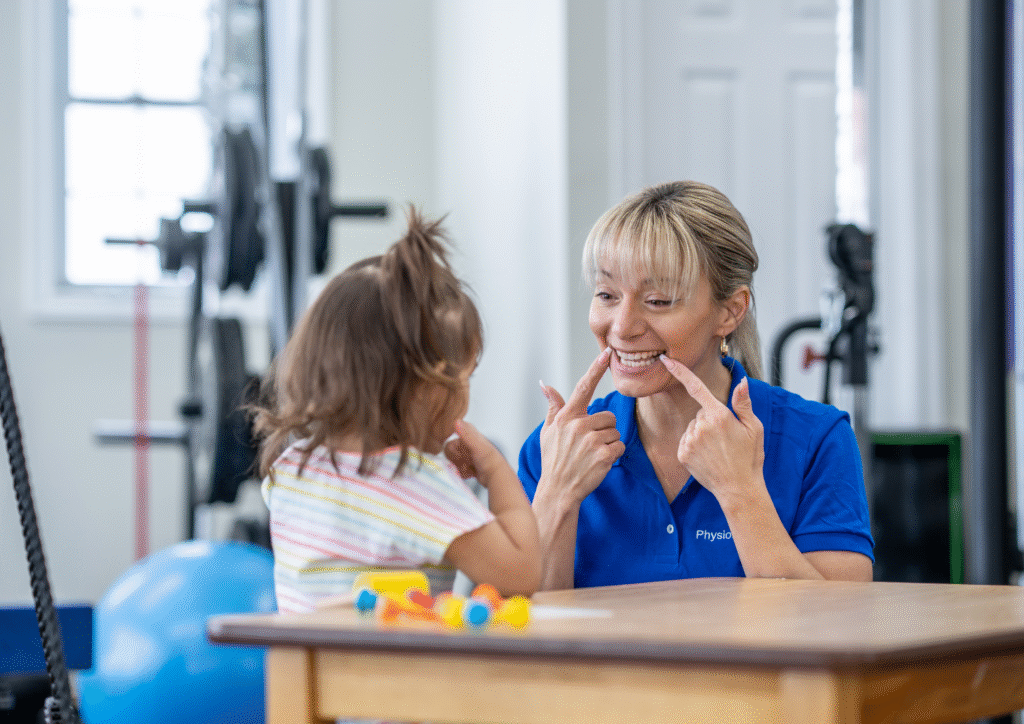
Encouraging your child to blow bubbles, whistle, or use a straw can go a long way in exercising the mouth muscles. Even making silly faces in the mirror, pretending to be animals, or licking yoghurt off the lips helps build control and awareness.
You don’t need special equipment or complicated exercises. Instead, turn snack time into a skill-building moment—biting into crunchy carrots, chewing on chewy foods, or sipping through a straw are all activities that engage the jaw and tongue. The goal is to blend development into your child’s routine so that progress happens naturally.
Important for speech: activities like blowing bubbles, using straws, and blowing cheek puffs are great for feeding/oral awareness, but they don’t improve speech sounds. For clearer speech, focus on practising real sounds and words in play (an SLT can show you which ones to target and how).
Point to note
ASHA clearly states:
“There is limited high-quality evidence supporting the use of oral motor exercises or sensory techniques in the treatment of paediatric feeding disorder–related sensory deficits and swallowing dysfunction in isolation” Paediatric Feeding and Swallowing.
Focus Activities: Musical instruments, complex food textures, pretend play with sounds
Expert insight and professional guidance
When to consult a specialist
If you’re unsure whether your child’s oral motor skills are on track, it’s always a good idea to speak with a speech-language pathologist. They can assess your child’s muscle tone, coordination, and movement patterns and recommend targeted exercises if needed.
According to the American Speech-Language-Hearing Association (ASHA) guidelines, early intervention can significantly impact the treatment of motor speech challenges and related delays. The earlier you identify a need and introduce the right supports, the better the outcomes tend to be. Search for a speech-language pathologist who uses evidence-based approaches rather than controversial nonspeech oral motor exercises.
However, even without a formal diagnosis, engaging in playful oral motor activities can still benefit your toddler’s overall development. They can also make your daily routine more engaging, silly, and full of bonding moments.
Red flags that warrant professional assessment
While home-based play is beneficial, some children may require additional support to develop their oral motor skills. Contact your paediatrician if your toddler:
Often gags on age-appropriate foods
Struggles to chew or swallow safely
Has persistently unclear speech beyond expected age
Avoids using their mouth during play
Shows extreme food texture aversions
Experiences frequent choking episodes
Demonstrates tongue thrust beyond 4 years
Has difficulty coordinating breathing while eating
They may recommend an evaluation or therapy to support more structured progress.
Creating an oral motor-friendly environment
Setting up for success at home
Your home environment plays a crucial role in supporting oral motor development. Here’s how to create spaces that encourage natural practice:
Kitchen setup:
Keep straws of various sizes accessible
Store crunchy snacks at toddler eye level
Have wipeable surfaces for messy play
Organise utensils for independent exploration
Play area organisation:
Dedicate a bubble station with different wands
Create a music corner with wind instruments
Set up a mirror at child height
Keep sensory bins with safe oral objects
Bathroom modifications:
Install a step stool for mirror access
Use fun toothbrushes with different textures
Keep cup options for rinsing practice
Add waterproof toys for bath bubble play
Incorporating technology and modern tools
Apps and Digital Resources
While hands-on play is irreplaceable, some digital tools can supplement your efforts:
Speech therapy apps with oral motor games
Video modelling for tongue and lip exercises
Timer apps for exercise duration
Progress tracking applications
Remember, screen time should complement, not replace, physical oral motor activities.
Nutrition’s role in oral motor development
Foods that build strength
Strategic food choices can naturally support oral motor development:
Jaw strengthening foods:
Raw vegetables (carrots, celery, bell peppers)
Whole fruits with skin (apples, pears)
Meat strips and jerky (age-appropriate)
Crusty bread and bagels
Tongue exercise foods:
Nut butters (spread thin for licking)
Lollipops and ice pops
Yoghurt and pudding
Sticky foods like raisins
Lip coordination foods:
Foods requiring pursing (noodles, string cheese)
Items needing precise lip closure (crackers)
Drinks through various straw sizes
Common challenges and solutions
Addressing typical concerns
“My toddler refuses to try new textures” Start with familiar flavours in new textures. Mix preferred foods with challenging ones gradually.
“We’re always rushed in the morning” Incorporate exercises during car rides or while waiting. Even 2-3 minutes helps!
“My child gets frustrated with exercises” Make it sillier! Turn exercises into games and let them lead sometimes.
“I’m worried we’re not doing enough” Quality over quantity—consistent daily practice of even 5 minutes is valuable.
Tracking progress and celebrating wins
Monitoring development
Keep a simple log of:
New sounds mastered
Foods successfully tried
Improved clarity in words
Decreased drooling
Better mealtime behaviours
Celebrate small victories – every bit of progress counts!
Looking ahead: long-term benefits
Helping your child build strong oral motor skills doesn’t have to feel like a therapy session. With a little creativity and consistency, everyday moments can turn into powerful opportunities for growth. Whether you’re making silly faces at the dinner table or encouraging your toddler to blow out pretend birthday candles, you’re doing more than just playing—you’re helping lay the foundation for lifelong skills in speech, feeding, and communication.
The investment you make in oral motor development today pays dividends in:
Academic success through clear communication
Social confidence in peer interactions
Healthy eating habits and nutrition
Strong self-advocacy skills
Reduced need for future interventions
Frequently asked questions
What are oral motor exercises for toddlers?
They’re playful activities that build feeding-related awareness and control around the lips, tongue, jaw, and cheeks—think bubbles, silly faces, crunchy foods, straws, and sound play. Note: current research does not support these activities for improving speech sounds; for speech clarity, children need to practice real sounds/words (ideally with guidance from an SLT).
At what age should I start oral motor exercises with my child?
You can begin simple oral motor activities as early as 6-12 months with age-appropriate exercises like offering textured foods and encouraging babbling. More structured exercises typically start around 12-18 months when toddlers can follow simple directions and engage in purposeful play. Always match activities to your child’s developmental level and interests.
How often should my toddler do oral motor exercises?
Ideally, incorporate oral motor activities into your daily routine rather than scheduling separate exercise sessions. Aim for 5-10 minutes of focused activities 2-3 times per day, but remember that many everyday activities like eating, drinking, and playing naturally provide oral motor practice. Consistency matters more than duration.
What are signs my toddler needs oral motor therapy?
Signs include persistent drooling beyond age 2, difficulty transitioning to solid foods, unclear speech beyond typical developmental stages, frequent gagging or choking, extreme aversions to certain food textures, an open-mouth posture at rest, difficulty using straws or cups, and tongue thrust beyond age 4. Consult your paediatrician if you notice multiple concerns. Most children have completely lost the tongue thrust reflex by age 4 or 5″ Tongue Thrust: Signs, Causes & Treatment and “It naturally fades by age 4 or 5” How Can Tongue Thrust Affect Speech? How It Can Be Treated – Atlanta Health Partners Paediatric Referral Directory.
Can oral motor exercises help with picky eating?
Yes! Oral motor exercises can help picky eaters by improving their ability to manage different food textures, increasing oral awareness, reducing sensitivity to new sensations, and building confidence with chewing and swallowing. Start with play-based activities before introducing challenging foods to reduce mealtime pressure.
What’s the difference between oral motor exercises and speech therapy?
Oral motor exercises focus specifically on strengthening and coordinating the physical muscles used for speech and feeding. Speech therapy is a broader field, addressing language development, articulation, communication strategies, and cognitive-linguistic skills. Oral motor exercises are often one component of comprehensive speech therapy.
Are there any risks to doing oral motor exercises at home?
When done appropriately, oral motor exercises are safe. However, avoid forcing exercises if your child is upset, never use items that pose choking hazards, respect your child’s comfort level, and stop if you notice signs of fatigue or frustration. Always consult a professional if you’re unsure about a specific exercise.
How can I make oral motor exercises fun for my resistant toddler?
Turn exercises into games, let your toddler choose activities, use favourite characters or toys as models, incorporate exercises into pretend play, offer rewards and praise, make it a family activity, keep sessions short and positive, and follow your child’s lead. Remember, if it’s not fun, it’s not sustainable!
What everyday activities naturally promote oral motor development?
Many daily activities support oral motor development: singing songs, brushing teeth, eating varied textures, drinking from different cups, blowing nose, giving kisses, making animal sounds, laughing and talking, chewing gum (age-appropriate), and playing wind instruments. These natural opportunities are just as valuable as structured exercises.
When should I see improvements from oral motor exercises?
With consistent and playful practice, you may notice small improvements in feeding comfort and participation within 2–4 weeks. Bigger shifts in feeding confidence usually take longer. For speech clarity, progress depends on practising specific sounds/words, an SLT can guide you on what to target and how.
Remember, you’re not alone in this journey. Every parent questions whether they’re doing enough for their child’s development. The fact that you’re reading this and seeking ways to support your toddler’s oral motor development indicates that you’re already on the right track. Keep it playful, stay consistent, and celebrate those small wins – they add up to big achievements!
*Collaborative feature post*
Caring for disabled children: tips for raising superstars
The beauty and the challenge of parenting means you often have to think on your feet and adapt your style according to your child’s needs. Some children might need more specific parenting adaptations and that can be tricky, especially if you’re not prepared.
However, these challenges often bring out extraordinary resilience and creative problem-solving skills. In every sense, you’re well on your way to becoming the best parent your child could ask for. So, below are some tips on caring for disabled children and raising superstars!
Understand the disability
One of the first things you should do is understand the specific disability your child has. You can regularly consult with therapists, doctors and specialists to ensure you’re up to date with care techniques and other necessary interventions.
Build a nurturing environment
A home isn’t just a dwelling, it’s a space, a playground, and a classroom all rolled into one. Below are some tips on how to build your environment around your child.
Adapt your home and travel
Ensuring your home is accessible is essential. Consider adaptations like wheelchair-friendly ramps, safety gates, or sensory-friendly spaces. Just as you tailor your home environment for ease and comfort, the same should apply to your travel arrangements too.
There is the option to hire a mobility car from Allied Mobility that can transform routine family outings and school runs. Their wheelchair accessible vehicles are widely available and give you the freedom and flexibility to go where your family adventures take you without restrictions.
Structured routines
Maintaining a consistent routine can provide comfort, control, and predictability in an otherwise very unpredictable world for your child. Below are some tips on how to create realistic routines that work for your child’s needs.
Start with the basics
Start with the basics like setting regular waking times, mealtimes and bedtime hours. These set times can help with any sensory or sleep issues. Then you could consider creating visual schedules using pictures or icons, especially for children with communication challenges.
Plan regular meals and snacks
You could create a structured eating schedule which can prevent hunger-induced meltdowns and maintain energy levels. If your child has any dietary needs or sensory aversions, you can incorporate these into the meal plan.
Incorporate therapy and medication
Incorporate therapy and medication into your routine by creating a checklist or chart to track the sessions/doses.
Allocate time for physical activity
Allocate some time for physical activity, depending on your child’s abilities. You can include light exercise, outdoor time or specific physical therapies in the routine. Activities like swimming, walking or adaptive sports can be beneficial.
Designate quiet/rest times
Periodic breaks can help children reset and avoid overstimulation. This is especially crucial for those with sensory processing disorders or ADHD.
Include educational activities
If your child goes to school, then you can create routines around homework and study times. For home-schooling/remote learning, create an educational timetable and break the tasks into manageable chunks, with breaks in between.
Consider games at home which develop the brain and encourage creativity.
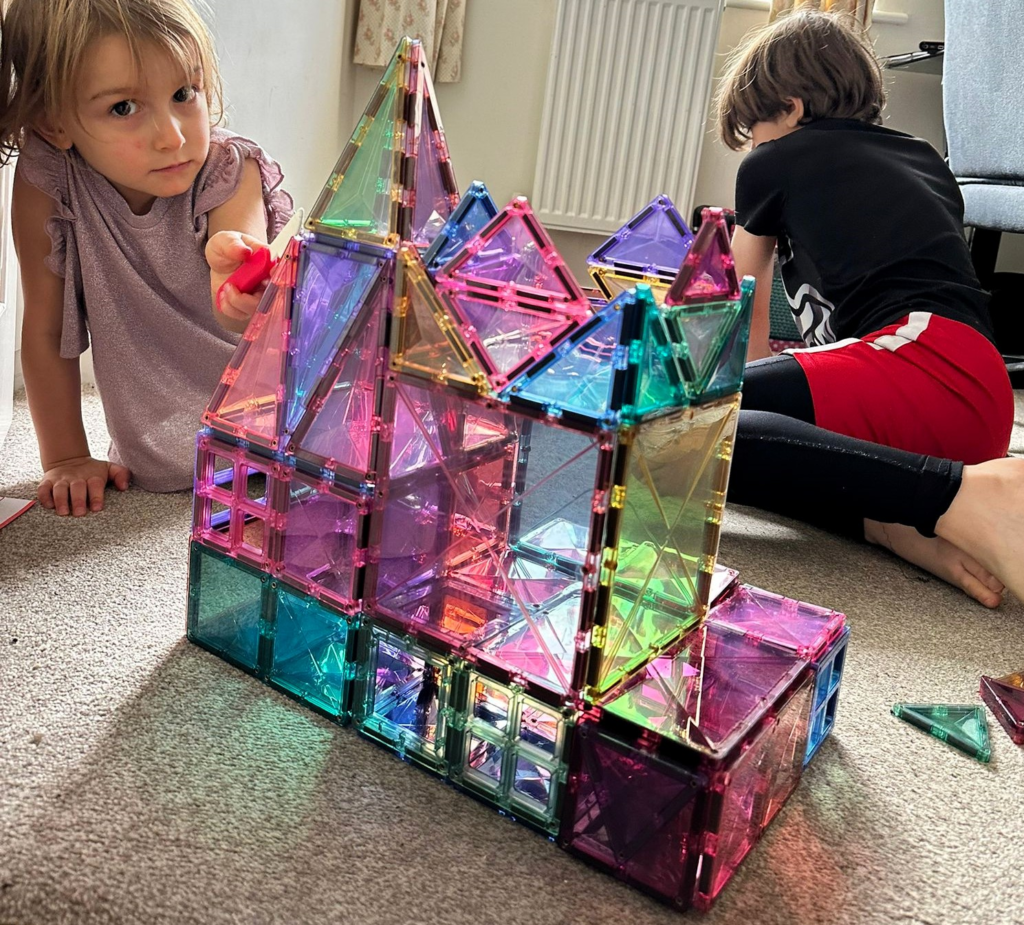
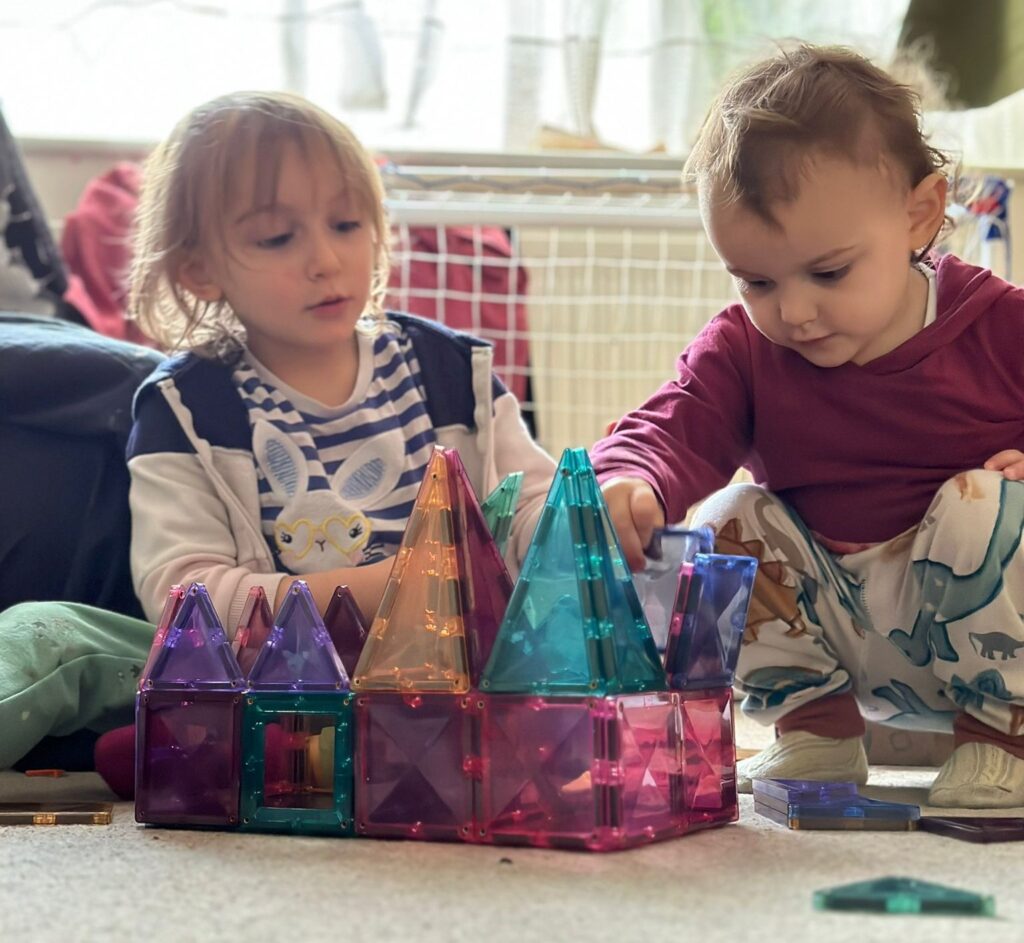
The Connetix Pastel Creative Pack* is a fantastic toy that helps kids have fun while they learn. This pack has 120 pieces in soft, pretty colours that are perfect for building all sorts of things like big castles, cool rockets, and tall towers. Playing with these pieces is not just fun; it’s also good for the brain! Kids can play alone or with others, and while they play, they learn about science, technology, engineering, art, and math (STEAM).
Building with these pieces is also great for little hands and bodies, helping children get better at moving and controlling what they do. They will also learn to solve problems and keep trying even when building gets tricky. This toy grows with your child, getting more fun as they learn and can build bigger and better things.
Here are some cool things about the Connetix Tiles:
Kids can use their imagination to make anything they dream up.
Playing with the tiles helps with coordination and using hands and fingers.
It’s a fun way to learn about different subjects like science and math.
Kids learn to think about how to fix problems and to keep going when things are hard.
The tiles can be used in so many ways, so kids never get bored.
Building with tiles also helps kids understand space and shapes.
The magnets in the tiles introduce kids to how magnets work, which is part of learning about science.
This Connetix Pack is a great way for kids to have a good time while they’re also learning important skills. The price for this set is £115, and it’s available from Connetix.
Schedule social interactions
Create opportunities for your child to socialise via playdates, group therapies, or other inclusive activities.
Incorporate free time and wind down time
Unstructured play is very important, so allow your child to choose their activity and foster their independence and decision making. Then you can establish a calm bedtime routine that could include some reading, light music or relaxation techniques to signal the body it’s time to rest.
Routines are essential, but it’s also equally crucial to adapt where you can if something isn’t working or causing stress. Observe your child’s cues as they’ll often show where in the routine it isn’t working or when it needs some tweaking.
Involve them in the routine as they grow and develop and let them have a say. This encourages autonomy and a sense of control. Communicate the routine continually throughout via visual aids like schedules and apps. Timers can also be very useful.
Remember consistency is key for a routine to work, but every child is different, so keep the routine flexible with room for growth and tweaks when needed.
Promote inclusive activities
Integrating your child into the ‘real’ world is massively important for their personal development. You can do this by enrolling them in group activities or classes which encourage social interaction and physical activity, as mentioned above.
Work closely with educators and schools to make sure your child is included in activities too. This is very important as your child should not be discriminated against if they can take part.
Strengthen your child’s emotional wellbeing
Your child’s mental health is integral to their overall development. Here are some tips on how to strengthen your child’s emotional wellbeing.
Create open communication
No question is too big or small. It’s vital to create an open dialogue with your child about their disability, answering any queries, so they can understand and process.
Use simple language and encourage your child to express their feelings and concerns. Have patience and be honest with them about their strengths and weaknesses. By making disability a part of normal conversation, you foster understanding and acceptance in your child’s mind. Just remember, it’s fine not to have all the answers. The only thing that matters is that you’re making the effort to communicate with them.
Offer therapeutic outlets
Therapies such as art, music and equine therapy can offer that much-needed extra emotional support, alongside a nurturing environment at home.
Understand your rights
Depending on the country you live in, you will have various laws and regulations protecting you and your child. In the UK, the Equality Act 2010 offers support for parents of a disabled child and ensures that disabled individuals, including children, are not discriminated against in areas including education, employment and accessing services. We’ll go through some of yours and your child’s rights below.
A right to education
Every child has a right to an education suitable for their needs. If your child has SEN, then they may have or apply to have an Education, health and Care Plan (EHCP), which details the support your child should get. You have a right to request an EHC assessment, although the waiting list in the UK is long.
Most children with SEN can attend mainstream schools, but there are also special schools tailored to their needs.
Health and social care
You may request an assessment of your child’s health and social care needs. If the local council agrees you need services, you may ask for direct payments to buy those services yourself.
Financial support
You can claim Disability Living Allowance (DLA) for your child under 16 if they have mobility issues and need extra care. You can also claim Carer’s Allowance if you spend at least 35 hours a week caring for your child. Look on the government’s website for more details on the benefits and how to claim.
Transport support
Some local councils provide free support for disabled children to and from school.
Respite care
You may request respite care, which provides a short-term break from caring duties. This can be at home, a day centre, or in overnight accommodation.
Participation and decision-making
You may be involved in decisions about services that affect your child. This includes discussions about health, education and social care plans.
Support for carers
Local authorities are required to assess the needs of carers who might need support in their caring role. If you meet the criteria, you may receive services or financial assistance to help look after your child.
You also may make complaints if you are unhappy with the service or treatment your child receives, as all agencies working with your child may safeguard and promote their welfare. This includes protecting them from bad treatment, and making sure they receive safe and effective care so they have the best chances in life.
Don’t forget that your child’s personal data, which includes medical records and school reports, are protected by the Data Protection Act, which means they must be kept confidential and can only be accessed by those with a legitimate reason.
Foster independence
Invest in adaptive tools like communication devices, mobility aids or specially designed utensils that can help your child perform their tasks independently. Regularly assess their abilities and work with healthcare professionals, teachers and therapists to understand what these tools would be. Some charities offer financial help on investing in tools to use at home.
Set achievable milestones for things like learning a new skill or taking on a household chore and encourage your child to make choices in selecting their own clothes, meals or activities. This promotes autonomy and builds on those important life skills.
The UK has many organisations and charities that provide training and programs to support disabled children in becoming more independent. Examples include the National Autistic Society and Scope.
Financially plan your journey
Looking toward the future may seem daunting, but it’s an essential part of being a proactive parent. Whether it’s setting up a savings account for your child’s education, or planning for potential changes in your child’s physical needs, forward-thinking is crucial.
Planning your medical care, therapies and other necessities in the long-term will help you budget and plan your finances accordingly. Learn about financial supports for children with disabilities and explore grants, scholarships and assistance programs available for disabled children.
Practice self-care
Caring for disabled children can be emotionally and physically taxing, so taking time for yourself can help you get that much needed respite to boost your wellbeing. Look into support groups and/or counselling to help with managing daily duties. Carers have access to adult wellbeing services, but it’s important to speak to your local council to see what kind of support is available for you.
Celebrate every milestone
Every achievement, large or small, is a testament to not only your child’s resilience but to your unwavering support. Always celebrate your milestones by using prompts or capturing memories via a journal, an achievement board or pictures and videos and go easy on yourself. You’re doing the best you can and minor setbacks are temporary.
Stay updated with new resources on caring for disabled children
Continuously update yourself on the latest research, therapies and technologies that might benefit your child and stay on top of the support available for you too. Every little bit helps to keep going.
As hard as it is to parent children with additional needs, it’s important not to compare your unique journey with others. With a whole lot of patience, understanding and love, you can embrace the sometimes arduous but rewarding journey with your child and cherish every moment you have with them when raising your superstar. You are their safe space, so treat yourself as special too. Because you are!
FAQ
What are the 3 challenges parents face with a special need child?
Raising a child with special needs presents a unique set of challenges, and while every family’s experience is unique, there are some common challenges many parents face, particularly in the UK. Here are three such challenges:
Access to education and support in school
Even with the UK’s Special Educational Needs and Disability (SEND) system in place, parents often struggle to receive the right support for their child in mainstream schools.
Obtaining an EHCP can be a lengthy and bureaucratic process, and not all children who need support will qualify for one.
There might not be enough specialist schools or places available, resulting in children sometimes having to travel long distances or attending a school that might not be the best fit for their needs.
Navigating health and social care services
Getting an initial diagnosis for a child’s special needs can be a long process, with families often facing long waiting times. This delay can prevent children from accessing the services and support they need at crucial developmental stages.
As children grow older and transition from child to adult services, there can be gaps in care or reduced support, which can be challenging for families.
Once a diagnosis is given, parents may feel lost or isolated, not knowing where to go next for advice, support, or therapeutic services.
Social and emotional challenges
Parents might feel isolated because of a lack of understanding or stigma from others about their child’s needs. This can lead to reduced social interactions and support.
Caring for a child with special needs often involves extra expenses, from specialised equipment to therapy sessions, which can place a financial burden on families.
The continuous advocacy, combined with daily caregiving tasks, can lead to physical and emotional exhaustion. Parents may also grapple with feelings of guilt, worry, or grief related to their child’s diagnosis.
While these challenges exist, many parents of children with special needs also speak of the unique joys, insights, and deep connections that come with their parenting journey. And, many organisations and support groups exist in the UK to assist families in navigating these challenges.
What are the benefits for parents caring for a disabled child?
In the UK, parents or carers of disabled children have access to a range of benefits and support services. The available assistance helps reduce the financial strain and offers respite resources, so families can lead a more manageable life. Here is a general overview of some of the benefits available:
Disability Living Allowance (DLA) for children: This is a tax-free benefit for children under 16 to help with the extra costs caused by long-term health conditions or disabilities. There are two components – a care component and a mobility component – and the child might be eligible for one or both.
Carer’s Allowance: If you spend at least 35 hours a week caring for a disabled child who receives the highest or middle-rate care component of DLA, you might be eligible for this benefit.
Carer’s Credit: This is a National Insurance credit that helps with gaps in your National Insurance record, ensuring that you can still qualify for certain benefits and the State Pension.
Council Tax Reduction: Depending on your circumstances, you might get a reduction in your council tax. For instance, if you have an extra room or a space for the child because of their disability, or you’ve had to make modifications to your home.
Blue Badge Scheme: This scheme provides special parking privileges for families with children who have severe mobility problems.
Direct Payments: These are given by local councils to help you arrange and pay for your own care instead of receiving them directly from the local authority.
Short breaks and respite care: Many local authorities provide schemes offering parents and carers of disabled children a break from their caring responsibilities.
Sure Start Maternity Grant: If you’re expecting a baby or have given birth or adopted a baby in the last 6 months, and there’s no other child under 16 in your family, and you or your partner are receiving certain benefits, you might be eligible for a one-off payment of £500.
Free NHS prescriptions and dental treatment: If your child receives the DLA or is named on a valid NHS tax credit exemption certificate, they may be eligible.
Educational support: Disabled children might also receive additional support in school settings through an Education, Health and Care Plan (EHCP).
Home adaptations: Grants like the Disabled Facilities Grant might be available to help make changes to the home to make it more accessible.
This is not an exhaustive list, and there may be other region-specific benefits or schemes available. The rules, eligibility criteria, and specific benefits can change over time. Therefore, it’s essential to check with local authorities, the Department for Work and Pensions (DWP), and relevant charities or organisations for the most recent and comprehensive information about available assistance.
How much is carers allowance for disabled child?
Currently carer’s allowance is offered in three components; lowest, middle and highest rate. The current rates are below:
Care component
Weekly rate
Lowest
£26.90
Middle
£68.10
Highest
£101.75
How does a nursing shortage affect families with disabled children?
A nursing shortage can have a broad range of implications for healthcare delivery. There may be decreased access to specialised care, increased wait times, overburdened nurses and increased financial strain on families who might need private nursing care or therapy because of the public system’s inadequacies, which leads to higher out-of-pocket expenses.
There may be limited respite care and increased emotional stress as well as potential burnout for family caregivers.
Given these challenges, it’s essential for healthcare systems and policymakers to address nursing shortages proactively. Strategies can include increasing educational opportunities for nursing, offering incentives to work in underserved areas, and promoting the profession to ensure a steady supply of qualified nurses in the future.
So how do you handle adult children who can’t take care of themselves due to social anxiety and bipolar disorder?
Handling adult children who struggle with significant mental health challenges such as social anxiety and bipolar disorder requires compassion, understanding, and proper medical and therapeutic intervention. Professional treatment, psychiatric evaluation and therapy are important to manage BP and SA symptoms.
A regular, predictable routine is important for people with BP to reduce unpredictability and chaos from manic or depressive episodes.
As a carer, you should educate yourself and learn more about how to offer understanding and support. There are many resources, both online and offline, to help you understand these conditions better.
Each individual’s needs will vary, so it’s crucial to adapt this guidance to your child’s specific situation. Working closely with professionals and therapists will ensure you’re taking the most effective steps to support and care for your adult child.
*Collaborative feature post*
*This product was gifted for a review, but all thoughts are 100% our own
How to spot the signs of low self-esteem in your child
*This post and the subsequent posts in the series are sponsored by Mindscreen – an online mental health and wellbeing tool which guides children towards higher self-esteem, at home or in the classroom.*
Over the past 30+ years, it has become increasingly clear that kids’ mental health disorders are on the rise. This generation’s children are experiencing an upsurge in low self-esteem, depression and anxiety because of the negative effects of our current climate, i.e. excessive social media use, gaming, cyberbullying and, recently, the pandemic’s lockdown (amongst other environmental factors).
One can argue that 30 years ago we simply didn’t have the resources or the knowledge to diagnose and manage mental health disorders early in children. However, we still find that mental health problems are often under-recognised, overlooked and under-treated.
Identifying any form of mental health disorder as early as possible allows for more time to manage that disorder and even reverse its effects before the child heads into adulthood.
Severe and persistent behavioural problems starting before secondary school years, which go unsupported, can have a long-term impact on children’s mental health and life chances.
But how do mental health issues present themselves in children?
There are a range of low self-esteem symptoms to look out for that may signify your child’s mental health is out of whack, and these can span from subtle personality traits to extreme medical disorders, depending on the length and severity. Some mental health disorders don’t present themselves at all until later into childhood and can either be exacerbated by the child’s environment or an undiagnosed medical condition – or both. We will go into what these symptoms are a little later.
What is low-self esteem in children?
In this article, we will concentrate on environmental factors that may cause low self-esteem, low confidence, anxiety and depression in children, rather than medical factors (for example, ADHD and ASD) which is outside the scope of this article. However, the tips displayed below can help to manage certain medical traits too, but you would need to discuss management steps with your medical provider first.
Self-esteem, simply put, is the opinion we have of ourselves. If our self-esteem is high, then we have a more positive outlook on ourselves and life in general. If our self-esteem is low then we tend to become self-critical, have negative thoughts and are less able to take on the challenges life throws at us.
What causes low self-esteem?
Low self-esteem often begins when you are a child and stems from the environment and people in which/whom we surround ourselves, for example, our parents, siblings, friends, teachers and the news/media, wherein they continuously fire positive and negative messages at us. And if a particular message resonates with us, whether it be positive or negative, it can influence our self-esteem.
If a child is constantly praised for having a good work ethic, which is classed as a positive message, then they would likely adopt a positive outlook on themselves which are signs of high self-esteem. However, if a child’s intelligence is criticised, then this is classed as a negative message and could impact the child’s self-esteem.
If the child constantly receives the message they’re not good enough, then over time their self-esteem will be impacted, and this mantra often stays with them until adulthood. As a result, the child finds it difficult to take on challenging obstacles in life because they think they’re not good enough to overcome them.
You are who you hang out with
My granddad used to always say the above to me. What he really meant was that if you hang around with ambitious people, you become ambitious. If you hang around with confident people, you will become confident. If you hang around critical people, you will become critical of yourself.
While this is not 100% gospel, there may be some truth to it. As the saying goes:
“Toxicity breeds toxicity.”
If the person who is a constant in your life is continuously negative about themselves and you, you will eventually become negative and it will affect your self-esteem if you cannot break away from the ‘chain’ and ‘see the light’ so to speak. You will continuously keep comparing yourself with others and find a way to feel like you’re lesser than, even if it’s not actually the case. But, as an adult, we have the benefit of life experience which can give us the strength to break away from the toxicity and make our own choices about ourselves, keeping our self-esteem intact.
A child who is surrounded by people who are negative will more likely have their self-esteem affected because they are like sponges and soak up the traits and characteristics of the people they encounter every day. Plus, children do not have the benefit of life experience and will most likely take what people say as gospel.
Environment affects self-esteem too
Environmental situations like life events, serious illness and bereavement can also often have a negative impact on self-esteem. My boys were, naturally, very affected by my late miscarriage back in 2017 and as a result, they are very overprotective over their baby sister, who was born in 2019. Poppy’s death made the boys anxious about losing their sister, which caused them to lack confidence, despite myself and my husband constantly reassuring them they’re doing a great job in protecting her.
Of course, their sister’s birth was a positive event after such a negative chapter in our lives, and so, therefore, even though they are anxious at losing their sister, their self-esteem is boosted every time we praise them for being so protective. So over time, they are less likely to believe their sister will go away.
It just goes to show how the environment can drastically change around us and our self-esteem is constantly taking a hit as a result.
We find it tough. Imagine how our children feel.
Personality
Some people are just born worriers or can’t help but be more prone to negative thinking. Others set impossibly high standards for themselves or have a fear of failure and therefore are too scared to try in the first place. In this instance, they require more assistance in overcoming their worries, which tend to be unfounded and not based on any actual negative circumstance.
But how do you spot the signs of low self-esteem in a child?
As I’m no psychological expert or a medical doctor, but I am indeed a doting parent, I am going to enlist in the help of Mindscreen to figure out if my boys (aged eight and nine years old) have any issues with their self-esteem and if so, how to overcome low self-esteem using the tips and techniques supplied.
But, first. What is Mindscreen?
Mindscreen is an online programme built for 11- 16-year-olds (younger and older children can use the online tools if they can follow the questions and lesson plans) which helps children to recognise their skills, interests, talents and strengths. Mindscreen also provides parents with step-by-step tools and guides to support children to develop their mental health and wellbeing as well as resilience and confidence at school through to adulthood.
Instances of low self-esteem, anxiety, and depression in children are increasing and support services can’t cope. The good news is world leaders are aware of the challenges but we all know that a ship like the Titanic is slow to turn, meaning it could be years before high-level policy change filters through into our everyday lives… Our Mindscreen experience® toolkit for parents and teachers will help you support your children to develop their self-esteem and unlock their potential.
Gav Devereux, Founder of Mindscreen
But every child is different
Indeed!
Which is why it’s important to work out what your child’s motivation is first. And, by motivation I mean, what drives your child? What makes them happy and what causes negative feelings in them? Are they natural worriers or sensitive souls (my middle one) or do they remain nonchalant in the harshest of crises (my eldest)?
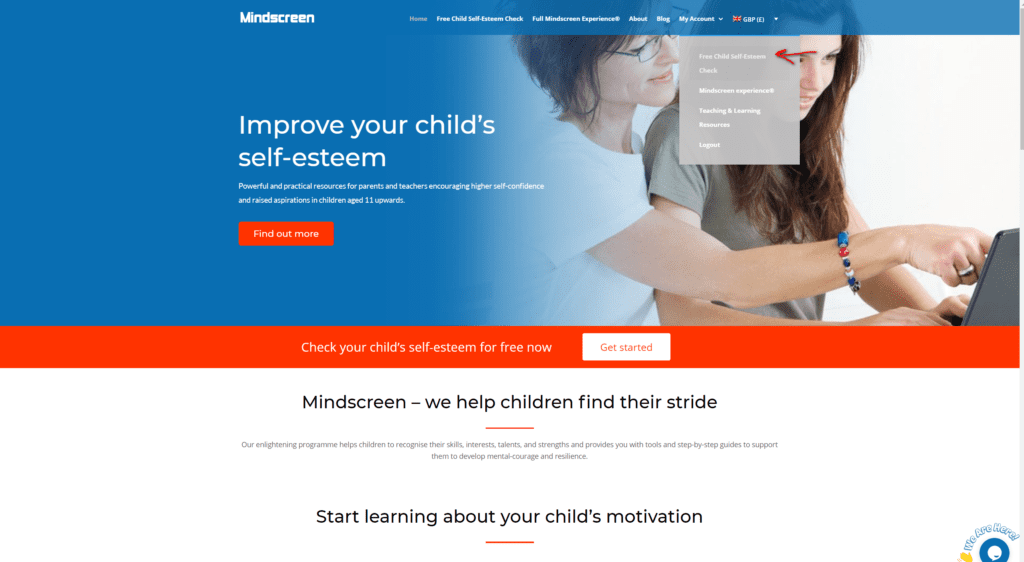
Mindscreen offers a tool called the FREE SELF-ESTEEM CHECK, which is a low self-esteem test and contains 36 quick-fire questions that you answer on behalf of your child, to help you identify any signs of anxiety, low self-esteem and depression.
You will be taken to a private dashboard where you can enter the details of your child’s first name and assess your child straight away to check how their self-esteem is doing. Each time you assess a child you will get a report giving you an insight about their self-esteem level.
The check is free. Your child is priceless!
Mindscreen
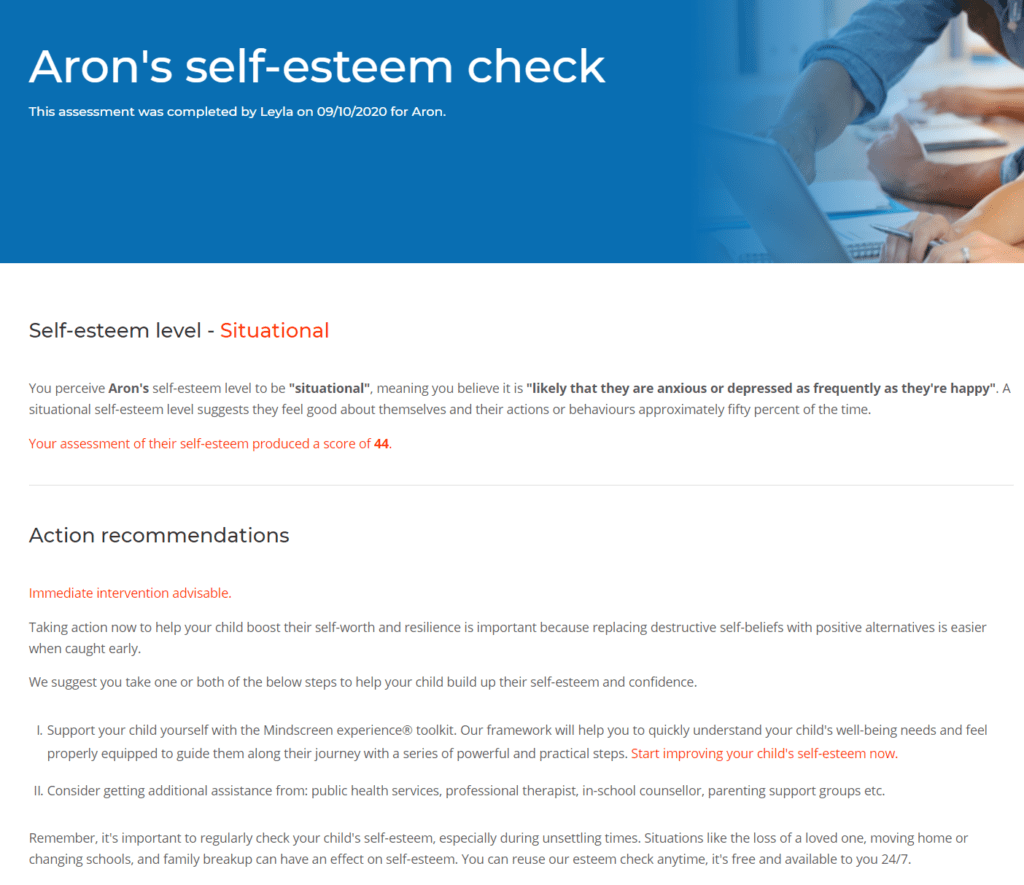
As mentioned, I am going to assess both my boys’ (Aron and Aidan) self-esteem, and as I’ve already filled out the FCSEC assessment for Aron (results below), I will go through the FCSEC with you for Aidan (I’m about halfway through).
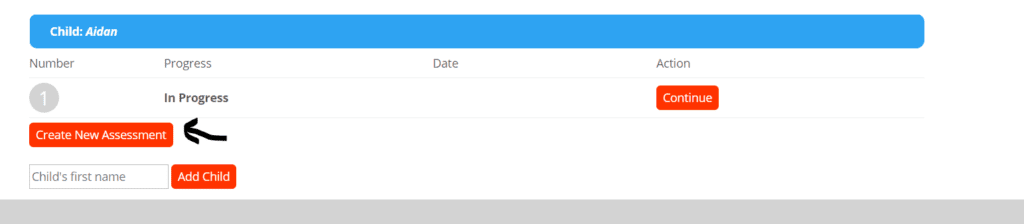
Click on ‘Create New Assessment’ in red to start the check and then click on ‘Continue’
You get 36 questions where you will select the answer that best describes your child for each question. The FCSEC constantly reminds you to keep asking yourself:
“Do I see these reactions often, do they occur only occasionally or not at all?”
Aron’s and Aidan’s report was the same:
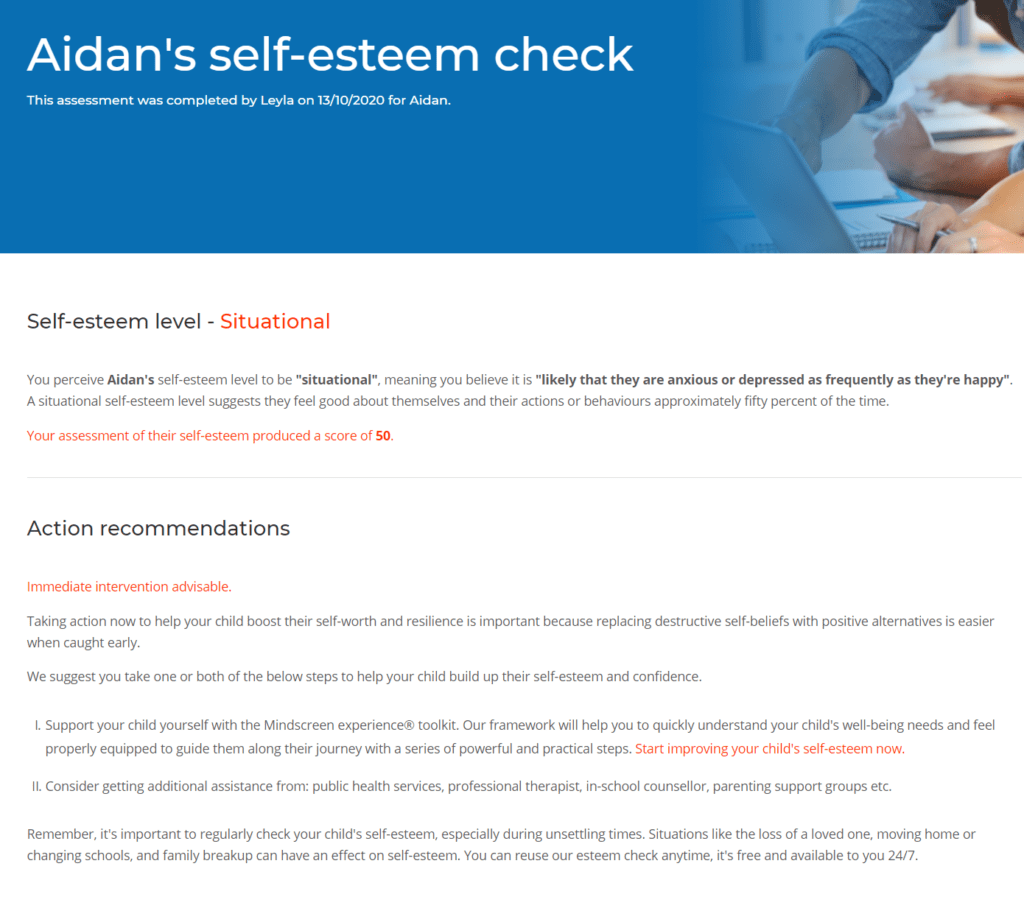
Aidan scored more than Aron with 50 against Aron’s 44. This means that, on paper, Aidan has lower self-esteem than Aron, which I thought would have been the other way around!
However, as both boys’ self-esteem levels were ‘SITUATIONAL’ this meant that:
They are anxious or depressed as frequently as they are happy.
The results from both reports advised that we as parents should intervene immediately and take action to boost our children’s self-worth and resilience with positive alternatives as soon as possible.
I was quite disheartened at reading the results because I have tried everything in my power to make sure my kids are happy and enjoy healthy living all the time. However, I have quickly come to learn that you cannot control their mindset 100% of the time and I am aware that environmental factors can skew our children’s mental health. So I’m glad I have caught it early and I am fully on board to take the necessary steps to develop my children’s self-esteem right NOW.
So, the first step is to take the full Mindscreen Experience® using the Mindscreen experience® toolkit, which is designed to equip you with powerful steps to improve your child’s self-esteem as soon as possible.
The other additional option, which you can take on its own or with the Mindscreen Experience®, depending on the severity of your child’s self-esteem, is to seek additional assistance from public health services, a professional therapist, in-school counsellor and/or parenting support groups.
What are the signs in your child which may indicate low self-esteem?
Is/does your child:
Apathetic and de-motivated?
Have less interest in things they used to like?
“Doubt” themselves?
Appear sensitive about other people’s opinions of them?
Make excuses or blame others a lot?
Behave inferior to others?
Unaware of themselves, their skills, strengths, wants and needs?
Unaware of how their words or actions affect others?
Use “inadequate” language when talking about themselves?
Worry a lot?
Seem unhappy?
Seem lonely?
Seem ashamed of themselves?
Appear anxious?
Withdrawn?
Have exaggerated emotional reactions to ordinary situations?
Have sudden outbursts?
Have unexpected contrasting mood swings?
Have trouble sleeping?
A change in their eating habits or weight?
Seem agitated, irritable or angry?
Disbelieve praise?
Defensive when confronted?
Appear uncertain and indecisive?
Overly apologetic?
Insecure?
Unhappy with their body size/shape?
Always on social media?
Had any negative statements posted about them on social media?
Have any unexplainable bruises/scratches?
Less interested in their personal hygiene/appearance?
Less interested in going to school or studying?
“Hiding away” from the world?
Have low expectations of themselves?
Dislike themselves, who they are and how they behave?
Avoid trying or they give up/give in too easily?
If your child frequently or always displays some or all of the above signs for low self-esteem then you should take action now to help your child boost their self-worth and confidence using the Mindscreen experience® toolkit.
What is the full Mindscreen Experience®?
For this article and subsequent articles in the series, we are going to go through the full Mindscreen Experience® and take the required steps to develop your child’s needs, interests, and behaviour by inviting them to complete the full programme.
The full Mindscreen Experience® will unlock tools and guides along with enhanced insights about your child’s characteristics and include practical resources to grow their self-awareness, confidence and resilience.
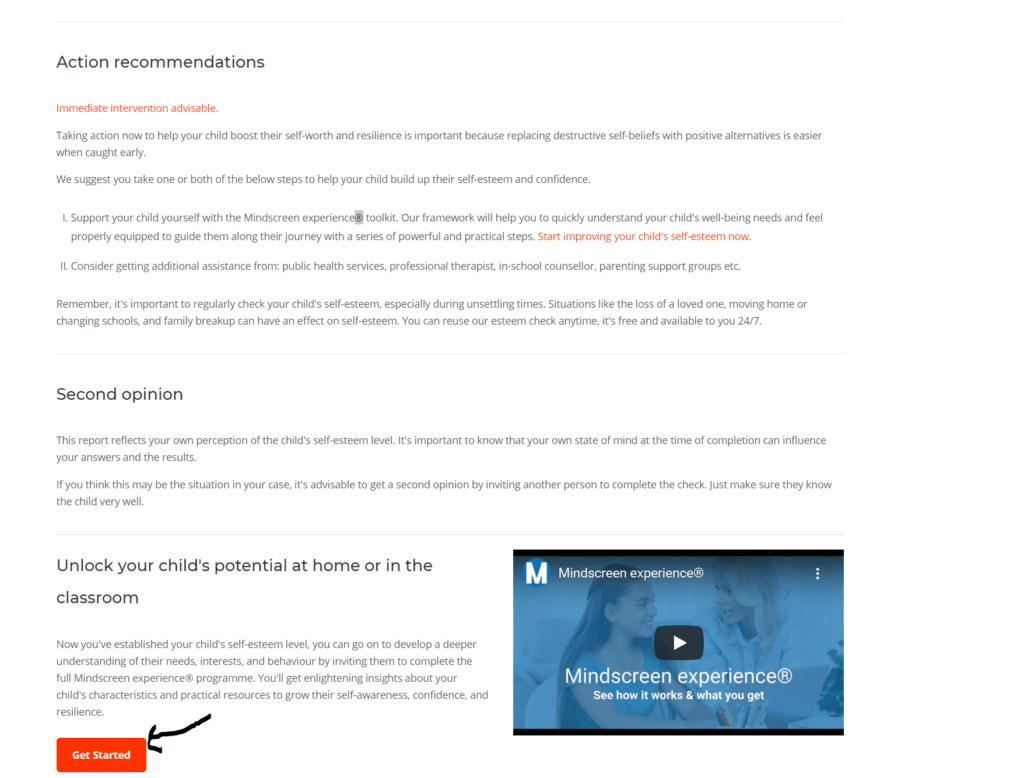
Once you have completed the FCSEC and you’re on the results page, head to the bottom of the page and click on ‘Get Started’:
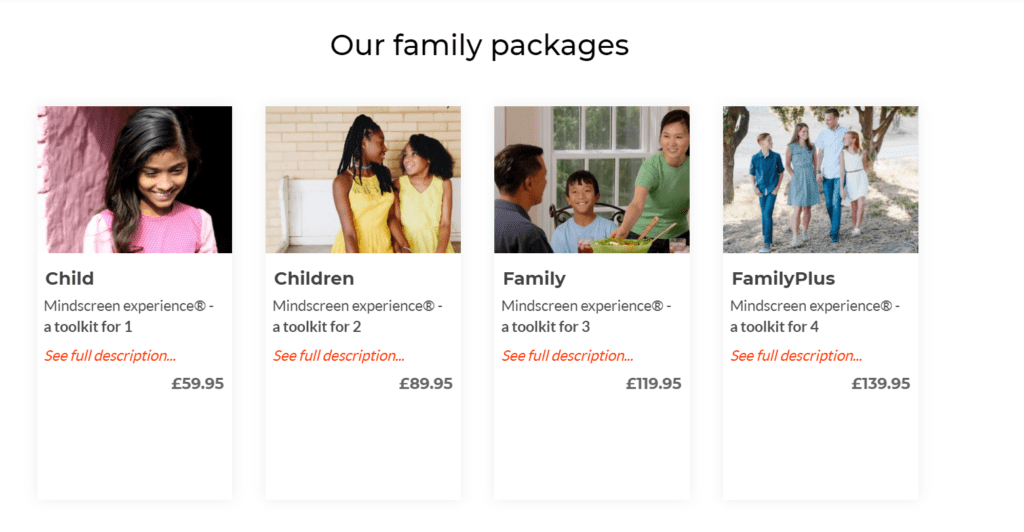
You will be invited to choose your packages which are designed for families and teacher class groups.
Mindscreen kindly gifted us the FamilyPlus package which invites both my husband and I as well as our two children to complete the full Mindscreen experience® together and compare our results.
What do you get in the FamilyPlus Mindscreen Experience® package?
B. Smart, easy-to-use tools and lesson plans for you to help your children to:
Build their self-awareness
Develop their self-esteem & self-confidence
Choose study & career pathways they’re more likely to enjoy
Determine what their goals & aspirations are
Unlock their potential
C. A way for you to measure improvement in your children’s level of confidence over time.
Click on the video below to learn more about how the Mindscreen experience® can help you and your children. It’s useful to complete your own Mindscreen experience® as a parent as you’ll be able to see how you differ from your children and adapt to their individual needs.
https://youtu.be/zimId5IPTG4
Let’s get started with the FamilyPlus Full Mindscreen Experience®!
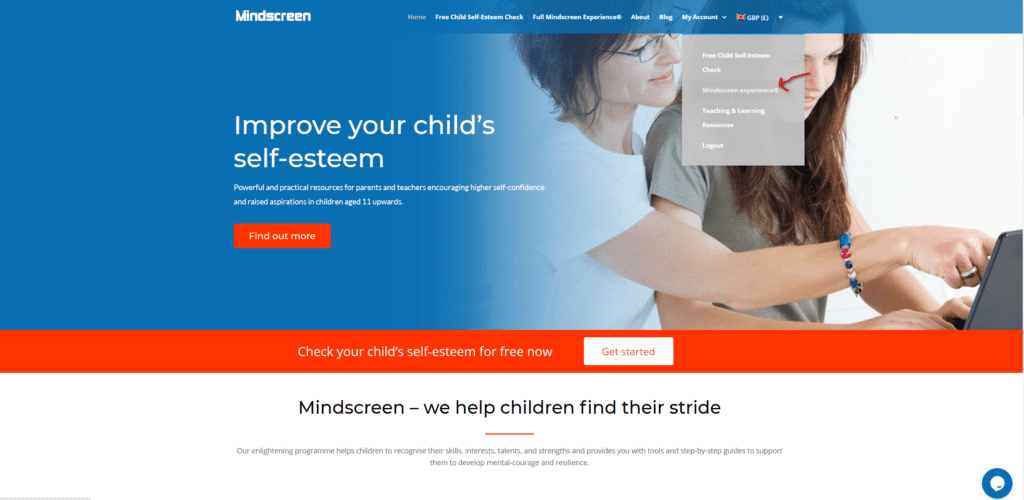
So, once you’ve selected your package (in our case we selected the FamilyPlus package) head over to your account and select Mindscreen Experience®
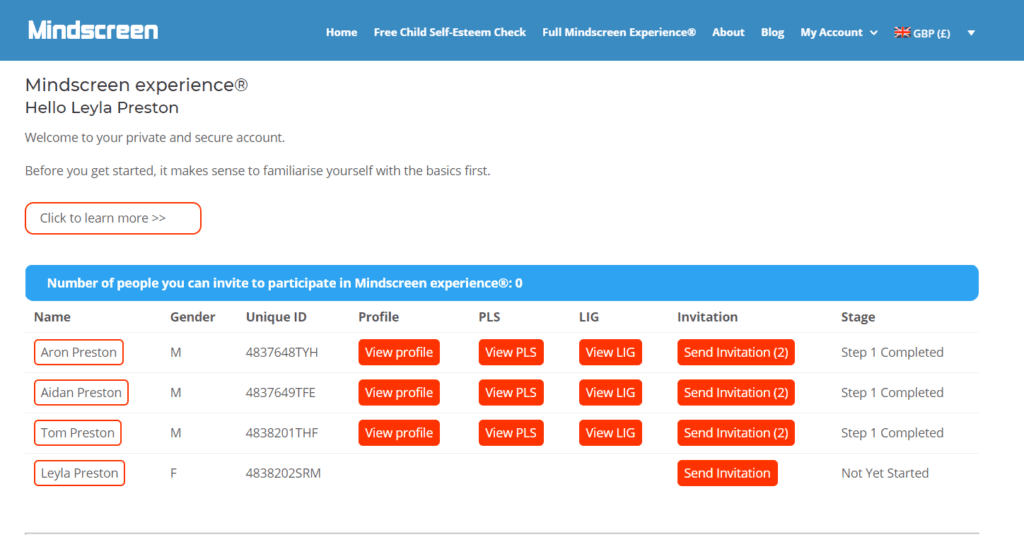
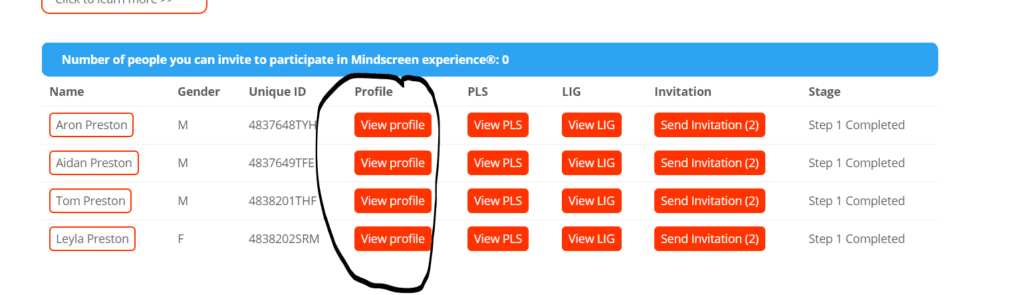
Depending on your package, your dashboard might look slightly different, i.e. for the FamilyPlus package, you are allowed to send up to four invitations to complete the Mindscreen Experience® profile.
Make sure you take a look around first and click on ‘Click to learn more’ to familiarise yourself with the process and what you will be required to do. Then, when you’re ready, start by adding your child.
Some points to note before you start:
Head over to “Teaching & Learning Resources” to get an idea of how the lesson plans and support materials look like
Complete your own Mindscreen Experience® profile before you invite your children, so you can get an idea of the process and what to expect. Don’t forget that the questions are designed for children around 11+ years old
Plan ahead before you start. How many times/days are you going to work together with your child to complete the activities? Each lesson lasts around 45 minutes so make sure you allow extra time to prep the work first
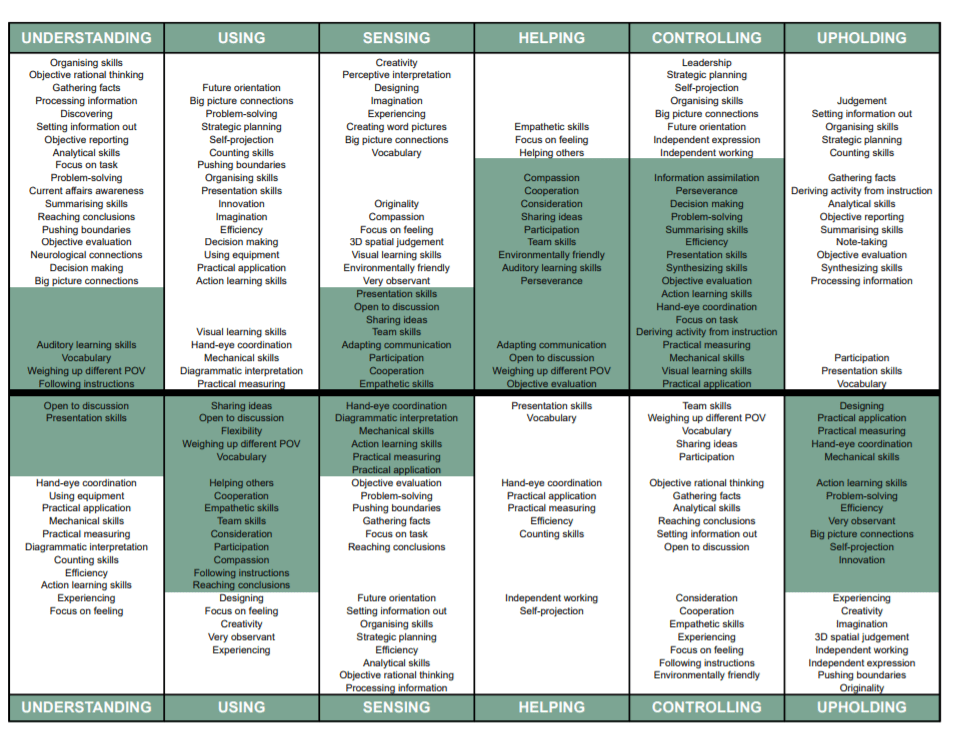
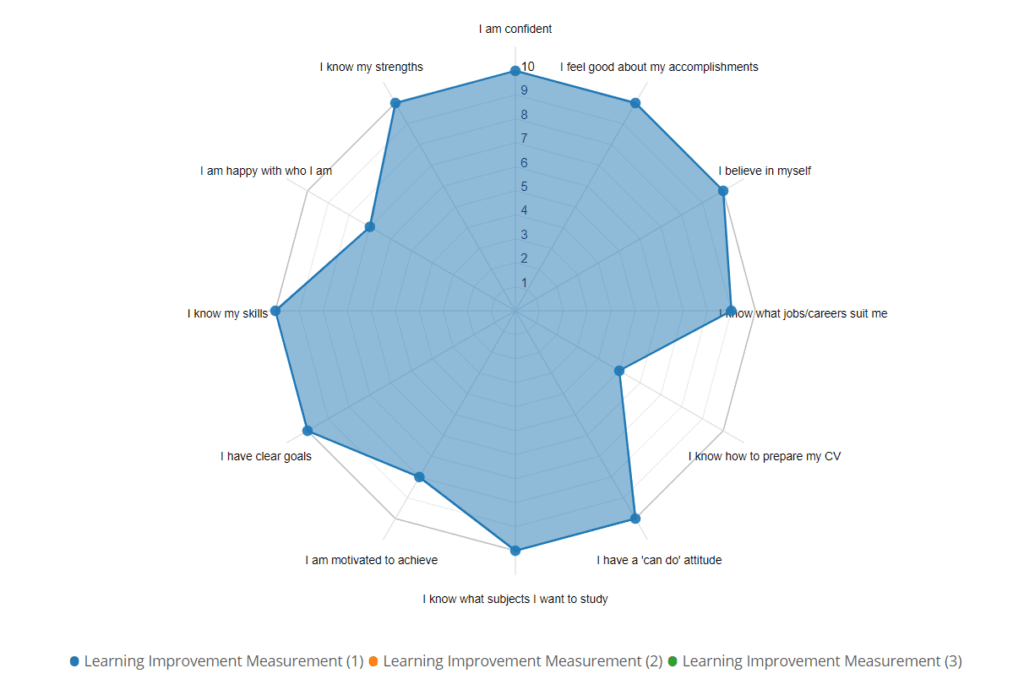
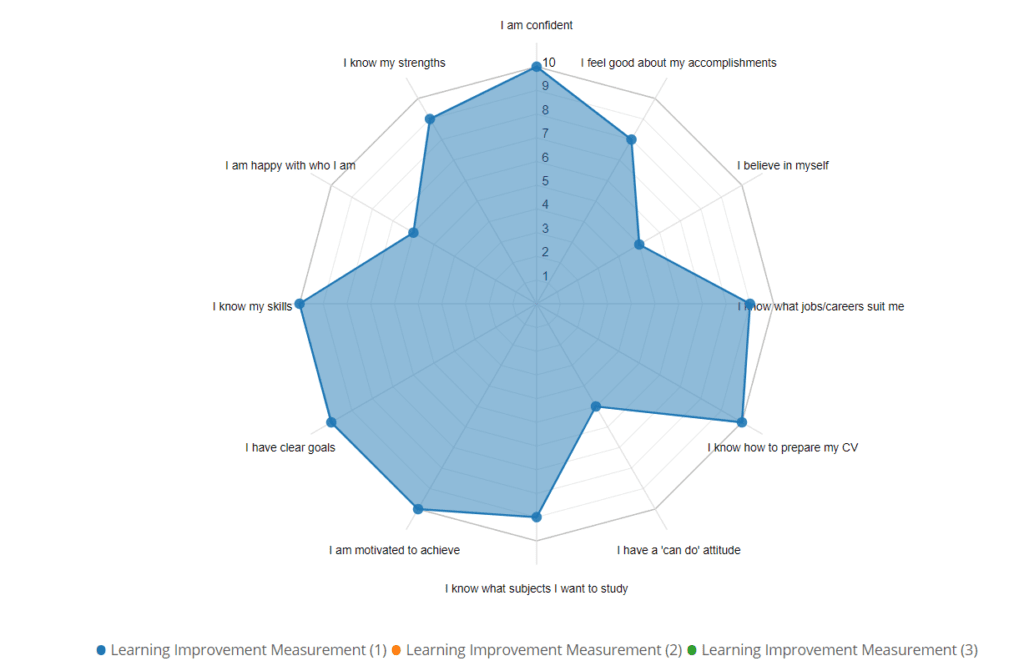
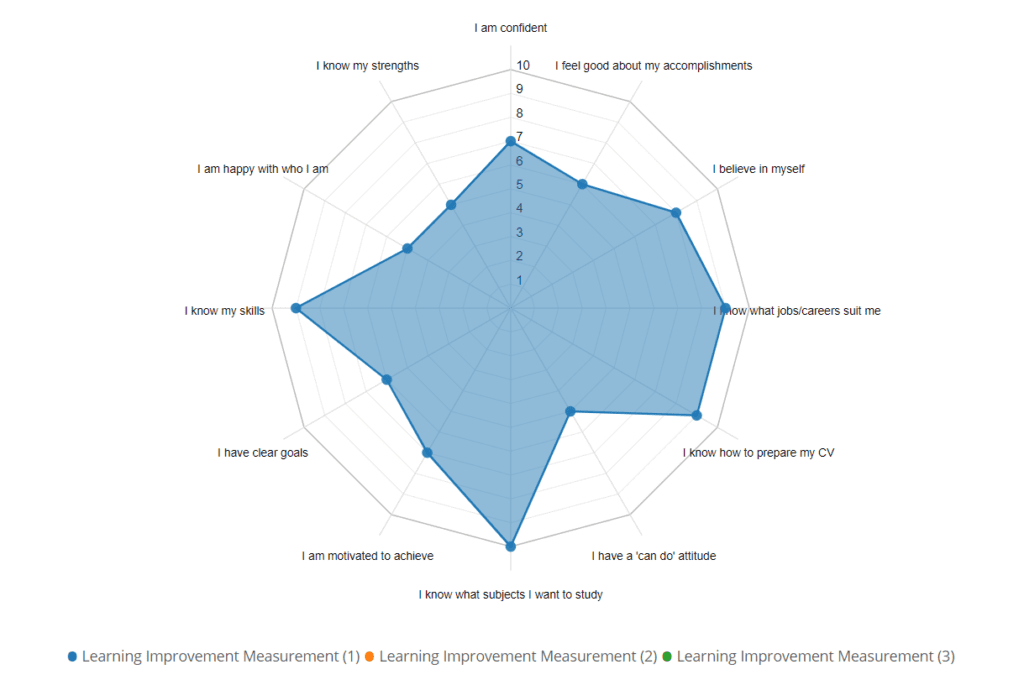
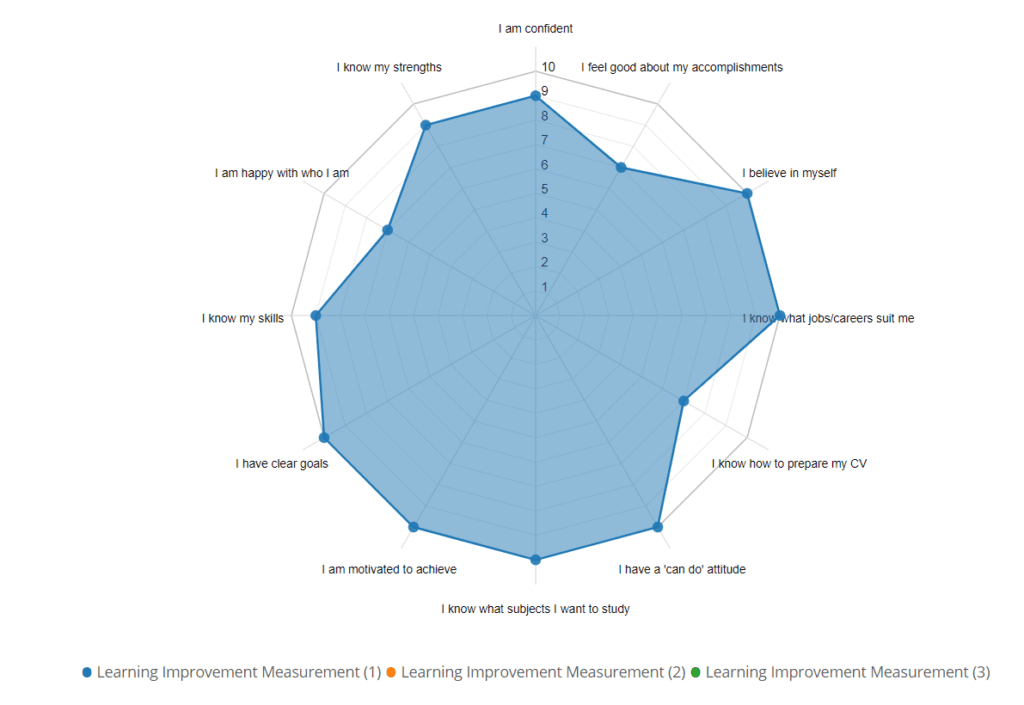
Make sure you read through your child’s Personalised Learning Style (PLS) and Learning Improvement Graph (LIG) because it’ll give you insights into how to connect with them on a deeper level and help them learn in their own unique way
Help your children to unlock their true potential! The point of this journey is to develop your child’s self-worth and confidence, so work through the steps with them and keep building on their profile after they complete each set of lesson plans, so they can follow their progress.
Involve your children in the journey and engage with them to make the Mindscreen Experience® an enjoyable and educational process for all!
We will go through the above points in more detail below.
Mindscreen have also provided me with a 10% off coupon code just for Motherhood Diaries readers so you can save money on each package!
Complete the Mindscreen Experience® yourself first
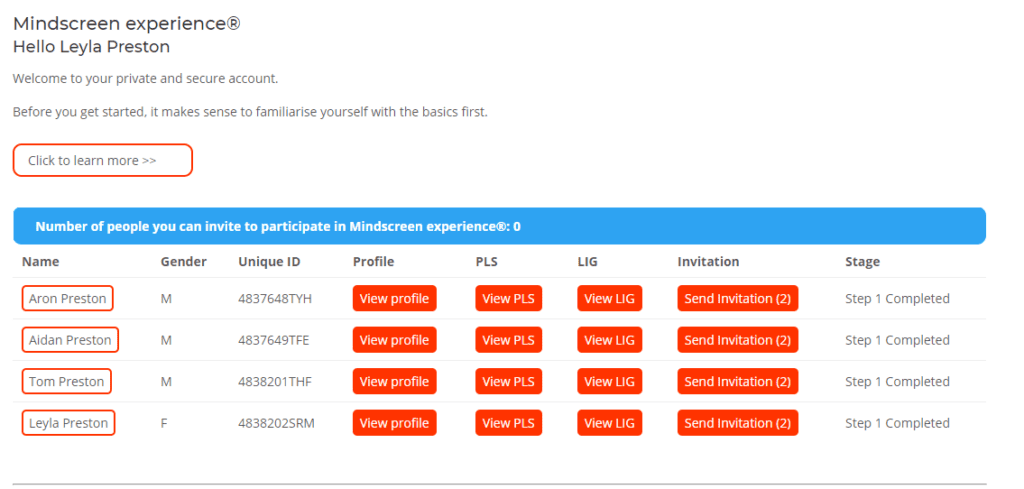
As you can see from our own personal dashboard that my husband and the two boys have all completed their own profiles and have received their PLS and LIG, so Step 1 has been completed! I have yet to do mine, so I will go through the Mindscreen Experience® with you:
When you click on ‘Send Invitation’ an invitation will be sent to the email address you provided when inputting your child’s details. So, it’s up to you to ensure your child opens and completes the questionnaire.
Once you’ve sent the invitation you or your child will see the following:
Click on the unique link provided and you are ready to start!
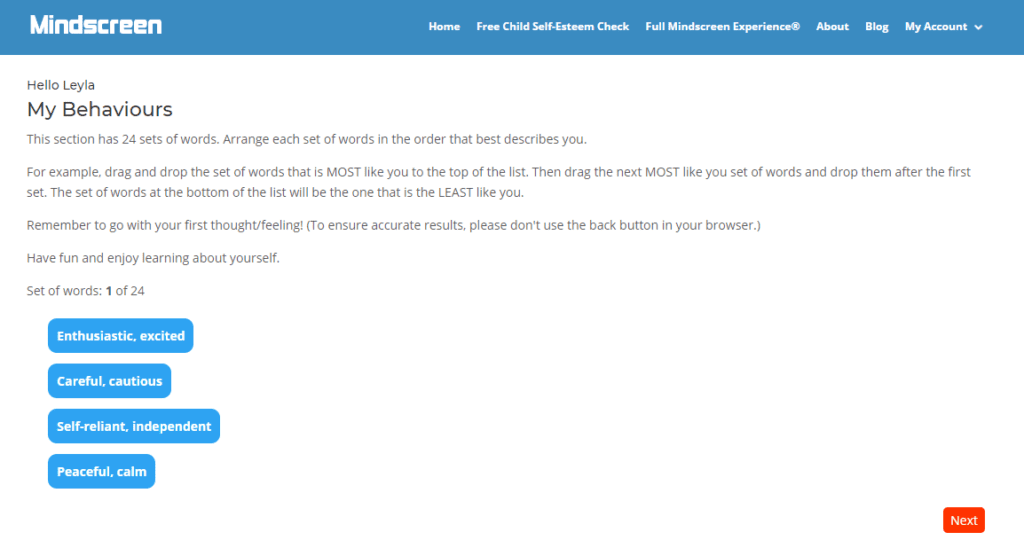
The profiling questionnaire starts with My Behaviours, a set of 24 questions designed to get you thinking about what best describes you. It’s a simple questionnaire – you just drag and drop the set of words that sounds MOST like you at the top and the words that are LEAST like you at the bottom.
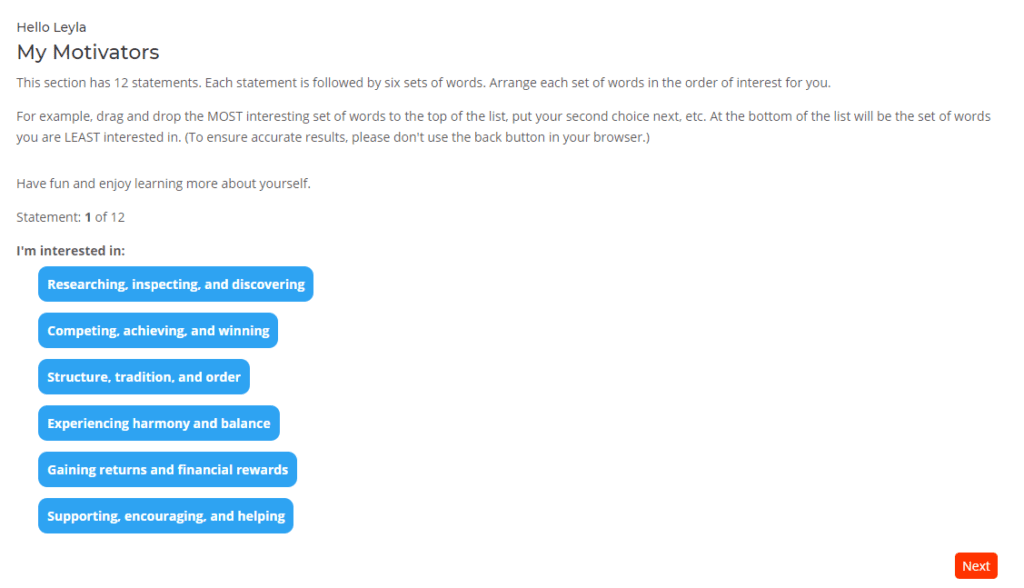
The second set of questions are My Motivators and comprises of 12 statements.
The third section concentrates on My Self-Skills.
Be careful when selecting your answers, as it doesn’t allow you to go back and correct the mistake. So take your time when taking the test, there’s no time limit.
Once you’ve completed all the sections, you are greeted with a reminder to speak to the person to get involved and chat about the next steps, which is to take a look at their profiles, as well as their PLS and LIG results.
Your child’s profile
Once completed, head back to the dashboard and click on each of your profiles to get a deeper insight into the results.
You will get a PDF which digs deep into learning more about yourself and your child. The profile provides the following insights to help better understand:
Yourself
How your friends, family, and other people see you
What your dreams and goals are
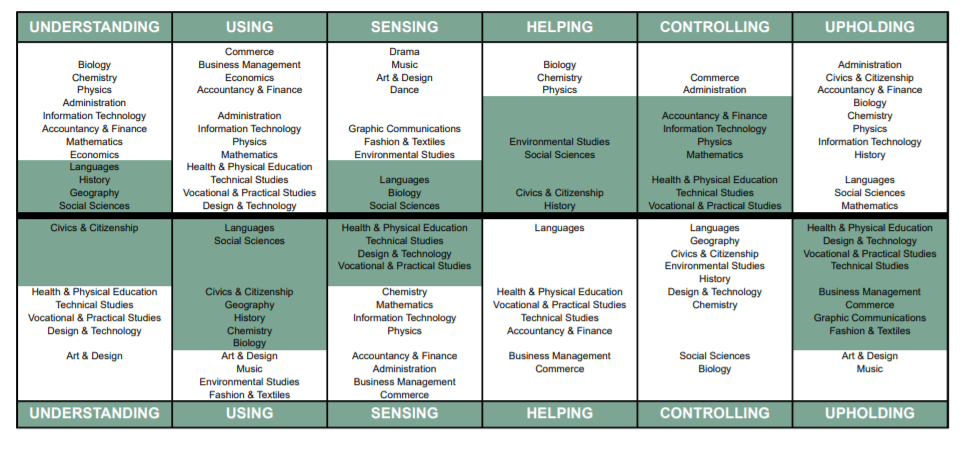
What study and career paths you are more likely to enjoy
What things make you happy and feel fulfilled
The profile is split into the following key areas which coincide with their respective Lesson Plans to help develop that key area:
About me
The ‘About Me’ section will contain a list of statements that relate to your child.
You can develop your child’s self-awareness and self-confidence using the easyConfidence Lesson Plan (more information on the different Lesson Plans below)
Most of the statements rang so true about Aron I was shocked! Some very uncanny examples are:
I sometimes interrupt others because of my strong desire to let them know how I see things.
I am usually very challenging and consider “my way” to be the best way.
Aidan’s also rang very true:
I want to be seen as a winner
Sometimes winning becomes more important than how things should be done or how I play the game
I was impressed to see some of my husband’s statements were bang on as well:
I think I am good at promoting ideas or projects and getting other people involved.
I think I am good at “selling” ideas and projects to other people.
I always thought my husband was great at sales!
And, lastly, I learned a few home truths about myself:
I can easily and eagerly talk at length about things that excite me.
People who know me know this is 100% true.
I am very open and trusting and believe other people when they make a promise to me.
Unfortunately this is true and I have been burned many a time!
My Wants and Needs
The next section relates to your child’s motivational wants and needs and this is an important section because satisfying them keeps them happy!
Again, you are provided with a list of statements related to what your child needs to keep them switched on.
Aron had motivational needs like wanting to be given the big picture and to do things his way so he could demonstrate his skills. He also needed information to be given quickly and in brief, to experience things as he went and to achieve results.
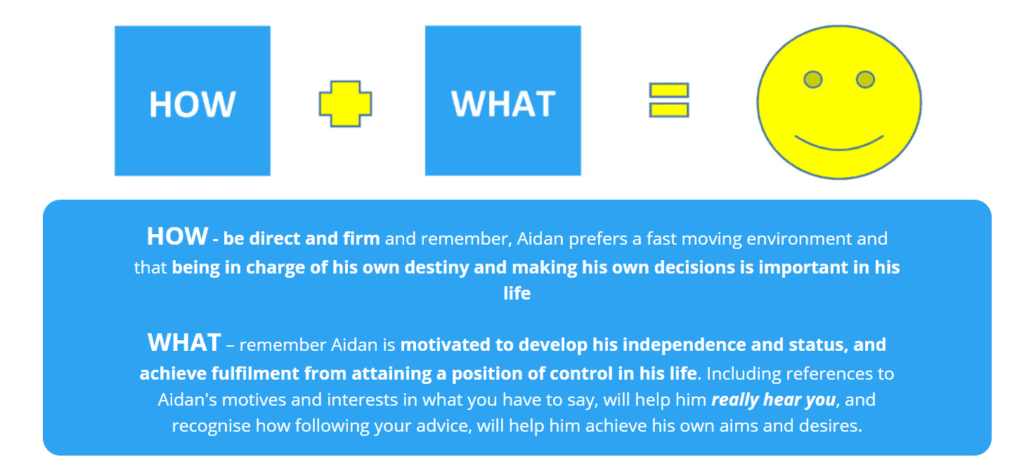
Aidan wanted and needed targets to aim for so he could be rewarded when he hit them. He also wanted to make the decisions and direct the actions of others and have complex puzzles and experiments to work on. He also liked new challenges and problems to solve.
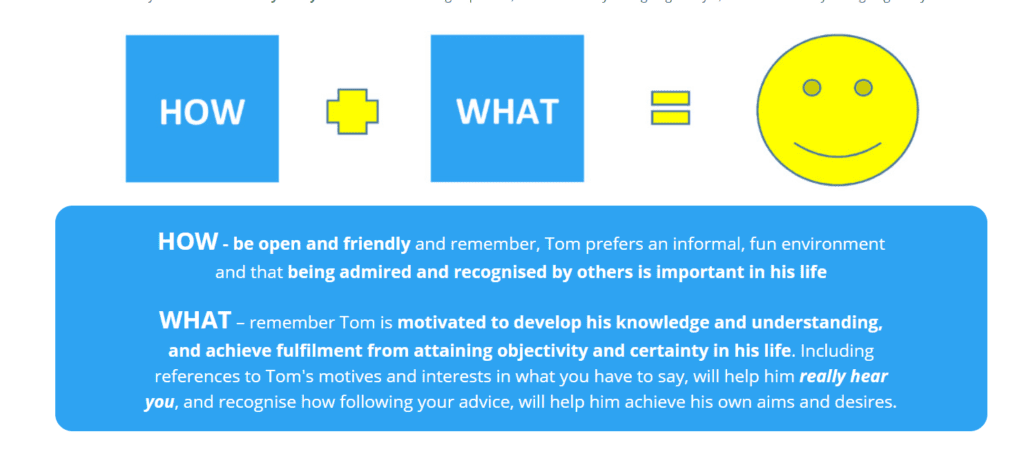
Tom wanted excitement and adventure in his life while I needed freedom from control and supervision.
My thoughts
I noticed that Aron is motivated by fun and excitement so sitting down to study subjects of which he has no interest is difficult for him. He also likes to have things done his way. So, I would need to find a way to inject some excitement into his Lesson Plans, while giving him a bit more responsibility to study on his own. He is very creative though, so it’d be great to build some creativity into his studies too.
Aidan wants clear goals and to concentrate on complex puzzles, which is great because he already completes fun and challenging puzzles in bed. I noticed that Aidan is productive and efficient and I do find that he is more motivated to work because he wants to always be the best. His work ethic is fantastic, so it’s all about building on his strengths here.
How I see myself
This was a very interesting section because it shows you how your child sees themselves. And the better they understand themselves, the more confident they will become. The highlighted statements in this section describe how your child sees themselves and will help them learn if they are more:
“Confronting” or “Agreeable” when challenged
“Talkative” or “Reflective” when interacting
“Relaxed” or “Restless” in your surroundings
“Respectful” or “Rebellious” regarding rules & procedures
This section works together with the easyAwareness Lesson Plan to help your child get to know themselves better. More information on the Lesson Plans below.
My thoughts
Very interesting results and I noticed that a lot of their traits are in the RED column which seems to be more on the confrontational scale. I have always joked that my boys are alpha males, but it’s definitely interesting to see that they’re not as different from each other as they’d like to think!
If your child knows what motivates them, then they’ll know better how to communicate and interact with others more confidently.
In this section, your child will receive a list of statements that shows the ways your child likes to engage with people.
Aron likes to experience things as he goes and express himself in a lively and open way.
Aidan likes to analyse everything and prefers other people to cover things in detail when interacting with him.
Tom likes to interact with people who recognise that taking risks is an important part of progress and change.
And I like to be around others and convince them in an enthusiastic way that what I am saying is exactly what they need.
Your child will get a list of statements that refer to how they’d like to engage so it’s important to go through the list and gauge their reaction to these statements.
My thoughts
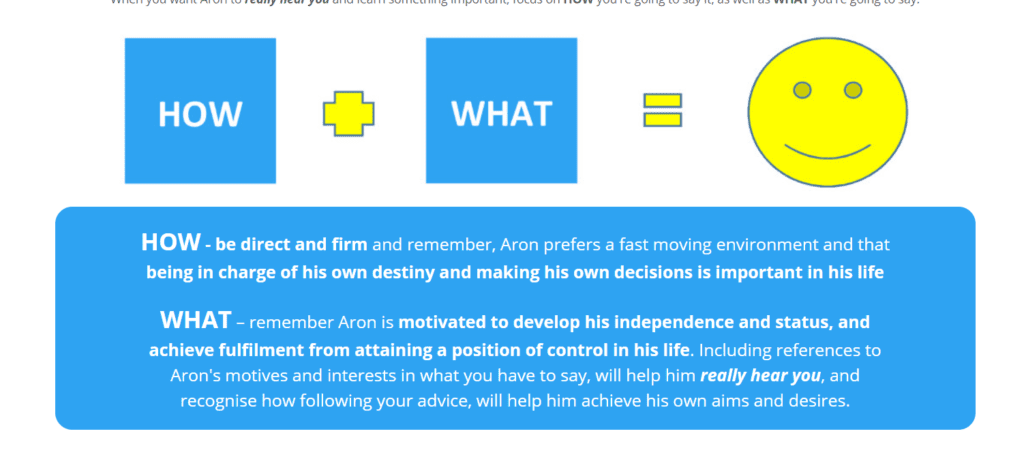
Again, I noticed the overriding theme in Aron’s results were that he wanted fun and exciting interactions with peers but that he also didn’t have time to mess around, so he also needed people to get to the point. It’s made me wonder about how I speak to him actually. I like to explain myself in detail, but that may be where I am going wrong and why I often wonder why Aron is ‘ignoring’ me.
I read somewhere that children only really retain the first five words and then their mind wanders. So, I will make an extra effort to try and limit what I want Aron to do in five words or less!
Aidan’s seemed a lot more ‘grounded’ and ‘serious’. Aidan wants to-the-point conversations and to feel constantly challenged, but also be given the time to analyse and process what people have said to him. He needs to be more matter-of-fact and so I will make an extra effort to treat him more seriously and ‘give it to him straight’ when I need him to do something for me.
My interaction dislikes
This section is important because it’s essential to learn what your child dislikes in what people say or do when they interact with them.
Aron dislikes it when people repeat activities or discussions when they are dull.
Aidan dislikes following other people’s idea if he disagrees with them.
Tom dislikes when other people distrust in what he is saying and does not share his optimism and enthusiasm.
And I dislike it when people “box me in” with too many rules.
Your child gets a list of statements that refer to their dislikes so, again, go through the statements with them and ask them what they think!
My thoughts
Again, Aron’s dislikes were centred around keeping him in one place for too long and slowing him down. He needs things to be done quickly and is bothered by people who are too slow. He also doesn’t like it when people block him from expressing himself. So, this is a great food for thought when I do the lesson plans with him and I have made a mental note to give him the stage so he can express himself freely during lessons.
Aidan’s dislikes were surprisingly about people getting up close and personal with him and invading his personal space. I have noticed that Aidan is starting to pull away from my hugs and kisses and I thought this may be because he wants to act cool. But, I’ve noticed that he does keep people at arm’s length when he speaks to them, so I will concentrate more on respecting his boundaries and not forcing cuddles or kisses at the school gate as he clearly dislikes this interaction.
The Natural and Adapted Me
This next section talks about your child’s “natural behaviour” which is the behaviour that usually remains similar throughout their lives, only changing during brief emotional and stressful situations.
Their “adapted behaviour” relates to when your child adapts their behaviour in different situations. For example, they may behave differently at school than when they’re at home or out with their friends.
Your child perceives their adapted behaviour as the way they believe they should behave to fit into and succeed in their current environment.
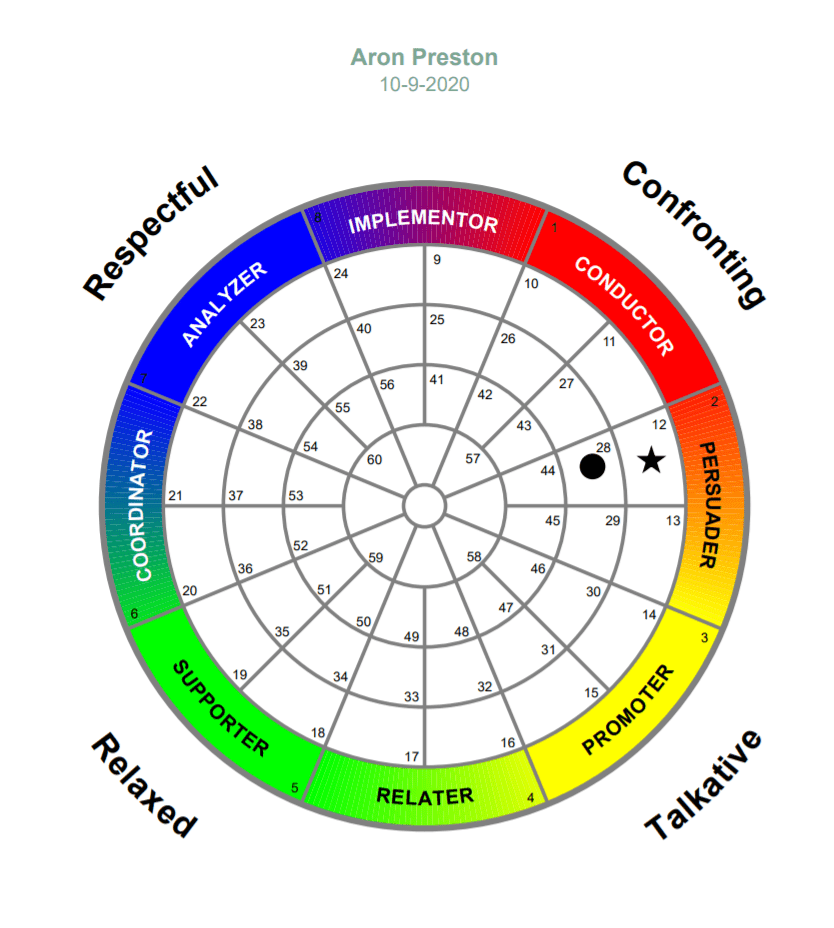
Their natural behaviour is shown on a Success Insights Wheel® in the profile and is marked as a dot. Their adapted behaviour is shown as a star. The further the star is from their dot the more your child is adapting their natural behaviour to their environment.
Remember, while you can afford to be flexible, stretching your natural behaviour can cause strain, much like when an elastic band is stretched. Human behaviour can be “stretched” in different directions but will snap back to its “natural” state. And this is perfectly normal, provided your child doesn’t stretch themselves too much or too far.
Because what happens when an elastic band is stretched too far?
It snaps.
The behaviours on the right of the wheel (Confronting and Talkative) are more Outgoing/Extroverted while the behaviours on the left (Relaxed and Obedient) are more Reserved/Introverted.
The behaviours in the top half of the wheel (Obedient and Confronting) are more Task/Thinking focused and the behaviours in the lower half of the wheel (Relaxed and Talkative) are more People/Feeling focused.
My thoughts
It’s amazing how we are all so different.
Aron’s natural and adapted behaviour shows that he is Outgoing/Extroverted, which are close together, i.e. in the Persuader column. I felt this reflected Aron very well as he is quite strong-minded and rarely changes his behaviour to suit others. It seems he doesn’t feel the need to adapt his behaviour which is great! However, on some occasions adapting your behaviour may be useful to be a team player, which is something I find Aron does struggles with. He is a born leader for sure, but sometimes he needs to learn to play in a team.
Aidan’s results, however, were more interesting. I assumed he would sit in the ‘Implementor’ column rather than ‘Conductor’. But, I feel like perhaps his adapted behaviour is stretched to be more confrontational than he really is because he is often coaxed by others to speak up over his brother when sometimes he would rather leave the room and walk away. When speaking to Aidan about this he agreed and said that sometimes he just wishes his brother would leave him alone so he could live in peace.
If your child has stretched adaptive and natural behaviours you may find that their wants and needs will be different from the other sections as well. We all adapt our natural behaviour throughout our lives and this isn’t something to worry about.
What is more important is WHAT is causing them to adapt? Go through the “My Wants and Needs” section with your child and ask questions about what is going on in their lives. It’s a great section to connect with your child and help them work through any issues they may be focused on at the moment.
The Understanding your Child’s Profile guidance has some great questions that you could ask your child. These are:
Has something changed in school?
Has something changed at home?
What seems to be the most important thing on their mind right now?
Have you noticed any change in their behaviour?
My Success Tips
So, now we want to make sure our children get ahead in life! How do we do that?
We start with the future in mind!
Get your child to set goals and break them into manageable steps by using their Success Tips straight away.
The road to self-belief and higher self-esteem is a journey, not a destination, therefore it needs to be achieved through steps in a way your child can understand and achieve. And make sure to congratulate them when they do succeed in every step which will boost their self-esteem and confidence.
Use this section with the easyBelief and easyFuture Lesson Plans to help your child develop their Success Tips (more information on these below).
Some Success Tips for Aron included:
Get up early.
Study in the morning.
Switch from subject-to-subject every 30 minutes
Use an alarm.
Walk around while you’re thinking.
Tell yourself to take notes and write down your ideas immediately. This will open your busy mind up to receive other information. You will be more organised and improve your memory too.
I love these tips and I think they would work really well on Aron as he can’t sit down for too long! I have also noticed he is more switched in the morning. So I look forward to implementing these new routines with Aron.
Some Success Tips for Aidan included:
Detach yourself from interruptions when studying.
Use the library.
Study alone.
Make sure you have everything you need to analyse the data and facts.
When in group activities take every opportunity to be in charge and lead others.
Some Success Tips for Tom included:
Learn how to manage your time.
Get a pocket diary. Describe each activity you do and how long it took. Within a month you will know what you are spending your time on.
Draw pictures or diagrams of the ideas and concepts you want to learn. Leave out unnecessary words.
Some Success Tips for me included:
Remind yourself that not everyone is like you.
Tell yourself that “normal” is OK too.
Remember that regular people, like your teachers, can help you achieve your goals.
Use your rebellious nature to your advantage. Choose to study in your own creative way. Decide what your study rules are.
Make an agreement with yourself to follow your own rules.
Love this last tip!
Your child will have more Success Tips so make sure to go through them all and go through the respective Lesson Plans to ensure they action these Success Tips now.
My Skills, Study & Career Choice Insights
This next section is a big one and looks into what your child’s natural skills are and which study and career choices use those skills. This section is a great way for your child to discover which skills they didn’t realise they had and which they knew they were good at already.
Choosing the study and career path that is right for your child is essential because it will help them feel confident and fulfilled that they are in the right path in life.
Look at the Skills Insights graph first and take note of your child’s skills in GREEN in each of the six columns. These are your child’s natural skills.
Now look at the Study and Career Insights graphs and check out the highlighted study and career options most suited to your child.
These insights are great to get an idea of the types of study and career paths available, but they shouldn’t make the basis of your child’s decisions. Family and teachers can help to broaden your child’s sources of study and career pathways so your child has a full-rounded view of which path they’d like to take.
This section can be used in conjunction with the easySkills, easyStudyChoice, easyCareerChoice and easyCV Lesson Plans which we’ll go into more detail below.
Aron’s natural skills
Aron’s study choices
Aidan’s natural skills
Aidan’s study choices
Remember that the highlighted study choices are more likely to use your child’s natural skills and are not necessarily what your child would want to study as a career. Talk through the subjects with them and find out which if any they seem genuinely happy to try out.
My thoughts
I noticed that Aron’s skills were around vocabulary, presenting, and sharing ideas, as well as helping others and participating in conversations. I feel these suit Aron very well and I could see him thrive in an open environment where creativity is key. His favourite subjects are history and Maths so it was great to see both come up as a possible career pathways. He is also obsessed with football at the moment so he is definitely keen on pursuing Health & Physical Education if it’s a possible career choice for him.
Aidan, I’ve found has always been very practical, especially with his hands, so it was great to see Practical application, Practical measuring and Hand-eye coordination coming up as his natural skills. He is also a keen mathematician and I noticed he has a lot of mathematical, problem-solving and analytical skills. It was no surprise then to see the sciences come up, as well as maths and physical education as possible career choices, as Aidan is also very enthusiastic about football.
It’s great to see that both are already following the subjects they love the most, so it’s up to myself and hubby now to ensure we guide them down the right path so they can be the best they can be in the subjects and careers they love already.
The great thing about the Mindscreen Experience® is that the results can provide specific insights into your child’s PLS, which means knowing how your child wants to learn and what interests motivate them, so you can connect with them on a deeper level. That way you can engage your child fully when you mould your parenting style to match their PLS.
When you want your child to really listen to you and learn then focus on how you’re saying it as well as what you are saying.
As mentioned before in ‘My Thoughts’ that the way I need to speak with the boys need to be more direct and concise, something of which I’m not great at if I’m honest.
Your child’s Learning Improvement Graph (LIG)
Your child’s LIG is designed to help you quickly spot your child’s skill strengths and the ones that may need some help developing. It’s a great way to get a bird’s eye view of their self-awareness, confidence, belief, and esteem at a glance.
The full Mindscreen Experience® allows you to send your child up to three LIG invitations and each time they complete a LIG the new answers are plotted into the main graph, so your child can measure their progress over time.
Aron’s LIG
Aidan’s LIG
Tom’s LIG
My LIG
Again, amazing how we’re all so different.
Once your child (and/or you and other members of the family) has completed their profile and you’ve gone through their insights, PLS and LIG, it’s time to start developing their self-esteem using the tools and resources supplied under ‘My Account’:
The full Mindscreen Experience® – Teaching and Learning Resources
Click on Teaching and Learning Resources and you will head to the main dashboard as seen below:
Make sure you click on ‘Read Me First’ and check out the Lesson Plan Summary and Understanding your Child’s Profile, so you have an understanding about what’s coming up ahead.
Lesson Plan Summary
The Lesson Plan Summary provides an overview of the lesson plans and support materials that are available to you during the full Mindscreen Experience®, plus any additional tips you need to accelerate your child’s learning.
You will see the Lesson Plan Summary will have gone through everything I talked about above, but take this time to read through it and understand what each section means so you can relay them to your child in a way they can understand too.
There are nine lesson plans designed to be delivered in a particular order, which is:
EasyAwareness
EasyBelief
EasyConfidence
EasySkills
EasyStudyChoice
EasyCareerChoice
EasyCV
EasyFuture
EasyFeedback
Each lesson lasts around 30-40 minutes (some last around 60-80 minutes depending on the number of children. If the lesson has a different duration it will specify how long it will take.) The guides provide enough detail for you to prepare for your lesson before you start, from detailing the lesson’s objectives to the resources needed and the order in which you take the lesson.
For full details of each lesson, which look like so much fun, watch out for Part 2 coming soon!
A brief overview of each lesson
EasyAwareness
This lesson is designed to provide your child with the opportunity to learn about their own personal characteristics and begin building their self-awareness.
EasyBelief
This lesson provides your child with the opportunity to explore how their own beliefs are formed. You can help them to understand that their beliefs drive their behaviour, by providing simple techniques to help them dispel negative beliefs and encourage positive ones.
EasyConfidence
This lesson gives your child the opportunity to explore their own strengths and talents and build their self-confidence.
EasySkills
This lesson helps your child to better understand what their unique skills are and how they use them. Help your child begin to build a personal “bank” of skills they “know” they have.
EasyStudyChoice
This lesson helps your child to choose subjects to study that line up with their own skills, personal interests, and what they value. It also helps them to identify career ideas related to their study choice options.
EasyCareerChoice
This lesson helps your child to identify career options they are more likely to enjoy. Help them to recognise the importance of taking action to achieve their aims and career goals.
EasyCV
This lesson gives your child the opportunity to prepare the most important part of their CV, their personal statement. Help them understand the “dos” and “don’ts” of CV writing. Some children may be too young to fill out this lesson, but it’s worth giving it a shot to introduce them to the world of CVs later on.
EasyFuture
This lesson gives your child the opportunity to discover the “Success Recipe” and its “vital” ingredients. Help them understand the importance of starting with a destination in mind, and demonstrate how having a goal helps them stay on course, even in tough times. Also, help them to recognise which study and career options will help them achieve their goals. Support them to create their own goals.
EasyFeedback
Part A – (Invitation): The objective of part A of this lesson plan is to invite your child to complete either the “Learning Improvement Measurement 2” or “Learning Improvement Measurement 3” online statements. Part B – (easyFeedback): The objective of part B of this lesson plan is to show your child how much they have learned about themselves and encourage them to keep going.
Some tips to prepare your child’s learning
Print out and read the profiles so that you can go through them with your child. Take your time to discuss the results and avoid putting words into their mouth. It’s important to learn how THEY feel and not how you feel first.
Print and read Discovering More About Yourself and Others booklet, together with the self-awareness, self-esteem, and self-confidence handouts, before you start
Read through the “Lesson plan resources” section of each Parent/Carer Guide carefully and check you have all the resources you need
Provide your child with a folder and all guides and lesson plans together so your child can reflect on their learning every week.
Set a specific day and time, either once or more times a week and write it down on a notice/whiteboard or fridge so your child knows when they will be working on their self-development
Participatory learning (like the full Mindscreen experience®) helps children learn better than passive learning, which is reading, demonstration and listening to lectures. So make sure they are engaging in the lesson plans and actively participating.
Repeat the lesson plans with them because, even though participatory is the most effective approach to learning, our child will still only retain 50% of what they learn, so repetition is key!
Stick with the lesson plan order. There may be a time where your child shows an urgent need or a particularly low self-skill score. But all of the activities in the lesson plan are designed to positively affect your child’s mental health so keep going and resist the temptation to work out of order.
What to expect next?
In Part 2, I will go through the first lesson which is easyAwareness.
Pop a comment below and let us know how you feel about your child’s self-esteem. What do you worry about most regarding your child’s mental health? Would they benefit from the full Mindscreen experience®?
*Contains affiliate links which means that if you click through to Mindscreen’s website and purchase a package, I may earn a small commission at no extra cost to you.*
Survival tips for kids that they should know
How many times have you said to yourself:
“If I only knew then what I know now?”
It takes time to develop our knowledge and gain life experience, and what we learn we should pass on to our kids, so they possess basic survival skills to protect them against this unpredictable world. And if heaven forbid, our children are left to fend for themselves in some weird, horrible turn of events, they are armed with a handful of survival tips and tricks, even if it’s just to get to the phone and ask for help. So, here are the ultimate survival tips for any situation that your child should know now:
How to call for help
Whether this means running out of the house and to the neighbours to ask for help, or picking up the phone and dialling 999, kids need to know how to survive when there is a crisis. Ingrain into their heads your phone number, address, and medical details, if they’re old enough to retain that information. Teach them how to call for an ambulance or the police and keep reminding them that whatever happens, they are to call the police/ambulance first. They should know where family and friends live so they can run away from imminent danger.
How to feed themselves
If kids find themselves on their own, they need to know how to make food and feed themselves until help arrives. I have taught my boys how to make toast and cereal and grab things out of the fridge and cupboard. I’ve also shown them what spoiled food looks like and to smell the food before they eat it. My husband has taught them the basics of what not to eat from the bushes and trees. Teach them things like food storage too so if they’re stranded for hours they know where the food is kept and how it should be stored.
How to practice safe hygiene
Since they were old enough to use their motor skills, I have drummed the importance of hygiene into my boys’ brains. They still forget now and again, but washing hands is fundamentally important to minimise harmful germs entering their systems and making them ill. The adage, “what won’t kill you will only make you stronger,” isn’t exactly correct. If you’re sick, your body takes a huge knock which it almost never recovers from. The more of these knocks you get the weaker your body becomes. It’s great to build up your baby’s immunity but within reason. They are naturally building their immunity from the air they breathe and the things they touch. There’s no need to add extra germs that might make them very ill.
How to stay strong and healthy
We are a very active family who practices eating healthy and staying positive. Since the boys could walk, they were on scooters and then bikes. Now, at eight and nine, they take part in a multitude of sports, including football, gymnastics and swimming. We have also bought them skateboards and in-line rollerblades for their birthdays because it’s very important to make sports fun and to teach them that exercising and staying fit and healthy is vitally important to surviving in the outside world if the forces of nature are against you. Since the boys were babies, they watched me exercise at home, so I’m hoping that this ethic will be instilled into their heads and keep it up into adulthood. Plus, sports and physical activities foster outdoor survival. Unstructured outdoor play is much more beneficial than structured indoor play, so make sure you take your kids to the local park/playground to enhance their mental and physical development.
It’s also a good idea for you to learn first aid so you can teach them basic skills, in case they are faced with a decision that may require basic first aid knowledge. It is also important to teach them about ailments they may face or injuries that require urgent attention. Any injuries to the brain, like brain contusions, need to be dealt with straight away, so they should call 999 as soon as possible.
How to self-medicate themselves
Kids should ideally take a mini medi-kit with them when you’re venturing about to new places. That way, if anything happens and they sustain an injury they can self-medicate themselves, either by cleaning the area with a wound spray and wound healing ointment and protecting the area with antibacterial water resistant plasters or bandages. ELASTOPLAST have a great selection of protective bandages and plasters for children so it’s worth checking them out.
How to keep warm
If your child isn’t old enough to generate heat from fire or they don’t have the supplies then they need to learn other ways to keep warm, like using their body heat or insulating their clothes. Teach them to tuck their trousers into their socks and shirt into their trousers, so heat doesn’t escape from the gaps on the body. They can also fill up their clothing with items they can see outside like dry leaves and plants. Make sure they know which plants to avoid so they don’t stuff their clothes with anything poisonous like poison ivy or poison oak.
If they are separated and likely will spend the night alone, then you should teach them survival tips in the woods/wild by learning how to create a bed from nearby leaves and branches.
How to make money
Unfortunately, money makes the world go around and, even though it may not directly bring you happiness, it buys you choices. Being poor hurts and constantly grafting for money hurts the family. So, I try to teach the boys entrepreneurial skills so they can watch out for gaps in the market and find their own way of making money. I am also instilling in them a good work ethic. They do chores around the house, so they learn the value of the pound and I am teaching them to save money rather than spend it. If you haven’t started doing this yet, it’s never too late. The earlier you teach them, the more likely they are to become savers rather than spenders later on in life.
How to create their own survival kit to survive the wilderness
You could make it a project with the kids to create their own survival kit so they can learn how to survive in the wild. The survival kit could include:
Duct tape
Char cloth
Glow sticks
Plastic bag
Compass to show where the north star is
Aluminium foil
A bottle/jug to collect water
Some kind of water filter and a way to boil water
Something that can create a smoke signal using waterproof matches
Small whistle
Pen knife (make sure the kids are thoroughly trained on how to use a penknife!)
Arm them with a survival guide
Next time you’re at the library or book shop, get your kids a book on how to survive in the wilderness or an outdoors survival guide which teaches them how to survive the outdoors and also includes:
Swimming may not be an outdoor sport, but it is a survival skill. In case of an emergency, the boys need to swim to safety. We take the boys swimming every week, and they have come on leaps and bounds with their swimming skills. We also kit them well in swimming gear from Simply Swim and take them even during the winter. We just make sure they’re thoroughly dry and wrapped up warm when they come out.
There are many other survival skills to teach kids how to thrive in this world, like working hard, being responsible for themselves and making them aware of their surroundings at all times. As they get older, it’s useful to teach kids about how to make a fire, shelter, and fetch water, as well as cook over the fire too. Another important skill is to judge the change in weather and teach them how they to protect themselves during harsh seasons. Some schools in the US are now integrating a weather curriculum that helps children collect and analyse weather data. This is so they can understand what the weather changes mean and how they can work with them, especially thunder and lightning, which can be dangerous if you’re not in a safe environment. Technology that includes lightning detection helps children to predict further changes in weather patterns so they are better prepared during climate changes. Plus, it’s a great way to get them interested in how nature and the environment work.
The important point to note is that in a survival situation, kids should be able to think on their feet and armed with the survival tips above, they should be able to fend for themselves in case we are not around to help them. What other survival tips and tricks do you think is useful for kids to learn when learning how to survive the wilderness? Share in the comments below.
*Collaborative feature post with Simply Swim and ELASTOPLAST