On Thursday 12th September at around 12.30 am, at 39+4 weeks pregnant, I waddled upstairs to try to get some sleep. As I laid down, I heard a very loud pop.
That’s weird I thought.
At first, I thought something had burst in my belly, but when I went to the toilet, I experienced trickling that didn’t stop.
I went downstairs to tell my husband I thought my water just broke. Hubby, who was still absent-mindedly watching TV, had heard my self-diagnosis three times already in the pregnancy, so he double-checked I hadn’t just peed myself again. But, as soon as he finished that sentence, more liquid trickled down my leg.
It took hubby about 30 seconds to grab a towel, but by the time he had returned, I had a puddle on the floor and my knickers were soaked through. I called my parents to ask if one of them could look after our older two boys, as they were asleep and they had school the next day.
My dad came over and asked me if I was in any pain. I wasn’t but I was experiencing quite a bit of cramping, which I had put down to Braxton Hicks. We called the triage first and they confirmed that it sounded like my water broke.
“Have you got any pain?”
“No.”
“Are you experiencing contractions?”
“I don’t think so. Tightenings possibly but nothing that’s painful to write home about.”
“You better come in.”
As I was considered high-risk due to my miscarriage previously, I had to come in as soon as my water broke.
Off to the hospital
I grabbed my hospital bag and we headed to triage and the midwife asked me to keep a pad on, so she could check whether it was amniotic fluid and not just pee.
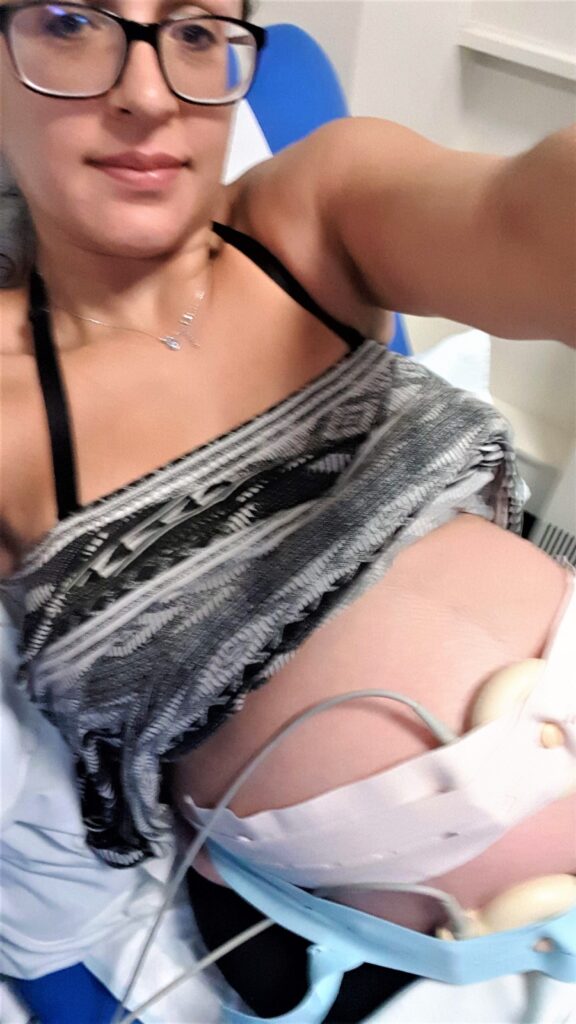
I laid on the bed as the midwives tested the liquid with a speculum, and they confirmed my waters had broken. A CTG was strapped to my belly to monitor the contractions, which I was experiencing regularly at this point. I thought this was strange because I wasn’t feeling any pain. After about half an hour to 40 minutes of checking, I was famished so I asked hubby to get me a sandwich.
I had to have an IV drip put in for Group B Strep antibiotics to be administered because I was tested positive for Group B Strep in 2017 when I had my miscarriage. The cannula put in was quite painful, apparently because my veins are really juicy and I had holes or waves in the veins. The midwife found air I think and so she had to take it out and put it on the other hand, which hurt a lot!
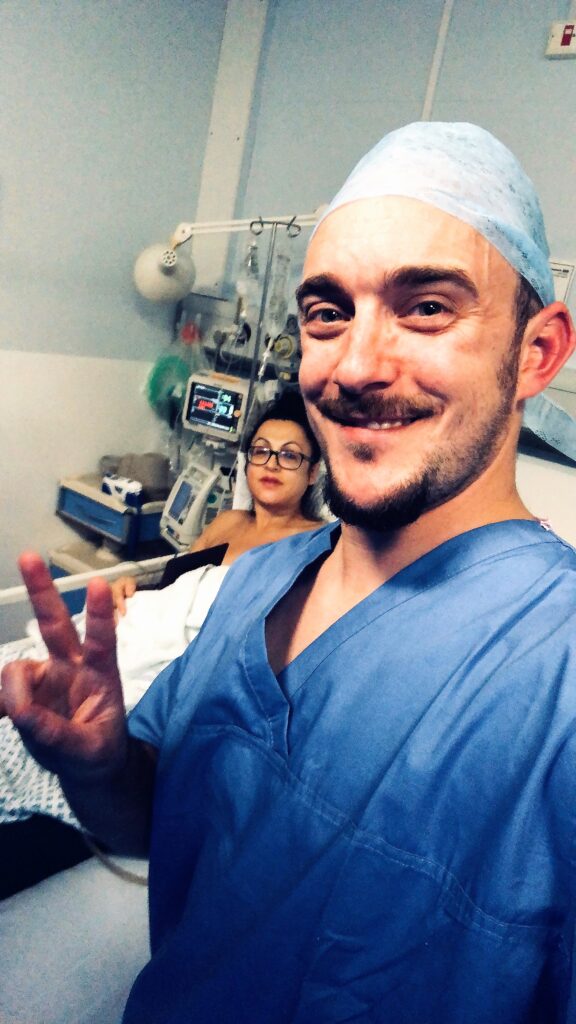
The two midwives in the room advised they were going to take me upstairs to the delivery suite soon. I was still fine and not experiencing that much pain until I was told to lie down. I told the midwife that I wasn’t comfortable with lying down on the bed and asked whether I could still be active. The midwife responded that when they took me to the delivery suite a bit later I would be able to move around then, but they had to continuously monitor me right now to check if the baby was ok.
It took a while for all the checks to be done and I felt so uncomfortable. The pain of some contractions was seeping in too, but I got the go-ahead to be moved to the delivery suite.
Off to the delivery suite
When I got to the delivery suite, a midwife examined me and she said I was 2 cm. The contractions were nothing to write home about; I could still talk, and I had some time in between them but they were starting to get a bit painful.
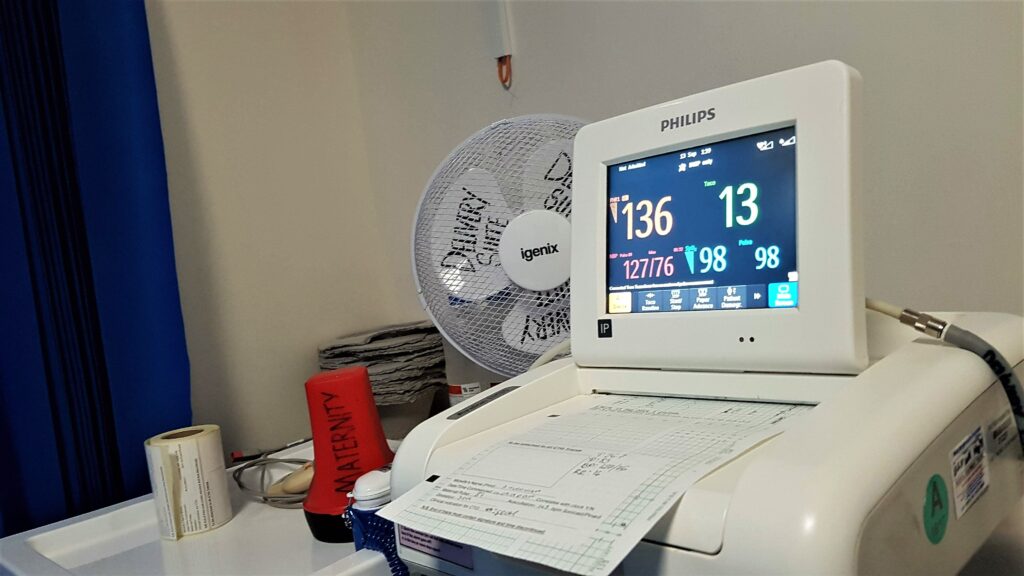
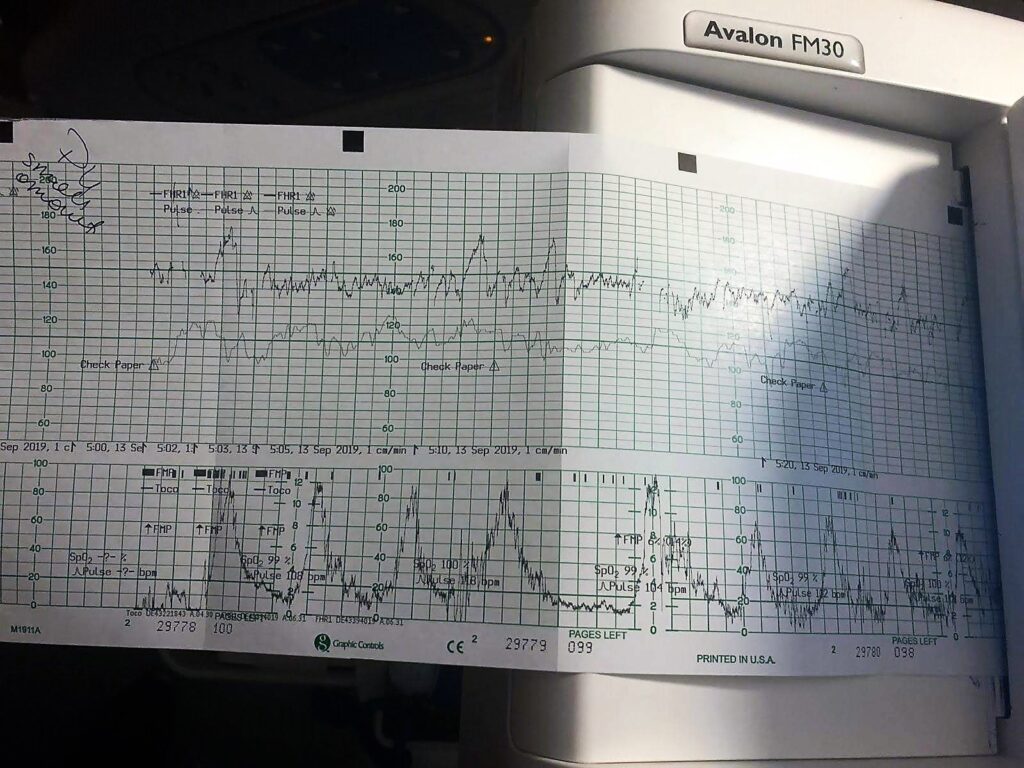
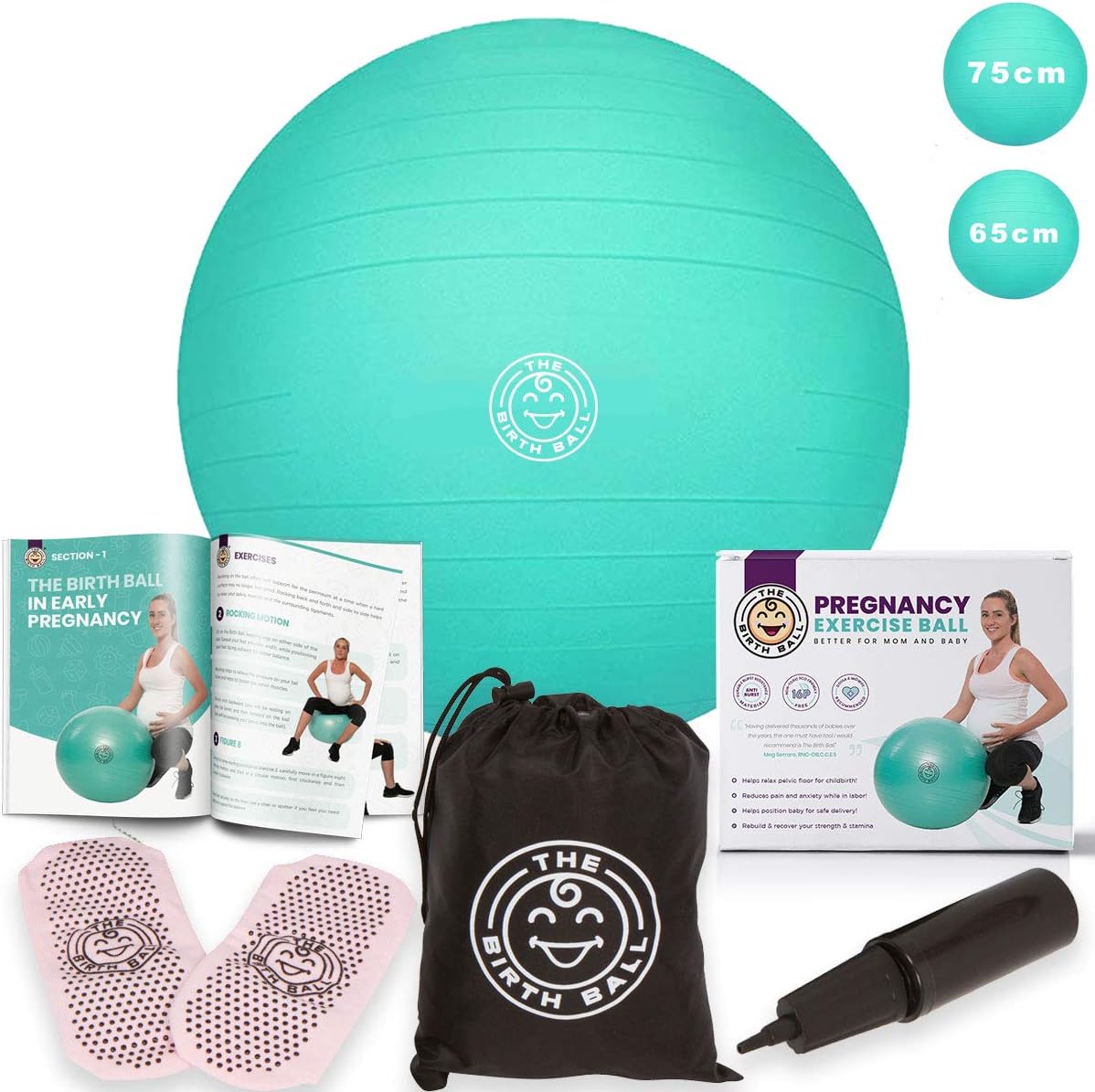
The midwives found me a birthing ball, but I still had a CTG strapped to my belly because they wanted to monitor my contractions and the baby’s heart rate, which was still high up on the 130/140 range.
We sat around and walked around a bit and I was advised not to eat in case I had to go to the theatre. I had a previous emergency c section and a planned c section, but I had made it very clear from the offset that I wanted to have a vaginal birth this time. I wanted to go as far as I could before the option of theatre had to come in. So I stuck my earphones in and listened to my hypnobirthing tracks. I kept concentrating on two chants I learned during my hypnobirthing course;
“Contractions are not that painful.”
“Your body can do this.”
I got into a rhythm of breathing in and out through the labour track while repeating the two chants in my head and I felt the process calmed me down.
Labour started and the pain increased steadily. The midwife asked me if I would consider having an epidural during this birth. I honestly didn’t know, but I said I would like the option. So the midwife brought the machine in.
The contractions were escalating now but I realised the pain was all in my back. I got really annoyed because I thought this baby was in an optimal position. I actually think she was in an optimal position until I got to the delivery suite because the contractions had changed drastically. I wasn’t feeling any contractions before 2cm. But, once I got to about 4 or 5cm, all of a sudden it felt like someone had stamped on my back and the pain was ongoing.
The midwife said she was going to try to turn the baby. So she got me to lie on the bed, which I didn’t think I could do because I was in so much pain. She assured me that lying on my side would take the tension off my back. She gave me some gas and air and told me to breathe in and out.
The midwife bent my inside leg and placed my foot on the floor and then she pushed against my back. She said we had to do this for three contractions and then we would turn to the other side.
It did feel like the pressure was off for a bit. The contractions were obviously still painful but they weren’t as painful as they were when I was walking around. When the midwife kept telling me to get on the bed, to rest a bit, I couldn’t. I couldn’t sit down, I couldn’t lie down. The only way I could lie on my side was when the midwife was pushing against my back.
We did that for three times each go, but when I had the next contraction, the pain was worse. She apologised for the manoeuvre not working. Well what can we do, I thought. It’s just the way it is. So I carried on trying to find a way to be one with the pain.
Then there was a shift change. A lovely very experienced midwife called Jo asked me whether it was ok to have a student midwife join and observe and I said yes, that’s absolutely fine – four eyes are always better than two in my opinion!
Contractions are real pain!
I was starting to struggle a lot. I thought this can’t be right, why am I not feeling anything in the front of my belly? Weren’t contractions at the front of my belly?
Jo said: “It’s because you’re having back labour. And, unfortunately, with back labour, things tend to take a bit longer.”
I thought, ok well I’m not going to let that cloud me. I had 3 days of back labour with Aron which was really intense and it ended in a crash caesarean, but Jo and Alicia were very positive that I was going to have my natural birth if I found a way to calm down.
“We’re still going to have our normal birth, don’t worry. Keep going, keep trying, keep breathing. Relax, stay positive, and breathe.”
I was examined at this point and I was 7cm. The last contraction felt like it had lasted five minutes, although it was probably only about 30 to 45 seconds. I tried to breathe through the pain and I had this system where I was shaking my hands as hard as I could to try and displace the pain. It worked until 7cm but then it stopped working.
From that point, I found it very difficult to keep the momentum of breathing through the pain and found myself holding my breath and tensing up. My husband kept reminding me about the chants, so I tried to focus back to the breathing and it worked for a couple of tries.
Epidural? Yes! A thousand times yes!
They asked me again if I wanted an epidural and I kept putting it off. I kept thinking, no I’m not going to do it. But when it got to about 7cm or 8cm, the pain had doubled, and they were getting stronger and longer. I found it too difficult to listen to the track, and couldn’t breathe through the pain anymore. It was getting to about 10.30 am at this point and hubby helped me by pushing and pressing on my back, as well as squeezing on my hips, which is what the midwife showed him to do. When the midwife asked again, “Do you want to try the epidural?” I said:
“Yes, 100% yes, I want to have the epidural NOW!”
The anaesthetist was running late; he had been called to theatre due to an emergency c section. The midwife apologised and I said no, no this is a blessing in disguise in some way. I had to deal with this on my own and I needed to find my way. So in a way, I was kind of glad it wasn’t there. But, at the same time, I was also thinking my gosh this is real pain.
So I must have got to about 8 cm, I wasn’t checked, but the contractions were coming hard and fast now and they were so painful. Then all of a sudden the anaesthetist turned up. The two midwives kept telling me:
“Come on, you can do it. Breathe! Breathe!”
They were really positive; they were breathing with me and rubbing my back. They were doing everything they could to try to get me to relax. And it worked for a while; I got into the zone a little bit. The anaesthetist again asked if I wanted the epidural and I didn’t hesitate. I screamed:
“Yes, I want the epidural! I can’t take this, it’s too much pain!”
I was given a button and advised that the epidural would need to be topped up every 25 minutes, although the pain wouldn’t necessarily come back in 25 minutes. So I was told to only press the button if I was in pain. So, from that point, I tried to challenge myself to not press the button as long as I could.
And sometimes I could feel the edge of the contractions coming back and then I’d wait for the next contraction before I pressed the button, or I’d wait until two contractions before I pressed. It was like my own private challenge to help me get through it. Plus, it was taking my mind away from how long everything was taking.
Every contraction gets you one step closer to your baby
I remember in the hypnobirthing course, Dani Diosi the course creator, said every contraction is getting you one step closer to your baby. So all you’ve got to think about is that you’ve done one, you’ll do another one and it’ll be one less than you’ll need to do. So I kept trying to think that way.
Every time the button came on I tried not to look at the green light. Jo advised me to be careful when I got to the pushing stage because I’d needed to stop topping up so I could feel the pressure to push.
I thought because I was still feeling the pressure of the contractions, I didn’t think it would make any difference.
Jo examined me and said I was at 9cm now.
Wow, that’s brilliant! I’d never got to 9cm before! I only got to 6cm with my first and my second was a planned c section, so I was in unchartered waters now.
I was so happy. I managed to get a little nap in as well and the midwives kept my mood up by joking around. At one point my husband said he was getting cramp from waving the fan to cool me down and Jo asked if it was ok to evict him from the birthing room or throw him out of the window.
I laughed and said:
“No he can keep fanning me, cramp and all!”
We joked briefly about how men think labour pain is like a toothache or adult colic and it relaxed me a lot.
We’re ready to push!
Jo reckoned in an hour’s time I would be at full dilation and once I got to 10cm, I was asked to rest a bit. When I got my contraction, Jo would ask me to push when I felt the pressure. Ok, I thought, sounds straightforward enough! So I topped up one last time, and we waited for about an hour. Jo checked me and said:
“Right, you’re ready to push. Let’s go! Wait for a contraction and then push down on your bottom.”
It was then I realised oh my gosh, it is really difficult to push without the pain or pressure because there wasn’t as much pressure as I thought there would be. I didn’t realise what Jo meant when she said it would be harder with the epidural.
Jo said, “Well 50% of women who have the epidural can’t push and 50% of women who can push end up with having an instrumental delivery because they can’t feel it.”
And I thought that was a silly mistake to accept the epidural in hindsight. If I had thought about what she had said and how difficult it was to push because of how desperately I wanted to have my baby naturally, I would have refused the epidural.
That was the first time I had kicked myself because I found pushing really difficult. I kept looking at the machine to check when I was having a contraction just in case because Jo said there was no point in pushing without a contraction because the baby wouldn’t come through.
So I pushed for about an hour. I didn’t know if I was making any progress, and I’m pretty sure I pooed at that point, but they didn’t tell me.
“Don’t worry, doesn’t matter, not thinking about it,” they said.
But I’m pretty sure I did.
Jo said, “Well baby is coming slowly but she’s coming.”
It got to just about before the hour, around 40 – 45 minutes when the doctor came in and said:
“Listen, at this point baby is doing absolutely fine, there is no distress on the heartbeat, contractions seem regular, and there doesn’t seem to be a problem.”
There was an issue at one point during the pushing stage when the contractions had faded a little bit and so Alicia brought a gauze with clary sage to trigger the contractions. I couldn’t have syntocin (to be induced) because of the previous births and risk of uterine rupture. So instead of syntocin, we went for something natural. The clary sage was so strong, but the smell was lovely. And it worked! The contractions came back really hard and fast, so I kept using the contractions to push as hard as I could and Jo kept saying, that baby’s making progress – just slowly.
The doctor continued, “We have to limit your pushing to an hour before we have to prep you for theatre in case the pushing doesn’t work.”
So the next part of the pushing had to happen in theatre and not in the delivery suite because the doctors had to make sure that if anything happened they could perform the c-section as soon as possible. The doctor examined the baby and he said that baby seemed fine. So they said to keep going with the pushing, but in about five minutes they were going to take me up to the theatre.
Off to the theatre
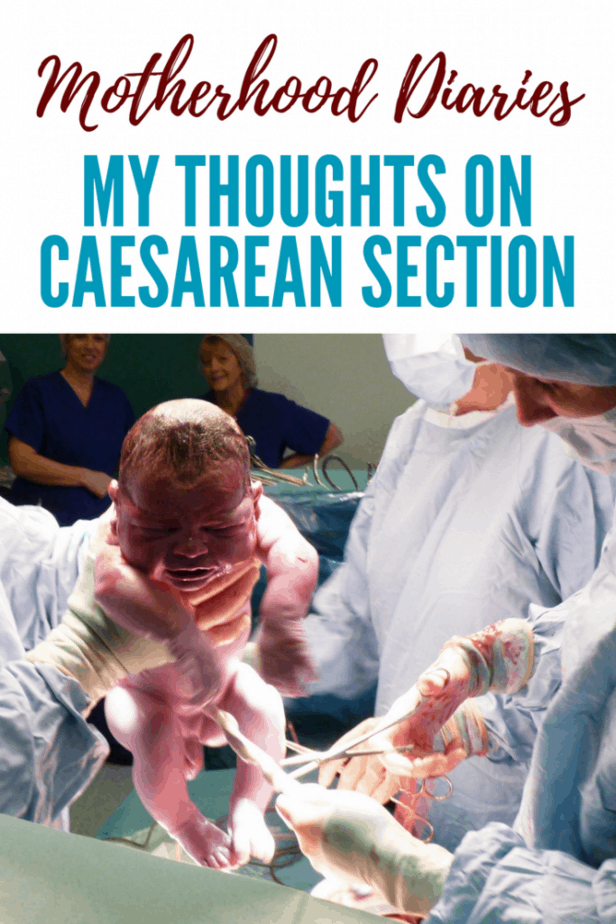
We got to the theatre and there were so many people there – so many staff and I didn’t know who they were. People kept coming and talking to me and they explained they were going to administer an epidural with a local anaesthetic so I couldn’t feel anything.
I had the checks done to see if the epidural was working and it hadn’t gone up to the chest – it’s a freezing cold test where they sprayed freezing cold water on my legs. The water felt warm until they sprayed on my chest which felt freezing cold. That meant the epidural was working fine. There was a situation earlier where on one part of my body, I could still feel the pain of the contractions so I was still taking in gas and air even though the epidural had kicked in. So Jo advised that the next time I topped up, I moved to the right-hand side of my hip so that the epidural drug filtered through.
In theatre, I was administered a local anaesthetic. The doctor advised that we were going to try pushing for a while, even though it wasn’t looking likely and we may end up with a c-section.
It was at that point I lost it. I just, I couldn’t hold back the tears. I was so upset that people kept asking me if I was ok. I said I really wanted to have a normal birth and at this point, this is where the two midwives really shone.
They really championed for me. I didn’t know about this but after the birth, my husband told me that the surgeon had been tugging with forceps to get the baby out. I tell you, it was even worse trying to push under a local anaesthetic. You have to try to remember the feeling of what it’s like to push, but you can’t push. I mean you cannot push!
But, apparently, it was working. Coupled with the local anaesthetic which made me shiver and feel weak, (I felt sick every time I pushed), I did everything I could to push my baby out. I had to push past the feeling of being sick, the feeling of shivering and the cold, which I later realised was down to low blood pressure.
She’s out! My baby is out!
So I thought I’m going to have to get through it, I have to push. So I did everything I could to push and finally, she was out. The relief I felt when they told me that she was out was just – it was euphoric. It’s something that I can’t explain:
“Wow, I did it! I pushed my baby out after two c sections!”
The baby wasn’t crying and she looked a little bit blue. The doctors took baby over to the examining table, straight away, and I could see they were moving her around. A few minutes later she started crying and my husband and I sobbed with relief that she’d made it. She made it through all the tugging and all this time she’d had a consistent heartbeat.
I had never felt so happy. The thought of managing a vaginal birth after two c sections was insurmountable, but I did it. I know loads of women have VBACS every day but I don’t care. For me, it was just the most immense feeling in the world.
I cried my eyes out thanking everyone in the theatre, especially the midwives.
“Thank you so much; you did it, you did it! Thank you, thank you!”
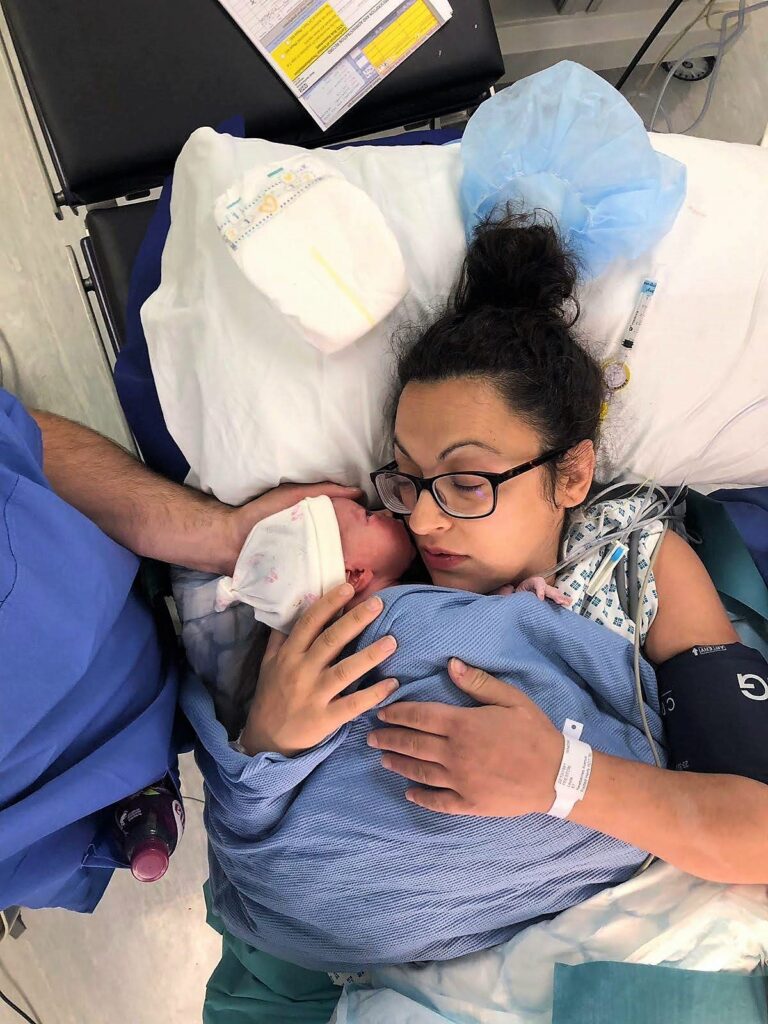
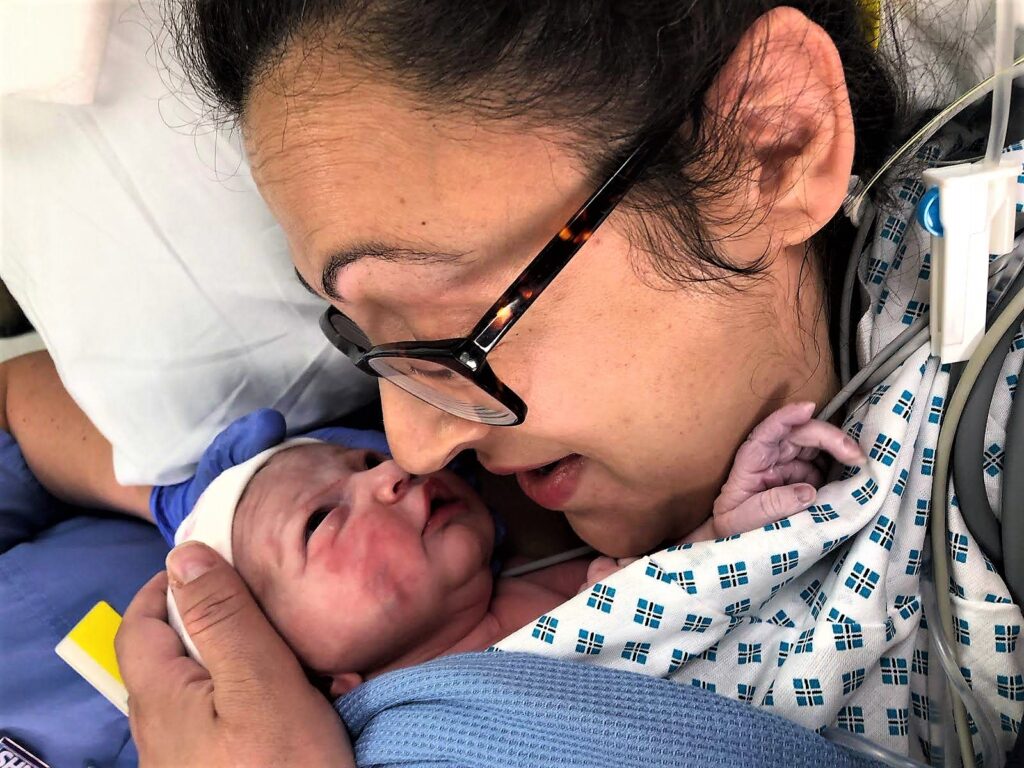
The surgeon congratulated me but mentioned it had been really tough. They had to do a forceps delivery, and I ended up with a second-degree tear and an episiotomy on each side. The midwife championed for skin on skin straight away, so while he was stitching me up I got to enjoy some really beautiful cuddles with my baby. I was so happy.
I noticed the bruises on her face from the forceps, but the doctor said not to worry as they will fade eventually. I was exhausted but I was immensely proud of myself, my body, my baby and the staff. Hubby was amazing at keeping me calm and focused too because there was one point where I thought I was going to lose it. But hubby stayed calm for me and talked me through everything. He was my absolute rock.
When they stitched me up, I got to enjoy skin on skin with my princess and they waited until the cord had stopped pulsing before they clamped and cut the cord.
They didn’t do any of the checks or weigh-ins until I had spent precious time with my baby and I thought that was amazing. It was in my birth plan, but I didn’t have to tell them that’s what I wanted.
“We don’t need to do the weigh-in checks, we don’t need to clean her now. Just put her on your skin and enjoy her.”
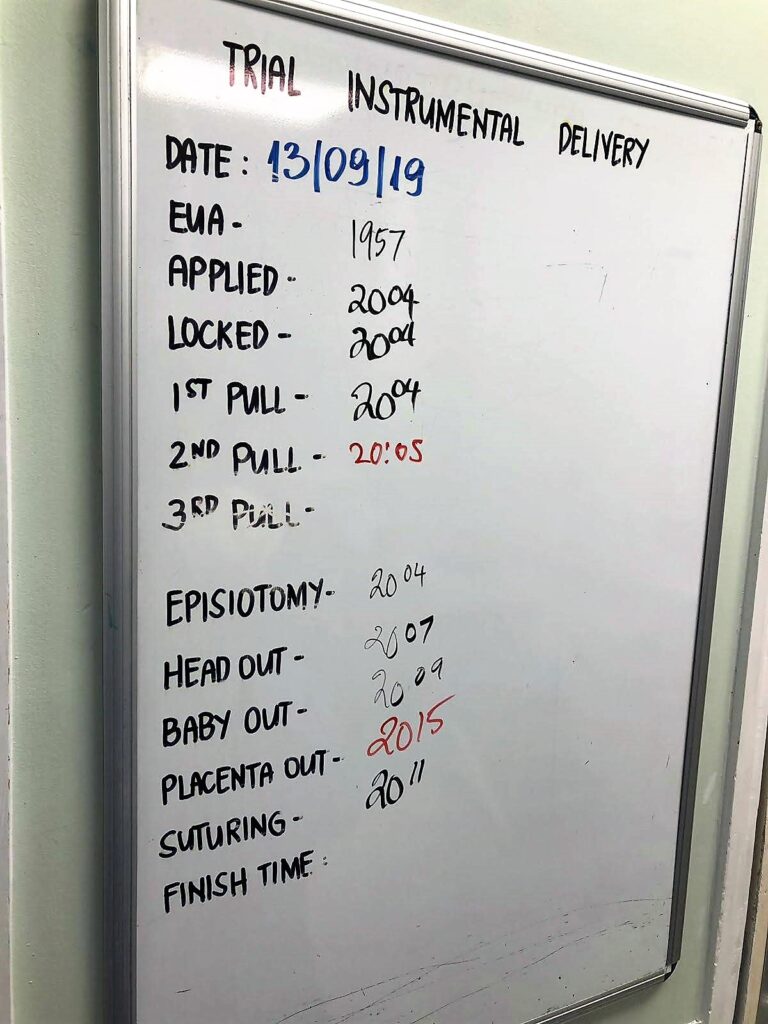
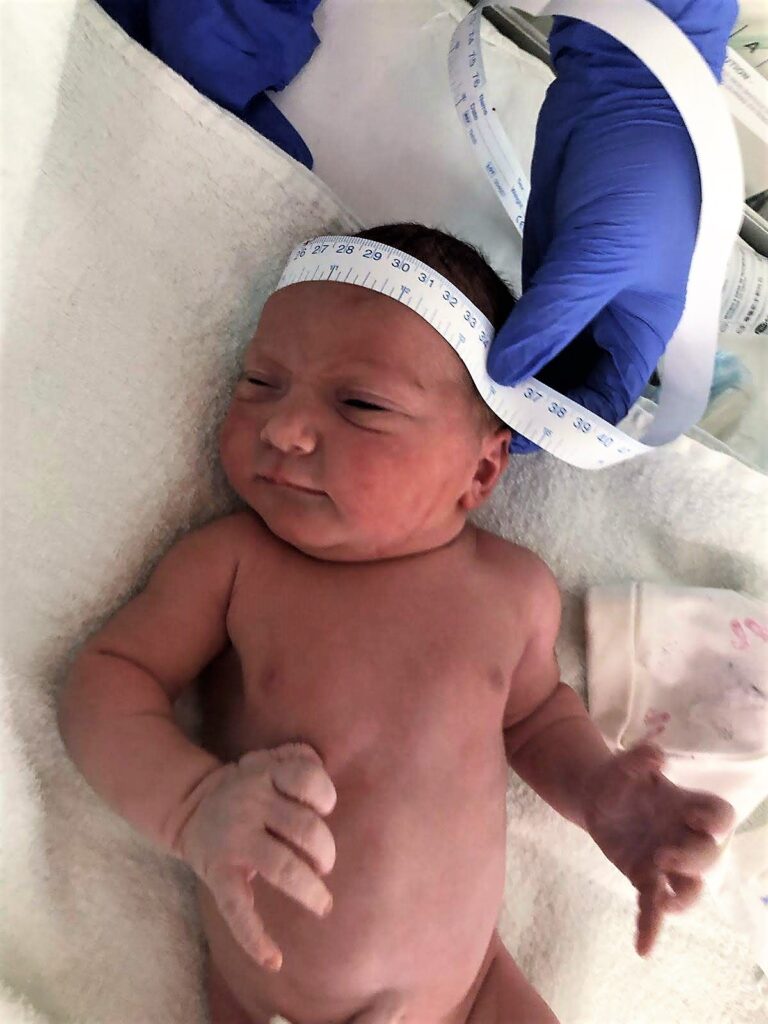
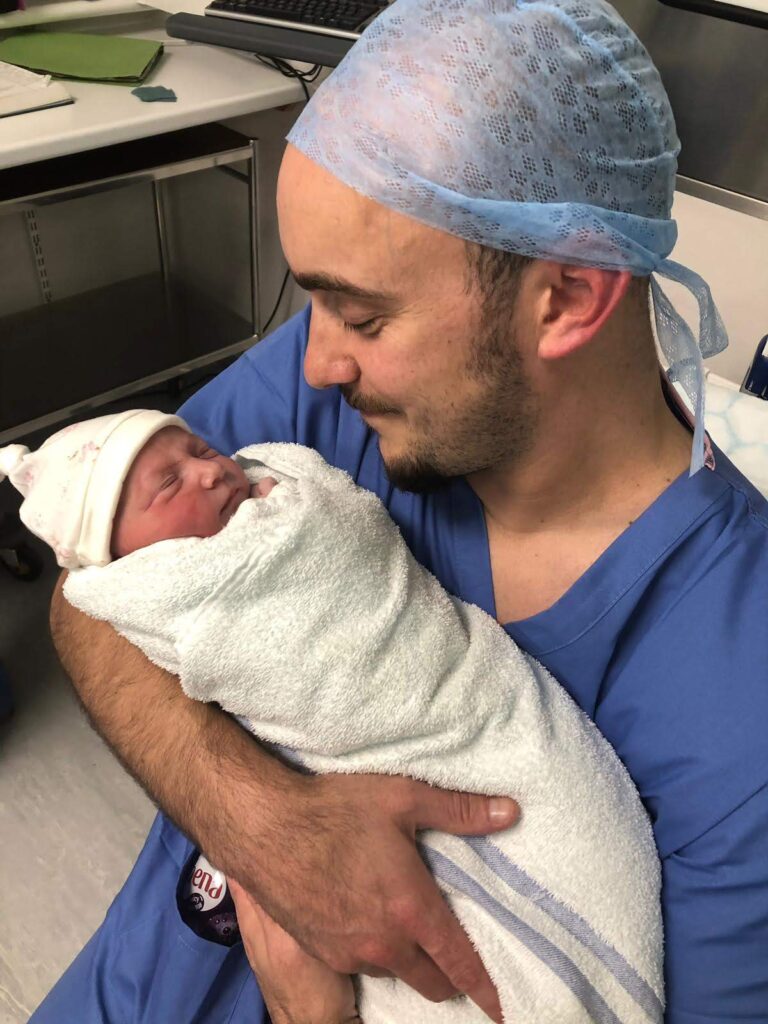
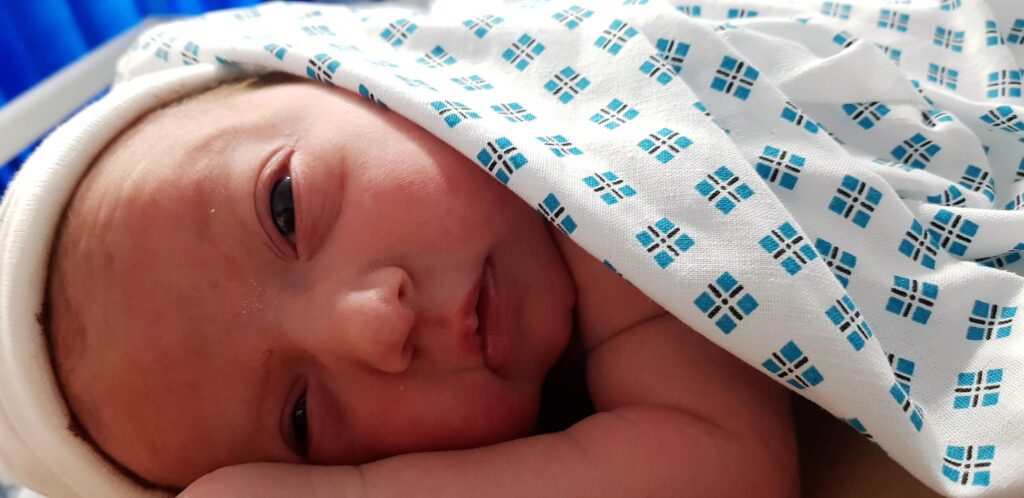
Baby was weighed at 7lbs, 7 ounces / 3.487 kg and born 39+5 weeks on Friday 13th September at 20.09. And, it was a fantastic experience!
I was wheeled into the labour ward as I was still under local anaesthetic, so I couldn’t feel anything in my legs. They put a catheter in me and I just relaxed with my baby. I was so happy she was there.
When the local anaesthetic wore off, however, oh my goodness! I was not aware of how painful birth really was! There was a swelling in my back passage, which the surgeon said I should take a look at because it could have been a prolapse. And, the afterpains, the pressure and the swelling was agonising. I couldn’t sit on my bum, I couldn’t do anything. They told me they had been giving me oramorph which was liquid morphine, but it wasn’t cutting the pain. It was getting rid of the vaginal pain but the back passage was just intense.
So, after many, many talks, the doctor decided to up the dosage. They gave me one small dose of epidural, which they tied to my back, and I scratched my back half to death because the epidural has a side effect, which is very itchy skin. I itched everywhere. It was so hot in the theatre as well, so I was sweating and so, so uncomfortable. I had also forgotten all about the bleeding aftermath.
I ate loads of food constantly. I didn’t know whether it was because of the drugs or breastfeeding, but I couldn’t stop eating. One of the midwives said I needed to let her know when I did my first poo. And I was like how the hell am I going to do my first poo, I can’t even feel that area!? She mentioned it was going to be tough because I’d had a bit of trauma down there.
I was convinced that I had over pushed and certain things had come out from the inside to the outside because of how swollen my back passage was. But apparently, you can’t overpush. The midwife assured me that the bottom will eventually heal. I asked her how long she thought it would take and she said maybe about 3 weeks; up to 3 weeks, depending on how quickly I healed. 3 weeks!? C section is 6 weeks!
She praised me again:
“Honestly, what you did was amazing, You would have not experienced the same if you had a c-section.”
She was right. It was all worth it. I had a beautiful baby out of it. So I told myself to take the pain. I’ll deal with it, just keep topping me up with painkillers!
The midwives kept asking about when I was ready to go to the toilet and and hubby desperately wanted to go home because the ward was so loud. I told him I didn’t want to go home until I hit the poo milestone, just in case I broke something else down there.
So I drank loads and loads of water, and thought about how I was going to pass this milestone with minimal disruption. The midwives advised just trying to pee first and then I thought, OMG how am I even going to pee!? The midwives took the catheter out and I thought just break the bullet; they won’t take the cannula out unless I pee.
It really wasn’t as bad as I thought it would be in terms of stinging but I was shocked at the lack of bladder control I had. As soon as I pulled my pants down it was free-flowing. I now needed to have a shower. But I thought, how am I going to have a shower!? I’ve got loads of stitches down there. The midwife told me not to use any shampoo or conditioner, I didn’t need it. I just needed to rinse off because I had been sweating buckets.
The epidural was taken off my back and it was such a relief to get all that tape off because it was so itchy. I was so sweaty, I’d actually scratched my back half to death! I had a really cold shower, which felt amazing. I felt so much better, apart from the pain downstairs.
As a result, I found it very difficult to sleep. But, the baby was amazing and she was so relaxed. We had a few problems with her latching on to the breast. She was a bit diva-like and couldn’t wait for me to show her where the nipple was – she had to have it now!
But while she was on she fed for ages and in her first night, she slept for six hours! The midwife asked me if I wanted to wake her up and I was like, do you know what? No. I think I’m just going to let her sleep, she seems fine. When she woke up, she was obviously very hungry, so I fed her again and she fell back to sleep. The poos took a while to come in but once they did she was pooing like a champion as well.
Off to the postnatal ward
The next day, I was wheeled into the postnatal ward. During the birth, I had lost 1.7 litres of blood, which is a ridiculous amount of blood to lose. I lost 900ml with my first, and 700ml with my second. I felt quite weak and lethargic – I really wasn’t feeling all too strong.
When I moved to the postnatal ward, I was prescribed iron tablets, lactulose so I could go to the toilet, co dydramol, and ibuprofen.
The consultants were worried that the oramorph was only working in the vaginal area and not in the back passage. How can liquid morphine not hit the pain in the back passage?
A consultant examined me to test whether something had happened with the epidural. They later deduced that the legs being on the stirrups may have caused some muscle tension or breakage near the hips, around the back passage and that could have been what was causing the pain. But whatever the reason was, it did not allow me to sit on my bum or lie on it.
So, I just had to lie on my the left side and very rarely on the right-hand side – it was so difficult. I couldn’t do anything. I couldn’t wait to get the next dose because the pain kept coming back.
That night my husband wasn’t around either, so I found that night really difficult. I was in a ward with two other hungry crying babies and I had to figure out how to get up off the bed, feed the baby, put her back in the cot, and then get back on the bed. So I was doing loads of ninja moves, by using my feet to control the height of the bed, the pillow area, the head area, and the headrest, and by pulling the headrest up to 90 degrees, to 45 degrees, or lying it down flat. But nothing worked. I was in constant pain.
The aftercare was amazing, though. The midwives regularly checked my obs. They also kept telling me my bloods were very low, so they might need to offer a blood transfusion. However, I said I preferred iron tablets instead, which was what I had been taking anyway.
The second night I told the midwives that my baby wanted to feed constantly and she struggled to sleep because of the other babies crying. I also found it quite hard because I couldn’t lie down with her, and I couldn’t sit up to breastfeed her. I had to do the advanced, lying-down-on-the-side breastfeeding move because I didn’t really have much of a choice.
I also found out that I couldn’t have any painkillers at night so I had to handle the pain until the ibuprofen came at 6am – I couldn’t have eaten it fast enough! Ibuprofen was the only thing that worked because it was anti inflammatory. So when I had ibuprofen, I felt relief. Actual relief.
I ate lots of food but I couldn’t go. I thought ok it’s not working so I am just going to just leave it and this really lovely midwife said to me that she’d experienced the same thing.
“Don’t push it; have Weetabix, prunes, and milk the next day and you’ll go.”
I ended up going the next day – and it didn’t hurt at all. We had lots of obs, and so did Ayla, which she passed with flying colours!
Our next-door neighbour’s husband constantly chatted on the phone in the middle of the night to his mum or family member and his baby was crying constantly. Then, when the husband went to sleep, he snored so loudly. I thought it was so selfish of him. We’ve got babies trying to sleep here and he’s chatting away throughout the night! Luckily Ayla like a champion slept really well.
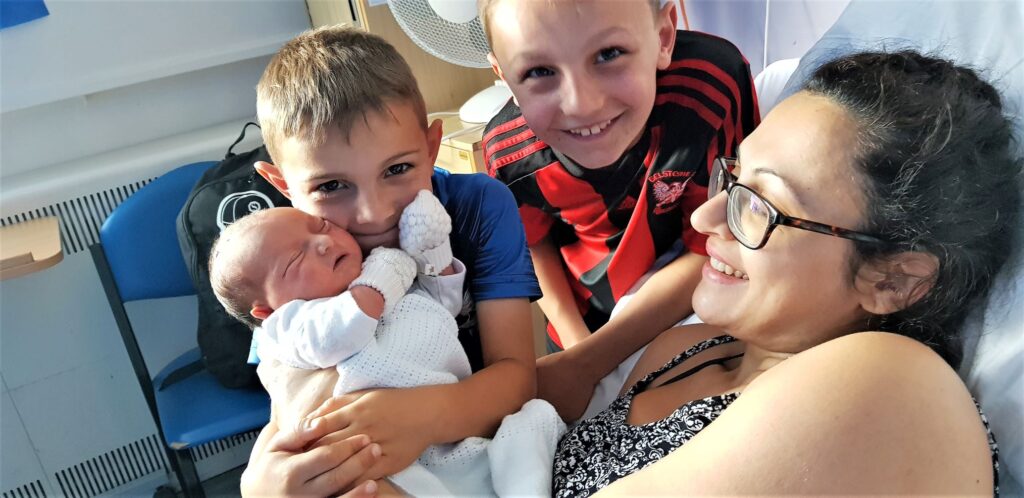
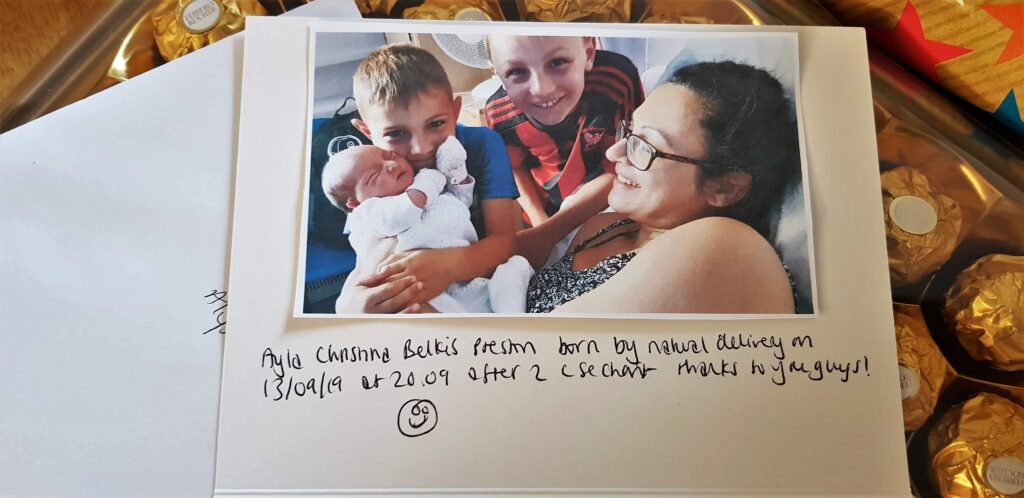
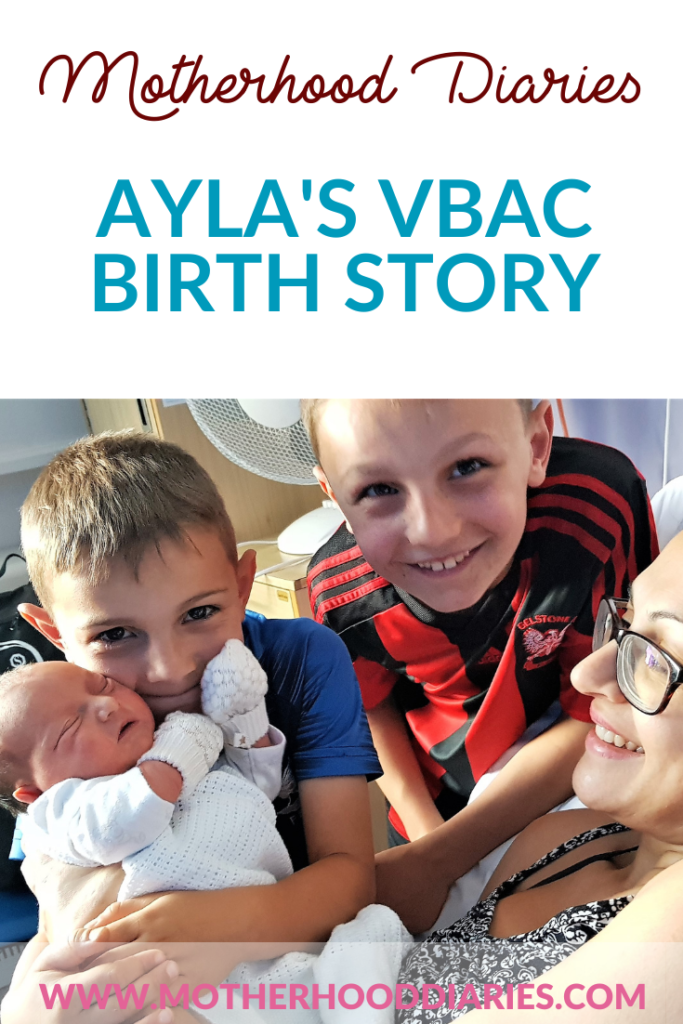
I still found it difficult to sit down on my bottom, so I slept much less. The boys came to visit me in hospital and we got a lovely photo in together. They also ate all my hospital food!
Off home – with a new addition!
We took a long time to be discharged and hubby was getting restless. But, the meds had to be signed off before we were finally able to leave for home. I looked like a state when I got into the car, wearing my husband’s clothes, no makeup, and hair scrunched up on my head. I also didn’t realise that I couldn’t sit on the seat, so I had to crouch. I asked hubby to get a towel from the back, which I turned into a ring cushion and that made it much better to sit down, although the pressure was still horrible.
The first three weeks were tough but I lived on the couch with my laptop. Hubby took time off from work and he and my parents did the school run for me. It was amazing to just sit and be with my baby and I have my support network to thank for that!
I realised how important it is to have a support network around you because it can turn an otherwise positive experience into a very negative one. Hubby had to inject me for 10 days with Enoxaparin to prevent any blood clots after birth and I had to continue my meds – there were so many I had to keep to a rigorous plan, so I wouldn’t forget. I used a cooling gel for downstairs which I placed on top of my really protective pads and that really helped with the soothing and healing.
And slowly but surely, I started to heal. I was told that you will know when you’re on the road to recovery when your stitches feel really tight. I felt that around 3/4 weeks. I hadn’t used any shampoo or conditioner until that point and it felt really good to use a mild detergent like Sanex to have a proper wash. I didn’t have a bath, though, just a standing shower to ensure downstairs was free from any chemicals. I was actually very strict with my aftercare and I think that helped.
The health visitor came to check me over and asked how my mental health was. I said that I was on top of the moon! I had a really positive birth and that was a lot down to the hospital being so positive too.
I since learned that the pain of vaginal birth was probably worse than the c-section and that it didn’t matter whether you had a vaginal or a c section delivery as long as it was made to be as positive as possible. Having had both now, it didn’t matter how our babies are born. What matters are that they’re happy and healthy!
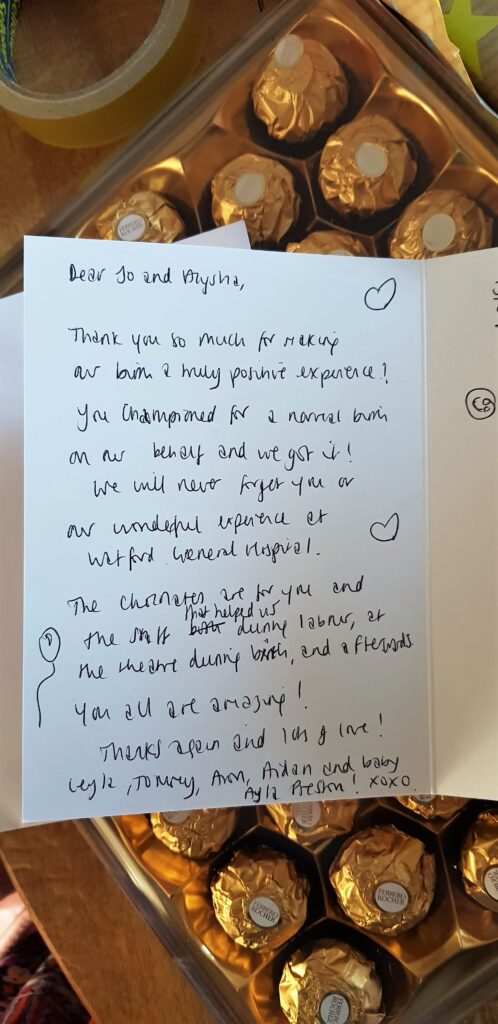
Thank you to Watford General Hospital for helping us achieve a really positive birth. We brought in some chocolates and a card to Jo and Alicia for being such amazing midwives throughout labour and birth.
A big thank you to Dani Diosi for the wonderful and very informative hypnobirthing course which helped me to think positive throughout my birth delivery and get me the positive birth I wanted and to Dr Verma for giving me hope in getting my girl. We did abandon the conception plan towards the end so it’s hard to know whether it was luck or whether Urobiologics helped me get my girl. Again looking back, it doesn’t matter to me anymore whether it’s a boy or or a girl. Being happy and healthy trumps all of it.
If you want more information on Dani Diosi’s hypnobirthing course, head here: mamaserene.co.uk
Don’t forget to read Part 1 and Part 2 of my Hypnobirthing series on how hypnobirthing works to achieve a positive birth.
If you want to learn more about how you can get the baby of your desired gender through non-invasive methods, head here: urobiologics.com
Click here for more birth stories (including VBAC stories)
After a very successful VBAC birth story, I welcome Ayla Christina Preston who was born on 13 September 2019 at 20.09, two days before my due date! Ayla is now 16 months old and a very active baby!
*Some links contain affiliate links where I may earn a small commission at no extra cost to you. As an Amazon Associate, I earn from qualifying purchases.*
Hypnobirthing techniques for a more positive labour and birth – Part 2
In Part 1, I introduced hypnobirthing and MamaSerene’s hypnobirthing course and discussed the effects of hypnobirthing on labour and birth. In this article, I will go through the hypnobirthing techniques that we learned at the hypnobirthing course to practice with your birth partner as early as possible and every day before labour kicks in, so you can apply these techniques to achieve a more positive birthing experience.
“A positive birth is the best gift you can give your baby… and yourself.” MamaSerene
At the beginning of the one-day course (from 9.30am to 5.30pm, with a few breaks in between), hubby and I were asked to write down three things that we were anxious about before our baby girl’s birth. These were:
The baby’s heart rate dipping and oxygen not flowing to the brain
The long labour causing damage to the baby in some way
During MamaSerene SereneBirth’s Hypnobirthing Course, Dani Diosi gave us a set of tools and techniques that you and your partner can use during labour and birth.
Before the course, which was attended in private at Dani Diosi’s beautiful home in Bushey we filled out an extensive questionnaire so Dani could get an idea of our birth history, where we were at during the pregnancy and how we felt about labour and birth in general.
I naturally wrote an essay, so I was very impressed that she retained all that information and applied it specifically to the course.
We started with Dani telling us the history of childbirth, which was fascinating and we were advised to read Ina May Gaskin’s, Guide to Childbirth to learn of its birth and progression throughout the years. We then talked about hypnobirthing and how it could help you have a more positive labour and birth, details of which you can find in Part 1 of this article series. So, let’s dig in to find out what you need to do to prepare for a hypnobirthing.
Introduction to labour and birth
Nature intends for us to procreate and even though reproduction isn’t for everyone, it is why we are all here in this world – to mate and continue our species like every other animal (even the asexual types who reproduce by themselves.)
In the natural world, the male and female are drawn together sexually, and the act of making love starts the procreation. During that act, there is no input from anyone else; the bodies know what to do and how to release the eggs and sperm, which then fertilise the egg and begin the road to pregnancy.
During pregnancy, the body instinctively knows how to grow the baby as long as mum keeps her body as healthy as possible or an unfortunate event such as a miscarriage/stillbirth occurs. Then, when the time is right, her uterus, pelvis and release of hormones are designed for her to birth her baby.
So, why does nature appear to fail us at the point of labour and birth?
Why do we experience excruciating pain, unplanned caesareans, and various birth complications?
And, why doesn’t this happen to other mammals?
Mammals are great at giving birth. If you’ve ever seen a cat give birth, the mother instinctively goes to find somewhere dark and quiet, and away from predatory danger. She appears to be relaxed, and she moans quietly and rhythmically until she births her baby.
We are all mammals – humans are more intelligent and sophisticated – and, our bodies haven’t changed physiologically in the last millions of years. The way our babies are born and our primal needs are the same as other mammals.
So why are our births so different?
The main difference is that we have developed much larger and more complex brains. We still have our primary/limbic part of the brain, but our neocortex, the part which handles intelligence, analysis, language, irrational fears and inhibitions are more developed, which means the neocortex ‘interferes’ with the ability for us to allow our body to take control of the birthing process.
In my article about anxiety, I talked about how our brains cannot distinguish between a genuine threat and a perceived threat, i.e. a tiger in front of us versus speaking in front of many people. In each case, adrenaline is still produced, which kicks off the fight-or-flight response, and the triggers aim to get you out of danger.
However, you are not in danger when you are speaking in front of people, but your brain cannot distinguish between the two. So, if a woman goes into birth feeling tense, her system will produce adrenaline and respond accordingly.
So what?
Well, let’s list out what adrenaline does to a woman in labour:
Oxygenated blood rushes away from the centre of her body, which means flowing away from the uterus and baby
The uterus doesn’t receive fresh blood, so can’t remove the lactic acid effectively
The muscle ends up hurting and becoming tighter
The baby is not receiving pure oxygen through the mother’s blood and so over a long period can become distressed
The muscles will tense up to prepare for the fight-or-flight response, which will affect her breathing and cause a lack of oxygen to the baby
Her body will think she is in a ‘dangerous situation’, and so her cervix will close, and labour will not progress
All the above is incredibly useful if there is genuine danger ahead, but many women who experience this adrenaline coursing through their bodies are not actually in danger. So, as a result, complications can occur, and the woman ends up with a negative birth experience.
If this birth situation continues for a while, then her baby can become distressed, and the cervix stops opening. The doctors and midwives may use terms like ‘not dilating fast enough’, ‘failure to progress’ and ‘baby in distress’, which causes more adrenaline and ultimately intervention to speed things up.
The care provider then gives the woman artificial hormones or chemical drugs, and her body stops producing the right amount of natural hormones. The anxiety, medical intervention, the embarrassment and the hostile environment all work together to cause adrenaline during labour. As a result, her body continues to pause labour because of the perceived danger and the rate of caesarean increases due to not being able to progress the birth.
Birth hasn’t just become like this. The stigma attached has happened over centuries and stems really from when religion came into being. Check out the image below from Dance of Life Midwifery, which shows the comparison between the Technocratic and Wholistic Models of Birth.
Understanding the physiology of labour and birth
To feel more in control of your labour and birth, you need to understand how the physiology works, i.e. the process that you will encounter during labour and birth. During the hypnobirthing course, my husband and I laid out a timeline from the first contraction to holding your baby to see whether we knew how the process worked.
It turned out that even though we’ve done this process twice before, we both still got it quite wrong!
We were provided with a lovely Path to Birth flowchart in our pack, which was designed by Kicki Hansard, and displays the stages of labour to birth beautifully:
Women should understand that birth is a process that unfolds slowly and the woman’s body responds according to the environment and support she has around her. Oxytocin, also known as the ‘love hormone’ is usually released at high levels when there are people around you who love and care for you. There are no clocks, no pharmaceutical pain management, and no regular timings of contractions. So it is important to start from a place of personal power and be made to feel in control of your labour and birth.
Understanding the risks to make more informed choices
They say knowledge is power.
So, having more knowledge of the obstetrical risks can provide you with that control you need to birth how you want to, whether that be a home birth or a caesarean. For example, when talking about risk, your birth provider might tell you:
“Remaining pregnant beyond 42 weeks more than doubles your risk of stillbirth.”
While the relative risk of stillbirth does more than double between 40 and 43 weeks, the absolute rate remains small – rare in fact.
The table above shows that 37 weeks would appear to be the safest week to induce labour to prevent most stillbirths. But the questions you need to consider – and ask – are:
What are the current known risks to the baby of inducing labour before it begins on its own
How is induced labour different from spontaneous labour?
Why do so many care providers recommend induction of labour at or near 41 weeks instead of at the end of 42 weeks?
And what exactly does ‘risk’ mean?
For example, there is a 1:1 risk or it is 100% likely that death and taxes will happen in our lives and there is a 1:1,000,000 or 0.0001% risk of dying in a fatal air crash. So if you look at the table above and we refer to the rate of stillbirth beyond 42 weeks again, you can see that even though the rate of stillbirth doubles, the actual rate of stillbirth is 2.13:1000, which is 0.213%! It doesn’t have quite the same buzz to it as ‘your risk doubles’, does it?
But what matters to you?
That is the real question. If the benefits of the medical intervention outweigh the risks, then opting for that intervention may be necessary.
But if the benefits and risks are unclear, then consider:
Are you ok now? Is the baby ok now? Then consider waiting a little longer before you act.
Is this medical intervention a routine procedure that the care provider offers everyone, or is there something unique about your situation? If it’s routine, then consider waiting a little longer.
Who benefits from this medical intervention now? Is it mum and baby? Or the care provider? If it’s the care provider, then consider waiting a little longer.
Asking these questions ensures you arm yourself with the right information before deciding, and a great way to make sure you are asking the right questions is to use a process called BRAINS:
Benefits
Risks
Alternatives
Intuition
Nothing
Smile!
What are the Benefits of medical intervention?
What are the Risks if I agree to the medical intervention?
Are there Alternatives that I can consider?
What is my Intuition saying?
What happens if I do Nothing?
Smile!
For example, if the care provider has recommended using artificial hormones like Oxytocin, to start labour artificially or to speed up labour, then note that this intervention interferes with the messaging system between the uterus and the brain and forces the uterus to do something it isn’t ready to do. And, because the brain is not getting the required information, the body stops producing the natural oxytocin and endorphins, resulting in more pain relief, which increases the risk of complications.
Of course, if it’s an emergency, then you need to let the medically trained professionals get on with it. However, if you (or your partner) ask whether you or the baby is in danger and they reply with ‘no’ or ‘we are not particularly happy with…’, then consider waiting a little longer. Use BRAINS!
Remember that all women and their cervix are different, so it’s important to weigh up the pros and cons of every decision you make about birth.
MamaSerene provides an in-depth handout at the hypnobirthing course, which goes into greater detail about each risk related to birth and is a great read for anyone who has been wondering about how to calculate risk.
So, now that you have more knowledge about the risks of labour and birth and the importance of relaxing through the process, below are some techniques you can practice at home to help you regain that control wherever and however you choose to give birth.
Breathing and relaxation
Breathing and relaxation is your biggest tool in the box because by nature, if you are breathing properly and in a relaxed way, you are not stressed or tense, and you are not initiating the fight-or-flight response. Breathing is going to make your contractions much more manageable, and encourage the hormones to do the job they need to do, which is to enable you to have a much calmer birth.
Again, it is important to note that hypnobirthing doesn’t guarantee you a natural birth – albeit it increases the chances, but it will help you have a more positive birth – even if you end up with a caesarean.
“If a birthing woman doesn’t look like a goddess – someone ain’t treating her right.” Ina May Gaskin
Breathing exercises
Hypnobirthing audio and music tracks
A great way to practice your breathing so that it feels more natural to go into a relaxed state during labour and birth is to listen to the hypnobirthing audio and music tracks, which are provided by MamaSerene in the hypnobirthing classes. The tracks help you stay relaxed by using post-hypnotic suggestions like “breathe, release and let go”, and when you hear these words, you are suggested to breathe deeply and let the tension go. You get three tracks, one which is all about Letting Go, which helps you to relax if you are feeling anxious about anything. It is also very helpful to listen to the Letting Go track when you are in early labour to make sure you are not holding onto anything emotionally.
The other track is a Labour Track, which you listen to when you are in the established/serious phase of labour. It helps you to focus on relaxing when contractions can get tough.
You are also provided with a track without the post-hypnotic suggestions so that if you don’t want to listen to the words, you can focus on the music. Dani Diosi also provides a track for those who are scheduled for a caesarean birth.
The MamaSerene vocal tracks provide those post-hypnotic suggestions to help you go into a very deep state of relaxation during labour and birth. Obviously, the more you practice, the easier it will be to go into this hypnotic state. MamaSerene advises you to listen to the tracks 2 to 3 times a week, building up to every day in the last couple of weeks of your pregnancy.
Avoid listening when you would normally go to sleep and remember that you may feel as though you are falling asleep during the relaxation session. But if you wake up at five (as MamaSerene counts from 1 to 5 to wake you up from the hypnosis state), then you are simply in a very deep state of relaxation. If you sleep, you are just giving your body what it needs. You can listen to any of the tracks during labour to help you stay relaxed and progress the birth naturally.
Practising breathing techniques with your partner
You can practice other great hypnobirthing breathing techniques with your birth partner as s/he will be your mouthpiece during the process of birth, which is why your birth partner should attend the hypnobirthing session with you so they learn what they would need to do to help you stay relaxed.
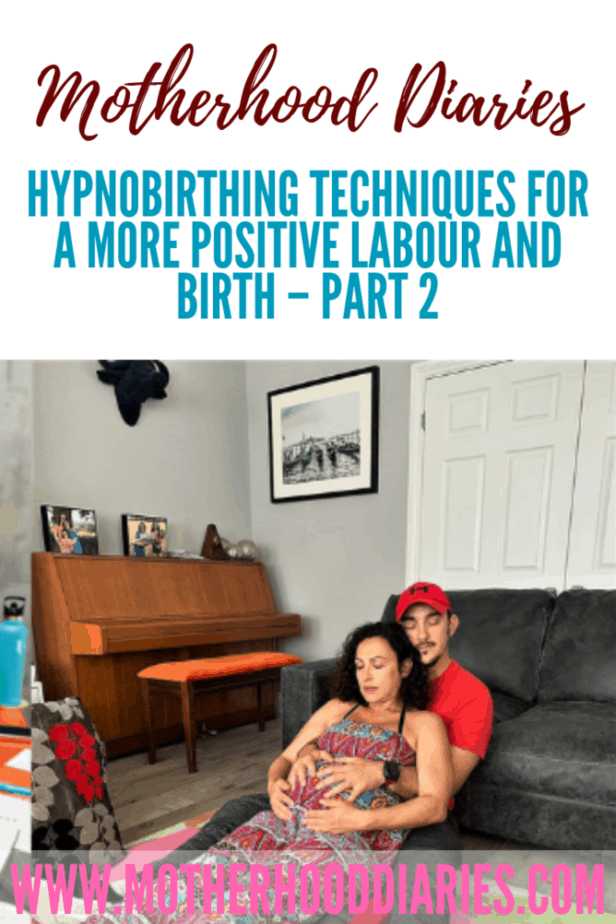
MamaSerene provides you with a handout containing two breathing exercises, one which is called Individual Breathing, where you sit together leaning against your birth partner. With your birth partner’s hands on your tummy, you begin by both relaxing and breathing gently. The exercise aims to notice the pace of your breathing. Did it differ from each other? Did you naturally breathe in sync with each other or were your breaths very different?
The second exercise is matching and pacing breathing where you sit together with your birth partner and this time your birth partner needs to pay attention to your breathing and match it in pace and breath. After a short while, you change to a more quickened breathing and your birth partner needs to exaggerate their breathing to encourage you to go back to breathing more deeply.
Matching and pacing breathing are great for established labour when you may lose focus, and your breathing will quicken. You want to stay away from adrenaline causing anxiety and focus on breathing deeply to encourage a more relaxed state, and you do this by matching your birth partner’s slow and deep breathing as much as possible.
A Positive Birth by DaddiLife Books* has an entire section dedicated to how dads can practice more breathing techniques alongside more relaxation scripts, anchors, and much more so they’re fully involved in the journey too.
Breathe, release, let go
Another way of encouraging the words, “Breathe, release and let go” to help you stay relaxed is to get your partner to say them when your breathing has quickened, and anxiety has set in during labour. If you have been listening to your hypnosis tracks, you should be able to use the post-hypnotic suggestions when the triggers words are said to go back into a deep state of relaxation.
Massaging techniques
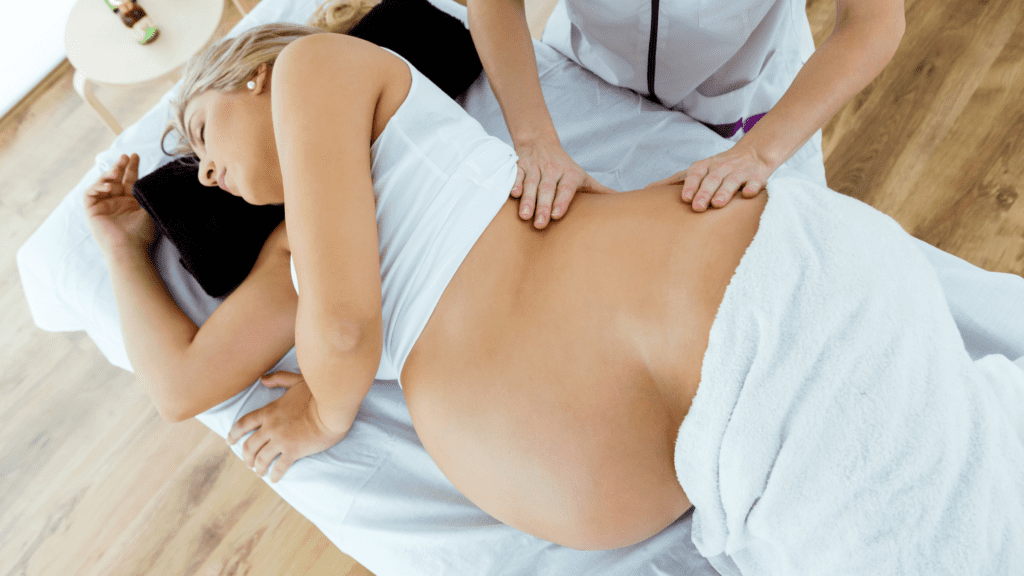
You may love a good massage during labour, or you may not want to be touched. But some techniques like a vigorous rub down your back, bottom and legs can relieve tension and release adrenaline when you are in the height of a contraction. MamaSerene has a great handout, which shows how your birth partner can massage your back effectively to release tension. Your birth partner can massage the shoulders, back and buttocks, upper back and sacrum during or in between contractions.
MamaSerene showed hubby how to perform the ‘Pressure Wave’, which helps to release tension in between contractions. Your birth partner starts by gently sweeping across the eyebrows, then moving onto the temples. Then they move down the body to the shoulders, tops of arms, forearms, thighs, calves and top of feet before they sweep off.
Positive birth affirmations
At the hypnobirthing course hubby was asked to stand up, raise his left arm and repeat ten times:
“My arm is weak.”
After the repeated chant, Dani Diosi pushed his arm down, and it fell against the weight quite quickly
He was then asked to repeat ten times:
“My arm is strong and powerful.”
And when she pushed down again, she found it a lot more difficult to move his arm. Hubby didn’t even chant the words with force or intention. It was enough to repeat the words for the psychology to work. Positive affirmations work in the same way – the more you repeat the words, the more your mind will believe it.
Positive birth affirmations are specific to birth, and Dani Diosi provided us with some flashcards to take home with us and practice reading out loud. My favourite affirmations are:
I trust in my ability to give birth
I am confident in my ability to give birth naturally
My body will give birth in its own time
I allow my body’s natural anaesthesia to flow through my body
The power intensity of my contractions cannot be stronger than me because it is me.
I am ready and prepared for childbirth
I relax so my baby can relax
I trust my instincts to do what is best for my baby
I am a strong and capable woman
Babies are born when they are ready, not when doctors, midwives or anyone else decides
Creating a nest safe enough to give birth
It is so important that we note how different a hospital environment is to our natural home environment and how important it is to create a nest to feel safe enough to give birth. Having your pillow, T-shirt or favourite smells can induce the feeling of safety and make the environment intimate and private.
The nest can be reproduced in a hospital if you’re not giving birth at home. The essence of a positive birth is to mimic a private, intimate, dark nest coupled with the deep relaxation and mindset to make childbirth much calmer and more positive – think of how cats do it! Some ideas on how to build your nest are in the image below.
Putting it all together when labour and birth starts
There are three main phases during labour, and your birth partner should know the phase you are in so that s/he can help you accordingly.
Phase 1 – Excited Mama
This first phase is where your birth partner encourages you to stay at home and sets the atmosphere by notifying others that the process has started. Your birth partner can also fix you a good meal to keep your energy levels up and entertain you until you head to the next phase. Contractions can last between 30 and 45 seconds, every 15 minutes. It is important at this stage that your birth partner matches your mood here.
Phase 2 – Focused Mama
You can still stay at home for this phase, but your birth partner’s aim is to now offer things without you asking for them, as well as counting through your contractions and putting some of the positive affirmations, triggers and suggestions that you have prepared before labour and birth into practice now. Your birth partner can use the massage techniques learned during the hypnobirthing course and other mental distraction techniques such as visualising your special place to encourage a relaxed state. But your birth partner should be led by you at this stage.
Phase 3 – Doubtful Mama
This phase is all about your birth partner encouraging and praising you that you are so close to the end now. Words like “You are doing so well,” “Your breathing is so effective,” etc will help to motivate you to carry on. Get your birth partner to use one-word hypnobirthing visualisation techniques like a holiday or a happy memory and get him/her to count with you through the contractions.
Phase 4 – Getting the baby out
Here, it is important to breathe the baby down rather than push the baby out. Breathing into the bottom can be more effective, so your birth partner needs to encourage you to breathe if s/he can see that you’re holding your breath and pushing.
Phase 5 – Delivering the placenta
Get your birth partner to encourage the support staff around to keep the place warm, quiet, and undisturbed, as well as leaving the cord until it has stopped pulsating before cutting it. Your birth partner is your mouthpiece so make sure s/he knows your birth plan inside out.
Other ways to help relax during labour and birth
Breathing, listening to relaxing music, building your nest and getting your birth partner to help are key ways to relax during labour. Below are some other ways to prepare for a more positive experience:
Moving around in labour
Lying on your back for any length of time defies gravity and can work against the natural labour process, so moving around will help your baby get in a good position. For some other great techniques, visit www.spinningbabies.com.
Water
Being in warm water during labour can feel enjoyable and relaxing. Opt for a shower, bath or birthing pool to help relieve tension and encourage relaxation.
Auditory stimulus
Focusing on sounds such as music, the voice of your birthing partner, or environmental sounds can help you to ‘vocalise’ the contractions through hums, moans and groans. It can be a really powerful way to release the tension and relax the body.
Mindfulness colouring
In the handout pack, we received a mindfulness colouring book containing pictures related to labour and birth. I took about 30 minutes after a stressful day to colour in one image, and it relaxed my mind. Colouring can take your mind off the pain and focus on the beautiful colours and patterns which can take you to your happy place.
Dani Diosi is a fantastically enthusiastic and very clued up professional, who knows more than most about the physiology of positive labour and birth. She is patient, understanding and personable with a mountain of knowledge on how to encourage you to have a more positive labour and birth. We finished off the course watching a lovely video of the hypnobirthing experience in real life (which you can watch here) – I can’t wait to have my own hypnobirthing experience in just a few weeks!
For more comfort measures during labour and birth and information on what I have discussed above, please visit www.mamaserene.co.uk and book your hypnobirthing course with Dani Diosi now. (07855 478 175 / dani@mamaserene.co.uk)
*We were gifted MamaSerene’s Hypnobirthing Course in return for our honest review and I can say, hand on heart, it was one of the most informative and eye-opening courses I have ever attended. I would thoroughly recommend you do book a course with Dani Diosi so you can learn how to have a more positive labour and birthing experience. You will not be disappointed!*
Hypnobirthing for more positive labour and birth – Part 1 – Hypnobirthing
When thinking about hypnobirthing one would be forgiven for envisioning a Paul McKenna or Matt Lucas lookalike who will hypnotise you to have a five-minute natural birth.
“Look into my eyes, look into the eyes, the eyes, the eyes, not around the eyes, don’t look around the eyes, look into my eyes. You’re under.”
The truth is hypnobirthing is about going into a hypnotic state, but not in the way you think. The stigma attached to the word ‘hypnosis’ stems from people’s perceptions thanks to media and well-known hypnotists like Derren Brown where it looks as if the subject is under complete control of the hypnotist and can be made to do embarrassing and scary things against their will.
This is not the case at all.
Instead, you are in a completely natural state, but you are still aware of what is going on around you. You have drifted off into a relaxing and suggestive zone, but you’re not asleep or under the control of someone else. It just means that your mind is unconnected to the activity that you are doing.
But, it all still sounds like hypnosis, right?
Yes, well, think about it like this.
When you drive to work or your kids to school, do you actively think about sticking your key in the ignition, placing your foot on the gas pedal, and driving from point A to point B? Or do you operate on autopilot?
Or when you’re making a cuppa, do you think about the process you go through while you are making your drink?
No, because you’ve done it so many times, you go through the motions like a robot. This is being in a hypnotic state.
Another example.
When you’re consciously trying to think of all the words to a song that you’ve heard many times, but you can’t remember them, and then, when the song comes on, you find you can sing all the words with ease. How are you doing that? You’re not actively remembering the words; you just seem to remember them when the song prompts you to dig out that memory.
One more example.
How about when you’re drifting off to sleep or you’re in the shower and you have the best idea for an article/project/song, etc? But when you come out of the situation, you were in you forget most of the vital bits of information because you forgot to write them down and now you’re trying to remember the details (I do this a lot, it’s so frustrating!)
In all the above situations, you were not asleep or under the control of someone else. Your mind drifted off to thoughts that were unconnected to the activity that you were doing.
You were in a hypnotic state.
So, how does hypnosis work?
Essentially, hypnosis revolves around the communication between your subconscious and your conscious mind, as well as the thoughts and actions that go along with them. The conscious part of your brain is the part which questions, analyses and rationalises things and situations. The subconscious part does everything else, i.e. stores the memories, emotions, physical functions, instincts, patterns of behaviour, language, and beliefs. Note in the image below how small the conscious part of your brain is, yet it is so powerful.
There are two different types of hypnosis and the one we dip in and out of naturally is called:
Natural Hypnosis
When we’re driving our car on autopilot and brushing our teeth, we’re in a natural hypnotic state and if nature had its way, we would live in a calm, non-pressurised society and be in a natural hypnotic state for approximately twenty minutes every hour and a half.
Intended hypnosis
Intended hypnosis is where you quieten the conscious part of your brain so you can communicate more effectively with your brain’s subconscious and emotional part. You use this type of hypnosis for a specific purpose, i.e. relaxation, pain management or overcoming a phobia or addiction. Intended hypnosis allows you to access the part of your mind that changes and reprogramming your brain to respond differently to a trigger (more on this later). It works when your subconscious mind is more receptive to relying on determination and will-power alone.
How and why does hypnosis work?
You can be taught to enter hypnosis because you are under your own control, and its positive effects are HUGE. Yet we have only scratched the surface of how beneficial being in a hypnotic state can be. There is growing clinical evidence to show the efficacy of hypnosis, where it has been scientifically proven to treat many medical and psychological conditions. Hypnosis works because:
It helps you to overcome your fears by re-programming your mind and changing your beliefs and patterns
It practices reinforcement of suggestions and creates new neural pathways
Post-hypnotic suggestions
Everything you do in life has a cause and an effect. For example, when the phone rings, you pick it up. When you’re thirsty, you reach for a drink. When you’re angry, you feel stressed, and when your baby cries, you instinctively want to pick him/her up.
A lot of your unwanted behaviour can also come from triggered responses that have been based on your experiences. For example, when you feel stressed, you eat, when you’re bored, you bite your nails etc. You may not even be sure why you have these triggered responses and, most times, you may feel it is nigh on impossible to change your reaction, which is why habits are hard to break. Hypnosis, unlike meditation, mindfulness, or straight relaxation, can allow you to go beyond the relaxation session and create major changes via post-hypnotic suggestions.
While you are in a relaxed, hypnotic state, the subconscious mind can listen to suggestive words and translate them into new ways of thinking and responding. This way you can help to retrain or reprogram your mind to provide a better/different response to the trigger, so a new cause and effect are created.
The hypnotic suggestions can be things related to what you’re doing during the hypnosis session, i.e. closing your eyes, imagining you are on a beach and relaxing your muscles etc. But, as real-life doesn’t allow you to close your eyes and relax as often as you hope, the post-hypnotic suggestions create the change and affect you need for when you are in those real-life situations.
(c) MamaSerene
And this is where the power of hypnobirthing comes in.
So, what is hypnobirthing and what has it got to do with helping you have a more positive labour and birth?
Notice that my title doesn’t say how hypnosis will increase your chances of having a natural birth because hypnobirthing, although it cannot guarantee that you will have a natural or an abdominal birth (I prefer MamaSerene’s word as caesarean sounds too clinical) it can increase your chances of having a positive birth. And this is not because hypnobirthing ‘hypnotises’ you to have a positive birth per se, but it encourages you to focus less on the pain of childbirth and more on the actual physiology of labour and birth itself by the power of post-hypnotic suggestion.
Intended Hypnosis allows you to do all the mental preparation for birth in advance so when you go into labour your body will automatically respond in the way you have instructed it to do, i.e. focusing on breathing and visualisation. And, as with anything, the more you practice, the more instinctive it becomes. The more you hear the post-hypnotic suggestions, the more your subconscious accepts them as reality, and when you go into labour (the trigger) the desired response will be quick and instinctive.
And THIS, my friends, is why the power of hypnotic suggestion during labour and childbirth can help you have a more positive labour and birth.
But first, you need to change your mindset so that you can start training your mind and body to work with you in labour and birth.
Mind over matter
My husband once suffered from terrible tooth pain and as it was a weekend, he could not have it fixed straight away. The temporary filling did nothing to ease the pain and by the end of the weekend, he had gone into a hypnotic state to get through it, via relaxed breathing and talking to his subconscious. He did this naturally (he would do wonderfully in childbirth!) but it literally was mind over matter that helped him manage the pain. He said that if he hadn’t gone into a hypnotic state, he would have gone mad.
The mind, if trained, can affect the body significantly, and a simple change in thoughts and emotions can stimulate the release of different hormones. Think about the physical responses you experience when you find someone attractive or the feeling you get when you watch a scary film. Have you ever shuddered at a distant, frightening memory? Even though these actions were not happening, a suggestion was made to the mind and body that manifested that feeling instantly and physically.
The same goes for someone like me who had a very traumatic first birth (you can find Aron’s story here), especially when I coupled the scary thoughts with all the negative connotations of labouring because of conflicting information on social media and the internet. I had a relatively peaceful second birth, but it’s my first that sticks out in my mind, even though it happened over a decade ago.
When you surround yourself with these negative images of labour and birth, it becomes part of your belief system which doesn’t come into fruition until you have babies of our own. Your thoughts race without even realising it, so the emphasis has to be made on reprogramming the brain and retraining it to believe that birth is a positive experience.
MamaSerene’s Hypnobirthing Course
This is where MamaSerene’s Hypnobirthing course comes in, created and run by the wonderful Dani Diosi, an experienced antenatal and childbirth educator, hypnotherapist and Doula – as well as a mum to three girls.
I received a lot of queries from pregnant women who wanted to learn more about whether hypnobirthing could offer them the birthing experience they wanted and were intrigued to find out whether I would try hypnobirthing in my 4th pregnancy to achieve my VBAC after two caesareans (I have one angel baby because of a late miscarriage).
I jumped at the chance and Dani kindly offered me to try the one-day course to help me retrain my brain to remove the negative aspect of birth because of my previous experience and think more positively about my impending birth of my baby girl.
If anything, I know that hypnobirthing teaches you life lessons, not just about how to experience more positive labour and birth. If you are aware of your negative thoughts in general, then you can change your behaviours from “I can’t” to “I can”. Funnily enough, it’s something I’ve tried to implement with my boys with very positive results. For example, “No, you can’t do that” or “Don’t do this” to “We can do it later,” or “if you do x then y will happen.”
The hypnobirthing course was fantastic and so very informative! We were provided with an extensive PowerPoint slide presentation all about the history of childbirth, and the stigma attached to labour and birth, as well as how hypnosis works to retrain the brain to overcome negative thoughts and achieve a more positive birthing experience.
We also practised some great techniques to help during labour and birth, like suggestive music, breathing exercises and massage that your birth partner can do during labour (in this case, hubby). And the great thing was that hubby got to learn so much more about the process of labour and birth and how he can help make it a more positive experience for me too.
The role of the birth partner during hypnobirthing is often not talked about enough, so you can also arm them with DaddiLife’s first ever book for dads on Hypnobirthing* recommended by The Royal College of Midwives. It’s packed full of information just for dad and contains a dad-specific toolkit to help him feel empowered along the birth journey.
We took away with us a handout full of great notes, along with a pen, notebook for notes and positive affirmations, which I’ll go into more detail Part 2 here: Preparing for labour and birth.
If you have any comments or questions about the above, please share in the comments below.
*I was gifted a hypnobirthing course by the lovely Dani Diosi of MamaSerene. It was a fantastic and very informative session and I would strongly suggest considering hypnobirthing if you are pregnant and you would like to explore natural ways of encouraging positive labour and birth. All thoughts are 100% my own.
*Links marked with a ‘*’ are affiliate links. As an Amazon Associate I may earn from qualifying purchases.
You are in your last few weeks of pregnancy, and you may be asking yourself, ‘How do I induce labour’ because you’re probably feeling a bit uncomfortable now. But, if your cervix is far back and there is no early sign that labour is on its way, then you may start to think of ways to induce labour naturally. But what are natural ways to induce labour quickly?
Below is a list and infographic of some guaranteed ways to induce labour naturally, as well as some old wives’ tales that are fun to try and some which may be best avoided.
Natural induction methods on how to start labour contractions naturally – Please pin to your board!
Walking
The motion of being upright while walking might help bring on labour as the gravity and movement will encourage your baby to place themselves in the correct position for birth, which is by your cervix. The gentle pressure of the baby’s head can stimulate your body to release oxytocin, which is a hormone that encourages contractions to start.
Make sure to take it easy during walking and don’t overdo it. The general rule of thumb is to maintain a conversation while you’re walking. If you can’t then you’re doing too much.
Also ensure you’re wearing the right walking shoe so you don’t end up with any unnecessary pain.
Reebok Women’s Club C 85 Walking Shoe, White/Light Grey, 8 M US – Buy from Amazon here*
Slow down and relax more
Getting labour started may be a tense process, but nothing will progress if you try too hard or you’re feeling worried. Relax, by getting some fresh air, having a bath, taking a nap or reading a book. Click here for an A-Z guide of relaxation techniques (and infographic) that you can also use to kick-start labour too.
Yoga – deep squatting
Squatting during labour is very effective because it helps to open your pelvic outlet by 10 per cent. But, when you’re inducing labour yourself, then squatting creates more room for the baby to move down into the birth canal, as well as decrease your labour time by 11 minutes!
Visualisation
Visualisation is a relaxation technique when you’re in labour, but it can also be used to psychologically trigger contractions. Draw a picture in your mind or on paper of what is going on in your body. Feel your cervix open and visualise the baby coming through. You can also look at pictures of a baby coming down and through the pelvis, but if you can imagine the process, then you’re helping your body to understand what it needs to do. It’s a very effective tool when you’re unsure of what will happen in the immediate future. Even using a picture or video of a flower opening can be a useful visualisation technique as well.
Eating curry or spicy foods
This one is an old wives’ tale, although some people swear by spicy food to induce labour. You can try it, but if you have a full stomach when you go into labour, you may feel sick and even throw up. Like the pineapple, too much spicy food irritates the bowels which may be why it feels like it can bring on labour. Just be careful not to overdo it, or you’ll end up with heartburn or indigestion.
Nipple stimulation
Some women massage their nipples to bring about the release of oxytocin, which is the natural form of Pitocin. Oxytocin brings on contractions, which can induce labour. Again, be careful with this technique as it has been known to lead to strong uterine contractions which can last for a long time and can cause the fetal heart rate to slow down. Most practitioners do not recommend nipple stimulation to bring on labour.
Again most practitioners do not recommend this technique because it can cause nausea, diarrhoea and sometimes vomiting, which can also lead to dehydration. Some women have mentioned that castor oil can help with constipation and when labour has stalled. After castor oil, women stated they could relieve their bowels and their labour progressed, leading to birthing their baby.
A recent study showed, however, there was no evidence of a difference between castor oil and placebo treatment, when related to instrumental delivery, meconium-stained liquor or an Apgar score of less than seven at five minutes. It’s best to err on the side of caution and leave this natural induction technique out.
Having sex/orgasm
Sex is one of the most popular ways to start labour. Semen contains natural prostaglandins, which is a hormone that is involved at the beginning of labour. After sex, elevate your hips to help the sperm stay on the cervix so that it can help to thin and dilate it.
Few women in late pregnancy are in the mood for sex, however, so simple foreplay can help too. Studies show that the female orgasm can open the cervix up to two centimetres. But don’t do it for too long as overstimulation can have counterintuitive effects.
Eating a pineapple
Like curry, eating a pineapple has very similar effects, in that the reason they are considered foods to induce labour is they irritate the bowels, so one hopes it will trigger the uterus to contract too.
This is an old wives’ tale and one I tried to no avail. But, pineapples are healthy and contain an enzyme called Bromelain which may be labour inducing. Try other tropical fruits like mango, kiwi and papaya as they contain traces of the enzyme too and might be considered labour inducers.
How much pineapple should you eat to induce labour?
Don’t overdo it or you’ll end up on the toilet!
Drink red raspberry leaf tea
Raspberry leaf tea is known to be a uterine tonic that also has benefits after birth too, including re-contracting the uterus back to its normal state, helping with bleeding, aiding breastmilk production and general recovery after childbirth. Women also drink raspberry leaf tea (as did I) believing it may help with shortening the length of labour. Studies have shown that there is no difference during the first stage of labour (contractions), but the second stage of labour (the pushing part) was shorter. There was also a significant reduction in using instrumental delivery as well. It is recommended to drink raspberry leaf tea after 12 weeks for low-risk pregnancies. But, as with anything, don’t overdo it!
Organic Red Raspberry Leaf Tea, Dried Cut and Sifted, All Natural, Raw from Germany, Support Immune System, Non-GMO, No Gluten, 2.2 Pound – Buy from Amazon here*
Traditional Medicinals Organic Raspberry Leaf Herbal Tea Caffeine Free 16 Bags Pack Of 3 – Buy from Amazon here*
Earth Mama Organic Raspberry Leaf Tea Bags for Labor Tonic and Menstrual Support, 16-Count (3-Pack) – Buy from Amazon here*
Massage/acupuncture
Trained massage therapists work on certain acupressure points (which are normally avoided during pregnancy) to help kick-start labour. A massage helps because it relaxes and calms the body, as well as eases any tension and worries. Make sure your therapist is specially trained, as certain oils cannot be used during pregnancy.
Acupuncture can help to bring on labour in overdue women, but only a few studies support this technique. However, one randomised controlled trial did show that acupuncture helped induce labour in 88% of pregnant mums. Acupuncture works by inserting needles into specific parts of the body, to stimulate the energy of a particular organ or system.
Other pregnant women have sworn by therapies like reflexology and shiatsu, but, again, they all help to calm and relax the body down. So as long as you’re with a trained professional, there is nothing wrong with going for a gentle treatment to rest before the storm of parenthood.
Blowing up balloons
Nope, your eyes don’t deceive you. Apparently blowing balloons builds pressure in the abdomen which apparently gets labour going. Again there is no evidence to show this, but it’s worth a shot as it’s not harmful and it could be quite fun–especially if you’re around a party on your due date!
Membrane sweeping by a midwife
Not my favourite of the bunch, I have to say, as membrane sweeping or membrane stripping can be uncomfortable. It’s not entirely natural either, but it is drug-free. Your midwife sweeps the membranes to separate them from the cervix via a vaginal exam.
Some spotting/bleeding may occur as a result afterwards, and it has been known for women to have irregular contractions after a sweep, which may or may not progress into labour. This method should be your last resort as it is invasive and not entirely natural.
Plus, you want to avoid any unnecessary bacteria in your vagina and your cervix as much as possible to prevent infection to you and your baby. Speak to your midwife/consultant first so they can provide medical advice about whether a sweep is suitable for you right now.
Thinking about getting pregnant (so soon)?
Arm yourself with our free starter kit to maximise your chances of getting pregnant as soon as you’re ready!
FAQ
How do hospitals induce labour?
If you’re being induced then you’ll go into the maternity unit and the midwife will start contractions by inserting a tablet (pessary) or gel into your vagina. The process of induction may take a while though, particularly if the cervix needs to be softened with pessaries or gels.
The process is not painful but you may feel some slight discomfort. You may be kept in hospital if you have prostaglandins and if you’re having your waters broken.
One study promotes nature’s plan and a normal birth by advising that unless there is a clear medical indication induction of labour will do more good than harm, nature beats science hands down.
Remember that inducing labour is artificial so there are some side effects, like intervening with the body’s natural processes to break the amniotic sac, taking medication or both. It can also lead to foetal distress and labour may take longer. Speak to your healthcare professional about the risks that come with induction and ask yourself whether induction is really needed to ensure the baby is delivered safely.
How do birthing balls help induce labour?
Sitting on a birthing ball in neutral wide-legged positions prepares the body for labour by increasing blood flow, opening the uterus and encouraging cervical dilation.
One randomised controlled study even found that labouring women with an epidural who used a peanut-shaped exercise ball had a significantly shorter length of labour and a higher likelihood of spontaneous vaginal birth. There were also no harmful effects identified to the mother and baby. The researchers think these changes may be down to the potential opening of the pelvis. So it may be worth requesting a peanut ball or birthing ball during labour and getting one to bounce on in the lead up to birth.
The Birth Ball – Birthing Ball for Pregnancy & Labor – 18 Page Pregnancy Ball Exercises Guide by Trimester – Non Slip Socks – How to Dilate, Induce, & Reposition Baby for Mom – Buy from Amazon here*
Why does intercourse induce a pregnant woman to give birth?
Intercourse can trigger the release of oxytocin, a hormone that helps your contractions start. Semen may also help to soften/ripen the cervix ready for it to open when labour starts. Semen has a high number of prostaglandins which are chemicals to help relax tissues in the cervix.
How to induce labour at 34 weeks?
The baby is still considered pre-term at this stage so I would consider natural induction methods carefully. Start by walking to places and staying upright but to avoid pre-term delivery I would start slowly at this stage.
How can you safely induce labour at 35 weeks pregnant?
Again, your baby is still considered preterm so start thinking about gravity-friendly methods like walking and bouncing on a birthing ball but try not to actively induce labour yet.
Is it safe to try to naturally induce labour at 36 weeks?
Another question asked was, ‘Is it safe to induce labour at 36 weeks pregnant?’
It is safe to start thinking about helping labour along at this stage, with walking probably being one of the best places to start. Relax and take it easy and labour will start when your body is relaxed and ready.
Is it safe to use castor oil at 36 weeks to induce labour?
According to the University of Texas Southwestern Medical Center castor oil can cause uterine contractions and irritation, but this could more down to digestive issues rather than actual labour.
Studies are mixed in concluding whether castor oil has labour-inducing properties but none of these studies examined issues of safety for mum and baby. So it’s best to speak with your healthcare professional and ask them for their advice before using castor oil to induce labour.
Can walking induce labour at 37 weeks?
Walking is a great way to draw the baby down into the pelvis because of gravity and swaying your hips. The pressure of the baby may then prime your cervix for labour and help labour progress if you’ve started contractions.
You may be offered an induction if your waters have broken at this point or a membrane sweep to kickstart labour. Both of these, unless medically necessary, are not natural ways to induce labour. So I would speak to your healthcare professional and get advice before considering.
Why would a doctor choose to induce my labour if I’m 38 weeks pregnant?
If you have any health conditions, i.e. gestational diabetes or pre-eclampsia then your doctor may advise labour induction as being pregnant may become a danger to your baby. Speak to your doctor and ask them why they are inducing labour at 38 weeks.
Now is the time to start trying the above methods and helping your body get ready for birth. Walking and using a birthing ball are my chosen methods!
Can you ask your doctor to induce labour?
You can but you need to ask yourself why. Is there a medical need for labour to start or are you just feeling uncomfortable? As mentioned above, artificial induction may bring with it side effects like longer labour. So unless medically necessary I would try the natural techniques first.
Why don’t some women go into labour naturally?
Some babies are overdue (my first was 1 week late and my second was 2 weeks and 1 day late!) Some women break their waters with no active labour in place. It is unclear why some women go into labour naturally and some don’t.
“If a woman has not gone into labour by 41 or 42 weeks, most doctors will elect to induce them to prevent the risk of a stillbirth… they may actually go into spontaneous labour, but there is a higher chance of having a bad outcome.”
Dr Laekisha Richardson, OB-GYN
What makes the Bradley method effective for natural childbirth? How is it better than the Lamaze method?
Dr Robert A Bradley developed the Bradley Method in the 1940s which is based on the idea that childbirth is a natural process. You simply increase self-awareness and learn how to deal with the stress of labour by tuning in to your own body. The emphasis is on normal, relaxed abdominal breathing and the loving support of a coach, which is usually the woman’s partner.
The Lamaze technique was also developed in the 1940s by Dr Fernando Lamaze and it focuses on the role of midwives in childbirth. It is one of the more popular techniques used in labour.
Both techniques focus on health and wellbeing to maximise a smoother delivery for mother and baby but the differences lie in pain management. The Bradley Method focuses on deep breathing and relaxation methods while the Lamaze method focuses on tools to help mother and partner conserve energy and ease discomfort as giving birth is a physical activity that requires both concentration and energy. Lamaze also focuses on deep breathing and pleasant memories.
The right method for you depends on your approach to childbirth. Your birthing journey is unique so you will naturally flock to a method that makes more sense for you.
Deep breathing and relaxation are key to helping labour progress as the body will go into survival mode and stall labour if you are scared and adrenalin is running high. Find a way to maximise those feel-good chemicals in the body. I found hypnobirthing to be one of the most effective ways for me and I ended up with a positive VBAC after two caesareans.
How can black cohosh pills help induce labour?
Women have been using plants and herbs to induce labour for a long time but are they all safe? Black cohosh is a herb that many women use for menopausal symptoms and it is possible it can induce labour but there isn’t much research on its effects in pregnancy and breastfeeding. Some studies show that black cohosh can trigger contractions, while other studies can’t see a clear link.
Do not try this at home by yourself. More studies need to show a clear safety link between taking black cohosh and inducing natural labour first before it is deemed safe to use.
I know it’s not long for you now, and you’re feeling quite uncomfortable, but it’s important to let your body do what it naturally wants to do. The above ways are not proven ways to go into labour overnight or even ways to go into labour tonight! Bt they may help you find ways of inducing labour naturally, only if your baby ready to come out. If they’re not ready, then they’re just not ready.
Try the above natural ways to bring on labour tentatively. If you’re feeling rushed through pressure from friends and family, remember that it’s your body and it’s your right to take things at your pace.
One afternoon (according to my journal it was Jan 30th, 2016), I was dancing with my toddler and 6-month-old when I was overcome by a sudden dizzy, nauseous, weak sensation all over my entire body. I distinctly remember that the feeling of weakness was so intense that for the rest of the day I felt completely out of it and continued to feel nauseous and very dizzy.
This was very hard to deal with, as I was a stay-at-home-mom of 2 under 2 with little help. I remember thinking I was only six months postpartum and still exclusively breastfeeding my youngest son, so I had yet to start my first postpartum period.
I decided that because I felt so odd and out of the ordinary I’d look at my fertility app where I had been keeping track of the times my husband and I were intimate. Although I didn’t have any data for bleeding or spotting logged into the app, I knew I had logged a day where my husband and I had not been as careful as hoped. So, I investigated and realized the day I felt weak, nauseous, and dizzy was exactly 14 days after my husband and I had our “accident”. This sent me into a state of panic. I was overwhelmed with anxiety thinking about what if I was pregnant? Was this coincidence or fate?
Just a little back story for you… Only 36 days prior, I felt weak, nauseous, and dizzy. Me, my husband, and both my sons were in a rollover accident in the snow. My husband, my oldest son, and I were all fine, but my son Sawyer was somehow ejected from his car seat and was found underneath the rear side passenger window buried in the snow.
After being flown to the nearest Children’s Hospital (a 40-minute flight) and thoroughly examined by three doctors, by the grace of God, it was found he only had a very small hairline fracture in his left femur. The stress, anxiety, and fear a parent feels when almost losing a child is traumatic. Saying this experience was disturbing feels like an understatement.
I explain this back story because it is important to understand that I was still coping and accepting what had happened only five weeks before. The amount of adrenaline that continued to pump through my system was intense.
After the day I felt weak, nauseous, and dizzy, I took notice of increasing symptoms, and the progression of the symptoms I had been experiencing before. After researching hCG, and the accuracy of pregnancy tests, as well as how some women don’t test positive until later into the pregnancy, I took three pregnancy tests throughout February, which all came back with a negative result. After more searches for “testing negative but still pregnant” or “pregnant with negative tests” I came across and became very active in the Cryptic Pregnancy Community.
In March, after I continued experiencing the same symptoms as well as began developing new symptoms such as tender breasts, stiff back, bloating, increased sense of smell, more acne, and belly growth, I began the exciting journey of documenting my experience on YouTube hoping to get the word out about this strange pregnancy experience.
At the very end of March, I began feeling flutters, pokes, and rolls which I thought was around the beginning of the second trimester. These sensations started sporadically and then progressed to become more frequent, regular, and varied in duration. As the phantom pregnancy (or pseudocyesis) progressed into the final months, these movements and feelings even responded to sound, light, and sugary foods.
At the end of April, after contacting some Cryptic Pregnancy Leaders and Administrators directly and being told I was, in fact, pregnant, I even became 100% convinced that it could be twins. Starting my YouTube Channel connected me to other women who also felt they were pregnant but couldn’t prove it. I began a direct correspondence with a few of them, sharing stories, hopes for the pregnancy, and validation of pregnancy symptoms and experiences.
By this time, May was around the corner, and my belly was measured to be around the right size for the gestation I estimated my unborn baby/babies to be. It was very round, firm, and noticeable. I had found a heartbeat, or what I had interpreted as a Fetal heartbeat, using an at-home Doppler. I was feeling regular round ligament pains, stretching, and pulling. My uterus felt very heavy and full.
I had about three months of research under my belt on how a Cryptic Pregnancy can happen. I had more than a dozen stories from real women who had shared their past or present Cryptic Pregnancy Experience with me personally. I knew this was happening to me, but most of all I knew this is exactly what was happening to my baby or babies, with no doubt!
No one knows my body better than me. Therefore, no one could tell me I was NOT pregnant.
That was until I laid waiting on the table in the ultrasound room exactly 28 days later…
I sent the email below to a woman who believed herself to be cryptically pregnant. She stopped correspondence before she updated me about the birth of her potential baby, so I don’t know what happened to her, which makes me sad. I hope she is well.
The email was written on May 20th, 2016, six days before I had an ultrasound, and seven days after a negative blood pregnancy test.
“Hello ____________!
Believe in YOURSELF! You know what is right for you. Trust your body!
So, I will be 20 (18) weeks tomorrow! Can you believe it? We have been in correspondence for a little over two months now! I will start pregnancy yoga on Monday, so I can deeply connect spiritually with these two little beings in my belly. I still think it is twins for a handful of reasons but the two major ones are: 1.) I feel distinct movement down low and high at the same time for about 4 weeks now and I am pretty sure the baby is not big enough then or now to be doing it alone. 2.) I found a heartbeat and hear movement with the Doppler on my left side (left lower quadrant) and on the right side (right upper quadrant)”
Something keeps telling me I’m having twins (boy-girl twins) just like something was telling me I was pregnant when I was trying to figure it all out. I also have this feeling it is a boy and a girl. We shall see!!!”
Six days later, I went in for my very, very, very anticipated vaginal ultrasound. The tech had me drink 32oz of water, strip from the waist down, and climb on the table. First, she used the abdominal probe to look at my entire abdomen and measure all my organs. After this, she proceeded with the pelvic examination and she inserted the vaginal probe. This is what I was waiting for with such anticipation. FINALLY, VALIDATION! I stared at the monitor beyond nervous to see my babies on the screen. I couldn’t wait to tell my husband and the world that I was right.
After about three minutes, I realized I saw nothing even close to resembling a baby. I saw nothing I had seen on the screen with my other babies. The tech said nothing except “your uterus looks normal” and she continued measuring my teeny tiny normal sized non-fluid filled baby lacking uterus. I felt so embarrassed. Defeated. Ashamed. Guilty. Vulnerable. Used. Wronged.
I hated that I was so sure I was pregnant. I hated that I was wrong. So wrong. I hated that my body had betrayed me, tricked me, played a cruel joke on me.
I was sent into a state of panic in my condition. I left the hospital and went straight to my doctor’s office. I couldn’t wait one more second. I needed test results interpreted NOW! My doctor had assured me she had requested the ultrasound technician to look for a baby or any signs of pregnancy.
I was sent on my way to cope and interpret my experience all by myself. After extensive research, I had found very limited resources for phantom pregnancy, and this is something I hope to change with the development of a website and my continued platform on YouTube and Facebook.
After I shared my personal story, health and ultrasound results with other women in the Cryptic Pregnancy Community, I was ridiculed, slandered, and blocked from these groups and profiles. One leader tried to convince me I was pregnant, but I had lost the baby before I had my ultrasound. She told me the baby had dissolved and was absorbed by my body, which is why I didn’t bleed, and the baby didn’t show up during the scan.
I was quickly shunned from the community that so eagerly validated my pregnancy suspicions but once I didn’t think or believe I was pregnant anymore these women who claimed to be just helping and supportive dropped me like a rotten potato about to infect the entire last crop!
So, I again took to social media after a few months of figuring it out, trying to cope with the news, and share my latest news across Facebook, YouTube, and Instagram.
I began educating, spreading awareness, providing support to women with phantom pregnancy cases and most importantly investigating the claims these women pass around as the ultimate truth in the Cryptic Pregnancy Community. I feel many women can relate to my story or experience, not only with falsely believing that you are pregnant but also having to admit that you were wrong to a few hundred followers, and, being misled and deceived by someone or in my case an entire community of men and women, who believe in their false pregnancy and who have an extreme desire in wanting you to believe that you are pregnant too.
If you have any cryptic pregnancy stories, phantom pregnancy stories, or you are experiencing phantom pregnancy symptoms then please visit Cristal’s Facebook group for support here.
FAQ
What is a phantom pregnancy?
A phantom pregnancy is an abnormal condition in which pregnancy symptoms occur because of the body thinking it’s pregnant but the woman is not actually pregnant. It can sometimes be called a hysterical pregnancy but some women also refer to the condition as pseudo pregnancies which is the false pregnancy medical term.
At this time, there is no definite answer to why there is phantom pregnancy in women, but mental health professionals believe it may be related to an intense desire or fear of becoming pregnant. There may or may not be a history of mental health issues or a life-changing situation which has caused this desire or fear. But it affects the endocrine system. which can cause fake pregnancy symptoms.
What are the causes of movement in your lower abdomen but you’re not pregnant?
The movement may be down to digestion, indigestion, ovulation or muscle spasm. A phantom pregnancy belly may be bloated because of an intolerance for certain foods which may cause gas. Visit here for more information.
Can you have a false pregnancy?
Another question asked was, ‘Can you have false pregnancy symptoms?’
False pregnancies, also known as pseudo pregnancy in women or a phantom pregnancy does not mean the woman is pregnant but may show psychological pregnancy symptoms. Therefore, you cannot have a false pregnancy but you may experience a psychological pregnancy which isn’t real.
Can you be pregnant for years – cryptic pregnancy?
A cryptic pregnancy is one that is missed by pregnancy tests and ultrasounds but some false pregnancy stories claim to occur because of an abnormally slow-growing foetus and gestate for years or even decades. You cannot be pregnant for years as this is physically impossible. Pregnancy lasts for a maximum of 42 weeks before health professionals will request to induce a pregnant woman or perform a c section if the baby doesn’t come naturally.
I have been thinking about VBACs, i.e. Vaginal Births After Caesarean. There is a very strong argument for allowing women wanting a VBAC to give birth at home or in a midwifery-led birth centre. Within the medical constraints of hospital care offered in the UK a home/birth centre birth would be strongly contraindicated and not encouraged.
If you think about it for a moment, a home/birth centre birth seems the perfect place for a VBAC. In my experience, most caesarean sections are performed when a woman fails at bringing on labour and during fetal monitoring, the baby is seen to be distressed by the long labour on the toco monitoring machine when measuring contractions. There are physiological reasons for this.
Going into hospital can be a stressful event, adrenalin will be secreted when a person is under physical or mental stress. Adrenalin (the hormone secreted by stressed people) attaches itself to the uterine cervix and prevents it from opening normally. So, when stress is a factor within active labour, expected progress will not be made due to the actions of adrenalin. The contractions will have to become stronger in order to pull up on a resisting cervix. How will this help someone having a VBAC? It will make a uterine rupture much more likely.
At home/birth centers however, a woman is much more likely to remain calm and in control. If she follows the advice on relaxation techniques then she will not secrete adrenalin and the cervix will be free to dilate. The contractions will not have to become stronger, as the cervix will not resist, and so they will remain at normal contraction levels. The first stage of labour, if conducted under the methods taught in my blog, will be pain-free.
When in hospital, a woman having a VBAC has to be continuously monitored (CTG reading) to detect any early signs of uterine rupture. She will most likely be confined to a bed with only brief breaks to visit the loo. Staying upright during labour helps the uterus work with gravity so that the contractions do not have to become strong. Lying down during toco monitoring will make the contractions become stronger and so will cause pain. The fact that she is not mobile will also impact on the descent of the rotating baby into the complicated anatomy of the birth canal.
At home/birth centre, a woman is free to move around and relax as her body dictates. She can eat and drink anything she chooses according to her body’s needs. She can remain upright and have the power of gravity which will encourage bringing labour on, rather than hindering it. The contractions will remain normal as her environment and mental state will be in harmony with her labour, instead of placing obstacles in the path of normal progress.
With the element of a pain-free first stage of labour, a home/birth centre birth can become a real option with all the benefits working toward encouraging normal progress. The only element that will prevent women from seeking out pain-free labour is FEAR. The fear of litigation. The fear that women are irresponsible little tykes that are all too willing to put their babies at risk. Hospitals will not support home/birth centre births for VBAC. But. They may support birthing on a labour ward that usually has at least one pool to birth in. Water births are so nice and gentle that no extra stress will be put on the scared uterus causing it to rupture, the contractions can remain normal. The midwife is still listening in every 15 minutes to the baby’s heartbeat on the fetal heart monitor, which will detect any adverse changes. Mobile CTG monitors are the latest thing at the moment – you can walk about or sit on a birth ball or even get in the pool as they are waterproof. The only trouble is they tend not to work very well and you will be constantly bothered by a midwife trying desperately to regain a lost signal!
Why using toco monitoring in labour for a VBAC is a bad idea:
Lying down on a CTG machine will cause the contractions to become painful as they work against gravity.
The pain will cause stress that will hold the cervix closed, which will make the contractions become stronger.
Not moving about in labour will slow the normal rotation of the baby.
Not eating in labour will prevent enough carbs from being available to fuel a contracting uterus, causing labour to slow down or stop.
If it slows down or stops, a drip may be started that will put extra stress on the scared uterus.
Everything we do in the hospital seems to be against helping women to achieve a VBAC. I know of a young lady who recently turned up at her local birth centre and was asked to leave as she was high risk. She calmly told them that she was going to labour in their pool and refused to leave. She had a normal delivery in their pool. Another I met was planning a home birth after a previous CS.
Let’s start a campaign today to allow women VBACs within a home/birthing centre setting. Let me know what you think?
I created this blog post after what Kirsty Allsop said about birth and parenting. On reading the articles myself I feel very familiar with many of her points. However, we have come to quite different conclusions. As a doula and AIMS member I strive like Kirsty for women’s rights to be respected and within that I want the care we receive to be appropriate for what each of us wants, not that birth be seen as so awful that we should just opt out and not that we feel there are no choices for fear of being judged.Anyway, with some time to consider Kirsty’s views on birth I wanted to revisit my own feelings after the birth of my son by Caesarean section.
C section recovery
Initially, I didn’t feel traumatised, or horrified. The recovery was a struggle and I felt disappointed and annoyed but mainly I felt angry. I was angry with others talking about their births, I felt left out and not full as a mother – I didn’t have this birth story everyone was sharing. I remember distinctly being so jealous of one friend as she described her labour and birth. She actually had a very traumatic and damaging instrumental birth but in my mind, at that time I thought that at least she had ‘birthed’, she had laboured spontaneously and her baby had come out the way he was meant to. So here I can understand Kirsty’s frustration that so many women feel like I did.
I was chemically induced (for no other reason than being almost 42 weeks) and after some other interventions due to my body ‘failing’ to progress (or baby not being ready to come yet) and my baby’s heart rate reacting to the epidural (that I was told to have to stop me pushing), I had an emergency c section. Some emergency c sections are urgent and life-saving. I do believe mine was necessary but I believe it only happened because of several elements that I felt I had no control over.
My overriding feeling afterwards was:
“Why does everyone keep looking at me with pity?!, I have a beautiful baby! It’s all fine! Stop pitying me!“
I remember thinking that society was wrong as I shouldn’t be made to feel bad about not having had a vaginal birth. That I wouldn’t have to feel bad about it if others didn’t. My feelings were that I hadn’t done it, I couldn’t do it. I didn’t work. I didn’t consider that actually what should and could change was the maternity system that I had my baby within.
Over the next 2 years, I spent time being disappointed, my c section recovery time was long because of an infection and anaemia. I coped with the emotional side by pushing it aside. When my son was 14 months old I fell pregnant for the second time. I told the midwife I wanted to go for a vaginal birth and not opt for an elective Caesarean. I knew this was an option but I didn’t look into it too much as I was absolutely terrified of being disappointed again.
However, I did start to read some resources when I got to around 30 weeks. Still, I wanted to go with the flow, but I realised that just going with the flow may not have been enough last time around. I could have said no to being induced, I hadn’t even been aware of the risks to the baby with being induced. I hadn’t known how alone I would feel and afraid on a ward alone in labour without anyone supporting me as I wasn’t considered to be labouring. Also, I had not been aware of the risks of the epidural and the Caesarean in relation to me and my baby. The risks of not doing these things were made clear at the time but not the risks of c section procedure. Having more knowledge and support may not have changed the mode of birth but it would certainly have changed how I was able to view the birth itself afterwards.
I sought out support from other women who had decided on a vaginal birth, I looked up the current research on the subject which all pointed to a vaginal birth still being safer all round than a caesarean. What seemed important in achieving a vaginal birth and avoiding unnecessary risky interventions was to have as minimal interventions to start with as possible. This was a battle, having had a previous caesarean the hospital protocol was to recommend (tell me) to have electronic fetal heart monitoring, a cannula sited on admission, restricted access to water for labour and time limits to prevent long labour. The research that these recommendations were based on was either limited or didn’t exist, it appears to have all come about the wrong way around. The technology was introduced and then they couldn’t take it away even though it never seems to have been proved to improve outcomes and there are many associated links to further interventions and other risks to mother and baby.
So….. I thought being informed was enough this time. I wanted to birth in the hospital with the NHS rather than at home and I had to fight my corner to request to be treated normally and not have the interventions unless needed. The previous caesarean not only affected my birth first time around but it was a major factor this time around also. I felt I had to change my community midwife to one who knew my rights and was supportive of me rather than telling what I wasn’t ‘allowed’ and I even found myself and hubby having a debate with staff in hospital during labour as to why I was wanting to have a mobile and active labour without straps and machines attached to me. I did have a VBAC, it was amazing and wonderful to birth my baby. But the support I had in labour was shocking, I was seen as someone who may or may not be able to do it. The hospital midwife was still doubting it 30 minutes before my babies head appeared. This is not good enough. The support we get in labour and birth is vital. However our babies are born, Kirsty is right, we should not feel guilty about it, but quite frankly I feel that often those working within the maternity system should!
Birth has no guarantees, and for some women, it can be truly traumatic, no matter the mode of birth. Sometimes birth is traumatic because of what happens to the baby or mother. What also often makes a birth traumatic is the support or lack of support a woman receives before during and after her labour and birth. This is what the focus should be, not the mode of birth or trying to control it.
Instead of campaigning that we should stop focusing on natural birth I support that we should be focusing on how to protect women in labour and how to reduce the number of births that are unnecessarily traumatic. If women automatically had a named midwife whom they knew and trusted (and could change if they wished) throughout pregnancy, labour and birth then this would automatically reduce so much intervention and importantly fear and guilt. Women would feel safer, the midwives would know the women and their history, midwives would be less dependent on machines and more dependent on their knowledge, skills and experience. This is what the M4M campaign is about, and you can read more here www.m4m.org.uk
Currently, in the UK we don’t usually have access to one to one care of this nature on the NHS. It has been called the ‘gold standard of care’ and has been proven to improve outcomes for women and babies but it is a long way from our centralised labour wards in busy hospitals. What we do have in the UK, are Independent midwives, who we hope will continue to provide care for women when new insurance regulations come in. Independent midwives may not be available to all (they are paid for by the client except in special circumstances where they have waived fees or been paid for by an NHS trust) But they are an amazing group of practitioners who not only have the right to practice independently but whom women have the right to access. To find out more and support the continued practice of IMs please visit here www.independentmidwives.org.uk
For those who support the idea of having a one to one midwife, can’t afford or access an IM there are also other regional changes taking place. In the north, there is a group called one2one midwives who are supporting women via the NHS in a one to one capacity. However, they too are facing constant challenges as the GP commissioning groups are not currently seeing women’s one to one care as a priority. As centralised maternity care has become the norm, birth centres, access to midwives for one to one care and home births seem to have become seen as expensive and unnecessary.
Well, I urge any pregnant women to seek information. Disappointment does not come from that. I’m not asking that we have huge expectations about birth and motherhood – what happens and how each of us experiences it is so different. But what we can have is expectations with regards to the level of care we should receive. What is available to you locally? What are the intervention rates of where you plan to give birth and how do you feel about them? How are you treated? What do other women say about their care? Are you spoken to with respect?
No, we cannot know how birth will turn out. But, we can expect support, appropriate care (for normal birth as well as for when intervention is truly necessary – which is more confidently ascertained when one to one midwifery is used) And all of this from a midwife who knows us, who is confident in normal birth not just machines and who is available to us when we have our baby.
This is not preparing for disappointment as I originally thought, it is not trying to ‘get an experience’. It is trying to reduce the likelihood of risky interventions, a traumatic birth or surgery and ultimately trying to ensure the safest birth for your baby which without other medical indications is still vaginally. For me, it is about trying to ‘not’ have an experience rather than trying to ‘get’ one.
Background reading
Tew, Marjorie, Safer Childbirth? A critical history of maternity care. 1998 NICE guidelines – Caesarean Section 2011 www.nice.org.uk/cg132 RCM Practice guidelines 2012
Pain Free Labour
Pain Free Labour Books on Amazon
The international best-seller Dean Koontz captured the essence of why we accept painful labours so easily when he wrote:
“Fear is the engine that drives the human animal. Humanity sees the world as a place of uncountable threats, and so the world becomes what humanity imagines it to be.”
In our dark dank past women were exploited. No surprise there then. They were not even allowed an education so that they could say “Hey, stop exploiting me you patriarchal society you”. We have had to fight tooth and nail for our relative freedom. The only battle that has yet to be won in the civilised world is childbirth.
Fear of childbirth has been instilled in us for hundreds of years. Doctors have made money out of us by keeping us in fear so that their services are needed to provide a medical model of care to help us birth. Early midwives were burned as witches so that women would turn to the medics in their time of need.
There are people on this planet that believe that the world is flat. Despite all the evidence to support a spherical earth, they still do not believe. Despite Aristotle, one of the first European thinkers to propose a round earth in 330 BC, who proved it by doing the math. Despite pictures from space that showed the awesome ROUND earth, they refuse to believe. “The world becomes what humanity imagines it to be.”
Modern health care follows blindly the belief in painful labours as the norm. There has been no research that I know of to support this belief. Within the UK we pride ourselves on offering evidence based practice and yet there is no evidence that uterine smooth muscle is designed to cause the sensation of pain when contracting normally. Yet we continue to believe.
Perhaps women want painful labours. Perhaps fear is the engine that drives the human animal. Perhaps we only feel comfortable when something we believe in comes true. Any other outcome would be too hard to accept, too big a paradigm shift for us to relate to.
Well tough. Get with the plan. Pain Free Labour has begun to seep into our belief system concerning childbirth. Midwifery led birthing centres are springing up all over the UK. Women are having pain free labours during the first stage when taught how to approach labour. Relaxation techniques are being learnt in parent craft sessions to keep women from entering the stress/pain cycle often seen in labour.
We are being allowed to learn the truth about labour now in the UK only because the strain on the NHS from medicalised care has become too much. A calm pain free labouring woman in a pool is cheap compared to a theatre full of expensive equipment and staff. The caesarean section rate has reached an all-time high. We have lost faith in our innate ability to labour naturally.
Two out of four of my labours were pain free. If I had not experienced this phenomena then I may well have been one of the supporters of offering elective caesarean sections for maternal choice. As a midwife I have helped countless women to have a pain free labour. As an author, I have explained in detail why uterine smooth muscle was never designed to cause the sensation of pain during a normal contraction.
So, who will join me in supporting the massive shift that we need in our belief system that will enable women to labour as nature intended; with medical support on standby if needed? Who will be brave enough to swim against the tide and face the wrath of humanity when one of their “uncountable threats” is removed leaving them uncertain and afraid? Who will take a leap of faith in order to free women from the last of society’s manacles holding us down? Who, maybe you?
Jack’s Birth Story
Mother: Rowena, 29 at time of birth
Baby: Jack , born May 2011, second baby
At my first antenatal appointment, my midwife asked me where I would like to give birth: at home or in hospital. Up until that point I hadn’t seriously considered having a baby at home, and I told the midwife that I was convinced that I would once again end up being induced at 42 weeks so I wouldn’t have any choice but to give birth in hospital. She said, though, that I could book a home birth to begin with, then if circumstances or a change of heart meant going into hospital, there would be no problem. What wouldn’t be possible, however, would be to plan for a hospital birth and then change my mind later. Well, after an unsatisfactory – to say the least – experience in hospital the first time round, I jumped at the chance of a home birth. I had only ever heard good things about home birth experiences, and the idea appealed to my inner hippie. What’s more, I was something of an ideal candidate: second birth, ground floor flat (i.e. easy transfer to hospital if necessary), address literally next door to the hospital and, as time went on, an uncomplicated pregnancy.
I actually feel that much of my ante-natal care was better as a result of my decision to opt for a home birth. Not only did I see the same midwife at virtually every appointment (in stark contrast to my first pregnancy, where it seemed to be a different face every time), I was also visited at home on a couple of occasions, making life much easier, especially bearing in mind that I had a toddler in tow by this point. There was one moment at about 34 weeks when the possibility of a home birth suddenly swung the other way towards a c-section as my baby was breech, but happily baby turned a week later following some bizarre alternative medicine and some gymnastics from yours truly. I hired a birthing pool, and it sat in my hall in a box for a month as the last weeks of pregnancy ticked by.
My midwife was determined that I would get my home birth. She believes in it and it also looks good for the maternity department if they can show that they really do give women the choice to give birth at home. She told me that she would have me referred for complementary therapies to bring on labour the moment I went over 40 weeks (something which had only become available at my hospital a few months after the birth of my first child) as I remained sure that I would be induced in hospital at 42 weeks, just like I was with my first child and my mother was with all three of her children. Not only that, she gave me a membrane sweep at 40 weeks, something normally given at 41.
Having been induced the first time round, I hadn’t experienced the natural onset of labour and, due to representations of labour and birth in the media, I rather thought it would take me by surprise. Not so. On giving me my sweep on my due date, my midwife informed me that I was 1 cm dilated and that she could feel the baby’s head. She said that she thought it would be very unlikely that I would be induced. A few days later, I went for my complementary therapies (massage, acupressure and aromatherapy – no idea if it works but it was very pleasant all the same!) and was given another sweep – by this time I was apparently 2cm dilated and 2cm effaced. The ‘show’ appeared later that evening so I cancelled my weekend plans as it was clear labour was imminent.
I’d been having odd contractions here and there for a few weeks, in fact, which was another clue that things would progress naturally this time. So when my contractions started at 1.00am Monday morning it was nice to know that it was now the real thing! My false ones had been strong enough to wake me at night too, but with all the other signs (not to mention the fact that I was a week overdue) I knew that baby was on the way. I had read all the advice about getting as much sleep as possible between contractions but I was far too excited to sleep! Not only that, the birth pool would require a good 90 minutes to inflate and fill so the advice was to get it ready at the start of labour, rather than wait until it was actually needed. My sister had arrived from the USA the previous day and was asleep on the sofa so I prodded her awake and set her and my husband onto inflating and filling the birth pool while I paced the room during contractions. We put ‘Back to the Future’ on and the next couple of hours flew by. Contractions got closer together but never really settled into a pattern. Nevertheless, I phoned (and woke) my midwife at about 4.30am as I was a little nervous about the baby suddenly coming and her having no idea that I even was in labour – particularly as this was my second labour (second ones being typically shorter than the first) and my first labour had only been 14 hours.
Well, I certainly jumped the gun on that one. 24 hours went by, during which contractions stopped and started, I got in and out of that sodding pool, my mum and foster brother dropped by for lunch, everyone managed a nap, we watched ‘The Wedding Singer’, ‘Blues Brothers’, ‘Austin Powers’ and documentaries about silent films and Burt Bacharach, Papa John’s pizza was eaten whilst leaning out of the pool, and my patience grew thinner and my energy stores shrank. I had a walk around the block to start things off again and not one but two midwives came and went – twice each. For about an hour early Tuesday morning I was kneeling over the sofa, a pillow under my head and knees, and a hot water bottle balanced on my back, asleep between contractions.
My 23 month old was desperate to join me for a paddle in the pool! The water was quite deep – and pretty murky by now – so he just leant over and dipped his fingers in. Although he was a bit worried by the sight of me hurting, just his very presence acted as mild pain relief for me. I think seeing him and touching him must have released endorphins or something. More consciously, he gave me something to focus on during contractions: I was able to tell myself, “that’s why you’re doing this; to get another one of those,” which made contractions seem shorter and more manageable. Things started to progress again in the small hours of Tuesday morning. Contractions grew closer together and my pain relief was augmented with the addition of portable Entonox canisters (surely one of science’s greatest inventions).
I was getting really fed up by this point. I’d been swindled! The second labour is meant to be shorter than the first! I really wanted someone else to take over for a bit, just so I could have a rest! I’d happily have taken up the reins again after an hour or so. Still the hours passed, but by dawn the midwives had unpacked their gear and contractions were getting stronger and more frequent. My husband and sister kept a note of the time of each contraction and over the course of the entire labour I had over 200. Yeah, ouch indeed.
The only bad aspect of giving birth in water was that I kept having to stand up to have the baby’s heart rate monitored as obviously the portable heart rate monitor can’t go in the water. So this meant standing up between literally every contraction. I did refuse once or twice. Having said that, sinking back down into the water was brilliant every time. I can’t explain just how good that felt. So I guess it evened out. Mind you, the relaxing effect of the water could quite possibly be what kept causing the labour to slow and stop, so I’m rather ambivalent towards it now.
At 8.30am Tuesday, after over 31 hours of labour, I decided I’d had enough of this, and it was time to start pushing that baby out. Apparently I wasn’t quite fully effaced yet, but the midwives said to just listen to my body and if it was telling me to push, then go ahead. My forewaters had broken but not my hindwaters (the pool was like a swamp by now) and with about three pushes of what felt like a bowling ball, the head was out, and had a cowl (membranes) over it. I have never put that much effort into a single moment before (even my first child was a ventouse delivery) and I felt myself tear in two places. It was a delicious and satisfying pain, though, like the scratching of an insect bite. The midwives flipped the membranes off the baby’s head and with one more push my enormous second child joined the family. My second stage had lasted just one minute.
Desperate to know the sex, I helped the midwife scoop the baby out of the water and immediately my eyes went between the legs. A second boy. As with my first child, I had seen the nappy area before his face! When I did look at his face, I did a double-take. He was like a clone of my first baby! They were so alike. “I’ve done it again!” I said to myself. I introduced Jack to the family and midwives and held him close to me in the water. He’d had almost as tough a time as I had and was a bit pale and floppy, but a few cuddles soon sorted him out. My mother missed the birth by about 15 minutes but arrived before we left the water. Jack was taken off to be weighed (9lb – “It’s a big one!” came the cry from the other room) and I stumbled, shaking, out of the pool. I asked for an injection to speed up the delivery of the placenta but was told that with a second birth the afterpains were likely to be very strong. It took a while, but eventually I squatted over an old washing-up bowl (I wonder what they’d have used if we hadn’t had one?) and delivered the placenta naturally. Apparently this too was a big one!
I lay back on my sofa to have my stitches done. Four lots of local anaesthetic were administered but not all of them took, and I screamed as I felt that needle go through me. I’m convinced that I made more of a fuss during my stitches than actual childbirth but witnesses disagree! The midwife also informed me that I had the wrong colour hair as it was the same colour as her thread and she couldn’t see what she was doing! Jack was returned to me at this point and lay down in the crook of my arm. He seemed to be rooting for a feed and I was keen to establish feeding quickly as I’d had trouble getting it off the ground with my first child and even had to give him some formula for the first few days. Jack knew exactly what to do though, and even though I was lying on my back, he squirmed around to find the milk. Once again, a midwife passed comment on a feature of my anatomy: “Look at those nipples,” she said, “they’re perfect!” Apparently I have ideal breastfeeding nipples, which was news to me, since I’d initially had such trouble first time round. So that was an interesting assessment of my body: big placenta, wrong colour pubic hair, perfect nipples. Excellent.
Jack scored nine on his Apgar at five minutes – not 10 as he never let out a big, lusty cry. At the midwives’ visit two days later we were still waiting for it! As I write this he is 8 months old and has been such a relaxed, easy-going little chap. I’m convinced that a large part of this is due to his entry into the world. He was born into his home, a place where I was relaxed and comfortable, his family were all there and we all spent his first night together in our room, with no staff or other families to distract us. If asked, I always say that that was the best aspect of a home birth. The contrast between the normal, restful surroundings of my own bedroom – lights out when I chose, my family within reach – and the traumatic, crowded, noisy and alien environment of the hospital could not be starker.
Predictably, I’m a real advocate for home birth now. Western hospitals are brilliant for saving the day when things go wrong, or might go wrong, but for a normal birth you can’t do better than staying at home. I never once felt I wasn’t in control (again, hugely contrasting with my first, hospital birth). What’s more, when I took Jack for his postnatal check a few days later, a doctor told me that the risk of infection at home is practically zero. I think people worry about cleaning up the mess of a home birth, but really, one’s partner, family and midwives can take care of all that! Anyway, you’re having a baby, you need to get used to massive amounts of mess, dirt and bodily fluids. I wouldn’t force anyone to stay at home to give birth if they really felt happier in hospital, but I do think women should make an informed choice. We all know a fair bit about hospital experiences but until you’ve researched home birth as well, how informed can you really say your choice is? If you’re reading this and considering your birth options, do look into home birth as, if you are able to give it a go, you’ll regard it as one of the best decisions and experiences of your life. I certainly do.