I am more productive if I chunk similar activities together so I’ll set time aside specifically for social media, schedule writing for a different time etc.
I think a really great way to be productive is to have your to -do list written out and on your clear and clean desk the night before. It means you start the day with absolute clarity of purpose.
Working from home can be distracting when you have a mountain of washing or other household tasks. I often take myself off to a nice cafe with free WiFi so I’m then totally focused on work. A good coffee and slice of cake is a good reward.
I make a list the night before my day off so I don’t procrastinate/waste time in the morning deciding what to do. I feel that way I get up knowing exactly what I’ve got to get done!
Don’t go for the false economy of not buying some of the productivity tools out there. The money you save not doing so is far outweighed by the increase in time you have if you use them. Tools like Tailwind, Buffer, Missing Letter are a godsend for me. And – have a set time to check your emails. Absolutely DON’T have it open all day distracting you.
Try and set certain tasks up the night before, such as the washing machine or dishwasher! By the time you then come downstairs in the morning, some of your tasks will already be done – resulting in more time for other tasks or a 5 minute sit down.
Starting something is probably the hardest thing to do, so the only way to start is, well, to start! Use the above tips to be productive at home, grab yourself a productivity pack like I did and start recording your habits.
Plan your goals and write out your monthly, weekly, and daily goals. Set yourself a target of 30 days to complete your habit and focus on tracking that habit every single day. After a few weeks, you will form your habit naturally as you have focussed on fulfilling that habit. I always feel amazing when I’ve had a particularly productive day.
You just need to find the motivation to start and what better time than to start implementing the ways to be productive now!
FAQs on how to be more productive with ADHD
How to be productive at home with ADHD?
Staying productive with ADHD at home requires creating routines, breaking down big tasks into small goals, and using productivity planners to stay on track.
How can ADHD people be more productive?
By using techniques like the Pomodoro method, prioritising important tasks, and limiting distractions, you can improve your productivity.
Can ADHD contribute to increased productivity and creativity in individuals who do not take medication for the condition?
Yes, many people with ADHD find they have bursts of creativity and productivity, especially during periods of hyperfocus. Medication isn’t always necessary for everyone.
How do I create a routine that sticks for someone with ADHD?
Start by setting small, achievable goals and using tools like task lists, timers, and accountability partners to build habits over time.
What strategies can a person with ADHD use to stay organised and remember tasks in their daily life?
Using visual cues like sticky notes, brain dumps, and productivity apps like Trello or Todoist can help you stay organised and on top of tasks.
How can people with ADHD use digital tools to create a more productive daily routine?
Apps like Trello and Notion offer visual task management, while timers like the Pomodoro technique help break the day into manageable chunks, making it easier to stay focused.
Are adults with ADHD more intelligent or creative?
Some research suggests that people with ADHD can be more creative and thrive in environments that reward innovative thinking. Hyperfocus can lead to impressive productivity in certain areas.
What are some ADHD productivity hacks for staying on task?
Using the Pomodoro method, limiting distractions, and working during peak productivity hours are all excellent ADHD productivity hacks.
*Collaborative feature post*
I feel more productive if I put my phone down… I get so easily sucked into irrelevant things on social media that I lose track of what I’m doing and feel like I have to start again. That goes for both work and at home. Once I sit down and just have 5 minutes, I don’t want to get up again.
I am definitely more productive if I stop working for regular breaks. I either do some housework, walk the dog, go for a run or swim or simply play the piano or read a book for 5 minutes. I’m much more able to properly focus on what I should be doing afterwards.
I am more productive if I chunk similar activities together so I’ll set time aside specifically for social media, schedule writing for a different time etc.
I think a really great way to be productive is to have your to -do list written out and on your clear and clean desk the night before. It means you start the day with absolute clarity of purpose.
Working from home can be distracting when you have a mountain of washing or other household tasks. I often take myself off to a nice cafe with free WiFi so I’m then totally focused on work. A good coffee and slice of cake is a good reward.
I make a list the night before my day off so I don’t procrastinate/waste time in the morning deciding what to do. I feel that way I get up knowing exactly what I’ve got to get done!
Don’t go for the false economy of not buying some of the productivity tools out there. The money you save not doing so is far outweighed by the increase in time you have if you use them. Tools like Tailwind, Buffer, Missing Letter are a godsend for me. And – have a set time to check your emails. Absolutely DON’T have it open all day distracting you.
Try and set certain tasks up the night before, such as the washing machine or dishwasher! By the time you then come downstairs in the morning, some of your tasks will already be done – resulting in more time for other tasks or a 5 minute sit down.
Starting something is probably the hardest thing to do, so the only way to start is, well, to start! Use the above tips to be productive at home, grab yourself a productivity pack like I did and start recording your habits.
Plan your goals and write out your monthly, weekly, and daily goals. Set yourself a target of 30 days to complete your habit and focus on tracking that habit every single day. After a few weeks, you will form your habit naturally as you have focussed on fulfilling that habit. I always feel amazing when I’ve had a particularly productive day.
You just need to find the motivation to start and what better time than to start implementing the ways to be productive now!
FAQs on how to be more productive with ADHD
How to be productive at home with ADHD?
Staying productive with ADHD at home requires creating routines, breaking down big tasks into small goals, and using productivity planners to stay on track.
How can ADHD people be more productive?
By using techniques like the Pomodoro method, prioritising important tasks, and limiting distractions, you can improve your productivity.
Can ADHD contribute to increased productivity and creativity in individuals who do not take medication for the condition?
Yes, many people with ADHD find they have bursts of creativity and productivity, especially during periods of hyperfocus. Medication isn’t always necessary for everyone.
How do I create a routine that sticks for someone with ADHD?
Start by setting small, achievable goals and using tools like task lists, timers, and accountability partners to build habits over time.
What strategies can a person with ADHD use to stay organised and remember tasks in their daily life?
Using visual cues like sticky notes, brain dumps, and productivity apps like Trello or Todoist can help you stay organised and on top of tasks.
How can people with ADHD use digital tools to create a more productive daily routine?
Apps like Trello and Notion offer visual task management, while timers like the Pomodoro technique help break the day into manageable chunks, making it easier to stay focused.
Are adults with ADHD more intelligent or creative?
Some research suggests that people with ADHD can be more creative and thrive in environments that reward innovative thinking. Hyperfocus can lead to impressive productivity in certain areas.
What are some ADHD productivity hacks for staying on task?
Using the Pomodoro method, limiting distractions, and working during peak productivity hours are all excellent ADHD productivity hacks.
*Collaborative feature post*
I realised quite late in life that I could have ADHD, even though all the signs were there from as early as I could remember. During my childhood, I was told I’d either distract people or get distracted. The teachers couldn’t handle me. I had bundles of energy and I never slept, so my parents struggled with me, too. It was only when I channelled my energy into music and sport that I realised I needed extra tools to manage daily life.
As a fully-fledged adult, I procrastinate when I should finish a deadline, complete a household chore, or even when I read to the kids before bedtime. Tackling household clutter can feel overwhelming, but starting with practical steps can make a huge difference. For instance, if you’re managing a major decluttering project, you might consider looking into how to rent a home cleanout dumpster that allows you to efficiently clear large amounts of waste and regain control of your space. Procrastination has become the biggest bane of my life, so staying productive can be challenging, especially when I have several distractions around me.
It’s safe to say we all experience procrastination in varying degrees when trying to manage everything. The Internet and social media have made it that much easier to waste time rather than get things done. Now I am a busy mum of four with (undiagnosed) ADHD and, at the best of times, it can feel like juggling plates while walking on a tightrope.
Whether it’s managing the house, the kids, or even your own business, staying productive while ADHD symptoms demand your attention is tough. So, this article is mostly geared towards those, like me, who work from home and juggle parenting and work duties, often at the same time, but with the added nuance of ADHD. From breaking down tasks to using accountability partners, here are 60 top tips on how to be more productive with ADHD. Let’s get stuck in!
What is productivity?
To be productive, we need to know what productivity means. Businessdictionary.com defines productivity as:
“The measure of the efficiency of a person… in converting inputs into useful outputs. Productivity is computed by dividing the average output per period by the total costs incurred or resources (capital, energy, material, personnel) consumed in that period. Productive is a critical determinant of cost efficiency.”
So, in essence, productivity basically means how efficient you are at what you are producing and what you receive economically as a result, i.e.output per unit of input. So, the more productive you are, the more chances you have of increasing your value.
What about productivity at home? Being busy vs productive
In simpler terms, productivity means using your time and energy effectively to achieve your goals. So, if the tasks you are working on are low-value or at the expense of high-value tasks, then doing something doesn’t always mean you are productive. The primary aim of being productive is to know exactly what you should spend your time, energy and attention on to improve yourself and your family around you.
Why does being productive matter?
Consider what it would be like if you could achieve all the high-value tasks you needed to complete in a shorter period, so you have more time to spend with your family. Perhaps productivity will allow you to use your energy on the things that make you happier or even work on tasks that will help you improve your work and home life.
Having something productive to do at home means that you can manage your daily tasks effectively and still increase your health and wellbeing. And at work, being productive means that you can improve your way of living and earn more income to spend on the things that make you happier.
So let’s dig into the tips on how to be more productive. Even if you don’t have ADHD, these tips will work for you too:
Tip 1: Break down big tasks into small goals
We’ve all been there – staring at a massive to-do list and feeling completely overwhelmed. For me, that feeling of being paralysed by the size of a task used to be my biggest barrier to getting things done. What I’ve learned is that breaking down big tasks into smaller, manageable goals is a game-changer. If you’re staring at a mountain of laundry or an overwhelming work project, don’t think about the whole thing. Just tackle the first small step. Before you know it, those little steps will add up, and you’ll be making progress without feeling buried under the weight of it all.
Tip 2: Use a timer (Pomodoro Method)
Let me tell you, the Pomodoro technique is like a secret weapon for ADHD productivity. The idea is simple, but so effective. Set a timer for 25 minutes and focus on one task during that time. Once the timer goes off, take a 5-minute break to reset. I use that little break to grab a coffee, stretch, or just give my brain a breather. After the break, I jump back in for another 25-minute sprint. It’s amazing how much you can get done with this method. Plus, those little breaks are perfect for recharging without losing momentum.
Tip 3: Find your peak productivity hours
Are you more productive in the morning or late at night? For me, it depends on the day, but I’ve learned that knowing my peak hours makes all the difference. If I didn’t have to do the school runs, I could work into the early hours of the morning. But, now I have to be up at 6am, so I find the period just after drop is off my most productive time to check off the most challenging tasks.
The idea is to work with your natural energy levels instead of fighting against them. If you know you’re sharper in the morning, use that time to tackle your most important tasks. If you’re a night owl, save the big stuff for the evening. Understanding when you’re at your best can help you make the most of those bursts of energy.
Tip 4: Keep a task list
I live by my task list. Without it, I’d probably forget half of the things I need to do. Whether you use a simple to-do list or something more structured like a Productivity Planner, having your tasks written down is a lifesaver. Not only does it help you stay on top of things, but there’s also something incredibly satisfying about crossing off completed tasks. It reduces stress and keeps everything manageable.
Tip 5: Use a brain dump
Sometimes, my brain feels like it’s running a million miles a minute, especially when I have a lot on my plate. That’s where a brain dump comes in handy. I just grab a piece of paper or open a productivity app and jot down everything that’s swirling in my mind. Getting it all out helps me focus on what’s most important without constantly being distracted by random thoughts or worries. It’s one of the best ways to clear mental clutter and stay productive.
Tip 6: Use an accountability partner
If you struggle to stay on track, an accountability partner can work wonders. It could be a friend, a family member, or even a colleague. The idea is that someone checks in on your progress, keeping you accountable. Knowing that someone will ask how you’re doing can give you that extra push to stay motivated. I’ve found it especially helpful when I’m working on long-term projects or tasks that feel overwhelming.
Tip 7: Limit distractions
Let’s face it: distractions are everywhere, especially when you have kids at home. For me, the key is creating a work zone where I can limit distractions as much as possible. Whether it’s using noise-cancelling headphones or setting up a quiet workspace, reducing external interruptions helps me stay focused. It doesn’t eliminate the chaos completely, but it certainly makes things a bit easier.
Tip 8: Use ADHD-friendly tools
There are so many tools out there designed to help with productivity, and some of them are particularly helpful for ADHD brains. Apps like Trello and Todoist, as well as my trustee Microsoft Outlook and To-Do help me stay organised, while a Productivity Planner keeps me on track with habits and goals, as I like to write things down. You can also use a LiveChat conversational platform with ChatGPT at its core for almost human-like interaction. I can’t live without it now!
The important thing is to find tools that suit your style and stick with them. These tools are like scaffolding for your productivity—they provide the structure you need to stay on task.
Tip 9: Create routines but stay flexible
Routine is essential for productivity, especially with ADHD. But life happens, and sometimes sticking rigidly to a schedule just isn’t possible. That’s why it’s important to stay flexible. I try to keep a basic routine, but if something throws off my day, I don’t beat myself up about it. The key is to stick to the most important tasks and give yourself a little grace when things don’t go as planned.
Tip 10: Start with one task
When there’s too much to do, it’s easy to get stuck in indecision. My advice? Just pick one task and start. It doesn’t have to be the biggest or most important thing—just start with something small. The act of getting started builds momentum, and before you know it, you’re ticking things off your list. Action leads to motivation, so don’t wait for that burst of energy. Just begin.
Tip 11: Take short breaks
We’ve talked about the Pomodoro Technique, but short breaks can make all the difference, especially when your brain feels overloaded. I try to work in 25 to 30-minute bursts and then take a 5-minute break to move around, grab a snack, or just relax. But, the important takeaway here is breaks are needed as they’re a great way to recharge without losing focus. And those little breaks prevent burnout, helping you stay productive for longer stretches of time.
Tip 12: Keep things fun and interesting
Let’s be honest—boring tasks are the worst. But I’ve found that adding a bit of fun can make even the most mundane chores more bearable. I’ll often put on a playlist or listen to an audiobook while I’m cleaning or working. Music can really shift your mood and make repetitive tasks feel less like a chore.
Tip 13: Celebrate small wins
One of the best ways to keep yourself motivated is to celebrate the little victories along the way. Finished a task? Take a moment to acknowledge it! Whether it’s treating yourself to a cup of tea or taking a quick break, these small rewards help build momentum and keep you moving forward.
Tip 14: Try body doubling
Body doubling is a brilliant productivity hack for people with ADHD. Simply having someone else around, even if they’re working on something completely different, can help you stay focused. I’ve even found virtual body doubling helpful—just having someone on a video call while we both work keeps me on task.
Tip 15: Don’t wait for motivation
If you’re waiting for motivation to strike, you might be waiting a long time! The truth is, ADHD brains often struggle with finding motivation. But here’s the secret: action creates motivation, as we mentioned before. Don’t wait for the spark—just start. Once you’re in motion, the motivation will usually follow.
Tip 16: Avoid multitasking
Multitasking is tempting, especially when you have a lot on your plate. But I’ve found that it rarely works, especially with ADHD. It’s better to focus on one task at a time and see it through to completion. You’ll be more efficient and less stressed when you’re not trying to juggle multiple things at once.
Tip 17: Use visual cues
I’m a huge fan of sticky notes and other visual reminders. If you’re the type of person who forgets what you were doing just two minutes ago, like me, having visible cues can be a lifesaver. Whether it’s a note on your desk or a reminder on your phone, keeping important tasks front and centre can help you stay focused.
Tip 18: Find an ADHD coach or expert
Sometimes, you need a little extra help. An ADHD coach or expert can provide personalised strategies that fit your unique challenges. They can help you find what works for your specific situation and even help you develop a plan for your business or guide you through any rough patches. It’s worth considering if you’re struggling to manage on your own.
Tip 19: Be kind to yourself
Productivity will vary day by day, especially when you’re managing ADHD. Some days, everything flows smoothly, and you feel like a superhero. Other days, it’s a struggle just to get out of bed. And that’s okay. Be kind to yourself and recognise that not every day will be perfect. Give yourself the same grace you’d offer a friend.
Tip 20: Plan your day the night before
One of the best habits I’ve developed is planning my day the night before. Before I go to bed, I write out my top tasks for the next day. This way, I wake up knowing exactly what I need to focus on. It takes the guesswork out of the morning and helps me hit the ground running.
Tip 21: Get some sleep
Sleep is key to being productive at home during the day and being at your very best work performance. Set a bedtime and wake time every day, even during the weekends, and stick to them so your body clock automatically shifts to these times.
To have an effective good night’s sleep, try to sleep in complete darkness. I use an eye mask which helps me sleep in pitch black because the slightest bit of light will wake me up. If you can, invest in blackout blinds, as they help to block out any light coming from the window. Avoid drinking alcohol and caffeine before bed, as they will keep you up and decrease your productivity the next day.
Tip 22: Fit in regular exercise
Exercise is literally my number one therapy! It helps to keep the heart pumping and will keep your mind and body happy and relaxed. I work out from home 30 minutes a day, and this works for me as I also work from home. But if you need extra motivation, perhaps classes are a good way to keep you motivated.
Exercising outside when the weather is nice is a great way to take your mind off your daily tasks and get in some much-needed fresh air, which will help to clear the cobwebs in your head. Studies have shown that if you step outside at the very start of your day, your productivity increases by up to 70%! When and where I can, I will take myself for a walk.
Diet is also just as important as exercise. Make sure you’re eating well and getting your 7-a-day. Try to avoid sugary food and drinks as they spike your sugar levels and will cause an energy crash, which is not good for productivity.
Tip 23: Practice mindfulness and meditation
Mindfulness and meditation are all about keeping your mind in the present moment, and not wandering off when you need it to focus on your work. It’s a great way to train your brain muscles and help you be more productive in your daily tasks.
This is a slow process, so take your time and keep going – you will reap the rewards later. Headspace is a great way to practice meditation, and I have written more about mindfulness and meditation to reduce anxiety, which you can find here.
Tip 24: Set up a home command centre
Set up a home office that limits distraction and makes your office space the hub of productivity. For more information on how to set up your home office, check out Forbes’ article here.
Tip 25: Embrace procrastination and use it as a tool
As I’ve mentioned before, I am a huge procrastinator and spend a lot of my time wasting time! So, as mentioned above, I incorporated a technique which works for me, and that is to work on my tasks in 30-minute bursts and then allow myself 5 – 10 minutes to procrastinate.
You will not beat procrastination, the temptation will always be there. So use your time effectively to get all your procrastinating done and then focus your time and energy on getting your projects done in periods which you can manage. Try the 30-minute burst and see if that works for you.
I wear a fitness tracker, so I set 30 minutes on my timer, and my wrist will buzz when I have finished those 30 minutes. Then I get off my seat, and I take a walk around, scroll on my phone, eat some food or schedule in my exercise.
Take your mind off work for those short few minutes, so you are ready to set another 30-minute timer and tackle your tasks.
Also, if you have deadlines and you set them a few weeks in advance, but you sit on that deadline until the last minute, then change your deadline to a shorter period in advance. If I have a deadline coming in a few days, then I make sure I get it sorted in those few days. If I had 3 weeks, I wouldn’t do anything until the last minute!
Tip 26: Use a productivity journal to reach your goals
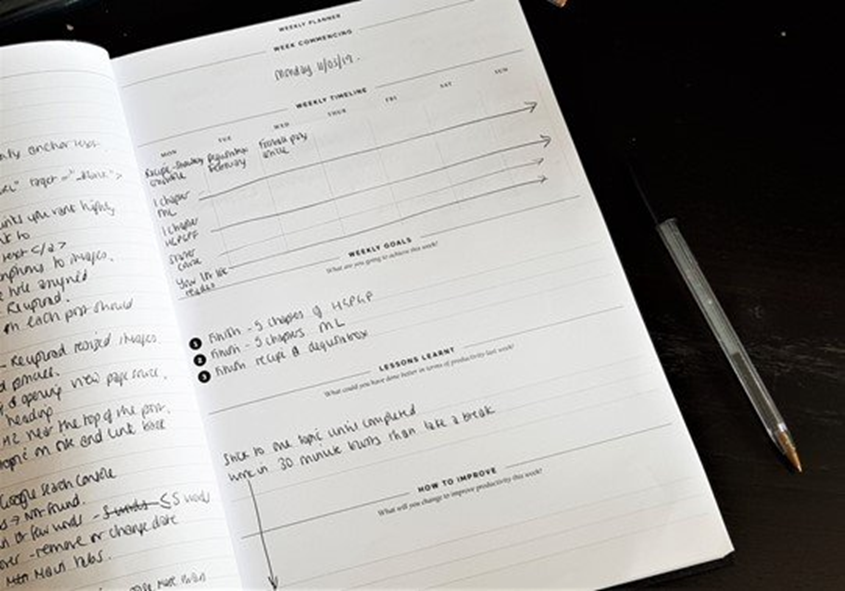
Start recording your habits and tasks so you know what you’re working on every day. You can set goals, manage your time, and plan your tasks, so you can see what you need to do every day.
At the start of each month, specify what you will work on each month. Then within each week, set goals that will contribute to that monthly goal, and each day work on the goals that will contribute to your weekly goals.
I found since using a productivity planner that I am so much more productive with my work and house duties because I know what my good and bad habits are and I know what I need to do every day, week and month.
Tip 27: Work out what your goals are and create habits to achieve those goals
What is it you would like to achieve? Are you trying to lose weight? Do you want to clean less and spend more time working on your business? Do you want to spend more time with your family? Be clear with what you want to achieve and note the point at which you want to get to, so you can create habits to achieve your goal.
For example, if you want to lose weight, set times to get to the gym or fit in your workout. If you want to spend more time with your family, then schedule a few hours in the day to purely spend time with the family – make sure you do nothing else in that time.
If you want to clean less and spend more time working on your business, then use my ‘short work-burst’ method and work on your business for 30 minutes and spend 10 minutes cleaning up a certain area of the house. You can use The Organised Mum’s Method where she talks about cleaning an area in your house for just 30 minutes a day, and this works just as well. I use a method similar to this, otherwise I would just end up cleaning all day and spending little time on work.
Use a habit tracker to track the habits you have identified. Each time you have fulfilled a habit, tick it off. Include your bad habits too like I did and cross-check them off when you have successfully not fallen into those bad habits that day.
If you’re stuck for ideas on how to be productive, here are some productive things to do when you are bored at home:
Tip 28: Improve yourself
As mentioned above, knowing your bad habits are just as important as creating good ones. Know where you need to work on and spend time improving yourself.
Tip 29: Try something new
Stepping outside your comfort zone is the only way you’ll grow. I try to do that regularly by learning a new skill or trying my hand at something new. I took a leap of faith and started publishing on Amazon and I’m so glad I did! I’ve learned a new skill and I feel like I’ve accomplished something huge.
Tip 30: Invest in your future
The best investment you can make is on yourself. So carve out some time to learn a new skill. Take some home learning courses and work towards building your portfolio, which will eventually help you to build on your income too.
Tip 31: Have fun
We’ve touched on this before, but give yourself a break now and again to wind down and forget about tasks and to-dos. Having fun is actually a very productive past-time because it clears the stress and it helps you step away from a task and have a birdseye view of the problem if you’re not thinking about it all the time. Plus, it’s healthy. Balance is key to being productive so have some downtime too. Go out with friends, go to the cinema or go shopping. Whatever it takes to get in those feel good hormones.
Tip 32: Better your health
I’ve noticed that when I eat junk, I am less productive because I feel lazy and I don’t have the energy to get up and get things done. Exercise has given my brain a natural energy boost, but so has fuelling my body with good food. Improving your health improves your productivity, so put health at the very top of your to-do list.
Tip 33: Get organised
I run a tight ship – I have to because I have four kids, triple school runs and a business from which I work at home. So household tasks, work day tasks and work time itself all have their own pockets in which they can’t overlap or be allowed to fall by the wayside. Project management and organisation is the only way I survive the multitude of tasks but it also keeps me ticking. So make sure you get organised, but be prepared to wing it if certain things prop up you haven’t accounted for. It’s also important to think on your feet too.
Tip 34: Hone your talent
Do you have a particular skill that you could potentially monetise? Then work on honing that talent and becoming an authority in that field. Knowledge is power, especially if it’s your ADHD superpower and you can teach your potential customers something that will help better their own lives.
Tip 35: Visit the library
If I get writer’s block or lose my mojo because I’ve had a particularly challenging day, then I put my work down and I head to the library. While I’m there I browse the shelves until I find a particular book that reaches out to me. I sit down for a few minutes and I read for a bit. The act of sitting down and tucking into a good book makes me forget about my day and once I’ve put the book down, I’m ready to tackle my tasks again.
Tip 36: Make a playlist
On Spotify I have a number of playlists that help me get into the mood for whatever I’m doing. I have a playlist all about bettering yourself and a playlist for winning in business. I also have a playlist of workout music to get me into the groove for working out. Playlists are effective at picking you up when you need an extra boost to get started.
Tip 37: Learn from mistakes
Mistakes aren’t failures, they’re perfect opportunities to learn and do better at succeeding. But if you repeat your mistakes, you learn nothing. Always take your mistakes as experiences and learn from them so you don’t repeat. Remember, without mistakes you won’t know the path to success, so keep trying, even if you fail.
Tip 38: Create an evening routine
We have touched on this before, but one thing I do to make sure I’m prepared for the next day is to set out clothes for the kids’ school, pack any lunches and basically do anything that doesn’t impinge on the morning routine. Then I get ready for bed by washing my face, applying my skincare and finishing any tasks that can’t spill onto the next day. Only then do I go to bed knowing I’ve done what I need to do.
Tip 39: Create a morning routine too
First thing I do when I wake up is review my 5 main productive tasks of the day in priority order. My to-do list also has other home tasks like making sure to fit exercise in and other child-related activities that are important. I consult my to-do list every hour on the hour because it keeps me on task and I make sure I’m not deviating from what I need to do that day. Then I forget the rest for the next day. As long as I’ve completed my five tasks for the day (and even if I don’t) that’s all i’m focussing on, and nothing more.
Tip 40: Go camping
There is nothing like leaving the materialistic stuff behind and getting back to nature to make you feel you can accomplish anything. Making a fire out of wood or frying an egg on a makeshift tinfoil pan can provide you with the animalistic tools to go out and get what you want. It also helps you shift your focus on what really matters, something we often forget to do when we’re knee deep in our to-dos.
Tip 41: Watch tutorials
Learn new skills in webinars if you want productive downtime because tutorials can help you become better in the business of what you’re doing. Perhaps you want to learn to become a better chef so you watch tutorials on how to hold a knife. Or you want to write a book so you watch a step by step process on how to write and publish a book. These are all skills you’re learning so make sure your downtime is filled with lots of productive watching.
Tip 42: Start a bullet journal
A bullet journal is much like a productivity planner in that it helps you set out the goals you want to achieve in the year ahead. First you lay out your index of plans you want to achieve and then you dissect them into monthly, weekly and daily goals. Define your purpose, review your goals and keep it simple and achievable.
Tip 43: Again set some goals
If you have some free time, set some goals, this time on things you’d like to achieve as a person. It could be a bucket list of things you want to do that’s not related to work.
Tip 44: Test out new time management strategies
Sometimes what you’re doing isn’t working, so it’s important to keep testing until you hit the magic formula. Keep testing new time management strategies to see what works for you. This also includes the time in the day you’re at your most productive and whether you prefer to work in longer stints than 30 minutes a day. Whatever works for you will be different to the next person, so try to focus on what you’re doing rather than what other people are doing.
Tip 45: Create a list of travel destinations
You may wonder why creating a travel list is a productive thing to do, but it helps you set goals for where you’d like to travel and allows you to work for them. Plus it’s something fun to look forward to!
Tip 46: Start planning your days
It’s really important to know what your daily schedule looks like in advance. So plan what you’re going to do in advance so you can focus on the tasks that offer the biggest reward and leave the less urgent, less important things for later.
Tip 47: Share your knowledge
It’s always nice to pay it forward and the act of sharing your knowledge with people will make you an authority in your field, which is great for business!
Tip 48: Build a blanket fort
You may think that building a blanket fort sounds like a waste of time but it’s actually a pretty effective way to shut the outside world out and focus on you in the here and now. Either build a blanket fort on your own and use it as a form of me time or build with friends and family and use it as a bonding exercise. It is a great way to forget about the mountain of tasks you have waiting for you and just enjoy yourself.
Tip 49: Make a new dish
I’ve mentioned before that change is good for the soul and making a new dish is a great way to build confidence in your culinary skills. Make a new dish, add it to your recipe arsenal and use the accomplishment to boost your productivity at work
Tip 50: Become a better decision maker
The famous saying, ‘indecision is the number one reason for failure’ could never ring more true because it halts productivity and stops you from getting things done. Become a better decision maker and the best way to start doing this is by making a decision and sticking to it. Go with your gut and decide – your decision is final.
Tip 51: Go for a swim
Swimming is such a fantastic sport to melt your troubles away. I find that a vigorous front crawl that gets the heart pumping makes me feel alive and strong, so much so that I want to run back to my desk and bash work out. Use the swim to feel strong mentally and physically and then bring that force back to your productivity.
Tip 52: Go airplane mode
Sometimes going offline means you can focus on the tasks ahead of you because you’re not messing about on the internet or scrolling through social media. It has taken me a long time to force myself to work on my tasks for the dedicated 30 minutes without caving and clicking on a notification that comes up. So I disabled notifications and went airplane mode. Now I don’t get distractions anymore to entice me to stop working.
Tip 53: Go for a hike
Another productive sport is hiking because it’s get you out into the fresh air which boosts productivity and it gets your heart pumping which boosts your mental health. Hiking helps you forget about your insular world for a moment and enjoy nature and the bigger picture. A good hike should leave you feeling refreshed and ready to tackle your tasks when you get home.
Tip 54: Envision your ideal body
One of my biggest goals is to get back to my pre-pregnancy athletic fit weight, but I have been lazy and often resorted to junk food because I haven’t got a goal or I haven’t envisioned how I want to look. I started looking through old photos of me and now I can envision my ideal body which helps me to push through the workout when I haven’t got the mental energy to start. Envisioning your goal helps you map out the steps to success, so that’s what I always do when I’m feeling like i don’t want to exercise. It helps so much.
Tip 55: Clear out your clutter
If you’re constantly asking yourself, ‘How can I be more productive in life?’ Perhaps your mental and visual load is a bit overwhelming and you need to declutter and compartmentalise your to-dos. Start by organising your space around you or venting to someone if you have anxiety. And don’t take on other people’s worries, you have enough to deal with!
Tip 56: Clean out your junk drawer
If you have junk everywhere, then you will not be very productive at home. Cleaning junk from your space is one of the most vital tips on how to be more productive.
Tip 57: Organise the spices
Another strange one to add to the productivity to do list but the act of organising your spices helps you organise your mind and it boosts you to organise other parts of your life too. If you do’t have spices, then organise your clothes or your books. Try it and see for yourself.
Tip 58: Prep your meals for the week
One of my favourite tips to be productive is to prep your tasks in advance, and one of them is definitely meal prepping. It helps me not to waste time on figuring out what to cook every day. I now subscribe to Hellofresh which means I don’t need to waste time figuring out what to cook or go to the shops and waste time figuring out what to buy. I just pick out the recipe card and the exact ingredients and I cook!
Tip 59: Make backups of everything
I now back all my work to a cloud which means no more hard drives and no more figuring out where everything is. Backups help you access your work easier and if something goes wrong, it doesn’t matter, because you have a copy in the cloud.
Tip 60: Know your why!
The infamous Simon Sinek penned this, but knowing your why means knowing why you do what you do. What is your biggest reason for what you are doing right now? Maybe you want a forever home or you want a bigger family. Figure out what it is and work backwards. It’s easier to forge a path ahead of you than fumble in the dark and get nowhere.
Best productivity tips for working from home from parents
I asked multitasking parents what their top tips are on productive things to do moving forward:
I feel more productive if I put my phone down… I get so easily sucked into irrelevant things on social media that I lose track of what I’m doing and feel like I have to start again. That goes for both work and at home. Once I sit down and just have 5 minutes, I don’t want to get up again.
I am definitely more productive if I stop working for regular breaks. I either do some housework, walk the dog, go for a run or swim or simply play the piano or read a book for 5 minutes. I’m much more able to properly focus on what I should be doing afterwards.
I am more productive if I chunk similar activities together so I’ll set time aside specifically for social media, schedule writing for a different time etc.
I think a really great way to be productive is to have your to -do list written out and on your clear and clean desk the night before. It means you start the day with absolute clarity of purpose.
Working from home can be distracting when you have a mountain of washing or other household tasks. I often take myself off to a nice cafe with free WiFi so I’m then totally focused on work. A good coffee and slice of cake is a good reward.
I make a list the night before my day off so I don’t procrastinate/waste time in the morning deciding what to do. I feel that way I get up knowing exactly what I’ve got to get done!
Don’t go for the false economy of not buying some of the productivity tools out there. The money you save not doing so is far outweighed by the increase in time you have if you use them. Tools like Tailwind, Buffer, Missing Letter are a godsend for me. And – have a set time to check your emails. Absolutely DON’T have it open all day distracting you.
Try and set certain tasks up the night before, such as the washing machine or dishwasher! By the time you then come downstairs in the morning, some of your tasks will already be done – resulting in more time for other tasks or a 5 minute sit down.
Starting something is probably the hardest thing to do, so the only way to start is, well, to start! Use the above tips to be productive at home, grab yourself a productivity pack like I did and start recording your habits.
Plan your goals and write out your monthly, weekly, and daily goals. Set yourself a target of 30 days to complete your habit and focus on tracking that habit every single day. After a few weeks, you will form your habit naturally as you have focussed on fulfilling that habit. I always feel amazing when I’ve had a particularly productive day.
You just need to find the motivation to start and what better time than to start implementing the ways to be productive now!
FAQs on how to be more productive with ADHD
How to be productive at home with ADHD?
Staying productive with ADHD at home requires creating routines, breaking down big tasks into small goals, and using productivity planners to stay on track.
How can ADHD people be more productive?
By using techniques like the Pomodoro method, prioritising important tasks, and limiting distractions, you can improve your productivity.
Can ADHD contribute to increased productivity and creativity in individuals who do not take medication for the condition?
Yes, many people with ADHD find they have bursts of creativity and productivity, especially during periods of hyperfocus. Medication isn’t always necessary for everyone.
How do I create a routine that sticks for someone with ADHD?
Start by setting small, achievable goals and using tools like task lists, timers, and accountability partners to build habits over time.
What strategies can a person with ADHD use to stay organised and remember tasks in their daily life?
Using visual cues like sticky notes, brain dumps, and productivity apps like Trello or Todoist can help you stay organised and on top of tasks.
How can people with ADHD use digital tools to create a more productive daily routine?
Apps like Trello and Notion offer visual task management, while timers like the Pomodoro technique help break the day into manageable chunks, making it easier to stay focused.
Are adults with ADHD more intelligent or creative?
Some research suggests that people with ADHD can be more creative and thrive in environments that reward innovative thinking. Hyperfocus can lead to impressive productivity in certain areas.
What are some ADHD productivity hacks for staying on task?
Using the Pomodoro method, limiting distractions, and working during peak productivity hours are all excellent ADHD productivity hacks.
*Collaborative feature post*
How to sleep with pillows when pregnant
Pregnancy is an exhilarating yet challenging journey, and one of the most common challenges is getting a good night’s sleep. Pregnancy also brings on new discomforts, such as back pain, leg cramps, frequent urination, and acid reflux, which can disrupt your rest, leaving you feeling more exhausted than ever.
Thankfully, pregnancy pillows can make a huge difference. Specially designed to support your growing bump, back, and legs, these pillows can help you sleep more comfortably and reduce strain on your body. If you’re not sure about what pregnancy pillows to get, then not to worry, Motherhood Diaries and My Dvija will not only show you how to sleep with pillows when pregnant, but what type of pillows are available, the best sleeping positions to try and relaxation techniques on how to improve your sleep quality during pregnancy.
Let’s dive in!
What is a pregnancy pillow and when should you start using one?
A pregnancy pillow is a specially designed pillow that provides full-body support, cradling your bump, back, and legs. Pregnancy pillows come in various shapes and sizes, including U-shaped, C-shaped, and wedge pillows. These pillows offer support to help alleviate pain and pressure, making it easier to sleep comfortably as your pregnancy progresses.
Many women start using pregnancy pillows as soon as they begin to feel discomfort, typically around the second trimester. However, you can start using one as soon as you notice your sleep being affected by physical discomfort or restlessness. In your third trimester, a supportive pillow becomes essential to managing your growing belly and promoting a comfortable sleep position.
Tools to aid sleep for pregnant women
Pregnancy pillows
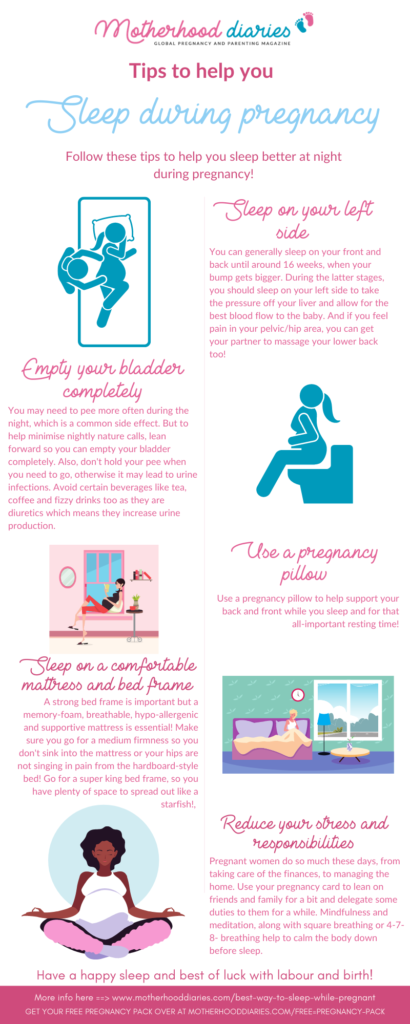
Pregnancy/maternity pillows are great because they can support the weight of your bump and back as you get bigger, encouraging less disruption during sleep.
Maternity pillows come in all shapes and sizes, so here is a rundown of what to look for:
Rounded pregnancy pillows
Rounded pregnancy pillows are generally multifunctional and also used for breastfeeding. They’re also cheaper and require less space in the bed. You place the pillow under your bump or to support your back, but during the latter stages, you may require extra support as most of these pillows don’t wrap all the way around.
CLICK HERE* TO BUY THE BEST ROUNDED PREGNANCY PILLOW ON AMAZON
V Shaped pregnancy pillows
V-shaped pregnancy pillows are naturally shaped into a V to support both the head and neck. You can also use this kind of pillow to support the bump or the back so it’s multifunctional too. These pillows are best used if you don’t have enough space to use a full-body pregnancy pillow, like the one below.
CLICK HERE* TO VIEW V SHAPED PREGNANCY PILLOWS ON AMAZON RIGHT NOW
Full body pregnancy pillows
Full body pregnancy pillows* are the pillow of choice at the moment because they provide the most all-round support for your bump and back. You can mould the U-shaped pillow to support the entire body which helps ease pregnancy symptoms, including pregnancy-induced sciatica and pelvic girdle pain. Some pregnancy pillows like the one on the left have a detachable extension which can be used as its own full body pillow or attached to the main body pillow for additional back or belly support. Just make sure you have a large bed to accommodate for the pillow, which brings me onto my next point.
CLICK HERE* TO BUY THE BEST FULL BODY PREGNANCY PILLOW ON AMAZON RIGHT NOW
Bed frames
Thanks to your growing body you’ll soon start to find that you’ll take up quite a good chunk of the bed, especially when you have full body pregnancy pillows* taking up one side. If you can and you have space, invest in a super king-size bed so your partner (and any extra kids) can cuddle up to you while still having ample space in the bed.
A firm wooden frame with wooden feet will provide enough stability to house an extra bump in bed. The Birlea Balmoral Grey Fabric Bed in Superking size has a large headboard with a soft velvet feel to offer the perfect comfort when you’re cuddling up with your baby bump and partner or when you’re stretched out like a starfish.
A comfortable mattress
A strong bed frame is important, but a comfortable and supportive mattress is essential.
Look for a mattress which has/is:
Memory foam to mould perfectly to your body and adapt to your growing bump. You can find fully adjustable mattresses from Ausbeds.
A breathable mattress with Octasprings which provides 8x more breathable fabric than pure memory foam. The constant airflow keeps the mattress cool when you’re overheating from that energetic bump!
A hypo-allergenic mattress to keep allergies away and protect against dust mites and bacteria, so you have the healthiest sleeping environment for you and your baby
Medium firmness which allows for the mattress to not be too hard or too soft (so it’s just right!)
Supportive – Find a mattress which also provides optimal support for your head, shoulders and hips, so your hips are not singing in pain when you’re lying on your side for too long
As your bump grows, it becomes harder to find a comfortable sleeping position. Some positions, like sleeping on your back or stomach, may not be safe later in pregnancy.
An NIH-funded study suggested that the sleeping position up to the 30th week of pregnancy didn’t actually affect the risk of stillbirth, low birth weight babies or other pregnancy disorders like high blood pressure. However, the study cautioned that it did not provide information on whether back or right-side sleeping in late pregnancy could increase the risk of birth or pregnancy complications.
So let’s look at all the sleep positions separately and gauge which is the most effective and safest position in which to sleep during pregnancy.
Sleeping on your stomach during pregnancy
Sleeping on your stomach is generally regarded as ok until you reach around 16 weeks, when the bump gets bigger and it’s no longer comfortable to sleep on your front. But, comfort is where it ends. Amniotic fluid and the uterine walls protect your baby from being squashed, so you won’t have to worry about squishing your baby during sleep.
If you really want to continue sleeping on your stomach, you should consider getting an inflatable stomach sleeping pillow (more on that below) or cut out a large hole in your pillow for your belly. Just be careful not to overheat the baby if your room is too hot and allow for plenty of ventilation during the night.
Sleeping on your back while pregnant
Sleeping on your back is generally regarded as safe during the first trimester, but from the second trimester, you should avoid sleeping on your back for the remainder of the pregnancy. New research shows that the risk of stillbirth is doubled if women go to sleep on their backs in the third trimester. And, some other studies, albeit small in size, have linked sleeping the whole night on your back to stillbirth, however, it is not as clear cut as that. Other issues like sleep apnea may also factor in pregnancy and birth complications too.
Sleeping on your back may also result in other complications like poor circulation, back pain, digestive issues and haemorrhoids. As you get on during the pregnancy, you may find that you’ll get lightheaded and dizzy when sleeping on your back for long periods anyway.
If you wake up in the middle of the night and find that you’re on your back, don’t fret. Placing a pillow wedge underneath will catch you from rolling onto your back and allow for more circulation and blood flow to your baby.
Sleeping on your left side
During pregnancy, you may often hear that you should sleep on your left side during pregnancy. But, do you know why that is?
It’s because your liver is on the right side of your bump, so sleeping on your left side not only keeps the uterus off the liver, but it improves circulation to the heart and allows for the best blood flow to the baby, kidneys and your uterus. Using a U-shaped pregnancy pillow can help maintain this position throughout the night by offering belly support and keeping your hips aligned.
But, it hurts to sleep on my side while pregnant
You may feel some pelvic pain from sleeping on your left side for too long, so you’ll find that changing position during sleep is a natural occurrence. So if you find yourself on your back or on your right side, this is normal and nothing to worry about. As soon as you realise just shift yourself back to your left side.
Start by lying on your side with your knees bent to take the weight off your heart’s large vein (the inferior vena cava) which carries blood back to the heart from your feet and legs. Then as you progress into the latter stages of your pregnancy, add pillows to your front and back to support the weight evenly.
Propping with a C-Shaped Pillow
C-shaped pillows are ideal for women experiencing lower back pain. Tuck the curve of the pillow behind you for back support, and place the long part of the pillow between your legs to help align your hips and reduce strain.
If you prefer sleeping on your side but need more support for your growing bump, you can place a pregnancy wedge pillow under your belly to alleviate pressure. This specific pillow can help relieve discomfort in the pelvic area.
Sleeping upright to prevent acid reflux
If you suffer from acid reflux or heartburn, consider propping yourself up with pillows to sleep in a more upright position. This can help prevent stomach acid from travelling up the oesophagus during sleep, promoting better blood flow and reducing discomfort. But in late pregnancy, you may find that you’ll be short of breath, so it’s better to switch to your left side when you are ready to settle to sleep at night.
Common sleep problems during pregnancy
The National Sleep Foundation created a poll in 1998 called the ‘Women and Sleep’ poll. They found that a whopping 78% of women reported more sleep disturbance during pregnancy than at any other time. They also found that:
15% of women developed restless leg syndrome (which we’ll go into later) during the third trimester of pregnancy
51% of pregnant/recently pregnant women reported having at least one weekday nap
60% reported having at least one weekend nap
Difficulty sleeping is common during pregnancy, so it’s vital to find ways to sleep that minimises disruption to your body and any health risks to the baby. Pregnancy is taxing on the body so it’s really important that you’re getting the recommended daily amount of sleep (some of you will sleep like a champion during the first trimester anyway) so you’re fit and strong for not just pregnancy, but for labour and birth too.
Pregnant women often experience a variety of sleep disturbances. Here are some common issues and how you can address them:
Frequent urination
Increased blood volume and pressure on your bladder can lead to more bathroom trips during the night. To minimise disruptions, limit your fluid intake before bedtime and make sure to empty your bladder completely before going to sleep.
You’ll find, especially in the first and third trimesters that you’ll need to go to the toilet more often, and this is down to the following reasons:
Your blood volume increases during pregnancy
You have almost 50 per cent more blood in your body than before which means more fluid is being processed in your kidneys, so your bladder fills up more frequently.
Hormonal changes
The hormonal changes in your body make your blood flow to your kidneys more quickly, filling up your bladder more frequently too.
Your growing uterus
As your little angel grows in your tummy, your uterus grows along with them, adding more pressure to your bladder, which brings back the need to pee frequently.
What can you do?
Unfortunately, frequent urination is a common and natural symptom of pregnancy, so you can’t avoid it completely. But you can limit nightly bathroom visits by doing the following:
Skip certain drinks
Skip drinks like coffee and tea, as well as carbonated drinks like soda because they are diuretics, i.e. they increase the amount of urine being made in the body.
Don’t hold your pee
Go to the bathroom when you need to because the more you strain your pelvic floor muscles, the more they will weaken, especially during pregnancy and birth.
Empty your bladder completely
When you go to the toilet, lean forward so you can empty your bladder as much as possible.
Drink most of your water during the day
You should still drink when thirsty of course, but try to limit most of your water intake to during the day. Never hold off on drinking though – the body needs lots of water, especially during pregnancy, so it’s better to go to the toilet than be dehydrated and risk getting a urine infection, which could cause complications to you and the baby.
Restless leg syndrome (RLS)
Around 1 in 5 pregnant women experience RLS in their last three months of pregnancy and this normally causes sleep issues. But what exactly is RLS?
RLS is this overwhelming urge to move your legs, which can also cause an unpleasant crawling or creeping sensation in the feet, calves and thighs. RLS is often worse in the evening and may affect the arms too. There’s no obvious cause of RLS, but some scientists reckon it may have something to do with how the body handles the chemical dopamine which is involved in controlling muscle movement. The problem does go away after birth though.
What can you do?
You can start by making sure you have a good bedtime routine and avoid caffeine at night too. Get in some gentle exercise every day during pregnancy as well to help get rid of any excess negative energy.
Leg cramps
You may feel this sudden sharp pain usually in your calf muscles or your feet which causes you to wake abruptly from your slumber. Around 30 to 50 per cent of women get leg cramps during pregnancy so leg cramps are a common part of pregnancy.
But why do you get leg cramps? Well, it’s not entirely clear why women get leg cramps, but scientists suggest little or too much exercise, an imbalanced metabolism, electrolyte imbalances or vitamin indeficiencies. The good news is leg cramps should disappear as soon as your baby is born.
What can you do?
Regular, gentle exercise will help to reduce leg cramps and often help ease symptoms when it happens too. When you experience an attack, do the following:
Bend and stretch your foot continuously and vigorously for around 30 seconds to 1 minute
Rotate the foot one way for around ten times and then the other way. Repeat with the other foot if needed.
Then with your fingers, pull your toes up to the ceiling to stretch the back of the calf and rub the muscle firmly at the same time with the other hand
Try getting out of bed and walking around on your heels before heading back to sleep
Keep bedding loose so you can do these exercises as and when needed without hopefully disturbing sleep or getting out of bed
Have a nice warm bath before bed to relax the muscles
Elevate your feet in bed by propping them up on a pillow with toes pointing up.
Insomnia
Fluctuating hormones, anxiety, and physical discomfort can all contribute to pregnancy insomnia, which can happen at any time during pregnancy and, with most pregnancy-induced problems, can be down to the fluctuating hormonal levels during pregnancy.
For most women, pregnancy insomnia attacks the hardest during the third trimester and you likely will have no idea when it will hit and how long it will end. You may find that you’ll fall asleep easily but staying asleep could be the issue.
What can you do?
Help your mind and body get into a set routine so your biological clock knows when it’s bedtime and your brain can get in line.
Avoid caffeine (you should be avoiding this anyway) and foods high in sugar and acid to avoid heartburn and/or a sudden burst in energy
It’s easier said than done but try to take your mind off your worries about not sleeping by thinking about something that makes you happy.
Practice the 4-7-8 breathing technique where you breathe in for four seconds, hold for seven seconds and exhale for eight. You might find the breathing duration difficult when you’re pregnant but as long as you are exhaling for longer than you are inhaling, the breathing will help you to calm down and eventually allow you to drift off to sleep.
Sleep apnea
Your breathing may change during pregnancy as your bump gets bigger and more pressure is placed on your lungs and airways. If you didn’t snore before or you were a soft snorer, you may find you’ll wake the house now with your loud snores. You may even experience some pauses or disruption in breathing and this disruption is called sleep apnea if the pauses last longer than ten seconds. Fortunately, the risk of developing sleep apnea in pregnancy is low – around 10 per cent of pregnant women are affected. However, if you’re overweight, obese, or experience excessive weight gain during your pregnancy, you may have an increased risk of developing sleep apnea.
What can you do?
It’s important to treat pregnancy-related sleep apnea as soon as possible as it could develop into complications for both you and your baby. Sleep apnea is also associated with gestational diabetes, diabetes and unplanned caesarean sections, so make sure you’re eating a healthy, balanced diet during your pregnancy. Make sure you sleep on your side too, to alleviate any pressure on the back and lungs
In severe cases treatment is available where a machine provides a constant flow of pressurised air to help maintain an open airway during the night. These are only used in extreme cases, but it’s worth checking with your doctor to ensure your sleep apnea is not placing any undue risk on you and your baby.
Otherwise known as heartburn, which is a common pregnancy symptom in the third trimester thanks to hormonal changes again and your growing baby pressing on your stomach. The muscles in your stomach relax during pregnancy causing stomach acid to escape back up the throat, which causes that burning sensation.
You’re likely to get indigestion/heartburn if you had indigestion in your previous pregnancies or you’re in the latter stages of your pregnancy.
Some symptoms include:
Feeling or being sick
Burning or pain in your chest and throat
Feeling heavy, bloated and full
Burping/belching
Bringing up food
What can you do?
Think about what you eat and how you eat it. Making changes to your eating and drinking habits can help to control symptoms if they are mild. Here are some tips:
Keep meals small and often rather than eating three large meals a day.
Don’t eat within three hours of going to bed at night
Cut down on caffeinated drinks and fatty, spicy and rich foods
Sit upright when you eat which will take the pressure off your stomach
Elevating your head and shoulders when you go to bed can help from stomach acid coming up when you sleep
Smoking and drinking can seriously harm you and your unborn baby’s health, but it also contributes to indigestion. If you need help to stop smoking and/or drinking talk to your midwife who can provide you with some support networks that you can call. NHS also has a Smokefree helpline which you can call on 0300 123 1044
If you’re still experiencing symptoms then speak to your midwife or GP who can examine you and provide further assistance and medicine if required
Excessive sleeping during pregnancy
Not getting enough sleep is an issue, but what if you’re getting too much sleep? Is there even such a thing as too much sleep during pregnancy?
According to the National Sleep Foundation, you should get around seven to nine hours of sleep each day. If you’re routinely sleeping more than nine to ten hours unbroken, good quality sleep, then this may be a sign of excessive sleep.
One study argued that women who slept for more than nine continuous hours without disturbance and they routinely had non-restless sleep in the last month of their pregnancy had a greater chance of stillbirth. However, this study was argued by other scientists who claimed that the non-restless nights were down to decreased foetal movement and not the cause of stillbirth.
What can you do?
If you are routinely sleeping for more than nine hours a night, then wow, lucky you! But it’s worth keeping some of those hours resting in bed, reading a book or writing, for example, to avoid oversleeping during the night.
Other major causes of sleep disturbance during pregnancy
Hormonal changes play a significant role in sleep disruption during pregnancy. Physical discomforts also contribute to restless nights for many pregnant women.
Exposure to technology
Blue light from digital screens can interfere with sleep quality. It affects the release of melatonin, a hormone that regulates sleep cycles. Pregnant women using electronic devices before bed may struggle more with falling asleep.
Hormonal changes
As mentioned before, hormonal changes during pregnancy significantly impact sleep patterns. Hormones like progesterone rise and can cause daytime drowsiness, which disrupts normal sleep cycles at night. Increased levels of oestrogen also lead to more frequent bathroom trips, interrupting deep sleep.
Lack of a healthy routine
An inconsistent schedule can lead to poor sleep quality and disrupted sleep patterns. Pregnant women who do not follow a regular bedtime may find themselves struggling with insomnia or waking up frequently at night.
Best pregnancy pillows 2024
With so many pregnancy pillows on the market, it can be hard to know which one to choose. Here are some top-rated options, along with their pros, cons, and where to buy them:
1. WEIKA Memory Foam Pregnancy Pillows for Sleeping
Price: £35.99 Rating: 4.8 out of 5 stars (41 ratings) Special Features: Portable, lightweight, adjustable, detachable cover, breathable. This pillow* provides excellent full-body support making it perfect for supporting your bump, back, neck, and legs. With its concave curve, ideal for side sleepers. The adjustable design allows you to customise it for your growing belly, hips, back, and legs. Its memory foam adapts to your body temperature, distributing pressure for optimal comfort. It also comes with a machine-washable cover. It’s also multi-purpose, as it can be used for breastfeeding or to support older babies during playtime. Best for: Pregnant women in all stages, relieving pain and discomfort in multiple areas.
2. Kolbray®️ U Shape Pregnancy Pillow – Full Body Maternity Pillow
Price: £42.99 Rating: 4.6 out of 5 stars (2,291 ratings) Special Features: Adjustable, includes a removable jersey cover. A UK-made pillow*, this U-shaped design provides full-body support for back, belly, legs, and hips. It comes with a detachable extension, so you can use it as a nursing pillow or for added comfort while sleeping. The soft-knit jersey cover keeps you cool throughout the night, and the machine-washable cover is easy to clean. Best for: All sizes and body types, providing comfort from pregnancy to nursing.
3. MOON PARK Pregnancy Pillows for Sleeping – U Shaped Full Body Maternity Pillow
Price: £71.28 Rating: 4.6 out of 5 stars (1,404 ratings) Special Features: Cooling cover, flexible, full-body support. This 57-inch pregnancy pillow* is designed with ergonomic features to support every part of your body, from your head to your feet. The cooling cover ensures that you don’t overheat, and the pillow provides relief from back pain, leg swelling, and other pregnancy discomforts. It is versatile enough to be used while nursing, reading, or relaxing. Best for: Pregnant women needing both comfort and cooling during sleep.
Price: £37.43 Rating: 4.6 out of 5 stars (965 ratings) Special Features: Flexible, removable, durable. This 57-inch full-body pregnancy pillow * offers premium comfort, replacing the need for multiple pillows. It supports your head, back, belly, sides, knees, hips, and feet. The polyester filling provides long-lasting support while maintaining its shape over time. Its soft, removable cover can be machine washed, making it ideal for frequent use. Best for: Expectant mothers looking for long-term support and versatility for various body positions.
Here are some additional tips to improve your sleep during pregnancy:
1. Develop a sleep routine
Establish a bedtime ritual that signals your body it’s time for rest. Engage in calming activities like reading, taking a warm bath, or practising gentle stretches before bed. Avoid using electronic devices as they can interfere with your ability to wind down. Consistent routines will help ensure quality sleep.
2. Stay active
Regular exercise can significantly enhance sleep quality during pregnancy. Engaging in physical activity helps reduce anxiety and fatigue, making it easier to fall asleep and stay asleep.
3. Limit caffeine and heavy meals
Caffeine, nicotine, and alcohol can significantly interfere with sleep quality during pregnancy. Opt for herbal teas or warm milk as bedtime beverages instead of caffeinated options.
4. Manage acid reflux
If you suffer from acid reflux, avoid lying down immediately after eating and try to elevate your head when you sleep to prevent heartburn.
5. Back massage
Lying on one side for too long can cause hip and lower back pain, so get your partner to massage the lower back to relieve some of the pressure built up when lying in one position for too long.
6. Nasal strips
You may find during pregnancy that you’re stuffy, even if you don’t have a cold. So if the snoring is waking up the whole town or the congestion is waking you up at night, your doctor may advise nasal strips to help open the airways and relieve nasal congestion.
CLICK HERE* TO BUY THE BEST NASAL STRIPS ON AMAZON RIGHT NOW
7. Diet can help
A ‘Sleep and Dietary Patterns in Pregnancy’ study in 2017 found that a good diet may help pregnant women sleep better at around 26 – 28 weeks gestation, with the Mediterranean diet coming up at the top of the list to helping combat sleep problems like insomnia. The Mediterranean diet is high in vegetables, legumes, fruits, cereals and fish, but low in dairy, saturated fat and alcohol, so it seems laying off heavy, unhealthy food and drink might help you to sleep at night.
The same study found that the Japanese diet which is rich in rice lowered the risk of poor sleep quality by 46 per cent. Suggested explanations were that rice has a high glycaemic index and is also high in melatonin which is the natural chemical we make in our bodies to help us sleep. Apparently even eating less of the seafood-noodle pattern can help you sleep better too!
8. Reduce your stress and responsibilities
We live in an age where we are sharing parental roles and duties. No longer does the old-school man-makes-fire-brings-in-the-bread-woman-is-the-homemaker work in this cultural and digital world.
This is great! Women can now be free from the kitchen-sink role and express themselves in the workplace, through their business, and at home, all while growing a baby. And, incidentally, men can take a more paternal role and share the load of looking after the kids.
However, because of the extra responsibility, sleep often gets pushed to the back of the priority list, resulting in sleep deprivation during pregnancy, which this study found was linked to postnatal depression, complicated birth and preterm delivery due to more pro-inflammatory serum cytokines released from the lack of sleep.
What does this mean?
It means that your mental health is affected as much as your physical health and when you’re pregnant you need sufficient sleep to nourish the development of your baby. This topic begs its own article but I found that running a business while being pregnant often didn’t help me get to sleep at night because I would be tapping away on my laptop screen for a long period while worrying about finances and whether we could afford to move to a bigger place.
Sometimes you have to learn to delegate certain duties and so I leaned more on my husband and parents to help me get through the tough later months of pregnancy and the vital fourth trimester where they did the school runs for me and took over some of the bills, of which I was very grateful because I needed the recovery time!
9. Mindfulness and meditation
Mindfulness and meditation, along with the 4-7-8 breathing technique can help to reduce some of the stress you feel during pregnancy. Breathing is a fantastic tool to instantly calm the body down and can even help to drift you off into the land of nod. Click here for more information on how mindfulness and meditation work to help you sleep during pregnancy.
One study urged that due to the high percentage of women who experience significant sleep disruption during pregnancy, there should be regular screening and treatment provided for sleep disturbances, especially the impact that sleep disruption has on the pregnancy, the baby and postnatal depression. I think this is a great idea!
It’s important that if you are finding it difficult to sleep during pregnancy, you should speak to your doctor, who can provide you with actionable, manageable steps to help you sleep better during pregnancy.
FAQ Section: How to sleep with pillows when pregnant
How should you sleep with a pregnancy pillow?
Sleeping with a pregnancy pillow depends on the type of pillow you have. For example, a U-shaped pillow can be used to support your entire body, while a wedge pillow is placed under your belly to relieve pressure.
When should you start using a pregnancy pillow?
Most women start using a pregnancy pillow during their second trimester when they begin to experience discomfort while sleeping.
Is it safe to sleep on your back while pregnant?
It is generally not recommended to sleep on your back during the second and third trimesters.
Can you sleep on your stomach while pregnant?
Sleeping on your stomach is usually fine in the early stages of pregnancy. However, by the second trimester, your bump may make it uncomfortable.
Final thoughts on sleep during pregnancy
Sleeping during pregnancy can be a challenge, but with the right tools, techniques, and support, you can improve your rest. Whether you’re using a pregnancy pillow, following a consistent sleep routine, or practising relaxation techniques, every small change can make a big difference.
Always consult your healthcare provider if you have concerns about your sleep during pregnancy. Their guidance, combined with these tips, can help ensure you get the restful sleep you need.
*Motherhood Diaries was gifted a Superking bed frame from Mattressman and a Superking mattress from Wayfair for the purposes of a review, but all opinions are 100% our own.
*This is a collaborative feature article, which also contains affiliate links, where if you click through and purchase, I may earn a small commission at no extra cost to you. Thank you for your support.
*As an Amazon Associate I earn from qualifying purchases.*
Top 20 best London suburbs for families for long-term stays
So, you’re thinking about setting up camp in London with your little ones? Choosing the right area to call home in this sprawling city is no small feat. Between juggling nappy changes and school runs, you’ll want a neighbourhood that ticks all the boxes—safety, great schools, green spaces, and a real sense of community. Lucky for you, the London boroughs are brimming with family-friendly suburbs that offer all of that and more. Whether you’re after the quaint charm of Richmond or the bustling vibe of Fulham, there’s a spot for every family’s taste and budget. So, grab a cuppa, and let’s dive into the top 20 best London suburbs for families for long-term stays.
Why stay long-term in London?
It can be difficult to achieve a good life balance, especially while trying to get your business up and running to provide a comfortable living in the next five to ten years! But it is doable, and your business and your family can benefit from experiences that might otherwise be drawbacks.
If you are trying to put together business deals, it can be a time-consuming process, and if you don’t want to be away from home for the time needed – anywhere from three to six months, there is the option to transplant the whole family for a while. Your children will benefit tremendously from experiencing life as other countries or communities live it.
London is an especially educational choice as it is packed with cultural offerings, historical buildings, and a thriving multicultural commercial aspect created by the ingress of the brightest and the best from all over the world who come to London to make their name and achieve their goals.
Most schools will help your children to maintain their education, either by letting them attend locally while you are living in the neighbourhood or by sending over work-packs to get them through the curriculum in time with their contemporaries. And you don’t have to put up in a hotel for that duration, which can become tiring over a long period, not to mention expensive. Instead, opt for a serviced apartment; you can check out some check out luxury aparthotels in London here.
Now, let’s explore the best family-friendly neighbourhoods that make London an ideal place for a long-term stay.
The top 20 best London suburbs for families for long-term stays
1. Richmond upon Thames
“Lovely place to live in”
Richmond is often at the top of any family’s list when considering where to live in London. Nestled by the River Thames, this suburb offers a countryside feel while still being close to the city centre. Richmond Park is one of the largest green spaces in London, where kids can run wild, and families can enjoy weekend picnics. The area is renowned for its excellent schools and a strong sense of community, making it an ideal place to raise children. Richmond also boasts some of the most beautiful houses in the city, making it a top choice for those looking for a family home.
Richmond benefits from excellent transport links like the London Underground (District Line tube stop), London Overground, and National Rail services, providing quick access to central London and beyond. The area also has easy access to the A316, which connects to the M3 motorway.
2. Greenwich
“Ideal for First-Time Buyers”
Greenwich is a tranquil area known for its maritime history and stunning views of the Thames. The Royal Observatory and the Cutty Sark are must-visits, offering educational experiences for the entire family. The schools here are good, and the area’s blend of historic charm and modern amenities makes it perfect for those new to London. Greenwich is also home to many international schools, making it a great choice for expat families.
Greenwich is well-connected by the Docklands Light Railway (DLR), National Rail services, and the Thames Clipper river services, which make commuting to central London and Canary Wharf
3. Sutton
“Great Location for Family”
Sutton is the perfect blend of suburban life and city access. Known for its outstanding schools, low crime rates, and family-friendly atmosphere, it’s a top pick for parents who want a peaceful environment to raise their children. The parks and open spaces are ideal for outdoor activities, making Sutton a firm favourite among families. The area is also well-known for its state schools and private schools.
Sutton has excellent National Rail connections to central London, with regular trains to London Victoria, London Bridge, and St Pancras International. It’s also well-served by buses.
4. Waltham Forest
“Costa del Walthamstow”
Waltham Forest, particularly Walthamstow, has seen a surge in popularity among young families. This vibrant area offers a mix of East London’s trendy vibe with a strong community spirit. With plenty of parks, good schools, and the famous Walthamstow Market, it’s a great neighbourhood for families looking for a lively environment. The area also offers some of the lowest crime rates in East London, making it a safe option for families.
5. Putney
“Nice view”
Putney is a picturesque area by the Thames, offering great views, plenty of green spaces, and excellent schools. The riverside walks and Putney Heath are perfect for family outings. It’s a quieter part of London, which appeals to those looking for a suburban feel with easy access to the city. Putney is also known for its independent shops and coffee shops that give the area a village-like feel.
Putney is served by both the London Underground (District Line) and National Rail services, providing quick access to central London. The Thames Clipper also offers riverboat services, and it’s close to major road networks like the A3.
6. Kensington and Chelsea
“Living in Portobello Square”
“Great value for money, particularly given the location”
Kensington and Chelsea may be known for their posh reputation, but they also offer a fantastic family environment. The area is packed with cultural attractions, top-tier schools, and beautiful parks. South Kensington is particularly popular with families, not only for its beautiful homes and garden squares but also for its proximity to some of London’s most famous museums, including the Natural History Museum and the Science Museum.
This iconic British museum is a must-visit for families, offering everything from dinosaur skeletons to interactive exhibits that will keep the little ones entertained for hours. The area around South Kensington is well-served by the London Underground (Piccadilly, Circle, and District Lines), making it easy to access other parts of the city. Portobello Market, located nearby, is a lively spot for weekend outings, and the neighbourhood’s safety and amenities make it a great choice for families. Kensington Gardens and Kensington Palace are also within walking distance, offering even more green space and outdoor activities.
This area is exceptionally well-connected with numerous London Underground stations (District, Circle, and Piccadilly Lines) and bus routes, making it easy to get around the city. Holland Park, another nearby green space, is perfect for a short walk or a relaxing afternoon with the kids.
7. Chiswick
Chiswick is a leafy suburb that feels like a village within the city. It’s perfect for families who want a slower pace of life without sacrificing proximity to central London. The area is home to excellent schools, beautiful parks, and a vibrant high street filled with independent shops and coffee shops.
Chiswick has great transport links via the London Underground (District Line) and National Rail services from Chiswick and Gunnersbury stations. It’s also close to the M4 motorway, providing easy access to Heathrow Airport and the west of England. Chiswick is also popular with prospective buyers looking for a new home in a great neighbourhood.
8. Fulham
“Perfect city life”
Fulham offers the best of both worlds—urban living with family-friendly amenities. The area is known for its excellent schools, parks, and community feel. With plenty of green spaces and a riverside location, Fulham is ideal for families who want to be close to the action without sacrificing comfort.
Fulham is well-served by the London Underground (District and Piccadilly Lines) and has multiple bus routes, making it easy to reach various parts of London. The area is also within close proximity to Covent Garden, a major attraction in the West End, known for its theatres, coffee shops, and family-friendly restaurants.
9. Wembley
“I and cats rate it 10/10”
Wembley has transformed from just a stadium hotspot to a thriving community with excellent housing options for families. The area is multicultural, vibrant, and offers great schools. It’s affordable, well-connected, and perfect for families looking for a dynamic environment. Wembley is also popular with sports fans due to its proximity to Wembley Stadium and Wembley Arena.
Wembley is served by the London Underground (Jubilee and Metropolitan Lines), London Overground, and National Rail services, offering excellent connectivity to central London and other areas.
10. Havering
“Amazing and convenient place to live”
Havering offers excellent value for money, with spacious homes, good schools, and a safe environment. It’s an ideal suburb for families who need more space but still want to be within easy reach of London. The green spaces and community vibe make it a top pick.
Havering, particularly Romford, has strong transport links via National Rail, which provides regular services to Liverpool Street. The upcoming Crossrail (Elizabeth Line) will further improve connectivity. Havering also offers some of the lowest crime rates in London, making it a perfect place for families looking for a family safety score.
11. Hampstead
Hampstead offers a quieter lifestyle with plenty of wonderful walks and perhaps the best land-based view of London from Parliament Hill. Known for being academic and arty, Hampstead is an excellent place for children to pick up lifelong learning habits. The area is also home to some of London’s best independent schools.
12. Notting Hill
Famous for its vibrant culture, Notting Hill is colourful, diverse, and full of character. It’s close to Portobello Road, perfect for vintage shopping, and offers a Bohemian lifestyle that appeals to families looking for something unique. The area is also renowned for the Notting Hill Carnival, one of the most celebrated events in London. Notting Hill is a great option for families who enjoy a lively environment with plenty of cultural experiences.
13. Battersea
Home to Battersea Park and excellent schools, Battersea offers great family living close to the river. It’s a lively area with plenty of activities for kids, making it a top choice for families who want to stay close to central London while enjoying a vibrant community. Battersea is also close to the South Bank, offering a variety of cultural experiences. The ecole de Battersea is a popular choice for parents seeking a bilingual education for their children.
14. Bayswater
With its central location and proximity to Hyde Park, Bayswater offers a blend of city life and open spaces. The area is known for its beautiful Victorian architecture and access to top schools, making it an attractive option for families. Bayswater is also a great neighbourhood for prospective buyers looking for a new home with easy access to London’s best areas.
Bayswater is centrally located with access to the London Underground (Circle, District, and Central Lines), making it very convenient for getting around London. It’s also within walking distance of Kensington Gardens, making it a great option for families who love spending time outdoors.
15. Primrose Hill
Famous for its stunning views and village-like atmosphere, Primrose Hill is a hit with families who enjoy a more relaxed pace. The area offers excellent schools, beautiful parks, and a strong sense of community. Primrose Hill is also within close proximity to Regent’s Park, which houses the famous London Zoo.
16. Dulwich
South East London’s hidden gem, Dulwich, offers excellent schools, green spaces, and a real community vibe. The area’s picturesque streets and high-quality educational institutions make it a great place for families. Dulwich is also a perfect place for those who want to enjoy the tranquillity of rural areas while still being close to central London.
17. East Finchley
A quiet, leafy suburb with excellent schools and easy access to central London, East Finchley is perfect for families who want the best of both worlds. The area’s peaceful environment and strong community spirit make it an ideal place to raise children. East Finchley is also well-connected via the Northern Line, providing quick access to the city centre.
18. Highbury
Combining Victorian charm with modern amenities, Highbury is a top spot for families who want to be close to the action without sacrificing green space. The area’s parks and excellent schools make it a family favourite. Highbury is also a short journey from Finsbury Park, another great spot for outdoor activities.
19. Queens Park & Kensal Rise
These neighbouring areas offer a strong community feel, great parks, and a host of family-friendly activities. The area’s vibrant atmosphere and excellent schools make it a popular choice for young families. Queens Park and Kensal Rise also offer plenty of independent shops and cafes, making it a great neighbourhood for families who enjoy a lively local culture.
20. Blackheath
With its village atmosphere and stunning heath, Blackheath is perfect for families who crave open space and a sense of history. The area’s excellent schools and peaceful environment make it an attractive option for long-term family living. Blackheath is also close to the Greenwich popular attractions like the Royal Observatory and Cutty Sark, making it an ideal spot for family outings.
What makes an area perfect for families?
When considering a neighbourhood for long-term family living, several factors come into play. Here’s what makes an area ideal for families:
Safety
Safety is a top priority for any family. You want a neighbourhood where you can let your kids play outside without constantly worrying. Most of the areas listed above have low crime rates and strong community policing, giving you peace of mind.
Schools
Good schools are essential when choosing where to live. London boasts some of the best schools in the country, from state to private, ensuring your children get a quality education. Areas like Sutton and Richmond are particularly renowned for their excellent schools.
Green space
Kids need space to run, play, and explore, and green spaces provide the perfect outlet for their energy. Whether it’s the vast Richmond Park, the scenic walks in Hampstead Heath, or the smaller local parks in Fulham and Putney, having access to nature is crucial for family well-being.
Top five areas for families to live in London
While all 20 areas offer fantastic family environments, these five stand out as the top choices for long-term family living in London:
Richmond (South-West)
Richmond is the ultimate family suburb, offering a blend of nature, top schools, and community spirit.
Battersea (South-West)
Battersea’s riverside location, coupled with Battersea Park and excellent schools, makes it a favourite for families.
Blackheath (South-East)
Blackheath combines historical charm with modern amenities, offering a village feel in the heart of London.
East Finchley (North-West)
A quiet, leafy suburb, East Finchley offers excellent schools and easy access to central London.
Highbury (North-East)
Highbury’s Victorian charm, green spaces, and proximity to central London make it a top pick for families.
Which are the best neighbourhoods for children?
These neighbourhoods are particularly well-suited for families with children, offering a mix of educational opportunities, cultural enrichment, and safe environments:
Regent’s Park
An expensive but beautifully central area, Regent’s Park offers a large green space, the famous London Zoo, and elegant Neo-Classical and Georgian houses. It’s a great area for families who can afford the luxury.
Hampstead
Hampstead offers a quieter lifestyle with plenty of wonderful walks and perhaps the best land-based view of London from Parliament Hill. Known for being academic and arty, Hampstead is an excellent place for children to pick up lifelong learning habits.
Notting Hill
Famous for its vibrant culture, Notting Hill is colourful, diverse, and full of character. It’s close to Portobello Road, perfect for vintage shopping, and offers a Bohemian lifestyle that appeals to families looking for something unique.
Richmond
Richmond feels like countryside living but with all the amenities of the city close by. It’s outdoorsy, perfect for families who love spending time in nature and offers excellent schools and a strong sense of community.
Greenwich
A tranquil area packed with history, Greenwich is perfect for families who appreciate cultural and educational experiences. The area is close to central London yet offers a peaceful retreat from the city’s hustle and bustle.
Final thoughts
If you have to stay in London for the long term, taking the family with you is a great way to ensure you don’t miss any of the children’s milestones while also doing the best for your company. London’s diverse neighbourhoods offer something for everyone, whether you’re looking for the tranquillity of Richmond, the cultural richness of Greenwich, or the vibrancy of Notting Hill.
Choosing the right neighbourhood for your family is essential to making the most of your time in London. With excellent schools, safe environments, and plenty of green spaces, these 20 areas are the best places to live in London for families planning a long-term stay. By immersing yourself and your family in the life of this incredible city, you’ll create memories that will last a lifetime.
FAQ
Choosing the right area for your family
What area of London is best for families?
Richmond, Sutton, and Greenwich are among the top areas for families due to their excellent schools, green spaces, and safe environments.
Where do families live in London?
Families are spread across London, but areas like Richmond, Putney, and Hampstead are particularly popular due to their family-friendly amenities and community feel.
Where should we live in London with a young family?
Consider Richmond for its green spaces, Sutton for its excellent schools, and Kensington and Chelsea for a blend of luxury and family amenities.
Where to live in London with kids?
Richmond, Greenwich, and Chiswick are great options with plenty of parks, good schools, and safe neighbourhoods.
Where to live near London with family?
Areas like East Finchley and Blackheath offer a quieter suburban feel while still being within easy reach of central London.
Safety and affordability concerns
Are there any areas of London that are affordable and safe for young professionals to live in with a family?
Sutton and Waltham Forest offer affordable housing options with low crime rates, making them ideal for young families.
What are the safest places to live in London?
Richmond, Sutton, and Havering are known for their low crime rates and safe environments for families.
What are the safest suburbs of London?
Richmond, Kensington and Chelsea, and Putney are among the safest suburbs with family-friendly amenities.
Where is the safest place to raise a family in London?
Richmond and Sutton are top choices for safety, excellent schools, and green spaces.
Specific Neighborhood Comparisons
As a family with a newborn, where should we live in London: Richmond, Angel Islington, Belsize Park, or Hampstead?
Richmond offers the best balance of green spaces, safety, and excellent schools, making it a top choice for families with newborns.
Should we live in West London or Northwest London with young children?
West London areas like Richmond and Fulham are great for families, offering plenty of parks and top schools, while Northwest London’s Hampstead provides a quieter, more academic environment.
What is a good area near London for a family with three young children moving from the States and having never been to Europe?
Sutton, with its excellent schools and suburban feel, and Richmond, with its green spaces and family-friendly amenities, are both ideal for families new to London.
What is the best location to settle with a family in West London?
Richmond and Putney are top picks in West London, offering green spaces, good schools, and a strong community vibe.
What are the best places to live in London that are equidistant to Marylebone and Heathrow for a family?
Consider Richmond for its excellent connectivity, family-friendly amenities, and proximity to both Marylebone and Heathrow.
Schooling and childcare
What are some recommended areas for an Indian family with children to live in London? Which areas have good schools and are considered safe?
Sutton, Richmond, and Waltham Forest are recommended for their good schools, safety, and vibrant multicultural communities.
What are some things to consider when choosing where to live with a child in London? Is it better to be closer or farther from school?
Proximity to good schools, safety, and access to green spaces are key factors. It’s often beneficial to live closer to schools to minimize travel time and provide a stable routine for children.
Relocation and Expat Concerns
What are the best London suburbs for expat families?
Richmond, Greenwich, and Hampstead are popular among expat families due to their international communities, excellent schools, and family-friendly environments.
Is it still worth moving to London? Is London still a good city to live and/or raise children?
Absolutely! London offers a wealth of cultural, educational, and recreational opportunities, making it a fantastic place to raise children, especially in its family-friendly suburbs.
Lifestyle and Community
What are the rich suburbs of London, i.e., the Hamptons of London?
Kensington, Chelsea, and Hampstead are considered some of the wealthiest and most prestigious suburbs in London.
What are some middle-class neighbourhoods in London?
Areas like Chiswick, Fulham, and Dulwich are solidly middle-class, offering a good balance of affordability, safety, and amenities.
Why is it that many people don’t like living in London, UK? Is it not a great place to live and raise a family?
While London can be busy and expensive, many families thrive in its vibrant, diverse neighbourhoods, especially in the family-friendly suburbs that offer a quieter, more balanced lifestyle.
Housing and real estate
Where is the best location to live with a family in Greenwich, London, that’s affordable?
Areas like West Greenwich or parts of East Greenwich offer a good balance of affordability and access to top schools and green spaces.
*Collaborative feature post*
60 best baby business ideas for kid-focused parents
As a parent, you’re always looking for ways to make life better for your little ones, but what if you could turn that passion into a thriving business? Whether you’re a crafty mum, a tech-savvy dad, or just someone with a heart full of ideas, there’s a world of opportunity out there in the baby and kid-focused business world. I’ve rounded up 60 of the best baby business ideas that you can start right from home, making the most of your talents while keeping family at the centre of everything you do.
Let’s dive in!
60 baby business ideas
1. Baby product development
Create innovative products that address common parenting challenges. This can include everything from safer baby gear to eco-friendly products. If you’re wondering how to start a baby product line, begin with market research to identify unmet needs and consider global market trends to ensure your product has potential worldwide.
2. Sell baby products online
Start an ecommerce store specialising in baby products. You can sell a curated selection of items or create your own line. This is an excellent way to reach a wide target market, especially by utilising social media platforms for brand awareness.
3. Baby boutique – retail baby store
Open a boutique that offers a range of baby products, from clothing to toys. Focus on quality and unique items that parents can’t find elsewhere. Baby boutique retail stores can thrive in local markets if you focus on providing top-quality products and creating a warm shopping environment.
4. Baby clothing business
Design and sell baby clothes. This can be through an online store, a physical location, or both. Consider focusing on organic baby clothes or custom designs that stand out in the babywear industry.
5. Baby food brand development
Develop a brand of healthy, organic baby food. You can create your own recipes and sell them in stores or online. The baby food and formula market is highly competitive but rewarding if you offer profitable ideas like subscription services.
6. Baby food cooking instructor
Offer classes to parents on how to cook nutritious meals for their babies. This can be done in person or through online tutorials, providing a valuable service to new parents seeking to give their children the best start in life.
7. Baby furniture and equipment rental
Rent out baby furniture and equipment, such as cribs, strollers, and car seats, to parents who need them temporarily. This is a great opportunity for an eco-conscious business model that minimises waste by promoting the reuse of products.
8. Baby food subscription service
Create a subscription service that delivers fresh, organic baby food to parents on a regular basis. With the rise of online platforms, it’s easier than ever to manage a subscription-based business, and this model ensures a steady income
9. Baby toy maker
Design and create educational and safe toys for babies. This could be a home-based business or something that grows into a larger operation. Focus on educational toys that help in the development of young children.
10. Baby nursery room designer
Offer design services for nurseries, helping parents create the perfect environment for their new arrivals. This niche business can grow through local market presence and brand awareness built through satisfied customers.
11. Baby day care
Open a daycare service that specialises in caring for infants and toddlers, providing a safe and nurturing environment. This is one of the most profitable baby and kid businesses, particularly if you cater to working parents in urban areas.
12. Cloth diaper service
Provide a cloth diaper cleaning and delivery service for eco-conscious parents. This business idea taps into the growing trend of sustainable living and can be marketed effectively with a focus on green parenting.
13. Toy store
Open a store that specialises in high-quality, educational toys for babies and children. Toy stores can thrive by focusing on educational experience and offering products that encourage learning and development.
14. Kids pre-school education
Start a preschool that focuses on early childhood education, helping children develop foundational skills. This business model can be expanded by offering additional services like after-school care or weekend classes.
15. Mobile app aimed at babies and kids
Develop a mobile app that helps children learn and develop through interactive activities. With the rise of mobile devices, this is an area with high demand among tech-savvy parents and young entrepreneurs.
16. Baby proofing service
Offer a service that helps parents make their homes safe for their babies by identifying and removing potential hazards. Baby proofing is an essential service that can be marketed to new parents looking for peace of mind.
17. Kids education materials
Create and sell educational materials, such as books, flashcards, and games, designed to help children learn. This business can expand into online platforms where parents can purchase and download digital content.
18. Baby furniture manufacturer
Manufacture custom or eco-friendly baby furniture, such as cribs, changing tables, and high chairs. This profitable venture caters to a niche market of parents who value quality and sustainability.
19. Baby play space playground
Open an indoor playground designed for babies and toddlers to play safely while parents relax. This business can also offer birthday parties and other special events to increase revenue streams.
20. Baby and kids resale shop
Start a resale shop that specialises in gently used baby and children’s items, offering parents high-quality products at a lower cost. This business can thrive in a local market by offering great deals on top-quality products.
Keeping costs low is crucial. One way to do this is by selecting the best water provider for your business. Utility Bidder can help you find the most affordable water supplier by comparing quotes, allowing you to save money on your water bills. This is especially useful if your shop has a lot of water-related needs, such as cleaning or maintaining products. Implementing water-saving strategies, such as installing water-efficient appliances or conducting a water audit, can further reduce your costs, making your business more profitable.
21. Baby portrait photographer
Offer professional photography services to capture the special moments of babies and young children. For those interested in business ideas involving children, photography allows you to blend creativity with a profitable service.
22. Family entertainer
Become a family entertainer, performing at children’s birthday parties and events with music, magic, or other talents. This business idea for kids provides joy while being a lucrative part-time gig.
23. Kid’s party planner
Plan and organise birthday parties for children, offering everything from decorations to entertainment and catering. This business can thrive in the local market, especially if you specialize in unique or themed events.
24. Scrapbooking
Provide scrapbooking services to help parents preserve their baby’s memories in a creative and personalised way. This is a small business idea that can be marketed through social media platforms to reach a broad audience.
25. Baby product reviewer/influencer
Start a blog or YouTube channel where you review baby products and offer advice to other parents. This is one of the best online business opportunities for parents, allowing you to work from home while sharing valuable insights.
26. Babywearing consultant
Help parents choose and use baby carriers effectively, offering consultations and workshops. This service can be a profitable venture if marketed correctly, tapping into the growing trend of babywearing among new parents.
27. Baby massage instructor
Teach parents how to massage their babies, which can promote bonding and help with issues like colic. This is a valuable service that combines education with practical support.
28. Baby sign language instructor
Offer classes that teach parents how to communicate with their babies using sign language before they can talk. This business idea taps into early childhood education and can be offered both in person and online.
29. Baby swimming instructor
Provide swimming lessons for babies, teaching water safety and helping them get comfortable in the water. This profitable business caters to the need for early swim education and can be expanded into group lessons or private classes.
30. Baby sleep consultant
Help parents with strategies and tips to get their babies to sleep better through personalised consultations. This business model is highly sought after by parents struggling with sleep issues and can be offered remotely.
31. Children’s book author
Write and publish books for babies and young children, focusing on stories that are educational and engaging. This business idea can also extend to creating digital content for online platforms.
32. Baby gift baskets
Create and sell customised gift baskets filled with baby care products, perfect for baby showers or new parents. This business idea can thrive with online business models, where customers can order personalised baskets.
33. Baby proofing products
Design and sell products that help parents baby-proof their homes, such as corner guards and cabinet locks. This profitable idea can be marketed alongside a baby proofing service, offering a comprehensive solution for safety-conscious parents.
34. Organic baby skincare products
Develop a line of organic baby skincare products, including lotions, oils, and bath products. This profitable venture appeals to eco-conscious parents and can be sold through both physical stores and ecommerce stores.
35. Baby sign language books
Write and sell books that teach parents how to use sign language with their babies. This business idea caters to the growing interest in early childhood communication and can be marketed alongside online platforms.
36. Baby sleepwear line
Create a line of baby sleepwear that is comfortable, safe, and promotes better sleep. This business idea can focus on niche markets such as organic baby clothes or specialised sleepwear for babies.
37. Baby sensory classes
Offer classes that focus on sensory play for babies, helping with their development and providing a fun activity for parents and babies to do together. This is a business idea that can be scaled through franchises or online business models.
38. Babywearing accessories
Design and sell accessories for babywearing, such as wraps, slings, and covers. This is a profitable idea that can be marketed online, especially through social media platforms targeting parents.
39. Baby food recipes blog
Start a blog where you share baby food recipes, cooking tips, and nutritional advice for parents. This online business can generate revenue through ads, sponsorships, and selling ecommerce products like cookbooks or meal plans.
40. Baby swimwear line
Design and sell swimwear for babies and toddlers, focusing on comfort and UV protection. This is a great business idea that can be marketed during the summer season or in areas with a warm climate.
41. Baby safety courses
Offer courses that teach parents about baby safety, including first aid, CPR, and home safety. This valuable service can be offered online or in person and appeals to safety-conscious parents.
42. Baby sensory toys
Create and sell toys designed to stimulate babies’ senses and support their cognitive development. This business idea focuses on educational toys that are both fun and beneficial for babies.
43. Baby boutique subscription box
Create a subscription box service that delivers curated baby products to parents each month. This profitable venture taps into the subscription economy, offering convenience and value to busy parents.
44. Children’s fitness classes
Offer fitness classes designed for babies and toddlers to help with their physical development. This business idea can expand into offering parent-child fitness sessions, promoting health and bonding.
45. Baby nutrition consultant
Provide consulting services to help parents ensure their babies are getting the right nutrition, especially when transitioning to solid foods. This business idea is essential for new parents and can be marketed as an educational experience.
46. Baby yoga instructor
Teach baby yoga classes that parents can do with their babies to help with bonding and physical development. This business idea taps into the wellness industry and can be offered through local classes or online sessions.
47. Baby event planner
Specialise in planning baby-related events, such as baby showers, christenings, and first birthdays. This business idea can cater to local events and special events, offering full-service planning.
48. Children’s clothing subscription
Start a subscription service where parents receive new children’s clothing each month, tailored to their child’s size and style. This business model is a great opportunity to offer convenience and fashion to busy parents.
49. Baby carrier designer
Design and sell baby carriers that are ergonomic, comfortable, and stylish. This profitable venture can focus on creating innovative designs that appeal to modern parents.
50. Custom baby name art
Create personalised artwork featuring babies’ names, perfect for nursery decor. This small business idea is popular among parents looking for unique and personalised items.
51. Baby milestone cards
Design and sell milestone cards that parents can use to document their baby’s growth and achievements. This business idea is ideal for creative entrepreneurs who enjoy design and crafting.
52. Eco-friendly baby products
Start a business that specialises in eco-friendly baby products, such as bamboo diapers and organic cotton clothing. This profitable venture appeals to environmentally conscious parents.
53. Baby shoes designer
Design and sell shoes specifically made for babies and toddlers, focusing on comfort and proper foot development. This business idea can cater to a niche market that values quality and craftsmanship.
54. Children’s music classes
Offer music classes for babies and toddlers, helping them develop rhythm and musical skills. This business idea is both fun and educational, making it a hit with parents.
55. Baby feeding products
Develop and sell products that make feeding babies easier, such as ergonomic bottles or spill-proof bowls. This business idea is essential for parents and can be marketed through ecommerce stores.
56. Baby furniture customisation
Offer customisation services for baby furniture, allowing parents to choose colors, designs, and finishes. This profitable venture is perfect for parents who want personalised nursery decor.
57. Baby photography props
Create and sell props for baby photography, such as backdrops, outfits, and accessories. This business idea is great for those with a creative flair and can be marketed through social media accounts to reach professional photographers and parents alike.
58. Children’s party supplies store
Open a store or online shop that specialises in supplies for children’s parties, including decorations, games, and themed items. This business idea can be a great way to tap into the local businesses market, especially by catering to school events and birthday parties.
59. Baby bedding designer
Design and sell bedding for babies, focusing on soft, safe, and hypoallergenic materials. This business idea appeals to parents looking for high-quality, comfortable, and safe bedding options for their children. Emphasising the use of organic materials can set your products apart in the global market.
60. Baby teething toys
Create and sell safe, effective teething toys made from natural materials that soothe babies during the teething process. This business idea can be marketed to new parents who are looking for top-quality products that are both safe and effective. Given the high demand for such items, this can be a profitable venture.
FAQs
1. What business can I start at home with a baby?
If you have a baby at home and want to start a business, consider options like baby clothing business, baby product reviewer/influencer, or baby proofing service. These businesses can be managed from home and allow flexibility around your parenting duties.
2. What are some good business ideas for kids?
For children interested in entrepreneurship, ideas like a lemonade stand, creating a YouTube channel, or offering babysitting services are great starting points. Older kids can explore developing a mobile app aimed at younger children or even writing children’s books.
3. What are the options for women to start a business while they have just had a baby?
Women who have recently had a baby might consider starting a baby boutique, an online baby products store, or offering baby yoga classes. These businesses allow for flexible hours and can often be started with minimal investment.
4. Is it a good idea to start a business educating parents with newborn babies?
Yes, starting a business focused on educating new parents can be very rewarding and profitable. Consider offering baby sleep consulting, baby nutrition consulting, or baby sign language classes.
5. How do I start an online baby product business?
To start an online baby product business, begin by identifying a niche market, such as organic baby clothes or eco-friendly baby products. Then, create an e-commerce website, establish relationships with suppliers, and use digital marketing strategies to reach your target audience.
6. What are some good kid-friendly business ideas?
Kid-friendly business ideas include opening a toy store, starting a children’s music class, or creating baby milestone cards. These businesses cater to the needs of children and can be both fun and profitable.
7. Would a baby store selling different types of products be a good business to start?
Yes, a baby store that offers a variety of products, such as baby clothes, toys, and nursery decor, can be a successful venture. Focus on quality, unique offerings, and excellent customer service to attract loyal customers.
8. How do I make a business for a kid?
To help a child start a business, encourage them to choose something they are passionate about, like crafting, creating videos, or offering a service. Start small, with a lemonade stand or selling handmade crafts online, and gradually build up as they gain experience.
9. How do I start my own business after having kids?
After having kids, consider starting a business that allows for flexible hours, such as an online baby boutique or offering consultation services for new parents. It’s important to balance your time and start with manageable goals.
10. Is baby business a thriving industry?
Absolutely! The baby industry is thriving, with a lucrative market for everything from baby products to services. The demand for innovative, safe, and high-quality baby products is consistently growing, making it a great sector to enter.
Final thoughts
Starting a baby-focused business can be a rewarding way to combine your passion for parenting with a profitable venture. Whether you’re creating products, offering services, or sharing your expertise, there are endless opportunities to make a positive impact on the lives of other parents and their children. With the right idea, a solid business plan, and a bit of creativity, you can turn your love for babies into a successful business. Remember, choosing the right niche, such as eco-friendly products or customised services, and utilising digital marketing and social media platforms effectively, can help you reach your target market and grow your business successfully.
*Collaborative feature post*
20 tips on how to survive the last month of pregnancy
Ah, the last month of pregnancy—when every day feels like a week and your due date seems like it’s playing hide-and-seek. You’re exhausted, excited, and probably more than a little ready to meet your little one. But those final weeks can test even the most patient among us. Having been through it four times I know it can feel like an eternity, but trust me, you’re almost there!
In these final days, it’s all about surviving with a smile (or at least without losing your sanity). Whether it’s dealing with the never-ending bathroom trips, the constant search for a comfortable sleeping position, or just trying to keep up with the rest of your life, it’s easy to feel overwhelmed. But don’t worry, I’ve got your back. I’ve pulled together some tried-and-true tips to help you make it through these last few weeks, all with your sanity (mostly) intact.
Whether you’re looking for ways to ease the aches and pains, tips to keep busy, or just a bit of reassurance that you’re not alone in feeling like a human balloon, I have 20 tips on how to survive the last month of pregnancy
Hang in there, mama, you’ve got this!
20 tips to survive the last month of pregnancy
Tip #1: Focus on gratitude
As your due date approaches, take a few moments each day to reflect on the little things you’re grateful for. Whether it’s the gentle kicks from your baby or the support of your family members, this positive mindset can help you stay grounded and calm during this exciting time. Try some of these positive affirmations to fake it until you make it!
Tip #2: Stick to your normal routine
Try to maintain a sense of normalcy in your daily life, even as your body changes. Keeping up with your normal routine can help you feel more like yourself. Just remember to adjust activities as needed to accommodate your third-trimester symptoms.
Tip #3: Get out of the house
Fresh air and light exercise are great for both your physical and mental health. Whether it’s a short walk or a visit to your favourite restaurant, getting out of the house can lift your spirits and help with discomfort. Just remember to wear comfortable pregnancy clothes and compression socks to prevent swelling.
Tip #4: Enjoy quality time with older kids
If you have older children, spend some special one-on-one time with them. This is a great opportunity to strengthen your bond and prepare them for the new baby’s arrival.
Tip #5: Spend time with your partner
Take advantage of these last few weeks to enjoy some quiet moments with your partner. Whether it’s a date night or simply watching a movie at home, these moments will help you both feel connected before your baby arrives.
Tip #6: Document the moments
Capture these final weeks of pregnancy by taking photos, writing in a journal, or even starting a blog. You’ll treasure these memories later when your little one is here.
Tip #7: Rest
Quality sleep can be hard to come by in the last month of pregnancy, but it’s essential for your well-being. A good pregnancy pillow can provide the support you need for a more comfortable night’s sleep. Consider using bra extenders to stay comfortable in your existing bras as your body continues to change.
Tip #8: Plan and prepare
Now’s the time to finalise your birth plan, pack your hospital bag, and prepare your home for the baby. You might also want to consider belly support options like a belly band to ease discomfort as your belly grows.
Tip #9: Check things off the to-do list
Tackle those last-minute tasks like installing the baby’s car seat, setting up the nursery, and stocking up on essentials like nappies and wipes. Completing these tasks can give you peace of mind as you approach your due date.
Tip #10: Pamper yourself
Treat yourself to a little self-care. Whether it’s a prenatal massage, a warm bath, or a cozy afternoon with a good book, taking time for yourself can help you recharge.
Staying comfortable in the third trimester: tips from moms
Tip #11: Relieve belly pain in the third trimester
As your baby grows, you may experience increased belly pain. Consider using a pregnancy pillow or belly band for extra support. Gentle stretching and prenatal yoga can also help alleviate discomfort. Happily, with the right belly support, you can help ease this discomfort and provide some additional help to your body as your baby grows. One of the most popular types of belly support to use during pregnancy is a belly band, which is a strip of reinforced fabrics that can be worn just below the belly to support it.
Tip #12: Try pregnancy massage and warm baths
A prenatal massage can work wonders for your aching muscles, especially in the lower back. Warm baths are also a great way to relax and relieve tension.
Tip #13: Use a pregnancy pillow (or other pillows) for support
Finding a comfortable sleeping position can be challenging during the third trimester. A pregnancy pillow can provide support where you need it most, helping you get a better night’s sleep.
Tip #14: Find the best pregnancy sleeping positions
Sleeping on your left side is often recommended during the last trimester to improve blood flow to your baby. Experiment with different pillow arrangements to find what works best for you.
Tip #15: Keep up the third trimester exercise
With your doctor’s permission first, gentle exercise like walking or prenatal yoga can help keep your body strong and prepare you for labor. Just be sure to wear compression socks to support circulation and reduce swelling.
Tip #16: More ways to handle third trimester discomfort
Stay hydrated by drinking plenty of water throughout the day. Consider eating small, frequent meals to avoid heartburn and keep your energy levels stable. Wearing belly support like a belly band can also provide relief from lower back pain.
Tip #17: Working while pregnant: tips for the third trimester
If you’re still working during the last month of pregnancy, be sure to take frequent breaks, stay hydrated, and use a footrest to alleviate swelling in your legs. Compression socks can also help reduce discomfort during long periods of sitting or standing.
Tip #18: Sleep problem: can’t get comfortable in bed
If you’re struggling to sleep, try using a pregnancy pillow to support your belly and back. Also, consider adjusting your sleep environment—keep the room cool, use blackout curtains, and eliminate noise to create a relaxing space.
Tip #19: Tired of being pregnant? You’re not alone
It’s normal to feel exhausted and impatient as you approach the end of your pregnancy. Take comfort in knowing that these feelings are common, and focus on activities that bring you joy and relaxation.
Tip #20: Prepare for labour and delivery
As you enter the last month of pregnancy, it’s important to prepare for labor and delivery. Attend childbirth education classes, discuss your birth plan with your healthcare provider, and make sure you have everything you need for your hospital stay.
By following these tips, you can navigate the final weeks of pregnancy with confidence and a little bit of extra comfort. Remember, you’re almost there—soon you’ll be holding your little one in your arms!
FAQ: Your last month of pregnancy
General information about the last month of pregnancy
Q: What is the last month of pregnancy?
The last month of pregnancy is typically the 9th month, spanning weeks 36 to 40. It’s the final stretch before your baby arrives, and it’s often the most challenging due to the physical and emotional changes your body goes through.
Q: What is the last month of pregnancy like?
The last month of pregnancy can be both exciting and exhausting. Physically, you may experience discomfort, difficulty sleeping, and increased fatigue. Emotionally, you might feel a mix of anticipation and anxiety as you prepare for labour and the arrival of your baby.
Q: What happens in the last month of pregnancy?
In the last month of pregnancy, your baby continues to grow and develop, gaining weight and getting into position for birth. You may experience more frequent Braxton Hicks contractions, and your body will start preparing for labour. You might also notice an increase in pressure as the baby moves lower into your pelvis.
Q: What happens to the baby in the last month of pregnancy?
During the last month, your baby’s lungs, brain, and nervous system are finalizing their development. The baby also gains the most weight during this time, typically around half a pound per week. The baby will likely move into a head-down position in preparation for birth.
Q: When does the third trimester of pregnancy start?
The third trimester begins at the start of the 28th week and lasts until you give birth. It’s the final phase of pregnancy, encompassing the 7th, 8th, and 9th months.
Q: What are symptoms of the third trimester of pregnancy?
Common symptoms include back pain, frequent urination, swelling in the feet and ankles, shortness of breath, and difficulty sleeping. You may also experience Braxton Hicks contractions, heartburn, and increased fatigue.
Q: Why is the last month of pregnancy so hard?
The last month can be difficult due to the physical strain of carrying extra weight, hormonal changes, and the emotional anticipation of labour. Discomfort, sleep disturbances, and anxiety about the impending birth can make this period particularly challenging.
Diet and nutrition in the last month of pregnancy
Q: What should I eat in the last month of pregnancy?
Focus on a balanced diet rich in nutrients that support both your health and the baby’s development. Include plenty of fruits, vegetables, whole grains, lean proteins, and healthy fats. Iron-rich foods and those high in fibre can help manage common third-trimester symptoms like anaemia and constipation.
Q: What should we eat in the last month of pregnancy?
Both you and your baby need adequate nutrition, so continue eating a variety of healthy foods. Include foods high in calcium, iron, and protein, and stay hydrated by drinking plenty of water.
Q: What should I avoid in the last month of pregnancy?
Avoid foods that pose a risk of foodborne illness, such as unpasteurized dairy products, raw or undercooked meat, and certain types of fish high in mercury. Limit your intake of caffeine and avoid alcohol entirely.
Q: How much weight should you gain the last month of pregnancy?
Weight gain in the last month of pregnancy typically slows down. On average, women may gain about 1 to 2 pounds per week, but this can vary. Your healthcare provider, like an OBGYN Atlanta, will monitor your weight gain to ensure it’s within a healthy range
Q: How much weight did you gain last month of pregnancy?
Every pregnancy is different, but most women gain around 4 to 8 pounds in the last month. This includes the baby’s weight gain, as well as increased fluid retention.
Q: How to lose weight in the last month of pregnancy?
It’s not recommended to focus on weight loss during the last month of pregnancy. Instead, focus on maintaining a healthy diet and staying active as much as possible. Any concerns about weight should be discussed with your healthcare provider.
Comfort and coping strategies
Q: How to make the last month of pregnancy more comfortable?
To stay comfortable, use pregnancy pillows to support your body while sleeping, wear loose-fitting clothes, and consider a belly band for extra support. Gentle exercise, like walking or prenatal yoga, can also help relieve discomfort.
Q: How can I be comfortable in the last month of pregnancy?
In addition to using pillows and supportive garments, stay hydrated, take warm baths, and get regular massages if possible. Compression socks can help with swelling, and taking frequent breaks can prevent exhaustion.
Q: How can I pass the last month of pregnancy?
Keep yourself occupied with light activities like reading, preparing the nursery, or spending time with loved ones. Attending prenatal classes and preparing for labor can also help pass the time and ease anxiety.
Q: How to sleep during the last month of pregnancy?
Sleeping on your left side with a pregnancy pillow supporting your belly and back is often recommended. Keep your bedroom cool, dark, and quiet to promote better sleep, and try to maintain a consistent bedtime routine.
Q: How to survive the last month of pregnancy?
Surviving the last month of pregnancy involves taking care of your physical and mental health. Rest when you need to, stay active with gentle exercises, and reach out for support when you’re feeling overwhelmed. Remember, it’s okay to ask for help from family and friends.
Q: How do you cope with the end of pregnancy?
Coping with the end of pregnancy can be challenging, but focusing on self-care, staying connected with your support system, and preparing mentally for labor can help. Practice relaxation techniques like deep breathing, and keep in mind that the discomfort is temporary.
Q: How to cope with the last month of pregnancy?
Break tasks into manageable pieces, focus on one day at a time, and remind yourself that the end is near. Treat yourself to small pleasures, and don’t hesitate to voice your concerns or feelings with your healthcare provider or a trusted friend.
Q: How much walking in the last month of pregnancy?
Walking is generally safe and recommended during the last month of pregnancy. Aim for 30 minutes a day, but listen to your body—if you feel tired or uncomfortable, take it easy.
Labour, travel, and activities
Q: What to do in the last month of pregnancy?
Use this time to finalize your birth plan, pack your hospital bag, and prepare your home for the baby. You can also take childbirth classes, spend quality time with your partner, and enjoy some relaxation before the baby arrives.
Q: Can you travel in the last month of pregnancy?
Travelling in the last month of pregnancy is generally not recommended, especially for long distances. If you must travel, consult with your healthcare provider first and make sure you’re comfortable and have access to medical care if needed.
Q: What to avoid during the last month of pregnancy?
Avoid strenuous activities, heavy lifting, and anything that causes undue stress or discomfort. It’s also wise to avoid new foods that might upset your stomach, and be cautious about exposure to illnesses.
Q: How difficult is the last month of pregnancy?
The last month can be difficult due to physical discomfort, emotional stress, and anticipation. However, with proper self-care, rest, and support, you can manage these challenges effectively.
*Collaborative feature post*
How to prepare your child for transition to secondary school
The primary school chapter is over and your child has suddenly become a pre-teen, about to enter the next phase of their lives. For many, this involves transitioning to a secondary school before heading off to college and then, ultimately, university.
While primary school may have had its fair share of difficulties, secondary school presents unique challenges, especially when the new school is much larger.
Preparing your child for the secondary school transition will not only help them ease into the new secondary school environment, but research shows a little preparation can also keep your child’s mental health intact as they also battle with the fluctuating emotions brought about by puberty. So, here are some transition to secondary school tips to help ease your child into their new school.
Ensure they are in the right place
A big part of the process is determining whether your child is going to the right school. This means assessing the school or college they are at and making sure you are focused on making this work for you. One of the key things you must consider is the safety and security of the school. And this means researching school accident claims, and understanding how this works for you logistically too.
Prepare them mentally for the transition to secondary school
Most schools offer a smooth transition period during the first term to help Year 7 students acclimatise to the change in their surroundings.
A good way to help your child become mentally ready for secondary is to prepare in advance during the summer holidays. Start talking about what to expect, perhaps request extra transition visits if your child has SEN and/or meet up with the kids in their new class. Try to take the route to school so your child knows what to expect and, if possible, request the timetable in advance. Help your child pack their bag and prepare their clothes the night before so they’re not rushed on their first day. Finding out who their new teacher, head teacher and pastoral care staff members are, so helps your child understand who to turn to for support.
Encourage your child to talk about their feelings and their worries. What are they most concerned about, and how can you take steps to help them work through their worries? Perhaps prepare a list of their most burning questions and ask a member of staff to answer them in advance, if possible. Communication and support are key here.
Prepare them for the work to come during the transition to secondary school period
The work is going to ramp up now and the primary to secondary transition will be a learning curve for most children. Most secondary schools start the term with Cognitive Aptitude Tests (CATS) to gauge which stage your child is at in the core subjects. Their results may dictate which group they’re in at the beginning of term, and will work at that level until they progress to the next stage. Offering enhanced learning at home will not only help them progress to the next stage, but it will offer them the confidence to keep going and achieve great results. Here are some tips on how to help your child with literacy at home:
Literacy
Areas like literacy, which encompasses reading, writing, speaking and listening, need to be fostered, as it’s the single-most important part of your child’s education. Research has shown that children who enjoy reading do better at school and parents play a key part in helping them develop this enjoyment,
Encourage your child to use a spellcheck and dictionary
Motivate your child to write where possible, for example, ideas for computer games, song lyrics, stories, a diary, etc.
Encourage them to think about the purpose of their writing, who their audience is, and the layout. You can remember this using the acronym, PAL, to help them layout their writing. Help them structure longer pieces of work into a plan too, including mind-maps and flow diagrams.
Ask them to read out longer pieces of work to you so you can help them improve their writing.
Let them rehearse oral presentations in front of you a few times, helping them concentrate on speaking clearly, getting the volume right, and structuring their speech properly. They should use formal language and keep slang to a minimum.
Audio books are great to help children learn how to speak out loud properly
Encourage your child to explain themselves clearly and fully using varied vocabulary
Let them lead with the shopping at the market, or by ordering food at a restaurant, for example.
Numeracy
Numeracy skills are vital throughout life and children who develop their numeracy skills feel more confident in maths, which later helps them stay in education for longer and earn more throughout their lives. Here are some tips on how to help your child do well in numeracy:
Be more positive in maths. Rather than saying, ‘I can’t do maths’ or ‘I don’t have a maths brain,’ try, ‘This maths problem is difficult to solve,’ or ‘I’ll take this problem one step at a time.’
Point out where maths is used in everyday life and do activities that involve maths, like baking, for example.
Encourage your kids to help with daily mathematical situations like working out how much food you need for the family meal or splitting the bill after a meal out. Other examples include:
Converting currency rates
Managing personal finances
Working out best buys at the supermarket
Working towards a budget during the grocery shop
Estimating how long a journey will take
Planning family outings and packing lunchboxes/suitcases
Reading graphs and tables
Working out odds at sporting events and keeping score
DIY jobs like painting and decorating and working out how many and how much you need to complete the job
Finding friends can help make the journey through secondary school easier, and if your child finds their tribe, they can support each other when things get tough. Encourage your child to find a friend they can trust and stick to those who give out positive vibes. If your child struggles to make friends, help them with conversation starters or meet up with children in their class during the summer holidays to break the ice before the first day of school.
Foster their independence for the future
Encourage your child to think about their future beyond secondary school. What do they need to do to have the best chance of succeeding in college? What extracurricular activities do they need, and how can you make sure they are self-sufficient to take on the mammoth responsibilities that come with becoming an adult?
Extra responsibilities could include getting a part-time job, cooking dinner once a week, taking care of younger siblings or doing the food shopping.
The aim here is to help them develop self-sufficiency, problem-solving skills, and overall accountability. It also conveys to them you trust them to do these activities.
As difficult as it might be, don’t be too hard on them if they make mistakes, or struggle with a task again and again. Making mistakes and dealing with the consequences are all part of growing up. Mistakes aren’t failures, they’re a step forward in helping your child grow, as long as the mistakes aren’t repeated.
Help them prepare for their academic future
Your child is far more likely to enjoy and be successful at secondary school if they work towards mini goals and being happy.
Try not to be that parent who forces their child to go down a particular course or occupation path because if they don’t perform towards their strengths and where they feel the most passion, then they will eventually lose interest and resent you for being unhappy.
Instead, help them choose the right topics for them, by giving them the encouragement and confidence to relay what they want to do.
For example, if you know your child enjoys working with young adults and youth, then TSA’s diploma of youth work later could be a great option for them. What would they need to do in secondary school to help foster that pathway later?
This won’t happen for a long time yet, so try not to bombard your child with too much talk about college, graduation and even GCSEs yet.
Be supportive and positive for your child. Things eventually work out in their chosen path. For now, just help them transition from primary where they are spoon-fed to secondary when they have to become much more independent in their choices. The rest will naturally follow as they learn more about themselves later.
Teach them how to budget and track their finances
Going to high school isn’t just about studying. It’s also about learning how to live responsibly and sustainably with your finances too.
When they get to secondary school, your child will have some autonomy in managing their finances, either using a lunch card at school to pay for their lunch or buying things with their friends using their own bank account.
Eventually, in college and ultimately university, they will learn to pay rent, buy food, settle utility bills and fund their social activities. In addition, they will have academic related costs for things like textbooks and other resources as well. So they can start this learning process by acknowledging how bills work. Providing financial education as early as possible will also help them learn how to manage debt too and stay in the green where possible.
Teaching them the importance of budgeting and financial management, as well as visiting these kids savings tips will help your children become better savers in the future.
Save up a college fund
College funds are a key part of preparing for your kid’s educational future, and this is something you need to save up for. There are so many factors that play a role in helping you make the most of this and a college fund is one of the biggest and best parts of being able to make the most of their education.
Encourage them to join volunteer and extracurricular clubs
Most students spend their free time sleeping and socialising, if they’re not studying, which is all part of the teenage experience!
However, try to encourage your child to take up other activities to pass their time, like volunteering or taking on an extracurricular opportunity that will not only help them with their future career but also the surrounding community.
Joining a student body that is related to their topics or gaining work experience when offered in a field that is aligned with their chosen career path will look great on their resume.
Doing this can be a great way to make new friends outside of their studies, as well as gain industry contacts that might be useful later in their careers.
It can also teach your child new skills and help them make an immediate difference in people’s lives, which they might find very rewarding.
Listen to their fears and encourage them to ask for help
While going to secondary school is an exciting step for your child. It can also be a very nervous time too.
After all, for many young people, it involves independence away from their parents, so it can be scary for them to decide things for themselves.
To ensure your child is well prepared for this step, talk to them about how they feel. Without pressing too hard, encourage them to open up about anything they are worried about.
Where possible, try to ease their mind by putting contingencies in place, or providing them with potential solutions.
For instance, if they are worried about going out alone, perhaps they can have a phone with them, so they can call/text you whenever they need help.
Offer extra support in their learning, whether that is private tutoring or checking in every night with their homework. Ask them what they need help with and take steps to find the support they need.
Outsource help with learning – use homework services to help build ability
People frown upon using assignment help services, but it can be a great way for older kids to learn how to structure and implement facts and apply them to the questions set for their homework. You can contact a professional for homework assignment help and use the project provided as a precedent for how to do future assignments.
Final thought
With your child heading off to secondary school, it can be an emotional and very nerve-racking time for them. After all, they have relied on you with every facet of their school life. Now they need to become responsible and can’t rely on you anymore to spoon-feed them.
Know that this step is natural and the more independence you afford them, the more they will stand on their own two feet and become reliable adults later. Just make sure they know you’ll always be there when they need you. Secondary school can be scary, but it can also be fun!
FAQ
Where can I find transition to secondary school worksheets for my child to do?
Your old and new school may have supplied a transition booklet to help your child with preparing for what to expect. If not, watch this space as I’m working on something pretty awesome to help with that!
What transition to secondary school activities do you recommend?
Follow the tips above to help your child transition to secondary school, like providing them with more responsibility to do the shopping, preparing their bag and clothes and giving them more independence to manage their day.
Are there any transition to secondary school resources you recommend?
Yes! Watch this space as I will prepare a great resource for you soon.
What should I do if I have a child struggling with transition to secondary school?
A lot of children struggle with the transition to secondary school. Know that there is a lot of support out there, so talk to your new school staff members and let them know your child might need an extra transition visit or just to talk through the process of how their first week might go. Start preparing them during the summer for what to expect on their first day.
Is there a transition to secondary school booklet you’d recommend?
Yes! I’m working on something which will be ready very soon. I’ll publish more info here when it’s ready.
Do you have a post secondary transition plan?
Most children don’t have a post-secondary transition plan at this stage, and that’s perfectly ok. Try not to worry about this stage just yet. It may naturally become apparent what your child will want to do when they head towards the college years. But if they do, that’s also ok! Don’t rush this part. Instead, offer pathways to help them decide for themselves, but, whatever you do, don’t force them down a path they don’t want to do – it will lead to miserable adults!
*Collaborative feature post which contains affiliate links. As an Amazon Associate I earn from qualifying purchases*
8 ways to prioritise ‘me time’ when solo parenting
Nobody can deny that being a parent is hard work. You handle a fragile but precious life, and parenting can consume much of your life. Your priorities change significantly, which means you may skip any personal time too. Solo parenting, in particular, comes with unique challenges, from changing family dynamics, new co parenting schedules, managing stress levels to balancing work obligations and family life on your own.
Once you’ve separated with the help of a family law solicitor in Eastbourne, it’s important to look after your needs. Let’s look at eight creative strategies on juggling work and family, prioritising ‘me time’, and coping with the higher levels of stress with solo parenting, so you can learn how to strike a better balance between your responsibilities and your hobbies and interests – and become yourself again.
1. Set clear boundaries
The first thing you can do to prioritise some personal time is to set clear boundaries about when you want to take a breather, even if it’s just for an hour. An hour can make all the difference when you’re overstimulated and overwhelmed!
If you allot a specific time each week for yourself, then you can build a schedule and make plans for someone to take care of your child. It may seem difficult to draw these lines at first, but you must remember that you are a person outside of being a parent. Stick to these ‘me time’ periods, because it’s easy to sacrifice them.
2. Involve your support network
If you can, collaborate with friends and a family unit to prioritise personal time. You may struggle to find or afford childcare responsibilities for when you need some ‘me time,’ so using friends and family for help is a cheaper alternative. Friends and family may relish an opportunity to be part of your child’s life, especially your parents or close friends. If you can leave your children with them for a few hours each week, it’ll help you unwind and manage the stress of solo parenting.
3. Embrace technology
We live in an era where technology has never been easier to use. There are countless apps out there for self-care and maintaining emotional and psychological well-being.
You could embrace technology both in your time and on a daily basis. You can simplify tasks and keep track of what you’re doing for self-care a lot easier. Apps like Headspace, which offers quick ten-minute guided meditation sessions, can be particularly helpful for solo parents who are trying to manage stress. There’s a little escapism in online games too, of course. For example, solitaire can help you focus on stacking cards and matching suits. Match that with deep breathing, and all of a sudden you’ve relaxed more than you had expected.
4. Engage in short, meaningful activities
What activities bring you joy? If your personal time is in short supply — like a few hours each week — then focus on doing something that can be enjoyed in short bursts. Reading a book or meditating are important self-care activities and can be done quickly with little preparation. These are often the best activities for ‘me time’ — but don’t be afraid to try what works for you.
5. Focus on quality over quantity
If you don’t have a lot of personal time, then you need to make the most of what you have available. This is key to getting a physically and mentally nourishing ‘me time’ session. It might tempt you to mindlessly scroll social media, but try to do something more substantial — something you know will make you feel better and help you manage the stress of solo parenting.
6. Practice self-compassion
It is normal to feel guilty or even like a ‘bad’ parent if you try to spend time away from your kids. This is a normal mentality but also one which is not correct.
First, and most importantly, you are still a person, and your emotional, physical, and psychological well-being is important. Second, your kids deserve you at your best, which means taking care of yourself. You should never feel bad for needing time for yourself, especially on bad days.
7. Pursue hobbies and interests
Your hobbies and interests are a vital part of who you are, and it is easy to neglect them as a parent. Therefore, when getting some ‘me time,’ try to pursue them again. You should come away from your time feeling refreshed and re-energised.
8. Celebrate you
When you finally carve out some personal time, consider indulging in simple, yet luxurious activities that help you feel special. Herbal tea can be naturally calming, so why not drink some tea while reading an inspiring book? Just make sure the caffeine content isn’t too high because that can only exacerbate the sense of stress. Green tea is a good option (not matcha), as is peppermint and camomile. Lemon tea can also be naturally soothing, as can ginger.
Adding a touch of elegance to your appearance can be incredibly uplifting. For those with a penchant for fine jewellery, consider gifting yourself a piece of tanzanite earrings. This might be the perfect way to enhance your ‘me time.’ These stunning pieces are visually striking and evoke a sense of calm. Whether lounging at home with a good book or stepping out for a casual outing, adorning yourself with tanzanite earrings can make those moments feel extra special and celebrate the time you’ve dedicated to yourself.
The Importance of building positive relationships with children as a solo parent
As a solo parent, you have sole responsibility for both roles: the only parent who is the nurturer and the provider, the soft-spoken and the disciplinarian. It can be challenging, but with patience, understanding, and a lot of love, you can successfully build positive relationships with your children. Positive relationships, in turn, can help kids understand why you may need ‘me time’ now and again because it helps you regulate, so you can tackle the overwhelming long hours and stressful nights when solo parenting.
Building a strong relationship with your children will take time and patience, but it’s worth the effort. These connections will serve as a strong foundation for their development and well-being and help you balance your life between you and your kids. It’s generally a good idea to tire your kids out before embarking on solo activities so your kids are calmer when you go,
It’s okay to have time alone
Looking for some ‘me time’ is not a bad thing. You deserve to feel like a person with a life outside of your children. In fact, happy single mothers raising happy healthy children is more important than an unhappy couple in a house full of anxiety.
We know it’s hard to get personal time as a solo parent. However, if you work with your friends and family, it becomes a lot easier. Hopefully, you’ll find the space you need to recharge and rejuvenate yourself!
The contents of this article are intended as advice and guidance for seeking a better balance between parental responsibilities and personal well-being. It is not a substitution for medical advice and intervention regarding depression, anxiety or other mental health issues. Please consult a doctor if you are in physical or psychological distress.
Solo moms are often defined as a person who is solely responsible for the upbringing of a child or children because of the absence of the other parent from the household. This term might be used in different situations such as:
A single parent who has full custody of the children and the other parent is not involved in the children’s lives.
A person who has become a parent through single parent adoption, artificial insemination, or surrogacy and there is no second parent involved.
A widow or widower raising children after the death of their spouse.
Being a solo parent is a major responsibility as they have to handle all aspects of child rearing, from emotional support systems to financial provision, on their own. They also have to juggle their own personal needs and responsibilities with those of their children.
It’s important to note that while the term “single parent” is often used interchangeably with “solo parent,” some people prefer the latter term because it highlights the fact that they are managing all parenting responsibilities on their own. The term “single parent” can sometimes imply that the other parent might still be involved in raising the children, even if the parents are not together, which is not always the case.
Is solo parenting hard?
Yes, solo parenting has its own challenges. Being the only person responsible for all aspects of a child’s care, including emotional, physical, and financial needs, can be overwhelming. Here are a few of the difficulties solo parents often face:
Financial Struggles: A solo parent is often the sole breadwinner of the family at the end of the day. This can lead to financial strain, as they must provide for all the needs of the family on a single income.
Time Management: Balancing work, child-rearing duties, household chores, and personal time can be incredibly challenging.
Parenting Decisions: Making all decisions about a child’s upbringing alone can be difficult, especially without another parent to discuss or share those decisions or when you have little support because of different parenting styles.
Lack of Personal Time: It can be challenging for solo parents to find time for their own needs and personal interests.
Fatigue: Managing all tasks related to the children and the home can be exhausting.
Despite these challenges, many solo parents also find the experience to be rewarding and empowering. It’s important to remember that help is available, including support groups, counselling, and various social services. Building a support network, prioritising self-care, and seeking assistance when necessary can help solo parents manage these challenges. Every parent’s situation is unique, and what feels hard for one might not for another. The most important thing is to stay positive, reach out for help when you need it, and remember that you’re doing the best you can for your children.
When to use solo parent leave?
Other questions asked were:
Is solo parent leave mandatory?
Is solo parent leave paid?
Who are entitled to solo parent leave?
Solo parent leave, where it’s available, provides solo parents with additional time off work to fulfil their parental responsibilities. When you use your solo parent leave, would depend on your specific needs, your children’s needs, and the regulations in your jurisdiction. Here are a few general scenarios where you might use it:
If your child has a doctor’s appointment or needs to undergo medical treatment, you may use your solo parent leave.
You may use your leave to attend your child’s school activities or parent-teacher conferences that typically happen during working hours.
If your child is unwell and needs to be taken care of at home, you may use your leave.
Any unexpected situation or emergency related to your child could be a reason to use your solo parent leave.
Solo parenting can be stressful and draining. You may use some of your leave for self-care to ensure you’re at your best for your child.
The specific eligibility requirements and processes to apply for solo parent leave can vary, so it’s important to understand the laws in your particular country or state and the policies of your employer. Always communicate your needs clearly and in advance with your employer.
Not all jurisdictions have explicit solo parent leave policies, but many have various family or sick leave policies that can cover the needs of solo parents. Check the current regulations and provisions in your area for more accurate information.
*Collaborative feature post*
A full guide to the best active family holidays
Are you tired of the same old activity holidays for families where the kids are glued to their screens and you’re left feeling like a glorified babysitter? Fear not, adventurous parents! We’ve scoured the globe for the best active family holidays that will leave your little ones begging for more.
Get ready to swap out those iPads for hiking boots and hit the great outdoors with these fun-filled, action-packed vacations. Grab your passports and get ready to make some memories – it’s time to go on an epic family adventure holiday!
The best active family holidays need to be planned in advance
You’re probably thinking, “Well, duh!”
Family action holidays with the kids are packed full of unforgettable adventures, but if you don’t plan your family holiday before you get to your destination, then you may end up with a huge nightmare rather than a treasured memory. There is so much to think about before setting off on holiday, from ensuring the passports are valid, to checking the hotel is kid-friendly. So, I’ve compiled an extensive guide on action holidays for families, which includes planning and prepping tips as well as the best family adventure holidays around the globe.
You don’t need to plan every activity to a ‘T’, but having a general idea of your outcome, will aid you to prepare for the holiday process, like booking all-inclusive packages (or separate flights and accommodation details), as well as where to eat, top places to visit and the flight back. Some websites like Away with the Kids offers to take the pain out of searching for affordable places to stay where the family are welcome, regardless of accommodation type, amenities or facilities.
Don’t worry, we’ll go into more detail on all of these later in the article. Just have a ballpark idea in mind while we jet through this guide (pun intended!).
So, let’s begin! The first step to planning your holiday is:
Check the passports
I cannot stress this enough. Take it from me because I have first-hand experience! My husband and then four-year-old son had to drive to Switzerland alone because my then five-year-old’s passport had expired. I ended up travelling by plane with my eldest the next day, but this palaver could have been avoided if we had just checked his passport during the planning process.
So, PLEASE CHECK YOUR PASSPORTS way in advance. You will need to have at least six months left on your passport to travel to most countries in Europe (not including Ireland). And, this includes your child’s passport too.
Consider your method of travel
We have tried most, if not all methods of travel, from riding in style in a camper van to cruising along in the ferry, and I have to say, no matter which way we chose with the kids, it turned out to be one heck of an adventure! Below are some modes of travel and what you should expect/plan when travelling by that vehicle of choice:
Take the train
Taking the train from London to Paris is becoming a fast favourite for Brits because it’s fast, simple, and the kids love it. Plus, you don’t have to worry about long lines at the airport or getting lost on the road.
If you’re planning a staycation, then there are loads of hidden pockets of gold in the UK, which boast fabulous views, great attractions for kids, and a happy holiday atmosphere, especially when the sun is shining. For example, the beautiful coastal town of Devon provides the best of what the British have to offer, while cultural York is steeped in history.
Eastbourne boasts one of the best airshows in Europe and you can try your hand at a new watersport by the coast too. It’s very easy to find trains to Eastbourne or any other town you’re looking to visit. Just Google “Trains to X” and you’ll find that many main train stations head out to your favourite spot within just a few hours. Some journeys include accommodation so look for inclusive deals too.
You could also take the coach, which saves you even more money. Megabus has some of the cheapest fare tickets in the country, so you could afford to spend more on your destination!
Prepare the car for long-distance travel
In 2016, we had decided to set off on our longest and most arduous journey yet, an exhausting 13-hour road trip to Switzerland. And, even though I said I wasn’t going to do that again, we are actually planning to hire a car and make the journey to Switzerland again with four children now.
We didn’t have to worry about baggage control, or waiting in the long stuffy queues at the airport. We could set off and stop at wherever we wanted and the towns and landmarks we saw on the way were magical. We captured so many memories on camera during our travels which we wouldn’t have been able to have seen if we flew by plane. Despite the numerous pit stops, the boys (then four and five) were absolutely fine and rode along the trip like warriors.
Travelling by car is probably one of the most overlooked methods of travel, but it can be such a fun way to spend time with the kids. However, even the most joyous of car journeys can be wrecked by an untimely car disaster (well, let’s face it, they’re never actually timely, are they?).
Remember to check the oil and air in the tyres. If you have noticed any problems with your car beforehand, then make sure you sort these issues out before you set off as well, so you don’t breakdown in the middle of nowhere.
Also, check whether your insurance is up to date and that it covers long-distance too. If you’re leasing your car, then some companies will cap the yearly mileage, so make sure your road trip doesn’t exceed the limit. Researching different car cover policies will also help you find insurance that won’t break the bank.
But if you do fancy planning a trip to Europe by car then Kwik Fit have come up with some great routes for you in the form of an eBook. I also go through some of these road trips below.
Rent an RV/Campervan for a travel home away from home
Driving in an RV is a fun way to travel whatever the weather because you have all the facilities to hand to make yourself a mobile home away from home. And with RVs, the journey can be more enjoyable than the destination itself! So I would strongly suggest renting an RV for your next family holiday – the kids will never forget the memories they made travelling in their home away from home.
UK friends, If you have a VW van, you can convert your van into a campervan, so you can still enjoy a scenic road trip, but with the comfort of beds, kitchen equipment and even toilet facilities.
To find the best van for conversion, Sherwood Campers provides services for a reasonable fee, so you can enjoy #vanlife in style!
Don’t forget your Sat Nav!
We all love to be spontaneous at times, but there’s nothing like a good old planned route to keep you on track. You can plan your route using the AA route planner, or just use your car/van’s in-built sat-nav. Handy apps like Waze are great because they alert you to traffic jams and hazards on the road. I’m really impressed with how drivers look out for each other on Waze and even alert others if authority are trawling the streets.
Take the plane
If you want to spend more time on holiday and less time on travel, a flight trip to Switzerland is only about 90 minutes, and it may just be easier to manage with young kids in tow. If you already have your accommodation sorted, Skyscanner compares prices and finds you the cheapest flights wherever and whenever you want to go.
Check-in online before you travel too, to save on the long queues and unnecessary airport hassle. Also, know the right time to book your ticket to save money. What do I mean? Well, there is a knack to knowing when to book your plane ticket!
So, when should you actually book your plane ticket then?
The next big seasonal holiday is coming up over the summer period and flight tickets can grow sky-high in the space of just a few weeks, especially when you are forking out for the whole family.
If you’re looking for cheap family adventure holidays, Momondo, a free global travel search site that compares millions of cheap flights, hotels, and car hire deals, brings out a study every year that aggregates data from billions of flights to give you the best ways to save money. It is worth looking at the results of their Annual Flight Study, but here is a rundown of what Momondo found, based on 13 billion fares across the top 100 routes.
Best time to book your ticket is…
… If you book 56 days in advance, which will save you around 28% on your ticket. The worst day to book is on the day you plan to fly, where prices can sometimes triple in value. To stay on top of price fares, create a ‘Fare Alert’ with Momondo so you can receive notifications of up to twice a week about any noticeable changes in price. This way you do not miss out on the best deals again.
The best day to fly is…
On a Tuesday.
Tuesday is the day you can get the best airfare deals, saving you around 11% on your ticket fee, while Saturday is the worst day to fly. Also, flying on a Tuesday means that when you get back you only endure 3 days of work before it is the weekend again.
The best time to fly is…
In the evening.
After sunset to sunrise is the best time to fly. What time you arrive obviously depends on where you are heading to, but travelling overnight can also help with tired kids who can sleep during the journey.
Other budget-friendly tips for saving money on your flights
Search for flights everywhere on the net, so you can be sure to get the best bang for your buck. Expedia offers access to the very best deals available when you need to travel and they have partnered with Groupon Coupons, so you can save even more money
Flying indirect may seem a little more cumbersome, but it does shave pounds off your overall flight tickets
Travel out of season. Travelling off-peak means you will find better bargains and beautiful countries with their long seasonal weather, so you do not have to miss out on the summer sun or the winter snow just because you’re not travelling during Christmas or the summer season.
Find small airports that offer cheaper fares. Even though there may be an airport right next to you, travelling to an airport further away might help to slice those flight fees.
Bring your own food on board. Flight food is expensive and a luxury you do not need to include with your fare tickets. Preparing snacks for the plane can ensure you know what the family is eating and you can make it as healthy or as ‘naughty’ as you want. I would not recommend the latter unless you want sugar-crazed children running up and down the aisles of the plane…
Are you going to book an all-inclusive package which includes flight and hotel? Or are you going to take a different form of transport and book the accommodation separately? Maybe you have family/friends living at the destination so you can save money on accommodation costs. Whichever you decide it’s important to get all the logistics sorted out before you set off.
When booking a hotel, check that it’s child-friendly. We once booked two rooms at a nearby hotel in North Cyprus and failed to mention that the rooms needed to be child-friendly. So, they housed us right by a swimming pool and the rooms were covered with marble flooring. Plus, the stairs were divided only by metal gates, which meant a child could quite easily slip through and fall to the hard floor. We managed to switch rooms, but we could have avoided this situation by mentioning we had young children. We managed to get a much better room in one of the nicest North Cyprus hotels on the island.
Also, ensure that family-friendly hotels are also walking distance from nearby children’s activities or an outdoor playground which will keep the kids busy when you want to lounge about and relax. You can even try something different and look into ice hotels if you’re planning a winter holiday. Igloo-style rooms are a growing trend now and can be an extra fun experience for the kids. Whichever you choose, make sure the room has easy access to the child-friendly amenities, so you’re not dragging your kids back and forth.
Think about travel insurance
It makes sense for families who are frequent travellers to purchase annual travel insurance. This type of insurance is ideal for travellers who undertake several trips over a period of 12 months. There are a range of insurance options that you can take out which provides coverage for 365 days.
Choosing a multi-trip annual plan is more cost-effective and convenient. Here are some of the benefits of taking out annual travel insurance:
If you take out the 45-day annual multi-trip coverage, you get free winter sports cover for 17 days.
Many insurance companies offer annual trip coverage where the duration of each stay can last up to 45 days. On top of this, they also offer free winter sports cover if you plan to go cross-country skiing or snowboarding. The free winter sports coverage may last up to 17 days.
For people ages 65 and above, you can have individual trip durations that last up to 120 days at a time.
The older you get, the harder it is to get good coverage. However, the best travel insurance companies offer trip durations up to 120 days at a time if the insured is 65 years old and above.
Couples are offered discounts, and if there are children under 17 years old, they get free coverage.
Families and couples can access a special annual travel insurance package that has great discounts. The whole family is protected as children are covered at no additional cost.
There are no hidden costs and there are low excess levels. 24-hour Emergency Assistance is also available.
Once the insured pays the premium, they will not be charged with any other costs. Having low excess levels mean that the amount you agree to pay once you make the claim on the policy will not be high. Another valuable perk is that 24-hour emergency assistance is available to you. This is especially useful in foreign countries where the costs of emergency assistance are prohibitive.
Cruise cover is included as standard.
If you are going on a cruise, you will also get coverage during the duration of the trip, whether you are on-board or your ship is docked in a port of call.
You will always be covered for the next twelve months no matter how many kids activity holiday you take within the period.
As long as your 12-month period has not lapsed, you can take as many activity family holidays or business trips as you want and you will be covered for each of your trips.
These are just some of the benefits of taking out annual travel insurance. It is more practical to have this kind of insurance because it will save regular travellers a lot of money. There is travel insurance available that provides multi-trip annual coverage, so there is less worry whenever you travel, whether for business or for pleasure.
I remember once when my suitcase went missing, I freaked out because I had all my toiletries in that case. I managed to get it back at the airport, thankfully, but it scared me into thinking about packing smart. Now we divide all our clothes and baby travel essentials between four suitcases so if one suitcase does go missing, one of us will not be completely left high and dry without anything for the holiday.
Packing all the baby/toddler/child essentials can add a surprising amount of weight to your luggage, so cut down where you can by opting for lightweight buggy and travel-sized toys and sanitary products.
Also, if you can, try to buy toiletries and other everyday products at the destination you’re travelling too, to cut down on luggage size. Make sure you don’t forget the all-important suncream! Brands like Skinnies Eco Sunscreen is suitable for all ages and offers maximum protection too.
Also packing multi activity packs for older kids will keep them occupied for much longer. More on what to pack for kids below.
Find the best personalised luggage tags here
Pack lots of snacks – I mean lots!
Snacks keep kids busy, so make sure you have them in abundance. Try not to offer snacks that are high in sugar, otherwise, you may see a huge energy outburst, followed by a sugar crash and irritable children.
Great travel-friendly snacks can include banana bread, cheese strings, pretzels, peanut butter on celery or breadsticks, mini pancakes and wraps. You also save a lot of money, as buying food on the plane or at the airport can come with a premium fee. Plus, you know what goes into your food when you make it yourself, so you can offer healthier and simpler snacks. Don’t forget to bring lots of water too!
Be careful with things like baby food and milk when travelling by plane as you can only carry 100ml through airport security in containers.
Give yourself plenty of time
Every simple task can be made so much harder when you travel with kids, so give yourself plenty of time for every milestone. Rushing around and being late will cause your stress levels to sky rocket especially if you have fussy children.
Pack a surprise bag for each child
I like to pack a rucksack/carry on Trunki with surprise activity packs, books, pencil case, cards and toys, as well as a lunchbox of snacks and something to drink too. And, I don’t let them see the rucksack until they sit down and they are ready for travel.
So if we’re taking a taxi to the airport, then I won’t give them their rucksacks until they are seated on the plane. This is so I ensure maximum time is used to keep them occupied and then hubby and I can take turns to have a nap while the boys get stuck in. An added bonus is to make sure the rucksack is waterproof, so if something leaks it doesn’t spill out of the bag, and vice versa if something gets wet, it doesn’t affect the contents of the bag.
Make sure you pick quiet games that are best used for public transport, so it doesn’t annoy the nearby passengers. And, have plenty of toys on hand for your young ones: from the car ride to the airport to the plane journey itself.
Don’t forget comforts like your baby’s soother, soft toy, blanket or even type of food. It will help them to calm down during long car rides or plane journeys.
Get the kids involved in the holiday details
If your children are old enough to understand, it’s important to keep them in the loop with what’s going to happen before you set off. Discuss the journey and update them throughout the trip if it is a long-distant journey.
If they need it, help them to be less apprehensive of flying and talk them through take-off and landing. We give the kids responsibility by telling them to keep an eye on road signs to our destination or flight details at the airport. Keeping kids occupied is better than dealing with bored kids – believe me!
Park your car at the airport
A few years ago, we travelled to North Cyprus for my brother’s wedding, but we had no idea how we were going to get to the airport as we were travelling during work/school days and no one was around to drop us off and pick us up. We pondered over taking a cab, which would have cost us £70 each way, which we thought was too expensive. So we decided to follow the airport car parking option for the first time.
Not having any idea where to start looking for quotes, we turned to our friend ‘Google’, which fired up hundreds of thousands of results from various sources, offering competitive prices. After scouring all the reviews and every single website in the search engine, we settled for a website called SkyParkSecure which offers a service that compares prices and reviews from over 300 UK airport parking services and with a 96% review rating.
Image taken from SkyParkSecure’s website
On the homepage, we selected our airport, which was Heathrow, the date and time we would need to drop and pick up the car, and then we hit ‘Search Prices’.
We found a quote for £58.78 and we were massively impressed with the large discount, especially as this amount covered both drop-off and pick up – taking a cab one-way was almost £20 more expensive!
The booking process was very simple, we inputted our car registration details, the dates and times we wanted to drop off and pick up the car and our flight details. We paid straight away online via PayPal and received a booking confirmation email immediately from Heathrow Happydays Meet & Greet, which listed out all our information and a detailed description of where to go and what time to get to the car park on the day of drop off and pick up, so there was no confusion with instructions.
Dropping off our car
On the day, we followed our booking confirmation instructions and headed over to Heathrow Terminal 5. The confirmation email is extensive and includes detailed instructions for each terminal in Heathrow. For Terminal 5 instructions, we followed the signs to the Short Stay Car Park and Level 4.
We took our ticket from the barrier and made our way to Zones R to S, as stated in the email. We were advised to call the driver about 15 – 20 minutes before we arrived at the terminal to make sure he was ready to pick up and park the car for the duration of our five-day trip.
The driver, who was wearing a black jacket as stated in the email, was waiting for us already by the ticket pay machine. We parked our car in one of the designated bay areas signposted as “Off Airport Meet & Greet” and left the keys with the driver, as we signed a few forms and headed over to the entrance to Terminal 5, which was just by the car.
This car parking area is ideal for families, as there is very minimal waiting time and distance between dropping the car and heading to security, especially if you’ve checked in beforehand. So, I was impressed with how quick the entire process was – about 20 minutes from handing the keys to getting over to security.
Picking up our car
After a fantastic wedding and a brilliant holiday, we were ready to head back to our car, which was already waiting for us at the same car parking bay. We checked around for any scuffs and marks on the car and couldn’t find anything at all, so the car had been kept very well during the five days. After waiting just a few minutes for the keys, we were ready to head back home. There were no delays and the drivers were approachable and easy to communicate with.
Overall, we would consider using the same airport car parking service again. We found the entire process to be very simple to book online and follow via the booking confirmation instructions. If you look carefully online and use SkyParkSecure’s website to browse reviews and prices, you will find the right airport car parking service for you at generally much cheaper rates than a one-way cab fare.
And the process is ideal for families because you don’t have to worry about public transport, dodgy cabs, and reliance on family or friends to drop you off and pick you up. Just park your car at the airport and then pick it back up in the same place when you’re back from your holiday.
Helpling came up with some travel hacks that I think we can all spend a few minutes looking at, especially if we have adventure family holidays planned. Check out the really cool infographic below, which includes hacks on how to book cheaper tickets, what essentials you’ll need to pack in your hand luggage for the plane and ways to keep your money safe at your destination.
Where to go on your family activity holiday? That is the question!
One of the trickiest decisions to make is where to take the family for a vacation. You will, of course, need plenty of fun and excitement, but it is still important for mum and dad to be able to relax and enjoy themselves too. Below are some holiday ideas to consider.
Go on a cruise
Child-Friendly Facilities and Events
Cruise liners are packed full of amazing facilities well-suited to families. The kids can enjoy swimming, sports, adventure playgrounds and even rides on a cruise ship. Certain cruises will also have kids’ clubs, film nights, children’s parties and plenty more events that are sure to excite and amuse the little ones. Many of these will be supervised, which means you can enjoy some peace and quiet, whether it is lounging by the pool or booking in for that pampering session at the spa we talked about earlier.
Themed Cruises
There is also the possibility of booking a themed cruise. Disney cruises are a popular type where everything is Disney themed, including film showings, Disney parties and even the kids’ favourite characters who are on board to entertain. Themed cruises have become very popular in recent years and now there are all kinds to choose from. The best way to find these cruises is to visit specialists, such as Bolsover Cruise Club who can take your details down and offer you the best cruise holiday catered to your requirements.
Exciting Destinations
One of the best aspects of cruise adventure holidays for families is you can travel to several different places in one trip, which means you can show your kids the great beauty of the world in a stress-free environment. During port days, there are all kinds of brilliant excursions that allow the family to explore and go on an adventure.
Peers
Cruises are very family-friendly, which means there is an opportunity for your kids to make new friends and spend time with those their age. And, who knows, they may come away with a penpal for life!
Cruising can also represent brilliant value for money, as you can incorporate any activity into one trip, i.e. dining, sports activities, movies, basking in the sun (if you’re cruising through the heat) and any other activity you could think of, the cruise holiday probably has some service related to it.
Cruiseagency.com.au offer lots of cruise holiday packages, which can be tailor-made to your own specifications. Plus, they offer cruise deals of the week, so you can get the most bang for your buck. Take a look at their website here and start putting together your very first action-packed cruise holiday with the family.
UK
When you’re planning a staycation, the beach is hard to beat. Britain boasts some stunning coastal paths and shorelines. A trip to your nearest beach, possibly with the dog in tow, will make for a great family day out. The United Kingdom is one of the top travel destinations for families in the world because it offers plenty of awe-inspiring attractions, as well as thrilling activities for kids of all ages.
Visit Central London
I’m a born and bred Londoner, but I don’t visit Central London nearly as much as tourists do. When hubby and I jumped on the tube one day with our two boys and headed over to the heart of the capital, we were amazed at how much we ended up doing simply by walking around the beautiful City.
Open all year round, 24 hours a day, this busy city is bustling to the brim with people from all parts of the globe, visiting spectacular sites and world-famous events. Any time of the year, you will catch something going on. If you’re from London, a Zone 1 – 5 Underground Travelcard can take you pretty much anywhere around London for the day, but if you’re from a little further out, then there are a huge selection of family-friendly hotels in London where you can catch a breather with the kids.
On a clear day, your first port-of-call should be the London Eye, which offers magnificent views over the Thames and many of the famous London landmarks, like the Wembley Stadium and the Shard. Then a short distance away, you can visit the London Aquarium or head on over to the London Dungeons if you fancy giving the kids a little fright.
Don’t forget to take a boat trip from the London Eye to the maritime Greenwich, which takes you through many of London’s most famous sights. The National Maritime Museum is a fantastic place to visit where kids can learn all about the history of seafaring.
There’s so much more to do and Google is your friend when planning a visit to London. Or, better still, ask a local, and they’ll happily point you to the best places to go with the family. Don’t forget that a lot of London Undergrounds offer lift access, so you can drag your buggies with you too!
(Photo by Tomas Preston Photography)
When in the UK, go camping!
My husband is a huge fan of camping, but I would be too if I grew up in the beautiful countryside of Switzerland. I, however, am a born and bred Londoner and, despite numerous requests to take me along with the kids, I have always been reluctant to step out onto the wilderness for fear of bugs, mud, and, well, lack of running water and electricity.
There’s no doubt that kids love camping, it offers simple fun in the great outdoors where the kids are almost guaranteed to make new friends fast and disappear down the field building a den or playing cricket!
My boys went camping with my brother and husband to our local country park where they enjoyed a summer night’s stay in the middle of the vast open field. I just popped in during the day to have a drink with them, and then left to go sleep in my own bed.
There are plenty of campsites to choose from that can cater to any type of family.
You can opt for a Tipi & Yurt holiday in Wales or if you’re looking for luxury family adventure holidays luxury glamping in Norfolk (more my cup of tea!). But, whether you fancy camping under the stars without the hassle of a carload of camping equipment and no space to squeeze the kids, or a family adventure holiday in fabulous luxury safari lodges, Britain is brimming with places to satisfy even the most citified of persons.
Go Ape!
Do your kids love monkeys? Do they dream of swinging through the trees like Tarzan and Jane? Then take them on a trip to Go Ape! With locations all across the UK, this tree-top adventure course is perfect for families who want to tackle obstacles, zip lines and rope bridges together. It’s the ultimate test of strength and agility, but also loads of fun!
Cork
Steeped in history, Cork and the surrounding County Cork are the perfect areas to explore fun activities like ghost-hunting!. Whether you choose to join an organised tour or bring the whole family with you, you’re in for a real fright. If you’re travelling from England, then you only need a car hire in the UK to bring you to some of the most renowned haunted sites in Cork, which are:
Legend has it the area was once owned by a king who declared the well out of bounds to local people. Only his daughter the princess was allowed to use it. Unfortunately for her, the well overflowed one night as she drew water from it, flooding the surrounding area and killing herself and her family too. Apparently, you can still hear the family’s screams at night from beneath the icy waters of the lake.
The Rocking Virgin Mary
On the 22nd of July 1985 at a roadside grotto in Ballinspittle, two women observed the statue of the Virgin Mary rocking on its heels. They witnessed exactly the same thing when they returned the following night with friends. Thousands of people have flocked to the statue since then to see if they will see the same.
On the 13th of September 1985, three children watched as the Virgin Mary started moving and almost fell on top of them. The mother of one of the children claimed the statue’s eyes turned red and its cheeks and feet turned black as it moved.
Every seven years the ghostly figure of a foal is seen in Kanturk. Don’t go looking for it though, it’s said that if you see it you’ll be dead within a day!
Kinsale Well
On New Year’s Eve, it’s said the water in Kinsale Well turns into wine. However, anyone looking into the well at this time will die. A couple who went to see if this legend was true was reportedly found dead next to the well one New Years Day.
Book yourself into a Travelodge with the family this year and head off to this enchanting area of Cork to see for yourself just how haunted the town really is. But make sure the children are old enough to handle the spooky sites because you may even stumble across a ghost yourself!
Cornwall
If you’re looking for a great combination of sun, sea and sand then why not try surfing in Devon or Cornwall? This classic British seaside activity is sure to get everyone in the family laughing as they try to catch some waves. Plus, it’s a fantastic way to stay active while getting some much-needed vitamin D.
The Cornish coast in south-west England has a pleasantly warm climate and is one of the country’s most beautiful, peaceful and exciting spots.
There are some lovely, and relatively secluded cottages, available to hire in Cornwall. They can play host to some fantastic family bonding time away from civilisation — allowing loud toddlers to play to their heart’s content! Try to go for accommodation that offers you and your family space but is still within walking distance to activities to keep children entertained — like the beach. In Cornwall, you can visit Newquay Zoo and the Minack Theatre, which is based in Porthcurno and features comedy puppet shows for kids.
Dorset
A few years ago, my family and I visited Verwood in Dorset. We stayed in a quaint little lodge owned by a lovely couple who have lived in Verwood for the last 50 years. We even managed to visit a local adventure park and the beautiful nature that surrounded the wonderful county.
As my husband’s family live in the neighbouring town of Ringwood, it gave us the perfect opportunity to do some sight-seeing around town and visit the family over the course of the weekend, instead of driving to and fro from London in one day. It was a great call from hubby because I would have had no idea how amazingly serene, calm and stunning Dorset is, especially in the summer. As a Londoner, I am sometimes guilty of thinking that London is the only place in the world, but I soon realised that there are other, even more wonderful places in the UK.
Like Cornwall, the Scottish coast can provide a fantastic backdrop for you to enjoy a beautiful family getaway — however, the weather may be slightly cooler than its southern comparison! Visit here, and you’ll have your choice of child-friendly hotels and quiet chalets to choose from.
The Scottish west coast is perfect for those travelling with an infant as well as older kids. There’s no need to head abroad for beautiful beaches — the Scottish west coast is peppered with gorgeous coastlines. Head to Sanna Bay, which features white sand and turquoise water, or enjoy epic family cycling holidays in the incredible landscape of Glencoe.
For families who love the great outdoors, cycling could be just what you need! From gentle bike rides through scenic countryside lanes to more challenging mountain bike trails – there are routes suitable for all ages and abilities. And with plenty of pit-stops along the way (think picnic lunches and ice cream breaks), it’s sure to be a memorable day out.
Rock Climbing
Is your child always climbing up everything in sight? Give them something safe (and legal) to climb instead! Indoor rock climbing centres offer exciting challenges for children as young as four years old – with qualified instructors on hand at all times. Not only will it improve their fitness levels but also boost confidence and self-esteem.
Wild Swimming
For families who aren’t afraid of getting wet, wild swimming is an excellent option – especially during those hot summer days when public pools can become overcrowded! From wild rivers to secluded lakes, there are plenty of natural swimming spots to explore across the UK. And with nothing but nature surrounding you, it’s the ultimate way to escape city life.
Go to an airshow
There are tons of outdoor activities to enjoy when the weather plays nice, and an airshow packs a lot of punch into one event. Airbourne: Eastbourne International Airshow opened its doors on 11th August 2016 for a four-day event that provided tons of entertainment for kids of all ages. If you have never been to an airshow before, here are five reasons why you should take the kids to an airshow this summer:
It’s free
Yep, 100% free. If you’re not one of those who can afford to buy or rent a private jet, then this is the next best thing. You just turn up and enjoy all the spectacular flying displays without spending a dime. The Airbourne show has been voted the UK’s best FREE airshow by Airscene and celebrates 28 years of airshow excellence this year. And, this is because there is so much to do on the ground as well as in the sky!
Planes and helicopters with mad skills will be putting on a mind-blowing flying display
Kids are mesmerised by things that fly in the sky. So, as well as enjoying all the ground attractions, look up and watch the amazing flying shows. Catch Mustangs, Spitfires, the RAF Red Arrows, Blenheim and many more lighting up the sky. There are tons of viewing areas to catch up on all the action too.
There are many viewing areas, each with their own ground action
Seafront & Beach is the prime position, on the seafront, as it’s the frontline of all the flying action. Other views are the Western Lawns & Wish Tower and if you head over to Beachy Head, you can watch the flying action while enjoying some refreshments. Reserve some Exclusive Seating at the Bandstand so you can enjoy the flying display line uninterrupted. You can also relax, chat and come and go as you please. Adult tickets cost £12 and children cost £8 per person.
There are so many attractions for the kids to enjoy on the ground
Kids will get to watch the Royal Navy, Royal Marines, Army and the Royal Air Force at work and even get to ask them questions about what they do. Older kids can take on the Royal Marines Commando Challenge and see how long it takes to lift the power bags around the course. And, The Army also has an inflatable assault course for you to test out your fitness and agility, along with a Gazelle helicopter on display.
There are two designated beach play areas for children, with giant inflatables and bungee trampolining. Check out the Play Zones marked on the sitemap in the Airbourne 2016 programme to find these areas.
The entertainment doesn’t stop when the sky gets dark
To top off the day’s events, fireworks will light up the night sky and live bands kick off some musical entertainment on the music stage by the beach. Relax and dance to the music while delighting in some refreshments for your eyes and your taste buds!
Europe
You don’t have to endure long flight journeys because Europe is bustling with some hidden holiday gems that are waiting for you to experience with the family. And, you don’t have to worry about the wintry weather either because some of these lucky countries experience the warm sun long into the winter season. So, here are the top family adventure holiday destinations in Europe, which you can enjoy all year round.
Disneyland Paris
Disneyland Paris is on a lot of parents’ bucket lists let alone their children’s. Although this destination may be best suited for youngsters, all kids will enjoy the colours, lights and characters on show at Disneyland Paris. Plus, you have a collection of family-friendly Disney hotels to stay in, which will make travelling to and from the park much less stressful.
Based in the capital city of France, it’s just a short journey away from the UK, making it a superb holiday choice if you’re travelling with babies or excitable toddlers. At Disneyland Paris, you have a wide selection of shows, rides and attractions designed to captivate and entertain babies, toddlers and adults. Wander through Wonderland at Alice’s Curious Labyrinth, go up in the air on Dumbo the Flying Elephant, enjoy the bouncing Slinky Dog Zigzag Spin ride, or book to meet Mickey Mouse himself!
The Algarve
Situated on the southwest tip of Portugal, the Algarve is a great family destination that can be enjoyed whatever the weather. During the summer, weather temperatures can get between 26 to 28 degrees, but you can enjoy the Algarve during the winter months too, where it rarely drops to below 16 degrees Celsius.
Just a short flight away (approx. three hours from the UK), you can fly the kids to the Algarve during the Easter break to enjoy warmer climes, kids’ clubs, and lots of other great family activities full to the brim, so you’re guaranteed to not get bored!
Like Disneyland, Portugal’s famous Algarve region is just a short trip from the UK, with a flight taking approximately two-and-a-half to three hours. So, if you think your little one can handle the journey, then definitely book your family adventure holidays abroad.
The Algarve region has long been a favourite haunt for British tourists, so it has plenty of child-friendly resorts, hotels and activities that will suit kids from newborn to teens. There are lots of water parks around the area featuring sections for babies, although I’d recommend choosing some of the calmer towns.
Middle east
When planning your next family adventure, why not consider expanding your horizons with a culinary twist? The UAE offers a treasure trove of experiences that go beyond its renowned luxury resorts and vibrant culture. For families who are food enthusiasts, exploring the diverse culinary scene in the UAE can be an adventure in itself. From traditional Emirati dishes to international gourmet options, the UAE provides a gastronomic journey that the entire family can enjoy. For the best dining recommendations and to discover family-friendly restaurants, check out Square Meal UAE, your ultimate guide to the finest eateries across the Emirates. Whether you’re looking for a casual bite or a fine dining experience, Square Meal UAE has you covered, ensuring that your family holiday is as delightful for the taste buds as it is for the soul.
Tenerife
If you think you can trust your toddler on a long flight, why not give Tenerife a go? After a four to five-hour flight, you’ll land on one of the most popular islands in the Canaries and a place where there’s no time difference — no need to spend time and effort getting your little one adjusted to a regular sleeping pattern!
Perhaps a high selling point for young families, many hotels offer an on-site childcare service so you can pencil in some alone time should you wish. How about taking a scenic walk up Mount Teide or giving a few organised water sports a go? Tenerife has a fantastic climate for children as well — not too hot, a little rain and practically no humidity, which will make sleeping more comfortable.
Tips to make the most of your holiday to the family-friendly Canary Island
If you’ve ever returned from a holiday with your young kids feeling anything but recharged then it’s time to consider a destination such as Tenerife for your next break. If the promise of direct flights from the UK, no time difference and average winter temperatures of 22°C are not enough, accommodation choices such as CLC World Resorts & Hotels are designed to make travelling with kids as relaxing as possible. Plus, you’ll find there’s plenty to tire toddlers out on the largest of the Canary Islands, both on and off your resort!
Adventures for active toddlers
Slam Park: This Thai-themed water park is not only Tenerife’s most popular attraction but ‘The Best Water Park in the World,’ according to TripAdvisor. While many of the rides have height restrictions, your toddler will love splashing around in the shallow waters of Siam Beach and visiting Sea Lion Park. Sun loungers, life jackets and umbrellas are included in the admission price.
Loro Park: Cuddly otters, friendly dolphins and cheeky meerkats are three of the toddler-friendly wild life at Loro Park, another of Tenerife’s top attractions. Along with fish, birds and reptiles, top billing here goes to the jaguars, lions and gorillas.
Mount Teide Cable Car: At the interior of the island, the volcanic Mount Teide is the highest peak in Spain, a massive 3,718 metres above sea level. An hour’s drive away from CLC’s resorts in Tenerife, toddlers aged two and above will love the cable car that transports you to the summit. The journey takes eight minutes and the doors open onto spellbinding views across to neighbouring islands. Operators recommend arriving early – for both the views and the lack of queues; good tips if you have a toddler who gets bored easily.
Submarine Safari: Strictly reserved for ages two+, this hour-long journey departs and returns to San Miguel Marina and will submerge you in an underwater world of colour as you get up close to a dazzling array of fish and other marine life – all enjoyed from the comfort of a bright red and yellow submarine.
Food for younger palates
Apart from the deliciously juicy fresh fruits such as bananas, papayas and mangoes that are a staple of the local diet, the cuisine of Tenerife is made for toddlers. Local ingredients range from the exciting and adventurous – young imaginations will love the promise of parrot fish or rock cold for dinner – to the most beloved dish across the whole of the island, papas arrugadas, or wrinkled potatoes, served with mojo or dipping sauce.
Where to stay in Tenerife
Of all Tenerife’s holiday resorts, CLC Sunningdale Village is designed with ultimate family relaxation in mind. You’ll immediately relax in your surroundings: spacious and well-equipped apartments, a dedicated kids’ pool and great menus, including a fun one of the kids, ensure you’re able to really recharge and unwind without having to leave the resort. Yet CLC World Tenerife’s close proximity to Los Cristianos and Playa de las Americas means the island’s most popular and vibrant attractions are never far away.
Majorca
Just a short flight away (approx. two hours), Majorca is well known for its beautiful beaches and warm summers. In October the weather cools down a bit, with average temperatures at around 18 degrees, with some days reaching 20 degrees Celsius. During the winter, the weather in Majorca is still in the double digits and, although, it’s not hot enough for the beach, it is still pleasant enough to enjoy the great outdoors with the family.
The warmer weather picks up again into the spring, with average temperatures hitting around 18 to 19 degrees Celsius – perfect weather for strolling outside and viewing the beautiful sights. The East coast typically attracts families looking for a quiet and relaxing break. Package family adventure holidays are available, which can range from self-catering to all-inclusive – or something in between.
Some all-inclusive deals start at around £116 per person for five nights, depending on the hotel and time. Holiday Gems has a range of Majorca deals for all seasons, so it’s worth checking them out now.
Crete
Between the coast of North Africa and Greece, Crete sits in the Mediterranean Sea and is the largest of the Greek Islands. Its location means you get beautiful warm weather from May to October, making it a popular destination for beachgoers.
However, there are tons of things to do off-peak, like exploring the country’s rich history, with Romans, Minoans and Venetians who have left their mark on the Island. Families can also enjoy lots of great facilities and entertainment and Crete is just a four-hour flight away from the UK, so you can catch the beginnings of the warm summer now.
Antalya
The Antalya region, otherwise known as the Turkish Riviera is steeped in history and boasting some of Europe’s finest beaches. However, there are tons of great historic sites to enjoy off-peak, like monuments, bazaars, markets, restaurants and quality hotels. Temperatures rarely drop below 20 degrees Celsius between May and October and so Antalya would make a great Easter holiday destination for the family, at only approx. four short hours away by plane.
Cyprus
Cyprus, the birthplace of Aphrodite, is a tiny island as it is, but it boasts absolute beauty and has enticed people to visit from around the world. With historical landscapes, warm climate, and rich culture, it’s no surprise that families return to Cyprus repeatedly. There is plenty to do in Cyprus, which hosts an average of 340 days of sunshine throughout the year.
Late spring and autumn are the best times to visit as temperatures are still very warm but not blistering hot. During the winter, you can even ski in the snow-capped mountains and then explore the beautiful Mediterranean waters in the afternoon. Being Turkish Cypriot myself, I would thoroughly recommend you take the 30-minute drive from the South of Cyprus to the Northern part, where culture and history changes, but you can still see the full beauty of Cyprus. Easily my favourite go-to family destination of the lot.
Sicily
After doing some research and trying to find some great ideas on where to travel next, I stumbled upon an article about Sicily and the island looks breathtakingly beautiful. Here are five reasons why you should holiday in Sicily with the family:
Untouched history
Sicily is bigger than you think. It takes about five hours to drive from the east coast to the west. Palermo, its capital, is the place to go to find the heart of Sicily and other great landmarks like Zingaro Nature Reserve. Check out this infographic below of some unforgettable tour ideas to make the most out of your holiday in Sicily.
The authentic Mediterranean food
Fruits and vegetables are ripe and rich and Sicilian food apparently offers a more specific and authentic twist on Italian food. The locals love to eat!
The biggest active volcano in Europe!
There is a park in Catania where you can sit and watch the sun set and its colours bounce off the landmark active volcano, Mount Etna.
The people
Hospitable, warm and friendly, you should expect a Mediterranean welcome when you visit Sicily. But, this isn’t a place for lager louts or rowdy tourists – the locals do not particularly understand the drunken, boozy way of life. Ideal for families then!
The views
The views look delicious. The 280 beaches in Sicily are said to be some of the most beautiful in the world, along with the amazing weather that Sicilians enjoy for half of the year. Summers stretch from May to October and the island enjoys many vibrant colours, thanks to its rugged coastal landscapes and white golden beaches. See for yourself:
(Image taken from travelzoo.com)
If you are in Europe this summer and want to check out Sicily during your adventure travel, there are ferries to Sicily that you can take from parts of Italy, so you can kill two birds with one stone, so to speak, and stop off in Sicily for some extra Mediterranean culture (my favourite kind).
If you’re looking to tick all the boxes during your summer holiday with the family, i.e. sun, sea, sand, heat and activities aplenty, then Sicily is definitely up there on the list of places to visit this year. The island’s virtually untouched beauty is a sight for sore eyes and a great place to build on the bank of great memories with the family.
Italy
So, this time we’re heading over to Elba Island, a quiet retreat on the Tuscan coast and an island that’s best known for Napoleon’s exile. Last year, the family and I were but a stone’s throw away in Perugia and I loved our time there so much that I never wanted to leave. I loved the people, the culture, the town, and the stress-free lifestyle… it fit me like a glove. So, even though I can think of twice as many more reasons, here are just five no-brainers as to why you should holiday in Elba Island with the family this summer:
The colourful small towns
There seems to be a trend on Elba Island where pockets of towns are draped in all the colours of the rainbow. And, every part has its own unique feel, culture and, even, economy! San Piero’s economy is based on granite extraction while Marciana, for example, is based on agriculture, woodcutting and sheep farming due to its plentiful chestnut trees. Rio is a mining town and Portoferraio is the place that harboured Napoleon. The Italian dialects may prove a challenge to a beginner, but there’s no way you can get bored in Elba, especially if you can just escape to the sea.
Image taken from https://thinkingnomads.com/2016/07/3-good-reasons-visit-isola-elba-italy/
The beaches are beautiful, but the Mediterranean Sea is magnificent – I know, I’ve enjoyed it all the way from North Cyprus and Tuscany (And it was a pretty amazing family Tuscany multiactivity adventure.) While we’re educating ourselves on the different islands on the Med, below is a map of the countries that surround that beautiful sea. The red cross/arrow shows where Elba Island is situated and the blue cross/arrow shows where my ethnic roots, North Cyprus, is on the map.
Back to Elba Island. Its 156 beaches boast crystal clear and inviting water with coastlines ranging from rocky coves to white golden sand. During the high season, you may find that you are sharing the space with hordes of sun worshippers, but the beach offers more than just basking by the sea.
You can also enjoy the amenities and facilities the beaches have to offer, like snack bars and diving centres. The main fine-sand beaches in Elba to visit, however, are Procchio, Fetovaia, Cavoli, Marina di Campo and Biodola. Whichever, your choice (perhaps visit all five?), the salty Mediterranean will also leave you with glowing skin and a certain state of euphoria that one only gets when they’re gracing the Mediterranean waters.
Image taken from https://www.travelonspot.com/en_GL/article/5-must-do-things-in-elba
The steeped history
The northern coast of Elba faces the Ligurian Sea, the eastern coast faces the Piombino Channel, the southern coast, the Tyrrhenian Sea and the western tip divides the Corsica Channel from neighbouring Corsica. So, no town is without its own unique history and culture.
A major historical mark was Elba Island’s harbouring of Napoleon during his exile in 1814. If you want to know more, there’s a great post on the history of Isola d’-Elba on thinkingnomads.com. But, the infographic below should point you to some of the best sites Elba Island offers for a great family holiday.
The culture
If you love culture then you’re heading to the right place. Art thrives and diversity lives through its people. The island is large enough to host eight different municipalities: Portoferraio, Marciana, Marciana Marina, Campo nell’Elba, Porto Azzurro, Rio Marina, Capoliveri, and Rio Elba. Each one has its own unique characteristic, from the architecture to the subtle linguistic diversity.
Nature
Elba’s views and landscapes look simply breathtaking, not just promoting itself as an island surrounded by sea, but a place enriched in nature and wonder. The climate is mostly Mediterranean, except for Mount Capanne, where winter can get quite cold.
Any road racers in the family will enjoy the network of trails that Elba Island offers, so get out your dirt bikes for some fun! There are also great alternative routes for families with children, so you will not have to compete with the racers on the road. The following infographic provides you with five great attractions to make the most out of your holiday to Elba with the family:
There are so many things you can do with the family in Elba Island, but if you’re visiting from Italy, check out the ferries to Elba from the mainland, so you know your travel options before you set off.
Sardinia
Sardinia is Gino D’Acampo’s home town and boasts a whole load of reasons why you should take the kids on holiday here.
“You will always find me in Sardinia.”
Gino D’Acampo, Celebrity TV Chef
Spectacular beaches
It has been said that Sardinia’s beaches are extraordinary and that there are literally thousands to choose from. When your only headache is choosing which of the beautiful beaches you should take your family to, then I can safely say that you don’t need painkillers – visit them all!
The Italian Food
It’s a fair assumption that food can rarely be disappointing or unappealing when you are visiting a part of Italy, for the locals share a real adoration for their cuisine. The island boasts its own culinary traditions, from Su Porcheddu, which is a roast suckling pig, to Culurgiones, which are stuffed pasta pockets made with semolina flour – there are choices aplenty! But, if you just want to stick to pizza or pasta, it’s still a safe bet to enjoy these staple recipes from where they were first born.
Image taken from foodyoushouldtry.com
Ancient history
The island is steeped in history wherever you go. What may look like piles of rocks to you are ancient prehistoric structures that stretch back to thousands of years. If you are fond of diving, the Roman ruins in Nora offer divers tonnes of wonders to explore beneath the water. The Nuraghi, one of the well-known symbols of Sardinia can be experienced all over the island, so be sure to visit one of the 7,000 megalithic monuments during your holiday.
The wondrous nature
To get the most out of Sardinia, you can book a tour where you can visit some of the most beautiful natural resorts on the Island. Check out the infographic below for some tour ideas that you can appreciate with the family.
The culture
Image taken from lifeinabreakdown.com
Festivals are big in Sardinia and during the summer, you’ll get to enjoy life with the locals at some amazing shows, like the horse races or the annual Sardinian Reggae Festival. Whatever you fancy, Sardinia is rife with life and full of excitement.
A nature holiday in Sardinia might sound like your idea of fun with the family. If you prefer laying by the beach, checking out some of the hotspot festivals or learning about the historical Nuraghi, Sardinia has a little something for everyone. And, if you’re visiting from Europe, there are ferries to Sardinia from parts of Italy, so be sure to check out your options while you are frequenting the mainland Italy.
Finland
Christmas is such a magical time of the year. Families get together to enjoy the festivities and presents are aplenty. There are tons of events open during winter, and Santa’s Lapland is one of the most popular destinations for family goers during the Christmas period, often getting booked up in as much as six months in advance.
It’s hard to imagine a bigger Christmas treat for kids than going to meet Santa at his own home in Lapland, and the beauty of this experience is that you are going to the real Finnish Lapland, a deep snow winter wonderland above the Arctic Circle.
There are tons of things to do and you can buy packages of three-day or two-night breaks in the first week of December, which include flights, accommodation, and activities. Kids get to meet the real Father Christmas on his snowmobile and older children and adults can enjoy husky dog rides. Visit www.santaslapland.com for more information on what you can do over in Santa’s Lapland, which also hosts a fantastic blog about what Santa is doing now in the offseason.
Some fun road trips to take in Europe
Grossglockner Hochalpenstrasse, Austria
The Grossglockner Hochalpenstrasse is a high alpine mountain pass that weaves through the Austrian Alps. At 48km and reaching more than 2,500m altitude, it’s not for the faint of heart but if you take a small, light car with you, you can witness the sheer beauty in the late spring, early summer, as the route is closed from November until May as it becomes dangerous during the winter. There is a toll charge of £35 per car and £25 per motorcycle. While you’re there, make sure to stop off at the Hohe Tauern National Park, which is the largest national park in Middle Europe.
Length and time:
30 miles, approximately 1 hour
Closest airport:
Salzburg
Route 500, Germany
A particular favourite for motorcyclists, the oldest and most treasured Santa’s Lapland road through Germany’s Black Forest is purely magic, sending adventurous drivers deep into the midst of the forest and through the mountains. Take a dip in the Baden Springs, stop off at Hohenbaden castle, and take in the crystal clear air in Freudenstadt at the Eastern edge of the Northern Black Forest. If you’re travelling by car, have some seasonal tyres fitted so you’re covered in all weather conditions. Motorcyclists are banned from certain parts of Route 500 so check your route beforehand.
Length and time:
40 miles, approximately 1 hour
Closest airport:
EuroAirport Basel, Frankfurt Airport, Stuttgart
Trollstigen, Norway
The ‘Trolls Path’ in Norway has one of Europe’s most winding roads, with a steep 10-degree incline and 11 hairpin bends. However, you can stop at the stunning views of Stigfossen Waterfall, which falls for more than 1,000 metres, and the famous National Tourist Route which leads you through the Norwegian fjords and across one of the world’s most stomach-churning bridges. The challenging terrain would probably fit a smaller car with a four-wheel-drive that’s great for gripping the winding roads. The route is closed through late autumn and all of winter, so head over in the summer.
Length and time:
4 miles, 2-3 hours (including landmark stops)
Closest airport:
Molde Airport, Aro
Ring of Kerry, Ireland
Ireland’s picturesque Iveragh peninsula, the Ring of Kerry, offers an unforgettable Irish journey, where you’ll transition from forest to leafy upland to beach scenes to fishing harbours. Experienced routers recommend starting the journey in Killarney and then taking the N72 up to Killorglin.
From there you can join the N80 around the peninsula to Kenmare before returning to Killarney via the N71. Always drive anticlockwise around the Ring of Kerry to avoid traffic issues in the narrower sections of the route. It would be handy to have a paper map to hand too if digital navigation fails as mobile signals will often dip through the forests. The lanes are narrow, so opt for a smaller car that will allow you to easily navigate the curves with ease.
Length and time:
110 miles, allow 1 – 2 days for full circuit during daylight
Closest airport:
Kerry
Route One, Iceland
IV. Destination 3: Iceland
Detail how this destination offers both excitement (glacier hiking) and relaxation (soaking in hot springs) for families
Note how it’s an eco-friendly destination that teaches kids about sustainability
Include a funny story about experiencing Icelandic cuisine
Iceland’s Route One offers spectacular sights, from erupting geysers spurting boiling water metres up in the air, to volcanoes and lava fields of the Blue Lagoon and it’s so simple to book an Iceland car rental. You can spot extraordinary waterfalls and even try your luck at whale-watching, as well as catching the Northern Lights.
Route One is accented with photo opportunities along the way, so leave plenty of time in your schedule to enjoy the detours and explore the track. Stop at the Solhelmasandur Plane Crash where a United States Navy DC-3 plane crashed on the beach in 1974. Make sure to fill up your tank before you head off as there aren’t many gas stations around. Also, many of the stations are self-service so ensure to pack your credit card too. A good quality four-wheel drive will be able to take you through the elements on this route.
Length and time:
800 miles, 7 – 10 days
Closest airport:
Reykjavik
Spoleto to Norcia, Italy
Italy is well known for its scenery as well as it’s coffee and gelato, and this scenic route does not disappoint. Sample the olives in Spoleto as you start on your journey and take in the town before you hit the road towards Valnerina. Then head upwards towards Norcia and grab yourself some fresh Italian air where you can visit the Benedictine monastery and the incredible views of the Sibillini mountains.
To make sure you witness the mass of floral nature at the Piano Grande, visit in late May to early June when it will be in full bloom. The Castelluccio village is 1,452 metres high in the sky so even when the sun is shining down on your bonnet, prepare for snow and ice when you reach this point. Make sure to pack sunscreen and sunglasses as well as a warm hat and glasses. Consider driving an automatic car for greater ease of use and driver comfort.
Length and time:
101 miles. allow 4 – 6 hours to include photo opportunities
Closest airport:
Perugia
Other great destinations outside of Europe
Thinking of travelling further away from Europe? Here are some great choices for the best family activity holidays with kids further abroad.
Disney World in America
Disney World can be a wonderful destination for a family adventure holiday for several reasons:
Magic and Imagination: Disney World is often referred to as the “happiest place on Earth,” and for good reason. It’s a place where both kids and adults can immerse themselves in a world of fantasy, filled with beloved characters from Disney movies and shows. The park brings to life the magic and imagination inherent in Disney stories, which can be a truly memorable experience for children.
Attractions for All Ages: Disney World has a wide range of attractions designed for all age groups, from toddlers to adults. This includes everything from gentle rides and character meet-and-greets for younger kids, to thrilling roller coasters and other attractions for older children and adults. It also includes more educational attractions, like Epcot’s World Showcase.
Entertainment and Shows: In addition to the rides, Disney World offers an array of shows, parades, and nightly fireworks. These can provide a nice break from the hustle and bustle of the park and offer entertainment that the whole family can enjoy together.
Themed Experiences: The park is split into several themed areas, such as the Magic Kingdom, Epcot, Animal Kingdom, and Hollywood Studios. Each provides a unique experience, allowing families to travel from the African savannah, to a galaxy far, far away, to the small-town charm of Main Street, U.S.A., all in one day.
Character Interactions: Meeting beloved Disney characters is a highlight for many kids. From princesses to Mickey Mouse himself, these interactions can create lifelong memories.
Educational Opportunities: Though it’s primarily known for its entertainment, Disney World also offers some educational experiences. Epcot’s World Showcase, for example, gives visitors a taste of cultures from around the world. Similarly, Animal Kingdom offers insights into wildlife and conservation efforts.
Quality and Service: Disney is known for its excellent customer service and attention to detail. The parks are clean, the staff (or “cast members”) are friendly and helpful, and every aspect of the experience is designed with guests’ enjoyment in mind.
Dining Options: Disney World has a variety of dining options, from quick service to fine dining. Many of the restaurants are themed, making mealtime part of the adventure.
Resort Amenities: If you choose to stay at a Disney resort, you’ll have access to amenities like pools, recreation areas, and transportation to and from the parks. Some resorts even offer themed rooms.
OrlandoVacation.com is a travel website that specialises in providing vacation packages, hotel bookings, and tickets specifically for Orlando, Florida – the home of Disney World, so they can find you the best Orlando hotels near Disney World. The site often provides package deals that combine hotel stays, park tickets, and sometimes other perks. These can be more convenient and cost-effective than purchasing each component separately.
OrlandoVacation.com also offers a variety of lodging options, from luxury resorts to more budget-friendly hotels and vacation homes. This can make it easier to find accommodations that fit your needs and budget. The site can also offer free quotes for their vacation packages, and you can call them to speak with a travel specialist who can help tailor your vacation to your specific needs and preferences.
The website allows previous guests to leave reviews of the properties and services, giving you more information to make an informed decision and it can also offer additional services like rental cars and shuttle services, making it a one-stop-shop for your vacation planning needs.
Sharm el-Sheikh
Sharm el-Sheikh is a top class holiday destination with winter temperatures averaging in the pleasant 20s. During the winter months, the normally blistering summer heat reduces slightly to around eight or nine hours per day, which makes Sharm el-Sheikh an ideal holiday choice for families. The December month brings a cool mid-20 degree weather, with a gentle cool breeze in the air, so it’s not too hot for the kids and the sea is still warm and crystal clear.
There are lots of options for families with flights to Egypt covering the coastal resort of Sharm el-Sheikh, boasting a wide range of benefits at an excellent value for money. The majority of hotels have their own swimming pools, theme parks, daytime activities such as tennis courts and beach volleyball, as well as a fun kids club to keep children entertained throughout their holiday.
It may be too cold to take the kids snorkelling, so a glass-bottom boat trip would be a great choice to still see the amazing underwater world without getting wet. Glass bottom boats can be found cruising in Naama Bay, which is nothing short of amazing as you get to watch the scuba divers below at dive sites such as Ras Katy.
If water activities are not your thing, you can book camel rides through the desert and fun safari daytrips, offering your family memories that will last a lifetime.
Sharm el-Sheikh even offers many organised trips with English speaking guided tour with tour guides who will look after you and make sure you get to see all the top sights. There are lots of family events available at a drop of a hat, with holiday representatives available to help you join in on small group activities to fill up your day. The markets are filled with traditional local Egyptian merchants, all readily available to serve the family tourists’ every need.
For those visiting Sharm el-Sheikh from the United Kingdom, you will usually be offered all inclusive family activity holidays packages within your holiday deal, so there is no reason to leave the resort or spend any extra money. You won’t need a Visa to visit Sharm el-Sheikh, but if you are planning to visit Cairo or Jordon, then you will need to buy a Visa, which can be collected at the airport for around $15-$20.
Thomson holidays are offering all-inclusive packages to Sharm El Sheikh for around £400 per person for 7 nights (includes 2 adults and 2 children).
Take a family tour to India
India is like a different planet, and its magic lies within its vibrant culture and nature. From the temples of Varanasi to the marble fortresses of Delhi, you’ll be confident in learning that there is something for everyone to see in India. Touring India with the family will allow you to witness what this vast country offers, from the countless temples to the infamous Indian slums. Book a tour with Jules Verne and their expert guides will show you all the hidden gems you might miss if you travelled without.
The Caribbean
Head over to the Caribbean and experience the ultimate paradigm of crystal clear waters and life as it should be. And, if money was not an issue, book an all-inclusive package to the best places to stay in Turks and Caicos Villas, where you could enjoy a large villa with a beachfront, pool, mini bar for the adults, and top-class amenities that come with a 24-hour concierge. You wouldn’t have to leave the villa for a few days, you could just chill and lap up the beauty of the Caribbean climes.
Mauritius
I’ve heard a lot of great things about Mauritius. So, I decided to do some digging to see if I could find five great reasons to take the kids to Mauritius during their summer holiday. And, here is what I found:
The weather
Any country’s weather would be better than England’s weather. In the summer months, we tend to still haul our umbrellas, jackets and hats around with us, as well as our sun cream on the odd occasion that it actually feels a little like summer for five minutes.
In Mauritius, the weather is hot (but not unbearable) from March to December every year. Even in the winter, Mauritius is a beautiful 20-odd degrees. So, if you want to pack as little as possible in terms of weather protection, you’re probably doing well to holiday in Mauritius.
There are so many activities for the kids to do
Forget the island’s beautiful beaches and coastline for a moment. There are TONS of things for the kids to do, I mean tons and tons. Here are but a few ideas:
Family outdoor activity holidays for children – which include quad biking, horseback riding, buggy rides and zip-lining
Panoramic landscapes activity holidays for kids – I mean, beautiful nature reserves, and greenery that rivals England’s green grass of home
Museums – The Blue Penny Museum is home to the world’s most expensive stamp and the National History Museum houses the bones of the now-extinct Dodo.
Walking holidays – walking with lions – Whaaat!? Yes, you can do a safari and interact with the legendary African animals, like feeding the giraffes and walking with lions. Talk about an adrenaline rush!
Family-friendly resorts
There are loads of package deals available for families that includes flight and family-friendly resorts and which are perfect for kids and adults alike. Thompsons offers a Mauritius Smart Travel Program that promises to offer a cooler, quieter and a whole lot more affordable holiday package for 2 adults and 2 kids (you have to pay extra for extra kids).
The food
If you love food, then you’ll love Mauritian food. You can experience street food to Michelin-style fine dining and all will be culturally sublime on the palate. Some foods to try are:
The glaring warmth of Mauritius is reflected in its people, who are genuine, natural and welcoming. Mauritius is often referred to as the Continent-Island and Mauritians pride themselves on being able to live and respect different ethnic origins, which makes a great change to the world’s current political and racial crises.
“The whole world in one island.” Mauritius 365
So, next summer will be all about taking in the cultural sights, partaking in some crazy family activities and, of course, lounging on the beautiful beaches (it would be a crime not to), but Mauritius has a lot to offer and, perhaps, a country that we could all learn a thing or two from.
In conclusion, choosing the right adventure holiday for your family depends on what your family want to do. There are plenty of amazing active family holidays out there that will leave your kids begging for more.
From skiing in the Alps to surfing in Hawaii and everything in between, the world is yours to explore. So go ahead and take a break from your everyday routine, pack your bags, and take your pick of exciting holidays for families. Who knows? You might even discover a new hobby or two along the way! And remember, no matter where you go or what you do, just make sure to have fun – after all, isn’t that what being a kid (or a parent) is all about?
Happy travels!
Treat the family with the hottest restaurant offers in Leeds!
Are you craving a delightful midweek dining experience in Leeds? Look no further! With tastecard, you can indulge in the city’s hottest restaurant offers in Leeds (check out more restaurants in Leeds on Square Meal too) and treat yourself to a variety of cuisines. Leeds boasts a vibrant food scene, offering a plethora of dining options that cater to every taste bud.
Whether you’re in the mood for mouth-watering Italian, spicy Indian, or contemporary British cuisine, tastecard has got you covered. Let’s dive into the culinary delights that await you and find the best meal deals in Leeds with the unbeatable value that tastecard brings to the table.
Leeds’ Vibrant food scene
Leeds is renowned for its vibrant food scene, where culinary diversity thrives. From trendy eateries to hidden gems, the restaurants offer a wide range of dining out in Leeds that will tantalise your taste buds. The culinary landscape is a melting pot of global flavours, with Leeds restaurants representing cuisines from all corners of the world. Whether you’re a fan of aromatic spices, succulent meats, or fresh seafood, Leeds has something to satisfy every palate.
Italian delights at La Piola
If you’re craving Italian cuisine, La Piola is one of the best Italian restaurants in Leeds. Located in the heart of Leeds, La Piola offers an authentic and inviting dining experience. Indulge in their classic pasta dishes, wood-fired pizzas with perfectly crispy crusts, and delectable desserts. With tastecard, you can enjoy exclusive deals at La Piola, making your Italian feast even more satisfying.
Middle Eastern flavours at Babel Grill<
For a taste of the Middle East in Leeds, Babel Grill is a must-visit restaurant. Known for its vibrant and aromatic Middle Eastern cuisine, Babel Grill creates dishes that are bursting with flavours. From succulent kebabs to fragrant meze platters, Babel Grill’s menu will transport you to the bustling streets of the region. With tastecard, you can unlock fantastic deals at Babel Grill and embark on a culinary journey through the Middle East without breaking the bank.
Asian delicacies at Newroz
Experience the vast flavours of Asia at Newroz, a hidden gem in Leeds. This Asian restaurant offers a diverse range of dishes inspired by the rich culinary traditions of the continent. From aromatic curries to mouthwatering stir-fries, Newroz’s menu is a celebration of Asian cuisine. With tastecard, you can enjoy exclusive discounts at Newroz and satisfy your cravings for Asian delicacies at an unbeatable value.
Unlock the hottest family restaurant offers in Leeds’ with tastecard
Now, let’s talk about how tastecard enhances your midweek dining experience in Leeds. With tastecard, you gain access to an extensive selection of exclusive Leeds restaurant deals and discounts across the city. By simply presenting your tastecard, you can enjoy significant savings on your bill, making dining out even more affordable and enjoyable with a restaurant voucher.
With a tastecard membership, you can explore the culinary scene to the fullest and take advantage of Leeds lunch deals. Whether you’re in the mood for Italian delights at La Piola, Middle Eastern flavours at Babel Grill, or Asian delicacies at Newroz, tastecard has partnered with a variety of restaurants at Leeds city centre and surrounding areas to offer you unbeatable deals. From well-established eateries to hidden culinary gems, tastecard ensures that you have endless dining options at your fingertips.
Additionally, tastecard provides a user-friendly platform where you can discover new restaurants, read reviews, and plan your midweek dining experiences with ease. The platform’s intuitive search function allows you to filter restaurants by cuisine, location, and even dietary requirements, ensuring that you find the perfect dining spot for your family to satisfy your cravings.
In conclusion, with a diverse and vibrant Leeds food scene, tastecard is your key to unlocking the Leeds restaurants special offers. Whether you’re in the mood for Italian delights, Middle Eastern flavours, or Asian delicacies, tastecard has you covered. With exclusive discounts and unbeatable value, tastecard enhances your midweek dining experiences, allowing you to treat your family to a culinary adventure without breaking the bank. So, grab your tastecard check the terms and conditions of each offer and indulge in the flavours of Leeds today!
FAQ
Why do children have a special menu in restaurants?
Children often have a special menu in restaurants for several reasons:
Children’s menus offer smaller portion sizes that are more suitable for their smaller appetites to prevent food waste and ensure children are comfortable with the amount they eat.
Children’s menus often feature dishes that children enjoy like chicken nuggets and chips, mac and cheese, hamburgers, or pizza.
Children’s taste can be different to adults. They may prefer milder flavours and simpler meal preparation. Children’s menus often offer dishes with straightforward flavour and ingredients that are less adventurous or spicy.
Children’s menus often feature items that can be prepared and served quickly. Children may have shorter attention spans and become restless if their food takes too long to arrive.
Children’s menus often come with lower prices compared to regular adult menus. This reflects the smaller portion sizes and acknowledges that children typically eat less. The reduced prices can make dining out more affordable for families with children.
Offering a dedicated children’s menu can attract families to the restaurant. Parents often seek out establishments that are family-friendly and have options suitable for their children.
Is it better to order from the kids menu for my children in a restaurant i e better financially for you not the restaurant more healthy quicker etc?
Ordering from the kids menu for your children in a restaurant can have certain advantages, because of portion size and cost, plus kids menus often include healthier choices and reduce food waste which can potentially
Kids menus often offer smaller portion sizes, which can be beneficial if your child has a smaller appetite or tends not to finish their meals. It can help reduce food waste and potentially save you money compared to ordering a full adult-sized meal.
Kids menus often include healthier choices such as grilled chicken, vegetables, or fruits, in addition to the usual like chicken nuggets or pizza.
Children’s menu items are easier to prepare, which can be beneficial if you’re in a hurry or want to ensure your child receives their food promptly. This can be particularly helpful if your child has a limited attention span or tends to get impatient while waiting for their meal.
However, there are a few things to keep in mind:
Kids menus may still include some less nutritious choices. It’s important to carefully review the menu and select options that provide a balanced meal for your child. If there are no suitable healthy options on the kids menu, it may be worth considering ordering a smaller portion from the regular menu or sharing a meal with your child.
As children grow older and their appetites increase, the kids menu portions may become insufficient to satisfy their hunger. In such cases, ordering from the regular menu or exploring other alternatives might be more appropriate.
If your child is adventurous and interested in exploring different foods, ordering from the regular menu can provide a more diverse dining experience.
Where can I get the best fish and chips in Leeds UK?
Finding the “best” fish and chips in Leeds is subjective, as taste preferences can vary. However, here are a few popular establishments known for serving delicious fish and chips in Leeds:
The Fisherman’s Wife: Located in the city centre, The Fisherman’s Wife is highly regarded for its fresh fish and crispy chips. They offer a variety of fish options and pride themselves on their high-quality ingredients.
Nash’s Fish and Chip Restaurant: Nash’s is a well-established fish and chip restaurant in Leeds, known for its traditional offerings. They have been serving fish and chips since 1924 and have built a loyal customer base over the years.
Graveley’s Fish and Chips: Graveley’s is a family-run fish and chip shop that has been serving the Leeds community since 1946. They focus on sourcing sustainable fish and use their own special batter recipe to achieve a delicious crispy coating.
The Wetherby Whaler: Although not directly in Leeds city centre, The Wetherby Whaler is a renowned fish and chip restaurant with multiple locations, including one in nearby Guiseley. They are known for their generous portions, quality fish, and classic chip shop experience.
Skyliner Fish & Chips: Skyliner is a popular fish and chip takeaway spot located in Headingley, a suburb of Leeds. They offer a range of fish options, including haddock, cod, and plaice, and their chips are highly rated for their taste and texture.
It’s always a good idea to check online reviews, ask locals for recommendations, and explore different fish and chip shops to find the one that suits your personal taste preferences.
What are the best restaurants in Leeds?
Leeds is known for its vibrant culinary scene, offering a diverse range of restaurants to suit various tastes and preferences. Here are some highly regarded restaurants in Leeds:
The Man Behind the Curtain: Located in the city centre, this Michelin-starred restaurant offers an innovative and experimental dining experience with a regularly changing menu.
Bundobust: Specialising in Indian street food and craft beers, Bundobust is a popular vegetarian restaurant known for its vibrant flavours, creative dishes, and relaxed atmosphere.
Ox Club: Situated within the Headrow House, Ox Club is a trendy restaurant that focuses on wood-fired cooking. They offer a seasonal menu featuring quality meats, fish, and vegetables cooked over an open flame.
Home: A contemporary British restaurant, Home combines modern techniques with locally sourced ingredients to create unique and flavourful dishes. Their menu changes frequently to showcase the best of each season.
Vice and Virtue: This upscale restaurant features an ever-evolving tasting menu that showcases innovative and beautifully presented dishes. The creative flavour combinations and attention to detail make for a memorable dining experience.
Shears Yard: Located in a converted warehouse, Shears Yard offers a menu inspired by British and European cuisines. They emphasise using local and seasonal ingredients to create dishes with bold flavours.
Tharavadu: Tharavadu is a highly regarded Indian restaurant that focuses on the cuisine of Kerala in South India. They offer an extensive menu of authentic dishes prepared with aromatic spices and flavours.
Salvo’s: A family-run Italian restaurant with a warm and welcoming atmosphere, Salvo’s has been a Leeds institution for over 40 years. They serve traditional Italian cuisine, including wood-fired pizzas and homemade pasta dishes available for all.
Iberica: Known for its contemporary Spanish cuisine, Iberica brings the flavours of Spain to Leeds. They offer a wide range of tapas dishes, including classics like paella and Iberico ham.
The Reliance: A gastropub with a focus on seasonal British ingredients, The Reliance offers a menu of inventive dishes and a selection of craft beers and wines. They also have a dedicated vegan and vegetarian menu.
These are just a few examples of the many excellent restaurants in Leeds. It’s always worth exploring further, as the city has a thriving food scene with new and exciting establishments constantly emerging.
Are there any Wednesday food offers in Leeds’ restaurants?
Other questions asked were:
Are there any Saturday food offers near me in Leeds?
Are there any Sunday food offers for the family in Leeds?
Are there any 2 for 1 restaurants near me on Wednesday?
Are there any midweek restaurant deals for the family in Leeds?
Are there any food deals in Leeds for the family during the week?
Specific Leeds food offers can vary from restaurant to restaurant and may change over time. However, many restaurants in Leeds offer midweek promotions, including on Wednesdays. Here are a few examples of potential food offers you might find in Leeds on Wednesdays:
Two-for-One Leeds Deals: Some restaurants may offer buy-one-get-one-free or two-for-one deals on selected menu items or specific dishes on Wednesdays. This could include burgers, pizzas, main courses, or other popular items.
Set Menus: Several restaurants create special set menus for specific days of the week, including Wednesdays. These menus often feature a selection of courses at a fixed price, providing good value for money.
Discounts on Specific Cuisine: Certain restaurants might have discounts or special offers on Wednesdays for specific types of cuisine. For example, you might find discounts on Mexican food, sushi, curry, or other international cuisines.
To find specific Wednesday food offers in Leeds, it’s recommended to check the websites, social media pages, or contact the restaurants directly. Local restaurant guides, online platforms, and apps that specialise in restaurant deals and discounts can also provide information about current promotions in Leeds.