36 weeks pregnant – my bump is huge!
Are you pregnant? Grab your free pregnancy pack now and receive personalised emails on your pregnancy week by week – details inside!
I had my midwife appointment this week and I asked my midwife if my bump was too big at 36 weeks pregnant because it’s massive and I can’t see how much bigger Boxer can get with still 4 weeks to go!

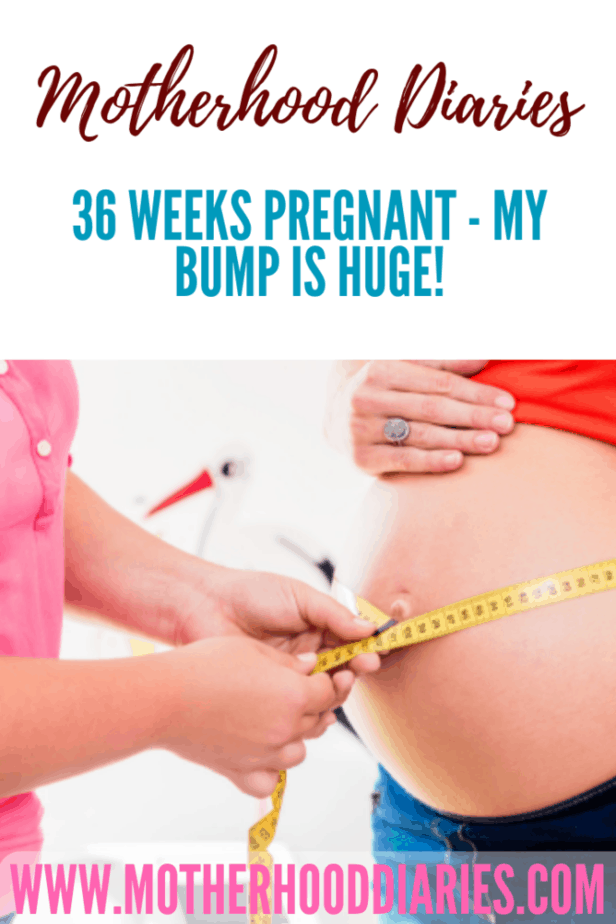
The midwife measured my bump and said that it was a perfect size at 36.4cm. Woohoo! I was worried that I was going to give birth to a 10-pound baby. I recorded the heartbeat to send to hubby, which sounded like a little train. Boxer’s heartbeat sounded so lovely and at least I know I am still keeping him alive inside me. I cannot believe that from getting pregnant to now, it has been 36 weeks. I feel like I’ve been pregnant forever.
At the antenatal classes, we had a woman-only session, and the lads went out for a drink to bond and talk about their anxieties as fathers. It was really nice to just talk with the ladies, as we got to discuss the niggles of pregnancy that perhaps our husbands/partners didn’t really understand.
For example, if I sit down for too long, then get up, my pelvis and lower back ache. And, I’ve really felt my belly drop this week, which is great as I can finally breathe and I don’t get heartburn as much. But it’s not so great that the baby now directly pressures my pelvis and bladder. Still, I’m only getting up once a night, though, so I can sleep well. Thanks, Boxer!
The NCT Counsellor, at the women-only session, talked about perineal massage, which prevents tearing during birth. I’m not sure I want anything to touch me down there, let alone have my husband to
Don’t know your due date? Use our due date calculator here!
Our last class was all about Caesareans and how and when a woman is expected to have a Caesarean section. The discussion definitely left me scared and wishing I won’t have surgery like that. It’s such a major operation and it can take up to six weeks to heal. It must be difficult if you don’t recover from an operation in the normal way, as you’ll have a newborn baby to tend to.
When I went home that night, I watched a really good DVD called Great Expectations, Laugh and Learn about Childbirth. The DVD is a bit out-dated, but the woman, Sheri Bayles, hosts childbirth classes on the DVD and explains everything so well, from pregnancy to having the baby. And she’s quite funny too! I learned a lot, especially the really useful breathing techniques she claims works like a charm during labour. I’m definitely going to try them out and hope the baby comes down the birth canal rather than the Julius Caesar way!
A fun fact – Your baby weighs as much as a crenshaw melon!
🍼 Create Your Perfect Baby Shower Wish List on Amazon Today! 🍼
The science part

36 weeks pregnant bump
You may feel like your whole body is growing along with your bump. At 36 weeks your bump should measure at around 36cm.
36 weeks pregnant baby
- The amount of space in your womb during the 3rd trimester is ever shrinking, but your baby at 36 weeks is still kicking away.
- Your baby is getting ready for their first breath of the world’s air when they are born. Their lungs are developed now and ready. However, they are still deflated as they are currently getting oxygen through the placenta (which is why there is no risk of drowning during a water birth)
- If they were born now, they’d still be premature, but they could suckle and their digestive system is ready to take in breast milk.
36 weeks pregnant symptoms
Braxton Hicks contractions
Your womb is getting ready for labour now, so you may experience more Braxton Hicks contractions – they can be quite strong and some women mistake them for labour contractions.
Cramps when 36 weeks pregnant
If you are experiencing cramps that as painful as menstrual cramps, this could be early labour. If you’re experiencing something more severe than menstrual type cramps, it’s time to call your hospital!
Swab when 36 weeks pregnant
Some women are screened for Group B strep as part of their routine prenatal care, especially if they’ve had Group B strep before. This isn’t a normal part of the procedure though, so if you’re worried, request a test, which is a swab sample from the vagina and the rectum. If you are Group B strep positive, then your baby will receive antibiotics during vaginal birth to avoid contracting Group B strep.
36 weeks pregnant signs of labour
You may experience the following signs of labour:
- Contractions or tightenings
- The mucus plug comes away from your cervix, which is otherwise known as a ‘show’ or ‘bloody show’.
- You may experience menstrual type cramps or backache
- You might have the urge to go to the toilet, which is caused by the baby’s head pressing down on your bowels.
- Your waters may break, in which case, call your doctor immediately.
36 weeks pregnant discharge
Another question asked was, ‘Discharge when 36 weeks pregnant’
You may see an increase in discharge as your body prepares for labour. If you see a watery discharge, this may be your waters (amniotic fluid) breaking, blood (a sign of preterm labour) or your mucus plug, which could be blood-tinged. Call your doctor immediately if you have any of these signs.
Leaking a bit when you pee?
Are you leaking a bit of pee when you’re coughing, sneezing or laughing? This is normal, but it means your pelvic floor needs a bit of strengthening. Work on your pelvic floor every day so you can prevent any further leakages when the baby is born.
36 weeks pregnant baby movement
Your baby is gaining more weight every day, so there will be less room to move around in the uterus. This means you may not feel the baby moving around as much. Instead, the baby might twist or stretch, but it is still important to monitor your baby’s movements. If their pattern of movement changes or increases/decreases, call your doctor immediately. Don’t waste time! It’s always better to be safe than sorry and you’re not wasting the hospital’s time.
36 weeks pregnant baby position
Another question asked was, ‘At 36 weeks pregnant, how is the baby positioned?’
The baby at week 36 has moved down and is most likely head down. But if not, your doctor or midwife will apply pressure to your abdomen to turn the baby around from the breech to the head-down position. This is called an external cephalic version.
36 weeks foetus pictures
Below is a picture of your bump and your baby at 36 weeks pregnant:

36 weeks pregnant in months
Other questions asked were, ’36 weeks is how many months?’, ‘How many months is 36 weeks?’, ‘Is 36 weeks pregnant 9 months?’, ‘Is 36 weeks pregnant full term?’, ‘How long is 36 weeks pregnant?’ and ‘Is 36 weeks pregnant 9 months?’
36 weeks in months means 9 months exactly but, in pregnancy terms it actually means you’re 8 months pregnant. This is because we count the pregnancy from 4 weeks being the first month rather than 0 weeks, as your baby doesn’t exist until conception at 2 weeks! It’s all very confusing.
36 weeks pregnant symptoms not to ignore
If you experience the following, call your doctor immediately:
- Any pain, cramping in your lower abdomen or severe back pain
- Severe headaches and tingling/swelling in hands and feet – this could be a sign of pre-eclampsia/high blood pressure
- Pain or burning when you pee, or not needing to go to the loo as much. This could be a sign of a UTI.
- Itchy hands and feet – this could be a sign of cholestasis, which is a liver condition that occurs late in pregnancy. Itching can also occur in other parts of the body.
- Chills, fever, vomiting and/or nausea that won’t go away
36 weeks pregnant nausea
Nausea, vomiting and diarrhoea can be a sign that you’re about to go into labour, so let your midwife or doctor know straight away if you’re experiencing any of these symptoms.
36 weeks pregnant diarrhoea
Another question asked was, ‘Diarrhoea when 36 weeks pregnant?’
Please see above. If you’re experiencing diarrhoea, this could be an early sign of labour.
Spotting when 36 weeks pregnant
1 in 10 women will experience vaginal bleeding during their 3rd trimester. You should tell your doctor immediately if you see any kind of spotting during the latter stages of pregnancy. Severe bleeding could be a sign of placental abruption.
Your next steps – what to do at 36 weeks pregnant
- Get in touch with your midwife if you feel a reduction in movements
- You’ll feel a bit more pressure on your bladder when the baby drops around this time, but thankfully your lungs will get a rest!
- Make sure you are going to sleep on your side when you reach the third trimester because research has shown that sleeping on your back increases the risk of stillbirth. This includes naps during the day and sleeping at night time.
- Practice massaging your perineum (the bit between your vagina and anus) in the weeks coming up to birth to reduce the chances of an episiotomy (cutting the perineum) during birth
- Have you thought about what kind of pain relief you want during labour? Speak to your midwife, who can explain the different pain relief available.
- Now is the time to get your birth plan sorted if you haven’t done so already
- From anytime until birth, your mucus plug may come out, which is a collection of mucus that collects in the cervical canal to prevent bacteria or infection from entering your uterus and getting to your baby. As your cervix prepares for labour, you will lose the mucus plug, which is very normal during late pregnancy. It’s a great sign that your baby will greet you soon – just not yet! It needs to cook a bit more yet!
FAQ
Flying when 36 weeks pregnant
“Is it safe to fly during pregnancy? Answer From Tatnai Burnett, M.D. Generally, commercial air travel before week 36 of pregnancy is considered safe if you have a healthy pregnancy. Still, if you’re pregnant, check with your health care provider before you fly.”
https://www.mayoclinic.org/healthy-lifestyle/pregnancy-week-by-week/expert-answers/air-travel-during-pregnancy/faq-20058087
What to eat 36 weeks pregnant
“
Eat a variety of healthy foods. Healthy foods include fruits, vegetables, whole-grain breads, low-fat dairy foods, beans, lean meats, and fish. Drink liquids as directed. Ask how much liquid to drink each day and which liquids are best for you. Limit caffeine to less than 200 milligrams each day.”
https://www.drugs.com/cg/pregnancy-at-35-to-38-weeks.html
Things to avoid at 36 weeks pregnant
“Wash your hands after you touch raw meat. Make sure any meat is well-cooked before you eat it. Avoid raw eggs and unpasteurized milk. Use gloves or ask someone else to clean your cat’s litter box while you are pregnant.”
https://www.drugs.com/cg/pregnancy-at-35-to-38-weeks.html
Can I travel at 36 weeks pregnant?
“Answer From Tatnai Burnett, M.D. Generally, commercial air travel before week 36 of pregnancy is considered safe if you have a healthy pregnancy. Still, if you’re pregnant, check with your health care provider before you fly.”
https://www.mayoclinic.org/healthy-lifestyle/pregnancy-week-by-week/expert-answers/air-travel-during-pregnancy/faq-20058087
Can a pregnant woman give birth at 36 weeks of pregnancy?
Another question asked was, ‘Is 36 weeks pregnant premature?’
“Delivering a baby at 36 weeks, which is known as late preterm, can happen spontaneously or may require induction. A doctor might induce a pregnancy for a variety of reasons, including preterm labor, severe preeclampsia, placental problems, fetal growth restriction, or gestational diabetes.”
https://www.medicalnewstoday.com/articles/322408
Is it safe to induce labour at 36 weeks pregnant?
“The American College of Obstetricians and Gynecologists (ACOG) do not recommend voluntarily inducing labor before 39 weeks gestation unless there is a medical need to do so. Most babies born at 36 weeks are generally healthy.”
https://www.medicalnewstoday.com/articles/322408
I’m 36 weeks pregnant and I seem to struggle with headaches, especially at night. Is it normal?
“Expectant mothers may experience an increase or decrease in the number of headaches. Unexplained, frequent headaches later in your pregnancy could be a sign of a more serious condition called pre-eclampsia, so tell your doctor if this is the case.”
https://www.pregnancybirthbaby.org.au/headaches-during-pregnancy
Also, if you have a borderline high pressure (sometimes called prehypertension) then at 36 weeks pregnant, you have a 70% increased risk for birthing a low birth weight baby or even having a stillbirth compared to women with normal blood pressure. So, it’s very important to ensure you seek medical advice when you have unexplained, frequent headaches.A
I am 36 weeks pregnant and my baby is breech. Will I have normal delivery?
“How does a breech baby affect delivery? If your baby presents in a breech position after 36 weeks of pregnancy, your birthing plan will likely change. It’s usually unsafe for a breech baby to be born vaginally due to risks of injury. In most cases, a planned C-section is the safest way to deliver your baby.”
https://www.babycenter.com/pregnancy/week-by-week/36-weeks-pregnant
Some pregnant women have given birth vaginally with a breech baby and some babies have turned in the final few weeks of birth, but this is anecdotal. Please consult your doctor for the safest next steps.
Note: These are just general ideas of how you and your baby are getting on and not medically reviewed. Don’t forget that every baby develops differently. If you are concerned about your baby’s development, please consult your healthcare provider or midwife for medical advice.
References
A. Prehypertension in Pregnancy and Risks of Small for Gestational Age Infant and Stillbirth study – https://pubmed.ncbi.nlm.nih.gov/26831196/


*Illustrations by Charlotte Watkins.
If you have any questions about her work, please contact Charlotte via her website, Facebook, Instagram or LinkedIn*