39 weeks pregnant – No sign of labour yet!
Are you pregnant?
Hubby’s mum came over from Switzerland to stay for a week, which is great because I really enjoy her company. We had a quick coffee at Starbucks before we went home to eat and prepare for my midwife appointment. Unfortunately, as soon as we arrived home, we realised we had left her Christmas card on the table at Starbucks and it took me a long time before I could get through to the store to ask them to hold on to the card for us. D’oh, pregnancy brain!
We went to my midwife appointment together at the birth centre and hubby’s mum commented on how cosy the place was.
During the visit, we discussed the hormone oxytocin and its role in stimulating contractions, an essential factor for beginning labour. The midwife emphasised how the intensity of these contractions could signal the start of active labour. She also highlighted the importance of regular intervals in monitoring the baby’s heart rate and movements, known as kick counts, a practice endorsed by the American College of Obstetricians and Gynecologists to ensure the baby’s well-being. The midwife explained the importance of informing the birth centre if I displayed any signs of pre-eclampsia or if I couldn’t feel over ten baby’s movements in a day. I told her there was no danger of that happening as Boxer is so active, especially at night.
The midwife measured my bump and told me I would probably have a baby weighing about 8/12 pounds, which meant I didn’t require a growth ultrasound scan as Boxer was growing a normal rate. OMG! Hubby’s mum explained that hubby was over 9 pounds and he was 2 weeks early. My sisters and brother were all over 8 pounds (except for me, but I was 5 pounds at 3 weeks early, so I probably would have been big if I had come out full-term). She told me not to worry though as he was in the optimal position, which is apparently the best birth position.
As my due date was in a couple of days, she offered to do a sweep to kick-start labour within 48 hours. I joked and said, “Since my mother-in-law is only here until the 15th we should do the sweep!” It was painful and very unpleasant, and the worst thing was she couldn’t find my cervix.
Apparently, it was so far back that this sweep couldn’t be counted as a proper sweep. So she booked me in for another sweep on my due date. She told me it didn’t mean that labour would take a long time to start because my cervix was so far back, but she offered me a sheet containing some natural induction techniques and the role of prostaglandins, which can be naturally released through certain activities. I was quite surprised at some things on the list, to be honest. Below is a list of what was on the sheet:
| Slow down, rest/relax more | Yoga–deep squatting |
| Visualisation | Walking |
| Freeing yourself | Hug a friend’s/relative’s baby |
| Sorting out environment/nesting/burst of energy and urge to clean | Eating curry or spicy foods |
| Relaxing bath – aromatherapy oils as directed by the practitioner | Letting go – glass of wine, massage |
| Nipple stimulation | Sex (no sheath!) |
| Orgasm | Eating pineapple |
| Going to a qualified practitioner for aromatherapy: * using clary sage to encourage labour * They can be used as a massage oil, hot compress, on a burner or in the bath | Homeopathy |
| Cranial | Shiatsu |
| Acupuncture/acupressure/moxa | Reflexology |
| Herbs – e.g. raspberry leaf tea etc | Sweeping of membranes by midwife |
| Spend time with your baby – talk to them |
I created an infographic too, which you can print off or pin to your Pinterest board.

A glass of wine? Nipple stimulation? I’m not sure I would want to drink any alcohol now that I’m only in the last stages of pregnancy, so I’m surprised the NCT advised this as a natural form of induction. Maybe a bit of alcohol doesn’t affect the pregnancy or the baby? I’m so confused about this part of the pregnancy because there are so many conflicting resources out there. Would you drink alcohol during your pregnancy? And, if so, how much is ok?
After the check-up, my mum-in-law and I took a long walk up into town (one thing I can check off in the natural induction list!) We passed a hairdresser along the way and she got her hair done. I offered to walk back to the flat, get her money, walk back to the hairdressers, then go to Starbucks to collect the Christmas card, and then back to the hairdressers, so I could speed up labour. By the time I got back to the hairdresser, although happy that I had helped the baby along, I was exhausted!

🍼 Create Your Perfect Baby Shower Wish List on Amazon Today! 🍼
In the evening, hubby came home from work and we all walked back into town for an Italian meal. I looked like a penguin waddling down the street, but at least I slept like a log that night. Pregnancy at 39 weeks is hard!
A fun fact – The baby is the size of a watermelon!
The science part

Your baby at week 39
- Your baby at 39 weeks isn’t growing much anymore, but their brain definitely is
- Your baby’s skin has turned white/grey and won’t have any pigment until after you have given birth
- Your baby is likely weighing around 6 to 9 pounds or around 3 to 4kg
Still not given birth? Check out our tips for inducing labour here!
At 39 weeks pregnant – what to expect – your pregnancy signs and symptoms
39 weeks pregnant symptoms include:
- Are you going to go into labour today? Maybe tomorrow? It’s any time now you’re in the last stretch of the 3rd trimester!
- You may experience more discharge than normal, which should be thin, white and not smell much. If you spot anything that looks like yellow or pinkish (bloody) mucus then you’re having a ‘show’, which is the sticky stuff that plugs up your cervix. Once it comes out, it’s one of the early signs of labour, If you experience any fluid leak, this could be your waters, so contact your doctor immediately.
- Your Braxton Hicks contractions may get stronger now
- You may also experience lightening and lower back pain as the baby moves down towards your pelvis.
- You may feel increased pressure at the bottom of your bump now too, which means more pressure on your bladder and more frequent trips to the loo!
Your next steps. What to do – 39 weeks pregnant.
39 weeks pregnant – symptoms not to ignore. Contact your midwife/GP if you have:
- Bleeding from your vagina – spotting when 39 weeks pregnant if in little amounts could be part of your mucus plug or a bloody show. But if you’re bleeding bright red and soaking through a pad, you must contact your hospital straight away
- Brown/pink discharge – a pink/brown discharge when 39 weeks pregnant could be a sign of your mucous plug coming away
- Headache that won’t go away – a severe headache when 39 weeks pregnant is one sign of pre-eclampsia
- Blurry vision, or sensitivity to light
- Pain below the ribs
- Extreme swelling of hands, feet, ankles and face
- Constant tummy pains – cramps when 39 weeks pregnant are normal, but if the pain is intense, you may be in labour
- Vomiting when 39 weeks pregnant
- Constant diarrhoea – Diarrhoea when 39 weeks pregnant is
- Severe itching, particularly at night
- A high temperature but with no other cold or flu symptoms
- You experience your water breaking (your amniotic fluid). If your water breaks, you need to contact your hospital/healthcare provider straight away for medical advice to monitor your and your baby’s health as labour may be imminent. Babies are rarely born on their due date, so be prepared because you may be giving birth soon.
39 weeks pregnant – baby weight in kg
Your baby is likely weighing around 6 to 9 pounds or around 3 to 4kg
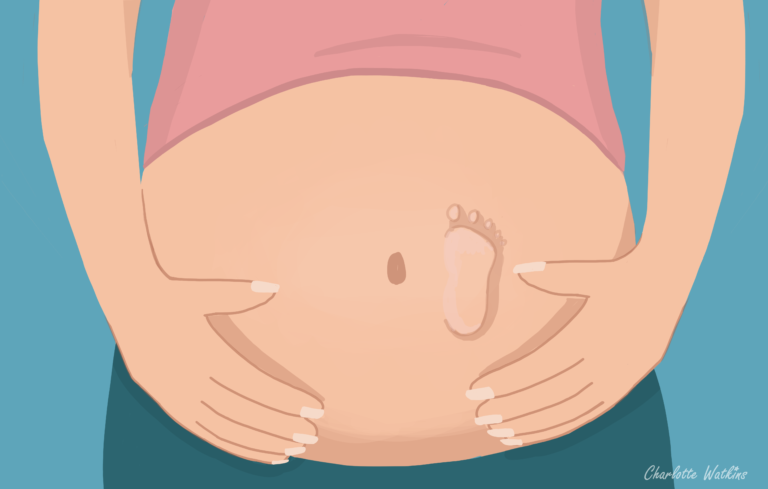
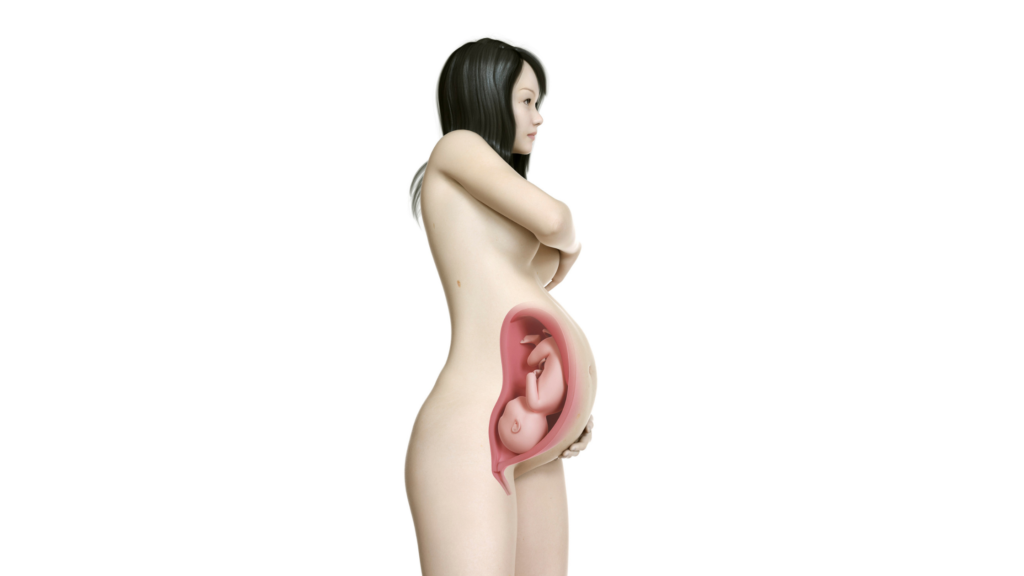
39 weeks pregnant belly
This is what your belly looks like at week 39 in pregnancy
What to eat – 39 weeks pregnant
You should start thinking about your post-pregnancy diet. Eat a variety of at least five portions of fruit and veg each day, plenty of starchy foods like wholemeal bread, pasta, rice and potatoes, protein from lean meat, poultry, fish, eggs, beans pulses and nuts, two portions of fish a week, and dairy foods like milk, cheese and yoghurt.
39 weeks pregnant – white milky discharge
At 39 weeks of pregnancy, the cervix in your uterus is growing thinner and softer to prepare for birth and it will be 10cm wide in dilation and effacement. You may have a lot of vaginal discharge and see a ‘show’, which is the mucus blob plus that kept your cervix closed. This is all part of the first stages of labour.
39 weeks pregnant – baby position
Your baby’s head is probably in the head-down position, ready for birth. If your baby is breech, then you may need to speak to your doctor / ob-gyn about how this will impact your birth choices and whether they can help the baby change positions.
39 weeks pregnant – no signs of labour
If there are no signs of labour, there are things you can do to help speed labour along. However, the baby will come when they’re ready so they’re not guaranteed to work. Check out my article on how to induce labour naturally now.
FAQs
Is 39 weeks pregnant full term?
In the past, a baby born anytime between 37 weeks and 42 weeks was considered full term. Now, a pregnancy is considered full-term at 39 weeks.
What is 39 weeks pregnant in months?
You are at the last stages of the third trimester and almost 8 months and 3 weeks pregnant. Congratulations, your baby is on its way!
Is driving at 39 weeks safe?
It is safe to drive during pregnancy unless you’re feeling too tired or uncomfortable with nausea. Some women experience pregnancy brain so if you feel like your reflexes are impaired, then, if you can, it would be preferable to avoid driving.
What does it mean if you are 39 weeks pregnant and feel depressed?
It is normal to feel up and down during pregnancy because of the emotional and physical pressure on your mind and body. I have written an article on how to help you be more positive during pregnancy here.
But if you feel like your mental health is impacting your life or you’re having negative thoughts that could affect you and your baby, then you need to seek professional help. You may experience prenatal depression and will need to manage this to avoid chances of postnatal depression too. Contact your GP for more information on how you can speak to someone about how you feel.
What can I do if I am 39 weeks pregnant and can’t sleep?
Another question asked was, ‘How to sleep 39 weeks pregnant’
Sleeping at 39 weeks can be difficult because of the big bump. Check out this article for tips on how to sleep while pregnant.
What does it mean if I am 39 weeks pregnant and my baby is not moving so much?
Your baby is filling the womb now and there’s not much space left in your belly, but it doesn’t mean their movements should slow down. If your baby is not moving as much as they were before or if you’re worried about the frequency and pattern of movements, then talk to your midwife or doctor immediately. Don’t delay!
What should you do if you are 39 weeks pregnant and 1cm dilated?
Being 1cm dilated could indicate that labour is on its way or it could still take weeks. Contact your doctor who may advise rest if labour hasn’t started yet, depending on whether you are a high-risk or low-risk pregnancy patient. If you’re high risk, you may be asked to stay in hospital for further examination.
What should you do if you are 39 weeks pregnant and 3cm dilated?
At 3cm dilated you are still in the early stages of labour and may experience mild contractions. Depending on whether you are high risk or low risk, you may be sent home until you are in the active phase (between 4cm and 7cm) or you will be kept in for further monitoring. Speak to your doctor for advice.
Why am I bleeding and cramping at 39 weeks pregnant?
Blood when 39 weeks pregnant could indicate an issue but not always. Contact your doctor ASAP to rule out any concerns over you and baby. Cramping is normal but if it’s accompanied with bleeding or it is intense, again call your hospital straight away.
Why am I cramping and have back pains at 39 weeks pregnant?
Braxton Hicks can become quite powerful in the lead up to birth and can sometimes be mistaken for labour contractions. If your tummy remains constantly hard or the tightenings become regular or painful contact your midwife or labour ward for advice.
I’m 39 weeks pregnant and it’s my first baby. I’m constipated from 2 this morning. What sign is this?
Constipation isn’t necessarily a sign of labour, but as your baby moves down the canal, there is more pressure on your rectum. It is more likely down to the food you’re eating, so make sure you drink enough water, exercise where possible and fill up on fibre and roughage.
Is it safe for a 39 weeks pregnant woman to take antiviral medication because of a suspected flu infection?
Antiviral drugs can alleviate flu symptoms and help you feel better faster, especially while pregnant. Speak to your doctor about the right antiviral medication to take during your pregnancy though.
I’m 39 weeks pregnant. Is it true that I should have stopped taking a calcium supplement since week 35?
You should ask your doctor about this but it is not generally recommended to stop taking calcium as it is an important nutrient, especially in the last trimester. Speak to your doctor about whether you should stop taking a calcium supplement.
Thinking about getting pregnant already? Download our FREE starter pack to help you get pregnant naturally
Note: These are just general ideas of how you and your baby are getting on. Don’t forget that every baby develops differently. If you are concerned about your baby’s development, please consult your doctor or midwife.



*Illustrations by Charlotte Watkins.