
Top tips on how to be more productive with ADHD
I realised quite late in life that I could have ADHD, even though all the signs were there from as early as I could remember. During my childhood, I was told I’d either distract people or get distracted. The teachers couldn’t handle me. I had bundles of energy and I never slept, so my parents struggled with me, too. It was only when I channelled my energy into music and sport that I realised I needed extra tools to manage daily life.
As a fully-fledged adult, I procrastinate when I should finish a deadline, complete a household chore, or even when I read to the kids before bedtime. Tackling household clutter can feel overwhelming, but starting with practical steps can make a huge difference. For instance, if you’re managing a major decluttering project, you might consider looking into how to rent a home cleanout dumpster that allows you to efficiently clear large amounts of waste and regain control of your space. Procrastination has become the biggest bane of my life, so staying productive can be challenging, especially when I have several distractions around me.
It’s safe to say we all experience procrastination in varying degrees when trying to manage everything. The Internet and social media have made it that much easier to waste time rather than get things done. Now I am a busy mum of four with (undiagnosed) ADHD and, at the best of times, it can feel like juggling plates while walking on a tightrope.
Whether it’s managing the house, the kids, or even your own business, staying productive while ADHD symptoms demand your attention is tough. So, this article is mostly geared towards those, like me, who work from home and juggle parenting and work duties, often at the same time, but with the added nuance of ADHD. From breaking down tasks to using accountability partners, here are 60 top tips on how to be more productive with ADHD. Let’s get stuck in!
What is productivity?
To be productive, we need to know what productivity means. Businessdictionary.com defines productivity as:
“The measure of the efficiency of a person… in converting inputs into useful outputs. Productivity is computed by dividing the average output per period by the total costs incurred or resources (capital, energy, material, personnel) consumed in that period. Productive is a critical determinant of cost efficiency.”
So, in essence, productivity basically means how efficient you are at what you are producing and what you receive economically as a result, i.e.output per unit of input. So, the more productive you are, the more chances you have of increasing your value.
What about productivity at home? Being busy vs productive

In simpler terms, productivity means using your time and energy effectively to achieve your goals. So, if the tasks you are working on are low-value or at the expense of high-value tasks, then doing something doesn’t always mean you are productive. The primary aim of being productive is to know exactly what you should spend your time, energy and attention on to improve yourself and your family around you.
Why does being productive matter?
Consider what it would be like if you could achieve all the high-value tasks you needed to complete in a shorter period, so you have more time to spend with your family. Perhaps productivity will allow you to use your energy on the things that make you happier or even work on tasks that will help you improve your work and home life.
Having something productive to do at home means that you can manage your daily tasks effectively and still increase your health and wellbeing. And at work, being productive means that you can improve your way of living and earn more income to spend on the things that make you happier.
So let’s dig into the tips on how to be more productive. Even if you don’t have ADHD, these tips will work for you too:
Tip 1: Break down big tasks into small goals
We’ve all been there – staring at a massive to-do list and feeling completely overwhelmed. For me, that feeling of being paralysed by the size of a task used to be my biggest barrier to getting things done. What I’ve learned is that breaking down big tasks into smaller, manageable goals is a game-changer. If you’re staring at a mountain of laundry or an overwhelming work project, don’t think about the whole thing. Just tackle the first small step. Before you know it, those little steps will add up, and you’ll be making progress without feeling buried under the weight of it all.
Tip 2: Use a timer (Pomodoro Method)
Let me tell you, the Pomodoro technique is like a secret weapon for ADHD productivity. The idea is simple, but so effective. Set a timer for 25 minutes and focus on one task during that time. Once the timer goes off, take a 5-minute break to reset. I use that little break to grab a coffee, stretch, or just give my brain a breather. After the break, I jump back in for another 25-minute sprint. It’s amazing how much you can get done with this method. Plus, those little breaks are perfect for recharging without losing momentum.
Tip 3: Find your peak productivity hours
Are you more productive in the morning or late at night? For me, it depends on the day, but I’ve learned that knowing my peak hours makes all the difference. If I didn’t have to do the school runs, I could work into the early hours of the morning. But, now I have to be up at 6am, so I find the period just after drop is off my most productive time to check off the most challenging tasks.
The idea is to work with your natural energy levels instead of fighting against them. If you know you’re sharper in the morning, use that time to tackle your most important tasks. If you’re a night owl, save the big stuff for the evening. Understanding when you’re at your best can help you make the most of those bursts of energy.
Tip 4: Keep a task list
I live by my task list. Without it, I’d probably forget half of the things I need to do. Whether you use a simple to-do list or something more structured like a Productivity Planner, having your tasks written down is a lifesaver. Not only does it help you stay on top of things, but there’s also something incredibly satisfying about crossing off completed tasks. It reduces stress and keeps everything manageable.
Tip 5: Use a brain dump
Sometimes, my brain feels like it’s running a million miles a minute, especially when I have a lot on my plate. That’s where a brain dump comes in handy. I just grab a piece of paper or open a productivity app and jot down everything that’s swirling in my mind. Getting it all out helps me focus on what’s most important without constantly being distracted by random thoughts or worries. It’s one of the best ways to clear mental clutter and stay productive.
Tip 6: Use an accountability partner
If you struggle to stay on track, an accountability partner can work wonders. It could be a friend, a family member, or even a colleague. The idea is that someone checks in on your progress, keeping you accountable. Knowing that someone will ask how you’re doing can give you that extra push to stay motivated. I’ve found it especially helpful when I’m working on long-term projects or tasks that feel overwhelming.
Tip 7: Limit distractions
Let’s face it: distractions are everywhere, especially when you have kids at home. For me, the key is creating a work zone where I can limit distractions as much as possible. Whether it’s using noise-cancelling headphones or setting up a quiet workspace, reducing external interruptions helps me stay focused. It doesn’t eliminate the chaos completely, but it certainly makes things a bit easier.
Tip 8: Use ADHD-friendly tools
There are so many tools out there designed to help with productivity, and some of them are particularly helpful for ADHD brains. Apps like Trello and Todoist, as well as my trustee Microsoft Outlook and To-Do help me stay organised, while a Productivity Planner keeps me on track with habits and goals, as I like to write things down. You can also use a LiveChat conversational platform with ChatGPT at its core for almost human-like interaction. I can’t live without it now!
The important thing is to find tools that suit your style and stick with them. These tools are like scaffolding for your productivity—they provide the structure you need to stay on task.
Tip 9: Create routines but stay flexible
Routine is essential for productivity, especially with ADHD. But life happens, and sometimes sticking rigidly to a schedule just isn’t possible. That’s why it’s important to stay flexible. I try to keep a basic routine, but if something throws off my day, I don’t beat myself up about it. The key is to stick to the most important tasks and give yourself a little grace when things don’t go as planned.
Tip 10: Start with one task
When there’s too much to do, it’s easy to get stuck in indecision. My advice? Just pick one task and start. It doesn’t have to be the biggest or most important thing—just start with something small. The act of getting started builds momentum, and before you know it, you’re ticking things off your list. Action leads to motivation, so don’t wait for that burst of energy. Just begin.
Tip 11: Take short breaks
We’ve talked about the Pomodoro Technique, but short breaks can make all the difference, especially when your brain feels overloaded. I try to work in 25 to 30-minute bursts and then take a 5-minute break to move around, grab a snack, or just relax. But, the important takeaway here is breaks are needed as they’re a great way to recharge without losing focus. And those little breaks prevent burnout, helping you stay productive for longer stretches of time.
Tip 12: Keep things fun and interesting
Let’s be honest—boring tasks are the worst. But I’ve found that adding a bit of fun can make even the most mundane chores more bearable. I’ll often put on a playlist or listen to an audiobook while I’m cleaning or working. Music can really shift your mood and make repetitive tasks feel less like a chore.
Tip 13: Celebrate small wins
One of the best ways to keep yourself motivated is to celebrate the little victories along the way. Finished a task? Take a moment to acknowledge it! Whether it’s treating yourself to a cup of tea or taking a quick break, these small rewards help build momentum and keep you moving forward.
Tip 14: Try body doubling
Body doubling is a brilliant productivity hack for people with ADHD. Simply having someone else around, even if they’re working on something completely different, can help you stay focused. I’ve even found virtual body doubling helpful—just having someone on a video call while we both work keeps me on task.
Tip 15: Don’t wait for motivation
If you’re waiting for motivation to strike, you might be waiting a long time! The truth is, ADHD brains often struggle with finding motivation. But here’s the secret: action creates motivation, as we mentioned before. Don’t wait for the spark—just start. Once you’re in motion, the motivation will usually follow.
Tip 16: Avoid multitasking
Multitasking is tempting, especially when you have a lot on your plate. But I’ve found that it rarely works, especially with ADHD. It’s better to focus on one task at a time and see it through to completion. You’ll be more efficient and less stressed when you’re not trying to juggle multiple things at once.
Tip 17: Use visual cues
I’m a huge fan of sticky notes and other visual reminders. If you’re the type of person who forgets what you were doing just two minutes ago, like me, having visible cues can be a lifesaver. Whether it’s a note on your desk or a reminder on your phone, keeping important tasks front and centre can help you stay focused.
Tip 18: Find an ADHD coach or expert
Sometimes, you need a little extra help. An ADHD coach or expert can provide personalised strategies that fit your unique challenges. They can help you find what works for your specific situation and even help you develop a plan for your business or guide you through any rough patches. It’s worth considering if you’re struggling to manage on your own.
Tip 19: Be kind to yourself
Productivity will vary day by day, especially when you’re managing ADHD. Some days, everything flows smoothly, and you feel like a superhero. Other days, it’s a struggle just to get out of bed. And that’s okay. Be kind to yourself and recognise that not every day will be perfect. Give yourself the same grace you’d offer a friend.
Tip 20: Plan your day the night before
One of the best habits I’ve developed is planning my day the night before. Before I go to bed, I write out my top tasks for the next day. This way, I wake up knowing exactly what I need to focus on. It takes the guesswork out of the morning and helps me hit the ground running.
Tip 21: Get some sleep
Sleep is key to being productive at home during the day and being at your very best work performance. Set a bedtime and wake time every day, even during the weekends, and stick to them so your body clock automatically shifts to these times.
To have an effective good night’s sleep, try to sleep in complete darkness. I use an eye mask which helps me sleep in pitch black because the slightest bit of light will wake me up. If you can, invest in blackout blinds, as they help to block out any light coming from the window. Avoid drinking alcohol and caffeine before bed, as they will keep you up and decrease your productivity the next day.
Tip 22: Fit in regular exercise
Exercise is literally my number one therapy! It helps to keep the heart pumping and will keep your mind and body happy and relaxed. I work out from home 30 minutes a day, and this works for me as I also work from home. But if you need extra motivation, perhaps classes are a good way to keep you motivated.
Exercising outside when the weather is nice is a great way to take your mind off your daily tasks and get in some much-needed fresh air, which will help to clear the cobwebs in your head. Studies have shown that if you step outside at the very start of your day, your productivity increases by up to 70%! When and where I can, I will take myself for a walk.
Diet is also just as important as exercise. Make sure you’re eating well and getting your 7-a-day. Try to avoid sugary food and drinks as they spike your sugar levels and will cause an energy crash, which is not good for productivity.
Tip 23: Practice mindfulness and meditation
Mindfulness and meditation are all about keeping your mind in the present moment, and not wandering off when you need it to focus on your work. It’s a great way to train your brain muscles and help you be more productive in your daily tasks.
This is a slow process, so take your time and keep going – you will reap the rewards later. Headspace is a great way to practice meditation, and I have written more about mindfulness and meditation to reduce anxiety, which you can find here.
Tip 24: Set up a home command centre
Set up a home office that limits distraction and makes your office space the hub of productivity. For more information on how to set up your home office, check out Forbes’ article here.
Tip 25: Embrace procrastination and use it as a tool
As I’ve mentioned before, I am a huge procrastinator and spend a lot of my time wasting time! So, as mentioned above, I incorporated a technique which works for me, and that is to work on my tasks in 30-minute bursts and then allow myself 5 – 10 minutes to procrastinate.
You will not beat procrastination, the temptation will always be there. So use your time effectively to get all your procrastinating done and then focus your time and energy on getting your projects done in periods which you can manage. Try the 30-minute burst and see if that works for you.
I wear a fitness tracker, so I set 30 minutes on my timer, and my wrist will buzz when I have finished those 30 minutes. Then I get off my seat, and I take a walk around, scroll on my phone, eat some food or schedule in my exercise.
Take your mind off work for those short few minutes, so you are ready to set another 30-minute timer and tackle your tasks.
Also, if you have deadlines and you set them a few weeks in advance, but you sit on that deadline until the last minute, then change your deadline to a shorter period in advance. If I have a deadline coming in a few days, then I make sure I get it sorted in those few days. If I had 3 weeks, I wouldn’t do anything until the last minute!
Tip 26: Use a productivity journal to reach your goals
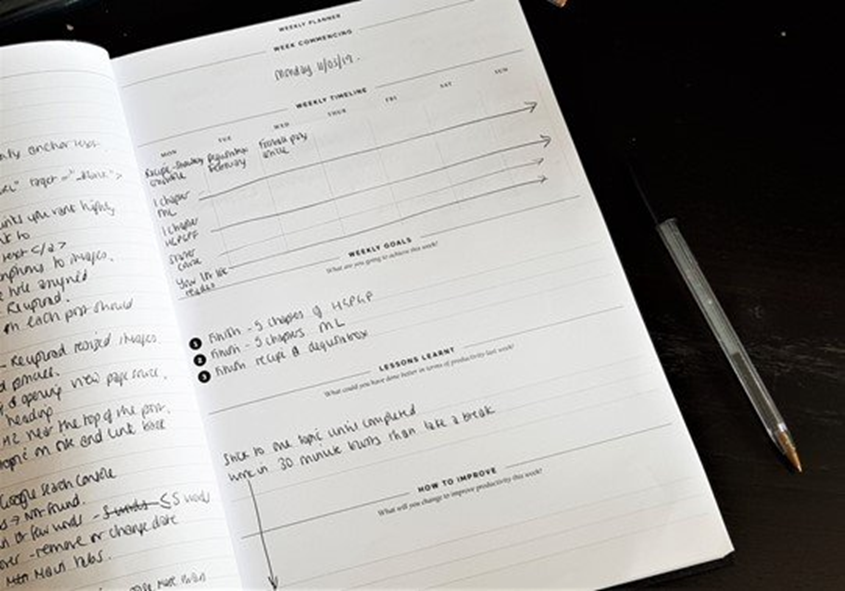
Start recording your habits and tasks so you know what you’re working on every day. You can set goals, manage your time, and plan your tasks, so you can see what you need to do every day.
At the start of each month, specify what you will work on each month. Then within each week, set goals that will contribute to that monthly goal, and each day work on the goals that will contribute to your weekly goals.
I found since using a productivity planner that I am so much more productive with my work and house duties because I know what my good and bad habits are and I know what I need to do every day, week and month.
Tip 27: Work out what your goals are and create habits to achieve those goals
What is it you would like to achieve? Are you trying to lose weight? Do you want to clean less and spend more time working on your business? Do you want to spend more time with your family? Be clear with what you want to achieve and note the point at which you want to get to, so you can create habits to achieve your goal.
For example, if you want to lose weight, set times to get to the gym or fit in your workout. If you want to spend more time with your family, then schedule a few hours in the day to purely spend time with the family – make sure you do nothing else in that time.
If you want to clean less and spend more time working on your business, then use my ‘short work-burst’ method and work on your business for 30 minutes and spend 10 minutes cleaning up a certain area of the house. You can use The Organised Mum’s Method where she talks about cleaning an area in your house for just 30 minutes a day, and this works just as well. I use a method similar to this, otherwise I would just end up cleaning all day and spending little time on work.
Use a habit tracker to track the habits you have identified. Each time you have fulfilled a habit, tick it off. Include your bad habits too like I did and cross-check them off when you have successfully not fallen into those bad habits that day.
If you’re stuck for ideas on how to be productive, here are some productive things to do when you are bored at home:
Tip 28: Improve yourself
As mentioned above, knowing your bad habits are just as important as creating good ones. Know where you need to work on and spend time improving yourself.
Tip 29: Try something new
Stepping outside your comfort zone is the only way you’ll grow. I try to do that regularly by learning a new skill or trying my hand at something new. I took a leap of faith and started publishing on Amazon and I’m so glad I did! I’ve learned a new skill and I feel like I’ve accomplished something huge.
Tip 30: Invest in your future
The best investment you can make is on yourself. So carve out some time to learn a new skill. Take some home learning courses and work towards building your portfolio, which will eventually help you to build on your income too.
Tip 31: Have fun
We’ve touched on this before, but give yourself a break now and again to wind down and forget about tasks and to-dos. Having fun is actually a very productive past-time because it clears the stress and it helps you step away from a task and have a birdseye view of the problem if you’re not thinking about it all the time. Plus, it’s healthy. Balance is key to being productive so have some downtime too. Go out with friends, go to the cinema or go shopping. Whatever it takes to get in those feel good hormones.
Tip 32: Better your health
I’ve noticed that when I eat junk, I am less productive because I feel lazy and I don’t have the energy to get up and get things done. Exercise has given my brain a natural energy boost, but so has fuelling my body with good food. Improving your health improves your productivity, so put health at the very top of your to-do list.
Tip 33: Get organised
I run a tight ship – I have to because I have four kids, triple school runs and a business from which I work at home. So household tasks, work day tasks and work time itself all have their own pockets in which they can’t overlap or be allowed to fall by the wayside. Project management and organisation is the only way I survive the multitude of tasks but it also keeps me ticking. So make sure you get organised, but be prepared to wing it if certain things prop up you haven’t accounted for. It’s also important to think on your feet too.
Tip 34: Hone your talent
Do you have a particular skill that you could potentially monetise? Then work on honing that talent and becoming an authority in that field. Knowledge is power, especially if it’s your ADHD superpower and you can teach your potential customers something that will help better their own lives.
Tip 35: Visit the library
If I get writer’s block or lose my mojo because I’ve had a particularly challenging day, then I put my work down and I head to the library. While I’m there I browse the shelves until I find a particular book that reaches out to me. I sit down for a few minutes and I read for a bit. The act of sitting down and tucking into a good book makes me forget about my day and once I’ve put the book down, I’m ready to tackle my tasks again.
Tip 36: Make a playlist
On Spotify I have a number of playlists that help me get into the mood for whatever I’m doing. I have a playlist all about bettering yourself and a playlist for winning in business. I also have a playlist of workout music to get me into the groove for working out. Playlists are effective at picking you up when you need an extra boost to get started.
Tip 37: Learn from mistakes
Mistakes aren’t failures, they’re perfect opportunities to learn and do better at succeeding. But if you repeat your mistakes, you learn nothing. Always take your mistakes as experiences and learn from them so you don’t repeat. Remember, without mistakes you won’t know the path to success, so keep trying, even if you fail.
Tip 38: Create an evening routine
We have touched on this before, but one thing I do to make sure I’m prepared for the next day is to set out clothes for the kids’ school, pack any lunches and basically do anything that doesn’t impinge on the morning routine. Then I get ready for bed by washing my face, applying my skincare and finishing any tasks that can’t spill onto the next day. Only then do I go to bed knowing I’ve done what I need to do.
Tip 39: Create a morning routine too
First thing I do when I wake up is review my 5 main productive tasks of the day in priority order. My to-do list also has other home tasks like making sure to fit exercise in and other child-related activities that are important. I consult my to-do list every hour on the hour because it keeps me on task and I make sure I’m not deviating from what I need to do that day. Then I forget the rest for the next day. As long as I’ve completed my five tasks for the day (and even if I don’t) that’s all i’m focussing on, and nothing more.
Tip 40: Go camping
There is nothing like leaving the materialistic stuff behind and getting back to nature to make you feel you can accomplish anything. Making a fire out of wood or frying an egg on a makeshift tinfoil pan can provide you with the animalistic tools to go out and get what you want. It also helps you shift your focus on what really matters, something we often forget to do when we’re knee deep in our to-dos.
Tip 41: Watch tutorials
Learn new skills in webinars if you want productive downtime because tutorials can help you become better in the business of what you’re doing. Perhaps you want to learn to become a better chef so you watch tutorials on how to hold a knife. Or you want to write a book so you watch a step by step process on how to write and publish a book. These are all skills you’re learning so make sure your downtime is filled with lots of productive watching.
Tip 42: Start a bullet journal
A bullet journal is much like a productivity planner in that it helps you set out the goals you want to achieve in the year ahead. First you lay out your index of plans you want to achieve and then you dissect them into monthly, weekly and daily goals. Define your purpose, review your goals and keep it simple and achievable.
Tip 43: Again set some goals
If you have some free time, set some goals, this time on things you’d like to achieve as a person. It could be a bucket list of things you want to do that’s not related to work.
Tip 44: Test out new time management strategies
Sometimes what you’re doing isn’t working, so it’s important to keep testing until you hit the magic formula. Keep testing new time management strategies to see what works for you. This also includes the time in the day you’re at your most productive and whether you prefer to work in longer stints than 30 minutes a day. Whatever works for you will be different to the next person, so try to focus on what you’re doing rather than what other people are doing.
Tip 45: Create a list of travel destinations
You may wonder why creating a travel list is a productive thing to do, but it helps you set goals for where you’d like to travel and allows you to work for them. Plus it’s something fun to look forward to!
Tip 46: Start planning your days
It’s really important to know what your daily schedule looks like in advance. So plan what you’re going to do in advance so you can focus on the tasks that offer the biggest reward and leave the less urgent, less important things for later.
Tip 47: Share your knowledge
It’s always nice to pay it forward and the act of sharing your knowledge with people will make you an authority in your field, which is great for business!
Tip 48: Build a blanket fort
You may think that building a blanket fort sounds like a waste of time but it’s actually a pretty effective way to shut the outside world out and focus on you in the here and now. Either build a blanket fort on your own and use it as a form of me time or build with friends and family and use it as a bonding exercise. It is a great way to forget about the mountain of tasks you have waiting for you and just enjoy yourself.
Tip 49: Make a new dish
I’ve mentioned before that change is good for the soul and making a new dish is a great way to build confidence in your culinary skills. Make a new dish, add it to your recipe arsenal and use the accomplishment to boost your productivity at work
Tip 50: Become a better decision maker
The famous saying, ‘indecision is the number one reason for failure’ could never ring more true because it halts productivity and stops you from getting things done. Become a better decision maker and the best way to start doing this is by making a decision and sticking to it. Go with your gut and decide – your decision is final.
Tip 51: Go for a swim
Swimming is such a fantastic sport to melt your troubles away. I find that a vigorous front crawl that gets the heart pumping makes me feel alive and strong, so much so that I want to run back to my desk and bash work out. Use the swim to feel strong mentally and physically and then bring that force back to your productivity.
Tip 52: Go airplane mode
Sometimes going offline means you can focus on the tasks ahead of you because you’re not messing about on the internet or scrolling through social media. It has taken me a long time to force myself to work on my tasks for the dedicated 30 minutes without caving and clicking on a notification that comes up. So I disabled notifications and went airplane mode. Now I don’t get distractions anymore to entice me to stop working.
Tip 53: Go for a hike
Another productive sport is hiking because it’s get you out into the fresh air which boosts productivity and it gets your heart pumping which boosts your mental health. Hiking helps you forget about your insular world for a moment and enjoy nature and the bigger picture. A good hike should leave you feeling refreshed and ready to tackle your tasks when you get home.
Tip 54: Envision your ideal body
One of my biggest goals is to get back to my pre-pregnancy athletic fit weight, but I have been lazy and often resorted to junk food because I haven’t got a goal or I haven’t envisioned how I want to look. I started looking through old photos of me and now I can envision my ideal body which helps me to push through the workout when I haven’t got the mental energy to start. Envisioning your goal helps you map out the steps to success, so that’s what I always do when I’m feeling like i don’t want to exercise. It helps so much.
Tip 55: Clear out your clutter
If you’re constantly asking yourself, ‘How can I be more productive in life?’ Perhaps your mental and visual load is a bit overwhelming and you need to declutter and compartmentalise your to-dos. Start by organising your space around you or venting to someone if you have anxiety. And don’t take on other people’s worries, you have enough to deal with!
Tip 56: Clean out your junk drawer
If you have junk everywhere, then you will not be very productive at home. Cleaning junk from your space is one of the most vital tips on how to be more productive.
Tip 57: Organise the spices
Another strange one to add to the productivity to do list but the act of organising your spices helps you organise your mind and it boosts you to organise other parts of your life too. If you do’t have spices, then organise your clothes or your books. Try it and see for yourself.
Tip 58: Prep your meals for the week
One of my favourite tips to be productive is to prep your tasks in advance, and one of them is definitely meal prepping. It helps me not to waste time on figuring out what to cook every day. I now subscribe to Hellofresh which means I don’t need to waste time figuring out what to cook or go to the shops and waste time figuring out what to buy. I just pick out the recipe card and the exact ingredients and I cook!
Tip 59: Make backups of everything
I now back all my work to a cloud which means no more hard drives and no more figuring out where everything is. Backups help you access your work easier and if something goes wrong, it doesn’t matter, because you have a copy in the cloud.
Tip 60: Know your why!
The infamous Simon Sinek penned this, but knowing your why means knowing why you do what you do. What is your biggest reason for what you are doing right now? Maybe you want a forever home or you want a bigger family. Figure out what it is and work backwards. It’s easier to forge a path ahead of you than fumble in the dark and get nowhere.
Best productivity tips for working from home from parents
I asked multitasking parents what their top tips are on productive things to do moving forward:
I feel more productive if I put my phone down… I get so easily sucked into irrelevant things on social media that I lose track of what I’m doing and feel like I have to start again. That goes for both work and at home. Once I sit down and just have 5 minutes, I don’t want to get up again.
I have been an early bird for as long as I can remember. Before Ted arrived, it wasn’t unusual for me to set my alarm at an ungodly hour – 5 am, sometimes earlier – when I had a specific task to turn around. I don’t have that luxury now… I sometimes have no choice but to work at night, but I always give myself time the next day to review what I’ve produced – because I can’t trust my morning person brain to make anything of quality after 5pm. You might be completely the opposite, so work with your strengths.
https://onlyteethin.com/2019/01/23/increase-productivity-positivity-working-from-home
I am definitely more productive if I stop working for regular breaks. I either do some housework, walk the dog, go for a run or swim or simply play the piano or read a book for 5 minutes. I’m much more able to properly focus on what I should be doing afterwards.
I am more productive if I chunk similar activities together so I’ll set time aside specifically for social media, schedule writing for a different time etc.
I’m more productive when I actually get dressed and out of my pyjamas. I ‘pretend’ I’m actually leaving the house and prepare in the mornings that way. Well, most days anyway!
For me it’s about turning notifications off on my phone/email. That way I don’t get distracted and actually get things done.
I think a really great way to be productive is to have your to -do list written out and on your clear and clean desk the night before. It means you start the day with absolute clarity of purpose.
Having a daily theme helps me so I know what to focus on that day. Then on the day, I prioritise e.g. Blog Day.
I recommend a to-do list. Either online using something like Trello or just on paper. It helps to write down everything you need to do and then tick off as you go.
Break the day down into blocks then allocate to different tasks. Only check your emails in the breaks between tasks so you don’t get distracted.
Working from home can be distracting when you have a mountain of washing or other household tasks. I often take myself off to a nice cafe with free WiFi so I’m then totally focused on work. A good coffee and slice of cake is a good reward.
I make a list the night before my day off so I don’t procrastinate/waste time in the morning deciding what to do. I feel that way I get up knowing exactly what I’ve got to get done!
Don’t go for the false economy of not buying some of the productivity tools out there. The money you save not doing so is far outweighed by the increase in time you have if you use them. Tools like Tailwind, Buffer, Missing Letter are a godsend for me. And – have a set time to check your emails. Absolutely DON’T have it open all day distracting you.
Try and set certain tasks up the night before, such as the washing machine or dishwasher! By the time you then come downstairs in the morning, some of your tasks will already be done – resulting in more time for other tasks or a 5 minute sit down.
A daily to do list, that I update each evening and morning is my main ‘productivity tool’, it really helps me focus and get things done!
Final thoughts
Starting something is probably the hardest thing to do, so the only way to start is, well, to start! Use the above tips to be productive at home, grab yourself a productivity pack like I did and start recording your habits.
Plan your goals and write out your monthly, weekly, and daily goals. Set yourself a target of 30 days to complete your habit and focus on tracking that habit every single day. After a few weeks, you will form your habit naturally as you have focussed on fulfilling that habit. I always feel amazing when I’ve had a particularly productive day.
You just need to find the motivation to start and what better time than to start implementing the ways to be productive now!
FAQs on how to be more productive with ADHD
How to be productive at home with ADHD?
Staying productive with ADHD at home requires creating routines, breaking down big tasks into small goals, and using productivity planners to stay on track.
How can ADHD people be more productive?
By using techniques like the Pomodoro method, prioritising important tasks, and limiting distractions, you can improve your productivity.
Can ADHD contribute to increased productivity and creativity in individuals who do not take medication for the condition?
Yes, many people with ADHD find they have bursts of creativity and productivity, especially during periods of hyperfocus. Medication isn’t always necessary for everyone.
How do I create a routine that sticks for someone with ADHD?
Start by setting small, achievable goals and using tools like task lists, timers, and accountability partners to build habits over time.
What strategies can a person with ADHD use to stay organised and remember tasks in their daily life?
Using visual cues like sticky notes, brain dumps, and productivity apps like Trello or Todoist can help you stay organised and on top of tasks.
How can people with ADHD use digital tools to create a more productive daily routine?
Apps like Trello and Notion offer visual task management, while timers like the Pomodoro technique help break the day into manageable chunks, making it easier to stay focused.
Are adults with ADHD more intelligent or creative?
Some research suggests that people with ADHD can be more creative and thrive in environments that reward innovative thinking. Hyperfocus can lead to impressive productivity in certain areas.
What are some ADHD productivity hacks for staying on task?
Using the Pomodoro method, limiting distractions, and working during peak productivity hours are all excellent ADHD productivity hacks.
*Collaborative feature post*