Epilepsy in childhood
You never really think that your child will be ill and you are just happy, if a little tired, to have a new baby crawling around. I was at work one day when our daughter was 8 months old and I received a call from the health clinic. At first, I was a little confused as I get many calls and thought it was to do with an existing client at work. The health worker said not to panic, which isn’t the best thing to say as you always start to panic straight away, that my daughter had a seizure whilst at the health centre and they had called for an ambulance. My wife then came to the phone which didn’t help the situation as she was very distressed and not explaining things properly.
“What happened to her?”
“She turned blue and started shaking, get to the hospital now.”
That’s the only thing I remember her saying and was focusing on all the way home:
“She turned blue”.

I stared at my computer screen for what seemed like ages, hoping that I hadn’t really heard what I just did. Somewhat dazed I left work immediately and got the train home, picked up the car and drove to the hospital. All I could think about was the worst thing possible – I couldn’t live without my little baby. When you haven’t got any information as to what has happened you feel sick and overwhelmed with emotion and don’t think logically. I just panicked all the way to the hospital.
I got to the hospital children’s emergency ward then saw my baby lying on a hospital bed with a load of wires taped to her, which was a terrible thing to see.
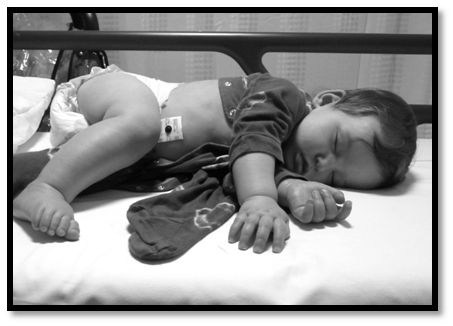
The doctor on call confirmed that she had a seizure. He explained that the most common type of seizure seen in children Amelia’s age was a febrile convulsion, caused by a high temperature. But Amelia’s temperature had been normal at every check, so she needed to be kept in for further tests. As with many things in life, it is the fear of the unknown that brings the greatest anxiety. Once the doctors had spoken with us about the situation and why they were doing the tests, the worry was still there but I felt a bit more in control, just by understanding the process and knowing what to ask next. The next morning, my daughter seemed fine and the doctors couldn’t find anything wrong with her. We were told that everyone is allowed one seizure throughout their life and it might never happen again, and we went home.
Several weeks later I was at home when she had a second seizure where she just went limp. We laid her on the floor and she started shaking, not violently but it was horrendous to see a tiny baby shaking. I phoned the ambulance panicking and cannot remember what I said, but if it wasn’t through my wife putting our daughter in the recovery position and being calm I am not sure what I would have done. I always thought I would be calm in an emergency situation, but it is different when the reality hits you and it’s your own child there shaking on the floor. When we got to the hospital we were asked the same questions constantly by many different doctors, which we didn’t mind as we had been told that there are over 40 different types of seizure and how the body shakes if one side of the body shakes more, where the eyes look etc, can all determine a diagnosis. However, I was so panic-stricken at the time I couldn’t really remember how her seizure developed or if her tongue came out – all I was doing was telling the ambulance person to get her quickly!
The hospital then took more blood samples and carried out further tests. They told us that Amelia might have a tendency towards seizures (epilepsy) and that most epilepsies have no known cause, but as there are other underlying conditions that can trigger seizures they would need to refer her for certain tests to eliminate these first. She was referred for ECG and EEG tracing and also for an MRI scan where she had to be sedated and went into a scanner. This is when we really started to get scared. When we were told they had to check she didn’t have a brain tumour, I think that was the worst moment, and having the scan on New Year’s eve meant it just played on my mind constantly for the four weeks we were off beforehand. How could we deal with news like she had a brain tumour, and then going through numerous operations and more worry – or worse?
Also when they said she could have delayed development from the seizures it made me cry, but thankfully she was always active several hours after her seizures and there hasn’t been a worry since. I suppose the doctor has to tell you the worst possible outcomes, but when you are dealing with children who cannot tell you how they feel there are times when I just wished they wouldn’t.
In between the tests and after the third seizure she was put on anti-epileptic medication (sodium valproate) and we had an epilepsy nurse visit which reassured us somewhat. She suggested that if Amelia had another seizure we film it, as strange as that sounds, as it could help them diagnose it better. She had a mild seizure shortly after seeing the nurse, though as she was on the medication this took the edge of it. My wife filmed part of the seizure when she knew my daughter was safe which really helped the consultant paediatrician. Her medication has been increased since the last seizure and thankfully she has not had one since.
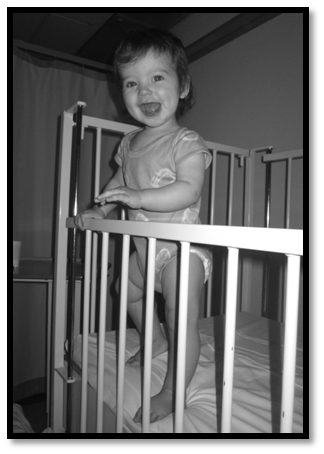
We have been told that the majority of children with epilepsy either grow out of it in later life or have the condition well controlled by medication, which is really reassuring. The doctors also told us that most epileptic seizures are not damaging to the person having them and are scarier for the person watching. If she doesn’t have a seizure in two years they can look at taking her off the medication. We are so grateful that she is well now and if she continues to have seizures in the future we are better prepared and more knowledgeable thanks to all the help and support we have received from our local hospital and epilepsy support nurse.
Childhood Epilepsy Facts
(from “Epilepsy – a Parent’s Handbook” by Nina Solomon, Young Epilepsy, 2011)
- Epilepsy is defined as “repeated seizures of cerebral origin”
- The condition affects approximately 1 in 200 children
- Epilepsy can be caused by damage to the brain, but in most cases, the cause is not known
- Epilepsy can be inherited, but in most cases, there is no family history of seizures
- Only about 5% of children with epilepsy are sensitive to flashing or flickering lights (photosensitive epilepsy)
- 75% of children either grow out of their epilepsy or have the condition well controlled by medication