

Why self-awareness is important to build your child’s self-esteem – Mindscreen Review – Part 2
*This post and the proceeding/subsequent posts in the series are sponsored by Mindscreen – an online mental health and wellbeing tool which guides children towards higher self-esteem, at home or in the classroom.*
In Part 1 of our Mindscreen Self Esteem Series, I talked about how to spot the signs of low self-esteem in your child by using an online tool called Mindscreen. Mindscreen offers insight into a child’s personality to spot the signs of low self-esteem and offer detailed lesson plans in key step-by-step areas to boost their confidence and ultimately their self-esteem. If you want to learn more about what Mindscreen can offer, please head to Part 1, which I urge you to read first before you continue with this article.
In this article, the first step of the Lesson Plan is to head to the first lesson of the Mindscreen Experience, easyAwareness, which is about helping your child build their self-awareness through discovering more about their unique characteristics.
So, let’s get started!
Please note – you need to purchase the Mindscreen Experience to access these lesson plans. Follow the link below to get 10% off your Mindscreen Package now.
Take the full Mindscreen experience now and get 10% off! CODE: save10%
General structure of the lessons
Once you have registered for a free account, you’ve completed the FREE SELF-ESTEEM CHECK for your child, and you have purchased a package to take the full Mindscreen Experience® which you have both looked over in length, you then head to the Teaching and Learning Resources section (everything can be accessed via your email address), which looks like this:
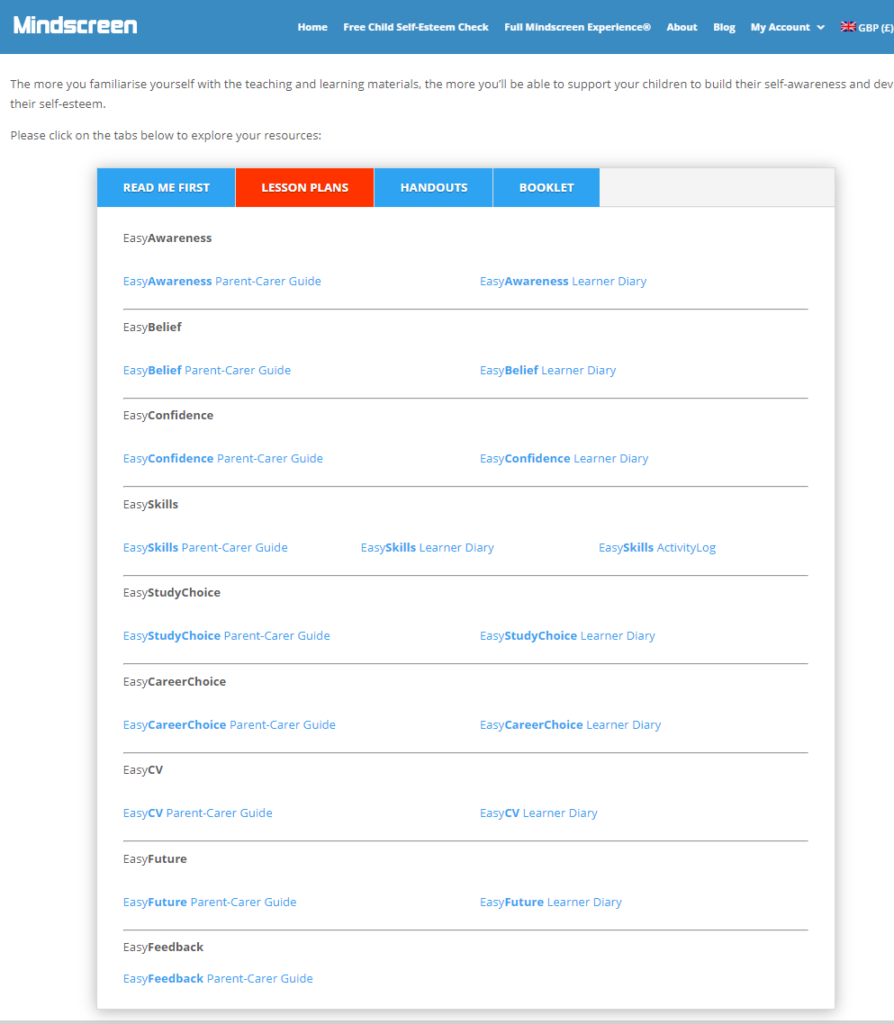
Each lesson plan will have a Parent-Carer Guide which you keep with you to prepare and host the lesson and a Learner Diary for the child to read and fill out during the lesson.
There are nine lessons, which are:
- EasyAwareness
- EasyBelief
- EasyConfidence
- EasySkills
- EasyStudyChoice
- EasyCareerChoice
- EasyCV
- EasyFuture
- EasyFeedback
Each lesson lasts around 30-40 minutes (some last around 60-80 minutes depending on the number of children. If the lesson has a different duration it will specify how long it will take.) The parent guide provides enough detail for you to prepare for your lesson before you start, from detailing the lesson’s objectives to the resources needed and the order in which you take the lesson.
Lesson 1 – EasyAwareness
In this lesson, me and the boys discussed the importance of learning about their personal characteristics to build their self-awareness.
So, let’s get started!
What is self-awareness?
EasyAwareness is the first of the nine lesson plans which is all about providing your child with the opportunity to learn about their personal characteristics and begin building on their self-awareness. We want to help our children become more aware of their own natural behaviour and how others see them too.
I showed the boys their folders which I created especially for their Mindscreen Experience. Each folder housed their Mindscreen Profiles and Learner Diaries.
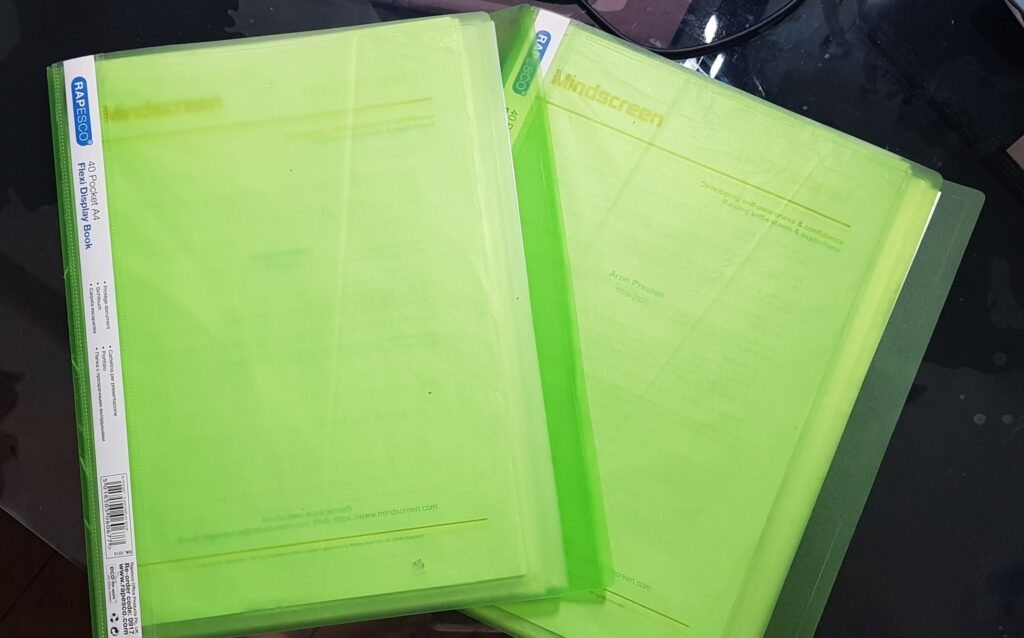
The boys were very intrigued by their special green Mindscreen Experience folders and wondered what it had to do with them sitting down and having a lesson with me outside of school hours.
I introduced Mindscreen as the website they used to complete their questionnaire to find out more about themselves.
Aidan (8) chimed in.
“That’s not good, we are going to get reported!”
“Why?” I asked.
“Because people will steal our information!”
Ah! He thought we were going to write about his date of birth, address and phone number! At least he was on the ball with online fraud.
I reiterated the reasons why self-awareness is important, i.e. that finding out about themselves meant learning about natural skills and strengths, as well as weaknesses and building their emotional intelligence so they can build confidence and experience success in life – and this meant learning more about their personality and characteristics.
“But it’s still bad to give away that information.”
“No, Aidan, the information is related to you personally and won’t be shared with anyone else but us, and only if you want to, as well as the owner of Mindscreen who won’t share it with anyone else. The website is protected.”
Aidan sat back with a reluctant look on his face.
“How do I learn about myself?”
“Let me explain so you understand what I mean and I promise you will feel better about it. Paying attention will help!”
The boys stopped messing about with their baby sister and Aidan nodded his head in silence while Aron (9) darted his eyes between us like ping pong balls at a table tennis match.
“I promise you, this lesson is very interesting! Once you start going through your Mindscreen profile you will be shocked at how much you will find out about yourself. And knowing about yourself can help you become great leaders one day! Anything is possible, ok?”
The boys perked up a bit.
I asked the boys if they remembered completing the questionnaire, where they had to drag and drop boxed statements about themselves, with the most like you at the top and the least like you at the bottom, for example ‘I am energetic’, ‘I am fun’, ‘I like people to leave me alone’.
“I am fed up of working all time,” Aidan said.
“Yes, something like that,” I replied.
I opened up my parent guide and read through briefly what I needed to do (Both Mindscreen and I advise that you read and prepare the lesson before you get started, so you don’t waste time faffing about).
Your Mindscreen profile starts with the following:
“Ready, steady, go! Do not wait for a second longer! Start figuring yourself out now, while you are young!
Knowing yourself is vital because it helps you to recognise what you get passionate about and what you love to do. Doing what you love makes you happy! Learning about your own natural skills is important too because later you can choose study and career paths that use your skills! The more you know your strengths, the more your self-confidence and self-belief will grow!
Your Mindscreen experience® profile is UNIQUE TO YOU.
It is full of insights that will help you to better understand:
* Yourself – How your friends, family, and other people see you
* What your dreams and goals are
* What study and career paths you are more likely to enjoy
* What things make you happy and feel fulfilled
Remember, you can learn even more about yourself with these fun Lesson Plans: easyAwareness | easyConfidence | easyBelief | easySkills | easyStudyChoice | easyCareerChoice | easyCV | easyFuture”
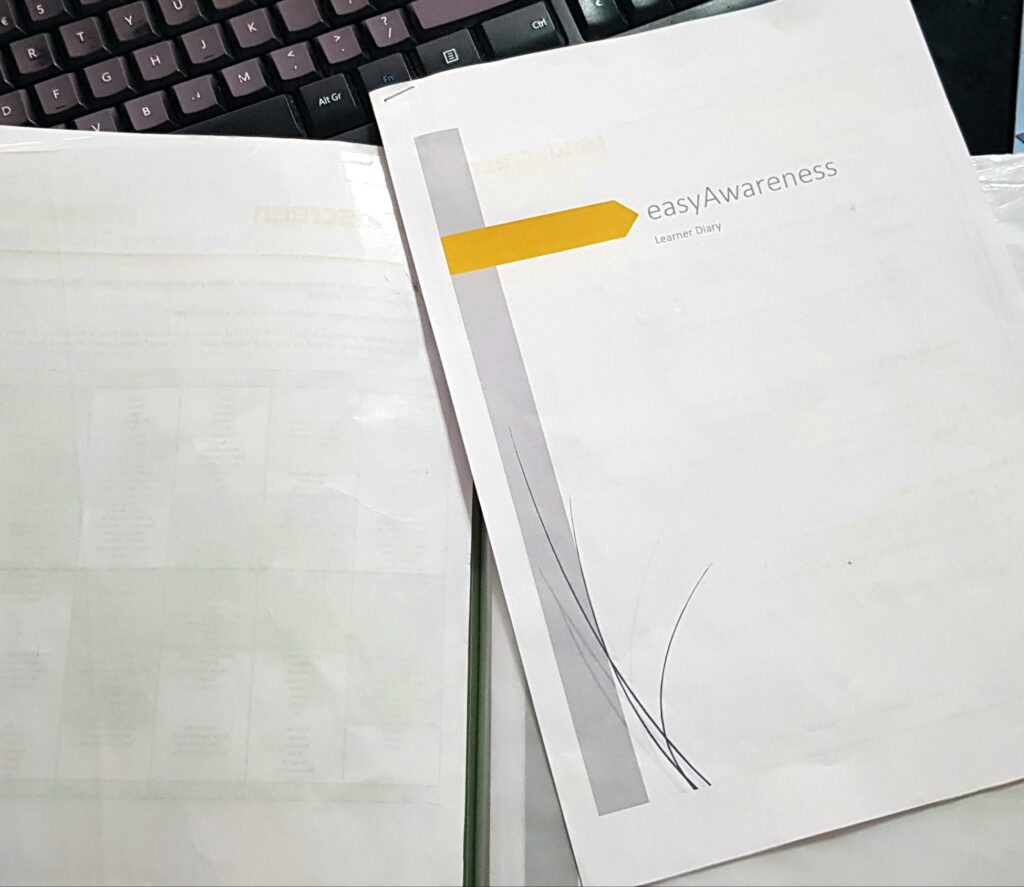
Once we talked briefly about their Mindscreen profiles and what it meant for them specifically, I got into the first lesson, EasyAwareness, and showed them where they could find their learner diaries.
I asked them:
“Do you know who you are and what you want?”
“Yes, I’m Aron.”
“Yes, you know your name. But do you really know who you are?”
The boys looked confused.
“Are you aware of how you act and what your characteristics are? Are you aware of how you are different from other people? “
I explained that being different was a good thing and that the importance of self-understanding meant that you could understand yourself better – understand what makes you angry or anxious about things. It is about being aware of your behaviour, your motivations, your emotions, how you feel etc.
Being aware when someone upsets you and how you feel when you’re upset, and understanding why you behave in the way you behave. For example, If you are loud and talking too much and you notice that you may be upsetting people, you are self-aware. If you are doing a skill really well and noticing the results are positive then you are self-aware.
When you are self-aware you can make changes to your actions to better suit yourself and the situation.
“If you are shouting in a room and you can’t see that it’s upsetting others then you are less self-aware or unaware of what you are doing. Does that make sense?”
Both boys nodded.
Aron asked, “Mum, is this crisp-munching annoying?”
“No.”
“See? I’m aware that this crisp munching may be annoying to some, so I am self-aware!”
“Yes!”
I was getting through – yay!
So now I wanted them to open their minds and accept the lesson as an open lesson where we could talk, interact, discuss, and debate what we talked about. Most importantly, I wanted the boys to take in what was going on in this lesson and understand how important it is to be self-aware.
Ultimately, I wanted them to enjoy learning about themselves because it’s supposed to be a fun thing!
I also mentioned that once we talked about being self-aware there were sections in their learner diaries that they could fill out and keep as a record for reference later.
Take the full Mindscreen experience now and get 10% off! CODE: save10%
My natural behaviour
I asked the boys to go to their Mindscreen profiles and look at the “My Natural Behaviour” section.
“So, how do you get to know yourself?” I asked
Both boys stared at me with blank faces.
“Ok. Do you feel you are more reserved or more outgoing? And do you know what I mean when I say reserved and outgoing?”
Aron shouted “Outgoing! I’d rather play in the football match than be subbed.”
“No….”
“I’m outgoing! OUTGOING!” Aidan shouted.
“Reserved means that you’d rather keep to yourself than go out and socialise, for example. If you’re outgoing then you like to spend time with people, go out to parties and socialise that kind of thing.
“What if you don’t like to social distance?” Aron replied.
“Well, everyone should social distance, whether they’re outgoing or not.”
“But if you don’t want to social distance then you’re more outgoing, right?”
“Erm…”
“I don’t really like people, so I guess I’m reserved,” Aidan said
“I have lots of friends, so I’m definitely outgoing,” Aron said
“I have lots of friends!” Aidan cried “So I’m outgoing then!”
“But, even if you have lots of friends you can still be reserved because you may want to keep certain things to yourself and not share everything with your friends.”
“Oh no, now I don’t know what I am,” Aidan said.
“Ok, let’s move on to motivation. What motivates you? Do you know what that means?”
“I feel motivated to quit,” Aidan muttered.
“Ok, what keeps you happy? What makes you want to do the things you do?” I interrupted.
Both boys stared blankly at me again.
“I wake up in the morning and I want to do [blank]. Fill in the word that most applies to you.”
“Roblox,” Aron said.
“Think bigger.”
“Playing on the fields at lunchtime.”
“Think even bigger than that.”
“Being myself?”
“What motivates you in life?”
“Being outside,” Aron replied.
“Ok, we’re getting there. What is it about being outside that motivates you?”
“Playing football, fresh air, being free.”
“Ok!”
Triumph. Aron is motivated by being outside playing football – and being free.
Aidan looked at Aron and agreed that being outside and playing football motivates him too.
I then asked the boys to catch themselves reacting and behaving in certain situations, like when something upsets them, or in a stressful situation, they should note of how they react – catch themselves in the moment
In stressful situations, do you get stressed easily? Are you able to stay calm?
Both boys shouted no.
“Are you happy? Do you feel demotivated? Demotivated means you don’t want to do things.”
“And then ask yourself what caused me to feel this way. What is your current mood? As in your feelings/emotions?”
Aidan responded, “Right, now my feelings are that I want to finish these crisps and go outside.”
I asked the boys to become their own mirror and see themselves clearly.
“But, what if I walk past the bathroom and see myself naked?” Aidan said, looking shocked at Aron.
“Ok, I don’t mean an actual mirror – it’s a metaphor. The metaphor means not a real mirror, a pretend mirror where you are seeing yourself like you are the mirror. Think about what you are like right now. Can you see yourself joking around? What is causing you to feel that way?”
“Ayla [baby sister] is distracting me.”
“Ok, let’s move on to the lesson.”
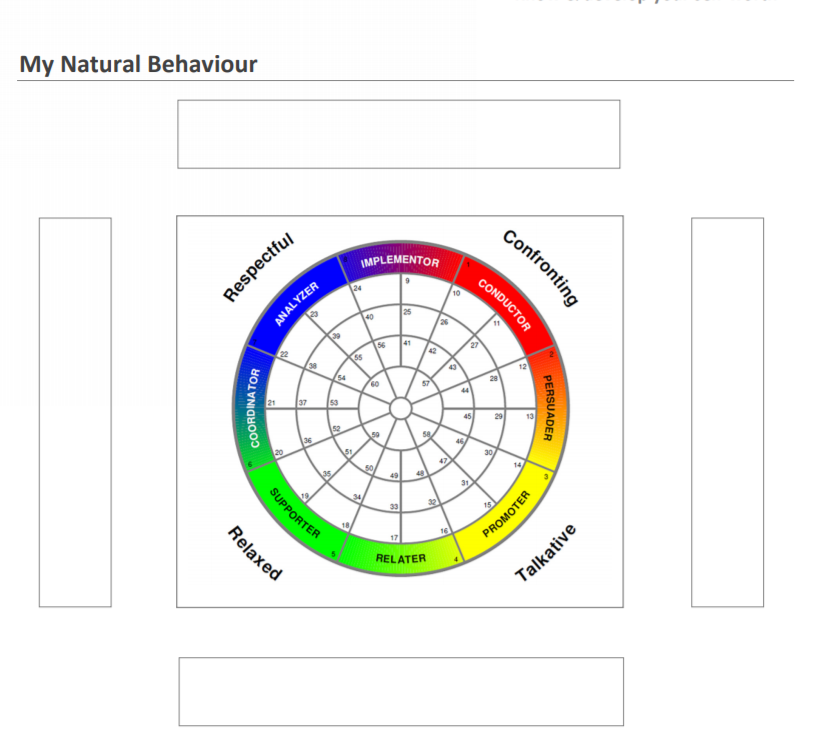
In the parent guide, the lesson asks you to set the scene in the form of a respected psychologist from years ago, His name is Carl Gustav Jung and he was the first person to describe human behaviour simply. He recognised that, by creating an easy-to-understand behavioural model, people could begin to become more aware of their behaviour.
I told the boys that we will be using this model to help them better understand themselves and to reiterate that different and unique doesn’t mean good, bad, right or wrong. It just means different and unique.
I asked the boys to take out their learner diaries and look at the model that was created. I told them that the fun was about to begin and gave them a pen to get started.
Aron immediately said, “I am a challenger I would do dangerous challenges like exploring a home where a tiger is.”
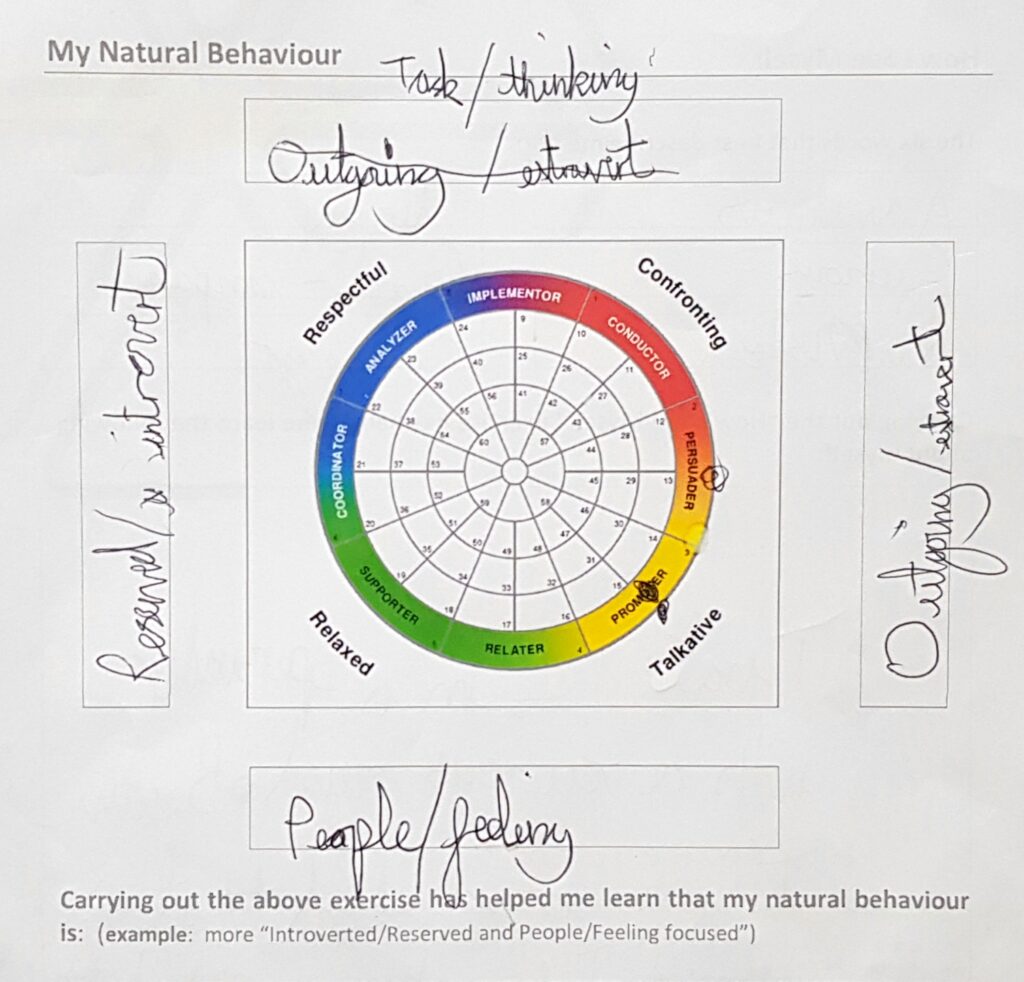
I asked the boys to write down ‘Reserved/Introvert’ on the left-hand side of the wheel.
In the right-hand box, I asked them to write ‘Outgoing/Extrovert’
At the top box on the wheel, I asked them to write ‘Task/Thinking’
At the bottom of the box, to write ‘People/Feeling.’
I then asked the boys to place their finger on the centre of the wheel. I again explained what reserved and introverted meant again to ensure they understood.
I asked them to move their finger either to the left if they felt they were more introverted or to the right if they felt they were more outgoing, The further to the end of the wheel they moved their finger, the more reserved or outgoing they were.
It took them ages to figure out what I was trying to say. Eventually, they moved and kept their fingers on the spot while I asked then to think about task/thinking, i.e. they are more task-focused if they liked to think things through, have lists to work through, and tick the tasks off when they are done.
And to move their finger more towards people/feeling if they prefer to be around other people, talk with other people, help other people etc. I asked them to move their finger either to the top or the bottom respectively. I had to remind them to move their fingers to the degree they thought they were either a little or a lot of each.
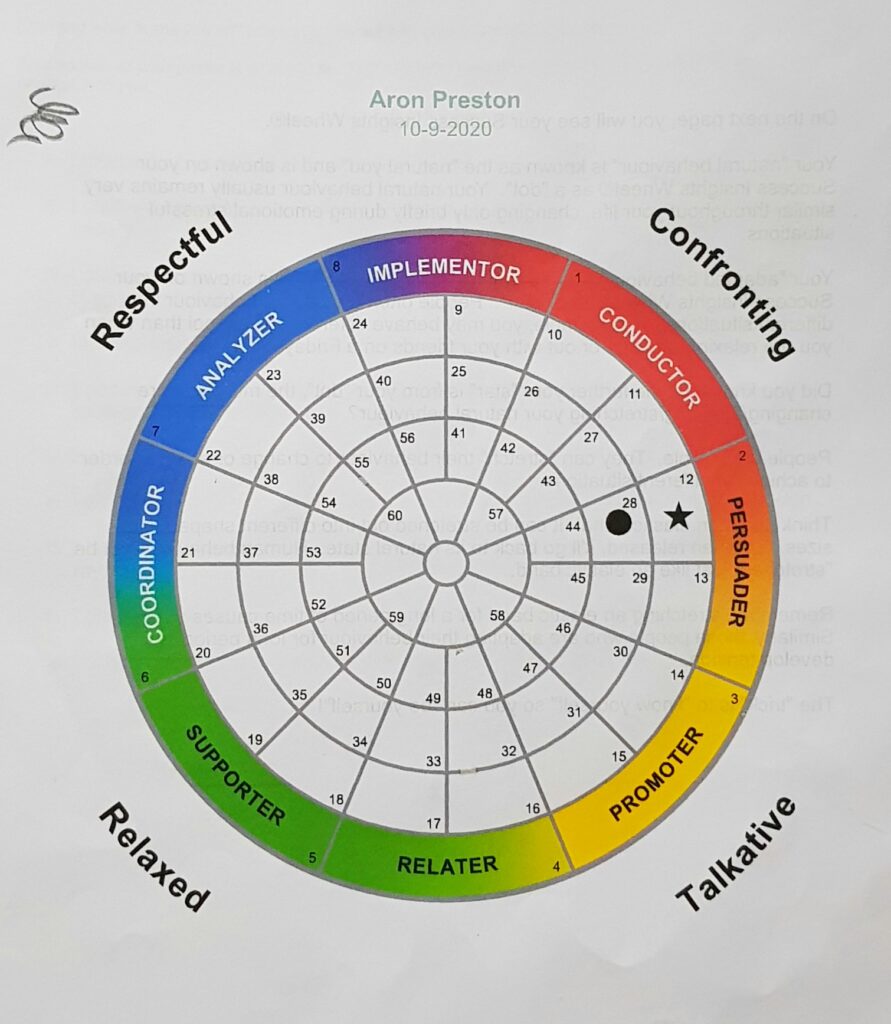
Aron ended up on the yellow area, i.e. between Outgoing/Extrovert and People/Feeling – right in the Talkative/Promoter section.
Aidan ended up on number 23 in the wheel, more towards the Task/Thinking section, up towards the Analyser/Respectful blue area.
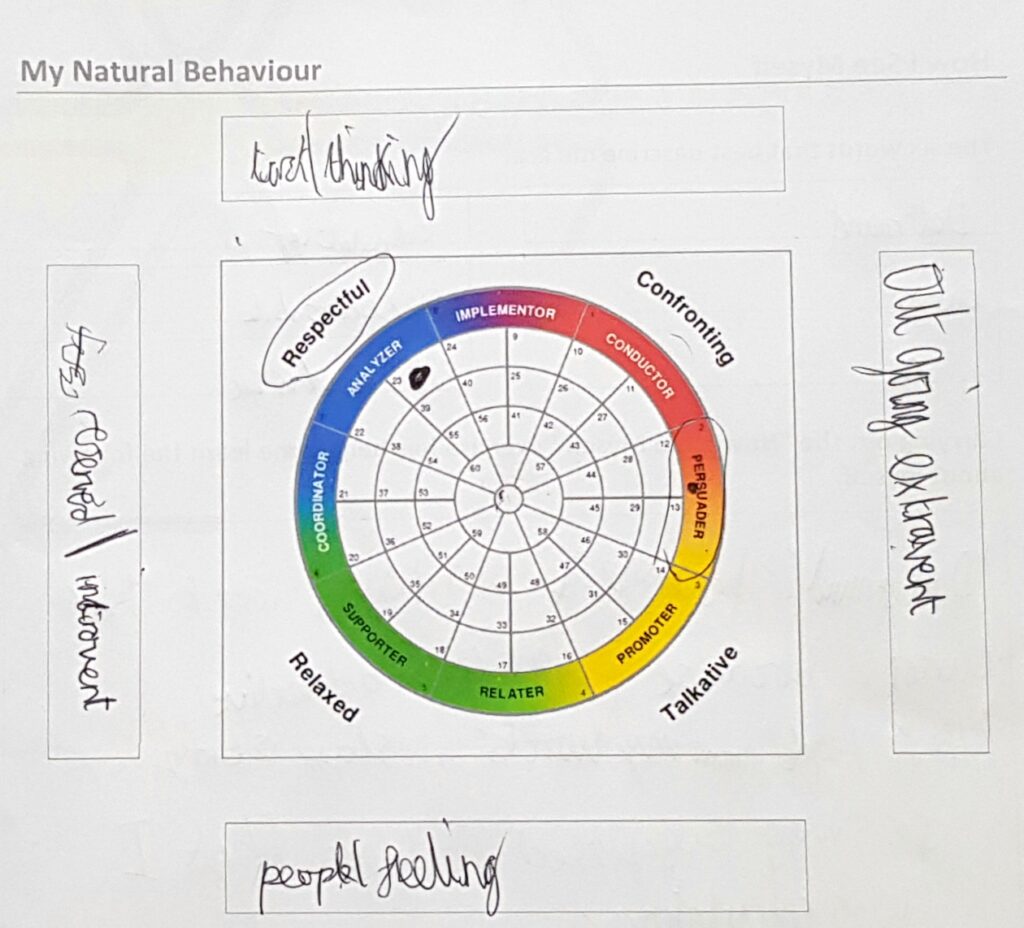
I asked them to put a dot where they ended up.
The comparison between how you see yourself and what is your natural behaviour and adapted behaviour
I asked them to turn to the “Wheel” page – The Natural & Adapted Me section in their Mindscreen profiles.
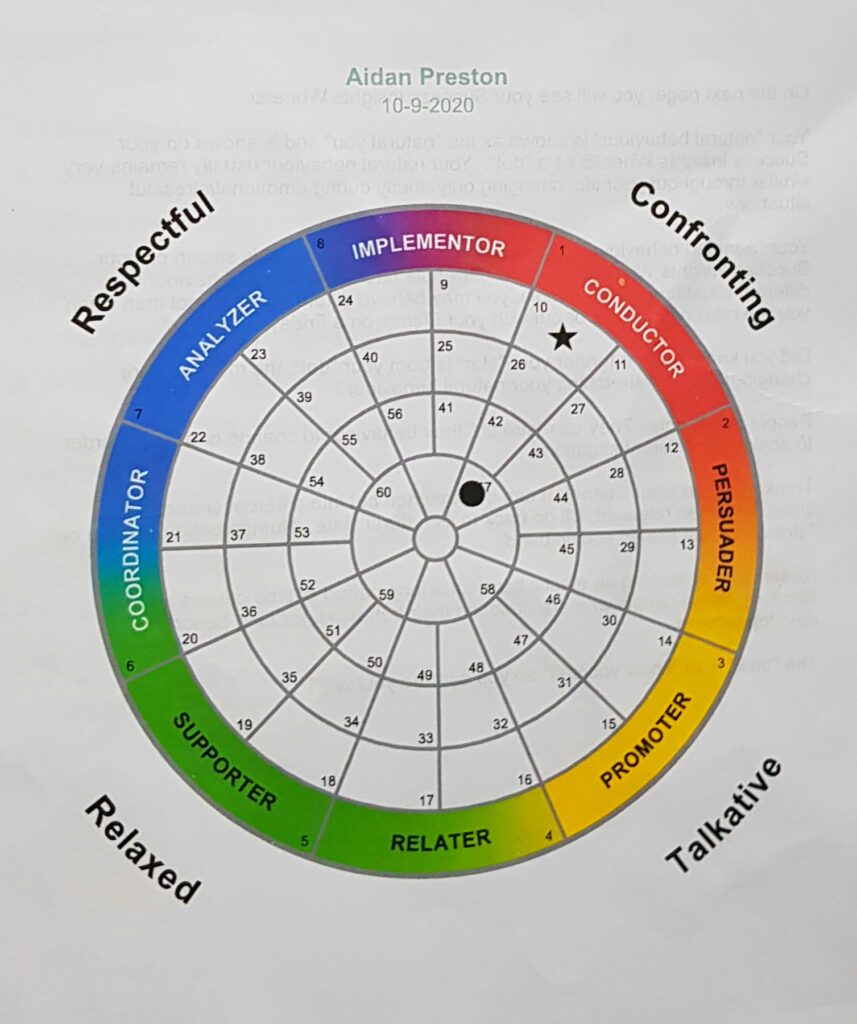
I wanted them to see the difference between how they saw themselves and where their questionnaires placed them on the wheel. I explained in the profile that the dot is their natural behaviour, the behaviour they carry with them throughout life, only changing very slightly to adapt to certain situations.
The star is their adapted behaviour. That means the behaviour they change when they are in different environments. For example, when they are at school their behaviour might be different from when they are at home. In a stressful situation, their adapted behaviour might be different from their natural behaviour.
The results were very interesting.
Aidan’s dot was further away from his star but in the same column. If the dot and star are further apart from each other, then Aidan seemed to be stretching his behaviour to adapt himself to certain situations to be more confrontational and controlling than he likely naturally was.
But Aron’s wheel showed no real change in his natural and adapted behaviour. He was who he was, whatever environment he was in.
Aidan shouted, “This is stupid. I am not argumentative!”
“Maybe not naturally, but perhaps you try to be in certain situations?”
“I don’t know, I’m confused! I don’t understand what any of this means!”
The elastic band metaphor
I asked the boys to think about an elastic band. The elastic band can stretch a little bit to adapt its surroundings, perhaps around a pot. But as the elastic band stretches further, what happens?
“It gets longer?” Aidan asked.
“No, Aidan, it will snap if you stretch it too much,” Aron responded
“EXACTLY!”
“It will snap?” Aidan responded looking like he was about to cry.
“Ok, let’s backtrack.”
I picked up the elastic band again and left it slack.
“Who you are is this. Now focus on the stretchiness.”
“I am not an elastic band!”
“No, but I want to imagine that your behaviour is like an elastic band.”
“What? How can my behaviour be the elastic band?”
“Ok,” I sighed.
“When the elastic band is left like this, is there any strain on it? Is it in its normal resting natural self?”
“Yes?” Both boys replied, still confused.
“Ok, so just pretend for a moment that this natural state is your natural behaviour. Your natural behaviour is like this elastic band. It’s not stretched, it’s in its most relaxed self. You are the most comfortable in your relaxed self.”
“Ohhhhhh….kkkkk?”
“Now look what happens when I stretch the elastic band a little bit. Is it ok still? Can it handle this stretchiness?
“It can handle a lot more stretching!” Aron replied
“Ok, so it’s happy to be stretched this much, right? Now, think about your behaviour stretching just a little bit and by that I mean, you’re adapting your behaviour a little bit to suit whichever environment you’re in, like at school or home etc. Makes sense so far?”
“Yes!”
“Now, think about what will happen if I do this.”
I stretch the elastic far to the point it’s very taut now and the boys wince.
“What do you think will happen?”
“It will snap!” the boys shouted.
“Ok, so the further you stretch your behaviour the more strain you are putting on yourself. Can you tell me why?”
“Because we are not being ourselves!”
“BINGO, ARON, BINGO!”
“And what happens when you are not yourself all the time?”
“We get sad because we just want to be ourselves.”
“HURRAH! You get it!”
“You see it’s not a bad thing to adapt your behaviour slightly to different situations because you’re reading the room and you’re responding in a way that helps the atmosphere of that room. For example, if you’re in a serious meeting, you act more serious to reflect the seriousness of the room. You don’t clown around and jump up on the table even if that’s what you want to do.”
“Now, think about when you are with a group of friends and they are all making fun of someone and you make fun of that person too because you want to fit in. But you like that person or you’re a nice person and it makes you feel sad inside.”
I held the elastic band in a very taut position.
“It hurts you inside that you are doing what you’re doing, but you are trying to adapt your behaviour to suit those so-called friends. Can you keep doing that again and again?”
I stretched the elastic band until it snapped. The boys gasped.
“Stretching the elastic band too far causes strain and it can only handle it for so long before it snaps. Sooner or later, you are going to get depressed. You are going to feel like you will snap because you are fighting to not be yourself, but you can’t do that forever. When you pick a job you hate and you have to work at that job every day then you will start to feel anxious, upset and stressed. Eventually, it will damage your health.”
I asked the boys if they’re the same at school as they are at home and what makes them different.
“I am the same,” Aidan replies, “I always act the same”
“Your wheel says different, though.”
“Maybe when you are at school, you’re a bit shyer so you try to act more strong by shouting?” Aron asked Aidan.
“Wow. Very good insight, Aron.” I reply.
“No. that’s not what I’m like.” Aidan replied with his arms crossed “I am number 57! Number 57!”
I look at the wheel and number 57 is in the centre, slightly towards conductor/confronting.
“Your wheel tells me that in some situations you try to be number 10, which is more confrontational.”
So I asked Aidan when he thought he could become a bit more argumentative than normal.
“What about when you’re on a stage and you’re being asked to present something on a stage?”
“I would just run away,” Aidan replied
“Do you think you might be a bit more serious? Confident?”
“No.”
“Why do you think your star and dot are far away from each other?”
“Because it’s rubbish.”
I finish the elastic band analogy by explaining to the boys they cannot change who they are but they can adapt, as long as they don’t try to change themselves for others.
It took us about an hour to get through this part of the lesson!
What did the boys learn about their natural behaviour?
I asked the boys to answer the question in their learner diaries about how this exercise had helped them learn what their natural behaviour was (i.e. were they more introverted, reserved, people/feeling focused?)
Aidan wrote, “I am a balance of implementer and get tasks done.”
Aron wrote “I am a persuader. I am more extrovert.”
How I see myself
I asked the boys to turn to the ‘how I see myself‘ section in their Mindscreen experience profiles and take a look at the highlighted words in each of the columns. These words reflect how they see themselves. I asked them to circle three words in the highlighted areas from each column which are accurate and positive statements about themselves.
The boys had to ask what some of the words meant, but after a while, they highlighted their three words.
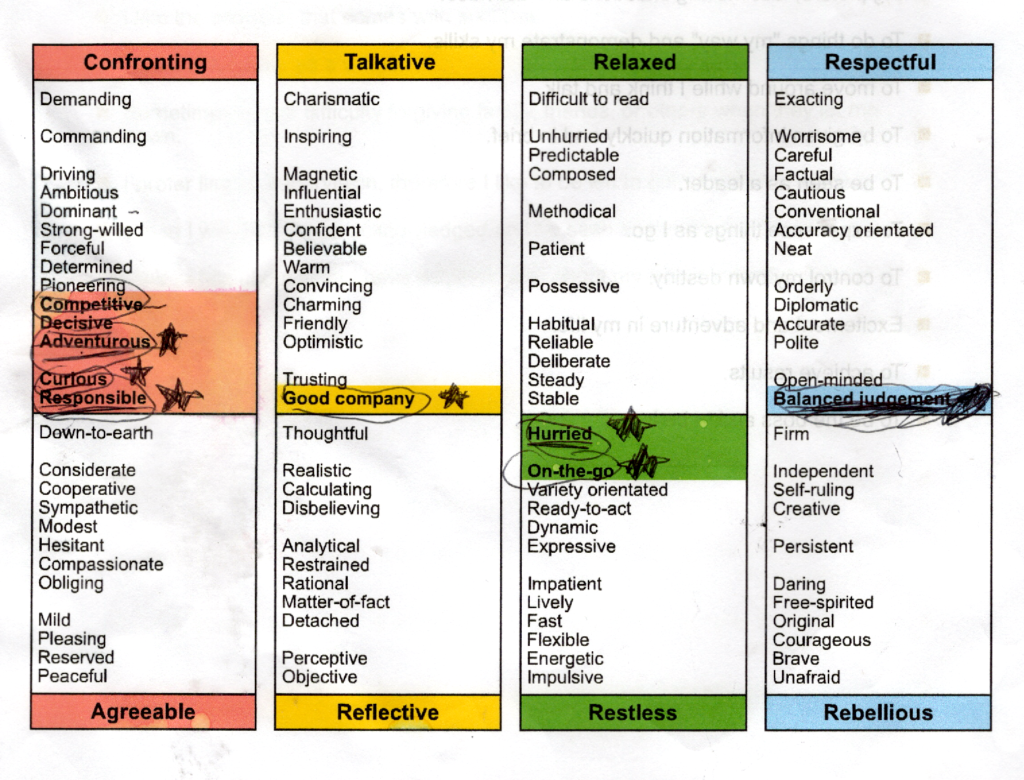
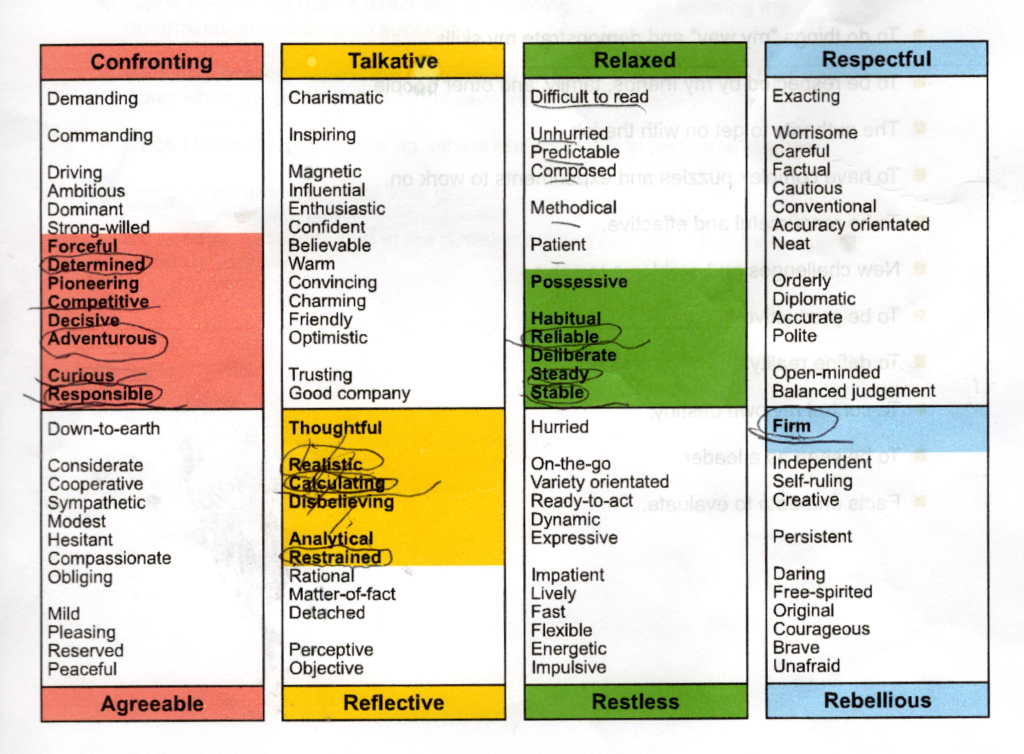
Then I asked the boys who wanted to be ‘Person A’ and who wanted to be ‘Person B’ where Person A looked at Person B’s profile and vice versa.
The boys were to underline six of the words that described how they saw their brother.
Both boys underlined ‘Responsible‘ for each other which I thought was sweet.
Aidan underlined ‘Adventurous’, ‘Curious’, ‘Responsible’, ‘Good Company’, ‘Hurried‘, and ‘On-the-Go’. Aidan explained that Aron was a nice brother and he was always loving and helpful, as well as very polite. He was also very fast and never stopped moving.
Aron picked ‘Responsible’, ‘Calculating’, ‘Reliable’, ‘Stable’, ‘Determined’ and ‘Firm’ for Aidan because he always wanted to be the best and get what he wanted. Competitive because he takes part in everything and always wanted to win. Responsible because you can rely on him and Calculating because he liked maths.
How I describe myself
I asked the boys to write down the six words that best described themselves.
Aidan wrote “Determined, calculating, curious, firm, responsible and realistic”
Aron wrote “Adventurous, curious, responsible, decisive, good company and on the go.”
I reminded the boys that these traits didn’t mean they were bad or weak, but that they made up their unique characteristics, which is a beautiful thing and being different is fantastic.
But the main lesson here is that if they learn more about themselves they can build their self-awareness, and keep these six words in mind so they can catch themselves when they are like that.
This is not just about working out who you are, it’s about catching yourself and how you’re like when you are at school, when you’re with your friends and when you’are at home.
What I’ve learned about how I see myself
I asked them to fill out the last box ‘Carrying out the “How I see myself” exercise has helped me learn the following about myself:’
Aron wrote “That I am a persuader with a curious mind. I’m so shocked that I’m hurried. It makes me feel shocked.”
Aidan wrote “Determined: because I am ready I can do this. Curious: because I want to be a detective. Firm: people mark my words, and I stay strong. I was surprised to learn that I was calculating. I feel happy when I learn new feelings about myself.”
How did we get on with Lesson 1?
I struggled to get their attention for most of the lesson – either they were distracted by each other or their baby sister who was running around pulling things off the shelf. I also found it difficult to get them to sit on the table with me and listen. They already had preconceived views that this lesson was going to be boring and it wasn’t until the last thirty minutes that they got into it and realised that learning about themselves was fun.
How long the lesson was supposed to be
30-40 minutes
How long it took us:
Over 1 ½ hours
I told the boys that I was looking forward to the next lesson, EasyBelief, because I enjoyed learning more about them. I explained that Lesson 2 will be about exploring how their own beliefs are formed and how those beliefs drive their behaviour.
It was tough but I really did enjoy learning more about the boys.
What did I want the boys to learn in this EasyAwareness lesson?
The most important part of this lesson, in my opinion, was that personal awareness is vital for growth and I really wanted to show them why self-awareness is important for professional development too. I also wanted to show them why self awareness is important in leadership, but at eight and nine years old, they would have had no idea what I meant if I had explained it in that way.
Instead, the importance of self-awareness is to learn how to be more aware of their natural behaviour in situations and how external factors can cause their behaviour to adapt, which is fine, as long as they’re not stretching their personalities and causing strain on their mental health. Why is self-awareness so important in mental health? Because we are most comfortable in our natural state and trying to be someone we’re not can damage us in the long run and lower our self-esteem because we may eventually end up thinking our natural behaviour is not good enough.
Why is it important to develop self-awareness? How can it help you balance your thoughts and feelings?
Why should people be aware of themselves? There are many benefits to self-awareness in humans because it can make us more proactive and encourage positive self-development (Sutton, 2016). Self-awareness also allows us to see things from the perspective of others, and practice self-control, as well as lead us to be better at our jobs and become better communicators too.
Why is self-awareness important in children?
If we can teach our children how to be self-aware when they’re young, we can help them to enhance their self-confidence early which is the whole point to this Mindscreen series. The earlier we start, the more chance they have in succeeding in the path they want to choose.
We also need to teach children how self-awareness is important to their personal growth as it can encourage them to be better people all-round.
What does self-awareness allow you to do that less self-aware people can’t?
Being self-aware can help you take better action towards life decisions and goals. Knowing about yourself means you can play to your strengths and improve your weaknesses – or avoid them altogether. Why is awareness important for children? You can help your child nurture their skills and ultimately find the job that’s better suited to them, allowing them more opportunity to succeed and be happy later in life.
What’s next?
In Part 3, we will be going through Lesson 2, EasyBelief lesson plan where me and the boys will explore how their own beliefs are formed and help them to understand how their beliefs drive their behaviour.
Click here to read Part 3, easyBelief now!
Take the full Mindscreen experience now and get 10% off! CODE: save10%






4 Comments