Early signs of labour – and what to do when you’re in labour
Are you pregnant? Grab your free pregnancy pack now – details inside!
During the last few weeks of pregnancy, you will notice a few changes that could indicate your body is showing signs that labour is weeks or days away. In this article, we will go through the early signs of labour, as well as when to go to the hospital and coping mechanisms that you can try, like massage therapy for labour.
What are the different stages of labour?
Labour can actually be categorised into the three stages of labour. These are:
- The Latent phase
- The Active phase
- The Afterbirth (when the placenta is delivered)
We’ll go through what each of these are in turn.
Latent phase of labour – what does early stages of labour mean?
The latent phase is when your cervix softens and becomes thin so that it can start to open for your baby. This stage can take anywhere from a few hours to a few days and, unless you are considered high risk and your hospital has told you to come in as soon as your pregnancy progresses, they will otherwise advise you to stay home, so you can relax and stay as comfortable as possible so labour can progress more smoothly.
Active stage of labour (also known as established labour)
Active labour usually lasts around four to eight hours and signs and symptoms of active labour is mainly when your contractions become regular, stronger, longer and more painful (from around five minutes apart and lasting 60 seconds), and your cervix is dilated to ten centimetres. This is when you’ll be asked to come in and things can happen a bit quicker at this stage. The baby is born during this stage of labour.
The afterbirth
This stage happens after birth and includes the delivery of the placenta which can happen either through physiological management (i.e. waiting for your placenta to deliver spontaneously) or active management (midwives will inject you in the leg with an ecbolic or contracting drug as your baby’s shoulders are born to speed up the delivery.
What are the early signs of labour? Early indications labour is near
You may experience one, any or all of the following labour pain symptoms, which indicate signs that labour has begun.
Signs you’re going into labour soon – your baby’s head engages into the pelvis
Your baby’s engagement may start at around 2 to 6 weeks before going into labour, but may also not happen until you are in actual labour, especially if this isn’t your first baby.
Early signs labour is near but hasn’t started yet – Braxton Hicks contractions
These painless contractions (which can sometimes become painful towards the end of your pregnancy) means that your uterus is tightening and preparing for labour. The more often and stronger they become the more indication that these are early signs of labour. However sometimes they can be construed as false labour, especially if they’re irregular and sporadic.
Early labour sign – Increased mucus discharge from the vagina
During pregnancy, your cervix is blocked by a thick plug of mucus to prevent any bacteria from entering the uterus. During the latter stages of pregnancy, this mucus plug might be pushed into your vagina which means you notice an increase in vaginal discharge that is either clear, pink or slightly bloody. A show can signal the start of labour but this may also happen for a few days before bringing on labour.
Early labour signs – Weight loss
You may experience slight weight loss, which indicates the early signs of labour. This is down to a reduction of amniotic fluid around the baby and the feeling that the baby has dropped lower (lightening) as their head settles into your pelvis and engages.
Sign of early labour – Spurt of energy: nesting
You may have heard of the term ‘nesting’ before and it refers to you suddenly having a burst of energy and feeling ready to prepare for the baby. You may start preparing meals, set up the nursery, re-pack your hospital bag and spring clean the house. This is known as the ‘nesting instinct’ and is a psychological sign that labour is coming.
Signs and symptoms of early labour – Baby is less active
Your baby is running out of space and so they are starting to prepare for active labour.
The first signs that labour may be starting – Rupture of membranes: your water breaks
Your amniotic sac cushions your baby in the uterus and protects them from any unwanted bacteria from the outside world. One of the early signs of labour approaching is when these membranes rupture, which is another word for your waters breaking. Unlike the movies, your waters don’t have to all come out at once in a massive gush in the middle of the street. Sometimes it can be just a little trickle for a few days.
If you’re unsure, contact your hospital straight away, where doctors can test to see if your water broke or that you’ve leaked urine. If confirmed that your membranes have ruptured then timing is of the essence because your baby is no longer protected by the amniotic sac cushion. The longer your labour takes to start after your water breaks, the more susceptible you and your baby are to developing an infection. If labour does not start after your waters break then you may find that your hospital will stimulate uterine contractions as a way of bringing labour on its own (labour induction).
Below is an infographic which you can print off and place on your fridge or pin to your Pinterest board to remind you of the early signs of labour.

How will you know you are in labour? Know the signs of early labour
Once you have experienced some or all of the signs listed above, you may be wondering, “Am I in labour?” Once confirmed, early contractions will follow shortly after and these contractions feel different to Braxton Hicks. But, if you’re still not sure of the imminent signs of labour, check out below the things you should look for as signs and symptoms of labour:
Regular labour contractions and signs of labour
Labour contractions have a rhythmic quality, with each one gradually building up to a peak and then falling back down. Start timing your contractions from the beginning of one to the beginning of the next contraction.
Labour contractions get stronger
Look for regular patterns that will become progressively more intense and closer together as time goes on. Braxton Hicks contractions will be irregular and won’t get stronger one after the other. Note the length and strength of each contraction to see if they get shorter in length, If they do, then you are heading into active labour.
Labour contractions require concentration
During early
Labour contractions will encourage you to find ways to ease the pain
You will be constantly looking for positions and ways to ease the pain between every contraction, like finding sitting positions, bouncing on a ball and breathing through the pain when doubled over.
Labour contractions are strong enough to require you to rest in between each peak and trough
When labour contractions are coming in thick and fast, all you want to do is find a way to rest – you are tired and you w
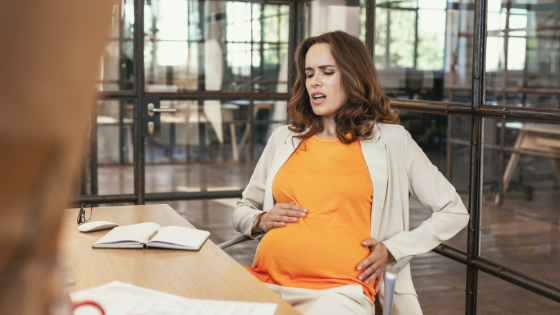
Labour contractions may also feature back pain
Especially with back labour, backache often comes on in labour and you will experience constant minor backaches, with regular bouts of stronger back pain.
How to cope when labour begins – A-Z relaxation techniques during early labour
| A | Get some fresh air | N | Take a nap |
| B | Have a bath | O | Observe your contractions and time them. |
| C | Clean the house | P | Practice different positions for labour |
| D | Dance to some really fun music | Q | Relaxing in labour is important. Find a way to sit back and relax |
| E | Do some light exercise | R | Read a book |
| F | Eat some food | S | Sit and relax/breathing exercises |
| G | Do some gardening | T | Talk to friends/family |
| H | Hoover | U | Understand the pain and go with it |
| I | Invite people over for company | V | Visit your friends/family |
| J | Do a jigsaw puzzle | W | Watch TV |
| K | Keep busy | X | Get involved in some X-rated fun with your partner |
| L | Listen to music | Y | Yoga |
| M | Mop the floors | Z | Go to the zoo |
What to do during early labour? When should you head to the hospital?
During early labour, you will probably feel more comfortable being at home, but as your labour contractions get progressively stronger and begin to settle into a pattern, i.e. lasting 60 seconds or more, then dilation will occur and that’s when you feel like you will need to head to the hospital as soon as possible.
Ask your partner to take you in the car preferably, so you can rest on your hands and knees on the back seat, as this position may be more comfortable for you. As soon as you get to the hospital, head to the admission desk and let your midwives know that you are in labour, as well as the length and strength of each contraction. You will be taken to the labour ward by one of the midwives.
If you are having a home birth then you would need to call the midwife to come to you. If there is a complication or an unlikely event occurring your midwife will let you know when it is necessary to go to the hospital.
Your admission into hospital
When you arrive in the labour ward, your midwife will take basic observations like your blood pressure, urine temperature, pregnancy history and your obstetric history by looking through your maternity notes.
Your midwife will then listen in on the baby’s heartbeat and have a feel for their position in your belly. You may have an internal examination to see if there is any progress with the labour. You can have your partner with you during these observations.
You may also sit in a chair and some hospitals will record a 20 – 30-minute trace on the electronic foetal monitor as part of their admission procedure. There is no research to prove the benefits of routine electronic monitoring in labour, however, once these admission procedures have been completed you will be shown to your labour room where you can try to make yourself comfortable for the rest of your labour and birth.
You may find that sometimes labour can slow down or even stop altogether. This is normal as it’s your body’s natural reaction to the change in environment. Allow some time to adjust to your surroundings, including the staff, and labour will re-establish itself again. If you want, you can always go home again, especially if you are in early labour. The midwife will let you know how dilated you are after an internal examination. There is no need to speed up labour unless your baby is showing clear signs of being distressed.
How long can early stages of labour last?
Unfortunately, it’s like asking how long is a piece of string. Labour will take as long as it takes for your
On average, the first stage of labour can be around 12 to 14 hours and the second stage of labour is from 1 to 2 hours. Labour and birth can obviously take much longer and still be normal as long as you and baby are in good health. It has been shown that subsequent births may have an average length of 6 to 8 hours with the second stage taking around 5 minutes to an hour to complete. Again these are approximate timings and if it takes longer, then as long as you and baby are ok, then allow labour to take its course.
Below is an infographic which shows you the different stages of labour that you can print out and stick to your fridge or pin on your Pinterest board.

How to make labour easier
Generally, your body will work best if it feels safe and secure during labour. Below are some techniques to lower cortisol levels (which has been known to pause or even stop labour) and help your body prepare for labour and birth.
Continuous support
It’s important to have continuous support from partner, friends or family during labour as they can provide you with that much-needed boost when you’re tired and offer you moral support when you feel like you are not getting anywhere during labour. Having suitable support also has shown to shorten labour and reduce the requirement for pain relief.
Find somewhere quite, dark and comfortable to labour
You need to feel safe and secure to labour progressively so ask the hospital staff to alter the conditions in the room so that the lights are dimmed, the door is closed and the bed is positioned so you have more floor space for bean bags, chairs and birthing balls. Remember you don’t have to lie down on the bed during labour. In fact, if you stay as vertical as possible you can actually stimulate labour and the contractions will feel more comfortable
Stay hydrated and fuel your energy
Drink regularly during labour and eat light snacks to provide yourself with enough energy to carry on.
Listen to your instincts
Your instincts should trump here as you are aiming to listen to your body during labour. Stay focused on what you are doing and if you have a certain wish, make sure it is fulfilled. For example, you need to stand up to help with the contractions, so make sure you stand up. Or if you want to rock from side to side then do so. You are the centre of attention and you should respond to any urges if you have them.
Breathe through your contractions
Breathing has been proven to be a very effective way of calming the body down and lowering the cortisol levels. Breathe through each contraction slowly, exhaling for longer and inhaling for less. Focusing on breathing will take your mind off the pain temporarily too. I learned some great breathing techniques during hypnobirthing, which you can find here.
Use massage therapy to help with labour pains symptoms
Massaging can be very effective to calming the body down and speeding up the labour process, as well as direct the pain somewhere else for temporary relief. Below are some techniques that you can ask your partner to do when you are feeling the need for massage therapy:
Head
Massage your scalp and temples lightly with small circles and then stroke your eyebrows and forehead in a straight motion lightly. Do this until you feel the need to change position.
Neck and shoulders
Get your partner to make large and small circles across your neck and shoulders and ask them to push gently down on your shoulders during a contraction.
Arms
Get your partner to rub your arms in circles and make light strokes up and down the inner and outer part of the arms towards your fingers.
Back
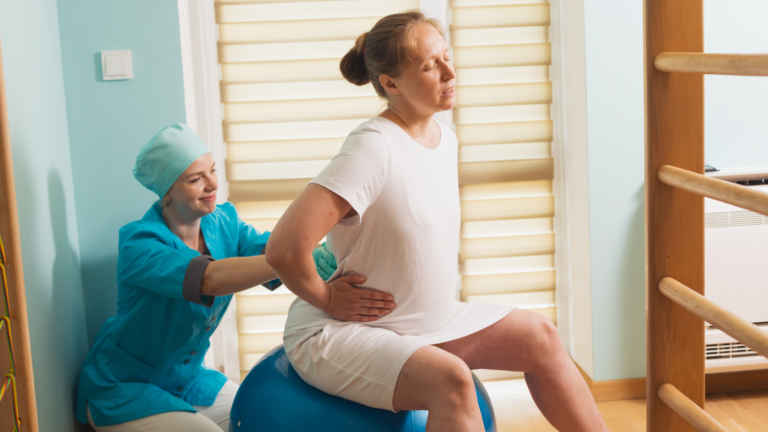
During a contraction, your partner can make slow but firm circles to the lower back and place firm pressure with the heal of his hand to help ease the pressure. Get him to make light strokes from the neck to the sacrum and then press lightly between the gaps in your pelvis.
Legs
It might help you to make light quick strokes up and down your thighs and rub gently to increase the circulation in your legs.
Ankles
Rub the inner and outer parts of your ankles and press the heels with the palm of your hands.
Remember – do not use any essential oils during
Giving birth – early signs of labour
What to watch for – signs of preterm labour
If before 37 weeks signs of labour have started, this means you are going into preterm labour. One of the biggest signs of labour at 37 weeks is your water breaking, perhaps due to an infection if it is premature. Check for signs of bleeding too. A small pink show may be normal but heavy bleeding is not. Alert your GP ASAP if your waters break during this time or you see bleeding.
Remember that your body knows what to do during birth, so it’s important to trust your instincts and let your body do what it’s meant to do. Sometimes factors like discomfort, stress and less emotional support can complicate labour or prolong it.
Its important to learn how to spot the early signs of labour and do what you can to relax to allow your body to feel comfortable enough to progress. Keep an open mind and prepare for all possibilities. You are only a few short moments away from finally meeting your baby!
FAQ
When do you get early signs of labour?
Other questions asked were:
- When does it become labour?
- How early can signs of labour start?
See above for how to read the signs of early labour
What do early signs of labour feel like?
Other questions asked were:
- What does early signs of labour feel like?
- What are the signs that labour is coming soon but hasn’t started yet?
- What are the first early signs of labour?
- How do you feel 24 hours before labour?
- How do you feel days before labour?
- How to know early signs of labour?
- What are the four early signs of labour?
- What are some signs that labour is nearing?
- What are 3 signs that labour is approaching?
- How to spot early signs of labour?
- How to know early stages of labour?
- What are early signs of labour pain?
- What can be early signs of labour?
- Are there any early signs of labour?
- What are the symptoms few days before delivery?
- What are the symptoms before labour begins?
- Are there any weird signs labour is near?
- What are the signs of labour at 38 weeks pregnant?
- What are the symptoms of labour pain in 9th month?
See above for possible symptoms of early labour.
What are early signs of labour with twins?
https://www.webmd.com/baby/premature-labor-twins
- Contractions in your uterus every 10 minutes or more often.
- Tightening or low, dull backache that may be constant or come and go, but changing positions and other comfort measures don’t ease it.
- Menstrual-like cramps or lower abdominal cramping that may feel like gas pains, with or without diarrhea.
What are the signs that labour is 24 to 48 hours away?
https://www.nhs.uk/pregnancy/labour-and-birth/signs-of-labour/signs-that-labour-has-begun/
- contractions or tightenings.
- a “show”, when the plug of mucus from your cervix (entrance to your womb, or uterus) comes away.
- backache.
- an urge to go to the toilet, which is caused by your baby’s head pressing on your bowel.
- your waters breaking.
What are the signs baby is coming before due date?
“In the days before labour starts, you might notice some subtle signs. It can be hard to tell them apart from your normal pregnancy discomforts. You might notice a change in the discharge from your vagina or a few cramps in your abdomen. You may have a low, dull ache in your back that can come and go.”
https://www.pregnancybirthbaby.org.au/giving-birth-early-signs-of-labour
Can diarrhoea be an early sign of labour?
Other signs labour could be near is when your bowels open and you may experience diarrhoea or loose stools. This is caused by the release of the prostaglandin hormones which is the body’s way of emptying the bowels to allow the uterus to contract efficiently for birth.
Are headaches an early sign of labour?
You may experience similar period pain symptoms and headaches could be a sign. But if the headaches are severe and accompanied by swollen hands and feet then check with your doctor straight away to eliminate preeclampsia.
Can vomiting be an early sign of labour?
Other questions asked were:
- Is vomiting early sign of labour?
“Some women will feel quite nauseous before they go into labour, some women also feel sick during the labour. Women also may Vomit or have diarrhoea before or during labour.”
https://www.esht.nhs.uk/service/maternity/your-labour/as-labour-approaches
Are period cramps early signs of labour?
Other questions asked were:
- Are period pains early signs of labour?
Period cramps an be a symptom of labour pain in the early stages of pregnancy. You may also experience some lower tummy and/or back pain.
Is constipation early sign of labour?
No, the opposite occurs actually where some women experience loose stools.
Can early stages of labour stop and start?
Other questions asked were:
- Can early stages of labour last days?
- How long can early signs of labour last?
- How long do early signs of labour last?
Yes this is quite normal during the early stages of labour and can last for days. This is why it’s better to stay at home, so you’re relaxed enough to let your body progress before you go to the hospital. Generally when your body believes it is safe, labour will start again.
What are the signs that something is wrong?
If you notice a pink discharge (called bloody show) then this is normal and it could be your mucus plug coming away. But, if you see bright red blood and you’re soaking through a pad, then this is not normal and you should speak to your health care provider straight away so they can inspect where the blood is coming from.
At what weeks can labour start?
Labour can start at anytime after 37 weeks. If it starts before 37 weeks then this is classed as premature labour and you should call your doctor right away.
Are you pregnant? Grab your free pregnancy pack now – details inside!