Pelvic Girdle Pain in Pregnancy
by Laura Edwards, Chester
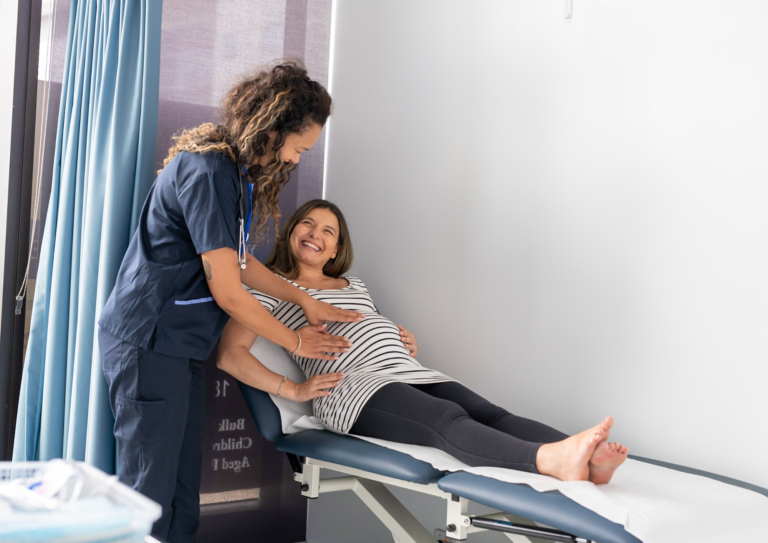
Early in my first pregnancy, while still in the grips of morning sickness, I began to feel aches in my lower back. I first put this down to DIY (we’d recently moved house) or the time I was spending bent over the loo, but I mentioned it to my midwife at a routine check-up and she referred me to the hospital physiotherapist. At about 18 weeks pregnant, I was diagnosed with pelvic girdle pain (PGP).
I was given a list of exercises to help ease the pain, a support belt to wear and a lot of advice about activities to avoid (including certain types of exercise, moving and lifting) and ways to relieve the pain. I consulted with my health and safety representative at work but was able to continue with some modifications to my role (as a scientist I had to be careful of some of the heavier equipment and make more use of the chairs and stools in the lab).
At home, the DIY proved tricky and I needed a lot more rest; I felt pretty useless and quite frustrated that I couldn’t get things done, but I did take up knitting and discovered a very enjoyable new pastime!

My son was born by emergency caesarean section (not linked to the PGP) in January 2009, and by the time I was up and about after that, the symptoms of PGP had gone. However, when I fell pregnant again in November 2010, the pain quickly returned. I felt some initial twinges around my coccyx at about 5 weeks pregnant and, by my first appointment with the midwife, I needed a referral to the physiotherapist.
She diagnosed me with PGP again (if you’ve suffered with it once, you are more likely to get it in subsequent pregnancies) and told me to take it easy. Unfortunately, this time around I had a toddler to look after so resting opportunities were limited. Walks with the buggy gradually got harder and had to be dramatically reduced, and even car trips became harder as I struggled to lift my son in and out of the car.
Nappy changes were switched to a mat on the floor to avoid the stairs and having to lift him onto the changing table. I had to come up with more sedentary activities to keep him entertained and rely a lot on the generosity of friends and family for help. The hardest thing I found was the guilt; I didn’t want my son to miss out on anything or feel pushed aside by his new sibling before he’d even been born. I just told him that mummy had a poorly back and couldn’t do as much for the time being.

PGP is very hard to cope with and, with no outwardly visible symptoms, I also worried that people thought I was over-exaggerating the pain. This probably led to me trying to do too much, which would then hurt even more and might have worsened my condition in the long run. Often, I would feel ok in the mornings and actually be able to lift heavy things, walk fair distances and do things I was supposed to be avoiding.
I knew that I would suffer later that day though; at about 20 weeks pregnant I pushed my son in the pushchair to the library and back (only about ½ mile to a mile) and spent the next two days barely able to move. Having to hold back when there was so much I wanted to do was terribly hard, but the pain was always there to some extent as a reminder to take it easy, and the threat of more pain, coupled with the knowledge that I would be even more incapacitated if I did stretch myself, served to reign in my activities.

By 32 weeks, I was on crutches and having real difficulty with day to day things. The pain was mainly in the joints at the back of my pelvis but I also had some pretty major twinges at the front too. For weeks, I’d had to roll out of bed, crawl up the stairs on my hands and knees (I took the lift at work!) and my husband had become used to hauling me up off the settee and out of the bath.
I’d planned to finish work at 35 weeks pregnant but I was signed off on sick leave at 33 weeks; my GP told me that I should have been off earlier but, again, I’d been trying to struggle on so I hadn’t visited the doctor before this. For the last few weeks of pregnancy, I did manage a bit more rest but I still felt frustrated, guilty (for not being able to do more for my son, my family or around the house) and, in some ways cheated (out of properly enjoying the pregnancy and for my son who missed out on so much I would have liked to do for him).
As my due date approached, I was looking forward to getting my mobility back, but I was quite nervous about the labour. After the emergency section first time around, I was aiming for a VBAC and as ‘normal’ a birth as possible. Obviously, the PGP would limit my options for active labour, and the previous section meant that I would need continuous monitoring so my hoped-for water birth was not allowed. At a check-up two days before my due date, I was told that it was unlikely that the baby was coming any time soon, so I was booked into the hospital the following week.
There was a good chance they’d do another section then so I was pretty disappointed. On my due date, we went to the zoo to cheer me up. As I could barely walk, we hired a wheelchair and I’m convinced that it was being bumped around in this with a toddler on my knee that made my waters break at two o’clock the next morning. Labour wasn’t easy but the hospital was aware of my PGP and took care not to open my legs wider than my pre-measured pain-free gap from the birth plan.
With every contraction, it felt as though the joints in my pelvis were being crushed like a ball of paper in a fist; a feeling that continued after each contraction was over and only eased momentarily before the next one started. My beautiful second son was born one day overdue, at 7.14 pm on the 15th August 2011 and was worth every minute of the pain. Apart from the odd twinge, the PGP was pretty much gone by the next morning and hasn’t troubled me since.
Within a couple of days of the birth, I was able to play on the floor with my eldest son again and stand up unassisted afterwards; a simple little thing but something I’d really missed. I have had some fitness issues recently, mainly because of the enforced immobility and lack of exercise for several months, but I’m now on the mend and building up my strength again. We’d always envisaged having three children, but I will be waiting until the boys are a bit older before we think about having another!
Also known as SPD or symphysis pubis dysfunction, osteitis pubis or pelvic girdle relaxation, PGP affects up to one in five women during pregnancy with varying levels of severity. The main symptom is a pain in the pelvic joints, but there can also be joint instability. A combination of postural changes, the growing baby, unstable pelvic joints under the influence of pregnancy hormones and changes in the centre of gravity can all add to the degree of pain or discomfort.
If you are pregnant and think that you may have PGP, your midwife will be able to advise you or refer you to a physiotherapist.
For further information see www.pelvicpartnership.org.uk.